“But the word of the Lord endureth for ever. And this is the word which by the gospel is preached unto you.”1 Peter 1:25, KJV
How the Scriptures were received, carried into the English tongue, and confessed by the Baptist churches. Each date is linked to its source, so that you may test every word.
Scripture & Canon (232)
The English Bible (37)
Baptist Witness (186)
Nothing in the Timeline matches that. Try a single word, such as a name, a place or a year.
The Ancient WorldBefore Christ
3rd–2nd century BC
Scripture & Canon
The Septuagint: the Hebrew Scriptures in Greek
Papyrus Rylands 458, fragments of Deuteronomy in the Greek Septuagint, mid-2nd century BC. John Rylands Library, Manchester, via Wikimedia Commons · Public domain
After Alexander’s conquests, many Jews lived in Greek-speaking cities, above all in Alexandria in Egypt, and few could read Hebrew. Scholars agree that the five books of Moses were translated from Hebrew into Greek by Jews living there, probably in the early or middle part of the third century before Christ, and that the remaining books followed, presumably in the second century. The version came to be called the Septuagint, “the Seventy,” after a story in the Letter of Aristeas that seventy-two translators made it for King Ptolemy II. Many scholars regard that story as a legend. One of its oldest surviving witnesses is Papyrus Rylands 458, fragments of a Pentateuch roll dated to the middle of the second century BC. Until the Dead Sea Scrolls were found, it was the oldest known manuscript of the Greek Bible.
Sourceen.wikipedia.org — Wikipedia, “Septuagint” (dating of the Pentateuch and later books; the Aristeas account and its doubters), and “Papyrus Rylands 458” (Rahlfs 957; mid-2nd century BC by palaeography). Year filed as c. 250 BC for ordering only.
c. 150–100 BC
Scripture & Canon
The Nash Papyrus: the Ten Commandments and the Shema in Hebrew
The Nash Papyrus, facsimile published in Proceedings of the Society of Biblical Archæology, vol. 25 (1903), p. 56, via Wikimedia Commons · Public domain
Four small papyrus fragments, bought in Egypt and given to Cambridge University Library in 1903 by W. L. Nash, make up a single sheet of twenty-four lines. They hold the Ten Commandments in Hebrew, combining wording from Exodus 20 and Deuteronomy 5, followed by the opening of the Shema. Stanley A. Cook first described them in 1903 and dated them to the 2nd century AD, but later study pushed the date back to about 150–100 BC. Until the Dead Sea Scrolls were found in 1947, this was by far the oldest Hebrew manuscript of Scripture known. Honesty requires a note. The sheet is not a scroll of the Bible but most likely a text for daily worship, and in places its wording differs from the standard Masoretic Hebrew and is nearer the Greek Septuagint. It is still a witness that, generations before Christ, God’s commandments were being written out in Hebrew and, very likely, recited daily. “Hear, O Israel: The LORD our God is one LORD” (Deuteronomy 6:4, KJV).
Sourceen.wikipedia.org — Wikipedia, “Nash Papyrus” (four fragments, one sheet, 24 lines; Decalogue combining Exod 20:2–17 and Deut 5:6–21, then the Shema; W. L. Nash, Cambridge University Library 1903; Cook 1903; redated c. 150–100 BCE; oldest Hebrew MS before 1947; differs from the Masoretic Text, nearer the Septuagint; likely liturgical). Deut 6:4 KJV verified.
c. 125 BC (found 1947)
Scripture & Canon
The Great Isaiah Scroll: the whole of Isaiah, a thousand years older than any copy then known
The Great Isaiah Scroll (1QIsaᵃ), photographic reproduction by Ardon Bar Hama for the Israel Museum, Jerusalem, via Wikimedia Commons · Public domain
In late 1946 or early 1947, Bedouin shepherds searching for a lost animal entered a cave at Qumran, near the Dead Sea, and found jars holding ancient scrolls. One was the Great Isaiah Scroll (1QIsaᵃ). It is a roll of seventeen sheets of parchment, about 24 feet long, in fifty-four columns, and it contains the entire Book of Isaiah apart from a few small damaged places. Its handwriting points to about 125–100 BC, and radiocarbon tests give a wider range. That makes it about a thousand years older than the oldest Hebrew manuscripts of Isaiah known before its discovery. Its text is, in the words of the cited article, “generally consistent with the Masoretic version”, and all sixty-six chapters stand in the same order. It has many small differences, mostly spelling, single words and word order, along with some copyist’s slips; another Isaiah scroll from the same caves, 1QIsaᵇ, is closer still to the Masoretic Text. The scroll is kept today in the Shrine of the Book at the Israel Museum in Jerusalem. “The grass withereth, the flower fadeth: but the word of our God shall stand for ever” (Isaiah 40:8, KJV).
Sourceen.wikipedia.org — Wikipedia, “Isaiah Scroll” (Qumran Cave 1, 1946–47; 17 sheets, c. 734 cm, 54 columns; entire Isaiah bar small damage; palaeographic 150–100 / scribal hand 125–100 BCE, radiocarbon 356–103 BC; c. 1000 years older than prior MSS; “generally consistent with the Masoretic version”, 66 chapters same sequence; variants mostly minor; 1QIsab closer to MT; Shrine of the Book). Isa 40:8 KJV verified.
The Early Church1st–5th centuries
Scripture & Canon
Paul writes to the churches of Galatia: “not after man … but by the revelation of Jesus Christ”
Papyrus 46, fol. 158r (c. 175–225): the close of Ephesians (6:20 ff.), then the heading “To the Galatians” and Galatians 1:1–8. University of Michigan (P. Mich. inv. 6238), via Wikimedia Commons · Public domain
The Epistle to the Galatians is Paul’s letter “unto the churches of Galatia” (1:2) in Asia Minor, written when the great question before the young churches was whether Gentile believers must keep the law of Moses, circumcision above all, to be saved. Paul answers that they need not: a man is justified by faith in Christ, and the law’s place is to be understood in the light of Christ. That the letter shows no sign of a developed church order and turns on this early dispute places it within Paul’s own lifetime. Honesty: a majority of scholars date it between the late 40s and early 50s; some place it as early as AD 48, before the council at Jerusalem (Acts 15), others in the 50s. Scholars also differ over whether “Galatia” means the Roman province in the south, where Paul preached on his first journey, or the Celtic Galatians further north. Its oldest near-complete copy is in Papyrus 46 (c. AD 200), where it follows Ephesians, as the plate shows. “But I certify you, brethren, that the gospel which was preached of me is not after man. For I neither received it of man, neither was I taught it, but by the revelation of Jesus Christ” (Galatians 1:11–12, KJV).
Sourceen.wikipedia.org — Wikipedia, “Epistle to the Galatians” (Paul to churches of Galatia; Gentiles and the Mosaic law, circumcision; early stage, no developed organisation; majority late 40s–early 50s, some c. 50–60, Jordan argues 48 before the Jerusalem council; south province vs north ethnic Galatia; P46 c. 200 earliest near-complete copy). Plate: P46 fol. 158r. Gal 1:2, 1:11–12 KJV verified.
Scripture & Canon
Paul writes 1 Thessalonians: the word received “not as the word of men, but as it is in truth, the word of God”
Papyrus 65, a 3rd-century copy of 1 Thessalonians 1:3–2:1 in Greek. Papyrological Institute, Florence (PSI XIV 1373), via Wikimedia Commons · Public domain
Paul had preached the gospel at Thessalonica, in Macedonia, and gathered a church there, many of whom had “turned to God from idols” (1:9). He wrote back to them, most scholars think from Corinth only months later, during the eighteen months he spent in that city on his second journey; notes added in many early manuscripts, Codex Alexandrinus among them, say instead that it was written from Athens after Timothy returned with news. The letter thanks God for their faith and love, reminds them how Paul worked so as not to burden them, and comforts those grieving their dead with the hope of the resurrection and the Lord’s return (4:13–18). A majority of scholars date it to AD 49–51, and it is widely agreed to be one of the first books of the New Testament written; many count it the earliest surviving Christian writing, though some place Galatians earlier. An inscription naming the proconsul Gallio, before whom Paul was brought at Corinth (Acts 18:12–17), anchors this part of Paul’s life. Most scholars accept it as Paul’s own. “For this cause also thank we God without ceasing, because, when ye received the word of God which ye heard of us, ye received it not as the word of men, but as it is in truth, the word of God, which effectually worketh also in you that believe” (1 Thessalonians 2:13, KJV).
Sourceen.wikipedia.org — Wikipedia, “First Epistle to the Thessalonians” (converts turned from idols; most scholars: from Corinth months after leaving; subscriptions in Alexandrinus etc. say Athens; majority 49–51 during 18 months at Corinth; among first NT books, earliest extant Christian text; Gallio inscription; most regard as authentic). Plate: P65, 3rd c. 1 Thess 1:9, 2:13 KJV verified.
Scripture & Canon
The Epistle of James: “be ye doers of the word, and not hearers only”
Papyrus 23 (P. Oxy. X 1229), early 3rd century: James 1:10–12 in Greek. Spurlock Museum, University of Illinois, via Wikimedia Commons · Public domain
The Epistle of James is written by “James, a servant of God and of the Lord Jesus Christ” to “the twelve tribes which are scattered abroad” (1:1). It is a letter of practical wisdom: patience in trials, asking God for wisdom, bridling the tongue, no favour to the rich over the poor, prayer for the sick, and the teaching that faith without works is dead. By tradition its writer is James the brother of the Lord, the leader of the church at Jerusalem, and if so it was written before his death, which Josephus places in AD 62; some who hold this view place it very early, even before the Jerusalem council of Acts 15. Honesty: many modern scholars think it was written in his name by a later hand, because of its polished Greek, and it is dated anywhere from the mid-first to the mid-second century. It was little cited in the early church, Eusebius lists it among the disputed books, it was widely received only by the late fourth century, and Martin Luther criticised it for its teaching on faith and works; it has always remained in the New Testament. The plate is Papyrus 23 (Spurlock Museum, Illinois), early 3rd century, with James 1:10–12. “But be ye doers of the word, and not hearers only, deceiving your own selves” (James 1:22, KJV).
Sourceen.wikipedia.org — Wikipedia, “Epistle of James” (1:1; wisdom themes, faith without works is dead; traditionally James the brother of Jesus; modern pseudepigraphy view; mid-1st to mid-2nd c.; Josephus: James died 62; some place it before Acts 15; disputed, sparsely cited, received by late 4th c.; Eusebius “disputed”; Luther) and “Papyrus 23” (early 3rd c.). Jas 1:22 KJV verified.
Scripture & Canon
Paul writes 2 Thessalonians: “stand fast, and hold the traditions which ye have been taught”
Papyrus 92 (P. Narmuthis inv. 69.39a + 69.229a): Ephesians 1:11–13, 19–21 and 2 Thessalonians 1:4–5, 11–12 in Greek. Egyptian Museum, Cairo, via Wikimedia Commons · Public domain
The Second Epistle to the Thessalonians opens in the names of Paul, Silvanus and Timothy, and is addressed to the same young church as 1 Thessalonians. It encourages believers who were suffering for their faith, corrects the report that the day of the Lord had already come, and warns against idleness: those who will not work should not eat. It was received early: it stood in Marcion’s list and in the Muratorian fragment, and Irenaeus names it. Honesty on authorship: it has been traditionally held to be Paul’s, but critical commentators are roughly evenly divided, because its style and teaching differ from 1 Thessalonians. A 2011 survey of 111 scholars at the British New Testament Conference found 63 in favour of Paul’s authorship, 13 against and 35 uncertain. Those who hold it is Paul’s date it to about AD 51–52, soon after the first letter; those who do not date it to about 80–115. The plate, Papyrus 92 (Egyptian Museum, Cairo), holds a few verses of Ephesians and of 2 Thessalonians 1. “Therefore, brethren, stand fast, and hold the traditions which ye have been taught, whether by word, or our epistle” (2 Thessalonians 2:15, KJV).
Sourceen.wikipedia.org — Wikipedia, “Second Epistle to the Thessalonians” (Paul, Silvanus, Timothy; authorship disputed, Dunn “roughly even split”; 2011 BNTC survey 63/13/35; authentic view 51–52, later view c. 80–115; in Marcion’s canon and the Muratorian fragment, named by Irenaeus). Plate: Papyrus 92 (Commons dates it 4th c.). 2 Thess 2:15 KJV verified.
Scripture & Canon
Paul writes 1 Corinthians from Ephesus: “not in the words which man’s wisdom teacheth, but which the Holy Ghost teacheth”
Papyrus 46, fol. 79v (c. 175–225): 1 Corinthians 2:11–3:5 in Greek. University of Michigan (P. Mich. inv. 6238), via Wikimedia Commons · Public domain
Paul had planted the church at Corinth, and while he was at Ephesus word and questions reached him from it (7:1). He answered in the letter we call 1 Corinthians. It deals with divisions in the church, moral disorder, marriage, food offered to idols, the right ordering of worship and spiritual gifts, and, in chapter 15, the resurrection of Christ and of those who are His. Scholars agree that Paul wrote it; Sosthenes is named with him in the greeting (1:1), and Paul signs the closing greeting in his own hand (16:21). Most date it to his stay at Ephesus, usually placed between AD 53 and 57, and most likely to the longer stay described in Acts 19. Despite its name it was not his first letter to them, for he refers back to an earlier one (5:9) that has not survived. Its oldest copy is in Papyrus 46 (c. AD 200); the plate shows the leaf with chapter 2, where Paul says the gospel he preached came not by human wisdom. “Which things also we speak, not in the words which man’s wisdom teacheth, but which the Holy Ghost teacheth; comparing spiritual things with spiritual” (1 Corinthians 2:13, KJV).
Sourceen.wikipedia.org — Wikipedia, “First Epistle to the Corinthians” (issues: divisions, immorality, marriage, idol food, worship, gifts, resurrection; Pauline authorship undisputed; Sosthenes co-sender; own-hand greeting; written at Ephesus, usually 53–57, more likely the extended stay; 5:9 earlier letter). Plate: P46 fol. 79v. 1 Cor 2:13 KJV verified.
Scripture & Canon
Paul writes 2 Corinthians from Macedonia: “My grace is sufficient for thee”
Papyrus 46, fol. 142r (c. 175–225): 2 Corinthians 11:33–12:9 in Greek. University of Michigan (P. Mich. inv. 6238), via Wikimedia Commons · Public domain
After 1 Corinthians, Paul made a sorrowful visit to Corinth, and would not come again “in heaviness” (2:1); he then wrote to them “with many tears” (2:4). Then, having left Ephesus for Macedonia (Acts 20), probably writing from Philippi or Thessalonica, he sent the letter we call 2 Corinthians, with Timothy named beside him, to the church at Corinth and the believers throughout Achaia. It is the most personal of his letters: comfort in affliction, the ministry of the new covenant, the collection for the poor saints at Jerusalem (chapters 8–9), and a defence of his apostleship in which he boasts only of his weakness. There is little doubt among scholars that Paul wrote it. Honesty: scholars debate whether it was first one letter or several of Paul’s letters to Corinth joined together, since the tone changes sharply at chapter 10 and the subject shifts at chapters 8–9; others hold that it is a single letter. Its date follows Paul’s three years at Ephesus, roughly AD 53–57. Papyrus 46 (c. AD 200) preserves it; the plate shows the leaf where the Lord answers Paul’s prayer. “And he said unto me, My grace is sufficient for thee: for my strength is made perfect in weakness” (2 Corinthians 12:9, KJV).
Sourceen.wikipedia.org — Wikipedia, “Second Epistle to the Corinthians” (Paul with Timothy, to Corinth and Achaea; little doubt Paul is author; one vs composite letter, chs 8–9 and 10–13; painful visit, letter of tears; written after leaving Ephesus for Macedonia, Philippi or Thessalonica; Ephesus c. 53–57). Plate: P46 fol. 142r. 2 Cor 12:9 KJV verified.
Scripture & Canon
Paul writes to the Romans from Corinth: “the power of God unto salvation to every one that believeth”
Papyrus 40, 3rd century: fragments of Romans 3:21–26, “the righteousness of God … by faith of Jesus Christ”. Institut für Papyrologie, Heidelberg (P. Heid. inv. G 645), via Wikimedia Commons · Public domain
The Epistle to the Romans, the longest of Paul’s thirteen letters, sets out the gospel of salvation through Jesus Christ. Scholars agree that Paul wrote it, most likely while staying in the house of Gaius at Corinth (16:23), with Tertius writing it down at his dictation (16:22), in late 55 to early 57. Paul had preached around the Aegean and meant to carry the gospel on to Spain, visiting Rome on the way (15:24), so the letter prepares the church there, of both Jewish and Gentile believers, for his coming. Some early manuscripts add a closing note naming Corinth and Phoebe, a servant of the church at Cenchrea (16:1), as its bearer. Honesty: versions with only fourteen or fifteen chapters circulated early, though the letter in its final form has sixteen; and Christians have read its teaching on justification differently, both those who hold to faith alone and the Roman Catholic view claiming support from it. William Tyndale, in the prologue to his 1526 Romans (drawn largely from Luther’s), called it “the principal and most excellent part of the new testament.” “For I am not ashamed of the gospel of Christ: for it is the power of God unto salvation to every one that believeth; to the Jew first, and also to the Greek” (Romans 1:16, KJV).
Sourceen.wikipedia.org — Wikipedia, “Epistle to the Romans” (longest of 13 Pauline epistles; consensus Paul; house of Gaius, Corinth; amanuensis Tertius; late 55–early 57; 14/15-chapter recensions; subscripts naming Corinth + Phoebe; Spain via Rome; sola fide and RC readings; Tyndale prologue from Luther, quoted). Plate: P40, 3rd c. Rom 1:16, 15:24, 16:1, 16:22–23 KJV verified.
Scripture & Canon
Paul writes to Philemon: “not now as a servant, but … a brother beloved”
Papyrus 87 (P. Col. theol. 12), early 3rd or late 2nd century: Philemon 13–15 in Greek. University of Cologne, via Wikimedia Commons · Public domain
The Epistle to Philemon is a short personal letter, only 335 words in Greek and the shortest of Paul’s surviving letters, written from prison to Philemon, a Christian in whose house a church met at Colossae. It is among the letters that nearly all scholars accept as Paul’s own. By the usual reading, Onesimus was Philemon’s slave who had run away, had come to Paul, and had become a Christian through him; Paul now sends him back with this letter and asks Philemon to receive him as a brother in Christ, offering to repay anything Onesimus owed. The letter does not directly condemn slavery, but it sets master and servant on the ground of brotherhood in the Lord, and that it was kept at all suggests Paul’s plea was granted. Honesty: some scholars, such as Allen Dwight Callahan, question whether Onesimus was a slave at all. It was written about AD 57–62, from Caesarea or from Rome, and probably at the same time as Colossians. The plate is Papyrus 87 (University of Cologne), early 3rd or late 2nd century, the earliest known copy of Philemon. “Not now as a servant, but above a servant, a brother beloved, specially to me, but how much more unto thee, both in the flesh, and in the Lord?” (Philemon 16, KJV).
Sourceen.wikipedia.org — Wikipedia, “Epistle to Philemon” (prison letter; church in Philemon’s house at Colossae; undisputed; 335 Greek words, shortest; Onesimus, runaway-slave reading and Callahan’s dissent; offer to repay; not explicitly condemning slavery; c. 57–62 from Caesarea or Rome; often with Colossians) and “Papyrus 87”. Phlm 16 KJV verified.
Scripture & Canon
Paul writes to the Ephesians, “an ambassador in bonds”: the letter that names the whole armour of God
Papyrus 49, a 3rd-century copy of Ephesians 4:16–29 in Greek. Beinecke Library, Yale University (P. CtYBR inv. 415), via Wikimedia Commons · Public domain
The Epistle to the Ephesians, tenth book of the New Testament, is the letter in which the Christian is told to “put on the whole armour of God” (6:11). It opens by naming Paul as its writer (1:1), and he calls himself a prisoner (3:1; 4:1). By tradition it was written from his imprisonment in Rome about AD 62, close in time to Colossians, which it closely resembles, and Philemon. Its first half sets out the blessings of the gospel and the making of Jew and Gentile into one body in Christ; its second half teaches holy living, and it closes with the armour of God and the sending of Tychicus (6:10–24). Honesty: since the nineteenth century many critical scholars have doubted that Paul wrote it and date it to AD 70–100; others, from Westcott and Hort to F. F. Bruce and John Stott, have defended Paul’s authorship, and Harold Hoehner’s survey of 279 commentaries (1519–2001) found 54% for Paul. The early canon lists, the Muratorian fragment among them, count it as Paul’s. “For which I am an ambassador in bonds: that therein I may speak boldly, as I ought to speak” (Ephesians 6:20, KJV).
Sourceen.wikipedia.org — Wikipedia, “Epistle to the Ephesians” (traditionally Paul, Rome, c. AD 62; resembles Colossians; Philemon same period; 1:1 names Paul; 6:10–24 armour + Tychicus; many modern scholars dispute authorship, date 70–100; defenders incl. Westcott, Hort, Bruce, Stott; Hoehner 2002 survey of 279 commentaries: 54% for, 39% against, 7% uncertain; Muratorian fragment attributes it to Paul). Plate: 𝔓49, 3rd c. Eph 6:20 KJV verified.
Scripture & Canon
Paul writes to the Philippians from his bonds: “I press toward the mark”
Papyrus 16 (P. Oxy. 1009), 3rd or 4th century: Philippians 3:10–17 in Greek. Found at Oxyrhynchus; Alexandria Antiquities Museum, via Wikimedia Commons · Public domain
Paul first came to Philippi, in Macedonia, on his second journey, around AD 50–52 (Acts 16). Years later, writing as a prisoner, he sent the believers there a letter of thanks and joy, with Timothy named beside him: thanks for the gift they had sent by Epaphroditus, a call to be of one mind, the great passage on Christ who “humbled himself, and became obedient unto death” (2:8), and his own resolve to count all things loss for Christ. That Paul wrote it is generally agreed. Honesty: where he was held is uncertain. Ephesus (52–55) and Caesarea (57–59) have both been proposed, but the most likely place is Rome, around AD 62. Many scholars since the 1960s also read it as more than one of Paul’s letters to Philippi joined together, while agreeing that the material is Paul’s own, written in the 50s or early 60s. A 3rd-century copy survives in Papyrus 16; the plate shows its fragment of chapter 3. “I press toward the mark for the prize of the high calling of God in Christ Jesus” (Philippians 3:14, KJV).
Sourceen.wikipedia.org — Wikipedia, “Epistle to the Philippians” (Paul with Timothy; first visit on 2nd journey c. 50–52; written in custody; Ephesus 52–55 or Caesarea 57–59 possible, most likely Rome c. 62; composite-fragments view since 1960s; material authentically Pauline, 50s or early 60s). Plate: P16, 3rd/4th c. Phil 1:1, 3:14 KJV verified.
Scripture & Canon
Paul writes to the Colossians: “Let the word of Christ dwell in you richly”
Papyrus 46 (P. Chester Beatty II), fol. 15 + 90, c. 175–225: a bifolio with Romans, the end of Philippians and the beginning of Colossians in Greek. Chester Beatty Library, Dublin, via Wikimedia Commons · Public domain
The Epistle to the Colossians opens in the names of Paul and Timothy and was written to the church at Colossae, a small city in Phrygia near Laodicea, about a hundred miles from Ephesus. It proclaims Christ as supreme over all creation, the one by whom and for whom all things were made and in whom all the fulness of the Godhead dwells, and it warns the church not to be drawn from Him by philosophy and the traditions of men. It was carried, with Philemon and Ephesians, by Tychicus and Onesimus. The early church held it to be Paul’s (Irenaeus, Clement of Alexandria, Tertullian, Origen, Eusebius). Honesty: since the 19th century many scholars have questioned that, on grounds of vocabulary, style and theology, while others still defend it; a 2011 survey of 109 scholars at the British New Testament Conference found 56 in favour, 17 against and 36 uncertain. If Paul wrote it, he probably wrote it in prison in Rome about AD 62 (Bruce Metzger places it in the 60s); if not, it may date to the late first century. The plate is Papyrus 46 (c. AD 200), a leaf from the Chester Beatty Library holding the end of Philippians and the opening of Colossians. “Let the word of Christ dwell in you richly in all wisdom; teaching and admonishing one another in psalms and hymns and spiritual songs, singing with grace in your hearts to the Lord” (Colossians 3:16, KJV).
Sourceen.wikipedia.org — Wikipedia, “Epistle to the Colossians” (Paul and Timothy; Colossae near Laodicea, ~100 mi from Ephesus; Christ pre-eminent; Tychicus and Onesimus with Philemon and Ephesians; early Fathers held Pauline; 2011 BNTC survey 56/17/36; Metzger 60s in prison; Rome c. 62, or late 1st c.). Plate: P46, Chester Beatty BP II fol. 15 + 90. Col 3:16 KJV verified.
Scripture & Canon
The Epistle to the Hebrews: the word of God “sharper than any twoedged sword”
Papyrus 13, fragment 1 (c. 225–250): Hebrews 4:2–12 in Greek. British Library (Inv. 1532v), via Wikimedia Commons · Public domain
Hebrews was written to believers who were tempted, under persecution, to turn back from Christ to the old system of the law. It answers by showing Christ as better than the angels, than Moses, and than the Levitical priesthood: the great High Priest after the order of Melchisedec, whose one sacrifice finished what the tabernacle only foreshadowed. Its Greek is the most polished in the New Testament. Honesty on authorship: the text does not name its writer. Most Greek manuscripts, the Syriac Peshitta and some Old Latin copies place it among Paul’s letters, and the King James Version heads it “The Epistle of Paul the Apostle to the Hebrews”; but doubts were voiced in the early church, and most modern scholars regard the author as unknown. Origen held that the thoughts were the apostle’s, commended any church that received it as Paul’s, and said, “But who wrote the epistle, in truth, God knows.” On date, because it speaks of the tabernacle service as still going on, the Catholic Encyclopedia placed it in late 63 or early 64, before the Temple fell; some scholars prefer AD 70–100. A 3rd-century copy survives in Papyrus 13; the plate shows the fragment that holds chapter 4. “For the word of God is quick, and powerful, and sharper than any twoedged sword, piercing even to the dividing asunder of soul and spirit, and of the joints and marrow, and is a discerner of the thoughts and intents of the heart” (Hebrews 4:12, KJV; compare the sword of the Spirit, Ephesians 6:17).
Sourceen.wikipedia.org — Wikipedia, “Epistle to the Hebrews” (anonymous; placed with Paul in most Greek MSS, Peshitta, some Old Latin; modern view author unknown; polished Greek; exhortation to persevere; Cath. Encyc. late 63/early 64; Attridge, Aitken 70–100). Origen quoted from Eusebius HE VI.25.14, NPNF (newadvent.org/fathers/250106.htm). Plate: P13. Heb 4:12 KJV verified.
Scripture & Canon
Paul writes 1 Timothy: “give attendance to reading, to exhortation, to doctrine”
The First Epistle to Timothy is addressed to Paul’s younger fellow-labourer, whom he had left at Ephesus (1:3). It gives counsel for the ordering of the church: prayer and worship, the qualifications of bishops (overseers) and deacons, the care of widows, and faithfulness to sound doctrine against false teaching. The church received it as Paul’s: the Muratorian fragment (c. 170–180) ascribes all three Pastoral Epistles to him, Irenaeus quotes them and names Paul, Eusebius counts them among the undisputed letters, and Polycarp very probably knew 1 and 2 Timothy. By the traditional account it was written after Paul’s release from his first Roman imprisonment, when he had gone on into Macedonia; older reference works such as Easton’s (1897) put it about AD 66 or 67, while others place Paul’s death earlier. Honesty: since the 19th century most modern scholars have held that the Pastoral Epistles were written after Paul’s death, in the late first or first half of the second century, because of their vocabulary, style and church order, and Marcion’s list (c. 140) left them out; a smaller number of scholars still defend Paul’s authorship. “Till I come, give attendance to reading, to exhortation, to doctrine” (1 Timothy 4:13, KJV).
Sourceen.wikipedia.org — Wikipedia, “First Epistle to Timothy” (counsels on church order; most modern scholars post-Pauline, “small and declining number” defend Paul; Marcion excluded Pastorals; Muratorian, Irenaeus, Eusebius “undisputed”; Polycarp probably knew 1–2 Tim; late 1st – first half 2nd c.). Traditional date: Easton’s Bible Dictionary (1897), “Timothy, First Epistle to” (A.D. 66 or 67, from Macedonia). 1 Tim 4:13 KJV verified.
Scripture & Canon
Paul writes to Titus in Crete: “Holding fast the faithful word”
Papyrus 32 (Rylands Gr. P. 5), c. AD 200: Titus 1:11–15 in Greek. John Rylands Library, University of Manchester, via Wikimedia Commons · Public domain
The Epistle to Titus is addressed to Paul’s companion Titus, who had gone up to Jerusalem with Paul and Barnabas (Galatians 2:1) and was later left on the island of Crete to set the churches in order. In three short chapters it describes the kind of men to be ordained as elders, how each part of the church should live, and the godly life that answers to God’s grace. By the traditional account it was written about the same time as 1 Timothy, after Paul’s release from his first imprisonment and a visit to Crete, and the two letters are closely alike in subject and wording. Honesty: many scholars regard it, with 1 and 2 Timothy, as the work of a later follower of Paul, and most of those date it between AD 80 and 100; others still hold that Paul wrote it, perhaps using a secretary. The plate is Papyrus 32 (John Rylands Library, Manchester), dated about AD 200, one of the earliest surviving copies of any of the Pastoral Epistles; it holds Titus 1:11–15. “Holding fast the faithful word as he hath been taught, that he may be able by sound doctrine both to exhort and to convince the gainsayers” (Titus 1:9, KJV).
Sourceen.wikipedia.org — Wikipedia, “Epistle to Titus” (Titus in Gal 2; left in Crete; requirements of elders; critics mostly 80–100; amanuensis view; close affinity with 1 Tim) and “Papyrus 32” (Titus 1:11–15; 2:3–8; c. AD 200). Traditional date: Easton (1897), “Titus, Epistle to” (about the same time as 1 Tim, after Paul’s release and visit to Crete). Titus 1:9 KJV verified.
Scripture & Canon
Peter writes to the scattered churches: “the word of the Lord endureth for ever”
Papyrus 81, 4th century: 1 Peter 2:20–3:1 in Greek. Private collection of S. Daris, Trieste, via Wikimedia Commons · Public domain
The First Epistle of Peter is written in the name of “Peter, an apostle of Jesus Christ” to the “strangers scattered throughout Pontus, Galatia, Cappadocia, Asia, and Bithynia” (1:1), Christians in Asia Minor who were suffering for their faith. It calls them to follow the suffering Christ, who rose from the dead and is now in glory; to repay evil with good; to love one another; and to live so honestly that no charge against them could stand. It names Silvanus as the one by whom it was written (5:12) and sends greetings from “Babylon”, generally taken to mean Rome (5:13). By tradition Peter wrote it before his death in the 60s under Nero. Honesty: most modern scholars think it came from the church at Rome in Peter’s name, pointing to its polished Greek; Britannica says the question “has not been solved”, notes that its simple picture of church order points to an early date, and suggests a secretary may have done the writing, while dating the Letters of Peter perhaps to the early 2nd century. Others, such as Karen Jobes, lean towards Peter as the author. The plate is Papyrus 81 (4th century, Trieste), with 1 Peter 2:20–3:1. “But the word of the Lord endureth for ever. And this is the word which by the gospel is preached unto you” (1 Peter 1:25, KJV).
Sourceen.wikipedia.org — Wikipedia, “First Epistle of Peter” (addressees in five provinces; Babylon = Rome; Silvanus 5:12; most scholars: Roman tradition associated with Peter; Jobes leans to Peter) and Britannica, “Letters of Peter” (authorship “has not been solved”; primitive church order suggests early composition; possibly a secretary; perhaps early 2nd c.). Tradition: Peter died in the 60s under Nero (Wikipedia, “Second Epistle of Peter”). Plate: “Papyrus 81” (4th c.). 1 Pet 1:25 KJV verified.
Scripture & Canon
Paul’s farewell to Timothy: “All scripture is given by inspiration of God”
The Second Epistle to Timothy is addressed to Paul’s younger fellow-labourer, Timothy, and has long been held to be the last letter Paul wrote before his death, which is usually placed around AD 64–65. It reads as a farewell: “For I am now ready to be offered, and the time of my departure is at hand” (4:6). It charges Timothy to “hold fast the form of sound words” (1:13), to endure hardness as a good soldier of Jesus Christ, and to preach the word; and it holds the New Testament’s plainest statement of what Scripture is. Honesty: since the early 19th century many scholars have judged 2 Timothy and the other Pastoral Epistles (1 Timothy, Titus) to be the work of a follower of Paul, written perhaps between AD 90 and 140, because their themes and their picture of church order differ from his other letters; a number of scholars still defend Paul’s authorship, and some who doubt the other two hold that 2 Timothy is his. “All scripture is given by inspiration of God, and is profitable for doctrine, for reproof, for correction, for instruction in righteousness: That the man of God may be perfect, throughly furnished unto all good works” (2 Timothy 3:16–17, KJV).
Sourceen.wikipedia.org — Wikipedia, “Second Epistle to Timothy” (traditionally Paul’s last letter before his death; critical view: unknown follower, 90–140; some defend Paul, Murphy-O’Connor holds 2 Tim authentic) and “Paul the Apostle” (died c. 64/65). No plate. 2 Tim 3:16–17, 4:6 KJV verified.
Scripture & Canon
The Second Epistle of Peter: “holy men of God spake as they were moved by the Holy Ghost”
Papyrus 72 (P. Bodmer VIII), 3rd–4th century: the end of 1 Peter and the beginning of 2 Peter in Greek. Vatican Apostolic Library, via Wikimedia Commons · Public domain
The Second Epistle of Peter is written in the name of “Simon Peter, a servant and an apostle of Jesus Christ” (1:1), who says that he must shortly put off this tabernacle (1:14) and calls this his second letter to the same readers (3:1). It recalls that he was an eyewitness of Christ’s majesty on the holy mount, declares that no prophecy of Scripture came by the will of man, warns against false teachers, and explains that the Lord is not slack concerning His promise, for one day is with the Lord as a thousand years. It also sets Paul’s letters beside “the other scriptures” (3:15–16). Taken at its word, it was written about AD 64–68, before Peter’s death. Honesty: its authorship was doubted as early as the 3rd century, it was among the last books to be widely received, and most critical scholars today regard it as written in Peter’s name by a follower; proposed dates run from about AD 60 to 150. The plate is Papyrus 72 (Bodmer VIII, 3rd–4th century, now in the Vatican Library), the earliest known copy of 1 and 2 Peter, at the page where 1 Peter ends and 2 Peter begins. “For the prophecy came not in old time by the will of man: but holy men of God spake as they were moved by the Holy Ghost” (2 Peter 1:21, KJV).
Sourceen.wikipedia.org — Wikipedia, “Second Epistle of Peter” (1:1, 1:14, 3:1; taken literally c. 64–68; scholars 60–150, list of proposed dates; most critical scholars pseudepigraphal; refers to Pauline epistles) and Britannica, “Letters of Peter” (Second Coming, 1,000 years as a day, false teachers; doubts from the 3rd century). 2 Pet 1:21 and 3:15–16 KJV verified.
Scripture & Canon
The Gospel according to Mark: “my words shall not pass away”
Papyrus 45 (P. Chester Beatty I), early 3rd century: a fragment of Mark 8:35–9:1 in Greek. Chester Beatty Library, Dublin, via Wikimedia Commons · Public domain
The Gospel of Mark tells the ministry of Jesus from His baptism by John to the cross, the burial and the empty tomb, and most scholars hold that it was the first of the four Gospels written. The text does not name its writer, as was usual for ancient lives, but every surviving manuscript titles it “according to Mark”, and the earliest Christian tradition, recorded by Papias of Hierapolis (see his entry on this timeline), says that Mark, Peter’s companion and interpreter, wrote down what Peter preached. Some scholars accept John Mark as the author; others doubt it. It was probably written in Greek at Rome for Gentile believers. Its date is usually reckoned from the Lord’s words about the Temple in chapter 13: most scholars place it in the years just before AD 70 (65–70), while a large number place it just after (71–75). The cited page notes that this dating does not rest on denying that Jesus could foretell the Temple’s fall, and that either way it was written while eyewitnesses were still living. Its early copies include Papyrus 45 (early 3rd century), the oldest surviving book of the four Gospels and Acts together, shown in the plate at Mark 8:35–9:1. “Heaven and earth shall pass away: but my words shall not pass away” (Mark 13:31, KJV).
Sourceen.wikipedia.org — Wikipedia, “Gospel of Mark” (baptism to empty tomb; most scholars earliest gospel; anonymous but uniform superscription; Papias: Mark, Peter’s interpreter; authorship debated; Rome, Gentile audience; Mark 13 dating, most 65–70, plurality 71–75; eyewitness lifetime) and “Papyrus 45”. Mark 13:31 KJV verified.
Scripture & Canon
The Gospel according to Matthew: “one jot or one tittle shall in no wise pass from the law”
Papyrus 104 (P. Oxy. 4404), 2nd century: Matthew 21:34–37 in Greek. Oxyrhynchus papyri, Oxford, via Wikimedia Commons · Public domain
The Gospel of Matthew, placed first in the New Testament, tells of the birth of Jesus, His ministry and teaching (including the Sermon on the Mount), His death, His resurrection and the Great Commission. It presents Him as the Messiah promised in the Hebrew Scriptures, the Son of David and the Son of God, and again and again shows prophecy fulfilled in Him. Papias of Hierapolis gives the first attribution to Matthew the apostle, and the Gospel was ascribed to him very early and was loved in the early church. Honesty: most modern scholars regard it as anonymous, the work of a Jewish believer skilled in the Law, written in the last quarter of the first century and probably using Mark; but the traditional authorship still has defenders, and some scholars, such as N. T. Wright and John Wenham, argue that it was written in the 40s–50s. It was probably written for Greek-speaking Jewish believers in Syria, perhaps at Antioch. Papyrus 104, shown in the plate, is one of the earliest surviving copies of Matthew; it is dated to the 2nd century and holds part of the parable of the husbandmen (21:34–37). “For verily I say unto you, Till heaven and earth pass, one jot or one tittle shall in no wise pass from the law, till all be fulfilled” (Matthew 5:18, KJV).
Sourceen.wikipedia.org — Wikipedia, “Gospel of Matthew” (birth to Great Commission; Messiah, Son of David, Son of God; Papias first attribution; most scholars anonymous Jewish author, last quarter 1st c.; traditional view has defenders; Wright, Wenham 40s–50s; Syria/Antioch) and “Papyrus 104” (2nd c., among earliest texts of Matthew). Matt 5:18 KJV verified.
Scripture & Canon
The Gospel according to Luke: “that thou mightest know the certainty of those things”
Papyrus 4, fragment D (dated from the late 2nd to the 4th century): Luke 6:4–16 in Greek. Bibliothèque nationale de France (Suppl. gr. 1120), via Wikimedia Commons · Public domain
The Gospel of Luke tells of the birth, ministry, death, resurrection and ascension of Jesus. With its second volume, the Acts of the Apostles, it makes up more than a quarter of the New Testament, the largest share from any one writer. It alone of the Gospels opens with a preface stating its method: the writer had followed all things carefully from the first and set them down in order for “most excellent Theophilus”, drawing on what eyewitnesses had handed down. The text does not name its author. A church tradition first recorded by Irenaeus identifies him as Luke, the physician and companion of Paul; critical opinion on that tradition has been roughly evenly divided, but most scholars hold that the writer, whatever his name, travelled with Paul. He used Mark, as most scholars agree. The most common dating is around AD 80–90. Papyrus 4, shown in the plate, is among the oldest copies of Luke; opinions on its age run from the late 2nd century to the 4th. “It seemed good to me also, having had perfect understanding of all things from the very first, to write unto thee in order, most excellent Theophilus, That thou mightest know the certainty of those things, wherein thou hast been instructed” (Luke 1:3–4, KJV).
Sourceen.wikipedia.org — Wikipedia, “Gospel of Luke” (birth to ascension; with Acts 27.5% of NT; prologue to Theophilus; anonymous; Irenaeus: Luke, Paul’s companion; opinion evenly divided, most hold author met Paul; used Mark; most common date 80–90) and “Papyrus 4” (late 2nd–4th c.). Luke 1:3–4 KJV verified.
Scripture & Canon
The Acts of the Apostles: the Bereans “searched the scriptures daily”
Papyrus 91 (P. Mil. Vogl. inv. 1224 + Macquarie inv. 360), mid-3rd century: Acts 2:30–37 and 2:46–3:2 in Greek. University of Milan, via Wikimedia Commons · Public domain
The Acts of the Apostles is the second volume of Luke’s work. It begins with the ascension of Jesus and the coming of the Holy Spirit at Pentecost, tells of the first believers’ shared life, the church at Antioch, and the gospel carried from Jerusalem into the wider Mediterranean world, and follows Paul until it closes with him at Rome, preaching while he awaits trial. The name “Acts of the Apostles” is first found in Irenaeus, in the late 2nd century. As with Luke, church tradition names Luke, Paul’s companion, as the writer; scholars are divided on that, though most hold the writer knew Paul, and the “we” passages are most often read as resting on an eyewitness. Honesty on date: the earliest possible date is around AD 62, when its story ends with Paul imprisoned in Rome; most scholars date it to 80–90. Its text survives in two main forms, the Alexandrian and the longer Western. Papyrus 91 (mid-3rd century), shown in the plate, holds part of Peter’s sermon at Pentecost (2:30–37) and the life of the first church (2:46–3:2). “These were more noble than those in Thessalonica, in that they received the word with all readiness of mind, and searched the scriptures daily, whether those things were so” (Acts 17:11, KJV).
Sourceen.wikipedia.org — Wikipedia, “Acts of the Apostles” (second part of Luke–Acts; ascension, Pentecost, Antioch, Paul to Rome; title first in Irenaeus; authorship divided, most hold author met Paul; “we” passages; earliest possible c. 62, most 80–90; Alexandrian vs Western text) and “Papyrus 91” (mid-3rd c.). Acts 17:11 KJV verified.
Scripture & Canon
The Epistle of Jude: “earnestly contend for the faith which was once delivered unto the saints”
Papyrus 78 (P. Oxy. XXXIV 2684), 3rd–4th century: Jude 4–5 and 7–8 in Greek. Sackler Library, Oxford, via Wikimedia Commons · Public domain
The Epistle of Jude is a short letter of 25 verses from “Jude, the servant of Jesus Christ, and brother of James” (1:1). James is generally taken to be James the brother of the Lord, and so, by tradition, Jude was a brother of the Lord too; Clement of Alexandria said so. Jude meant to write of “the common salvation”, but instead urged his readers to contend earnestly for the faith once delivered to the saints: to hold fast the truth of the gospel against ungodly men who had crept in among them, a contending by faith and doctrine, not by force. It closes with one of the great doxologies of Scripture: “Now unto him that is able to keep you from falling.” Honesty: it quotes the Book of Enoch, which is not in the Bible, and Jerome wrote in 392 that for this reason it was rejected by many; Eusebius counted it among the disputed books. Yet the Muratorian fragment, Clement and Tertullian received it, and the Council of Carthage (397) listed it. It was most likely written in the late first century; many scholars think 2 Peter borrowed from it, and some consider it written in Jude’s name. The plate is Papyrus 78 (Sackler Library, Oxford), 3rd–4th century, with Jude 4–5 and 7–8. “Beloved, when I gave all diligence to write unto you of the common salvation, it was needful for me to write unto you, and exhort you that ye should earnestly contend for the faith which was once delivered unto the saints” (Jude 3, KJV).
Sourceen.wikipedia.org — Wikipedia, “Epistle of Jude” (25 verses; brother of James; Clement of Alexandria; quotes Enoch; Jerome 392 “rejected by many”; Eusebius antilegomena; Muratorian, Clement, Tertullian, Carthage 397; most likely late 1st c.; most favour Jude before 2 Peter; doxology) and “Papyrus 78” (3rd/4th c.). Jude 3 KJV verified; Jude 24 checked.
Scripture & Canon
The Gospel according to John is written: the last of the four, “that ye might believe”
Papyrus 90 (P. Oxy. 3523), late 2nd century: John 18:36–19:1, “my kingdom is not of this world” and Pilate’s question. Sackler Library, Oxford, via Wikimedia Commons · Public domain
The fourth Gospel sets out seven signs of Jesus, rising to the raising of Lazarus, and then the last week of His life: the farewell discourse, His passion and His resurrection. It names as its witness “the disciple whom Jesus loved,” and says of him, “this is the disciple which testifieth of these things, and wrote these things” (21:24). Irenaeus of Lyons, writing about 180, gives the church’s earliest account of it: “John, the disciple of the Lord, who also had leaned upon His breast, did himself publish a Gospel during his residence at Ephesus in Asia.” Most scholars today agree that the Gospel was completed between AD 90 and 100. Honesty: many modern scholars continue to hold the traditional authorship by John the apostle, but most reject it, while still treating the beloved disciple as a real person and the source of much of the Gospel. Within a century or less of its writing it was being copied in Egypt, as Papyrus 52 (already on this timeline) and the plate here show. “To this end was I born, and for this cause came I into the world, that I should bear witness unto the truth. Every one that is of the truth heareth my voice” (John 18:37, KJV).
Sourceen.wikipedia.org — Wikipedia, “Gospel of John” (seven signs to Lazarus; final week, farewell discourse; beloved disciple; most scholars: completed 90–100; traditional attribution first in Irenaeus, many affirm, most reject). Irenaeus, Against Heresies III.1.1 (ANF, newadvent.org/fathers/0103301.htm), quoted verbatim. Plate: P90, late 2nd c. John 18:37, 21:24 KJV verified.
Scripture & Canon
John on Patmos writes the Revelation to the seven churches of Asia: the last book of the Bible
Papyrus 98, dated c. 150–250: Revelation 1:13–2:1, John’s vision of Christ among the seven candlesticks and the start of the letter to Ephesus. French Institute of Oriental Archaeology, Cairo (P. IFAO inv. 237b), via Wikimedia Commons · Public domain
The last book of the New Testament opens with its writer naming himself simply John, a servant of Jesus Christ, who was “in the isle that is called Patmos, for the word of God, and for the testimony of Jesus Christ” (1:9). It begins as a letter to seven churches of the province of Asia, cities close together near the coast across from Patmos, each given words of commendation, warning and promise from Christ (chapters 2–3), and it goes on to prophetic visions of the things to come before the Lord’s return. Irenaeus, about 180, says the vision “was seen … towards the end of Domitian’s reign,” and the book is commonly dated to about AD 95, the reign of Domitian (81–96). Some of its images have been read as pointing to Nero (reigned 54–68), which the cited scholarship notes does not require a date in the 60s. Honesty: Irenaeus names John the apostle as its author, and the church long received it so; modern scholars debate who this John was, and no consensus exists. “Blessed is he that readeth, and they that hear the words of this prophecy, and keep those things which are written therein: for the time is at hand” (Revelation 1:3, KJV).
Sourceen.wikipedia.org — Wikipedia, “Book of Revelation” (author names himself John, on Patmos, 1:9; letters to the Seven Churches of Asia, close together near Patmos; commonly dated c. 95 under Domitian; Nero allusions do not imply 60s; Irenaeus tradition = John the apostle; no consensus). Irenaeus AH V.30.3 (ANF, newadvent 0103530), date phrase quoted. Plate: P98, 150–250. Rev 1:3, 1:9 KJV verified.
Scripture & Canon
The First Epistle of John: “that ye may know that ye have eternal life”
Papyrus 9 (P. Oxy. III 402), 3rd century: 1 John 4:11–12, 14–17 in Greek. Houghton Library, Harvard University, via Wikimedia Commons · Public domain
The First Epistle of John has no greeting or signature; it speaks to its readers as “little children” and teaches them how to know that their fellowship with God is real: by walking in the light, keeping His commandments, loving the brethren, and confessing that Jesus Christ is come in the flesh. It is traditionally held to have been written by John, the writer of the fourth Gospel, at Ephesus in his old age, and its thought and language are very close to that Gospel. Honesty: there is no scholarly consensus on its authorship; most scholars think the three letters of John share one author, but not all agree that he also wrote the Gospel. It is usually dated after the Gospel, probably between AD 95 and 110, though some, such as I. Howard Marshall, allow a date between the 60s and 90s. It was known early: the Muratorian fragment cites its opening verses, and Polycarp and Papias quote from the letters of John. The plate is Papyrus 9 (Houghton Library, Harvard), 3rd century, with 1 John 4:11–12, where John writes, “if God so loved us, we ought also to love one another.” “These things have I written unto you that believe on the name of the Son of God; that ye may know that ye have eternal life, and that ye may believe on the name of the Son of God” (1 John 5:13, KJV).
Sourceen.wikipedia.org — Wikipedia, “First Epistle of John” (no epistolary opening; “little children”; traditionally John the Evangelist at Ephesus in old age; no consensus; probably Ephesus 95–110; Muratorian cites 1:1–3; P9 3rd c.) and “Third Epistle of John” (Marshall 60s–90s; Polycarp and Papias quote 1–2 John). 1 John 4:11 and 5:13 KJV verified.
Scripture & Canon
The Elder writes 2 and 3 John: “I have no greater joy than to hear that my children walk in truth”
The Second and Third Epistles of John are the two shortest books of the Bible (3 John by words, 2 John by verses), each from a writer who calls himself only “the elder”. 2 John is written “unto the elect lady and her children”, which many read as a church and its members and others as a particular Christian woman; it urges them to walk in truth and love, and warns against deceivers “who confess not that Jesus Christ is come in the flesh.” 3 John is a personal letter to Gaius, commending his hospitality to travelling preachers of the gospel, commending Demetrius, and rebuking Diotrephes, “who loveth to have the preeminence”. 3 John is the only book of the New Testament in which the names “Jesus” and “Christ” do not appear, though it speaks of those who went forth “for his name’s sake.” By tradition both were written by the apostle John at Ephesus, near the end of the first century and soon after 1 John. Honesty: many modern scholars do not identify the elder with the apostle, and dates proposed run from the 60s (J. A. T. Robinson) to about 110. Being so brief, 3 John is not clearly mentioned until the 3rd century, and both letters were doubted by some before they were received with 1 John. “I have no greater joy than to hear that my children walk in truth” (3 John 4, KJV).
Sourceen.wikipedia.org — Wikipedia, “Third Epistle of John” (the elder; Gaius, Demetrius, Diotrephes; hospitality; no “Jesus”/“Christ”; first reference mid-3rd c.; accepted by early 5th c.; Robinson c. 60–65, Dodd 96–110, Brown 100–110; Ephesus by tradition) and “Second Epistle of John” (elect lady: church or person; deceivers who deny Christ come in the flesh; most modern scholars not the apostle). 3 John 4 KJV verified; 2 John 1, 7 and 3 John 7, 9 checked.
Scripture & Canon
Clement of Rome: “Take up the epistle of the blessed Apostle Paul”
A page of the Epistle of Clement as preserved at the end of the Codex Alexandrinus (5th century), from Roger Fenton’s photographic facsimile of 1856. Metropolitan Museum of Art, via Wikimedia Commons · CC0
Near the end of the first century the church at Rome wrote a long letter to the church at Corinth, where the congregation had put out its elders. The letter does not name its author, but it has always been attributed to Clement, a leader of the Roman church, and most scholars accept this. Most date it to about 96, at the end of the reign of Domitian, though some place it earlier. It is full of the Old Testament, and it sends the Corinthians back to the letter the apostle had written them a generation before: “Take up the epistle of the blessed Apostle Paul. What did he write to you at the time when the gospel first began to be preached? Truly, under the inspiration of the Spirit, he wrote to you concerning himself, and Cephas, and Apollos.” That is the quarrel of 1 Corinthians 1:12, “I am of Paul; and I of Apollos; and I of Cephas” (KJV). Within about forty years of its writing, Paul’s letter was being read at Corinth and known at Rome, and it was appealed to as written under the Spirit.
Sourcenewadvent.org — 1 Clement 47 (Ante-Nicene Fathers vol. 9, trans. John Keith, 1896, public domain; text at newadvent.org), quoted verbatim. Authorship and date: Wikipedia, “First Epistle of Clement” (internally anonymous; attributed to Clement, accepted by most scholars; most commonly c. 96 under Domitian, range to before 70). 1 Cor 1:12 KJV verified.
Scripture & Canon
The Chester Beatty papyri: the Law and the Prophets in early Christian books
P. Chester Beatty VI: fragments of Deuteronomy, 2nd century (P. Mich. inv. 5554, recto). University of Michigan Library, via Wikimedia Commons · Public domain
The Chester Beatty biblical papyri are eleven Greek manuscripts of Christian origin, first announced on 19 November 1931 and published by Sir Frederic Kenyon between 1933 and 1958. Seven hold parts of the Old Testament in the Septuagint Greek: two copies of Genesis, Numbers with Deuteronomy, Isaiah, Jeremiah, and one book of Ezekiel, Daniel and Esther (Papyrus 967, already on this timeline). The oldest, P. Chester Beatty VI (Numbers and Deuteronomy), is dated to the first half of the 2nd century; about fifty of its 108 leaves survive in part. Every one of these books is a codex, a book with pages, which surprised the first scholars, who had thought Christians took up the papyrus codex widely only in the 4th century. In P. VI even the name Joshua is written as a sacred abbreviation, because it is the same name as Jesus. All but two come from before the Diocletian persecution, when Christian books are said to have been destroyed (already on this timeline). Honesty: the find was probably handled by dealers in illegal antiquities, so its exact place is unknown; the leaves are divided between Dublin, the University of Michigan and other holders. The plate shows Deuteronomy fragments of P. VI now in Michigan. “And these words, which I command thee this day, shall be in thine heart” (Deuteronomy 6:6, KJV).
Sourceen.wikipedia.org — Wikipedia, “Chester Beatty Papyri” (11 MSS, Greek, Christian origin; announced 19 Nov 1931; Kenyon 1933–58; 7 OT MSS in the LXX; P. VI Numbers–Deuteronomy, first half 2nd c., c. 50 of 108 leaves; all codices; Joshua as nomen sacrum; pre-Diocletian; dealers; Dublin + Michigan). Plate: P. Mich. inv. 5554. Deut 6:6 KJV verified.
Scripture & Canon
Ignatius of Antioch writes to the Ephesians and names Paul’s letters
Ignatius “Theophoros” holding a Gospel book: Byzantine glazed tile, 10th century. Walters Art Museum, Baltimore, via Wikimedia Commons · Public domain
Ignatius, overseer of the church at Antioch, was condemned for his faith and taken under guard to Rome, where he died about 108. On the way he wrote a series of letters to churches, among them one to the church at Ephesus, the very congregation Paul had written to. Ignatius modelled his letters on the epistles of Paul, Peter and John, quoting and paraphrasing them freely; to the Ephesians he quotes 1 Corinthians 1:18 on the cross. Writing within living memory of the apostles, he honours Paul, who “in all his Epistles makes mention of you in Christ Jesus” (To the Ephesians 12, Ante-Nicene Fathers translation). Honesty requires two notes. Scholars have long debated which of the letters under his name are genuine: seven are commonly accepted, and some argue for fewer. His letters also press a high view of the bishop’s office, which Baptists, holding to Scripture alone, do not follow. Here he is a witness only to how early Paul’s letters were read and valued. “Paul, an apostle of Jesus Christ by the will of God, to the saints which are at Ephesus, and to the faithful in Christ Jesus” (Ephesians 1:1, KJV).
Sourceen.wikipedia.org — Wikipedia, “Ignatius of Antioch” (bishop of Antioch; died c. 108 en route to Rome; seven letters incl. Ephesians; modelled on the epistles of Paul, Peter and John, “quoting or paraphrasing these apostles’ works freely”; quotes 1 Cor 1:18; authenticity debated, Ruis-Camps argues for four; role of bishops). Quotation from To the Ephesians 12, ANF trans., https://www.newadvent.org/fathers/0104.htm. Eph 1:1 KJV verified.
Scripture & Canon
Polycarp of Smyrna quotes Ephesians as “these Scriptures”
Polycarp in the procession of saints: mosaic, Sant’Apollinare Nuovo, Ravenna, completed by c. 526, via Wikimedia Commons · Public domain
Polycarp, bishop of Smyrna, died about 155–167. His letter to the church at Philippi is his only writing to survive. Scholars generally accept it as genuine, and many think it joins two letters written at different times in the first half of the second century. It is woven through with phrases from the writings that became the New Testament. In one place Polycarp goes further than allusion. Writing “I trust that you are well versed in the Sacred Scriptures,” he goes on: “It is declared then in these Scriptures, Be angry, and sin not, and, Let not the sun go down upon your wrath.” The second phrase is Ephesians 4:26: “Be ye angry, and sin not: let not the sun go down upon your wrath” (KJV). So less than a century after Paul wrote it, the epistle of the whole armour of God was being quoted as Scripture.
Sourcenewadvent.org — Polycarp, Epistle to the Philippians 12 (Ante-Nicene Fathers vol. 1, trans. Roberts & Donaldson, 1885, public domain; text at newadvent.org), quoted verbatim. Authenticity, Harrison’s two-letter theory, dating and Polycarp’s death c. 155–167: Wikipedia, “Epistle of Polycarp to the Philippians”. Eph 4:26 KJV verified. No plate: no licensed manuscript image was found.
Scripture & Canon
Papias of Hierapolis: the earliest word on how Mark and Matthew came to be written
Papias, an imagined portrait: hand-coloured woodcut by Michael Wolgemut and Wilhelm Pleydenwurff, Nuremberg Chronicle, 1493, via Wikimedia Commons · Public domain
Papias, bishop of Hierapolis in Asia Minor, gathered what he could learn from men who had heard the apostles, and wrote it down in five books called the Exposition of the Sayings of the Lord, usually dated about 110. The books themselves are lost; only quotations survive in Irenaeus and Eusebius. Eusebius preserves his report of what “the presbyter” taught: “Mark, having become the interpreter of Peter, wrote down accurately, though not in order, whatsoever he remembered of the things said or done by Christ” — and he adds that Papias also wrote of Matthew’s Gospel and used testimonies from 1 John and 1 Peter. Honesty: Eusebius, who disliked Papias’s millennial views, thought little of him as an interpreter, and scholars still debate what Papias meant by some of his words. But within living memory of the apostles, the Gospels were already being received as faithful written witness. “Even as they delivered them unto us, which from the beginning were eyewitnesses, and ministers of the word” (Luke 1:2, KJV).
Sourceen.wikipedia.org — Wikipedia, “Papias of Hierapolis” (c. 60–c. 130; five books; consensus date c. 110, range 100–120/130; known only from Irenaeus and Eusebius; Eusebius’s view of his millennialism). Quotation: Eusebius, Church History III.39.15–16, NPNF2 vol. 1, newadvent.org/fathers/250103.htm. No licensed likeness exists. Luke 1:2 KJV verified.
Scripture & Canon
Papyrus 52: the St John fragment, the earliest surviving piece of the New Testament
Rylands Papyrus P52, recto (John 18:31–33). John Rylands Library, University of Manchester, via Wikimedia Commons · Public domain
A scrap of papyrus about the size of a credit card, now in the John Rylands Library, Manchester, is generally accepted as the earliest surviving copy of any part of the New Testament. One side holds parts of John 18:31–33; the other, verses 37–38 — Christ before Pilate. Because it is written on both sides it came from a codex, a bound book, not a scroll, and its large, careful letters suggest it may have been made for reading aloud in a congregation. It was bought in Egypt in 1920 by Bernard Grenfell and first published by C. H. Roberts in 1935. Honesty about the date: Roberts proposed the first half of the 2nd century (100–150); a recent re-dating proposes 125–175; a few scholars allow later still. Either way, John’s Gospel was being copied and carried far from where it was written within a few generations. “To this end was I born, and for this cause came I into the world, that I should bear witness unto the truth” (John 18:37, KJV).
Sourceen.wikipedia.org — Wikipedia, “Rylands Library Papyrus P52” (P. Ryl. Gr. 457; John 18:31–33, 37–38; codex; 100–150 per Roberts, 125–175 per Orsini & Clarysse, later dates allowed by some; acquired 1920 by Grenfell; published 1935; possibly for congregational reading). Plate also hangs in the Gallery. John 18:37 KJV verified.
Scripture & Canon
Aquila of Sinope makes a word-for-word Greek translation of the Hebrew Bible
Aquila’s column beside Symmachus and the Septuagint: specimen of the Hexapla at Psalm 45:1–4 (Greek numbering 44), after Klostermann’s Milan fragments. Dictionnaire de la Bible, via Wikimedia Commons · Public domain
Aquila, a native of Sinope on the Black Sea and a convert to Judaism, flourished about the year 130 and is remembered as a disciple of Rabbi Akiva. He translated the Hebrew Bible into Greek so closely that his version came to be used in place of the Septuagint in Greek-speaking synagogues. Christians generally disliked it, saying that it rendered the Messianic passages incorrectly; yet both Origen and Jerome spoke in its praise for its faithfulness to the Hebrew, and Origen set it in a column of his Hexapla (already on this timeline). For centuries it was known only from the Hexapla excerpts copied into the margins of Greek manuscripts, until 1897, when palimpsest leaves from the Cairo Genizah reached Cambridge with parts of Kings and the Psalms in Aquila’s own words. Today an international Hexapla Project, one of whose directors, Peter J. Gentry, teaches at the Southern Baptist Theological Seminary, is re-editing these fragments. Honesty: the tradition that Aquila was once a Christian and a kinsman of Hadrian rests on the late account of Epiphanius and is left aside here. “The words of the LORD are pure words: as silver tried in a furnace of earth, purified seven times” (Psalm 12:6, KJV).
Sourceen.wikipedia.org — Wikipedia, “Aquila of Sinope” (fl. 130; proselyte, disciple of Akiva; used in place of the LXX in Greek-speaking synagogues; Christians alleged Messianic passages mistranslated; praised by Origen and Jerome; in the Hexapla; Genizah fragments 1897, Burkitt 1897 / Taylor 1899; Hexapla Project, Gentry of SBTS). No licensed plate found. Ps 12:6 KJV verified.
Scripture & Canon
Marcion cuts down the Scriptures, and the churches hold to the whole
St John with a figure identified by R. Eisler (1938) as Marcion. Italian manuscript, 11th century, Morgan Library MS M.748, fol. 150v. Via Wikimedia Commons · Public domain
Marcion of Sinope, a shipowner from Pontus, came to Rome in the late 130s and taught that the God of the Old Testament was a different, lesser god from the Father of Jesus Christ. He was put out of the church at Rome about 144. He then published his own list of sacred books. It held no book of the Old Testament, only one Gospel that ancient writers describe as an edited Luke, and ten letters of Paul, without the letters to Timothy and Titus. It is the earliest record of a New Testament canon that survives, and it forced the churches to say plainly which books they had received. Justin Martyr, Irenaeus and Tertullian denounced his teaching, and the churches went on reading the Law and the Prophets together with the apostolic writings. Honesty: a few modern scholars have argued that Marcion’s Gospel came before Luke, a view that is contested. The plate, from an 11th-century Italian manuscript, shows St John with a second figure whom R. Eisler (1938) identified as Marcion; the identification is not certain. “And if any man shall take away from the words of the book of this prophecy, God shall take away his part out of the book of life” (Revelation 22:19, KJV).
Sourceen.wikipedia.org — Wikipedia, “Marcion of Sinope” (c. 85–c. 160; distinct “vengeful” creator god; excommunicated at Rome c. 144; canon of ten Pauline epistles without the Pastorals + Gospel of Marcion, claimed edited Luke; earliest record of a NT canon; catalyst for the canon; Justin, Irenaeus, Tertullian; Klinghardt view contested). Plate: Morgan MS M.748 fol. 150v, ID per Eisler 1938. Rev 22:19 KJV verified.
Scripture & Canon
The Peshitta: the Scriptures in Syriac
A parchment manuscript of the Peshitta, 9th century, displayed at the National Library of Israel, Jerusalem. Photograph by JHistory, via Wikimedia Commons · CC BY-SA 4.0
Syriac, a dialect of Aramaic centred on Edessa, became the language of the churches of the East. The general consensus of scholars is that the Old Testament was translated into Syriac, largely from the Hebrew, by or before the second century, and that the New Testament was translated from the Greek and had become a standard by the early fifth century. The name Peshitta is usually rendered “simple” or “common,” that is, the version for everyone. At first its New Testament left out five books that many churches then counted as disputed (2 Peter, 2 and 3 John, Jude and the Revelation). They were supplied in the Harklean version of 616. Its New Testament often reflects the Byzantine text-type, the family of Greek manuscripts that underlies the Received Text. From the fifth century it circulated widely across Asia, and by the eighth century the Syriac Scriptures had reached China.
Sourceen.wikipedia.org — Wikipedia, “Peshitta” (consensus dating of OT and NT; the name; the five omitted books and the Harklean version of 616; Byzantine character of the NT; spread to China by the 8th c.), and “Byzantine text-type” (it underlies the Textus Receptus). Year filed as c. 150 for ordering only.
Scripture & Canon
Justin Martyr: the apostles and the prophets read aloud on the Lord’s day
Justin Martyr, an imagined portrait: engraving from André Thevet, Les vrais pourtraits et vies des hommes illustres (1584), via Wikimedia Commons · Public domain
Justin, born at Flavia Neapolis (Nablus) in Samaria, came to Christ after a search through the schools of the philosophers. About 155–157 he addressed a defence of the Christians to the Emperor Antoninus Pius, dated by its mention of a recent prefect of Egypt. Near its close he describes how the churches met: “on the day called Sunday, all who live in cities or in the country gather together to one place, and the memoirs of the apostles or the writings of the prophets are read, as long as time permits; then, when the reader has ceased, the president verbally instructs, and exhorts to the imitation of these good things.” In the chapter before, he says these memoirs “are called Gospels.” Here, in the middle of the second century, the apostolic writings stand beside the prophets as the Scriptures read and preached to the gathered church. “Till I come, give attendance to reading, to exhortation, to doctrine” (1 Timothy 4:13, KJV).
Sourcenewadvent.org — Justin Martyr, First Apology 67 (Ante-Nicene Fathers vol. 1, trans. Dods & Reith, 1885, public domain; text at newadvent.org), quoted verbatim. Justin’s own term “called Gospels” is from First Apology 66, same source. Life and date (155–157, from the reference to Lucius Munatius Felix): Wikipedia, “First Apology of Justin Martyr”. 1 Tim 4:13 KJV verified. No plate.
Scripture & Canon
Tatian’s Diatessaron: the four Gospels woven into one
Ephrem the Syrian’s Commentary on the Diatessaron, Syriac on parchment, Egypt, late 5th or early 6th century. Chester Beatty Library, Dublin (CBL Syc 709), via Wikimedia Commons · Public domain
Tatian, born in “the land of the Assyrians”, became a Christian at Rome and a pupil of Justin Martyr. About 166–169 he composed the Diatessaron (Greek, “out of four”), the most prominent early harmony of the Gospels. It combined the material of the four Gospels, Matthew, Mark, Luke and John, into a single narrative, adding no significant words of its own. For three centuries it served as the standard Gospel text in parts of the Syriac-speaking church, and Ephrem the Syrian wrote a commentary on it. Honesty requires a note. Irenaeus reports that after Justin’s death Tatian was expelled from the church for Encratite (extreme ascetic) views. In the fifth century, Rabbula of Edessa ordered that every church have the four separate Gospels, and Theodoret removed more than two hundred copies of the harmony from his churches. The original text is lost and is known through later translations and Ephrem’s commentary. “But these are written, that ye might believe that Jesus is the Christ, the Son of God; and that believing ye might have life through his name” (John 20:31, KJV).
Sourceen.wikipedia.org — Wikipedia, “Diatessaron” (c. 166–169; four gospels into one narrative; no significant added wording; standard in some Syriac churches for three centuries; Ephrem’s commentary, Chester Beatty Syriac MS 709; Theodoret; original lost); “Tatian” (Assyria; Rome; pupil of Justin; expelled after 165 per Irenaeus for Encratite views; Rabbula ordered separate Gospels). John 20:31 KJV verified.
Scripture & Canon
The Muratorian fragment: an early list of New Testament books
The Muratorian fragment, 8th-century copy. Biblioteca Ambrosiana, Milan, Cod. J 101 sup., via Wikimedia Commons · Public domain
In 1740 the Italian historian Ludovico Antonio Muratori published eighty-five lines of Latin that he had found in the Ambrosian Library at Milan, in a manuscript bound about the eighth century at the abbey of Bobbio. They are a copy of perhaps the oldest known list of most of the books of the New Testament. The beginning is lost and the end breaks off, and the Latin is poor, apparently translated from a Greek original. Because it speaks of Hermas writing The Shepherd “most recently in our time,” while Pius (bishop c. 140–155) led the church at Rome, it is traditionally dated to the late second century. Some scholars argue for the fourth century instead, though that is not the consensus. The list receives four Gospels (the names of the first two are lost, though Luke and John are named third and fourth), the Acts, thirteen letters of Paul, Jude, two letters of John and the Revelation. It rejects letters “forged in Paul’s name” to further Marcion’s heresy, and says The Shepherd may be read but not publicly in church. It does not mention Hebrews, James or the letters of Peter, and it also names the Wisdom of Solomon and an Apocalypse of Peter, which some of its churches would not allow to be read. It shows that, long before any council, the churches were already distinguishing the apostolic writings from all others.
Sourceen.wikipedia.org — Wikipedia, “Muratorian fragment” (discovery, manuscript, contents, dating debate: Metzger and Hill for the 2nd century, Sundberg 1973 for the 4th). Words in quotation marks are from the fragment as translated there.
Scripture & Canon
Melito of Sardis: the earliest Christian list of the Old Testament books
Melito, bishop of Sardis, teaching the Christian faith: an imagined likeness in a Dutch book illustration of 1698. Rijksmuseum, Amsterdam (RP-P-1896-A-19368-1267), via Wikimedia Commons · CC0
Melito, bishop of Sardis in Asia Minor (died c. 180), wrote to a brother named Onesimus who had asked for “an accurate statement” of the ancient books “as regards their number and their order.” Melito answered that he had gone “East” to “the place where these things were preached and done” and had there “learned accurately the books of the Old Testament.” His list, preserved by Eusebius in his Church History (IV.26), is the earliest Christian list of the Old Testament canon known. It names the books of Moses, the histories, the Psalms, the writings of Solomon, Job, and the prophets. Honesty requires two notes: Esther is not named, and scholars debate whether the words “Wisdom also” are another name for Proverbs or a separate book. From these books Melito made six volumes of extracts “concerning the Saviour.” “And beginning at Moses and all the prophets, he expounded unto them in all the scriptures the things concerning himself” (Luke 24:27, KJV).
Sourcenewadvent.org — Eusebius, Church History IV.26.13–14, tr. A. C. McGiffert, NPNF 2nd ser. vol. 1 (1890), via New Advent (letter to Onesimus quoted). Wikipedia, “Melito of Sardis” (died c. 180; first Christian OT canon list; Esther absent; Wisdom/Proverbs debate). Plate: Rijksmuseum RP-P-1896-A-19368-1267, 1698 print, an imagined likeness. Luke 24:27 KJV verified.
Scripture & Canon
Papyrus 46: the earliest book of Paul’s letters — Ephesians 6 included
Papyrus 46, folio 157 verso (Ephesians 6:8–18). University of Michigan Papyrology Collection, via Wikimedia Commons · Public domain
Papyrus 46, part of the Chester Beatty Papyri (with some leaves at the University of Michigan), is a single-quire papyrus codex of Paul’s epistles, dated by its handwriting to about 175–225. It holds, in this order, the last eight chapters of Romans, Hebrews, 1 and 2 Corinthians, Ephesians, Galatians, Philippians, Colossians and part of 1 Thessalonians — and among them the armour passage of Ephesians 6, which this museum is built around. Unusually, every page is numbered, and a later reader added small marks to divide the text for reading, perhaps in worship. Honesty requires two notes: the last seven leaves are lost, and scholars still debate whether the codex ever held the pastoral epistles; and textual scholars class its text as Alexandrian. “And take the helmet of salvation, and the sword of the Spirit, which is the word of God” (Ephesians 6:17, KJV).
Sourceen.wikipedia.org — Wikipedia, “Papyrus 46” (P. Chester Beatty II + Michigan leaves; 175–225 or early 3rd c.; contents and order; numbered pages; reader’s marks; seven lost leaves and the Kenyon/Duff debate on the pastorals). Plate: fol. 157v, Eph 6:8–18, also in the Gallery. Eph 6:17 KJV verified.
Scripture & Canon
Irenaeus of Lyons: “neither more nor less” than four Gospels
Title page of the first printed edition of Irenaeus, Against Heresies, edited by Erasmus and printed by Johann Froben, Basel, 1526. Biblioteca Nazionale Centrale, Rome, via Wikimedia Commons · Public domain
About the year 180 Irenaeus, bishop of Lyon in Gaul, wrote five books against the Gnostic teachers of his day. The work is dated by its mention of Eleutherus as the current bishop of Rome. Against them Irenaeus appealed to the Gospels the churches already held. He wrote that “it is not possible that the Gospels can be either more or fewer in number than they are.” He showed how each sect that twisted one Gospel could be answered from that same Gospel. His reasons for the number four, drawn from the four winds and the four faces of the cherubim, are figures of speech. His witness is plain: within a century of the apostles, the churches of Gaul knew the four Gospels as a closed and settled number. He called the Gospel “the pillar and ground” of the Church, taking the words of 1 Timothy 3:15, “the pillar and ground of the truth” (KJV). The Greek original survives only in fragments, but an early Latin translation is nearly complete, and Erasmus printed it at Basel in 1526.
Sourcenewadvent.org — Irenaeus, Against Heresies III.11.8 (Ante-Nicene Fathers vol. 1, trans. Roberts & Rambaut, 1885, public domain; text at newadvent.org), quoted verbatim. Dating and textual survival: Wikipedia, “Against Heresies” (c. 180, from the reference to Eleutherus; Greek fragments; early Latin version). 1 Tim 3:15 KJV verified.
Scripture & Canon
Theophilus of Antioch names John among the inspired writers — and first uses the word “Trinity”
Theophilus of Antioch, an imagined likeness from the Nuremberg Chronicle (1493), woodcut by Michael Wolgemut and Wilhelm Pleydenwurff. Via Wikimedia Commons · Public domain
Theophilus, bishop of Antioch from about 169, was born a pagan and, by his own account, was led to Christ by reading the Holy Scriptures, especially the prophets. His one surviving work, To Autolycus, written for a learned pagan friend soon after 180, argues that the books of Moses and the prophets are older than all Greek wisdom and divinely inspired. In it he quotes the opening of John’s Gospel and names its writer as one of the inspired men: the holy writings teach us, he says, and “all the spirit-bearing [inspired] men, one of whom, John, says, In the beginning was the Word.” It is also the earliest surviving Christian work to use the word Trinity (Greek trias), which he gives as “God, and His Word, and His wisdom.” Honesty: his quotations from the New Testament are few, and he does not name Jesus in the work. “In the beginning was the Word, and the Word was with God, and the Word was God” (John 1:1, KJV).
Sourceen.wikipedia.org — Wikipedia, “Theophilus of Antioch” (bishop c. 169–183; converted by reading Scripture; To Autolycus; John 1:1–3 cited naming the evangelist; earliest extant use of “Trinity”; sparse NT citation). Quotations: To Autolycus II.22 and II.15, ANF vol. 2, newadvent.org/fathers/02042.htm. Plate is an imagined 1493 likeness. John 1:1 KJV verified.
Scripture & Canon
Theodotion’s Greek version, whose Daniel the churches came to read
Specimens of Origen’s columns after Field’s Hexapla; the top row sets Daniel 9:26 in Aquila, Symmachus, the Septuagint and Theodotion. Dictionnaire de la Bible, via Wikimedia Commons · Public domain
Theodotion is remembered, beside Aquila and Symmachus, as one of the three Jewish translators who put the Hebrew Bible into Greek in the second century. Irenaeus calls him a proselyte from Asia Minor, probably Ephesus; Epiphanius places him in the reign of Commodus, about 190. His style stands between Aquila’s word-for-word rendering and Symmachus’s free Greek, and he often kept Hebrew words untranslated. His version survives mostly in quotations and in marginal notes drawn from Origen’s Hexapla (already on this timeline), where it filled a column of its own. Its Daniel superseded the Septuagint Daniel in church use. Honesty: readings called “Theodotionic” appear in texts a century older than he, including the New Testament, where 1 Corinthians 15:54 quotes Isaiah 25:8 in a form matching his; many scholars therefore trace that text to an earlier Hebraizing revision of the Septuagint (the “kaige” recension), and who Theodotion was is still debated. His Daniel also carried the Greek additions (Susanna, Bel and the Dragon), which are not in the Hebrew. “Death is swallowed up in victory” (1 Corinthians 15:54, KJV).
Sourceen.wikipedia.org — Wikipedia, “Theodotion” (one of three 2nd-c. translators with Aquila and Symmachus; Irenaeus Adv. haer. III.23: proselyte, prob. Ephesus; Epiphanius: Commodus c. 190; style between Aquila and Symmachus; transliteration; survives via Hexapla; his Daniel superseded the LXX in church use; proto-Theodotionic problem, kaige; 1 Cor 15:54 / Isa 25:8). No licensed plate found. 1 Cor 15:54 KJV verified.
Scripture & Canon
Pantaenus of Alexandria finds the Gospel of Matthew already in “India”
Pantaenus of Alexandria, with his school below: an imagined likeness, Dutch print of 1698. Rijksmuseum, Amsterdam (RP-P-1896-A-19368-1268), via Wikimedia Commons · CC0
Pantaenus, a Sicilian-born Stoic philosopher who became a Christian, led the catechetical school of Alexandria from about 180 and was the teacher of Clement of Alexandria; none of his writings survive. Eusebius, writing in the early fourth century, records what was said of him: that he showed such zeal “for the divine Word” that he was sent as a herald of the gospel to the nations of the East, “as far as India.” There, “it is reported,” he found the Gospel according to Matthew had arrived before him: the apostle Bartholomew had preached to them “and left with them the writing of Matthew in the Hebrew language, which they had preserved till that time.” Honesty: Eusebius gives this as report, not as something he saw, and Jerome’s later account appears to rest on Eusebius alone. Some writers suggest Pantaenus mistook the Aramaic “Mar Thoma” (St Thomas, whom the Indian churches honour) for “Bar Tolmai” (Bartholomew), and some think the book may have been the Gospel of the Hebrews. “And this gospel of the kingdom shall be preached in all the world for a witness unto all nations” (Matthew 24:14, KJV).
Sourcenewadvent.org — Eusebius, Church History V.10.1–3 (NPNF2 vol. 1, tr. McGiffert, via New Advent; quotations verbatim). Also Wikipedia, “Pantaenus” (Sicilian, Stoic, head of the school c. 180; teacher of Clement; no writings extant; Mar Thoma / Bar Tolmai suggestion; Gospel of the Hebrews possibility; Jerome dependent on Eusebius). Plate imagined (1698). Matt 24:14 KJV verified.
Scripture & Canon
The Coptic versions: the Scriptures in the tongue of Egypt
Papyrus Bodmer III, fol. 77r: Genesis 2:16–19 in Bohairic Coptic, 4th century. Bodmer Lab, University of Geneva, via Wikimedia Commons · CC BY-SA 4.0
In Upper Egypt, where Greek was less well understood, the Scriptures were put into Coptic, the language of the Egyptian Christians. The first translation into the southern (Sahidic) dialect is thought to have been made at the end of the second century, and it was the first great literary work in Coptic. Other versions followed in several dialects, among them the northern Bohairic, which later became the only one in church use. The Old Testament books were translated from the Greek Septuagint. Some early copies survive in substantial part, such as Papyrus Bodmer III, a fourth-century Bohairic manuscript of the Gospel of John and the opening of Genesis. Together these versions are among the earliest translations of the Bible into any language.
Sourceen.wikipedia.org — Wikipedia, “Bible translations into Coptic” (dialects; Sahidic at the end of the 2nd century in Upper Egypt; OT from the Septuagint; Bodmer III, John + Gen 1:1–4:2, 4th c., Bohairic; “some of the earliest translations into any language”). Year filed as c. 190 for ordering only.
Scripture & Canon
Symmachus renders the Hebrew into elegant Greek, and Jerome weighs his “young woman”
Symmachus flourished in the late second century and translated the Hebrew Bible into Greek with an aim opposite to Aquila’s: where Aquila followed the Hebrew word for word, Symmachus sought idiomatic, even elegant Greek, while still trying to keep the sense of the Hebrew more exactly than the Septuagint. Origen placed his version in the Hexapla (already on this timeline), and Jerome admired it and used it in making the Vulgate. Jerome also faulted him on a point that mattered to Christians: in Isaiah 7:14 Symmachus wrote the Greek word for “young woman” where the Septuagint and the Gospel of Matthew have “virgin.” Honesty: little is known of the man. Eusebius called him an Ebionite, but that is now generally thought unreliable, and Epiphanius’s account that he was a Samaritan who became a Jew is given more credence. His version survives only in fragments of the Hexapla. “Behold, a virgin shall conceive, and bear a son, and shall call his name Immanuel” (Isaiah 7:14, KJV).
Sourceen.wikipedia.org — Wikipedia, “Symmachus (translator)” (fl. late 2nd c.; in Origen’s Hexapla and Tetrapla; idiomatic, elegant Greek, per Metzger the opposite of Aquila’s method; admired and used by Jerome for the Vulgate; Jerome faulted neanis for parthenos in Isa 7:14; Eusebius’s “Ebionite” now thought unreliable; Epiphanius: Samaritan convert). No licensed plate found. Isa 7:14 KJV verified.
Scripture & Canon
Papyrus 47: the oldest surviving copy of the Book of Revelation
Papyrus 47, folio 7 recto (Revelation 13:16–14:4), early 3rd century. Chester Beatty Library, Dublin, via Wikimedia Commons · Public domain
Among the Chester Beatty Papyri, now in the Chester Beatty Library in Dublin, is a single-quire papyrus codex of the Book of Revelation, dated by its handwriting to the early 3rd century. Ten leaves survive, holding parts of Revelation 9 to 17; from the way the leaves are folded, scholars reckon the whole book once filled some 30 to 32 leaves and held Revelation alone. Sir Frederic Kenyon, who first published it, described the writing as rough, “with no pretensions to calligraphy” — a working copy, made to be read. Honesty: textual scholars class its text as Alexandrian and not the strongest witness to Revelation. Even so, it shows the last book of the Bible being copied and read within about a century and a half of John’s exile on Patmos. The plate shows Revelation 13:16–14:4. “And I looked, and, lo, a Lamb stood on the mount Sion, and with him an hundred forty and four thousand, having his Father’s name written in their foreheads” (Revelation 14:1, KJV).
Sourceen.wikipedia.org — Wikipedia, “Papyrus 47” (P. Chester Beatty III; early 3rd c.; Rev 9:10–17:2 in 10 leaves of a single quire; est. 30–32 leaves; Kenyon quoted; Alexandrian text, Aland Category I). Plate: fol. 7r, Rev 13:16–14:4. Rev 14:1 KJV verified.
Scripture & Canon
Papyrus 967: Ezekiel, Daniel and Esther in one early Greek book
Papyrus 967, P. Köln Theol. 37v: the close of Susanna and the scribe’s blessing, 3rd century. Via Wikimedia Commons · Public domain
Found in Egypt and first made known in the 1930s, Papyrus 967 is a 3rd-century papyrus codex of the Greek Old Testament that once held Ezekiel, Daniel and Esther in 59 sheets. Its surviving leaves are now scattered between Dublin (the Chester Beatty Library), Princeton, Cologne, Barcelona and Madrid. For Ezekiel it is an important early witness in Greek; for Daniel it preserves the older Greek translation that, by the end of the 4th century, had been almost wholly replaced in the churches by the version of Theodotion. At the close of Daniel the scribe wrote a short blessing, “Peace to him who wrote and to those who read.” Honesty: this Greek Daniel orders some chapters differently and includes the stories of Susanna and of Bel and the Dragon, which are not part of the Hebrew book, the text the King James translators followed. The plate shows the end of Susanna and that closing blessing. “But I will shew thee that which is noted in the scripture of truth” (Daniel 10:21, KJV).
Sourceen.wikipedia.org — Wikipedia, “Papyrus 967” (3rd c.; discovered 1931; 59 sheets; Ezekiel, Daniel, Esther; Old Greek Daniel superseded by Theodotion by end of 4th c.; Susanna and Bel; closing wish quoted; five present locations). Plate: P. Köln Theol. 37v, Susanna 62a–b + subscriptio. Dan 10:21 KJV verified.
Scripture & Canon
The Magdalen papyrus: scraps of Matthew 26 from an early Gospel codex
Papyrus 64 (the Magdalen papyrus), fragments of Matthew 26. Magdalen College, Oxford, via Wikimedia Commons · Public domain
In 1901 the Reverend Charles Huleatt bought small Greek fragments in Luxor, Egypt, recognised them as verses from Matthew 26, and gave them to Magdalen College, Oxford, where they are kept as Papyrus 64. They are written on both sides, so they come from a codex, a bound book, not a scroll. Further fragments in Barcelona (Papyrus 67), published in 1956, are agreed to come from the same book. When Colin Roberts published the Oxford pieces in 1953 he dated them to about 200, and three other leading papyrologists agreed. Honesty: there is no consensus on the date, and estimates have run from the first century to the fourth. In 1994 Carsten Thiede proposed a date before AD 70, which drew wide publicity, but nearly all papyrologists and biblical scholars have rejected it. “Heaven and earth shall pass away, but my words shall not pass away” (Matthew 24:35, KJV).
Sourceen.wikipedia.org — Wikipedia, “Magdalen papyrus” (P. Magdalen Greek 17 = 𝔓64; bought in Luxor 1901 by C. B. Huleatt; Matt 26:23, 31; codex, written both sides; 𝔓67 Barcelona, 1956, same codex; Roberts 1953 c. 200, confirmed by Bell, Skeat, Turner; estimates 1st–4th c.; Thiede 1994 mid-1st c., viewed with scepticism by nearly all). Matt 24:35 KJV verified.
Scripture & Canon
Tertullian: the apostles’ own writings read in the churches they founded
Tertullian of Carthage (c. 155–c. 220) was the first Christian author to write extensively in Latin, and has been called the father of Latin Christianity; he is the first Latin writer known to use the word trinity. In his Prescription against Heretics, one of his earlier works, he answered teachers who claimed a hidden tradition by pointing to the open one: the churches the apostles themselves had founded, “in which their own authentic writings are read.” He named them for his readers: Corinth in Achaia, Philippi and the Thessalonians in Macedonia, and, across the sea in Asia, “you get Ephesus”, the church to which Paul sent the letter that describes the whole armour of God. He also wrote that the church he knew joined the law and the prophets in one volume with the writings of the evangelists and apostles. In later life Tertullian sided with the New Prophecy (Montanism), though most scholars now doubt that he left the church. His witness here is plain: around 200 the apostles’ letters were already being read aloud, as Scripture, in the congregations that first received them. “And when this epistle is read among you, cause that it be read also in the church of the Laodiceans” (Colossians 4:16, KJV).
Sourcenewadvent.org — Tertullian, Prescription against Heretics ch. 36 (tr. Peter Holmes, ANF vol. 3, 1885, public domain), via New Advent; two short phrases quoted verbatim. Life, “trinity”, Montanism and Kaye’s pre-Montanist placement of the work: Wikipedia, “Tertullian”. No plate (none suitable). Col 4:16 KJV verified.
Scripture & Canon
Papyrus 66: St John’s Gospel in a little codex
Papyrus 66 (P. Bodmer II): the title and opening of St John’s Gospel (John 1:1 ff.). Bibliotheca Bodmeriana, via Wikimedia Commons · Public domain
In 1952 a near-complete little book of the Gospel of John was found at Jabal Abu Mana, near Dishna in Upper Egypt. Published in 1956 as Papyrus Bodmer II, it is known to scholars as 𝔓66, and its publication was called the most important for the New Testament since the Chester Beatty papyri of 1933–34. It holds most of John’s Gospel on pages about 14 by 16 centimetres, and its first 26 leaves were so well preserved that even the stitching of the binding remained. Its first editor dated it from the handwriting to about AD 200; Herbert Hunger argued for the middle or early part of the 2nd century; and Brent Nongbri, weighing its format and construction as well, has argued for the early or middle 4th century. Its scribe wrote the sacred names in the short forms called nomina sacra, and in at least ten places in chapter 19 used the staurogram, a monogram that pictures the cross within the word. It is kept at the Bibliotheca Bodmeriana at Cologny, near Geneva. “In the beginning was the Word, and the Word was with God, and the Word was God” (John 1:1, KJV).
Sourceen.wikipedia.org — Wikipedia, “Papyrus 66” (P. Bodmer II; found 1952 at Jabal Abu Mana near Dishna; published 1956; first 26 leaves intact with stitching; 14.2 × 16.2 cm; dating: editor c. 200, Hunger mid/early 2nd c., Nongbri early/mid 4th c.; nomina sacra; staurogram at least ten times, ch. 19; Bibliotheca Bodmeriana). John 1:1 KJV verified.
Scripture & Canon
Papyrus 1: the opening of Matthew, “the book of the generation of Jesus Christ”
Papyrus 1, recto: Matthew 1 in Greek. Penn Museum, University of Pennsylvania (E 2746), via Wikimedia Commons · Public domain
Papyrus 1 is a single folded sheet from a Greek codex of the Gospel of Matthew, dated by its handwriting to the early third century and found at Oxyrhynchus in Egypt. It preserves most of Matthew chapter 1, the genealogy of Christ from Abraham through David, and it stands first in the standard numbered list of New Testament papyri. The words run on without spaces, and the sacred names (Jesus, Christ, Son, Spirit, Lord) are written in the short forms early Christian scribes kept for them. Scholars reckon the whole book may have been a single large gathering of about 23 folded sheets. It is now in the Penn Museum at the University of Pennsylvania. Honesty: its text is classed as Alexandrian and is usually said to agree closely with Codex Vaticanus; the scholar Herman Hoskier, who counted many differences, denied that close agreement. Most of its variants are spellings of names in the genealogy. “The book of the generation of Jesus Christ, the son of David, the son of Abraham” (Matthew 1:1, KJV).
Sourceen.wikipedia.org — Wikipedia, “Papyrus 1” (𝔓1, Gregory-Aland; ε 01 von Soden; early 3rd c. by palaeography; Oxyrhynchus; Penn Museum E 2746; one bifolium; Matt 1:1–9, 12, 13, 14–20; no word division; nomina sacra ΙΣ ΧΣ ΥΣ ΠΝΑ ΚΣ; perhaps one quire of 23 bifolia; Alexandrian, Aland Cat. I; close to Vaticanus, denied by Hoskier; ten variants are name spellings). Matt 1:1 KJV verified.
Scripture & Canon
Origen’s Hexapla: the Old Testament in six columns
Facsimile of a hexaplaric text from the Codex Barberini, from Vigouroux, Dictionnaire de la Bible, vol. III (1912), art. “Hexaples,” via Wikimedia Commons · Public domain
Origen of Alexandria learned Hebrew in his youth. Troubled that the copies of the Greek Old Testament disagreed, he compiled, sometime before 240, an immense edition in six parallel columns. It set out the Hebrew text, the Hebrew transliterated into Greek letters, three later Greek translations (Aquila, Symmachus and Theodotion), and the Septuagint. He marked the Septuagint with an obelus where it had words not found in the Hebrew, and with an asterisk where it lacked words the Hebrew had. The Hebrew was the standard by which the Greek was checked. The whole work is lost, and only fragments survive in later manuscripts and in a Syriac translation of its Septuagint column. They are still being edited by an international team that includes scholars at two Baptist seminaries. Origen held views Baptists do not share, and he is shown here only for his care over the text.
Sourceen.wikipedia.org — Wikipedia, “Hexapla” (compiled before 240; six columns; Origen’s own statement of purpose on the obelus and asterisk; survival in fragments and in the Syro-Hexaplar; the Hexapla Institute editorial board incl. Meade, Midwestern BTS, and Gentry, Southern BTS).
Scripture & Canon
Dura-Europos: the earliest known house church, and its baptistery
Women approaching a great tomb, most likely the women at Christ’s tomb: wall painting from the Dura-Europos house church, c. 240–256. Yale University Art Gallery; photograph via Wikimedia Commons · Public domain
At Dura-Europos, a town on the Euphrates in Syria, a private house built around a courtyard (an inscription in its plaster gives the year 232/233) was converted, probably in 240/241, into a meeting place for Christians. It is the earliest identified house church. A wall between two rooms was taken down to make an assembly room with a raised platform at its east end, where a reader could be seen and heard. A smaller room was made into a baptistery: a basin about 1.6 metres wide and nearly a metre deep was set against the west wall under a vaulted canopy painted with white stars on a blue ground. Its walls carry what are acknowledged as the earliest church wall paintings yet found, among them the Good Shepherd, the healing of the paralytic, Christ and Peter walking on the water, and women approaching a great tomb, most likely the women at Christ’s tomb. Before the town was abandoned in 256, an earth embankment raised along the city wall buried the building and so preserved it. It was excavated in 1931–32 by a French–American team, and its paintings are kept at the Yale University Art Gallery. “Therefore we are buried with him by baptism into death: that like as Christ was raised up from the dead by the glory of the Father, even so we also should walk in newness of life” (Romans 6:4, KJV).
Sourceen.wikipedia.org — Wikipedia, “Dura-Europos church” (earliest identified house church; plaster inscription 232/233; conversion probably 240/241; assembly room with raised platform; baptistery basin 1.63 m wide, 0.95 m deep, under a vaulted ciborium with white stars on blue; earliest church wall paintings; buried by embankment before the town was abandoned in 256; excavated 1931–32; paintings at Yale). Rom 6:4 KJV verified.
Scripture & Canon
The Vetus Latina: the Old Latin Bible before Jerome
Codex Vercellensis (Old Latin Gospels, codex a), fols 196v and 181r. Museo del Tesoro del Duomo e Archivio Capitolare, Vercelli, via Wikimedia Commons · Public domain
Before Jerome made the Vulgate, the Latin-speaking churches of North Africa and Europe already read the Scriptures in Latin. There was no single Old Latin Bible. Instead there were many translations, made from the Greek Septuagint and the Greek New Testament. Scholars group them into text-types, the earliest being the “Old African,” from about 250. More than eighty manuscripts and fragments of Old Latin New Testament books survive, around fifty of them Gospels. The copies differ so much from one another that Bruce Metzger counted at least twenty-seven variant readings in a single passage of Luke. The earliest surviving Old Latin Gospel book is thought to be the Codex Vercellensis. By a respectable tradition it was written under Bishop Eusebius of Vercelli, which would place it in the later fourth century.
Sourceen.wikipedia.org — Wikipedia, “Vetus Latina” (no single Bible; four text-types, Old African from c. 250; 80+ NT MSS, c. 50 Gospels; Metzger on Luke 24:4–5; revised into the Vulgate), and “Codex Vercellensis” (earliest Old Latin Gospels; tradition of Eusebius of Vercelli, late 4th c.).
Scripture & Canon
Dura Parchment 24: the four Gospels woven into one account
Dura Parchment 24 (0212), 3rd century: a Greek harmony of the Gospel accounts of the women at the cross and Joseph of Arimathea. Beinecke Rare Book & Manuscript Library, Yale; archival photograph via Wikimedia Commons · CC0
On 5 March 1933, in the same embankment at Dura-Europos that had buried the house church, excavators found a small parchment leaf, about 10.5 by 9.5 centimetres; Susan M. Hopkins was the first to recognise it as Gospel text. It weaves together phrases from all four Gospels (Matthew 27:56–57, Mark 15:40 and 42, Luke 23:49–51 and John 19:38) into one account of the women who watched the crucifixion and of Joseph of Arimathea. Carl Kraeling, who published it in 1935, judged it a copy of Tatian’s Diatessaron, the 2nd-century harmony of the four Gospels. Some scholars have argued against that identification and others have defended it; Mina Monier and Joan E. Taylor conclude that it is a genuine attempt at copying Tatian’s work, though not a perfect copy of any master text. It is dated from its handwriting to the 3rd century. The scribe wrote the sacred names as nomina sacra and spelled the town’s name Erinmathea. The leaf is kept at the Beinecke Library, Yale. “And, behold, there was a man named Joseph, a counsellor; and he was a good man, and a just” (Luke 23:50, KJV).
Sourceen.wikipedia.org — Wikipedia, “Dura Parchment 24” (Uncial 0212; found 5 March 1933 under the embankment that covered the church; S. M. Hopkins; 10.5 × 9.5 cm; Matt 27:56–57, Mark 15:40, 42, Luke 23:49–51, John 19:38; Kraeling 1935; identification disputed; Monier & Taylor; 3rd c.; nomina sacra; “Erinmathea”; Beinecke Dura Parch. 10). Luke 23:50 KJV verified.
Scripture & Canon
Papyrus 72: the earliest complete copy of 1 and 2 Peter and Jude
Papyrus 72 (P. Bodmer VIII), bifolio with the ending of 2 Peter. Biblioteca Apostolica Vaticana, via Wikimedia Commons · Public domain
The Bodmer Miscellaneous Codex, bought on the antiquities market in Egypt by the Swiss collector Martin Bodmer and now in the Vatican Library, contains the letters of Jude and 1 and 2 Peter copied by one scribe. Together they are catalogued as Papyrus 72, dated by handwriting to the 3rd or 4th century. It is the earliest known manuscript of these three epistles in their entirety. It uses the reverent abbreviations (nomina sacra) for the names of God, Jesus, the Lord and the Spirit. Textual scholars class its text as Alexandrian — “normal” in Peter and “free” in Jude, in the Alands’ words. That 2 Peter stood in a Christian book this early is itself a witness to the letter’s reception. “For the prophecy came not in old time by the will of man: but holy men of God spake as they were moved by the Holy Ghost” (2 Peter 1:21, KJV).
Sourceen.wikipedia.org — Wikipedia, “Papyrus 72” (P. Bodmer VII–VIII; Jude, 1–2 Peter; one scribe; 3rd or 4th c.; earliest in entirety; nomina sacra; Alexandrian, Aland “normal”/“free”). Plate: P. Bodmer VIII, ending of 2 Peter, Vatican Library (digi.vatlib.it). 2 Pet 1:21 KJV verified.
Scripture & Canon
Diocletian’s edict: the Scriptures ordered to be burned
Marble head of Diocletian, found at Nicomedia, late 3rd century. Istanbul Archaeology Museums. Photo: Yair Haklai, via Wikimedia Commons · CC BY-SA 4.0
On 23 February 303 the emperor Diocletian ordered the new church at Nicomedia to be razed, its Scriptures burned and its treasures seized. The next day his first edict against the Christians was published. It forbade them to assemble for worship and ordered the destruction of their Scriptures, their service books and their places of worship across the empire. Harsher edicts followed, especially in the East. Christians tried to keep their Scriptures as far as they could, and some refused to surrender them at the cost of their lives. Those who handed them over were called traditores, and the churches of North Africa were split for a century over whether they could be restored. Enough copies survived that early biblical papyri run on unbroken through this period. Historians caution that many later martyr stories were embellished, but the edict itself is well attested. It was the last and most severe persecution of Christians under Rome. Its end is traditionally dated to the Edict of Milan in 313, and the Book the emperors had sought to burn was still being read.
Sourceen.wikipedia.org — Wikipedia, “Diocletianic Persecution” (first edict, 23–24 Feb 303; its terms; traditores and the Donatist schism; de Ste Croix on the survival of biblical papyri; Barnes and Curran on embellished martyr tales; 311 Serdica, 313 Milan).
Scripture & Canon
Lucian of Antioch: the Greek text read at Antioch and Constantinople
Lucian of Antioch was a presbyter of Antioch, remembered for his scholarship and his plain, disciplined life. He is credited with a careful revision of the Greek Old Testament, which he compared with the Hebrew, and of the Greek New Testament. The text linked with his name became the text in common use in Syria, Asia Minor and Constantinople; it was later read by John Chrysostom and the Greek fathers who followed him, and the 1913 Catholic Encyclopedia, which Wikipedia follows here, says it “lies at the basis of the textus receptus.” Honesty requires the other side: Jerome spoke slightingly of the copies that bore Lucian’s name, and the same source concludes that, “in the absence of definite information,” the merits of his work cannot be decided. Later Arian leaders claimed him as their teacher, but what Lucian himself believed is disputed. He would not deny Christ under the persecution of Maximinus Daia and died a martyr at Nicomedia; tradition gives the date as 7 January 312. “Every word of God is pure: he is a shield unto them that put their trust in him” (Proverbs 30:5, KJV).
Sourceen.wikipedia.org — Wikipedia, “Lucian of Antioch” (c. 240 – 7 Jan 312; presbyter of Antioch; recension of the LXX and Greek NT, popular in Syria, Asia Minor and Constantinople, used by Chrysostom, “lies at the basis of the textus receptus” (text incorporated from Catholic Encyclopedia 1913); Jerome’s criticism; merits undecidable; Arian claims, theology disputed; refused to renounce the faith under Maximinus Daia). Prov 30:5 KJV verified.
Scripture & Canon
Eusebius sets the four Gospels side by side: the canon tables
The London Canon Tables: Eusebian canon tables on gold-stained vellum, Byzantine, 6th or 7th century. British Library, Add MS 5111, via Wikimedia Commons · Public domain
Before chapters (13th century) and verses (16th century), the Gospels were divided into short numbered sections, about 1,165 in all: some 355 in Matthew, 235 in Mark, 343 in Luke and 232 in John. Eusebius of Caesarea explained in his letter to Carpianus that Ammonius of Alexandria, early in the 3rd century, had set the parallel passages of the other Gospels beside the text of Matthew; this gave Eusebius the idea of ten tables (kanones). The first nine list, in parallel columns, the sections shared by all four Gospels, by three, or by two; the tenth lists what each Gospel alone records. A reader could see at a glance where the evangelists agree. From the 5th century the section numbers were written in the margins of nearly all Greek and Latin Gospel books, and the tables themselves, framed in painted arches, became the opening pages of great Gospel books, their form hardly changing down to the Romanesque age. Honesty: the sections were long credited to Ammonius; they are now ascribed to Eusebius, who was always credited with the tables. “It seemed good to me also … to write unto thee in order” (Luke 1:3, KJV).
Sourceen.wikipedia.org — Wikipedia, “Eusebian Canons” (c. 1165 sections: Matt 355, Mark 235, Luke 343, John 232; letter to Carpianus; Ammonius c. 220; ten tables; margins from 5th c.; sections now ascribed to Eusebius). Plate: London Canon Tables, BL Add MS 5111, 6th–7th c. (Wikipedia “London Canon Tables”: numbers differ from other copies). Luke 1:3 KJV verified.
Scripture & Canon
Eusebius sums up the New Testament: accepted, disputed, rejected
Rabbula Gospels (Syriac, completed 586), fol. 4v: the Eusebian canon tables for the four Gospels. Biblioteca Medicea Laurenziana, Florence, Plut. I.56, via Wikimedia Commons · Public domain
Eusebius, bishop of Caesarea, wrote the first full history of the Church. It was completed in its present form at the end of 323 or in 324, after the persecutions had ended. In Book III he summed up the writings of the New Testament as the churches received them. “First then must be put the holy quaternion of the Gospels,” then the Acts, the epistles of Paul, 1 John and 1 Peter. These were the accepted books. He placed the Revelation with them “if it really seem proper,” noting that some rejected it. Among the “disputed writings, which are nevertheless recognized by many,” he named James, Jude, 2 Peter, and 2 and 3 John. Other books, such as the Shepherd of Hermas and the Epistle of Barnabas, he reckoned “among the rejected writings.” His lists show that the churches had been weighing these books for generations before any council ruled. Eusebius also drew up the Gospel canon tables, which show where the four Gospels run parallel.
Sourcenewadvent.org — Eusebius, Church History III.25 (Nicene and Post-Nicene Fathers 2nd ser. vol. 1, trans. McGiffert, 1890, public domain; text at newadvent.org), quoted verbatim. Dating: Wikipedia, “Ecclesiastical History (Eusebius)” (end of 323 or 324). Canon tables: Wikipedia, “Eusebian Canons”.
Scripture & Canon
The Council of Nicaea, 325, and the myth that it chose the books of the Bible
The bishops who met at Nicaea in 325 confessed the full deity of the Son of God against Arius and framed the first form of the Nicene Creed; they also settled the date of Easter and issued church rules. A popular modern story, spread by novels such as The Da Vinci Code, says that the council, under the emperor Constantine, decided which books would be in the Bible. John D. Meade, professor at Midwestern Baptist Theological Seminary and co-director of the Text & Canon Institute, answers that there is no historical basis for it: no early record of the council and no eyewitness who attended, such as Eusebius or Athanasius, mentions any decision on the canon, and canon lists show the question discussed both before and after 325. Jerome did say the council “is read” to have counted Judith among the Scriptures, but the earliest Nicene writers, Jerome included, left Judith out of their lists. The story traces instead to a late ninth-century Greek summary, the Synodicon Vetus, printed in 1601, which tells of the true books staying on the altar while the false fell beneath it, a legend Voltaire later popularised. The churches recognised the books God gave; they did not make them. “My sheep hear my voice, and I know them, and they follow me” (John 10:27, KJV).
Sourcetextandcanon.org — John D. Meade, “Did Nicaea Really Create the Bible?”, Text & Canon Institute (MBTS), 2021; first at The Gospel Coalition (no basis for the claim; no council record or eyewitness—Eusebius, Athanasius—mentions it; lists disputed before and after; Jerome’s Judith preface; Synodicon Vetus, ed. Pappus 1601; Voltaire). Council’s work per Wikipedia, “First Council of Nicaea”. No plate: icons show Arius struck down. John 10:27 KJV verified.
Scripture & Canon
Cyril of Jerusalem: “Read the Divine Scriptures”
Cyril of Jerusalem, an imagined likeness: engraving by Francesco Bartolozzi after a painting by Domenichino, via Wikimedia Commons · Public domain
Around 348–350 Cyril of Jerusalem, bishop there from about 350, gave a course of lectures to people preparing for baptism. Each lecture was built on a text of Scripture, and in the fourth he told his hearers which books to read: “Read the Divine Scriptures, the twenty-two books of the Old Testament,” and “Study earnestly these only which we read openly in the Church,” having “nothing to do with the apocryphal writings.” He then recited the books by name: the five books of Moses, the histories, the five books in verse, and the prophets; and for the New Testament, “the four Gospels only,” the Acts, the seven general epistles, and “as a seal upon them all” the fourteen epistles of Paul. Honesty requires two notes: Cyril counted Baruch and the Epistle within Jeremiah, and his list does not include the Revelation. Nearly twenty years before Athanasius’s letter of 367, a pastor was already teaching new believers to know the books of God and read no others as Scripture. “And that from a child thou hast known the holy scriptures, which are able to make thee wise unto salvation through faith which is in Christ Jesus” (2 Timothy 3:15, KJV).
Sourcenewadvent.org — Cyril of Jerusalem, Catechetical Lecture 4.33–36, tr. E. H. Gifford, NPNF 2nd ser. vol. 7 (1894), via New Advent (quoted). Wikipedia, “Cyril of Jerusalem” (lectures c. 350 or 348; each based on a text of Scripture). Plate: engraving by Francesco Bartolozzi after Domenichino, an imagined likeness. 2 Tim 3:15 KJV verified.
Scripture & Canon
The Synod of Laodicea: only the canonical books read in church
The Western Theatre at Laodicea on the Lycus in Phrygia, the city where the synod met. Photo: Basak, 2021, via Wikimedia Commons · CC0
About 363–364 some thirty clergy of Asia Minor met at Laodicea in Phrygia and set down sixty rules for the order of the churches. The 59th canon reads: “No psalms composed by private individuals nor any uncanonical books may be read in the church, but only the Canonical Books of the Old and New Testaments.” A 60th canon gives a list of the books, but it is missing from various Greek manuscripts and from the Latin versions, and its genuineness is doubted; that list also leaves out the Revelation. The certain decision is the 59th: in the worship of the churches, the canonical Scriptures alone were to be read as the Word of God. It was to the church at this same city that Paul had asked his letter to the Colossians to be sent on. “And when this epistle is read among you, cause that it be read also in the church of the Laodiceans” (Colossians 4:16, KJV).
Sourcenewadvent.org — Synod of Laodicea, Canon 59, tr. H. R. Percival, NPNF 2nd ser. vol. 14 (1900), via New Advent (quoted; Canon 60 marked “of most questionable genuineness”). Wikipedia, “Council of Laodicea” (c. 363–364; about thirty clerics; sixty canons; Canon 60 doubtful, missing from Greek MSS and Latin versions; omits Revelation). Col 4:16 KJV verified.
Scripture & Canon
Athanasius lists the twenty-seven books of the New Testament
Athanasius holding a book: icon from Sozopol, late 17th century, tempera on wood. National Art Gallery, Sofia, via Wikimedia Commons · Public domain
In his Thirty-Ninth Festal Letter, Athanasius, bishop of Alexandria, listed the books of the Old and New Testaments received as canonical. His New Testament list is identical with the twenty-seven books in the Bible today, and the letter has been regarded as the first authoritative statement of the New Testament canon. He wrote it to end disputes over writings such as the Shepherd of Hermas and the Epistle of Barnabas. Historians note that recognition of the canon was a process, not the decision of one bishop.
Sourcechristianhistoryinstitute.org — Carsten Peter Thiede, “367 Athanasius Defines the New Testament,” Christian History, Issue 28 (1990).
Scripture & Canon
Ulfilas and the Gothic Bible
Codex Argenteus (the Silver Bible), fol. 97, Gothic Gospels, c. 500. Uppsala University Library, via Wikimedia Commons · Public domain
Ulfilas (c. 311–383), also called Wulfila, was descended in part from Christian captives carried off from Asia Minor by the Goths, and was raised a Christian among them. Consecrated bishop in 336 or 341, he preached among the Goths north of the Danube until persecution in 348 drove him and his followers into the Roman province of Moesia. There he is credited with devising a Gothic alphabet, largely from Greek letters, and with overseeing the translation of the Bible from Greek into Gothic. Tradition dates its completion to about 369. Analysis of the text suggests a team of translators, possibly under his direction. Its most famous surviving copy is the Codex Argenteus, the “Silver Bible,” written about 500 in silver and gold ink on purple vellum and now at Uppsala. Ulfilas held the Homoian, or Arian, view of Christ, which Nicene Christians rejected and which Baptists reject; he is remembered here for the Scriptures he gave a people in their own tongue.
Sourceen.wikipedia.org — Wikipedia, “Ulfilas” (life; c. 369 traditional date; team-of-translators view; Homoian creed; citing Heather & Matthews 1991 and Wolfram 1988), and “Codex Argenteus” (Uppsala; UNESCO Memory of the World, 2011).
Scripture & Canon
Jerome and the Latin Vulgate
Codex Sangallensis 1395, Vulgate Gospels, John 16:30–17:8, 5th or 6th century. Stiftsbibliothek St. Gallen, via Wikimedia Commons · Public domain
In 382 Damasus, bishop of Rome, asked the scholar Jerome to revise the Old Latin Gospels then in use from the best Greek manuscripts. Jerome finished the Gospels by 384 and then, on his own initiative, went on to translate the books of the Hebrew Bible directly from the Hebrew; his Psalter from the Hebrew dates from about 390–398. He called it the “Hebrew truth,” and he preferred it to the Greek Septuagint. His contemporary Augustine wrote that Jerome had made his translation “not from Greek but directly from the original Hebrew.” The rest of the New Testament in the Vulgate was revised by others. For more than a thousand years, from about 400 until the Reformation, this Latin Bible was the Scripture of Western Europe. It was from the Vulgate that the Wycliffite Bible of 1382 was translated. The plate shows one of the oldest surviving Vulgate Gospel manuscripts, now at St. Gall.
Sourceen.wikipedia.org — Wikipedia, “Vulgate” (Damasus 382; Gospels by 384; Hebrew Psalter c. 390–398; Hebraica veritas; Augustine, City of God XVIII.43, as quoted there; c. 400–1530 dominance). “Codex Sangallensis 1395” for the plate (5th-century Vulgate NT).
Scripture & Canon
John Chrysostom preaches on the whole armour of God
John Chrysostom, icon, Novgorod school, 15th century. National Museum of Art, Architecture and Design, Oslo (NG.M.01522), via Wikimedia Commons · Public domain
John of Antioch (c. 347–407), later called Chrysostom, “golden-mouthed”, gave his early years to such strict devotion that he committed the Bible to memory; as a presbyter at Antioch (386–397) he became famous for preaching verse by verse through the Scriptures, and he died as the exiled archbishop of Constantinople. Some 600 of his sermons survive, among them a full series on Ephesians. When he reaches chapter 6 he treats the armour as a whole outfitting of the soul: we must first be armed within, he says, and if this is so with soldiers, “much more is it with spiritual soldiers.” Of the sword of the Spirit, the word of God, he writes: “by this we cut off even the serpent’s head.” Honesty requires one plain sentence: his early sermons against the Jews and Judaizing Christians are rightly condemned, and they did lasting harm. His expositions of Paul were nonetheless read and reprinted for centuries. “Wherefore take unto you the whole armour of God, that ye may be able to withstand in the evil day, and having done all, to stand” (Ephesians 6:13, KJV).
Sourceen.wikipedia.org — Wikipedia, “John Chrysostom” (c. 347–407; Bible memorised; Antioch 386–397; archbishop of Constantinople; c. 600 sermons; Homilies on Ephesians; Adversus Judaeos 386–387). Quotations: Homilies on Ephesians 23 and 24, NPNF1 vol. 13, newadvent.org/fathers/230123.htm and 230124.htm. Eph 6:13 KJV verified.
Scripture & Canon
Augustine in Milan: “Take up and read”
Benozzo Gozzoli, St Augustine reading the Epistle of St Paul (“Tolle lege”), fresco, 1464–65, Sant’Agostino, San Gimignano. A later depiction, via Wikimedia Commons · Public domain
In late August of 386, in a garden in Milan, Augustine of Hippo, then a thirty-one-year-old teacher of rhetoric, came to faith in Christ through one sentence of Scripture. He told the story himself about ten years later in his Confessions (Book VIII, chapter 12). Weeping under a fig tree, he heard a child’s voice from a neighbouring house “chanting, and oft repeating, Take up and read; take up and read.” He went back to where he had left “the volume of the apostles” and read the first words his eyes fell on, Romans 13:13–14. “No further would I read, nor did I need; for instantly, as the sentence ended,—by a light, as it were, of security infused into my heart,—all the gloom of doubt vanished away.” He was baptised in Milan at Easter 387. He became bishop of Hippo in North Africa and one of the most influential writers in the history of the Western church. The picture is not from his time: it is Benozzo Gozzoli’s fresco of 1464–65 in San Gimignano, imagining Augustine reading the epistle. “But put ye on the Lord Jesus Christ, and make not provision for the flesh, to fulfil the lusts thereof.” (Romans 13:14, KJV).
Sourceccel.org — Augustine, Confessions VIII.12.28–29 (NPNF1 vol. 1, tr. J. G. Pilkington, 1886, PD; CCEL, cross-checked on New Advent 110108). Date, age, and baptism at Easter 387: Wikipedia, “Augustine of Hippo”. Rom 13:13–14 KJV verified.
Scripture & Canon
The Synods of Hippo and Carthage list the canon
The Roman ruins of Hippo Regius (Annaba, Algeria); the basilica on the hill behind is 19th-century. Photo: Carole Raddato, 2022, via Wikimedia Commons · CC BY-SA 2.0
In 393 a synod of North African bishops met at Hippo Regius, in modern Algeria. Augustine of Hippo attended some of these synods. It was the first time a council of bishops listed and approved a canon of Scripture, and the list was confirmed at Carthage in 397. Its New Testament is the same twenty-seven books Athanasius had named in 367 and that stand in our Bibles today: the four Gospels, Acts, fourteen epistles of Paul, two of Peter, three of John, James, Jude and the Revelation. Its Old Testament list, however, also included Tobit, Judith, Wisdom, Ecclesiasticus and the two books of Maccabees, which Protestants, Baptists among them, class as Apocrypha. Baptists confess that the authority of Scripture “dependeth not upon the testimony of any man or church, but wholly upon God,” and that the Apocrypha, “not being of divine inspiration, are no part of the canon.” The councils did not make the canon; they recognised it.
Sourceen.wikipedia.org — Wikipedia, “Synod of Hippo” (393; Canon XXIV list; confirmed at Carthage 397). Baptist words quoted verbatim from the Second London Confession (1677/1689), ch. 1 §§3–4, as printed by The Reformed Reader (reformedreader.org/ccc/1689lbc/english/Chapter01.htm).
Scripture & Canon
Codex Washingtonianus: the four Gospels in an early Greek book
Washington Manuscript III, the Four Gospels (Codex Washingtonensis), ink on parchment, Egypt, late 4th–early 5th century. Freer Gallery of Art, Smithsonian Institution, via Wikimedia Commons · Public domain
Among the manuscripts bought by the American industrialist Charles Lang Freer early in the 20th century was a Greek book of the four Gospels, written on 187 parchment leaves with painted wooden covers and first published by Henry A. Sanders. Dated by its handwriting to the 4th or 5th century, it is counted the third-oldest parchment codex of the Gospels in the world. Its copyist has been described as “generally a careful worker”. Honesty requires a note on its text, which is a mixture: in Matthew and in Luke from 8:13 to the end it reads with the Byzantine text, the family from which the Received Text descends, while other parts follow other textual families. Scholars have suggested it was assembled from several older copies, possibly ones that survived Diocletian’s destruction of the Scriptures. It is kept today at the Freer Gallery of Art in Washington. “Heaven and earth shall pass away, but my words shall not pass away” (Matthew 24:35, KJV).
Sourceen.wikipedia.org — Wikipedia, “Codex Washingtonianus” (W/032; 4th or 5th c. by palaeography; 187 leaves, painted wooden covers; Freer, early 20th c.; Sanders; third oldest Gospel parchment codex; copyist “generally a careful worker”; Byzantine text in Matt 1–28 and Luke 8:13–24:53, other sections Western/Caesarean/Alexandrian; possibly pieced together from MSS that survived Diocletian). Matt 24:35 KJV verified.
Scripture & Canon
Codex Glazier: the Acts of the Apostles in the Coptic of Middle Egypt
Codex Glazier: a page opening of the Coptic Acts. Morgan Library & Museum, New York, via Wikimedia Commons · Public domain
Codex Glazier is a small parchment book, about 12 by 10 centimetres, holding the Acts of the Apostles from 1:1 to 15:3 in Coptic, in the dialect of Middle Egypt. It is dated by its handwriting to the late 4th or early 5th century. The text runs in a single column with wide margins, the chapter numbers are written in the margin, and the sacred names are abbreviated in the ancient manner. At the end, on an added leaf, is a painted cross with a loop at its head in yellow, red and brown, a motif also found in Coptic textiles and carvings. Its text belongs to the so-called Western family and is very close to the Greek of Codex Bezae, and scholars value it because it lets them tell the older readings of that family from later ones. Among the passages it contains is Acts 8:37, the Ethiopian’s confession of faith before his baptism. It came to the Morgan Library in New York in 1983 with the collection of the banker William S. Glazier, and its text was edited by Hans-Martin Schenke in 1991. “And Philip said, If thou believest with all thine heart, thou mayest. And he answered and said, I believe that Jesus Christ is the Son of God” (Acts 8:37, KJV).
Sourceen.wikipedia.org — Wikipedia, “Codex Glazier” (copG67; Acts 1:1–15:3, Middle Egyptian Coptic, parchment, 12.1 × 10.4 cm; late 4th/early 5th c.; crux ansata leaf; Western text close to Bezae; Acts 8:37 included; Glazier Collection to the Morgan 1983; Schenke ed. 1991). The page’s conflicting Berlin line is not used. Acts 8:37 KJV verified.
Scripture & Canon
The Old Syriac Gospels: the Curetonian manuscript
The Curetonian Gospels: a facsimile page in Estrangela script, from The S.S. Teacher’s Edition of the Holy Bible (1890s), via Wikimedia Commons · Public domain
Before the Peshitta became the standard Syriac Bible, the churches of the Syriac-speaking East read the four Gospels in an older translation, now called the Old Syriac version. Only two manuscripts of it survive. One is the Curetonian Gospels, a 5th-century book written in the old Estrangela script without vowel points; the other is a palimpsest found at St Catherine’s Monastery on Mount Sinai in 1892. The Curetonian manuscript was among a great mass of books brought to England in 1842 from the Syrian monastery of St Mary Deipara in the Wadi Natrun in Egypt, and it is kept in the British Library; a few more of its leaves, bound into another book, are in Berlin. William Cureton published it in 1858 and argued that it preserved an Aramaic Gospel not translated from Greek; Henry Harman concluded in 1885 that its original had been Greek from the outset. Its Gospels run in an unusual order: Matthew, Mark, John, Luke. Its text may go back as early as the 2nd century. “But these are written, that ye might believe that Jesus is the Christ, the Son of God; and that believing ye might have life through his name” (John 20:31, KJV).
Sourceen.wikipedia.org — Wikipedia, “Curetonian Gospels” (syr-cur; Old Syriac with the Sinaitic palimpsest; 5th-c. MS per Cureton; Estrangela, unpointed; from St Mary Deipara, Wadi Natrun, 1842; British Library Add 14451, Berlin leaves; Cureton 1858 vs Harman 1885; order Mt–Mk–Jn–Lk). Sinai find 1892 per “Syriac Sinaiticus”. John 20:31 KJV verified.
Scripture & Canon
The Cotton Genesis: a Greek Genesis that came through fire
Cotton Genesis, fragment 26v: Abraham and the angels (Genesis 18), a leaf scorched in the fire of 1731. British Library, Cotton MS Otho B VI, via Wikimedia Commons · Public domain
The Cotton Genesis is one of the oldest illustrated Bible books to survive. It is a Greek copy of the book of Genesis in the Septuagint version, written in capital letters in one column, and Tischendorf dated it to the 5th century. It was a luxury book: from what remains, it seems to have had more than 440 pages and about 340 to 360 framed pictures set into the text. Kessler and Weitzmann argued that it was made in Alexandria. It appears to have been in Venice in the 1220s, when its pictures seem to have served as the pattern for the Genesis mosaics in the porch of St Mark’s. Two Greek bishops later brought it from Philippi and gave it to Henry VIII. It passed to Sir Robert Cotton, and until the mid-19th century it was thought to be the oldest manuscript of the Septuagint; Thomas Hartwell Horne counted it the most correct as well as the most ancient. In 1731 fire swept the Cotton library, and the book was reduced to charred and shrunken scraps. Most of those fragments are now in the British Library (Cotton MS Otho B VI). Tischendorf (1857) and Gotch (1881) deciphered them, and in 2026 the British Library imaged them in infrared and ultraviolet light. The fragment shown pictures Abraham and the three visitors of Genesis 18. “Is any thing too hard for the LORD?” (Genesis 18:14, KJV).
Sourceen.wikipedia.org — Wikipedia, “Cotton Genesis” (BL Cotton MS Otho B VI; Greek LXX Genesis, uncial, one column; 4th or 5th c., Tischendorf 5th; c. 165 leaves, 340–360 miniatures; Alexandria per Kessler/Weitzmann; basis of St Mark’s narthex mosaics, 1220s; from Philippi to Henry VIII; Cotton; 1731 Ashburnham House fire; Tischendorf 1857, Gotch 1881; BL multispectral imaging 2026; Horne on its correctness). Gen 18:14 KJV verified.
Scripture & Canon
Codex Veronensis: the Gospels in silver on purple, as the West read them before Jerome
Codex Veronensis, a purple leaf written in silver and gold. Biblioteca Capitolare, Verona, via Wikimedia Commons · Public domain
Codex Veronensis, known as b, is a 5th-century Latin book of the four Gospels. It is written on parchment dyed purple, in silver ink with some gold, in one column of eighteen lines to the page. The Gospels stand in the old Western order. The first page of each Gospel is written in gold, and so are the sacred names of God and of Christ wherever they occur. Its text is the Old Latin, the Latin the Western churches read before Jerome’s Vulgate, in its European or Italian form. It is one of the chief witnesses to that text. F. C. Burkitt judged that it represents the kind of text Jerome used as the basis of the Vulgate. Some leaves have been lost. It takes its name from Verona, where Giuseppe Bianchini examined it in the mid-18th century, and it is still kept in the Chapter Library of Verona Cathedral. It is cited by the letter b in the Nestle-Aland and UBS editions of the Greek New Testament. “Heaven and earth shall pass away, but my words shall not pass away.” (Matthew 24:35, KJV).
Sourceen.wikipedia.org — Wikipedia, “Codex Veronensis” (VL 4, siglum b; 5th c.; purple vellum, silver and some gold ink, 1 col., 18 lines; Western order; gold first pages and nomina sacra; Old Latin, European/Italian recension; Burkitt on Jerome’s base; Bianchini mid-18th c.; Chapter Library, Verona). Matt 24:35 KJV verified.
Scripture & Canon
Codex Palatinus: Old Latin Gospels in gold and silver, kept in three cities
Codex Palatinus, known as e, is a 5th-century book of the four Gospels in Latin, written on purple parchment in gold and silver ink. It has two columns of nineteen or twenty lines to the page, and its leaves measure about 35 by 26 centimetres. Its Gospels stand in the old Western order: Matthew, John, Luke, Mark. Its text is the Old Latin, the Latin of the churches before Jerome’s Vulgate. At root it is the African form of that text, strongly reshaped toward the European. It was probably made in northern Italy, and its earliest history is unknown. Much of it has been lost: of John, 1:1 to 18:11 survives, and of Luke most of the book from 1:1 to the end. It was acquired from Trent between 1800 and 1829 and kept in Vienna. Tischendorf published it in 1847. In 1919 it returned to Trent, where it is kept in the Library of the Buonconsiglio Castle (MS 1589). Two leaves separated from it in the 18th century are in Trinity College, Dublin, and the British Library. No licensed image of it has been found. “And the Word was made flesh, and dwelt among us, (and we beheld his glory, the glory as of the only begotten of the Father,) full of grace and truth.” (John 1:14, KJV).
Sourceen.wikipedia.org — Wikipedia, “Codex Palatinus” (VL 2, siglum e; 5th c.; purple, gold and silver ink; 230 ff., 35.5×26 cm, 2 cols, 19–20 lines; Western order; African recension, Europeanized; probably N. Italy; acquired from Trent 1800–29; Tischendorf 1847; Vienna until 1919; Trent, Buonconsiglio MS 1589; leaves in TCD MS 1709 and BL Add. MS 40107). John 1:14 KJV verified.
Scripture & Canon
Codex Corbeiensis II: the Old Latin Gospels from the library of Corbie
Codex Corbeiensis II, known as ff2, is a 5th-century Latin book of the four Gospels on 190 parchment leaves, written in a fine round capital hand. Its Gospels stand in the order Matthew, Luke, John, Mark. It has lost the first eleven chapters of Matthew and a few shorter passages. Its text is the Old Latin, the Latin of the Western churches before Jerome’s Vulgate, and it is close to the text of the Vercelli and Verona Gospels (Codex Vercellensis and Codex Veronensis). For centuries it belonged to the library of Corbie Abbey on the Somme, near Amiens. About 1638 it went with the best of that library to the abbey of Saint-Germain-des-Prés in Paris. Scholars from Sabatier and Bianchini onward quoted and collated it, and its full text was published by Belsheim, Buchanan (1907) and Jülicher. It is now in the National Library of France (Lat. 17225). No licensed image of it has been found. “Yea rather, blessed are they that hear the word of God, and keep it.” (Luke 11:28, KJV).
Sourceen.wikipedia.org — Wikipedia, “Codex Corbeiensis II” (VL 8, siglum ff2; 5th c.; 190 ff.; round uncial; order Matt–Luke–John–Mark; lacunae incl. Matt 1:1–11:16; Old Latin, akin to a and b; Corbie Abbey → Saint-Germain-des-Prés c. 1638; Sabatier, Bianchini, Belsheim, Buchanan 1907, Jülicher; BnF Lat. 17225). Luke 11:28 KJV verified.
Scripture & Canon
Mesrop Mashtots: an alphabet made for the Bible in Armenian
A page of an Armenian Gospel book written in 989, with ekphonetic (chanting) signs. Matenadaran, Yerevan, Ms. 2374, via Wikimedia Commons · Public domain
About 405 the Armenian theologian and linguist Mesrop Mashtots (c. 362–440) invented the Armenian alphabet. The first monument of Armenian literature written in it was the version of the Holy Scriptures. According to Moses of Chorene, the catholicos Isaac (Sahak) made a first translation from the Syriac about 411. It was judged imperfect, and disciples were sent to Edessa and Constantinople, returning with authentic copies of the Greek text. From these the Bible was translated again from the Greek, following the Septuagint and Origen’s Hexapla, and the work was completed about 434. That version is still in use in the Armenian Church. Our chief source for Mesrop’s life is the biography written by his disciple Koriun.
Sourceen.wikipedia.org — Wikipedia, “Mesrop Mashtots” (dates c. 362–440; alphabet c. 405; Koriun as chief source; the Scripture version: Isaac from Syriac c. 411 per Moses of Chorene, retranslation from Greek per LXX and Hexapla, completed c. 434).
Scripture & Canon
The Quedlinburg Itala: the oldest illustrated Bible leaves
Quedlinburg Itala, a page of text in uncial script. Staatsbibliothek zu Berlin, Cod. theol. lat. fol. 485, via Wikimedia Commons · Public domain
The Quedlinburg Itala is what remains of a large and costly Latin Bible book made, probably in Rome, in the 420s or 430s. It carried an Old Latin (Itala) translation from before Jerome’s Vulgate, and it is the oldest illustrated biblical manuscript that survives. Only six leaves are left, each about 30 by 20 centimetres. The text is written in a fine uncial hand, and full pages of framed pictures carry the passages they illustrate on the other side of the leaf. There are fourteen miniatures in all, with gold used for highlights and captions, and among the scenes that survive is the story of Saul and Samuel. Where the paint has flaked away, the written instructions to the painter can still be read beneath. Kurt Weitzmann wrote that “it staggers the imagination” to picture what a fully illustrated book of Samuel and Kings must have looked like. The leaves were re-used in the bindings of 17th-century books in Quedlinburg, home of a great abbey. They were found there from 1865 onward and have been in the Berlin State Library since 1875–76 (Cod. theol. lat. fol. 485). The page shown is one of its pages of text. “Behold, to obey is better than sacrifice, and to hearken than the fat of rams.” (1 Samuel 15:22, KJV).
Sourceen.wikipedia.org — Wikipedia, “Quedlinburg Itala fragment” (Berlin SBB-PK Cod. theol. lat. fol. 485; six folios, c. 305×205 mm; Old Latin 1 Samuel; probably Rome, 420s–430s; oldest surviving illustrated biblical MS; 14 miniatures; artist instructions visible; found in Quedlinburg bindings 1865–87; Berlin since 1875–76; Weitzmann quoted). 1 Sam 15:22 KJV verified.
Scripture & Canon
Codex Alexandrinus: the whole Greek Bible in one book
Codex Alexandrinus, fol. 41v: the end of the Gospel of Luke with its decorative tailpiece, 5th century. British Library, Royal MS 1 D VIII, via Wikimedia Commons · Public domain
The Codex Alexandrinus is a fifth-century parchment manuscript of the Greek Bible, dated by its handwriting. It is one of the four great uncial codices, books that once held both Testaments entire. It survives in four volumes of 773 leaves, three of the Septuagint and one of the New Testament. In the Gospels its text is the oldest example of the Byzantine text-type, the form found in the largest number of surviving Greek manuscripts and underlying the Received Text of the Reformation Bibles. In the rest of the New Testament its text is Alexandrian. The Patriarch Cyril Lucaris brought it from Alexandria to Constantinople in 1621, and in 1627 it was given to King Charles I of England, sixteen years after the King James Bible. It is kept today in the British Library. A page from it hangs in our Gallery.
Sourceen.wikipedia.org — Wikipedia, “Codex Alexandrinus” (5th c. by palaeography; 773 folios in four volumes; Byzantine in the Gospels, “the text-type’s oldest example,” Alexandrian elsewhere; Lucaris 1621; to Charles I 1627; British Library), and “Byzantine text-type” (majority of MSS; underlies the Textus Receptus).
Scripture & Canon
Codex Bezae: a Greek–Latin Gospel book that passed through Stephanus and Beza
Codex Bezae Cantabrigiensis, Greek text of John 3:26–4:1, 5th century. Cambridge University Library, via Wikimedia Commons · Public domain
Codex Bezae is a 5th-century manuscript of the four Gospels and Acts, with a fragment of 3 John, written with the Greek on each left-hand page and a Latin translation facing it. For centuries it was kept in the monastery library of St Irenaeus at Lyon. In the 16th century it was consulted for disputed readings at the Council of Trent and, at about the same time, collated for Stephanus’s edition of the Greek New Testament. Taken from the Lyon library in 1562 amid France’s religious strife, it came into the hands of the Reformed scholar Theodore Beza, Calvin’s friend and successor, who gave it in 1581 to the University of Cambridge, where it remains (Cambridge University Library, Nn. II 41). Honesty requires a note: its Greek text is the chief Greek witness of the so-called “Western” text, full of readings found in no other manuscript, and scholars generally treat it as unreliable on its own, though valuable where it agrees with other early copies. “That thou mightest know the certainty of those things, wherein thou hast been instructed” (Luke 1:4, KJV).
Sourceen.wikipedia.org — Wikipedia, “Codex Bezae” (D/05; 5th c.; Greek left, Latin right; Gospels, Acts, 3 John fragment; St Irenaeus, Lyon; consulted at Trent; collated for Stephanus’s edition; taken from Lyon 1562; delivered to Beza, who gave it to Cambridge 1581; CUL Nn. II 41; principal Greek “Western” witness; “In general the Greek text is treated as an unreliable witness”). Luke 1:4 KJV verified.
Scripture & Canon
Codex Ephraemi Rescriptus: a whole Greek Bible hidden beneath sermons
Codex Ephraemi Rescriptus: the opening of St Luke’s Gospel in the lower (5th-century) writing. Bibliothèque nationale de France, Grec 9, via Gallica and Wikimedia Commons · Public domain
Codex Ephraemi Rescriptus was written in the 5th century as a complete Greek Bible, Old and New Testaments together, and it is counted among the four great uncial Bibles, alongside such books as Codex Alexandrinus. In the 12th century its pages were washed and scraped, and Greek translations of 38 treatises by Ephrem the Syrian were written over them; that is why it is called “Ephraemi rescriptus,” Ephrem written again. Beneath the later writing the Bible text survived. Today 209 leaves remain, 145 of the New Testament and 64 of the Old; the New Testament leaves hold part of every book except 2 Thessalonians and 2 John. After 1453 the book was carried to Florence, and it came by way of Catherine de’ Medici to the French royal library, now the Bibliothèque nationale de France. A Protestant pastor, Pierre Allix, first noticed the older writing. In 1834–35 a chemical reagent was brushed on to raise the faded ink, and it stained the parchment. Constantin von Tischendorf read the lower text by eye and published the New Testament in 1843 and the Old in 1845; about 60 percent of the New Testament text has been recovered. “That thou mightest know the certainty of those things, wherein thou hast been instructed” (Luke 1:4, KJV).
Sourceen.wikipedia.org — Wikipedia, “Codex Ephraemi Rescriptus” (C/04; one of the four great uncials; 209 leaves, 145 NT/64 OT; all NT books but 2 Thess & 2 John; overwritten 12th c. with 38 Ephrem treatises; Florence after 1453; Catherine de’ Medici → BnF Gr. 9; Allix; reagent 1834–35; Tischendorf 1843/1845). Date and “about 60 percent” from Britannica, “Codex Ephraemi Syri”. Luke 1:4 KJV verified.
Scripture & Canon
Codex Claromontanus: the letters of Paul in Greek and Latin, face to face
Codex Claromontanus, leaf 468v: part of the inserted list of books with their line-counts. Bibliothèque nationale de France, via Wikimedia Commons · Public domain
Codex Claromontanus holds the letters of Paul on 533 leaves of vellum, with the Greek on one page and the Latin on the facing page. It is dated by its handwriting to the 5th or 6th century, and at least nine correctors worked on it over the centuries. Its Greek text is an early form of the so-called Western text, and scholars use it as an outside witness when they compare the other great early copies of Paul. Its name comes from Clermont-en-Beauvaisis, north of Paris, where the Reformer Theodore Beza obtained it; Beza was the first to study it and noted some of its readings in his editions of the Greek New Testament. It is now in the Bibliothèque nationale de France. Bound into it, before Hebrews, is a separate list of the books of both Testaments with their lengths in lines, of uncertain date. That list omits Philippians, 1 and 2 Thessalonians and Hebrews, and includes some writings the churches did not receive as Scripture, such as the Shepherd of Hermas; the list is separate from the codex’s own contents, which include Hebrews. “And take the helmet of salvation, and the sword of the Spirit, which is the word of God” (Ephesians 6:17, KJV).
Sourceen.wikipedia.org — Wikipedia, “Codex Claromontanus” (D-p/06; Greek–Latin diglot of Paul, 533 leaves; 5th/6th c.; ≥9 correctors; early Western text, used as an “outside mediator”; named from Clermont, procured and used by Beza; BnF Gr. 107; Catalogus Claromontanus inserted before Hebrews, uncertain date, its omissions and inclusions). Eph 6:17 KJV verified.
The Early Middle Ages6th–10th centuries
Scripture & Canon
The Garima Gospels: the four Gospels in Ethiopic
The Garima Gospels, fol. 3v: a canon table under an arch with birds and flowers. Abba Garima Monastery, Ethiopia, via Wikimedia Commons · Public domain
In the monastery of Abba Garima in northern Ethiopia are kept three ancient books of the four Gospels in Geʽez, the classical language of Ethiopia. Monastic tradition ascribes them to Abba Garima, said to have come to Ethiopia in 494 and to have written the Gospels in a single day. That is a tradition. Western scholars once dated the books to about 1100, but radiocarbon tests have moved them back to late antiquity: samples from Garima 2 gave about 390–570, and from Garima 1 about 530–660. They are the oldest surviving Ethiopian manuscripts of any kind, Garima 2 is believed to be the earliest surviving complete illuminated Christian book, and together they are the chief witness to the Ethiopic version of the Gospels. Their text was translated from the Greek, and they are counted among the earliest versional witnesses to the Byzantine form of the Gospel text. The books are not known ever to have left the monastery.
Sourceen.wikipedia.org — Wikipedia, “Garima Gospels” (Geʽez; tradition of Abba Garima, 494, one day; earlier c. 1100 dating; radiocarbon Garima 2 c. 390–570 and Garima 1 c. 530–660; oldest Ethiopian MSS; earliest complete illuminated Christian MS; Greek text-base; early Byzantine text-type; never left the monastery). Year filed as c. 500 for ordering only.
Scripture & Canon
Codex Marchalianus: the Prophets copied in Egypt and kept for fourteen centuries
Codex Marchalianus, 6th century: Ezekiel 1:28–2:6. Vatican Library, via Wikimedia Commons · Public domain
Codex Marchalianus is a 6th-century Greek copy of the Prophets, written on vellum in bold uncial letters in Egypt. It holds the Twelve Minor Prophets, Isaiah, Jeremiah with Lamentations, Ezekiel and Daniel, together with the additions found in the Greek Bible of that age (Baruch, the Epistle of Jeremiah, Susanna and Bel). From Egypt it was carried to southern Italy, then to the Abbey of Saint-Denis near Paris; it takes its name from a later owner, René Marchal, and is now in the Vatican Library. Its greatest value lies in its margins: early readers noted there the readings of other Greek translations from Origen’s Hexapla, so that one book preserves several witnesses side by side. Honesty: scholars place its main text in the Hesychian family, one of the recensions of the Greek Old Testament, and the King James translators worked from the Hebrew, not from the Greek. The plate shows Ezekiel 1:28–2:6. “Write the vision, and make it plain upon tables, that he may run that readeth it” (Habakkuk 2:2, KJV).
Codex Zacynthius: St Luke hidden under a later book, and kept by a Bible Society
Codex Zacynthius: Luke 3:7–8 with commentary in the lower writing, beneath a later lectionary text of Matthew 26. Cambridge University Library, via Wikimedia Commons · Public domain
Codex Zacynthius is a palimpsest: a book whose first writing was washed off so that the parchment could be used again. The later, upper writing, of the 12th or 13th century, is a book of weekday Gospel readings. Beneath it lies the older text, portions of Luke 1:1–11:33 in Greek capitals, surrounded on three sides by a commentary of sayings from nine church fathers, among them Origen, Basil, Cyril of Alexandria and Chrysostom. It is the only known codex in which both the Bible text and its commentary are written in capitals. Its Gospel text is a mixed one. The date is debated: Tregelles thought it 8th-century; Hatch in 1937 argued for the 6th, which most scholars accept; Parker in 2004 proposed the 7th. In 1821 it was brought from the Greek island of Zakynthos to England by General Colin Macaulay, who gave it to the British and Foreign Bible Society, which kept it in its London library. Samuel P. Tregelles deciphered much of the hidden text and published it in 1861. The Society lent it to Cambridge University Library in 1985, and in 2014, when the Society chose to sell it, a public appeal raised £1.1 million and the Library bought it; multispectral imaging in 2018 made the lower writing fully readable. “Bring forth therefore fruits worthy of repentance” (Luke 3:8, KJV).
Sourceen.wikipedia.org — Wikipedia, “Codex Zacynthius” (Ξ/040; palimpsest; upper text lectionary ℓ299, 12th/13th c.; lower text Luke 1:1–11:33 with a catena of nine fathers, all in uncials; Tregelles 8th c., Hatch 6th (majority), Parker 7th; Macaulay 1821 → BFBS; Tregelles ed. 1861; Cambridge loan 1985, purchase 2014 after £1.1m appeal; MSI 2018). Luke 3:8 KJV verified.
Scripture & Canon
Codex Beratinus: Matthew and Mark in silver on purple
Codex Purpureus Beratinus: a purple leaf with Matthew 6:30–7:2 in silver capitals. National Archives of Albania, Tirana, via Wikimedia Commons · Public domain
Codex Purpureus Beratinus is a Gospel book of the 6th century, written in large, regular Greek capitals in silver ink on parchment dyed purple, with the title and first line of Mark in gold. It is one of the “purple uncials,” a small family of luxurious Gospel books from the same age. What survives are the Gospels of Matthew and Mark, with gaps, on 190 leaves about the size of those of Codex Alexandrinus. The text is marked with the ancient chapter numbers and chapter titles, and Old Testament quotations are flagged in the margin. Its text is generally of the Byzantine type, with a few readings shared with Codex Bezae and the Old Syriac. It takes its name from the town of Berat in Albania, where it was kept in the church of St George and where it is recorded from 1356. Pierre Batiffol published its text in 1887. Since 1971 it has been preserved in the National Archives of Albania in Tirana, and in 2005 it was inscribed on UNESCO’s Memory of the World Register. The page shown holds Matthew 6:30–7:2. “But seek ye first the kingdom of God, and his righteousness; and all these things shall be added unto you” (Matthew 6:33, KJV).
Sourceen.wikipedia.org — Wikipedia, “Codex Beratinus” (Φ/043; 6th c.; silver on purple, gold for Mark’s title; purple uncial; Matthew and Mark with lacunae, 190 leaves, same size as Alexandrinus; kephalaia/titloi; OT quotations marked; generally Byzantine; St George, Berat, from 1356; Batiffol 1887; National Archives of Albania since 1971; UNESCO MoW 2005). Plate caption per Commons (Mt 6:30–7:2). Matt 6:33 KJV verified.
Scripture & Canon
The Vienna Genesis: Genesis in silver on purple
Vienna Genesis, Rebecca and Eliezer at the well (Genesis 24). Austrian National Library, cod. theol. gr. 31, via Wikimedia Commons · Public domain
The Vienna Genesis (Austrian National Library, cod. theol. gr. 31), probably made in Syria in the first half of the 6th century, is one of the oldest well-preserved illustrated biblical books. Its text is the Book of Genesis in the Greek Septuagint, written in silver ink on calfskin dyed purple; twenty-four leaves survive of perhaps ninety-six, each with a painting at the foot of the page. It belongs with the Rossano and Sinope Gospels, already on this timeline. Honesty requires two notes: the text is often abbreviated, and some pictures include incidents and people not in Genesis, drawn from popular retellings or Jewish commentary. The plate shows Rebecca at the well with Abraham’s servant, from Genesis 24. “Blessed be the LORD God of my master Abraham, who hath not left destitute my master of his mercy and his truth” (Genesis 24:27, KJV).
Sourceen.wikipedia.org — Wikipedia, “Vienna Genesis” (ÖNB cod. theol. gr. 31; probably Syria, first half 6th c.; LXX Genesis, abbreviated; 24 of c. 96 folios; silver on purple; non-biblical incidents from popular elaborations or Jewish commentaries; Rebecca and Eliezer at the well). Gen 24:27 KJV verified.
Scripture & Canon
Codex Laudianus: the Acts of the Apostles that Bede read
Codex Laudianus: a facsimile of a page of Acts, Latin and Greek in parallel columns, from The S.S. Teacher’s Edition of the Holy Bible (1890s), via Wikimedia Commons · Public domain
Codex Laudianus is a copy of the Acts of the Apostles in Latin and Greek, set side by side in two narrow columns on each page, Latin on the left, in very short lines of one to three words. Its 227 parchment leaves hold almost all of Acts. It was probably written in Sardinia after 534, and it must be older than 716, because the Venerable Bede used it in his revised commentary on Acts; it had come to England, perhaps with Theodore of Tarsus in 668 or with Abbot Ceolfrith of Wearmouth–Jarrow. English missionaries likely carried it to the Continent, where it was kept at Hornbach Abbey in the Rhineland. During the Thirty Years’ War it came to Archbishop William Laud, who gave it to the Bodleian Library in Oxford in 1636, where it still is. Its Greek text is mixed, most often agreeing with the Byzantine text. It is the earliest known manuscript to contain Acts 8:37, the Ethiopian’s confession of faith. “And Philip said, If thou believest with all thine heart, thou mayest. And he answered and said, I believe that Jesus Christ is the Son of God” (Acts 8:37, KJV).
Sourceen.wikipedia.org — Wikipedia, “Codex Laudianus” (E-a/08; Latin–Greek diglot of Acts, 227 leaves, lacuna 26:29–28:26; Sardinia after 534; used by Bede before 716; Theodore 668 or Ceolfrith; Hornbach; Laud → Bodleian 1636, MS. Laud Gr. 35; mixed, usually Byzantine text; earliest known MS with Acts 8:37). Acts 8:37 KJV verified.
Scripture & Canon
Cassiodorus founds Vivarium and sets monks to copying the Scriptures
Cassiodorus, an imagined portrait: hand-coloured woodcut, Nuremberg Chronicle, 1493, fol. 143v, via Wikimedia Commons · Public domain
Cassiodorus (c. 485 – c. 585), once a high official at the Ostrogothic court in Italy, turned in later life wholly to Christian learning. On his family estates on the shores of the Ionian Sea at Squillace he founded the monastery of Vivarium. For its monks he wrote the Institutiones (composed over the 530s–550s), a guide to study whose first part guided the reading of Scripture and Christian writings. Secular learning was meant chiefly to help in understanding Scripture, which he held far above every other writing. He had a complete Bible made in the Old Latin version, the Codex Grandior, and a complete Greek Bible as well. Through his example the copying of manuscripts, once left to the weak or unskilled, became a regular and valued monastic labour. His library was later scattered: the Codex Grandior was bought in Italy about 679–80 by Ceolfrith and carried to Wearmouth–Jarrow, where it served as a model for the Codex Amiatinus (see 692 · 716 on this timeline). “But his delight is in the law of the LORD; and in his law doth he meditate day and night” (Psalm 1:2, KJV).
Sourceen.wikipedia.org — Wikipedia, “Cassiodorus” (c. 485 – c. 585; Vivarium near Squillace; Institutiones 530s–550s, first book on Christian texts; secular arts as aids to Scripture; Codex Grandior (Vetus Latina pandect) + Greek pandect; copying made regular; Grandior bought by Ceolfrith 679–80, model for Codex Amiatinus). Political career omitted. Ps 1:2 KJV verified. No plate: the Amiatinus Ezra page is already used at 692.
Scripture & Canon
Codex Fuldensis: a Latin New Testament corrected by its bishop, kept at Fulda since 745
Codex Fuldensis, a spread of the first Epistle to the Corinthians (printed page 297 at right; 1 Cor 15:3–4 in Latin). Fulda University and State Library (Codex Bonifatianus 1), via Wikimedia Commons · Public domain
Between 541 and 546 a Latin New Testament was written at Capua, in southern Italy, for its bishop, Victor. It was corrected until 2 May 546 according to Wikipedia; another description gives May 547 for Victor's own correction. Victor (died 554) reported that he had found an Old Latin harmony of the Gospels arranged after Tatian's Diatessaron, and the codex gives the Gospel story in that single consecutive form in place of the four separate Gospels. It holds the rest of the New Testament in Jerome's Latin, with his prologue. Honesty requires two notes: it also contains the Epistle to the Laodiceans, which is not among the 27 books of our canon, and its Gospels are a harmony, not the four books as the KJV gives them. Boniface acquired the codex and in 745 gave it to the monastery library at Fulda, in Germany, where it remains, as Codex Bonifatianus 1. The plate shows a spread from the first Epistle to the Corinthians; on the right-hand page the Latin reads of Christ who died for our sins and rose the third day, the words of 1 Corinthians 15:3–4: “how that Christ died for our sins according to the scriptures; And that he was buried, and that he rose again the third day according to the scriptures” (KJV).
Sourceen.wikipedia.org — Wikipedia, “Codex Fuldensis” (made 541–546; corrected until 2 May 546; Victor of Capua; Boniface gave it to Fulda in 745). The May 547 correction and the one-column uncial hand are from historyofinformation.com/detail.php?id=4054. Dates differ between sources; both are given.
Scripture & Canon
The Rossano Gospels: Matthew and Mark in silver on purple
The Rossano Gospels (Codex Purpureus Rossanensis), 6th century. Archiepiscopal Treasury, Rossano Cathedral, Calabria, via Wikimedia Commons · Public domain
The Rossano Gospels (Codex Purpureus Rossanensis) is a 6th-century Greek Gospel book of 188 leaves of calfskin parchment dyed purple and written in silver ink. It holds the Gospel of Matthew and nearly all of Mark (a companion volume is thought to be lost), and it is among the oldest surviving illustrated manuscripts of the New Testament, perhaps the oldest, with fourteen painted scenes. Its lavish materials have led scholars to suggest it was made in an imperial workshop at Constantinople. Its text is Byzantine: Kurt Aland placed it in his Category V, for manuscripts with “a purely or predominantly Byzantine text”, the family from which the Received Text descends. Long kept at Rossano Cathedral in Calabria, it was brought to scholars’ attention in 1879 by Oskar von Gebhardt and Adolf Harnack, and in 2015 UNESCO entered it on its Memory of the World register. “The book of the generation of Jesus Christ, the son of David, the son of Abraham” (Matthew 1:1, KJV).
Sourceen.wikipedia.org — Wikipedia, “Rossano Gospels” (042/Σ; 6th c.; purple parchment, silver ink; 188 folios; Matthew and most of Mark, companion volume lost; oldest or among oldest illuminated NT MSS, 14 illuminations; possibly imperial scriptorium, Constantinople; Byzantine text-type, Aland Category V; Rossano Cathedral; rediscovered 1879 by von Gebhardt and Harnack; UNESCO Memory of the World 2015). Matt 1:1 KJV verified.
Scripture & Canon
Codex Petropolitanus Purpureus: the Gospels in silver and gold on purple
Codex Petropolitanus Purpureus, Gospel of Matthew 10:10–17, silver on purple parchment, 6th century, via Wikimedia Commons · Public domain
Codex Petropolitanus Purpureus (N) is a 6th-century Greek book of the four Gospels, written in large uncial letters in silver ink on parchment dyed purple, with gold ink for the sacred names of Jesus, God, Lord, Son and Saviour. It is one of the group known as the Purple Uncials, alongside the Rossano Gospels, and is thought to have come from the imperial workshop at Constantinople. The book, which once had about 462 leaves, was later broken up and its leaves scattered; in 1896 the greater part of it was bought for the Imperial Public Library in St Petersburg, and other leaves are kept elsewhere. Its text is counted a representative of the Byzantine text, the family from which the Received Text descends, with a number of earlier readings; Kurt Aland placed it in his Category V. Honesty requires a note: the copyist often confused like-sounding letters, and the surviving book has many gaps. “But these are written, that ye might believe that Jesus is the Christ, the Son of God; and that believing ye might have life through his name” (John 20:31, KJV).
Sourceen.wikipedia.org — Wikipedia, “Codex Petropolitanus Purpureus” (N/022; 6th c. by palaeography; silver ink on purple vellum, gold nomina sacra; Purple Uncials with Rossano, Sinope, Beratinus; imperial scriptorium of Constantinople; c. 462 leaves originally, 231 in St Petersburg; bought 1896 for the Imperial Public Library; Byzantine with pre-Byzantine readings, Aland Category V; iotacisms; many gaps). John 20:31 KJV verified.
Scripture & Canon
The Sinope Gospels: Matthew in gold on purple
Sinope Gospels, fol. 11r, Matthew in gold on purple parchment, with the miniature of the five thousand fed, 6th century. Bibliothèque nationale de France, Suppl. grec 1286 (Gallica), via Wikimedia Commons · Public domain
The Sinope Gospels (Codex Sinopensis, O) are 44 surviving leaves of a 6th-century Greek book of the Gospels, written in very large uncial letters in silver and gold on parchment dyed purple, and illustrated with five small paintings at the foot of the page, among them the feeding of the five thousand and the feeding of the four thousand. The leaves that survive are all from the Gospel of Matthew. The style of the paintings points to Syria or Palestine. The leaves were bought at Sinope on the Black Sea in 1899 and published in 1901, and 43 of them are now in the Bibliothèque nationale de France in Paris. Scholars have classed its text differently: B. H. Streeter and Bruce Metzger counted it a witness of the “Caesarean” text, while Kurt Aland placed it in his Category V, the Byzantine text, the family from which the Received Text descends. Recent study found real gold and ultramarine in its colours. “And they did all eat, and were filled: and they took up of the fragments that remained twelve baskets full” (Matthew 14:20, KJV).
Sourceen.wikipedia.org — Wikipedia, “Sinope Gospels” (O/023; 6th c.; 44 folios, Matthew only; purple vellum, silver and gold writing, very large uncials; five miniatures incl. five thousand fed (f. 11r); Syria or Palestine by style; bought at Sinope 1899, published by Omont 1901; 43 leaves BnF Suppl. Grec 1286; Streeter/Metzger Caesarean, Aland Category V; ultramarine, gold). Matt 14:20 KJV verified.
Scripture & Canon
Codex Brixianus: a Latin Gospel book in silver and gold, beside the Gothic Bible
Codex Brixianus, a purple leaf written in silver. Biblioteca Civica Queriniana, Brescia, via Wikimedia Commons · Public domain
Codex Brixianus, kept in the Queriniana Library at Brescia, is a 6th-century Latin book of the four Gospels, probably made at Ravenna. It is written in silver and gold ink on 419 purple-dyed leaves, with the Eusebian section numbers in the margin and an arcade painted at the foot of each page, much like the Gothic Codex Argenteus of Ulfilas’s Bible. Its text is Jerome’s Vulgate with many Old Latin readings, and some readings seem to follow the Gothic translation. The Gospels stand in the old “Western” order — Matthew, John, Luke, Mark. A preface discusses the difficulty of translating between Greek, Latin and Gothic, and appears to criticise Jerome’s rendering. Here, in one book, the Word is seen crossing three languages at once. “The entrance of thy words giveth light; it giveth understanding unto the simple” (Psalm 119:130, KJV).
Sourceen.wikipedia.org — Wikipedia, “Codex Brixianus” (VL 10, siglum f; 6th c.; probably Ravenna; Biblioteca Queriniana, Brescia; 419 purple folios, silver and gold ink; Western order; Vulgate with Old Latin readings, Gothic influence; preface on translation, critical of Jerome; arcades like Codex Argenteus). Ps 119:130 KJV verified.
Scripture & Canon
The Rabbula Gospels: the Syriac Peshitta Gospels, signed by their scribe in 586
Rabbula Gospels, fol. 13v: the Ascension. Biblioteca Medicea Laurenziana, Florence (Plut. I.56), via Wikimedia Commons · Public domain
In 586 a scribe named Rabbula finished copying the four Gospels in Syriac at the monastery of St John of Zagba, now thought to have stood between Antioch and Apamea in Syria. The text is the Peshitta, the Syriac version already on this timeline. The book opens with the Eusebian canon tables (also on this timeline), set in arcades of flowers and birds, and it carries some of the earliest large Christian miniatures to survive, among them the Crucifixion, the Ascension and Pentecost; its Crucifixion is the earliest known in an illuminated manuscript. It passed through Lebanon in the Middle Ages and reached the Laurentian Library in Florence around 1500, where it remains. Honesty: recent scholarship proposes that the miniatures came from at least one other manuscript and were bound with the 586 text only in the 15th century, and that some were later overpainted. “This same Jesus, which is taken up from you into heaven, shall so come in like manner as ye have seen him go into heaven” (Acts 1:11, KJV).
Sourceen.wikipedia.org — Wikipedia, “Rabbula Gospels” (Florence, Laurenziana Plut. I.56; completed 586 at St John of Zagba, prob. between Antioch and Apamea; scribe Rabbula; Peshitta text; canon tables; earliest surviving MS Crucifixion; Ascension, Pentecost; Byblos 11th c., Qannubin, Florence late 15th/early 16th c.; miniatures possibly from another MS, bound 15th c., overpainted). Acts 1:11 KJV verified.
Scripture & Canon
The St Augustine Gospels: the Gospel book of the mission to the English
St Augustine Gospels, fol. 129v, portrait of St Luke. Corpus Christi College, Cambridge, MS 286. Photo: Gennadii Saus i Segura, via Wikimedia Commons · CC BY-SA 4.0
This Latin Gospel book, copied in Italy in the 6th century in Jerome’s Vulgate text, is by tradition one of the books brought to England by Augustine of Canterbury’s mission in 597, or sent after him by Gregory the Great in 601. Honesty: that link is tradition, not proof, though scholars such as Kurt Weitzmann see “no reason to doubt” it; it was certainly in England by about 700, when corrections were added in an English hand. It is the oldest surviving illustrated Latin Gospel book and one of the oldest books in Europe. For much of the Middle Ages it lay on the altar of St Augustine’s Abbey, Canterbury; since 1575 it has been kept in the Parker Library of Corpus Christi College, Cambridge, and it is still carried to Canterbury Cathedral for the enthronement of each new archbishop. The plate shows its portrait of St Luke, framed by small scenes from his Gospel. “How beautiful are the feet of them that preach the gospel of peace, and bring glad tidings of good things!” (Romans 10:15, KJV).
Sourceen.wikipedia.org — Wikipedia, “St Augustine Gospels” (Cambridge, Corpus Christi College MS 286; 6th-c. Italian uncial, Vulgate; 597/601 tradition, Weitzmann quoted; insular corrections c. 700; oldest surviving illustrated Latin Gospel book; on the altar at St Augustine’s Abbey; Parker Library since 1575; archbishops’ enthronements). Plate: fol. 129v, St Luke. Rom 10:15 KJV verified.
Scripture & Canon
The Ashburnham Pentateuch: the Books of Moses in Latin, painted scene by scene
Ashburnham Pentateuch, fol. 76r: Moses receives the Law on Sinai. Bibliothèque nationale de France, via Wikimedia Commons · Public domain
The Ashburnham Pentateuch is a Latin manuscript of the first books of the Old Testament, made in the late sixth or early seventh century. It once held all five books of Moses; Deuteronomy and parts of the others are now lost. Its 142 surviving leaves carry 19 miniatures, out of perhaps 68 full-page pictures at first, some showing one scene (Noah’s ark) and others a whole story in bands of colour (Cain and Abel). A frontispiece lists the Latin names of the books beside Latin spellings of their Hebrew names. Its pictures later served as the model for wall paintings in the church of St Julian at Tours. Honesty: no one knows where it was made; scholars have proposed Spain, North Africa, Syria or Italy. It was stolen from the library at Tours in 1842, sold to the Earl of Ashburnham, and returned to France in 1888; it is now in the Bibliothèque nationale de France. “Two tables of testimony, tables of stone, written with the finger of God” (Exodus 31:18, KJV).
Sourceen.wikipedia.org — Wikipedia, “Ashburnham Pentateuch” (BnF nouv. acq. lat. 2334; late 6th/early 7th c.; Deuteronomy lost; 142 ff., 19 miniatures of perhaps 68; Noah f. 9r, Cain and Abel; frontispiece of Latin/Hebrew book names; origin Spain, N. Africa, Syria or Italy; St Julian, Tours; stolen 1842 by Libri, Ashburnham 1847, BnF 1888). Exod 31:18 KJV verified.
Scripture & Canon
The Springmount tablets: the Psalms learned on wax in Ireland
In 1914 a man cutting peat in the Springmount bog, near Clough in County Antrim, found about four feet down a little book of six yew-wood tablets, bound along one edge with a leather thong. Their inner faces had been hollowed and filled with wax, making a book of ten writing pages, and on the wax someone had written with a stylus parts of Psalms 30 to 32 in Latin (31 to 33 in the numbering of the English Bible), in Jerome’s Gallican version and in the Irish majuscule script. They are considered the earliest surviving example of Irish writing in the Latin alphabet. They were dated from the handwriting to the late 7th century; in 1963 David H. Wright suggested about 600, which has been generally accepted. They probably came from a nearby monastery, and were most likely used to teach reading and to learn the Psalms by heart. They are in the National Museum of Ireland in Dublin. “Blessed is he whose transgression is forgiven, whose sin is covered” (Psalm 32:1, KJV).
Sourceen.wikipedia.org — Wikipedia, “Springmount Bog Tablets” (found 1914 near Clough, Co. Antrim, about four feet down; six yew tablets, leather thong, ten wax pages; Vulgate Pss 30–32 (31–33 modern), Gallican version, Irish majuscule; earliest Irish writing in Latin script; late 7th c. palaeographically, Wright 1963 c. 600 generally accepted; teaching/memorising; NMI S.A. 1914.2). No plate (none on Commons). Ps 32:1 KJV verified.
Scripture & Canon
Codex Usserianus Primus: perhaps the oldest surviving Irish book
Codex Usserianus Primus, fol. 149v: the end of Luke and the opening of Mark, with a dotted cross between alpha and omega. Trinity College Dublin MS 55, via Wikimedia Commons · Public domain
Trinity College Dublin MS 55 is a Gospel book in the Old Latin version, the Latin read in the West before Jerome’s Vulgate. Dated from its handwriting to the 6th or 7th century, most likely the early 7th, it is now thought to have been written in Ireland, and so may be the earliest surviving Irish codex. It keeps the Gospels in the old Western order: Matthew, John, Luke, Mark. About 180 vellum leaves survive, damaged and discoloured and now remounted on paper, and some passages are lost. Its one remaining ornament stands at the end of Luke (fol. 149v): a cross drawn in black dots between the Greek letters alpha and omega, set between the closing words of Luke and the opening words of Mark, within a frame of dots. That dotting around letters would become a mark of the later Insular Gospel books. Its name, “the first book of Ussher”, honours Archbishop James Ussher, though it is doubtful he ever owned it; T. K. Abbott collated its text in 1884. It can be read online through Trinity College’s digital collections. “I am Alpha and Omega, the beginning and the ending, saith the Lord, which is, and which was, and which is to come, the Almighty” (Revelation 1:8, KJV).
Sourceen.wikipedia.org — Wikipedia, “Codex Usserianus Primus” (TCD MS 55; Old Latin Gospels, siglum r; 6th/7th c., early 7th; probably Irish, possibly earliest Irish codex; Western order Mt–Jn–Lk–Mk; c. 180 folios remounted; cross between alpha and omega at end of Luke, fol. 149v; dotting motif; Ussher name doubtful; Abbott 1884; TCD Digital Collections). Rev 1:8 KJV verified.
Scripture & Canon
Thomas of Harqel completes the Harklean Syriac New Testament
Thomas of Harqel was educated in Greek at the monastery of Qenneshre and became bishop of Mabbug in Syria, but was deposed before 602. He went into exile at the Enaton, a Coptic monastery near Alexandria in Egypt. There, at the request of the patriarch Athanasios I, he worked on a Syriac translation of the Greek Bible. His New Testament, known as the Harklean version or Harclensis, was completed in 616. It revised the earlier Philoxenian version of 508 and was in part a new and very literal translation from the Greek, and scholars note its close affinity with the Byzantine text. According to the account followed here, it was at this time that 2 Peter, 2 John, 3 John, Jude and Revelation were added to the Syriac Bible, having been left out of it until then. So the Syriac-speaking churches, who read the Scriptures in a form of Aramaic, received all twenty-seven books of the New Testament.
Sourceen.wikipedia.org — Wikipedia, “Harklean version” (616, Enaton, Byzantine affinities, partly based on the Philoxenian); “Thomas of Harqel” (Qenneshre, Mabbug, exile, Athanasios I, the five books added); “Philoxenian version” (508). No plate: no licensed image of a Harklean manuscript was found on Commons.
Scripture & Canon
The Syro-Hexapla: Origen’s Greek Old Testament in Syriac
The Syro-Hexapla: a page of the Codex Syro-Hexaplaris Ambrosianus (Milan, C. 313 Inf.) in A. M. Ceriani’s photolithographic facsimile, Milan 1874. Via Wikimedia Commons · Public domain
Around 617, at the monastery of the Enaton in Egypt, Bishop Paul of Tella translated into Syriac the Greek Old Testament as it stood in the fifth column of Origen’s Hexapla, the six-column edition compiled before 240. Origen had used signs to mark where the Greek differed from the Hebrew, and Henry Swete believed the Syriac often keeps them. Because many later Greek copies dropped those signs, the Syro-Hexapla is one of the main ways scholars can still trace Origen’s work. It is distinct from the Peshitta, the older Syriac Old Testament translated directly from the Hebrew. It was used most in the West Syrian church: Jacob of Edessa drew on it when revising the Peshitta, and the East Syriac scholar Ishodad of Merv used it in his commentaries. Its chief manuscript is in the Ambrosian Library, Milan (C. 313 Inf.), which Antonio Ceriani published in photolithographic facsimile in 1874. “The words of the LORD are pure words: as silver tried in a furnace of earth, purified seven times” (Psalm 12:6, KJV).
Sourceen.wikipedia.org — Wikipedia, “Syro-Hexaplar version” (Paul of Tella, monastery of the Enaton, Egypt, c. 617; fifth column of the Hexapla; Swete on Origen’s signs; distinct from the Peshitta; West Syrian use; Jacob of Edessa; Ishodad of Merv; Codex Ambrosianus C. 313 Inf.). Facsimile: A. M. Ceriani, Monumenta sacra et profana VII, Milan 1874 (Commons file record). Ps 12:6 KJV verified.
Scripture & Canon
Alopen brings the Scriptures to China
The head of the Xi’an Stele (781), with the cross and its title, “Memorial of the propagation in China of the luminous religion from Daqin”: drawing published by Henri Havret, 1895. Via Wikimedia Commons · Public domain
In 635 a missionary of the Church of the East (long called “Nestorian”) named Alopen, probably a Syriac speaker, reached Chang’an, the capital of Tang China, most likely by the Silk Road. He is the first recorded Christian missionary to have reached China. According to a stone monument set up in 781, he brought sacred books and images; the Emperor Taizong received him, had the writings translated in the imperial library, found their teaching acceptable and allowed it to be spread, and in 638 issued a decree protecting the church and built its first church in China. That monument, the Xi’an Stele, is a limestone block 279 centimetres high, inscribed in Chinese and Syriac and composed by the monk Adam (Jingjing), and it records some 150 years of Christian communities in China. It was probably buried during the persecution of 845, was found again between 1621 and 1625, and now stands in the Forest of Steles at Xi’an. “Go ye into all the world, and preach the gospel to every creature” (Mark 16:15, KJV).
Sourceen.wikipedia.org — Wikipedia, “Alopen” (Church of the East; probably Syriac-speaking; Chang’an 635; sacred books and images; translation in the Imperial Library; 638 decree, first church) and “Xi’an Stele” (781; limestone, 279 cm; Chinese and Syriac; composed by Adam/Jingjing; 150 years; buried 845; rediscovered 1621–25; Stele Forest). Mark 16:15 KJV verified.
The English Bible
Cædmon sings the Scriptures in English
Cædmon’s Hymn in the Moore Bede, 8th century. Cambridge University Library, MS Kk.5.16, fol. 128r, via Wikimedia Commons · Public domain
At the abbey of Streonæshalch, now Whitby, while Hilda was abbess (657–680), a lay brother named Cædmon looked after the animals. By Bede’s account he could not sing, and when the others sang at the feast he slipped away to sleep with the animals. One night, in a dream, he was bidden to sing of the beginning of created things, and he woke with a hymn of praise to God the Creator. The abbess had her scholars teach him the Scripture history. Bede wrote that “whatever was interpreted to him out of scripture, he soon after put the same into poetical expressions of much sweetness and humility in Old English.” He was not a translator in the strict sense; he retold the Bible in English verse for people who could not read Latin. His nine-line Hymn is among the oldest surviving poems in the English language. The plate shows it written in the margin of the Moore Bede, an eighth-century copy of Bede’s History.
Sourceen.wikipedia.org — Wikipedia, “Cædmon” (Bede, Ecclesiastical History IV.24, the sole source; Hilda’s abbacy 657–680; the Bede quotation as translated there), and “Old English Bible translations” (not a translator per se).
Scripture & Canon
The Echternach Gospels: a Gospel book carried to the mission field
Echternach Gospels, the Man, symbol of St Matthew. Bibliothèque nationale de France, MS lat. 9389, via Wikimedia Commons · Public domain
The Echternach Gospels are a Latin Gospel book made, presumably at Lindisfarne in Northumbria, around the year 690; the scribe is believed to be the same master who wrote the Durham Gospels. Each Gospel is introduced by a page showing its evangelist’s symbol drawn in the flat, patterned Insular style, like the Man for Matthew shown here. The book was probably carried by Willibrord, a Northumbrian missionary, to the abbey he founded in 698 at Echternach, in present-day Luxembourg, and it takes its name from there. Books like it served both for reading in worship and for teaching those who were hearing the Gospel for the first time, and Echternach became the leading centre for Insular book-making on the Continent. The manuscript is now in the Bibliothèque nationale de France in Paris (MS lat. 9389). “How beautiful are the feet of them that preach the gospel of peace, and bring glad tidings of good things!” (Romans 10:15, KJV).
Sourceen.wikipedia.org — Wikipedia, “Echternach Gospels” (Paris BnF MS lat. 9389; presumably Lindisfarne c. 690; same scribe as Durham Gospels; evangelist symbols in Hiberno-Saxon style; probably taken by Willibrord to Echternach, founded 698; teaching and liturgical use; Echternach the leading continental centre). Rom 10:15 KJV verified.
Scripture & Canon
The Codex Amiatinus: a whole Bible made at Jarrow
Ezra the scribe, frontispiece of the Codex Amiatinus, fol. 5r, Monkwearmouth–Jarrow, c. 700. Biblioteca Medicea Laurenziana, Florence, via Wikimedia Commons · Public domain
In 692 Ceolfrith, abbot of the twin monastery of Monkwearmouth–Jarrow in Northumbria, commissioned three great single-volume Bibles. The land to raise the two thousand cattle needed for their vellum was granted that year, and the young Bede was very likely involved in the work. One of the three survives whole. It stands 49 centimetres tall, weighs over 34 kilograms, and is the earliest complete one-volume Latin Bible to survive except for one palimpsest. It is considered the best-preserved manuscript of Jerome’s Vulgate and the most reliable witness to its text for the New Testament and most of the Old. In 716 Ceolfrith set out to carry it to Rome as a gift, but he died on the way, at Langres, on 29 September 716. The book reached Italy, lay for centuries at the abbey of Monte Amiata, and is now in the Laurentian Library at Florence. Its famous frontispiece shows Ezra the scribe at work before a cupboard of the sacred books.
Sourceen.wikipedia.org — Wikipedia, “Codex Amiatinus” (commission 692; size; earliest complete one-volume Latin Bible save the León palimpsest; Ceolfrith’s death 29 Sept 716; Monte Amiata; Laurentian Library, Amiat. 1; de Rossi 1888 identification), and “Bede.”
Scripture & Canon
The Book of Durrow: the oldest complete illuminated Gospel book of Britain and Ireland
Book of Durrow, opening of the Gospel of Mark, c. 700. Library of Trinity College Dublin, MS 57, via Wikimedia Commons · Public domain
The Book of Durrow is a Latin book of the four Gospels, dated to about 700, written in Insular majuscule on 248 vellum leaves. Its text is Jerome’s Vulgate with some Irish variations, preceded by Jerome’s letter, prefaces, summaries, a glossary of names and the canon tables that let a reader find parallel passages across the Gospels. It is counted the oldest surviving complete illuminated Gospel book in the Insular style, more than a century older than the Book of Kells, with carpet pages and a full page for each Gospel’s symbol. Where it was made is debated: most scholars now think it was written in Ireland, at or near the abbey of Durrow in County Offaly, rather than in Northumbria, and records suggest it was at Durrow by 916. Badly worn and many times rebound, it is kept today in the Library of Trinity College Dublin (MS 57). “The beginning of the gospel of Jesus Christ, the Son of God” (Mark 1:1, KJV).
Sourceen.wikipedia.org — Wikipedia, “Book of Durrow” (c. 700; Vulgate Gospels “with some Irish variations”; Insular majuscule; 248 folios; Jerome’s letter, prefaces, summaries, glossary, canon tables; oldest surviving complete illuminated Insular gospel book, predating Kells by over a century; origin debated, probably Ireland at/near Durrow; probably at Durrow by 916; TCD MS 57). Mark 1:1 KJV verified.
Scripture & Canon
The St Cuthbert Gospel: the oldest intact European book is the Gospel of John
St Cuthbert Gospel, fol. 1, the opening of the Gospel of John, Northumbria, early 8th century. British Library, Add MS 89000, via Wikimedia Commons · Public domain
The St Cuthbert Gospel is a pocket-sized copy of the Gospel of John in Latin, only 138 by 92 millimetres, written in a plain and elegant uncial hand on 94 vellum leaves and still in its original tooled red leather binding, the earliest Western bookbinding known to survive. The British Library calls it “the earliest surviving intact European book”. It was probably written at the twin monastery of Monkwearmouth–Jarrow and placed in the coffin of Cuthbert of Lindisfarne (died 687), where it was found when his remains were moved at Durham in 1104. It was long treasured as Cuthbert’s own Gospel, but it is now dated after his death, between about 700 and 730. After the Dissolution of the Monasteries it passed to collectors and came at last to Stonyhurst College; in 2012 the British Library bought it, and it is now Add MS 89000. “In the beginning was the Word, and the Word was with God, and the Word was God” (John 1:1, KJV).
Sourceen.wikipedia.org — Wikipedia, “St Cuthbert Gospel” (early 8th-c. pocket Gospel of John in Latin; 138 × 92 mm; 94 vellum folios; earliest known surviving Western bookbinding; probably written at Monkwearmouth–Jarrow; placed in Cuthbert’s coffin; removed 1104 at Durham; once thought Cuthbert’s own; 2015 research dates it c. 700–730; Stonyhurst College; BL purchase 2012, Add MS 89000; BL quotation). John 1:1 KJV verified.
Scripture & Canon
Jacob of Edessa: faithful in the smallest marks of the text
Jacob of Edessa (c. 640–708), a Syriac bishop and scholar, was trained in both Greek and Syriac at the monastery of Qenneshre. After resigning his see he spent eleven years at the monastery of Eusebona teaching Greek, instructing his students in the Psalms and training them to read the Scriptures in Greek. He then moved with seven students to the Great Convent of Tel ʿAde, where he spent nine years revising the Peshitta, the Syriac Old Testament, by comparing it with the Greek versions. William Wright later called the result “a curious eclectic or patchwork text”; five volumes of it survive in Europe, and it was the last attempt at an Old Testament revision in his church. He is counted the principal founder of the Syriac Massorah, the careful system for preserving the biblical text, and he gave Syriac writing five vowel signs adapted from Greek, still used in West Syriac today. In his Letter to George, bishop of Serugh, he insisted that copyists must be faithful even in the smallest details of spelling. Later interpreters called him “the Interpreter of the Scriptures.” He was recalled as bishop of Edessa in 708 and died four months later. “For verily I say unto you, Till heaven and earth pass, one jot or one tittle shall in no wise pass from the law, till all be fulfilled” (Matthew 5:18, KJV).
Sourceen.wikipedia.org — Wikipedia, “Jacob of Edessa” (c. 640–708; Qenneshre; Eusebona 11 years; Tel ʿAde, nine years revising the Peshitta OT with the Greek; Wright’s phrase quoted; five volumes; last OT revision; Syriac Massorah; five vowel signs; Letter to George of Serugh; “Interpreter of the Scriptures”; recalled 708, died four months later). No plate (none of his own manuscripts on Commons). Matt 5:18 KJV verified.
The English Bible
The Lindisfarne Gospels, and the oldest English Gospels between their lines
Lindisfarne Gospels, fol. 27r, the opening of Matthew, “Liber generationis,” early 8th century. British Library, Cotton MS Nero D.IV, via Wikimedia Commons · Public domain
On Holy Island, off the coast of Northumberland, a monk named Eadfrith, bishop of Lindisfarne from 698 until his death in 721, is believed to have written and painted a Latin book of the four Gospels in honour of God and of St Cuthbert. Current scholarship dates it about 715, though some argue it was made before 698. It is one of the finest books of the age and its text survives complete. When the community left the island about 875, they carried the book with them. At Chester-le-Street, between about 950 and 970, a priest named Aldred wrote an Old English translation word for word between the Latin lines, and a colophon naming the men who made the book. That gloss is the oldest surviving translation of the Gospels into the English language. The book is now in the British Library.
Sourceen.wikipedia.org — Wikipedia, “Lindisfarne Gospels” (BL Cotton MS Nero D.IV; Eadfrith; c. 715 vs. pre-698; Aldred’s gloss and colophon; oldest extant English Gospels), and “Old English Bible translations” (gloss dated 950–970).
Scripture & Canon
The Lichfield (St Chad) Gospels: the Gospels, and the oldest written Welsh
Portrait of St Luke (p. 218), St Chad Gospels, c. 730. Lichfield Cathedral; image: College of Arts & Sciences, University of Kentucky, via Wikimedia Commons · CC BY-SA 3.0
The Lichfield Gospels, also called the St Chad Gospels, are a Latin Gospel book of the 8th century, dated by the art historian Peter Lord to about 730 and by style to between 698 and 800. 236 pages survive, eight of them illuminated, including portraits of Mark and Luke and a cross-carpet page. In its margins are some of the earliest known examples of written Old Welsh: notes showing that in the 9th century the book belonged to the church of St Teilo in Wales. By the late 10th century it was at Lichfield, where it has remained ever since and is still kept in the cathedral. Where it was made is debated; scholars have argued for Ireland, Northumbria, Wales and Lichfield itself. More than eight centuries before the Welsh had the whole Bible in their own tongue, their earliest writing was set down beside the words of the Gospels. “That thou mightest know the certainty of those things, wherein thou hast been instructed” (Luke 1:4, KJV).
Sourceen.wikipedia.org — Wikipedia, “Lichfield Gospels” (8th-c. Insular Gospel book; 236 pages, 8 illuminated; Old Welsh marginalia among the earliest known; Peter Lord dates c. 730, style 698–800; at St Teilo’s church in the 9th c.; at Lichfield by the late 10th c.; origin debated: Ireland, Northumbria, Wales, Lichfield). Luke 1:4 KJV verified.
The English Bible
Bede translates the Gospel of John as he dies
The Venerable Bede, an imagined portrait, woodcut from the Nuremberg Chronicle, 1493, fol. CLVIIIv, via Wikimedia Commons · Public domain
Bede (c. 672–735), the monk of Jarrow and father of English history, spent his last weeks of Lent and Easter in 735 teaching his pupils, singing the Psalms and giving thanks, though he was short of breath. His pupil Cuthbert wrote that in those days Bede translated the Gospel of St John into English “as far as the words: ‘But what are these among so many,’” that is, John 6:9, which in the King James Bible reads “but what are they among so many?” He did it “for the benefit of the Church.” On Ascension Day, 26 May 735 by the reckoning of his time, he was still dictating to a boy named Wilberht, and when the boy said the last sentence was written he answered, “It is well, you have said the truth. It is ended.” He died soon after on the floor of his cell, singing “Glory be to the Father, and to the Son, and to the Holy Ghost.” His English John is lost; we know of it only from Cuthbert’s letter. The plate is not a true likeness but a woodcut imagined for the Nuremberg Chronicle in 1493.
Sourceen.wikisource.org — Cuthbert’s letter to Cuthwin on the death of Bede, tr. J. A. Giles (public domain), Wikisource; Wikipedia, “Bede” (dates; the boy Wilberht) and “Old English Bible translations” (translation lost). John 6:9 KJV verified on bible-api.com.
Scripture & Canon
The Codex Aureus of Canterbury: the Gospels written in gold
Codex Aureus of Canterbury, fols. 9v–10r: St Matthew and the opening of Matthew 1:18, mid-8th century. National Library of Sweden, MS A. 135, via Wikimedia Commons · Public domain
Made in southern England, probably at Canterbury, in the middle of the 8th century, this Latin Gospel book alternates purple-dyed leaves written in gold, silver and white with plain leaves written in black and red. Purple parchment had been reserved in the Roman world for the grandest books, and here it was spent on the words of Christ. It is the oldest surviving manuscript with initials decorated in gold leaf, and its art joins the knotwork of the British Isles to Italian painting. An inscription asks prayers for four men — the goldsmith Wulfhelm, and Ceolhard, Niclas and Ealhhun, probably the monks who made it. Now in the National Library of Sweden, Stockholm (MS A. 135), 193 of its leaves survive. The plate shows St Matthew facing the opening of Matthew 1:18. “More to be desired are they than gold, yea, than much fine gold: sweeter also than honey and the honeycomb” (Psalm 19:10, KJV).
Codex Basilensis: the common Gospel text, waiting in Basel
Codex Basilensis (E/07): a page with Mark 2:9–14, the healing of the man sick of the palsy. Basel University Library, via Wikimedia Commons · Public domain
Codex Basilensis, known to scholars as E (07), is a Greek Gospel book of 318 parchment leaves, written in one column of capital letters, with its initials picked out in green, blue and vermilion. Most scholars (Scrivener, Gregory, Nestle, Aland, Metzger) date it to the 8th century; Cataldi Palau has argued for the 9th, suggesting it was copied in Italy by a non-Greek, probably Latin, scribe. Its errors are remarkably few. Its text is the Byzantine text, the common text read in the Greek churches, and it is probably the oldest nearly complete manuscript of the Gospels with a purely Byzantine text. It was probably brought to Basel by Cardinal Ragusio, who may have obtained it in Constantinople, and in 1559 it passed to the University Library of Basel, where it remains. It was in the city when Erasmus prepared his first printed Greek New Testament there, though he did not consult it; later John Mill used it, and it has been cited in printed Greek New Testaments since the 18th century. “I say unto thee, Arise, and take up thy bed, and go thy way into thine house” (Mark 2:11, KJV).
Sourceen.wikipedia.org — Wikipedia, “Codex Basilensis A. N. III. 12” (E/07; 318 leaves; decorated initials; 8th c. per Scrivener, Gregory, Nestle, Aland, Metzger; Cataldi Palau 9th c., Italy, few errors; Byzantine text, probably oldest with pure Byzantine text; Cardinal Ragusio; Basel University Library 1559; available to Erasmus but unused; used by Mill). Mark 2:11 KJV verified.
Scripture & Canon
The Book of Dimma: an Irish pocket Gospel book from the abbey of Roscrea
Book of Dimma: the eagle, symbol of St John. Trinity College Dublin, via Wikimedia Commons · Public domain
The Book of Dimma is an eighth-century Irish pocket Gospel Book from the abbey of Roscrea in County Tipperary, founded by St Crónán. Small enough to carry, it holds the four Gospels together with an order for anointing the sick and giving them communion. It is decorated with initials, three Evangelist portraits and a page bearing the eagle, the symbol of John. John’s Gospel was copied by a different scribe from the others, in a neat book hand, and a scribe signed himself Dimma MacNathi at the end of each Gospel. In the 12th century it was sealed in a metalwork book-shrine, which is still kept with it. After passing through several hands it came to Trinity College Dublin in 1836. Honesty: a well-known legend says Dimma copied it in a single day that lasted forty; that is legend, not history. The old identification of Dimma with a seventh-century bishop cannot be sustained. “And the Word was made flesh, and dwelt among us” (John 1:14, KJV).
Sourceen.wikipedia.org — Wikipedia, “Book of Dimma” (TCD MS A.IV.23 [MS 59]; 8th-c. Irish pocket Gospel Book from Roscrea, founded by St Crónán; Gospels + order for Unction and Communion of the Sick; initials, three Evangelist portraits, eagle of John; John by a different scribe; signed Dimma MacNathi; bishop identification cannot be sustained; one-day/forty-days legend; 12th-c. cumdach; TCD 29 March 1836). John 1:14 KJV verified.
Scripture & Canon
The Lorsch Gospels: a golden Gospel book of Charlemagne’s age, now in three countries
Codex Aureus of Lorsch, carved ivory cover (c. 810): Christ treading on the beasts, between archangels. Vatican (Bibliotheca Laureshamensis digital), via Wikimedia Commons · Public domain
The Codex Aureus of Lorsch is a Latin Gospel Book written in gold letters between about 778 and 820, during and just after Charlemagne’s reign. It was recorded in 830 in the library catalogue of Lorsch Abbey in Germany as a Gospel “written with gold” with ivory panels; in the 10th and 11th centuries Lorsch’s library was among the finest in the world. In the 16th century it was taken to Heidelberg; in 1622 it was split in two and its covers were removed. Today Matthew, Mark and the canon tables are in the Batthyaneum Library at Alba Iulia, Romania; Luke and John are in the Vatican Library; and the carved ivory covers are divided between the Vatican Museums and the Victoria and Albert Museum in London. One ivory cover shows Christ standing on the beasts, a picture of Psalm 91. “Thou shalt tread upon the lion and adder: the young lion and the dragon shalt thou trample under feet” (Psalm 91:13, KJV).
Sourceen.wikipedia.org — Wikipedia, “Codex Aureus of Lorsch” (Latin Gospel Book 778–820; Lorsch catalogue 830 under Abbot Adelung “Evangelium scriptum cum auro…”; Heidelberg 16th c.; split and covers torn off 1622; Alba Iulia: Matthew, Mark, canon tables; Vatican: Luke, John; ivories: Vatican Museums and V&A; Christ treading on the beasts). Ps 91:13 KJV verified.
Scripture & Canon
The Godescalc Evangelistary: the Gospel readings in gold and silver on purple
Godescalc Evangelistary, 781–783: Christ in Majesty holding the book. Bibliothèque nationale de France (Gallica), via Wikimedia Commons · Public domain
The Frankish scribe Godescalc began this book on 7 October 781, at the order of Charlemagne and his wife Hildegard, and finished it on 30 April 783; he tells of the commission in a dedication poem at the end, which marks the king’s journey to Italy and the baptism of his son Pepin. It is the earliest known book from the scriptorium of Charlemagne’s Court School. It holds the Gospel passages appointed to be read through the church year, written in gold and silver ink on 127 pages of purple parchment, and it is the earliest example of the Carolingian style of illumination; the dedication poem is written in Caroline minuscule, the script from which our lower-case letters descend. Six pictures open the book: the four evangelists, Christ in Majesty holding a book, and the Fountain of Life, an old symbol of the Gospels as the fountain of eternal life. It was made in the years when Charlemagne’s scholars were correcting the Psalters and Gospel books of his realm. “For with thee is the fountain of life: in thy light shall we see light” (Psalm 36:9, KJV).
Sourceen.wikipedia.org — Wikipedia, “Godescalc Evangelistary” (BnF nouv. acq. lat. 1203; commissioned by Charlemagne and Hildegard 7 Oct 781, completed 30 Apr 783; earliest from the Court School; dedication poem; gold and silver ink, 127 pp. purple parchment; Caroline minuscule; 4 evangelists, Christ in Majesty, Fountain of Life; correction of Psalters and Gospel books). Ps 36:9 KJV verified.
Scripture & Canon
The Book of Mulling: a pocket Gospel book in the high Irish hand
Book of Mulling, fol. 193: St John. Trinity College Dublin, via Wikimedia Commons · Public domain
The Book of Mulling is an Irish pocket Gospel Book of the late eighth or early ninth century, now in Trinity College Dublin. It holds the four Gospels, a short service that includes the Apostles’ Creed, and a colophon with a drawing thought to be a plan of St Moling’s monastery, set within two circles. Three portraits survive, of Matthew, Mark and John; John stands facing the reader with his hand over a book held to his heart. It is one of the last books written in the high style of Irish minuscule, and its jewelled shrine is also kept at Trinity. Honesty: a note at the end of John names the scribe as Mulling, and the book was long thought to be the work of St Moling, who died in 697, but its script is later and shows three scribes. It may still have been copied from a book St Moling wrote. “Thy word have I hid in mine heart, that I might not sin against thee” (Psalm 119:11, KJV).
Sourceen.wikipedia.org — Wikipedia, “Book of Mulling” (TCD MS 60 (A. I. 15); Irish pocket Gospel Book, late 8th/early 9th c.; four Gospels, liturgical service with Apostles’ Creed; colophon with supposed monastery plan in two circles; “Nomen scriptoris Mulling dicitur”; St Moling d. 697; three scribes; possibly copied from Moling’s autograph; Irish minuscule; portraits of Matthew, Mark, John; cumdach at TCD). Ps 119:11 KJV verified.
Scripture & Canon
The Dagulf Psalter: the Psalms written wholly in gold for a gift to Rome
Dagulf Psalter, ivory front cover (before 795): David directs the writing of the Psalms, then sings them. Musée du Louvre (MR 370); photo Jebulon, via Wikimedia Commons · Public domain
The scribe Dagulf wrote this Psalter in about 793–795 at Charlemagne’s court, as a gift from the king to Pope Adrian I; two dedicatory poems open the book, and in the second Dagulf names himself. Its 161 leaves carry the Psalms and a set of canticles, all in gold Caroline minuscule, twenty-three lines to a page, with ornamental initial pages but no portraits or pictures. Its ivory covers tell the story of the book itself: on the front, King David chooses men to write down the Psalms and then sings them among musicians; on the back, Jerome is asked to put the Psalms into Latin and dictates his translation to a scribe. Honesty: the gift was made during a dispute between king and pope over the Second Council of Nicaea, and because Adrian died in 795 it probably never reached Rome. The leaves are now in the Austrian National Library in Vienna and the ivories in the Louvre. “The Spirit of the LORD spake by me, and his word was in my tongue” (2 Samuel 23:2, KJV).
Sourceen.wikipedia.org — Wikipedia, “Dagulf Psalter” (scribe Dagulf, 793–795, Charlemagne’s gift to Adrian I; 161 ff. in gold Carolingian minuscule; Psalms + canticles, 23 lines; no portraits; dedicatory poems; ivories: David and the Psalms, Jerome’s Latin translation; Nicaea II/Libri Carolini context; Adrian d. 795; Vienna ÖNB; ivories Louvre). 2 Sam 23:2 KJV verified.
Scripture & Canon
The Ada Gospels: the book that gives Charlemagne’s court school its name
Ada Gospels: St Matthew. Stadtbibliothek Trier (Codex 22); The Yorck Project, via Wikimedia Commons · Public domain
The Ada Gospels is a Carolingian Gospel Book of the late eighth or early ninth century, written on vellum in the clear new Caroline minuscule and now kept in the city library of Trier in Germany. It takes its name from a dedication to Ada, named in it as Charlemagne’s sister. It has an ornate opening page for Matthew and portraits of Matthew, Mark and Luke, drawing on Insular, Italian and Byzantine models and showing a sure grasp of classical style. Modern scholars group about ten manuscripts from the same circle of scribes and painters as the “Ada School”, among them the Godescalc Evangelistary and the Lorsch Gospels already on this timeline, and the Harley Golden Gospels and the Soissons Gospels that follow. In 1499 the book was given a rich gold binding. “One jot or one tittle shall in no wise pass from the law, till all be fulfilled” (Matthew 5:18, KJV).
Sourceen.wikipedia.org — Wikipedia, “Ada Gospels” (Trier, Stadtbibliothek, Codex 22; late 8th/early 9th c. Carolingian Gospel Book; dedication to Charlemagne’s sister Ada; vellum, Carolingian minuscule; 36.8 × 24.5 cm; “Ada School”, about ten MSS incl. Soissons, Harley Golden, Godescalc, Lorsch; Matthew initial page, portraits of Matthew, Mark, Luke; Insular, Italian, Byzantine influences; gold binding 1499). Matt 5:18 KJV verified.
Scripture & Canon
Alcuin of York corrects the Latin Bible at Tours
The story of Adam and Eve (Genesis 2–3), Moutier-Grandval Bible, Tours, c. 830–840. British Library, Add MS 10546, fol. 5v, via Wikimedia Commons · Public domain
Alcuin of York, a scholar in the service of Charlemagne, was made abbot at Tours in 796. By his time copies of Jerome’s Latin Vulgate had gathered many variant readings, and Alcuin took up the work of correcting its text. Dedicatory poems show that four Bibles were prepared by him or under his direction at Tours, probably in 799–801. His aim, as the cited article puts it, was to recover Jerome’s original text as far as possible, and his changes were not far-reaching. One of the one-volume Bibles later made at Tours from his revised text, the Moutier-Grandval Bible of about 830–840, now in the British Library, is shown here. Alcuin’s monks at Tours also worked to perfect the clear Carolingian minuscule script, ancestor of modern Roman typefaces. “Every word of God is pure: he is a shield unto them that put their trust in him” (Proverbs 30:5, KJV).
Sourceen.wikipedia.org — Wikipedia, “Alcuin” (abbot at Tours 796; textual criticism of the Vulgate with many variants; four Bibles by dedicatory poems, probably 799–801; aim to recover Jerome’s text, changes not far-reaching; Carolingian minuscule); “Moutier-Grandval Abbey” (Bible of c. 840, probably written at Tours, BL Add MS 10546). Prov 30:5 KJV verified.
Scripture & Canon
The Book of Kells: the four Gospels in Latin
The Book of Kells, fol. 34r: the Chi Rho page, opening Matthew 1:18, c. 800. Trinity College Library, Dublin, MS A. I. 58, via Wikimedia Commons · Public domain
The Book of Kells is a Latin book of the four Gospels, made about 800 by Columban monks. It was probably begun on Iona and finished at Kells in Ireland, though scholars still debate where it was made. Its Gospel text is largely the Vulgate, with passages from the older Latin versions. Its opening pages carry the canon tables of Eusebius. It is counted the summit of Insular book-painting, and its most lavish page, folio 34r, gives the whole leaf to the first word of Matthew 1:18, the Greek letters chi and rho that stand for “Christ”: “Now the birth of Jesus Christ was on this wise” (KJV). In 1007 the Annals of Ulster recorded that “the great Gospel of Columkille” had been stolen for its jewelled cover; it was found months later “under a sod,” without the cover. Since 1661 it has been kept at Trinity College, Dublin.
Sourceen.wikipedia.org — Wikipedia, “Book of Kells” (c. 800; Columban origin, Iona/Kells debated; Vulgate text with Old Latin readings; Eusebian canon tables; fol. 34r Chi Rho at Matt 1:18; Annals of Ulster 1007 as quoted there; Trinity College Dublin since 1661). Matt 1:18 KJV verified.
The English Bible
The Macregol (Rushworth) Gospels: an Irish Gospel book given an English gloss by Farman and Owun
Ornament from the Macregol Gospels (Bodleian MS Auct. D. 2. 19): an early 20th-century teaching slide, KU Leuven EuroPhot collection, via Wikimedia Commons · Public domain
This Latin Gospel book was written and illuminated in Ireland, at Birr, by a scribe who signed himself Macregol, probably the abbot of Birr who died in 822; a second scribe copied part of it. At the end Macregol asks whoever reads the Gospel to pray for the scribe. By about 950–970 the book had come to England, where an Old English translation was written between its Latin lines. Farman, a priest at Harewood, glossed Matthew and part of John in the Mercian dialect; for the rest, Northumbrian glosses were carried over from the Lindisfarne Gospels. A second glossator, Owun, names himself beside Farman. Their closing note asks the reader to pray for Owun who glossed the book and for Farman the priest. John Rushworth owned it by 1665 and gave it to the Bodleian Library in Oxford, perhaps in 1681, where it remains as MS Auct. D. 2. 19. Honesty: like the other Old English glosses, it renders the Latin, not the Greek. “The entrance of thy words giveth light; it giveth understanding unto the simple” (Psalm 119:130, KJV).
Sourcemedieval.bodleian.ox.ac.uk — Bodleian, Medieval Manuscripts: MS. Auct. D. 2. 19 (Birr, before 822; scribes A “Macregol” and B; Macregol prob. abbot of Birr d. 822; OE gloss 10th c.; glossators Owun and Farman “preoste æt harawuda”; Rushworth 1665, to Bodleian perhaps 1681). Also Wikipedia, “Old English Bible translations” (c. 950–970; Farman: Matthew + some of John). Plate: KU Leuven lantern slide. Ps 119:130 KJV verified.
Scripture & Canon
Codex Campianus: a Gospel book in minute capitals, given to a king
Codex Campianus (M/021), fol. 91r: the beginning of the Gospel of Mark. Bibliothèque nationale de France, Gr. 48, via Wikimedia Commons · Public domain
Codex Campianus, known as M (021), holds the complete text of all four Gospels on 257 parchment leaves, in two columns of what Scrivener called a “very elegant and minute uncial” script, in brown ink, with accents and reading marks added in red. It was made for reading aloud in church: the beginnings and endings of the lessons are marked in the text, and a harmony of the Gospels runs along the foot of each page, pointing the reader to the same event in the other Gospels. Before each Gospel stands a small picture of its evangelist. Its early history is unknown. It takes its name from the Abbé François de Camps, who gave it to King Louis XIV of France (the year is given as 1706 or 1707), and it is now in the National Library of France in Paris (Gr. 48). Its text is Byzantine. Kuster used it in 1710 in his reprint of John Mill’s Greek New Testament, and 19th-century editors praised it (Tregelles found in it “many good readings”), though 20th-century critical editions came to set it aside. “The beginning of the gospel of Jesus Christ, the Son of God;” (Mark 1:1, KJV).
Sourceen.wikipedia.org — Wikipedia, “Codex Campianus” (M/021; 9th c. per INTF; 257 leaves, 2 cols; Scrivener’s description quoted; lection marks; harmony at foot of pages; evangelist miniatures; Abbé de Camps to Louis XIV, 1706/1707; Kuster 1710 for Mill; Tregelles quoted; later neglect; BnF Gr. 48). Mark 1:1 KJV verified.
Scripture & Canon
Codex Mosquensis II: from Mount Athos to Moscow
Codex Mosquensis II (V/031): a page with Matthew 1:10–18, the close of the genealogy of Christ. State Historical Museum, Moscow, via Wikimedia Commons · Public domain
Codex Mosquensis II, known as V (031), is a small Greek Gospel book of 220 parchment leaves, each about 16 by 11.5 centimetres, written in one column of small, fine capital letters. Before the Gospels it carries Eusebius’s Letter to Carpianus and his canon tables, the ancient system that let a reader find the same story in each Gospel, and the section numbers stand in its margins. The capital-letter hand runs as far as John 8:39; from there a 13th-century scribe completed the book in a smaller hand. Its text is Byzantine, akin to Codex Campianus. It was kept at the Vatopedi monastery on Mount Athos until 1655, when the monk Arsenius brought it to Moscow at the suggestion of Patriarch Nikon. Christian Frederick Matthaei collated it in 1779 and 1783 and judged its scribe diligent, and Scrivener counted it among the best manuscripts Matthaei collated. Some leaves have been lost since his day. It is now in the State Historical Museum in Moscow. “And she shall bring forth a son, and thou shalt call his name JESUS: for he shall save his people from their sins” (Matthew 1:21, KJV).
Sourceen.wikipedia.org — Wikipedia, “Codex Mosquensis II” (V/031; 9th c.; 220 leaves, 15.7 × 11.5 cm; Epistle to Carpianus + Eusebian tables; uncial to John 8:39, 13th-c. minuscule after; Byzantine, resembles M; Vatopedi → Moscow 1655, Arsenius, Nikon; Matthaei 1779/1783; Scrivener; State Historical Museum V. 9). Matt 1:21 KJV verified.
Scripture & Canon
Codex Petropolitanus: a small Gospel book from Smyrna
Codex Petropolitanus (Π/041), fols. 164v–165r: the beginning of the Gospel of Luke. National Library of Russia, Gr. 34, via Wikimedia Commons · Public domain
Codex Petropolitanus, known as Π (041), is a Greek Gospel book of 350 parchment leaves, each only about 14.5 by 10.5 centimetres. It is written in one column of small capital letters with breathings and accents, and it has a table of chapters before each Gospel, with the section numbers and Eusebian canon references in the margins. It holds almost the whole of the four Gospels; a few gaps remain, and the last verses of Mark and of John were supplied by a later hand in the 12th century. Its text is Byzantine, and it gives its name to a family of related manuscripts that includes Codex Cyprius. The book belonged to the Parodi family in Smyrna until Constantin von Tischendorf brought it to St Petersburg in 1859; it is now in the National Library of Russia (Gr. 34). The page shown opens the Gospel of Luke, who wrote so that his reader might be sure of what he had been taught. “That thou mightest know the certainty of those things, wherein thou hast been instructed” (Luke 1:4, KJV).
Sourceen.wikipedia.org — Wikipedia, “Codex Petropolitanus (New Testament)” (Π/041; 9th c.; 350 leaves, 14.5 × 10.5 cm; kephalaia, Ammonian sections, Eusebian canons; Mark 16:18–20 and John 21:22–25 supplied 12th c.; Byzantine, family Π with Codex Cyprius; Parodi family, Smyrna; Tischendorf 1859; NLR Gr. 34). Luke 1:4 KJV verified.
Scripture & Canon
Codex Boreelianus: a Gospel book carried home to Holland
Codex Boreelianus (F/09): the beginning of the Gospel of Mark, with its decorated headpiece and initial. Utrecht University Library, Ms. 1, via Wikimedia Commons · Public domain
Codex Boreelianus, known as F (09), is a Greek Gospel book written in the larger late capital-letter hand, two columns to the page, by what Jodocus Heringa called an “elegant and careful” hand. Its headings are written in gold and red, and here and there decorated initials in red or gold mark the text. It was divided for reading by the Ammonian sections, with a table of chapters before each Gospel and lesson marks in the margin. Its text is the Byzantine text, the common text of the Greek churches; Metzger called it a typical Byzantine text. It takes its name from Johannes Boreel (1577–1629), Dutch ambassador at the court of James I, who is believed to have brought it back from the East. Wettstein cited it from a partial collation in his Greek New Testament of 1751. For almost two centuries it passed through private hands and many leaves were lost, until the Utrecht professor Jodocus Heringa identified it in 1823. It has been in Utrecht University Library since 1830 (Ms. 1), was digitised in 2007, and is still cited in the Nestle-Aland Greek New Testament. The page shown opens the Gospel of Mark. “The voice of one crying in the wilderness, Prepare ye the way of the Lord, make his paths straight.” (Mark 1:3, KJV).
Sourceen.wikipedia.org — Wikipedia, “Codex Boreelianus” (F/09; 204 leaves, 2 cols, 19 lines; late uncial, “elegant and careful” hand per Heringa; gold and red headings; Ammonian sections, kephalaia tables, lectionary marks; Byzantine, “typical” per Metzger; Aland Cat. V; Johannes Boreel 1577–1629, ambassador to James I; Wettstein 1751; Heringa identified 1823; Utrecht University Ms. 1 since 1830; digitised 2007; in Nestle-Aland; dated 8th (Deane), 9th (INTF), 10th (Tregelles)). Mark 1:3 KJV verified.
Scripture & Canon
Codex Seidelianus I: a Gospel book that reached Wolf, Wettstein and the Harleian library
Codex Seidelianus I (G/011): an opening of the manuscript, two pages written in two columns. British Library, Harley MS 5684, via Wikimedia Commons · Public domain
Codex Seidelianus I, known as G (011) and also called Codex Wolfii A, is a Greek Gospel book of 252 parchment leaves, written two columns to the page in capital letters, dated by its handwriting to the 9th or 10th century. It is divided by the Ammonian sections with references to the Eusebian canons, and it carries the chapter titles at the head of the pages. In the genealogy of Luke 3 each new name is set on a line of its own. Its text is chiefly Byzantine, the common text of the Greek churches. The scholar Andreas Erasmus Seidel brought it from the East to Germany; after his death in 1718 it passed through the Berlin royal librarian Mathurin Veyssière de La Croze to Johann Christoph Wolf, who published extracts from it in 1723. Wettstein and Griesbach cited it under the letter G. It was cut apart in 1721 so that pieces could be sent to Richard Bentley; most of it was later bought for the library of Edward Harley and is now in the British Library (Harley MS 5684), with one leaf at Trinity College, Cambridge. Tregelles found further fragments in 1845 and collated it in 1847. “Which was the son of Enos, which was the son of Seth, which was the son of Adam, which was the son of God.” (Luke 3:38, KJV).
Sourceen.wikipedia.org — Wikipedia, “Codex Seidelianus I” (G/011, Wolfii A; 9th/10th c.; 252 leaves, 2 cols, 21 lines; Ammonian sections + Eusebian canons, titloi; Luke 3 genealogy one name per line (Scrivener); secondary Byzantine, Aland Cat. V; Seidel († 1718) → La Croze → J. C. Wolf, extracts 1723; mutilated 1721 for Bentley; Wettstein and Griesbach siglum G; Tregelles 1845/1847; British Library Harley MS 5684, one leaf Trinity College Cambridge B. XVII. 20). Luke 3:38 KJV verified.
Scripture & Canon
Codex Macedoniensis: a small, carefully written Gospel book
Codex Macedoniensis (Y/034): the subscription at the close of the Gospel of Luke. Cambridge University Library, Add. MS 6594, via Wikimedia Commons · Public domain
Codex Macedoniensis, known as Y (034), is a small Greek Gospel book of 309 parchment leaves, each about 18 by 13 centimetres, written in one column of capital letters in black and brown ink, with accents, breathings and punctuation. Its first describer, the historian William C. Braithwaite, called it “very carefully written.” Chapter lists stand before Mark, Luke and John, ornamented headpieces open Mark, Luke and John, and the chapter titles, section numbers and the signs marking the beginning and end of each church reading are picked out in carmine. Its text is Byzantine, the common text of the Greek churches. Its early history is unknown. In 1901 the stockbroker Joseph Bevan Braithwaite acquired it from Macedonia and gave it to his brother William, who described it in the Expository Times and dated it to the 9th century, the date it still bears. Metzger judged that it “deserves to be studied more thoroughly than has hitherto been the case.” It is now in Cambridge University Library (Add. MS 6594), where it has been digitised. The page shown is the close of the Gospel of Luke. “And were continually in the temple, praising and blessing God. Amen.” (Luke 24:53, KJV).
Sourceen.wikipedia.org — Wikipedia, “Codex Macedoniensis” (Y/034; 9th c.; 309 leaves, 18 × 13 cm, 1 col; black and brown ink; Braithwaite “very carefully written”; kephalaia lists, ornamented headpieces, carmine lection marks; Byzantine, Aland Cat. V; J. B. Braithwaite acquired from Macedonia 1901 → W. C. Braithwaite, Expository Times 13; Metzger quoted; Cambridge University Library Add. MS 6594; digitised at Cambridge Digital Library and CSNTM). Luke 24:53 KJV verified.
Scripture & Canon
Codex Athous Dionysiou: a Gospel book still kept on Mount Athos
Codex Athous Dionysiou (Ω/045): a page with John 21:15–22. Dionysiou monastery, Mount Athos, Ms. 55, via Wikimedia Commons · Public domain
Codex Athous Dionysiou, known as Ω (045), is a Greek Gospel book of 259 thick parchment leaves, each about 22 by 16 centimetres, written in two columns of large capital letters in brown ink, with the first lines in red. It holds almost the whole text of the four Gospels; only a few verses of Luke 1 are missing. It was fully furnished for use in the church: tables of chapters before each Gospel, the Ammonian sections and Eusebian canons, lesson marks in the margins, a calendar of readings for the year (the Synaxarion and Menologion), and at the end of each Gospel a subscription with its count of lines. Its text is Byzantine, the common text of the Greek churches, with some readings of other families. Hermann von Soden counted it among the three oldest manuscripts of the earliest form of the Byzantine text, and Kurt Aland placed it in his Category V. It was collated by Mary W. Winslow and published by Kirsopp Lake and Silva New in 1932. It is kept today in the library of the Dionysiou monastery on Mount Athos (Ms. 55). The page shown carries John 21:15–22, where the risen Lord gives Peter his charge. “So when they had dined, Jesus saith to Simon Peter, Simon, son of Jonas, lovest thou me more than these? He saith unto him, Yea, Lord; thou knowest that I love thee. He saith unto him, Feed my lambs.” (John 21:15, KJV).
Sourceen.wikipedia.org — Wikipedia, “Codex Athous Dionysiou” (Ω/045; 9th c.; 259 thick leaves, 22 × 16 cm, 2 cols; brown ink, first lines red; lacuna Luke 1:15–28; kephalaia, sections, canons, lection marks, Synaxarion, Menologion, stichoi; Byzantine, some Alexandrian readings; von Soden: among 3 oldest early-Byzantine; Aland Cat. V; Winslow, ed. Lake and New 1932; Dionysiou (10) 55). Plate passage per Commons. John 21:15 KJV verified.
Scripture & Canon
The Book of Armagh: an Irish New Testament, with Patrick’s Confession
Book of Armagh, fol. 32v: the symbols of the four evangelists (man, lion, calf, eagle), c. 807. Trinity College Dublin, MS 52, via Wikimedia Commons · Public domain
The Book of Armagh, now in the Library of Trinity College Dublin (MS 52), is one of the earliest manuscripts from the insular (Irish and British) churches to hold a near-complete copy of the New Testament. It was once reputed to be the work of St Patrick’s own hand; research has shown that its first part was written by the scribe Ferdomnach of Armagh in 807 or 808 for Torbach, abbot of Armagh, with two other scribes assisting. It is a small book, written in two columns of fine Irish minuscule. Its New Testament follows the Vulgate, but with many Old Latin readings in Acts and the letters of Paul. Beside it are early Lives of Patrick, an abbreviated form of Patrick’s own Confessio, and some of the oldest surviving continuous prose in Old Irish. On folio 32v the four living creatures are drawn as the symbols of the evangelists: a man, a lion, a calf and an eagle. Honesty: most of the prefaces to Paul’s letters in the book are by Pelagius. “And the first beast was like a lion, and the second beast like a calf, and the third beast had a face as a man, and the fourth beast was like a flying eagle” (Revelation 4:7, KJV).
Sourceen.wikipedia.org — Wikipedia, “Book of Armagh” (TCD MS 52; near-complete NT; once thought Patrick’s hand; Ferdomnach 807/808 for Torbach; 2 cols insular minuscule; Vulgate with Vetus Latina readings in Acts and Paul; Lives by Muirchú and Tírechán; Confessio abbreviated; Old Irish prose; f. 32v evangelists’ symbols; Pauline prefaces mostly Pelagius). Rev 4:7 KJV verified.
Scripture & Canon
The Harley Golden Gospels: the four Gospels written in gold ink
Harley Golden Gospels, fol. 161v: St John. British Library, Harley MS 2788, via Wikimedia Commons · CC0
The Harley Golden Gospels is a Carolingian Gospel Book made in about 800–825, probably at Aachen, and one of the manuscripts of the Ada School. Like the other “golden books” of the age, its text is written in gold ink. It opens with canon tables, which let a reader find the parallel passages in the four Gospels, and it has full-page portraits of the four Evangelists, each paired with a decorated opening page. It is now in the British Library in London, where it is catalogued as Harley MS 2788. “More to be desired are they than gold, yea, than much fine gold: sweeter also than honey and the honeycomb” (Psalm 19:10, KJV).
Sourceen.wikipedia.org — Wikipedia, “Harley Golden Gospels” (British Library, Harley MS 2788; Carolingian Gospel Book c. 800–825, probably Aachen; Ada School; four pairs of full-page Evangelist portraits and Incipit pages; canon tables; text in gold ink). Plate f. 161v (John), CC0. Ps 19:10 KJV verified.
Scripture & Canon
The Utrecht Psalter: a drawing for every psalm
Utrecht Psalter, Psalm 150 (detail): men playing and blowing an organ, labelled “et organo.” Utrecht University Library, via Wikimedia Commons · Public domain
The Utrecht Psalter, now in the university library at Utrecht, is a Latin Psalter of the 9th century and a masterpiece of Carolingian art. It is famous for its 166 lively pen drawings in brown ink, one for each psalm and for each of the other texts in the book, among them the canticles and the Athanasian Creed. It is written in old-fashioned rustic capitals, which once led scholars to date it to the 6th century. It was made near Reims and is usually dated between 816 and 835, because it may have been sponsored by Ebbo, Archbishop of Reims. One suggestion is that it served young monks learning the Psalms by heart together. By about the year 1000 it had reached Canterbury, where it was copied three times in the Middle Ages; the second copy is the Eadwine Psalter, already on this timeline. It stayed in England until about 1640, came to the Netherlands soon after, and has been in Utrecht University Library since 1716. The plate shows the drawing for the last psalm, labelled “et organo.” “Let every thing that hath breath praise the LORD. Praise ye the LORD” (Psalm 150:6, KJV).
Sourceen.wikipedia.org — Wikipedia, “Utrecht Psalter” (Utrecht UB MS 32; 9th c.; 166 pen illustrations; canticles, Te Deum, Athanasian Creed; imitation rustic capitals, once dated 6th c.; near Reims, perhaps sponsored by Ebbo, so usually 816–835; Canterbury by c. 1000; copied 3 times incl. Eadwine Psalter; in England c. 1000–1640; Utrecht 1716). Ps 150:6 KJV verified.
Scripture & Canon
The Gospels of Saint-Médard de Soissons: the Fountain of Life in a court Gospel book
Gospels of Saint-Médard de Soissons, fol. 6v: the Fountain of Life. Bibliothèque nationale de France (lat. 8850), via Wikimedia Commons · Public domain
The Gospels of Saint-Médard de Soissons is a Gospel Book of the Ada School, made before 827, when Louis the Pious and his wife Judith gave it to the abbey of Saint-Médard at Soissons in France. It stayed there until the French Revolution and is now in the Bibliothèque nationale de France in Paris. It holds the Latin Vulgate text of the four Gospels, with the Eusebian canon tables (already on this timeline) across twelve decorated pages and other prefaces. Its 239 surviving leaves carry six full-page miniatures and four decorated pages. One of them shows the Fountain of Life, a picture modelled on the one in the Godescalc Evangelistary. “But the water that I shall give him shall be in him a well of water springing up into everlasting life” (John 4:14, KJV).
Sourceen.wikipedia.org — Wikipedia, “Gospels of Saint-Médard de Soissons” (BnF MS lat. 8850; 9th c.; Court/Ada School; given before 827 by Louis the Pious and Judith to Saint-Médard; at Soissons until the Revolution; Vulgate Gospels, Eusebian canon tables, prefaces; 239 ff., 362 × 267 mm; 12 decorated canon-table pages, 6 full-page miniatures, 4 decorative pages; Fountain of Life after Godescalc). John 4:14 KJV verified.
Scripture & Canon
The Stuttgart Psalter: every psalm illustrated, page by page
Stuttgart Psalter, fol. 2r: the opening of Psalm 1, “Beatus vir”. Württembergische Landesbibliothek, Cod. bibl. fol. 23, via Wikimedia Commons · Public domain
The Stuttgart Psalter is one of the most important illustrated books of the Carolingian age. Bernhard Bischoff’s study of its handwriting in the 1960s placed it at the royal abbey of Saint-Germain-des-Prés in Paris around 820; who first owned it is not known. Written in Carolingian minuscule, it gives the Psalms in the Latin Gallican version, with 162 decorated initials and 316 small pictures set into the text, two or three to a psalm. Some pictures show the words of the psalm itself, some show the Old Testament history a psalm recalls, and some show a psalm as speaking of Christ. It was sold to Charles Eugene, Duke of Württemberg, in 1787, was recorded in the ducal library at Stuttgart by 1818, and is now in the Württemberg State Library, which has put every page online. The plate is the opening of Psalm 1, “Beatus vir”. “But his delight is in the law of the LORD; and in his law doth he meditate day and night” (Psalm 1:2, KJV).
Sourceen.wikipedia.org — Wikipedia, “Stuttgart Psalter” (WLB Bibl. fol. 23; Bischoff: Saint-Germain-des-Prés c. 820; owner unknown; Carolingian minuscule; Gallican Psalter; 316 images, 162 initials; literal / historical / Christological pictures; 1787 sale to Charles Eugene; in Stuttgart by 1818; full scans at WLB). Ps 1:2 KJV verified.
The English Bible
The Vespasian Psalter: the oldest English rendering of any part of the Bible
The Vespasian Psalter, fol. 30v: King David the psalmist with his musicians, 8th century. British Library, Cotton MS Vespasian A I, via Wikimedia Commons · Public domain
The Vespasian Psalter is a Latin book of the Psalms, with hymns and canticles, made in southern England, probably at Canterbury, in the second quarter of the eighth century. Some time later a scribe wrote an Old English word-for-word translation between the lines of the Latin. The hand of that gloss is typical of Canterbury scriptoria of about 820 to 850. It is the oldest surviving English translation of any portion of the Bible. It is not yet a free-standing English Psalter, but it puts the words of the Psalms into the tongue of the English people more than five hundred years before the Wycliffite Bible. The manuscript passed through the hands of Archbishop Matthew Parker and Sir Robert Cotton and is now in the British Library. “For ever, O LORD, thy word is settled in heaven” (Psalm 119:89, KJV).
Sourceen.wikipedia.org — Wikipedia, “Vespasian Psalter” (BL Cotton Vespasian A.i; southern England, 2nd quarter 8th c.; interlinear Old English gloss “the oldest extant English translation of any portion of the Bible”; gloss script typical of Canterbury c. 820–850; Parker and Cotton). Ps 119:89 KJV verified.
Scripture & Canon
The Old High German Tatian: the four Gospels as one story, in Latin and German side by side
The Old High German Tatian, St. Gallen, Stiftsbibliothek, Cod. Sang. 56, p. 25: Luke 1:1 in Latin (left) and Old High German (right), via e-codices and Wikimedia Commons · Public domain
Around 830, at the abbey of Fulda under the direction of Rabanus Maurus, scribes made a German translation of the Gospel harmony that goes back to Tatian’s Diatessaron of about AD 170, which weaves the four Gospels into one continuous account. They copied it from a Latin text of the harmony, and set Latin and Old High German in two columns, line matching line and word following word. It is one of the most important translations of the Carolingian age. Six scribes wrote it. Only one copy survives, at the Abbey Library of St Gall since the 10th century (Codex Sangallensis 56). It seems to have served two ends: to bring the faith in their own tongue to people who knew little or no Latin, and to help clergy in training come to the Gospels themselves. The plate shows the page where Luke’s preface begins, “Quoniam quidem multi”. “That thou mightest know the certainty of those things, wherein thou hast been instructed” (Luke 1:4, KJV).
Sourceen.wikipedia.org — Wikipedia, “Old High German Tatian” (Fulda under Rabanus Maurus c. 830; Diatessaron c. 170; Latin/OHG in two columns, same line and word order; six scribes; sole MS Cod. Sang. 56 at St Gall since 10th c.; two purposes: faith in the vernacular and clergy training). Library record: e-codices csg-0056. Luke 1:4 KJV verified.
Scripture & Canon
The Heliand: the life of Christ, “the Saviour”, sung in Old Saxon verse
The Heliand, Munich manuscript: Bayerische Staatsbibliothek, Cgm 25, fol. 5r, via Wikimedia Commons · Public domain
The Heliand, whose name means “Saviour”, is a poem of about 6,000 lines in Old Saxon that tells the life of Jesus in the alliterative verse of the Germanic peoples. It was written in the first half of the 9th century, probably around 830, for the Saxons, who had lately become Christian. The poet drew not straight on the four Gospels but on a Latin Gospel harmony of the Tatian kind, and he knew the commentaries of Bede, Alcuin and Rabanus Maurus. A Latin preface, printed by Matthias Flacius in 1562 and generally held to be genuine, says the emperor Louis the Pious wished his people to have the word of God in their own tongue and asked a Saxon poet to put the Scriptures into verse. It is the largest work to survive in Old Saxon. Two nearly complete copies survive, one in the British Library and one in Munich, where marks above the words suggest the poem was sung, and pieces of four more have been found, the latest at Leipzig in 2006. “The entrance of thy words giveth light; it giveth understanding unto the simple” (Psalm 119:130, KJV).
Sourceen.wikipedia.org — Wikipedia, “Heliand” (Old Saxon, first half of 9th c., probably c. 830 at Louis the Pious’s request; c. 6,000 lines; based on the pseudo-Tatian harmony; knew Alcuin, Bede, Rabanus; Praefatio printed by Flacius 1562, generally authentic; Cotton and Munich MSS, neumes in Munich; four fragments, Leipzig 2006). The Saxon-wars and “warrior” readings are deliberately not used. Ps 119:130 KJV verified.
Scripture & Canon
The Uspenski Gospels: the oldest dated manuscript of the New Testament
The Uspenski Gospels (Minuscule 461, AD 835): the opening of St Mark’s Gospel, Mark 1:1–6. National Library of Russia, via Wikimedia Commons · Public domain
Greek scribes of the early Middle Ages seldom wrote down when they finished a book, so most New Testament manuscripts are dated only by the style of their handwriting. The Uspenski Gospels are the exception that begins the list. At the end of the book the scribe, a monk named Nicholas, wrote in the same hand and ink that he had finished this holy book in the year 835, and asked all who read it to remember him, that he might find mercy in the day of judgment. The book holds all four Gospels on 344 small leaves, written in the compact minuscule (lower-case) hand; before it was known, scholars thought that hand was not yet in use in the 9th century. Its text is of the Byzantine type, in its oldest form, and it carries marginal notes for reading in church, such as the note that Mark 1:1–8 is read on the Sunday before the Feast of Lights (Epiphany). It was probably written in Constantinople and later belonged to the monastery of Mar Saba in Palestine; in 1844 Porphyrius Uspensky took it to Russia, and it is now in the National Library of Russia in St Petersburg. Because of its date it is cited in the Nestle–Aland Greek New Testament. “The voice of one crying in the wilderness, Prepare ye the way of the Lord, make his paths straight” (Mark 1:3, KJV).
Sourceen.wikipedia.org — Wikipedia, “Uspenski Gospels” (Minuscule 461; colophon of 835 by the monk Nicholas; oldest known dated NT MS; 344 leaves; minuscule; Byzantine, family K1; Mark 1:1–8 lection note; Constantinople → Mar Saba → Uspensky 1844 → NLR Gr. 219; cited in NA). Mark 1:3 KJV verified.
Scripture & Canon
Codex Tischendorfianus IV: one Gospel book kept in two cities
Codex Tischendorfianus IV (Γ/036): a page with Matthew 8:11–18. Bodleian Library, Oxford, via Wikimedia Commons · Public domain
Codex Tischendorfianus IV, known as Γ (036), is a Greek Gospel book of 257 parchment leaves, each about 30 by 23 centimetres, written in one column of large capital letters that lean to the left, with breathings and accents. Its Gospels stand in the Western order: Matthew, John, Luke and Mark. Luke and John are complete; there are gaps in Matthew and Mark. Before each Gospel is a table of chapters, the margins carry chapter numbers, Ammonian sections and Eusebian canons, together with lesson marks and musical notes for reading in worship. Gregory noted that it is free of the common spelling errors of its age. At the end of John the scribe recorded that the book was finished on 27 November, on a Thursday; Tischendorf reckoned that the only such year between 800 and 950 was 844, though 979 is also possible, and its handwriting is usually dated to the 10th century. Its text is Byzantine, the common text of the Greek churches. Tischendorf found one part in an eastern monastery in 1853 and another in 1859, so the book is now divided: 158 leaves in the Bodleian Library, Oxford, and 99 in the National Library of Russia, St Petersburg. “That it might be fulfilled which was spoken by Esaias the prophet, saying, Himself took our infirmities, and bare our sicknesses.” (Matthew 8:17, KJV).
Sourceen.wikipedia.org — Wikipedia, “Codex Tischendorfianus IV” (Γ/036; 10th c., 9th possible; 257 leaves, 30 × 23 cm, 1 col, 24 lines; Western order Mt–Jn–Lk–Mk; lacunae in Matthew and Mark, Luke and John complete; kephalaia, sections, canons, lection marks, musical notes; no itacisms (Gregory); colophon 27 Nov, Thursday → 844 (Tischendorf) or 979; Byzantine, Aland Cat. V; found by Tischendorf 1853 and 1859; Bodleian Auct. T. inf. 2. 2 (158 leaves), NLR Gr. 33 (99 leaves)). Matt 8:17 KJV verified.
Scripture & Canon
The Vivian Bible: a whole Bible from the scriptorium of Tours
Vivian Bible (First Bible of Charles the Bald), fol. 367v: initial P opening the Acts of the Apostles. Bibliothèque nationale de France, Latin 1 (Gallica), via Wikimedia Commons · Public domain
In 845 Count Vivian, lay abbot of Saint-Martin at Tours, commissioned a complete illuminated Bible, and in 846 it was presented to King Charles the Bald on a visit to the church; it is also called the First Bible of Charles the Bald (Bibliothèque nationale de France, Latin 1). It has 423 vellum leaves, nearly half a metre tall, and is thought to be the third great illuminated Bible made at Tours, after the Bamberg Bible and the Moutier-Grandval Bible — the scriptorium where Alcuin’s revised Vulgate was copied (see 799). Among its paintings is a frontispiece to the Psalms showing David playing the lyre. The plate shows the great initial P that opens the Acts of the Apostles, the “former treatise” continued. “The former treatise have I made, O Theophilus, of all that Jesus began both to do and teach” (Acts 1:1, KJV).
Sourceen.wikipedia.org — Wikipedia, “First Bible of Charles the Bald” (BnF Lat. 1; commissioned 845 by Count Vivian, lay abbot of Saint-Martin de Tours; presented 846; 495×345 mm, 423 folios; third Tours Bible after Bamberg and Moutier-Grandval; David frontispiece). Plate: fol. 367v, initial to Acts (Gallica btv1b8455903b). Acts 1:1 KJV verified.
Scripture & Canon
Codex Koridethi: a Greek Gospel book kept in the mountains of Georgia
Codex Koridethi (Θ, 9th century): Mark 6:19–21, from the facsimile in Beermann and Gregory, Die Koridethi-Evangelien (Leipzig, 1913), via Wikimedia Commons · CC BY-SA 3.0
Codex Koridethi, marked Θ, is a Greek manuscript of the four Gospels on 249 parchment leaves, written in the 9th century in a rough hand by a scribe who seems not to have known Greek well. Notes in the book show it belonged from about 965 to a monastery at Koridethi, near the Black Sea in what is now Georgia, where it was rebound. It was later carried to a church at Kala, high in the Caucasus, and a visitor found it there in 1853, after it had probably lain there for centuries. Gustav Beermann and Caspar René Gregory published it in full in 1913. Its text is mixed: Byzantine in Matthew 1–14, Luke and John, closer to the Alexandrian type in the rest of Matthew, and in Mark it stands apart, and it became the chief witness for what B. H. Streeter called the “Caesarean” text, a grouping that later scholars such as Kurt and Barbara Aland have questioned. Parts of the first five chapters of Matthew are lost. It is kept today at the Georgian National Centre of Manuscripts in Tbilisi. “Heaven and earth shall pass away: but my words shall not pass away” (Mark 13:31, KJV).
Sourceen.wikipedia.org — Wikipedia, “Codex Koridethi” (Θ/038; 9th c.; 249 leaves; scribe unfamiliar with Greek; Koridethi notes from c. 965, rebound; Kala, found 1853; Beermann & Gregory 1913; Byzantine in Mt 1–14, Lk, Jn; Mark “Caesarean” per Streeter, contested by the Alands; gaps in Mt 1–5; Tbilisi Gr. 28). Mark 13:31 KJV verified.
Scripture & Canon
Codex Nanianus: the Gospels written “carefully and luxuriously” in gold-lettered capitals
Codex Nanianus (U, 9th century): the opening of St Matthew’s Gospel, Matt 1:1–5. Biblioteca Marciana, Venice, via Wikimedia Commons · Public domain
Codex Nanianus, marked U, is a complete Greek manuscript of the four Gospels on 291 parchment leaves, written in the 9th century in two columns of tall, rounded capitals. The 19th-century scholar F. H. A. Scrivener described it as written “carefully and luxuriously”; its initial letters are in gold and it is ornamented in gold and colours, with a picture of the baptism of Jesus before Mark and of John, with Prochorus writing, before John’s Gospel. It carries Eusebius’s letter to Carpianus and his canon tables, a table of contents before each Gospel, and the old chapter divisions. Its text is of the Byzantine type, with a small number of other readings. It takes its name from Giovanni Nanni (1432–1502), and it is now in St Mark’s Library in Venice. Tischendorf collated it in 1843 and Samuel Tregelles in 1846, and the two compared their work at Leipzig to correct each other. “The book of the generation of Jesus Christ, the son of David, the son of Abraham” (Matthew 1:1, KJV).
Sourceen.wikipedia.org — Wikipedia, “Uncial 030” (Codex Nanianus, U; 9th c.; complete Gospels, 291 leaves, 2 cols; Scrivener “carefully and luxuriously”; gold initials, pictures before Mark and John; Carpianus, canons, kephalaia; Byzantine, Aland V; named for Giovanni Nanni; Venice, Marciana; Tischendorf 1843, Tregelles 1846). Matt 1:1 KJV verified.
Scripture & Canon
Codex Cyprius: a complete Gospel book brought from Cyprus to Paris
Codex Cyprius (K): the page with the Lord’s Prayer. Bibliothèque nationale de France; photograph by the Center for the Study of New Testament Manuscripts (CSNTM), via Wikimedia Commons · CC BY-SA 4.0
Codex Cyprius, marked K, is one of the few Greek manuscripts in capital letters that holds the complete text of all four Gospels, on 267 parchment leaves. Its history before the 17th century is unknown; in 1673 it was brought from Cyprus to the Colbert library in Paris, and it is now in the Bibliothèque nationale de France. Its date is disputed. Tischendorf, Gregory and Tregelles placed it in the 9th century, which is the date most often given; Frederic Kenyon and Silva Lake argued for the 11th. It is laid out for use in church, with a calendar of readings, Eusebius’s canon tables and lesson markings in the margins. Its text is mainly Byzantine, with a good many readings of its own; William Hatch called it one of the more important of the later uncial manuscripts of the Gospels. Richard Simon made extracts from it for John Mill, who used its readings in his edition of the Greek New Testament, and Tischendorf and Tregelles each collated it and compared their results at Leipzig in 1850. “After this manner therefore pray ye: Our Father which art in heaven, Hallowed be thy name” (Matthew 6:9, KJV).
Sourceen.wikipedia.org — Wikipedia, “Codex Cyprius” (K/017; complete Gospels, 267 leaves; Cyprus → Colbert library 1673 → BnF; 9th c. per Tischendorf/Gregory/Tregelles, 11th per Kenyon/Lake; Synaxarion, Menologion, canons; mainly Byzantine; Hatch; Simon’s extracts used by Mill; collations 1842/1849, compared 1850). Matt 6:9 KJV verified.
Scripture & Canon
Codex Augiensis: Paul’s letters in Greek and Latin, side by side, from Reichenau
Codex Augiensis (F, 9th century): Ephesians 1:12–19, Greek and Latin in parallel columns. Trinity College, Cambridge, B.17.1, via Wikimedia Commons · Public domain
Codex Augiensis, marked F, is a 9th-century manuscript of the letters of Paul written in two parallel columns, Greek beside Latin, on 136 parchment leaves. It is named after the monastery of Augia Dives, Reichenau, on Lake Constance. The Greek lacks the opening of Romans and a few other passages, and the Epistle to the Hebrews is given in Latin only. Its Greek text is almost the same as that of Codex Boernerianus, copied at St Gall, though the Latin differs; Tischendorf held that both were copied from the same manuscript, and scholars tend to prefer the readings of Augiensis. Its Greek text is of the Western type. In 1718 the Cambridge scholar Richard Bentley owned it, and it is now in the library of Trinity College, Cambridge. F. H. A. Scrivener edited its Greek text in 1859, and Tischendorf examined and collated it. The page shown here holds Ephesians 1:12–19, Paul’s prayer that the saints might know “the exceeding greatness of his power.” “In whom ye also trusted, after that ye heard the word of truth, the gospel of your salvation” (Ephesians 1:13, KJV).
Sourceen.wikipedia.org — Wikipedia, “Codex Augiensis” (F/010; 9th c.; Greek–Latin Paul in parallel columns; 136 leaves; Greek gaps incl. Rom 1:1–3:19; Hebrews Latin only; Western text; Greek almost the same as Boernerianus, Tischendorf: common exemplar, Augiensis preferred; named for Augia Dives; Bentley 1718; Trinity College B.17.1; Scrivener 1859; Tischendorf). Eph 1:13 and 1:19 KJV verified.
Scripture & Canon
Codex Boernerianus: an Irish monk at St Gall reads Paul in Greek
Codex Boernerianus (G, 9th century): folio 1, Greek with interlinear Latin, as digitised by the Saxon State and University Library (SLUB), Dresden, 2008, via Wikimedia Commons · Public domain
Codex Boernerianus, marked G, holds the letters of Paul (without Hebrews) on 99 small vellum leaves, in Greek with a word-for-word Latin translation written above each line. It was probably written between 850 and 900 by an Irish monk at the abbey of St Gall in Switzerland: the Latin letters are of Anglo-Saxon form, and the same kind of interlinear layout is found in the St Gall Gospels, Codex Sangallensis 48, which some scholars think was once part of the same book. Its Greek text is of the Western type, close to Codex Augiensis. At the foot of one page a verse in Old Irish reflects on pilgrimage to Rome, and it concludes, in Whitley Stokes and John Strachan’s translation of 1903, that “the King whom thou seekest here, unless thou bring him with thee, thou findest him not.” The codex was at Leiden by 1670 and takes its name from the Leipzig professor Christian Frederick Boerner, who bought it in 1705. It was badly damaged by water during the Second World War, so the facsimile of 1909 is now its most legible text. It is kept in the Saxon State Library in Dresden. “For whatsoever things were written aforetime were written for our learning, that we through patience and comfort of the scriptures might have hope” (Romans 15:4, KJV).
Sourceen.wikipedia.org — Wikipedia, “Codex Boernerianus” (G/012; Pauline epistles without Hebrews; 99 leaves; Greek + interlinear Latin; Irish monk, St Gall, 850–900; Anglo-Saxon letter forms; linked to Δ 037; Western text; Old Irish verse, trans. Stokes & Strachan 1903; Junius, Leiden 1670; Boerner 1705; WWII water damage; 1909 facsimile; SLUB A 145b). Rom 15:4 KJV verified.
Scripture & Canon
Cyril and Methodius: the Gospels in Slavonic
Codex Zographensis, fol. 77r: the Gospels in Glagolitic Old Church Slavonic, late 10th or early 11th century. National Library of Russia, via Wikimedia Commons · Public domain
In 862 Prince Rastislav of Great Moravia asked Constantinople for teachers for his Slavic people. The brothers Constantine (later called Cyril) and Methodius of Thessalonica were sent. In 863 they began translating the Gospels and the essential service books into the language now called Old Church Slavonic. For this they devised the Glagolitic alphabet, the first used for Slavonic writing, whose successor, Cyrillic, is still used by many languages today. German clergy opposed a Slavic liturgy, but Pope Adrian II authorised it. How much the brothers translated cannot be known exactly: the New Testament and the Psalms seem to have come first, followed by Old Testament lessons. One of the classic early Old Church Slavonic manuscripts is the Codex Zographensis, a Glagolitic book of the four Gospels from the end of the tenth or beginning of the eleventh century. “And how hear we every man in our own tongue, wherein we were born?” (Acts 2:8, KJV).
Sourceen.wikipedia.org — Wikipedia, “Cyril and Methodius” (Rastislav’s request 862; translation of the Gospels begun 863; Glagolitic; German opposition; Adrian II’s authorisation; extent of translation uncertain), and “Codex Zographensis” (Glagolitic Tetraevangelium, late 10th/early 11th c.). Acts 2:8 KJV verified.
Scripture & Canon
Otfrid of Weissenburg puts the Gospel into German verse
Otfrid’s Evangelienbuch, Manuscript P, fol. 19v: the song of Mary, c. 870. Universitätsbibliothek Heidelberg, Cod. Pal. lat. 52, via Wikimedia Commons · Public domain
Otfrid, a monk of Weissenburg in Alsace who had studied at Fulda under Hrabanus Maurus, spent most of his life teaching novices and copying commentaries on the books of the Bible. As an old man he wrote the Evangelienbuch, a harmony of the four Gospels in 7,104 rhymed couplets of Old High German, finished between about 863 and 871. It is the first substantial literary work in German and the first German poem in rhyme, and Otfrid is the first German poet known by name. He opened it with a chapter explaining why he had written the book in his own tongue rather than in Latin, so that his people might have the Gospel story in the words they spoke. The plate shows the chapter on the song of Mary, with the Latin cues of the Magnificat in the margin beside the German lines. “And Mary said, My soul doth magnify the Lord” (Luke 1:46, KJV).
Sourceen.wikipedia.org — Wikipedia, “Otfrid of Weissenburg” (c. 800–after 870; Weissenburg; Fulda under Hrabanus Maurus; Evangelienbuch, 7,104 couplets, 863–871; first rhyme in German; first named German poet; chapter “Cur scriptor hunc librum theotisce dictaverit”). Plate: Heidelberg, Cod. Pal. lat. 52, fol. 19v (read this run). Luke 1:46 KJV verified.
Scripture & Canon
Codex Sangallensis 48: the four Gospels in Greek, with the Latin above each word
Codex Sangallensis 48 (Δ, 9th century): folio 3r, the opening of Jerome’s letter to Damasus. Abbey Library of St Gall, Cod. Sang. 48, via Wikimedia Commons · Public domain
Codex Sangallensis 48, marked Δ, holds the four Gospels on 198 parchment leaves, lacking only John 19:17–35. The Greek is written in large letters with every word marked off by a dot, and a Latin translation is written above it word by word, often offering two Latin words for one Greek, as “wife or spouse.” It was probably written in the 9th century by an Irish monk at St Gall, and it cannot be earlier than 868, since its margins refer to the teachings of Gottschalk of Orbais, who died that year. It carries Jerome’s letter to Pope Damasus about his translation of the Gospels (the page shown here), the Eusebian canon tables, and tables of contents in Greek and Latin before each Gospel. Its Greek text is mixed: close to the Alexandrian type in Mark, Byzantine in the other Gospels. Some scholars have thought it was once part of the same book as Codex Boernerianus. It is kept in the Abbey Library of St Gall, where its shelf number is 48. “And beginning at Moses and all the prophets, he expounded unto them in all the scriptures the things concerning himself” (Luke 24:27, KJV).
Sourceen.wikipedia.org — Wikipedia, “Codex Sangallensis 48” (Δ/037; 198 leaves, lacks Jn 19:17–35; Latin interlinear, alternative renderings e.g. uxorem vel coniugem; Irish monk at St Gall, 9th c.; not before 868 (Gottschalk notes); Jerome to Damasus, canons, kephalaia; Alexandrian in Mark, Byzantine elsewhere; Rettig: same book as G; St Gall Cod. Sang. 48). Luke 24:27 KJV verified.
Scripture & Canon
The Codex Aureus of St Emmeram: the four Gospels in gold, under a cover bearing John 14:6
Codex Aureus of St Emmeram, 870: the jewelled upper cover with Christ enthroned. Early 20th-century lantern slide (Franz Stoedtner, Berlin), KU Leuven collection, via Wikimedia Commons · Public domain
The Codex Aureus of St Emmeram, now in the Bavarian State Library at Munich (Clm 14000), is a book of the four Gospels made in 870 for the Carolingian ruler Charles the Bald at his Palace School. The monks Liuthard and Beringer wrote it out in gold uncial letters, with every page framed; it has twelve canon tables (see the Eusebian tables, above on this timeline), ten illuminated initials, and seven full-page pictures, among them the four evangelists and Christ in Majesty. Its cover of gold, set with sapphires, emeralds and pearls, can be dated to 870 and is one of the very few treasure bindings of that age to survive. At its centre Christ is seated in majesty, holding on His knee a book inscribed with His own words from John 14:6. The book takes its name from the abbey of St Emmeram at Regensburg in Bavaria, where it was kept for most of its history. “Jesus saith unto him, I am the way, the truth, and the life: no man cometh unto the Father, but by me” (John 14:6, KJV).
Sourceen.wikipedia.org — Wikipedia, “Codex Aureus of Saint Emmeram” (BSB Clm 14000; Gospel Book for Charles the Bald, 870, Palace School; Liuthard and Beringer; gold uncials; 12 canon tables, 10 initials, 7 full-page miniatures; cover dated 870, gems, Christ in Majesty with book inscribed John 14:6; St Emmeram’s Abbey, Regensburg). John 14:6 KJV verified.
Scripture & Canon
Codex S1 (Sassoon 1053): an almost complete Hebrew Bible a century older than Leningrad
A page of Codex S1 (Sassoon 1053), Hebrew Bible, late 9th or 10th century (photograph Ardon Bar-Hama; National Library of Israel), via Wikimedia Commons · Public domain
Codex S1, long known as Codex Sassoon 1053 after its owner David Solomon Sassoon, is an almost complete Masoretic codex of all twenty-four books of the Hebrew Bible. It is written in three columns to the page, and only twelve of its leaves are wholly missing, though hundreds more are partly lost. It is dated to the 10th century, or perhaps the late 9th; carbon dating points to the late 9th or early 10th. That makes it about as old as the Aleppo Codex and a century older than the Leningrad Codex (both already on this timeline); and where Aleppo lost some 40 per cent of its leaves, S1 lost few. Its notes of ownership show it passing from hand to hand in the Middle East, and in the 13th century it was dedicated to a synagogue at Makisin, in today’s north-eastern Syria. Sassoon bought it in 1929. Since 2023 it has belonged to ANU – Museum of the Jewish People in Tel Aviv, and the National Library of Israel publishes it in colour online. Honesty: its scribe was “unusually sloppy,” often leaving out vowels and accents, and where the Masoretic traditions differ it agrees with Ben Asher only 40 per cent of the time. “The grass withereth, the flower fadeth: but the word of our God shall stand for ever” (Isaiah 40:8, KJV).
Sourceen.wikipedia.org — Wikipedia, “Codex Sassoon 1053” / Codex S1 (almost complete, 24 books, 12 leaves missing; 10th c. or late 9th, carbon-dated late 9th–early 10th; vs Aleppo 40% missing and Leningrad 1008; 3 cols; “unusually sloppy” scribe; Ben Asher 40%, Ben Naphtali 20%; Makisin synagogue 13th c.; Sassoon 1929; sold 2023 to American Friends of ANU; NLI images). Isa 40:8 KJV verified.
Scripture & Canon
Saadia Gaon puts the Torah into Arabic for readers in the Arabic-speaking world
Saadia ben Joseph, called Saadia Gaon, was born in the Faiyum in Egypt in 892, studied at Tiberias, and in 928 became head of the Jewish academy of Sura in Babylonia; he died in 942. He was the first important rabbinic figure to write extensively in Judeo-Arabic, Arabic written in Hebrew letters. He translated the five books of Moses (and some other books of the Hebrew Bible, among them the Psalms) into Judeo-Arabic, adding a commentary. His translation, the Tafsir, set the Scriptures before the unlearned in clear and consistent language. For centuries it served Jews living in Arabic-speaking lands, and the Jews of Yemen copied it into nearly all their handwritten Bibles. He also laid foundations for the study of Hebrew grammar and made an early Hebrew dictionary. Honesty: his identifications of places, animals and the stones of the high priest’s breastplate were disputed, and Abraham ibn Ezra criticised them sharply. “The entrance of thy words giveth light; it giveth understanding unto the simple” (Psalm 119:130, KJV).
Sourceen.wikipedia.org — Wikipedia, “Saadia Gaon” (892–942; born Dilaz, Faiyum; Tiberias 915; gaon of Sura; first important rabbinic figure to write extensively in Judeo-Arabic; Tafsir of the Pentateuch + other books incl. Psalms, with commentary; copied by Yemenite Jews in nearly all codices; Scriptures for the unlearned; grammar, Agron; ibn Ezra’s criticism). No licensed plate found. Ps 119:130 KJV verified.
The English Bible
King Alfred sets the Ten Commandments before his laws
The Alfred Jewel, inscribed “AELFRED MEC HEHT GEWYRCAN” (Alfred ordered me made), late 9th century; believed to be the handle of an æstel, a reading pointer like those Alfred sent out with his English Pastoral Care. Ashmolean Museum, Oxford. Photo: Giles Watson, via Wikimedia Commons · CC BY-SA 2.0
Alfred, king of the West Saxons (849–899), gathered the older law codes of Kent, Wessex and Mercia into one book of “dooms,” or judgments, about 893. Before the laws he set a long prologue in English: a version of the Ten Commandments and passages from the law of Moses in Exodus, followed by the Christian teaching of mercy, so that the laws of the realm stood upon Scripture. In this way Alfred circulated passages of the Ten Commandments and the books of Moses in the English tongue. Alfred is also said to have had the Psalms translated, though scholars are divided on whether the prose version of the first fifty Psalms in the Paris Psalter is his own work.
Sourceen.wikipedia.org — Wikipedia, “Doom book” (c. 893; the three prior codes; the Mosaic prologue; Treschow on mercy), and “Old English Bible translations” (Ten Commandments and Pentateuch passages prefixed to the laws; Paris Psalter debate).
Scripture & Canon
Codex Cairensis: the Hebrew Prophets with their vowels and Masorah
Codex Cairensis, p. 12: the opening of Joshua (reproduction from the facsimile). Via Wikimedia Commons · Public domain
Codex Cairensis, the Cairo Codex of the Prophets, holds the complete Hebrew text of the Former Prophets (Joshua, Judges, Samuel and Kings) and the Latter Prophets (Isaiah, Jeremiah, Ezekiel and the Twelve) in 575 pages, with vowel points and the notes of the Masoretes. Its colophon says it was written and pointed by Moses ben Asher in Tiberias in the year that answers to AD 895, and for generations it was described as the oldest dated Hebrew codex of the Bible. It was long kept by the Karaite community in Cairo, which deposited it in 1983 at the Hebrew University of Jerusalem. A team of Spanish scholars published its text and Masorah in full between 1979 and 1992. Honesty: modern study, including radiocarbon testing, points to the 11th century rather than 895, and finds that the scribe and the one who added the vowels were different people; in its pointing it stands nearer to ben Naphtali than to Aaron ben Asher of the Aleppo Codex (already on this timeline). The plate shows its first page of Joshua. “This book of the law shall not depart out of thy mouth; but thou shalt meditate therein day and night” (Joshua 1:8, KJV).
The Adishi Gospels (897): two openings with Mark 7:11–8:2, plate 15 of the 1916 facsimile edition, photographed by Dmitri Yermakov. Via Wikimedia Commons · Public domain
The Bible was first translated into Georgian as early as the fifth century. The oldest dated manuscript of the Georgian Gospels is the Adishi Gospels, written in 897 by a scribe named Mikaeli at the Shatberdi monastery in Klarjeti, in the south-west of medieval Georgia (now in north-eastern Turkey). It was later taken for safekeeping to the remote village of Adishi, high in the mountains of Svaneti. Its first five leaves are illuminated. The Georgian scholar Ekvtime Takaishvili published it in 1916, and it has been studied by Georgian and Western scholars, among them Robert Pierpont Blake of Harvard. It is kept today in the Mestia Ethnographic Museum in Georgia. “And he said unto them, Go ye into all the world, and preach the gospel to every creature” (Mark 16:15, KJV).
Sourceen.wikipedia.org — Wikipedia, “Adysh Gospels” (897; Mikaeli; Shatberdi, Klarjeti; Adishi, Svaneti; five illuminated folios; Takaishvili 1916; Blake; Mestia museum) and “Bible translations into Georgian” (as early as the 5th c.). Mark 16:15 KJV verified.
Scripture & Canon
The Damascus Pentateuch: the Five Books of Moses with the Masorah, a thousand years old
Damascus Pentateuch (NLI Ms. Heb. 24°5702), a page in three columns with Masoretic notes. National Library of Israel, via Wikimedia Commons · Public domain
The Damascus Pentateuch (Codex Sassoon 507) is a tenth-century Hebrew codex of almost the whole Torah, written in three columns in a large square script and surrounded by the Masorah, the scribal notes that guarded the text letter by letter: the large Masorah above and below, the small Masorah between the columns. It is counted among the oldest Bible codices in existence, with the Aleppo and Leningrad codices (both already on this timeline). The collector David Solomon Sassoon bought it in Damascus early in the 20th century, and the National Library of Israel acquired it in 1975. Honesty: it begins at Genesis 9:26 and lacks Exodus 18:1–23; its text agrees with Aaron ben Asher’s readings only about half the time, and Sassoon judged that its notes follow ben Asher while its vowels follow ben Naphtali. It is not the 13th-century Spanish “Damascus Crown”, a different manuscript. “Ye shall not add unto the word which I command you, neither shall ye diminish ought from it” (Deuteronomy 4:2, KJV).
Sourceen.wikipedia.org — Wikipedia, “Damascus Pentateuch” (Codex Sassoon 507; 10th c.; almost complete Torah; begins Gen 9:26, lacks Exod 18:1–23; NLI 1975; facsimile 1978; not the Damascus Keter; bought by D. S. Sassoon in Damascus; ranks with Aleppo and Leningrad; ben Asher agreement up to 52%; three columns, Masora magna/parva; Sassoon: Masora ben Asher, text ben Naphtali). Deut 4:2 KJV verified.
Scripture & Canon
The Mac Durnan Gospels: an Armagh Gospel book dedicated to God, then carried to Canterbury
Mac Durnan Gospels, fol. 170v: St John. Lambeth Palace Library (MS 1370), via Wikimedia Commons · Public domain
The Mac Durnan Gospels is an illuminated Gospel Book made in Ireland in the ninth or tenth century and now in Lambeth Palace Library, London. It holds the four Gospels of the Latin Vulgate in Irish minuscule, without the usual prologues, in a text very close to the Echternach Gospels and the Book of Armagh (both already on this timeline). It opens with a cross framing the symbols of the four Evangelists, and each Gospel begins with a full-page portrait of its writer. A Latin verse inscription added later in the 10th century, possibly by Koenwald, afterwards bishop of Worcester, says the book was written or commissioned by Máel Brigte mac Tornáin, abbot of Armagh (died 927), who dedicated it to God, and that the English king Æthelstan later gave it to Christ Church, Canterbury. In the 16th century it belonged to Archbishop Matthew Parker. Honesty: its later history is patchy, and it does not appear in the Lambeth catalogues until 1932. “The words of the LORD are pure words: as silver tried in a furnace of earth, purified seven times” (Psalm 12:6, KJV).
Sourceen.wikipedia.org — Wikipedia, “Mac Durnan Gospels” (Lambeth Palace MS 1370; Ireland, 9th or 10th c.; four Gospels, Vulgate, Irish minuscule, no prologues; text close to Echternach and Armagh; cross with Evangelist symbols; four portraits; f. 3v inscription: Máel Brigte mac Tornáin, abbot of Armagh from 888, d. 927, dedicated it to God; Æthelstan gave it to Christ Church, Canterbury; Parker by 1574; Lambeth catalogues 1932). Ps 12:6 KJV verified.
Scripture & Canon
The Aleppo Codex: the Masoretic Hebrew Bible in one volume
Joshua 1:1 in the Aleppo Codex, 10th century, scanned by aleppocodex.org, via Wikimedia Commons · Public domain
For centuries Jewish scholars called Masoretes guarded the Hebrew text, adding vowel signs, accents and marginal notes that fixed how every word was to be read. About 920, at Tiberias, the scribe Shlomo ben Buya’a copied the consonants of the whole Hebrew Bible into one codex. The text was then checked, pointed and given its Masoretic notes in the tradition of Aaron ben Moses ben Asher, the most prominent of the Tiberian Masoretes, and ben Asher’s tradition became the accepted one for the Hebrew Bible. Maimonides consulted the codex in Egypt and relied on it when he set down the rules for writing Torah scrolls, describing it as trusted by all. It was later kept for five centuries in the synagogue at Aleppo. After the synagogue was burned in 1947 the codex went missing, and when it reached Jerusalem in 1958 about forty per cent was lost, including most of the Torah. Umberto Cassuto doubted in 1943 that it was the codex Maimonides used, but Moshe Goshen-Gottstein’s later study of the surviving Torah pages seems to have confirmed it. It is kept today in the Shrine of the Book. “The words of the LORD are pure words: as silver tried in a furnace of earth, purified seven times” (Psalm 12:6, KJV).
Sourceen.wikipedia.org — Wikipedia, “Aleppo Codex” (Tiberias c. 920; consonants by Shlomo ben Buya’a; verified, vocalized and annotated in the ben Asher tradition; Maimonides’ use for Hilkhot Sefer Torah; Aleppo five centuries; 1947 fire; c. 40% missing on arrival 1958; Cassuto 1943; Goshen-Gottstein; Shrine of the Book). Riots, Crusader ransom and lawsuit deliberately omitted. Ps 12:6 KJV verified.
Scripture & Canon
Codex Vaticanus 354: the only dated Gospel book in capital letters
Codex Vaticanus 354 (S, AD 949): Luke 17:34–18:8, beginning the parable of the unjust judge. Vatican Library, Vat. gr. 354, via Wikimedia Commons · Public domain
Codex Vaticanus 354, known to scholars as S, holds the four Gospels on 235 large leaves in two columns of the older capital (uncial) script. A note by its scribe gives the very day it was finished: a monk named Michael completed it on the fifth day of March, at the sixth hour, in the year 6457 from the creation by the Byzantine reckoning, that is, AD 949. It is one of the four oldest New Testament manuscripts dated in this way, and the only uncial so dated, It opens with Eusebius’s letter to Carpianus and his canon tables, gives each Gospel a table of contents and a closing note, and carries neumes, signs for chanting the text, which make it one of the oldest manuscripts to have them. Its text is of the Byzantine type, standing close to Codex Mosquensis II and to Codex Washingtonianus. Constantin von Tischendorf corrected its earlier collation in 1866. It is kept in the Vatican Library. “And he spake a parable unto them to this end, that men ought always to pray, and not to faint” (Luke 18:1, KJV).
Sourceen.wikipedia.org — Wikipedia, “Codex Vaticanus 354” (S/028; 235 leaves, 2 cols; colophon: the monk Michael, 5 March, 6th hour, AM 6457 = 949; one of 4 oldest dated NT MSS, only dated uncial; Epistle to Carpianus, kephalaia, neumes; Byzantine, close to V and W; Birch 1781–83, Tischendorf 1866; Vat. gr. 354). Luke 18:1 KJV verified.
Scripture & Canon
The Book of Deer: a pocket Gospel book whose margins hold Scotland’s oldest Gaelic writing
Book of Deer, fol. 29v: the evangelist Luke. Cambridge University Library (MS Ii.6.32), via Wikimedia Commons · Public domain
The Book of Deer is a small tenth-century Latin Gospel Book, 86 leaves of about six inches by four, of the Irish “pocket Gospel” kind made for private reading rather than church services. It holds the whole Gospel of John and parts of Matthew, Mark and Luke in a Vulgate text with Irish peculiarities, together with part of an office for visiting the sick and the Apostles’ Creed, written by a single scribe in Irish minuscule. It may be the oldest surviving manuscript made in Scotland. Honesty: its origin is uncertain; most scholars argue for Scotland, though its scribe was certainly Irish. The Gaelic notes in its blank spaces, which tell of the founding of the monastery at Deer in Aberdeenshire and record gifts of land to it, were added in the early 12th century; they are the earliest Gaelic writing to survive from Scotland. Cambridge University Library has held the book since 1715. “But these are written, that ye might believe that Jesus is the Christ, the Son of God” (John 20:31, KJV).
Sourceen.wikipedia.org — Wikipedia, “Book of Deer” (CUL MS Ii.6.32; 10th-c. Latin Gospel Book; additions early 12th c.; earliest surviving Gaelic from Scotland; Irish pocket gospel for private use; 86 ff., 157×108 mm; John complete, parts of Mt, Mk, Lk; Visitation of the Sick; Apostles’ Creed; Vulgate with Irish peculiarities; one scribe; Scottish origin argued; Cambridge since 1715). John 20:31 KJV verified.
Scripture & Canon
The Gero Codex: an early Ottonian Gospel book from Reichenau
Gero Codex, fol. 4v: the evangelist John. Universitäts- und Landesbibliothek Darmstadt, Cod. 1948, via Wikimedia Commons · Public domain
The Gero Codex is a Gospel book probably made at the island abbey of Reichenau, on Lake Constance, between about 950 and 970. It is one of the first and finest of the early Ottonian illuminated books. It has portraits of the four evangelists, and two dedication pictures: the monk-scribe Anno giving the book to Gero, probably Gero of Cologne, and Gero offering it to the apostle Peter. Its paintings resemble those of the 9th-century Lorsch Gospels, a book already on this timeline, above all its Christ in majesty, which was copied from a Carolingian model. It is kept today in the University and State Library at Darmstadt (Cod. 1948). The plate is the portrait of St John, at the head of his Gospel. “In the beginning was the Word, and the Word was with God, and the Word was God” (John 1:1, KJV).
Sourceen.wikipedia.org — Wikipedia, “Gero Codex” (probably Reichenau, 950–970; among the first and finest of the Eburnant group; four evangelists; Anno → Gero (probably of Cologne) → St Peter; Christ in Majesty copied from a Carolingian model, cf. Lorsch Gospels; Darmstadt Cod. 1948). John 1:1 KJV verified.
The English Bible
The Junius manuscript: Genesis, Exodus and Daniel in Old English verse
Junius manuscript, page 1: the opening of the Old English Genesis. Bodleian Library, MS Junius 11, via Digital Bodleian and Wikimedia Commons · Public domain
The Junius manuscript is one of the four great books of Old English poetry, and its subject is the Bible. It holds four long poems in the English of the Anglo-Saxons. Modern editors call them Genesis, Exodus, Daniel, and Christ and Satan; the manuscript itself gives them no titles. Genesis retells the book from the Creation to the test of Abraham’s faith in chapter 22. Exodus tells of Israel’s flight from Egypt and the crossing of the Red Sea. Daniel follows the first five chapters of that book, dwelling on the three young men in the fiery furnace. The poets are unknown. It was long called the Cædmon manuscript, after the belief that Cædmon wrote the poems, but that view is no longer held. It is dated to c. 960–1000. It was illustrated with line drawings in the Winchester style, a scheme that was never finished, and that scheme suggests the book was meant for devotion or teaching. The scholar Franciscus Junius published it in 1655 and bequeathed it to Oxford, where it remains in the Bodleian Library (MS Junius 11). The page shown is the opening of Genesis. “In the beginning God created the heaven and the earth.” (Genesis 1:1, KJV).
Sourceen.wikipedia.org — Wikipedia, “Junius manuscript” (Bodleian MS Junius 11; poems Genesis, Exodus, Daniel, Christ and Satan (modern titles); anonymous; Cædmon attribution discarded; c. 1000 by palaeography, 960–1000 for Liber I per recent work (Lockett 2002); Winchester-style drawings, unfinished; Junius ed. 1655, bequeathed to Oxford). Gen 1:1 KJV verified.
The English Bible
The Vercelli Book: English sermons and the Dream of the Rood
Vercelli Book, fol. 80v: the opening of Homily XV, on the Day of Judgement. Biblioteca Capitolare, Vercelli, via the Digital Vercelli Book and Wikimedia Commons · Public domain
The Vercelli Book is one of the oldest of the four great books of Old English poetry. It was copied in the late 10th century in a careful Anglo-Saxon hand, and it is an anthology of religious writing in the people’s own tongue. Its 135 leaves hold twenty-three prose homilies, sermons for teaching and warning, and a life of Saint Guthlac. Six poems are set among them, including the Dream of the Rood, in which the cross itself tells of the crucifixion of Christ. Elaine Treharne suggests it was gathered by someone in a monastery for private devotion, with a special interest in repentance and the last things. How it came to northern Italy is not known for certain. One explanation is a hospice for English pilgrims founded by Guala Bicchieri, bishop of Vercelli, who had been papal legate in England in 1216–18. Friedrich Blume found it in 1822 in the Chapter Library of Vercelli, where it is still kept. The page shown opens Homily XV, on the Day of Judgement (fol. 80v). “But God forbid that I should glory, save in the cross of our Lord Jesus Christ, by whom the world is crucified unto me, and I unto the world.” (Galatians 6:14, KJV).
Sourceen.wikipedia.org — Wikipedia, “Vercelli Book” (Biblioteca Capitolare, Vercelli; late 10th c.; 135 ff.; 23 homilies, prose Guthlac, six poems incl. Dream of the Rood; Anglo-Saxon square minuscule; compiled for private inspiration, penitential/eschatological themes (Treharne); Guala Bicchieri hospice; found by Blume 1822). Gal 6:14 KJV verified.
Scripture & Canon
The León Bible of 960: a Bible of both Testaments finished on a known day in Christian Spain
León Bible of 960, Sanctus and Florentius: the opening initial of Genesis. Basilica of San Isidoro, León, via Wikimedia Commons · Public domain
The León Bible of 960 (Codex Biblicus Legionensis) is a Latin Bible of both Testaments copied and illuminated at the monastery of Valeránica, at Tordómar in northern Spain. Its colophon records that it was finished on 19 June 960 by a scribe named Sanctus and his master Florentius. It is written in two columns of Visigothic minuscule, the book-hand of Spain in that age, and its margins carry many glosses in Latin and in Arabic, a sign of the Mozarabic world in which Christians of Spain lived and read. It opens with Christ in majesty among the four Gospel symbols and tables tracing His descent from Adam; some eighty small pictures illustrate the Old Testament passages beside them. The monastery that made it disappeared by the end of the 10th century, and the Bible has long been kept at the Basilica of San Isidoro in León. Honesty: how it came to León is not known; it may have been given in the 11th century by King Ferdinand I and Queen Sancha, the basilica’s chief patrons. The plate shows the great initial that opens Genesis. “In the beginning God created the heaven and the earth” (Genesis 1:1, KJV).
Sourceen.wikipedia.org — Wikipedia, “León Bible of 960” (Codex Biblicus Legionensis; Valeránica, Tordómar; colophon 19 June 960, Sanctus and Florentius; Visigothic minuscule, 2 cols; Latin + Arabic glosses; Christ in majesty + genealogy tables; ~80 OT images; San Isidoro, route unknown, perhaps Ferdinand I and Sancha). Plate: Genesis initial. Gen 1:1 KJV verified.
Scripture & Canon
The Glagolitic Gospels: Codex Zographensis and Codex Marianus
Codex Zographensis: the first page of the Gospel of Mark in Glagolitic, late 10th or early 11th century. National Library of Russia, via Wikimedia Commons · Public domain
A century after Cyril and Methodius gave the Slavs an alphabet and began to translate the Scriptures (already on this timeline), two books of the four Gospels in their Glagolitic letters stand among the oldest witnesses to the Old Church Slavonic language. Codex Zographensis belonged to the Bulgarian Zograf Monastery on Mount Athos; it has 304 leaves, the first 288 holding Matthew, Mark, Luke and John in Glagolitic, and it is dated to the end of the 10th or the beginning of the 11th century. The monks gave it to the Russian emperor in 1860, and it is now in the National Library of Russia at St Petersburg. Codex Marianus, dated to the beginning of the 11th century, was found by Victor Grigorovich in a hermitage of the Monastery of the Mother of God on Athos in 1844–45 and is now in the Russian State Library at Moscow. Both use the rounded Glagolitic script, the oldest recorded Slavic alphabet. The plate is the opening of the Gospel of Mark in Codex Zographensis. “The beginning of the gospel of Jesus Christ, the Son of God” (Mark 1:1, KJV).
Sourceen.wikipedia.org — Wikipedia, “Codex Zographensis” (304 ff., 288 Glagolitic Gospels; end 10th/start 11th c.; Zograf Monastery, Athos; Mihanović 1843; given to Alexander II 1860; National Library of Russia) + “Codex Marianus” (early 11th c.; Grigorovich 1844–45; Russian State Library; with Zographensis among oldest OCS witnesses; round Glagolitic). Mark 1:1 KJV verified.
Scripture & Canon
The Codex Egberti: the Gospel readings of the church year, pictured for Egbert of Trier
Codex Egberti, fol. 27v: Christ rescues Peter from the sea. Stadtbibliothek Trier (Cod. 24), via Wikimedia Commons · Public domain
The Codex Egberti was made for Egbert, archbishop of Trier (977–993). It is a book of Gospel readings, the passages read in services through the church year, and besides portraits of the four Evangelists it carries fifty-one miniatures of events told in those readings, the oldest and most extensive series of pictures of the life of Christ in a single book. Where it was made is told two ways: Wikipedia credits the scriptorium of Reichenau monastery, while Trier’s own tourist office credits a scriptorium Egbert set up at St Maximin’s in Trier, with the gifted painter known as the Master of the Registrum Gregorii among its artists. Egbert later gave the book to the church of St Paulinus in Trier, where it was used into the eighteenth century; it is now in Trier’s city library (Cod. 24), and since 2004 it has been listed in UNESCO’s Memory of the World. The plate shows Peter sinking and caught by the Lord’s hand (Matthew 14). “And immediately Jesus stretched forth his hand, and caught him, and said unto him, O thou of little faith, wherefore didst thou doubt?” (Matthew 14:31, KJV).
Sourceen.wikipedia.org — Wikipedia, “Codex Egberti” (Reichenau for Egbert of Trier 980–993; Trier city library Cod. 24; lectionary; Evangelist portraits + 51 miniatures; oldest, most extensive Life of Christ cycle; UNESCO Memory of the World 2004). Trier-info.de, “Codex Egberti” (St Maximin scriptorium; Master of the Registrum Gregorii; to St Paulinus, used into 18th c.). Matt 14:31 KJV verified.
The English Bible
The Wessex Gospels and Ælfric’s Old Testament
The Old English Hexateuch, 11th century, a page of the illustrated manuscript that used Ælfric’s translations. British Library, Cotton MS Claudius B IV, fol. 60r, via Wikimedia Commons · Public domain
About 990 a full, free-standing translation of the four Gospels appeared in the West Saxon dialect of Old English. It is known as the Wessex Gospels, and seven manuscript copies survive. It gives the most familiar Old English form of the Lord’s Prayer, beginning “Fæder ure þu þe eart on heofonum.” At about the same time Ælfric, a monk trained at Winchester and later abbot of Eynsham (c. 955–c. 1010), was asked by the nobleman Æthelweard to translate Genesis into English. He did so reluctantly, and wrote a preface warning readers not to take the customs of ancient Israel as rules for Christians. His translations of the books of Moses, Joshua and Judges were used for the illustrated Old English Hexateuch. Ælfric translated by the sense and not word for word. It was among the first translations of the Old Testament from Latin into Old English. After the Norman Conquest of 1066, Old English gave way to Middle English, and the next whole English Bible would not come until Wycliffe’s day.
Sourceen.wikipedia.org — Wikipedia, “Wessex Gospels” (c. 990; seven MSS; Lord’s Prayer), “Ælfric of Eynsham” (Æthelweard’s request; preface to Genesis; sense-for-sense), and “Old English Bible translations” (Hexateuch; 1066).
The High Middle Ages11th–13th centuries
Scripture & Canon
Notker of St Gall puts the Psalms into German for his pupils
Notker’s Psalter in Latin and Old High German, 12th-century copy. St. Gallen, Stiftsbibliothek, Cod. Sang. 21, p. 244 (Stiftsbibliothek St. Gallen), via Wikimedia Commons · CC BY-SA 4.0
Notker, called the German (Teutonicus), was a monk and schoolmaster at the Abbey of St Gall in present-day Switzerland, where he died in 1022. So that his pupils could understand what they read, he translated Latin texts into their own Old High German, and the greatest of these was the Book of Psalms, given verse by verse with a German translation and explanation, about the year 1000. He also spent more than five years on the Book of Job, which is now lost. In doing so he worked out the first systematic way of spelling German, and his Psalter is among the chief witnesses to the German of his day. Honesty: Notker translated from the Latin Psalter, not from the Hebrew, and mixed commentary with the text; his own copy does not survive, and the only complete copy is a 12th-century manuscript made at Einsiedeln, now in St Gall. The plate shows a page of that copy, Latin verses followed by German. “The entrance of thy words giveth light; it giveth understanding unto the simple” (Psalm 119:130, KJV).
Sourcee-codices.unifr.ch — e-codices, St. Gallen, Stiftsbibliothek, Cod. Sang. 21 (Old High German translation and commentary on the Psalms by Notker, c. 1000; only extant complete copy, 12th c., Einsiedeln). Also Wikipedia, “Notker Labeo” (c. 950–1022; Psalter; lost Job; first systematic OHG orthography). Ps 119:130 KJV verified.
Scripture & Canon
The Hitda Codex: a Cologne Gospel book of Christ’s miracles, made for the abbess of Meschede
Christ in Majesty, from the Hitda Codex. Universitäts- und Landesbibliothek Darmstadt (Hs 1640), via Wikimedia Commons · Public domain
The Hitda Codex is an evangeliary, a book of selected passages from the four Gospels for reading in worship, commissioned by Hitda, abbess of Meschede, about 1000–1020. It is a high point of the Cologne school of painting in the later Ottonian period and holds the only surviving cycle of pictures of the life of Christ made in Cologne at that time, many of them showing His miracles of healing: Peter’s wife’s mother, the man with the withered hand, and those possessed by devils. Each picture is paired with a full-page framed inscription drawing out its meaning, an arrangement found in no other manuscript. It is now kept in the University and State Library at Darmstadt (Hs 1640). The plate shows Christ in majesty, surrounded by the four living creatures, with a book in His hand. “Jesus Christ the same yesterday, and to day, and for ever” (Hebrews 13:8, KJV).
Sourceen.wikipedia.org — Wikipedia, “Hitda Codex” (evangeliary; commissioned by Hitda, abbess of Meschede, c. 1020; Darmstadt, Hessische Landesbibliothek MS 1640; Cologne school, late Ottonian; only surviving Cologne Life of Christ cycle; healing miniatures listed; image-and-inscription pairing unique). Commons dates the plate 1000–1040. Heb 13:8 KJV verified.
Scripture & Canon
The Leningrad Codex: the oldest complete Hebrew Bible
Carpet page (fol. 474a) of the Leningrad Codex, Cairo, 1008. Scan by USC Dornsife West Semitic Research Project, via Wikimedia Commons · Public domain
According to its colophon, this codex was copied in Cairo in 1008 (or possibly 1009) from manuscripts written by Aaron ben Moses ben Asher. Unusually, one man, Samuel ben Jacob, wrote the consonants, the vowels and the Masoretic notes. Because much of the Aleppo Codex has been lost since 1947, the Leningrad Codex is the oldest complete manuscript of the Hebrew Bible in the Masoretic tradition to survive intact. Scholars count it, after Aleppo, the most faithful witness to ben Asher’s pointing. Honesty requires a note: its letter-text is not flawless, and in hundreds of places it contradicts its own Masoretic notes. It was sold in Fustat in 1134, came to Odessa in 1838 with the Karaite collector Abraham Firkovich, and has been in the national library at St Petersburg since 1863. It is the Hebrew text printed in Biblia Hebraica (1937) and its successors. Sixteen pages carry decorative geometric designs, like the “carpet page” shown here. “But the word of the Lord endureth for ever. And this is the word which by the gospel is preached unto you” (1 Peter 1:25, KJV).
Sourceen.wikipedia.org — Wikipedia, “Leningrad Codex” (colophon: Cairo 1008 or 1009, from ben Asher MSS; Samuel ben Jacob wrote consonants, vowels and masora; oldest complete Tiberian codex surviving intact; most faithful after Aleppo; contradicts its masora in hundreds of places; sold Fustat 1134; Firkovich, Odessa 1838; St Petersburg 1863; Biblia Hebraica 1937, BHS, BHQ; sixteen decorated pages). 1 Pet 1:25 KJV verified.
Scripture & Canon
Codex Assemanius: the Gospel lessons in Glagolitic letters, beginning with John
Codex Assemanius (Vatican, Cod. Vat. Slav. 3), a Glagolitic page with an ornamented initial, via Wikimedia Commons · Public domain
Codex Assemanius is a Gospel lectionary in Old Church Slavonic, written in the rounded Glagolitic script on 158 illuminated parchment leaves in the early 11th century and linked with the literary school of Ohrid in Macedonia. It is an aprakos Gospel: rather than the four Gospels in order, it gives the passages read in church through the year, beginning with the opening of the Gospel of John, followed by readings for saints’ days. Many hold it to be the most beautiful Old Church Slavonic book. Its language shares Macedonian features with Codex Marianus, and like the Zographensis and Marianus Gospels (already on this timeline) it keeps the Slavonic Gospels in the Glagolitic alphabet. The Maronite scholar Giuseppe Simone Assemani bought it in Jerusalem in 1736, and his nephew gave it to the Vatican Library, where it remains. “In the beginning was the Word, and the Word was with God, and the Word was God” (John 1:1, KJV).
Sourceen.wikipedia.org — Wikipedia, “Codex Assemanius” (rounded Glagolitic OCS evangeliary, 158 illuminated ff., early 11th c.; Ohrid Literary School; bought by G. S. Assemani in Jerusalem 1736, nephew donated to Vatican Library; aprakos lectionary beginning with John; menologium; “most beautiful” OCS book; Macedonian traits shared with Marianus). John 1:1 KJV verified.
Scripture & Canon
The Uta Codex: the Gospel readings in gold at Regensburg, grouped under each evangelist
The evangelist John, from the Uta Codex, Regensburg, c. 1020–1025. Bavarian State Library, Munich (Clm 13601), via Wikimedia Commons · Public domain
About 1025 Abbess Uta of Niedermünster in Regensburg, Bavaria, had a book of Gospel readings made for her community in the scriptorium of St Emmeram’s Abbey, the abbey that also kept the golden Codex Aureus of 870 (already on this timeline). It holds the passages of the Gospels read in the church’s services, but unlike most such lectionaries it does not arrange them by the calendar: it groups them under the evangelist who wrote them, each section opening with that evangelist’s portrait. It is written on 119 leaves of parchment, about 38 by 27 centimetres, and its case of gold set with gems bears a relief of Christ in Majesty. The art historian Georg Swarzenski called it “perhaps the most significant work of Western illumination of its time.” It is now in the Bavarian State Library at Munich as Clm 13601. Honesty: like the other Ottonian Gospel books, it carries the Latin Vulgate, and its opening pages include dedication and devotional images of the abbey’s own tradition, which are not shown here. The plate is its portrait of John, the eagle above him. “And the Word was made flesh, and dwelt among us, (and we beheld his glory, the glory as of the only begotten of the Father,) full of grace and truth” (John 1:14, KJV).
Sourceen.wikipedia.org — Wikipedia, “Uta Codex” (Clm 13601, BSB Munich; gospel lectionary grouped by evangelist, not calendar; commissioned c. 1025 by Abbess Uta of Niedermünster; St Emmeram scriptorium; 119 leaves, 382 × 274 mm; gem-set gold case with Christ in Majesty; evangelist portraits; Swarzenski quoted). Commons dates the plate ca. 1020. John 1:14 KJV verified.
The English Bible
The Old English Hexateuch: Genesis to Joshua in English, illustrated
The building of the Tower of Babel (Genesis 11), Old English Illustrated Hexateuch, British Library Cotton MS Claudius B.iv, 11th century. The Yorck Project, via Wikimedia Commons · Public domain
In the late Anglo-Saxon period a group of translators, presumably under the editorship of Abbot Ælfric of Eynsham (d. c. 1010), rendered the first six books of the Old Testament, Genesis through Joshua, into Old English. It was the first English vernacular translation of those books, and it was probably meant for lay readers. The text survives in seven manuscripts, most of them fragments. The best known, British Library Cotton MS Claudius B.iv, was probably compiled in the second quarter of the eleventh century at St Augustine’s Abbey, Canterbury, and includes Ælfric’s own preface and translations. It carries 394 drawings with about 550 scenes, showing the patriarchs in the dress and houses of eleventh-century England. It is the earliest illustrated manuscript of a large part of the Bible in any vernacular language. Five centuries before Tyndale, English readers could already turn the pages of Moses and Joshua in their own tongue. “This book of the law shall not depart out of thy mouth; but thou shalt meditate therein day and night” (Joshua 1:8, KJV).
Sourceen.wikipedia.org — Wikipedia, “Old English Hexateuch” (collaborative; presumably edited by Ælfric of Eynsham, d. c. 1010; first English vernacular translation of Genesis–Joshua; probably for lay people; seven MSS; Cotton Claudius B.iv, 2nd quarter 11th c., St Augustine’s Canterbury; 394 drawings, c. 550 scenes; earliest illustrated MS of a large part of the Bible in any vernacular). Josh 1:8 KJV verified (first half quoted).
Scripture & Canon
The Codex Aureus of Echternach: the Gospels written entirely in gold
Codex Aureus of Echternach, folio 24: text in gold with painted initials. Germanisches Nationalmuseum, Nuremberg, via Wikimedia Commons · Public domain
At the Abbey of Echternach, under Abbot Humbert, a Gospel book was made in about 1030–1050 whose whole text is written in gold ink. It is now in the Germanisches Nationalmuseum, Nuremberg. It contains Jerome’s Vulgate of the four Gospels with the Eusebian canon tables, and more than sixty decorated pages: sixteen full-page miniatures, evangelist portraits, and pages of narrative scenes covering the life, miracles and parables of Christ — the parables of the labourers in the vineyard, the wicked husbandmen, the great supper, and the rich man and Lazarus each fill a page. One historian remarked that its planner “was in no hurry to bring his reader to the text”; yet all that gold was spent to honour the text itself. The same abbey had produced the Echternach Gospels some three centuries before (see c. 690). “More to be desired are they than gold, yea, than much fine gold: sweeter also than honey and the honeycomb” (Psalm 19:10, KJV).
Sourceen.wikipedia.org — Wikipedia, “Codex Aureus of Echternach” (c. 1030–1050, cover c. 980s; Germanisches Nationalmuseum; Abbot Humbert; Vulgate Gospels + canon tables; entire text in gold; 16 full-page miniatures; parable pages; “in no hurry” quote). Ps 19:10 KJV verified.
Scripture & Canon
Rashi of Troyes explains “the plain sense of Scripture”
The Book of the Prophets with Rashi’s commentary, France (?), late 13th century, MS. Opp. 2, fol. 207a. Image via The Jewish Museum, New York, and Wikimedia Commons · Public domain
Shlomo Yitzchaki of Troyes in France (c. 1040–1105), known as Rashi, wrote comprehensive commentaries on the Hebrew Bible and the Talmud and is generally counted a leading biblical interpreter of the Middle Ages. He was concerned, he wrote, “with the plain sense of Scripture”: he explained hard Hebrew words, clarified grammar and syntax, and often gave the French word of his day for a difficult term. His commentary on the five books of Moses became the first dated Hebrew printed book, at Reggio di Calabria on 18 February 1475. It also reached Christian readers. The French scholar Nicholas of Lyra relied on Rashi so heavily that he was called “the ape of Rashi,” and Lyra’s Postillae (already on this timeline) were among the primary sources used in Luther’s translation of the Bible; Christian Hebraists went on studying Rashi for the meaning of the Hebrew. Honesty: Rashi wrote as a Jewish teacher, and his comments also draw on rabbinic tradition where he judged it fitted the words. “So they read in the book in the law of God distinctly, and gave the sense, and caused them to understand the reading” (Nehemiah 8:8, KJV).
Sourceen.wikipedia.org — Wikipedia, “Rashi” (c. 1040–1105, Troyes; commentaries on Tanakh and Talmud; “plain sense of Scripture” with Agadoth that fit the words; grammar and syntax; Old French glosses; first dated Hebrew printed book, Reggio 18 Feb 1475; Nicholas de Lyra “ape of Rashi”, Postillae a primary source for Luther; Christian Hebraists). Neh 8:8 KJV verified.
The English Bible
The Paris Psalter: the whole Psalter in Latin and Old English
In the middle of the eleventh century a scribe who signed himself Wulfwinus, surnamed Cada, copied a complete psalm book in two languages. The Latin runs beside the West Saxon dialect of Old English. Psalms 1–50 are in English prose, and Psalms 51–150 are in English verse. The prose psalms have been credibly attributed to King Alfred the Great (d. 899), who is said to have had the Psalms put into English, though scholars are divided on how much he did himself. The book is now in Paris (Bibliothèque nationale, MS latin 8824), which gives it its name. Old English was one of very few early medieval vernaculars in the West into which the Bible was translated, and the Paris Psalter is one of the translations that was meant to be circulated. “Thy word is a lamp unto my feet, and a light unto my path” (Psalm 119:105, KJV).
Sourceen.wikipedia.org — Wikipedia, “Paris Psalter (Anglo-Saxon)” (BnF lat. 8824, scribe Wulfwinus Cada, prose 1–50 / metrical 51–150, prose credibly attributed to Alfred); “Old English Bible translations” (Alfred said to have directed a Psalter translation, scholars divided; Paris Psalter meant for circulation). Ps 119:105 KJV verified. No plate: none found on Commons.
The English Bible
The Tiberius Psalter: the Psalms with an English word written over every line, at Winchester
Tiberius Psalter, the opening of Psalm 1 (“Beatus vir”). British Library, Cotton MS Tiberius C VI, via Wikimedia Commons · Public domain
The Tiberius Psalter is one of at least four Latin Psalters made at the New Minster, Winchester, in the years around the Norman Conquest. Between the lines of the Latin Psalms runs a continuous Old English gloss, so that an English reader could follow the sense of every verse, with other English material besides. It also has the earliest known cycle of pictures set before a Psalter, pairing scenes from the life of David with the life of Christ, a pattern many later Psalters followed. Its date has been placed at the middle of the eleventh century, or, by the British Library, in its third quarter. The book was damaged in the Cotton Library fire of 1731, which burned away the top corners of its first pages, and it was rebound in 1894 with each leaf mounted separately; it is British Library Cotton MS Tiberius C VI. The plate is the opening of Psalm 1, “Beatus vir,” “Blessed is the man.” “But his delight is in the law of the LORD; and in his law doth he meditate day and night” (Psalm 1:2, KJV).
Sourceen.wikipedia.org — Wikipedia, “Tiberius Psalter” (BL Cotton MS Tiberius C.vi; one of ≥4 Gallican psalters from New Minster, Winchester, around the Conquest; continuous interlinear OE gloss; earliest known prefatory miniature cycle, David and Christ; dated mid-11th c. / c. 1050 / 3rd quarter per BL 2016; Cotton fire 1731; rebound 1894). Ps 1:2 KJV verified.
Scripture & Canon
The Ostromir Gospels: the oldest dated book of the Eastern Slavs
St Luke the Evangelist, miniature from the Ostromir Gospels, Novgorod, 1056–57. National Library of Russia, St Petersburg, via Wikimedia Commons · Public domain
In 1056 or 1057 the deacon Gregory finished a Gospel book for his patron Ostromir, the posadnik (chief magistrate) of Novgorod, probably as a gift to a monastery, and recorded the circumstances of its making in a note at the end. The Ostromir Gospels are a lectionary, holding the Gospel readings for Sundays and feast days, written in a large uncial hand in two columns on 294 parchment leaves, with three surviving full-page portraits of the Evangelists. They are the oldest dated book of Kievan Rus’, written in Church Slavonic with early Russian features, two centuries after Cyril and Methodius first gave the Slavs the Scriptures in their own tongue. The book came to St Petersburg in the 18th century and has been kept in the Imperial Public Library, now the National Library of Russia, since the early 19th century; it was first published in 1843. “Forasmuch as many have taken in hand to set forth in order a declaration of those things which are most surely believed among us” (Luke 1:1, KJV).
Sourceen.wikipedia.org — Wikipedia, “Ostromir Gospels” (oldest dated book of Kievan Rus’; 1056 or 1057 (6564 Byzantine); deacon Gregory for Ostromir, posadnik of Novgorod, probably a gift for a monastery; Gospel lectionary, Sunday and feast-day readings; uncial, two columns, 294 sheets; three Evangelist portraits; Church Slavonic with Russian features; National Library of Russia; Vostokov edition 1843). Luke 1:1 KJV verified.
Scripture & Canon
The Stavelot Bible: four years of labour for one great book
Christ in Majesty, Stavelot Bible, 1093–1097. British Library, Add MS 28106–28107, via Wikimedia Commons · Public domain
The Stavelot Bible is a two-volume Latin Bible made between 1093 and 1097 for the Benedictine abbey of Stavelot, in what is now Belgium. Its scribes were two monks, Brother Ernesto and Brother Goderannus, and a colophon records that the work took four years, including its paintings and a precious binding. It was probably the abbey’s main Bible for worship, kept on the altar or in the sacristy rather than in the library; each page measures 58 by 39 centimetres. It is now in the British Library (Add MS 28106–28107). The plate is its most famous painting, Christ in Majesty, by an artist sometimes called the Master of the Holy Majesty. Honesty: it is the Latin Vulgate, made for monks and for the altar, not for ordinary readers in their own tongue. “I am Alpha and Omega, the beginning and the ending, saith the Lord, which is, and which was, and which is to come, the Almighty” (Revelation 1:8, KJV).
Sourceen.wikipedia.org — Wikipedia, “Stavelot Bible” (1093–1097; two volumes; Stavelot abbey; scribes Ernesto and Goderannus; colophon: four years; main liturgical Bible; 581 × 390 mm; British Library Add MS 28106–28107; Christ in Majesty by a different hand). Rev 1:8 KJV verified.
Scripture & Canon
Minuscule 2: the Gospel manuscript Erasmus sent to the printer
Minuscule 2 (Codex Basiliensis A. N. IV. 1), first page of Matthew. Universitätsbibliothek Basel, via Wikimedia Commons · Public domain
Minuscule 2 (Codex Basiliensis A. N. IV. 1) is a Greek manuscript of the four Gospels, complete, on 248 parchment leaves, written in the standard minuscule hand of the 11th or 12th century and kept today at the University Library in Basel. Its text is Byzantine: Kurt Aland placed it in Category V, for manuscripts with “a purely or predominantly Byzantine text.” When Erasmus prepared his Greek New Testament at Basel in 1516, this manuscript was used for the Gospels and became the basis of the Received Text there. Red chalk marks on its pages show how the printer laid out the type, and Erasmus’s own corrections run faintly between its lines. Honesty requires a note: the copyist often confused like-sounding letters, and Erasmus corrected these so often that in some places he changed a right spelling to a wrong one. “For verily I say unto you, Till heaven and earth pass, one jot or one tittle shall in no wise pass from the law, till all be fulfilled” (Matthew 5:18, KJV).
Sourceen.wikipedia.org — Wikipedia, “Codex Basiliensis A. N. IV. 1” (Minuscule 2; 11th or 12th c.; complete Gospels, 248 leaves; Basel University Library; used by Erasmus and “became the basis for the Textus Receptus in the Gospels”; red chalk printer’s marks; Erasmus’s notes; itacism errors, Erasmus sometimes mis-corrected; Byzantine, Aland Category V). Matt 5:18 KJV verified.
Scripture & Canon
The Mstislav Gospel: the four Gospels in Old Church Slavonic for Novgorod
Luke the Evangelist, miniature from the Mstislav Gospel, early 12th century. State Historical Museum, Moscow, via Wikimedia Commons · Public domain
The Mstislav Gospel is a 12th-century book of the four Gospels in Old Church Slavonic, written on 213 parchment leaves. It was commissioned by Prince Mstislav the Great and written by a scribe named Alexa for one of the churches of Novgorod. Its miniatures, headpieces and initials are painted in several colours with a great deal of gold; the portrait of the evangelist Luke is shown here. In 1551 the book was given a new treasure binding set with Byzantine and Russian miniatures, and it later came to the Kremlin in Moscow. It is kept today in the State Historical Museum in Moscow. With the older Ostromir Gospels, it shows the Gospels read in the Slavonic tongue that Cyril and Methodius had first given to the Slavs. “But he said, Yea rather, blessed are they that hear the word of God, and keep it” (Luke 11:28, KJV).
Sourceen.wikipedia.org — Wikipedia, “Mstislav Gospel” (12th-c. four Gospels in Old Church Slavonic on 213 parchment leaves; commissioned by Mstislav the Great; scribe Alexa; for a Novgorod church; miniatures with gold; treasure binding 1551 with Byzantine and Russian miniatures; later in the Kremlin; State Historical Museum, Moscow). Luke 11:28 KJV verified.
Scripture & Canon
The Bury Bible: Master Hugo’s giant Bible for the abbey of Bury St Edmunds
The Vision of Ezekiel, Bury Bible, fol. 281v. Cambridge, Corpus Christi College, MS 2. Photograph by Gennadii Saus i Segura, via Wikimedia Commons · CC BY-SA 4.0
Between about 1121 and 1148 the abbey of Bury St Edmunds in Suffolk commissioned a giant Latin Bible from an artist known as Master Hugo; it is the only major work of his that survives. Its pages stand over half a metre tall. It is recorded that no suitable calf-skin could be found locally, so the paintings were made on vellum bought from Ireland and fixed into the book. Only the first half of the original two-volume Bible survives, now bound as three volumes; six of its twelve full-page pictures and 42 of its 44 painted initials remain. Since 1575 it has been kept in the Parker Library of Corpus Christi College, Cambridge. The plate shows the prophet Ezekiel’s vision. Honesty: like the other great Bibles of its age it is the Latin Vulgate, made for reading aloud in the abbey church. “This was the appearance of the likeness of the glory of the LORD. And when I saw it, I fell upon my face” (Ezekiel 1:28, KJV).
Sourceen.wikipedia.org — Wikipedia, “Bury Bible” (Bury St Edmunds, 1121–1148; Master Hugo; vellum from Ireland; first part only survives, 3 vols, 357 folios; 6 of 12 pictures, 42 of 44 initials; Parker Library CCCC MS 2 since 1575). Plate: vol. 3, fol. 281v, Vision of Ezekiel. Ezek 1:28 KJV verified.
Scripture & Canon
The Glossa Ordinaria: the Bible with the fathers in its margins
The Book of Job with the Glossa Ordinaria, Latin manuscript of the 13th–14th century. Bibliothèque nationale de France, Latin 100, via Wikimedia Commons · Public domain
The Glossa Ordinaria (“the ordinary gloss”) is a body of comments on the whole Bible, written around the text in the margins and between the lines, drawn mostly from the early church fathers. It was not the work of one author: its chief impulse came from the school of Anselm of Laon (died 1117) and his brother Ralph, with other scholars adding to it, and it reached a more or less standard form at Paris in the second half of the 12th century. For centuries it was wrongly credited to the 9th-century monk Walafrid Strabo. It became the standard reference for reading Scripture in the medieval schools, later joined by the commentaries of Hugh of Saint-Cher and Nicholas of Lyra, and it was first printed at Strasbourg in 1480–81. Honesty requires a note: it gathers the fathers’ readings, including their allegories, rather than the plain sense alone. “So they read in the book in the law of God distinctly, and gave the sense, and caused them to understand the reading” (Nehemiah 8:8, KJV).
Sourceen.wikipedia.org — Wikipedia, “Glossa Ordinaria” (commentaries in the form of glosses drawn mostly from the Church Fathers, arranged in the 12th c.; not one coherent work; school of Anselm of Laon (d. 1117) and Ralph; Gilbert the Universal; standard form at Paris in second half of 12th c.; misattributed to Walafrid Strabo; standard reference into Early Modern period, supplemented by Hugh of St Cher and Lyra; first printed Strasbourg 1480/1). Neh 8:8 KJV verified.
Scripture & Canon
The Winchester Bible: the largest English Bible of the 12th century, written by one hand
Winchester Bible, opening of the Book of Hosea, c. 1160–75. Winchester Cathedral Library; image via Web Gallery of Art and Wikimedia Commons · Public domain
Probably commissioned by Henry of Blois, bishop of Winchester, this great Latin Bible was made at Winchester between about 1150 and 1175. Its 468 leaves of calf-skin — the hides of some 250 calves — measure nearly two feet tall, making it the largest surviving English Bible of its century. The whole text was written by a single scribe with a goose quill, each book beginning on the same page where the last one ends to save costly parchment. Six artists are thought to have worked on its painted initials, and many were never finished, so the book still shows every stage of the work, from first drawing to burnished gold. Honesty: like other Bibles copied from the Latin Vulgate, it contains the Apocrypha alongside the Old and New Testaments, and two versions of the Psalms. It is on display in Winchester Cathedral. The plate shows the opening of Hosea. “The entrance of thy words giveth light; it giveth understanding unto the simple” (Psalm 119:130, KJV).
Sourceen.wikipedia.org — Wikipedia, “Winchester Bible” (Winchester, 1150–1175; probably for Henry of Blois; 468 leaves, c. 250 calves; largest surviving 12th-c. English Bible; one scribe; six artists; unfinished art; full Vulgate with two Psalters and Apocrypha; Winchester Cathedral). Plate: opening of Hosea (Hos 1:1 read this run). Ps 119:130 KJV verified.
Scripture & Canon
The Lambeth Bible: a giant Bible parted for centuries and matched again
The Tree of Jesse, Lambeth Bible, 12th century. Lambeth Palace Library, MS 3. Via Web Gallery of Art and Wikimedia Commons · Public domain
The Lambeth Bible, made about 1150–1170, is among the finest of the giant Bibles of 12th-century England. Its first volume, Genesis to Job on 328 leaves of vellum, has been in Lambeth Palace Library since the library was founded in 1610; its second, incomplete volume, Psalms to Revelation, is in Maidstone Museum. For many years the Lambeth volume was paired with the wrong companion; only in 1924 was the Maidstone book recognised as its true second half. Honesty: no one knows for certain where it was made. Scholars have argued for Christ Church or St Augustine’s Abbey in Canterbury, and Christopher de Hamel has linked it to Faversham Abbey; its painter clearly learned from Master Hugo of the Bury Bible. The plate is its Tree of Jesse, the prophecy of Isaiah drawn as a family tree with Christ at the summit. “And there shall come forth a rod out of the stem of Jesse, and a Branch shall grow out of his roots” (Isaiah 11:1, KJV).
Sourceen.wikipedia.org — Wikipedia, “Lambeth Bible” (c. 1150–1170; Lambeth Palace MS 3, Genesis–Job, 328 leaves, since 1610; Maidstone Museum MS P.5, Psalms–Revelation; correct pairing found 1924; provenance debated: Christ Church / St Augustine’s Canterbury, Faversham per de Hamel; influence of Master Hugo). Isa 11:1 KJV verified.
The English Bible
The Eadwine Psalter: the Psalms in Latin, Old English and French on one page
Eadwine the scribe at work, Eadwine Psalter, Christ Church, Canterbury, 12th century. Trinity College, Cambridge, MS R.17.1. Via Wikimedia Commons · Public domain
About 1155–1160 the monks of Christ Church, Canterbury, made one of the most ambitious books of 12th-century England: a great Psalter that sets three Latin versions of the Psalms side by side, with translations into Old English and into Anglo-Norman French. Its pictures are adapted from the Carolingian Utrecht Psalter, then at Canterbury. It is named after the scribe Eadwine, who seems to have overseen the work and who appears in a famous full-page portrait at work, possibly a portrait of himself. The book is now in the Wren Library of Trinity College, Cambridge (MS R.17.1). Nearly a century after the Norman Conquest, the Psalms were still being given in English as well as sung in Latin. Honesty: the date is approximate; the book was perhaps made in two campaigns of work, in the 1150s and the decade after. The plate is that portrait of Eadwine. “My heart is inditing a good matter: I speak of the things which I have made touching the king: my tongue is the pen of a ready writer” (Psalm 45:1, KJV).
Sourceen.wikipedia.org — Wikipedia, “Eadwine Psalter” (Christ Church, Canterbury; Trinity College Cambridge MS R.17.1, Wren Library; three Latin versions with Old English and Anglo-Norman translations; “most ambitious” English MS of 12th c.; images after the Utrecht Psalter; Eadwine portrait; c. 1155–60). Ps 45:1 KJV verified.
Scripture & Canon
Valdes of Lyon has the Scriptures put into the common tongue
Valdes (Peter Waldo) with an open book: bronze from Ernst Rietschel’s Luther Monument at Worms, unveiled 1868, via Wikimedia Commons · Public domain
Valdes, remembered as Peter Waldo, was a wealthy merchant of Lyon. About 1173 he gave away his property to follow Christ in poverty. He had clerics of Lyon translate the Gospels and other parts of the New Testament into the Franco-Provençal tongue of the people, one of the first translations of Scripture into a modern European language. His followers, the Poor of Lyon, went about preaching from the Scriptures as laymen. In 1179 Waldo went to Rome, where Pope Alexander III approved his vow of poverty but forbade him and his followers to preach, because they were laymen. They kept preaching, and in 1184, at Verona, Pope Lucius III excommunicated them. The Waldenses survived centuries of persecution in the Alpine valleys; in 1532 they joined the Reformed churches, and their vernacular New Testament fed into Olivétan’s French Bible of 1535. Some Baptist writers of the nineteenth century claimed an unbroken succession through the Waldenses from the apostles; modern scholars have largely rejected that claim, and this museum does not make it. What Baptists do share with Valdes is the conviction, in the words of their 1689 Confession, that the Scriptures are “to be translated into the vulgar language of every nation unto which they come.”
Sourceen.wikipedia.org — Wikipedia, “Waldensians” (c. 1173; translation 1175–1185; 1179 Rome and Third Lateran; 1184 Verona; Chanforan 1532; Olivétan 1535; Baptist successionism “largely rejected”), and “Peter Waldo.” Britannica, “Waldenses,” agrees on 1173, the clerics’ translation and the 1184 ban. Confession: 2LCF ch. 1 §8.
Scripture & Canon
Peter Comestor’s Historia Scholastica: the “popular Bible” of the medieval schools, and its limits
A page of Peter Comestor’s Historia Scholastica, France, late 12th century. Boston Public Library, via DPLA and Wikimedia Commons · Public domain
About 1173 Peter Comestor, a master at the cathedral school of Notre-Dame in Paris, finished the Historia Scholastica, a Latin retelling of the whole sacred history of the Bible for students. It became a required school text at Paris and Oxford and was sometimes called the medieval popular Bible; more than 800 manuscripts survive from 1175 to the end of the 15th century, and it was among the earliest printed books, about 1470. Through later verse versions and translations into Dutch, German and French it reached far beyond the schools: the French Bible historiale (already on this timeline) was built upon it. Honesty is essential here: the Historia is not Scripture. It is a paraphrase that weaves the Bible together with the Church Fathers and classical historians, so that readers often met the holy history mixed with other men’s words. That is why a whole, faithful translation matters. The plate is a page from a French copy of the late 12th century. “Every word of God is pure: he is a shield unto them that put their trust in him. Add thou not unto his words, lest he reprove thee, and thou be found a liar” (Proverbs 30:5–6, KJV).
Sourceen.wikipedia.org — Wikipedia, “Historia scholastica” (Petrus Comestor; c. 1173; Notre-Dame school, Paris; “Medieval Popular Bible”; draws on Bible, classical scholars and Fathers; curriculum at Paris and Oxford; 800+ MSS 1175–15th c.; basis of Bible historiale, Rijmbijbel, Weltchronik; printed c. 1470). Plate: Boston Public Library MS via DPLA, France, 1175–1199. Prov 30:5–6 KJV verified.
The English Bible
The Ormulum: the Gospel readings explained in English verse
A page of the Ormulum (lines 3607–3623), Orrm’s own manuscript, showing his revisions. Bodleian Library, Oxford, MS Junius 1, via Wikimedia Commons · Public domain
The Ormulum is a work of Bible teaching written in early Middle English verse by an Augustinian canon who names himself Orrm, at the request of his brother Walter, a fellow canon; it was most likely written at Bourne Abbey in Lincolnshire. After a preface, it sets out the Gospel passages read at the mass through the church year and explains each one in English, at a time when many local priests may have spoken Norman French. Orrm devised his own careful spelling so that readers would pronounce the English rightly, which has made the work precious to scholars of the language. Only about a fifth of what he planned survives, in a single manuscript that is his own copy, now in the Bodleian Library at Oxford (MS Junius 1). Scholars cannot fix the date exactly; about 1180 is usual, and it may have been begun as early as 1150. Honesty requires a note: even its admirers agree it is tedious and repetitive when read straight through. “The entrance of thy words giveth light; it giveth understanding unto the simple” (Psalm 119:130, KJV).
Sourceen.wikipedia.org — Wikipedia, “Ormulum” (12th-c. biblical exegesis by the Augustinian canon Orrm, just under 19,000 lines of early Middle English verse; for Brother Walter; homilies on the mass texts of the year; phonemic orthography; many priests may have spoken Anglo-Norman; about a fifth survives; single autograph MS, Bodleian MS Junius 1; Bourne Abbey widely accepted; date c. 1180, perhaps begun 1150; “tedious and repetitive”). Ps 119:130 KJV verified.
The English Bible
The Hatton Gospels: the four Gospels in Old English, still being copied more than a century after the Conquest
Long after the Norman Conquest, English scribes were still copying the Gospels in their own tongue. The Hatton Gospels, made in the late twelfth or early thirteenth century and probably at Canterbury, contain all four Gospels in the West Saxon translation of about 990, written in a late Kentish form of the language. The book was copied from another surviving manuscript, itself a copy of an earlier one, and the Gospels run in an unusual order: Mark, Luke, Matthew, John. Only one passage is lacking, Luke 16:12 to 17:1, for which a replacement leaf was later supplied, probably for John Parker, son of Archbishop Matthew Parker. The book later belonged to Christopher, Lord Hatton, was used by Francis Junius for his printed edition of the Old English Gospels in 1665, and was bought by the Bodleian Library in 1671; it is MS Hatton 38. Honesty: like all the Old English Gospels, it was translated from the Latin Vulgate, not from the Greek. “Then opened he their understanding, that they might understand the scriptures” (Luke 24:45, KJV).
Sourceen.wikipedia.org — Wikipedia, “Hatton Gospels” (late 12th/early 13th c.; West Saxon OE Gospels; prob. Canterbury; copied from an extant MS itself a copy; from the Vulgate; lacks Luke 16:12–17:1, fol. 62 supplied via John Parker; Hatton; Bodleian 1671). Order Mk–Lk–Mt–Jn and Junius 1665 per Bodleian/EM1060 and “Old English Bible translations”. No plate. Luke 24:45 KJV verified.
Scripture & Canon
The Miroslav Gospel: the Gospel readings in the Serbian form of Church Slavonic
Miroslav Gospel, first page, c. 1180. National Museum of Serbia, Belgrade, via Wikimedia Commons · Public domain
The Miroslav Gospel is a richly decorated Gospel book of 362 parchment pages, one of the oldest surviving works written in the Serbian form of Church Slavonic, in Cyrillic letters. It was commissioned about 1180 by Prince Miroslav of Hum, brother of the Serbian ruler Stefan Nemanja, and was copied at Kotor, on the Adriatic, between about 1186 and 1190 from an earlier text. Most of it is by an unknown scribe of Zeta, and the last pages are signed by Grigorije the scribe. Its language stands at the turn from Old Church Slavonic to a recognisably Serbian tongue, and its lettering and ornament are counted a masterpiece. It was long kept at the Hilandar monastery on Mount Athos; in 1845 Porphyrius Uspensky cut one leaf out of it, and that leaf was first shown in public at Kiev in 1874. The book was given to King Alexander I of Serbia in 1896 and is now in the National Museum of Serbia in Belgrade. In 2005 UNESCO entered it in the Memory of the World register. “But these are written, that ye might believe that Jesus is the Christ, the Son of God; and that believing ye might have life through his name” (John 20:31, KJV).
Sourceen.wikipedia.org — Wikipedia, “Miroslav Gospel” (362 pp.; Serbian recension of Church Slavonic, Cyrillic; commissioned 1180 by Prince Miroslav of Hum, brother of Stefan Nemanja; transcribed in Kotor 1186–1190; scribe from Zeta + Grigorije; Hilandar; leaf cut 1845 by Porphyrius Uspensky; given to Alexander I 1896; National Museum of Serbia; UNESCO Memory of the World 2005). John 20:31 KJV verified.
Scripture & Canon
The Gospels of Henry the Lion: a Romanesque masterpiece of the four Gospels
Gospels of Henry the Lion: St Mark, at the opening of his Gospel (“Secundum Marcum”). Herzog August Bibliothek, Wolfenbüttel, via Web Gallery of Art and Wikimedia Commons · Public domain
The Gospels of Henry the Lion were made at the Benedictine abbey of Helmarshausen for Henry, Duke of Saxony, to be given to the altar of the Virgin in St Blaise’s church at Brunswick, now Brunswick Cathedral. Scholars once dated the book to about 1175, but most now place it about 1188, when that altar was dedicated. It holds the text of the four Gospels on 266 pages, with 50 full-page paintings, and is counted a masterpiece of 12th-century Romanesque book painting. It has survived complete. In 1983 it was bought at auction in London for £8.14 million, with money raised by the German government, two federal states, a cultural foundation and private donors, many of them from Brunswick; for some years it was the most expensive book ever sold. It is kept at the Herzog August Library in Wolfenbüttel and, to protect it, is shown only once every two years. The plate is the opening of St Mark’s Gospel. “The beginning of the gospel of Jesus Christ, the Son of God” (Mark 1:1, KJV).
Sourceen.wikipedia.org — Wikipedia, “Gospels of Henry the Lion” (Helmarshausen; altar of the Virgin, St Blaise Brunswick, dedicated 1188; early dating c. 1175 vs late dating c. 1188 (current balance); 266 pp., 50 full-page miniatures; Sotheby’s 6 Dec 1983, £8,140,000; most expensive book until 1994; Herzog August Bibliothek, shown once every two years). The coronation page is not used. Mark 1:1 KJV verified.
Scripture & Canon
The Vukan Gospel: the Gospel readings of the year, written at Ras
The Vukan Gospel: a text page in two columns of Serbian Cyrillic, with an interlaced initial. National Library of Russia, St Petersburg, via Wikimedia Commons · Public domain
The Vukan Gospel is a complete aprakos, a Gospel book arranged as the readings for the church year, written on parchment in Church Slavonic of the Serbian recension about 1200. Several scribes wrote it in two columns of uncial Cyrillic; the chief of them was the elder monk Simeon. His note on the last leaf says it was made at Ras, the capital of Rascia (Raška), for Prince Vukan, a son of Stefan Nemanja; the National Library of Russia notes that this part of the note was revised, and researchers think it first named Vukan’s brother Stefan. It is the oldest aprakos Gospel of the Serbian recension. It has two pictures, St John the Evangelist writing his Gospel and Christ Emmanuel, and many initial letters, some woven with wolf heads (Vukan means “wolf”). In 1883 it came to the Imperial Public Library in St Petersburg, now the National Library of Russia, with the collection of Archbishop Porfiry Uspensky; one leaf is in the Library of the Academy of Sciences. “In the beginning was the Word, and the Word was with God, and the Word was God” (John 1:1, KJV).
Sourcenlr.ru — National Library of Russia, exhibition “Ostromir Gospel and the Manuscript Tradition”: Vukan Gospel (complete aprakos, c. 1200, Serbian recension; I+189 leaves; 2 cols, several hands, Monk Simeon; St John fol. 1v, Emmanuel fol. 76r; wolf-head initials; note fol. 189v, revised; oldest Rascian aprakos; to Imperial Public Library 1883 via Porfiry Uspensky; F.п.I.82). Ras/Nemanja also per Wikipedia “Vukan Gospel”. John 1:1 KJV verified.
Scripture & Canon
Stephen Langton divides the Bible into the chapters still used today
The seal of Stephen Langton as Archbishop of Canterbury (1207–1228), from W. de Gray Birch, Catalogue of Seals in the Department of Manuscripts in the British Museum (1887), via Wikimedia Commons · Public domain
The ancient Hebrew scrolls were divided only by open and closed paragraphs, and early Greek copies of the New Testament by topical sections called kephalaia. Neither matches the chapters we know. Stephen Langton, an Englishman who studied at the University of Paris and lectured there on theology until 1206, is credited with dividing the Latin Bible into the arrangement of chapters used today. One account dates his scheme to 1205. His contemporary Cardinal Hugo de Sancto Caro devised another system in the 1240s, but it is Langton’s that remains. Langton became Archbishop of Canterbury in 1207 and died in 1228. His chapters were later carried into printed Greek New Testaments in the sixteenth century, and they stand in every King James Bible. “So they read in the book in the law of God distinctly, and gave the sense, and caused them to understand the reading” (Nehemiah 8:8, KJV).
Sourceen.wikipedia.org — Wikipedia, “Chapters and verses of the Bible” (parashot and kephalaia; Langton 1205; Hugo de Sancto Caro; chapters inserted into Greek MSS in the 16th c.); “Stephen Langton” (Paris, lectured until 1206; Archbishop 1207–1228; credited with the modern chapter arrangement; Hugo 1244–48). His political career is deliberately omitted. Neh 8:8 KJV verified.
Scripture & Canon
The Bible moralisée: God with the compass, and Scripture paired with pictures
Bible moralisée, Vienna, ÖNB Cod. 2554, fol. 1v: God as architect of creation, with compasses (c. 1220–1230). Austrian National Library, via Wikimedia Commons · Public domain
The Bibles moralisées are the grandest picture Bibles of the Middle Ages: very large, very costly illuminated books of the 13th century, made for the personal use of the French royal family. Each page sets short passages of Scripture beside medallion pictures, pairing an Old Testament episode with a New Testament one and adding a written moral or allegorical reading. Seven fully illustrated copies survive; four were made in the early 13th century, and the smallest, Vienna 2554 (131 leaves), thought to be among the earliest, is famous for its frontispiece of God as the architect of creation, measuring out the world with a pair of compasses. Honesty: these books carry only selections of the Bible, and much of their text is commentary, not Scripture; their allegories are a medieval reading laid over the text. Their dates are debated (one theory places Vienna 2554 as early as 1208–1215), and the many artists who made them are unknown. “When he prepared the heavens, I was there: when he set a compass upon the face of the depth” (Proverbs 8:27, KJV).
Sourceen.wikipedia.org — Wikipedia, “Bible moralisée” (13th-c. picture Bibles for the French royal family; selections of Scripture with commentary and paired OT/NT medallions; seven fully illustrated survivors, four early 13th c.; Vienna 2554, 131 ff., frontispiece of God with compasses; one theory dates it 1208–1215; artists unknown). Plate dated c. 1220–30 on Commons. Prov 8:27 KJV verified.
Scripture & Canon
The Council of Toulouse forbids the Scriptures to laymen
In 1229 Folquet, bishop of Toulouse, called a local council to act against the Albigensian (Cathar) movement then spreading in southern France. Among its decrees was a ban on lay people having the Scriptures at all: “We prohibit also that the laity should be permitted to have the books of the Old and the New Testament.” A layman could keep a Psalter or a Breviary for his devotions, but, it went on, “we most strictly forbid their having any translation of these books.” Unauthorised and vernacular copies were to be destroyed. In 1234 a council at Tarragona went further: no one was to possess the books of the Old and New Testaments, and anyone who did was to hand them to the bishop within eight days to be burned. Toulouse was a local council, but it shows how far some were willing to go to keep the Word from the people. “The entrance of thy words giveth light; it giveth understanding unto the simple” (Psalm 119:130, KJV).
Sourceen.wikipedia.org — Wikipedia, “Council of Toulouse” (1229; called by Folquet de Marselha against the Albigensian/Cathar movement; canon quoted verbatim as translated there; Tarragona 1234 restatement). Ps 119:130 KJV verified.
Scripture & Canon
Hugh of Saint-Cher and the first concordance of the Bible
Tommaso da Modena, portrait of Hugh of Saint-Cher (painted 1352), chapter house of the former convent of San Nicolò, Treviso, via Wikimedia Commons · Public domain
Hugh of Saint-Cher (c. 1200–1263), a Dominican friar and master of theology at Paris, directed the compilation of the first concordance of the Bible, an index of the words of the Latin Vulgate, completed by the usual account in 1230. For the first time a reader could find every place a word stood in Scripture and compare passage with passage. Hugh, or scholars working under him, also compiled the first known “correctorium”, a collection of variant readings of the Latin Bible, and his preface says he compared Latin copies, commentaries and Hebrew manuscripts. His running commentary on the whole Bible read it in four senses, literal, allegorical, anagogical and moral. The portrait here was painted nearly ninety years after his death and gives him spectacles, which did not yet exist in his lifetime. “These were more noble than those in Thessalonica, in that they received the word with all readiness of mind, and searched the scriptures daily, whether those things were so” (Acts 17:11, KJV).
Sourceen.wikipedia.org — Wikipedia, “Hugh of Saint-Cher” (c. 1200–1263; Dominican, Paris, Master of Theology 1230; “directed the compilation of the first Bible concordance (of the Vulgate), completed in 1230”; first correctorium, Correctio Biblie, collated Latin versions, commentaries and Hebrew MSS; Postillae juxta quadruplicem sensum). Portrait: Commons description (Tommaso da Modena 1352, anachronistic spectacles). Acts 17:11 KJV verified.
Scripture & Canon
The Paris Bible: the whole Bible in one volume, in the order we still read it
Leaf from a Paris Bible with St Paul writing, late 13th century. The Walters Art Museum, Baltimore, MS W.51, fol. 477v, via Wikimedia Commons · CC0
Until the early 13th century there was no single order for the books of the Bible, and a Latin Bible was often bound in four volumes. In Paris, scribes began to produce complete Bibles in one volume, with the books in a uniform order close to the one in printed Bibles today, divided into chapters, with running headings, prologues mostly drawn from Jerome and a guide to the meaning of Hebrew names. Between about 1230 and 1280 these Bibles were copied more often and spread more widely across Europe than any other form of the Bible. Many were small enough to carry, made for travelling preachers and for students in the new universities; some 20,000 small Bibles of this kind are estimated to have been made in the 13th century alone. Honesty requires a note: they included the deuterocanonical books (the Apocrypha), and their chapters did not yet have numbered verses. “All scripture is given by inspiration of God, and is profitable for doctrine, for reproof, for correction, for instruction in righteousness” (2 Timothy 3:16, KJV).
Sourceen.wikipedia.org — Wikipedia, “Paris Bible” (standardised one-volume Vulgate, 13th c.; no single order before; often in 4 volumes; uniform order similar to modern Bible; 1230–1280 copied and spread more widely than any other; pocket Bibles for friars; universities; c. 20,000 small-format Paris Bibles in 13th c.; Deuterocanonical books; 64 prologues mostly from Jerome; Interpretation of Hebrew Names; chapters but no numbered verses; running headers). 2 Tim 3:16 KJV verified.
The English Bible
The Story of Genesis and Exodus: the first books of Moses sung in English verse in Norfolk
About 1250 an unknown writer in Norfolk retold the books of Genesis and Exodus in English rhyming verse, 4,162 lines running from the creation of the world to the death of Moses. He opens with a prayer to God, “Almighty Lord,” to help him show “this world’s beginning,” to God’s honour, “whetherso I read or sing,” His Victorian editor observed that such religious works in English were composed for the unlearned, who knew no other language than the one they spoke. The poem survives in a single small manuscript of about 1300 at Corpus Christi College, Cambridge (MS 444). Richard Morris edited it for the Early English Text Society in 1865, and it is now free to read on Project Gutenberg. It also holds the earliest known use of the word firmament in English. Honesty: this is a verse retelling, not a translation; Morris notes that the Bible narrative is “here and there varied” by medieval legends, though its author is “far less bold” with them than many later writers. It shows that more than a century before the Wycliffite Bible, English people were hearing the history of the Law in their own tongue. “In the beginning God created the heaven and the earth” (Genesis 1:1, KJV).
Sourcegutenberg.org — Richard Morris, ed., The Story of Genesis and Exodus, an Early English Song, about A.D. 1250 (EETS, 1865; Project Gutenberg 50685; phrases quoted from his introduction and his translation of the opening prayer). Also Wikipedia, “Middle English Story of Genesis and Exodus” (Norfolk c. 1250; 4,162 lines; creation to Moses’ death; earliest “firmament”). No plate. Gen 1:1 KJV verified.
Scripture & Canon
The T’oros Roslin Gospels: the Armenian Gospels at their most splendid
T’oros Roslin Gospels, fol. 163r: the Transfiguration. Walters Art Museum, Baltimore (W.539), via Wikimedia Commons · CC0
In 1262, at Hromkla, the seat of the Armenian Catholicos in Cilicia, the illuminator T’oros Roslin made this Gospel book for a priest also named T’oros, nephew of the Catholicos Constantine I. It is one of seven known manuscripts signed by Roslin and the most sumptuous of them, with 15 full miniatures and 67 smaller pictures; Roslin widened the art of the Gospel book beyond the traditional portraits of the four Evangelists into a narrative of the life of Christ, from the Nativity and the Baptism to the Transfiguration, the Passion and Pentecost. A long colophon records how it was made. The book was long cherished in the Armenian church, and in the 17th century it still served scribes as a model. It was kept at Sebastia (Sivas) from 1604 into the early 20th century; the Walters Art Museum records that it may have been removed from Armenian lands during the First World War and the Armenian Genocide. It was bought by Henry Walters by 1929, and Sadie Walters gave it to the Walters Art Museum in Baltimore in 1935. The picture shows the Transfiguration. “This is my beloved Son, in whom I am well pleased; hear ye him” (Matthew 17:5, KJV).
Sourceart.thewalters.org — Walters Art Museum, W.539, “T’oros Roslin Gospels” (1262, Hromkla; for the priest T’oros, nephew of Catholicos Constantine I; 1 of 7 signed MSS, most sumptuous, 15 miniatures + 67 smaller; narrative cycle; colophon fol. 406v; model for 17th-c. scribes; provenance: Sebastia 1604–c. 1914, “may have been removed … during World War I and the Armenian Genocide”, Kelekian, Henry Walters c. 1929, gift 1935). Matt 17:5 KJV verified.
Scripture & Canon
Jacob van Maerlant’s Rijmbijbel: Bible history in Dutch verse
Maerlant, Rijmbijbel, Utrecht 1332 (Museum Meermanno, The Hague, MMW 10 B 21, fol. 9v): the building of the tower of Babel. Via Wikimedia Commons · Public domain
The Flemish poet Jacob van Maerlant, who was born near Bruges and is believed to have served as town clerk at Damme, put the Bible’s history into Middle Dutch rhyming verse and finished the work on 25 March 1271. In the oldest surviving copy it runs to about 27,000 lines. He did not translate the Bible itself: he adapted, with many omissions and additions, Peter Comestor’s Historia scholastica (already on this timeline), the Paris schools’ handbook of Bible history, and he called his work “the Scolastica in Dutch.” Maerlant laid more weight than Comestor on reading the Old Testament as a mirror of the New. Honesty: the name Rijmbijbel (“rhyme Bible”) is a later one and, strictly, a misnomer, since this is a verse paraphrase and not Scripture. Later scribes divided it into numbered chapters, turning a book for reading aloud into a reference book; the copy completed at Utrecht in 1332 is now in the Museum Meermanno in The Hague. “Therefore is the name of it called Babel; because the LORD did there confound the language of all the earth” (Genesis 11:9, KJV).
Sourcenl.wikipedia.org — Wikipedia (nl), “Rijmbijbel” (adaptation of Comestor’s Historia scholastica; c. 27,081 lines in KB Brussel Ms. 15001; completed 25 March 1271; Maerlant’s own title “Scolastica in dietschen”; name a misnomer; typology stressed; later chapter divisions). Also en.wikipedia “Jacob van Maerlant” (Bruges, Damme). Plate: MMW 10 B 21 (Utrecht 1332). Gen 11:9 KJV verified.
Scripture & Canon
The Bible historiale: the Bible most French lay readers knew — and its limits
The Creation, with the opening of Genesis 1, Bible historiale, c. 1411, vol. 1, f. 3. British Library, Royal MS 19 D III, via Wikimedia Commons · CC0
Between 1291 and 1295 Guyart des Moulins, a priest and canon of Aire-sur-la-Lys, translated large parts of the Latin Vulgate into French, woven together with Peter Comestor’s Historia Scholastica, a 12th-century retelling of the Bible’s history. It became the predominant French Bible of the Middle Ages; 144 manuscripts survive, many richly painted. Honesty requires its limits to be stated: Guyart did not translate the whole Bible; by his own account he left out portions that he judged “should not, according to reason, be translated”, rearranged the rest, and mixed in commentary and even stories from pagan history. From 1317 Paris booksellers began filling it out with other translated books until it matched the whole Vulgate. It shows both how hungry ordinary readers were for the Bible in their own tongue, and why a whole, faithful translation matters. The plate shows the Creation, from a copy of about 1411. “Ye shall not add unto the word which I command you, neither shall ye diminish ought from it” (Deuteronomy 4:2, KJV).
Sourceen.wikipedia.org — Wikipedia, “Bible Historiale” (Guyart des Moulins, 1291–1295; Vulgate + Comestor’s Historia Scholastica; predominant medieval French Bible; portions censored/omitted, quoted; pagan “incidents”; 144 MSS; from 1317 expanded to the full Vulgate). Plate: BL Royal MS 19 D III, f. 3. Deut 4:2 KJV verified.
The Late Middle Ages1300–1515
Scripture & Canon
The Mokvi Gospels: the four Gospels in Georgian, with 157 pictures on gold
The Mokvi Gospels (1300): the Transfiguration, fol. 59v. National Centre of Manuscripts, Tbilisi, Q-902, via Wikimedia Commons · Public domain
In 1300 a monk named Ephraim copied the four Gospels in Georgian at the monastery of Mokvi, in western Georgia, at the command of Daniel, Archbishop of Mokvi, and the book was given to the cathedral there. The text is written in the Georgian nuskhuri script in two columns on large parchment pages, and it is illustrated with 157 scenes from the Gospels and four portraits of the Evangelists, all painted on gold leaf, with ten canon tables. Art historians think Ephraim trained in Constantinople and brought the Byzantine style of painting home to Georgia. In the 1880s the book was moved for its protection to the library of Gelati Monastery near Kutaisi. In 1921 the historian Ekvtime Takaishvili had it carried to France for safekeeping with other Georgian national treasures, and it came back in 1945 to what is now the National Centre of Manuscripts in Tbilisi. It was conserved in 2015 and is listed in UNESCO’s Memory of the World Register. The page shown here pictures the Transfiguration. “This is my beloved Son: hear him” (Mark 9:7, KJV).
Sourceen.wikipedia.org — Wikipedia, “Mokvi Gospels” (Georgian, nuskhuri; 1300; monk Ephraim at Mokvi, for Archbishop Daniel; 157 miniatures + 4 Evangelists on gold leaf, 10 canon tables; Naumann/Belting: trained in Constantinople; Gelati 1880s; Takaishvili to France 1921, returned 1945; Q-902, Tbilisi; conserved 2015; UNESCO MoW). Mark 9:7 KJV verified.
Scripture & Canon
The Queen Mary Psalter: the Psalms, with the whole Bible story told in pictures
Queen Mary Psalter, fol. 67v: the Tree of Jesse. British Library, Royal MS 2 B VII, via Wikimedia Commons · CC0
The Queen Mary Psalter, probably made in London about 1310–1320, is one of the most fully illustrated psalters ever produced in Western Europe, and unusually for so rich a book it is the work of one main scribe and a single artist, known today as the Queen Mary Master. The Latin Psalms are preceded by an Old Testament cycle of 223 scenes, each captioned in Anglo-Norman French, and accompanied by more than 800 further pictures, among them initials of David, large paintings of the life of Christ, and drawings along the foot of every page. Some captions show the influence of Comestor’s Historia scholastica (already on this timeline). Its name comes from Mary I, who gained the book in 1553; George II gave the Old Royal Library, with this book, to the British Museum in 1757, and it is now in the British Library. Honesty: its first owner is unknown; Queen Isabella of France has been proposed, but there is no agreement. “And there shall come forth a rod out of the stem of Jesse, and a Branch shall grow out of his roots” (Isaiah 11:1, KJV).
Sourceen.wikipedia.org — Wikipedia, “Queen Mary Psalter” (BL Royal MS 2 B.vii; c. 1310–1320, prob. London; one main scribe, single artist “Queen Mary Master”; “one of the most extensively illustrated psalters”; OT cycle of 223 scenes with Anglo-Norman captions; 800+ illustrations; Historia scholastica influence; Mary I 1553; George II 1757; patron disputed, Isabella proposed). Isa 11:1 KJV verified.
Scripture & Canon
Nicholas of Lyra and the plain, literal sense of Scripture
Elevation of Solomon’s Temple, a leaf from a manuscript of Nicholas of Lyra’s Postilla litteralis, France, c. 1360–80. The Metropolitan Museum of Art (The Cloisters), via Wikimedia Commons · CC0
Nicholas of Lyra (c. 1270–1349), a Franciscan who became a doctor at the Sorbonne by 1309, wrote a running commentary on the whole Bible, the Postillae perpetuae. In its second prologue he held that the literal sense of Scripture is the foundation of every other reading, and he lamented that the plain meaning had been choked by piled-up allegories, copyists’ carelessness and places where the Latin Vulgate departs from the Hebrew, which he urged should be used to correct it. He learned Hebrew and drew heavily on the Jewish commentator Rashi. It was the first Bible commentary ever printed (Rome, 1471), became the most-consulted manual of interpretation until the 16th century, and Martin Luther leaned on it in his lectures on Genesis. Honesty requires two notes. Nicholas submitted all he wrote to the correction of the Roman Church, and he also wrote a polemical tract against the Jewish faith that Luther later drew on in his notorious treatise against the Jews. “Study to shew thyself approved unto God, a workman that needeth not to be ashamed, rightly dividing the word of truth” (2 Timothy 2:15, KJV).
Sourceen.wikipedia.org — Wikipedia, “Nicholas of Lyra” (c. 1270–1349; Sorbonne by 1309; Postillae, first printed commentary, Rome 1471; literal sense; correct from Hebrew; Rashi; most consulted to 16th c.; Luther, Lectures on Genesis; submission to the Church; tract used in On the Jews and Their Lies). Also Catholic Encyclopedia (1911), newadvent.org/cathen/11063a.htm (second prologue). 2 Tim 2:15 KJV verified.
Scripture & Canon
The Velislav Bible: the Scriptures told in 747 pictures
Velislav Bible (detail): the canon Velislav kneeling in prayer; artist unknown. National Library of the Czech Republic, Prague (Kramerius), via Wikimedia Commons · CC BY-SA 4.0
The Velislav Bible is a picture Bible made by several artists between about 1325 and 1349, probably for Velislav, a canon of the church who served as notary to King John of Bohemia and his son Charles IV. Its 188 parchment leaves hold 747 pictures, most drawn in ink with touches of colour, running through the Old and New Testaments. The words are kept to short titles and descriptions of each picture, so it is a “Bible of pictures” of the Biblia pauperum kind, though with far more images than usual. It is now in the National Library of the Czech Republic in Prague. Honesty: it is a picture book with captions, not a translation, and besides the Scriptures it also pictures writings about the Antichrist and legends of the saints, especially St Wenceslas; those are not Scripture. The plate shows Velislav himself kneeling in prayer. “And beginning at Moses and all the prophets, he expounded unto them in all the scriptures the things concerning himself” (Luke 24:27, KJV).
Sourceen.wikipedia.org — Wikipedia, “Velislai biblia picta” (Velislavova bible; 1325–1349; picture-book Bible; brief titles; 747 pictures from OT, NT, Antichrist writings, saints’ legends esp. Wenceslas; a Biblia pauperum in atypical form; mostly ink, some colour; 188 ff., 307 × 245 mm; Czech National Library, Prague; probably for Velislav the Canon, d. 1367, notary to John of Bohemia and Charles IV). Luke 24:27 KJV verified.
Scripture & Canon
The Holkham Bible Picture Book: Genesis and the life of Christ in pictures with French captions
The Holkham Bible is a picture book made in England in the decades before 1350, probably for a Dominican friar: 42 parchment leaves carrying 231 pen drawings, usually two to a page, tinted with colour washes and captioned in Anglo-Norman French, sometimes in verse. The pictures run from the Creation to the Flood, through two Jesse Trees and the four evangelists, then through the life of Christ from the Annunciation to the Ascension, and end with the signs before the Second Coming and the Last Judgment. Its opening page shows a friar telling the artist to do the work well, since it will be shown to important people. The artist set the stories in the England of his own day, so the book is also a record of medieval English life. Honesty: it mixes biblical scenes with apocryphal legends, such as tales of Christ’s childhood, which are not Scripture. It was bought for Holkham Hall in Norfolk in 1816 and entered the British Library in 1952. “Write the vision, and make it plain upon tables, that he may run that readeth it” (Habakkuk 2:2, KJV).
Sourceen.wikipedia.org — Wikipedia, “Holkham Bible” (BL Add MS 47682; England, decades before 1350; for an unidentified Dominican friar; 42 ff., 231 tinted drawings; Anglo-Norman captions, sometimes verse; Genesis to Flood, Jesse Trees, evangelists, Life of Christ, Last Things; f. 1r friar and artist; contemporary English settings; biblical and apocryphal stories; Coke of Holkham 1816; BL 1952). Hab 2:2 KJV verified. No plate: candidates rejected on tone/provenance.
The English Bible
Richard Rolle’s English Psalter
Richard Rolle of Hampole (c. 1300–1349) was a Yorkshire hermit who left Oxford young to live a life of prayer, and wrote in both Latin and English. His English works all appear to date from after about 1340. Among them is a commentary on the Psalms with a translation of the Latin Psalter into English. He made it for Margaret Kirkby, an anchoress, to help her understand the Psalms she chanted. It survives in about twenty manuscripts. Decades before the Wycliffite Bible, part of the Scriptures was already being read in English. After the Constitutions of Arundel of 1409 restricted English Scripture, Rolle’s Psalter remained for nearly two hundred years the only authorised English rendering of any portion of the Bible, needing no bishop’s licence. Rolle died at Hampole in 1349.
Sourceen.wikipedia.org — Wikipedia, “Richard Rolle” (dates; Oxford; English works after c. 1340; the English Psalter for Margaret Kirkby; c. 20 MSS; its status after the Constitutions of Arundel; death at Hampole 1349). No plate: no licensed image of the Psalter was found this run.
Scripture & Canon
The Gospels of Tsar Ivan Alexander: the four Gospels in 366 pictures
The Gospels of Tsar Ivan Alexander, f. 88r: the opening of St Mark’s Gospel. British Library, Add MS 39627, via Wikimedia Commons · Public domain
This Gospel book was written in 1355–56 in Church Slavonic for Tsar Ivan Alexander of the Second Bulgarian Empire, probably for his own chapel. The whole text is in the hand of a monk named Simeon, who gives his name at the end. It holds the four Gospels on 286 parchment leaves, with 366 miniatures following Byzantine tradition, so many that it has been called the most celebrated work of art made in medieval Bulgaria; at least three artists painted them. It is a true Gospel book, not a lectionary, though the reading passages for the church year are marked. Its original red leather binding survives. After Tarnovo fell in 1393 the book was carried to Moldavia, and it later came to the monastery of St Paul on Mount Athos. In 1837 the abbot gave it to the English traveller Robert Curzon, which probably saved it from the fire that burned the monastery library in 1905. Curzon’s family lent it to the British Museum in 1876 and gave it in 1917; it is now British Library Add MS 39627. One leaf, probably with a Last Judgment, was cut out and stolen in modern times. In 2017 it was added to UNESCO’s Memory of the World Register. The page shown opens the Gospel of Mark. “The beginning of the gospel of Jesus Christ, the Son of God” (Mark 1:1, KJV).
Sourceen.wikipedia.org — Wikipedia, “Gospels of Tsar Ivan Alexander” (1355–56; scribe the monk Simeon, colophon f. 275; 286 folios, 366 miniatures; ≥3 artists; Gospel book with lectionary markings; original binding; Moldavia after 1393; Agiou Pavlou, Athos; Curzon 1837; fire 1905; BM loan 1876, gift 1917; BL Add MS 39627; f. 74 stolen; UNESCO MoW 2017). Mark 1:1 KJV verified.
Scripture & Canon
The Leskovec–Dresden Bible: the first whole Bible in Czech, and in any Slavic tongue
The Leskovec–Dresden Bible, often simply called the Dresden Bible, was the oldest known manuscript of the complete Bible translated from Latin into Czech, and the oldest complete Bible in any Slavic language. It is usually dated to about 1365–1375. Honesty: that date is uncertain, because the emperor Charles IV, who ruled from Prague in those years, had forbidden the translating of Scripture. The manuscript itself is lost. It was destroyed by fire at Leuven, in Belgium, in 1914, where it had been sent to be photographed, and only about a third of its text survives, in black-and-white photographs and copies; a facsimile was published from those photographs in 1993. The Bible of Kralice, already on this timeline, belongs to the later history of the Czech Bible. No plate is hung: no licensed image of the lost manuscript was found. “And how hear we every man in our own tongue, wherein we were born?” (Acts 2:8, KJV).
Sourceen.wikipedia.org — Wikipedia, “Leskovec-Dresden Bible” (Bible leskovecko-drážďanská; oldest known MS of the complete Bible in Czech, from Latin; oldest complete Bible in any Slavic language; c. 1365–1375, date uncertain because Charles IV forbade translating Scripture; destroyed by fire in Leuven 1914 while sent to be photographed; about one third survives in photographs; facsimile Rothe/Kyas/Scholz, Paderborn 1993). Acts 2:8 KJV verified. No plate.
The English Bible
The Wycliffite Bible: the whole Bible in English, copied by hand
Opening of the Gospel of John in a pocket-sized late-14th-century copy of the Wycliffite translation (“In þe bigynnyng was þe word”), Glasgow University Library, MS Hunter 191, fol. 2v, via Wikimedia Commons · Public domain
Between about 1382 and 1395 a sequence of Middle English translations of the whole Bible appeared, made from the Latin Vulgate and circulated in handwritten copies. Scholars identify a word-for-word Early Version and a more readable Later Version. They are the earliest known translations of the entire Bible into English. The work bears John Wycliffe’s name, but historians now treat his personal share in it as uncertain.
Sourceen.wikipedia.org — Wikipedia, “Wycliffe’s Bible” (citing Daniell, The Bible in English, 2003; Kelly, 2023).
Scripture & Canon
The Wenceslas Bible: a German Bible for a king, made in the teeth of a ban
The opening of Genesis in German, Wenceslas Bible, Prague, 1390s. Austrian National Library, Vienna, via Wikimedia Commons · Public domain
About 1375–1380 Martin Rotlev, a wealthy citizen of Prague, commissioned a translation of the Latin Vulgate into German. In the 1390s King Wenceslas IV of Bohemia and Queen Sophia had it copied as a lavishly painted book, the oldest German deluxe Bible manuscript, with an inscription in the book recording their patronage. They did so although Wenceslas’s father, the Emperor Charles IV, had in 1369 forbidden translating the Bible from Latin into the common tongue as heresy; the book reflects the Bohemian court’s ties to the reform movement then stirring in Bohemia. Honesty: it was never finished. Daniel, the Minor Prophets and Maccabees are missing and the New Testament was never begun; 654 paintings were completed, with space left for more than 900 others. It is a translation of the Latin, not of the Hebrew and Greek. It is now in the Austrian National Library in Vienna. The plate shows the opening of Genesis in German. “In the beginning God created the heaven and the earth” (Genesis 1:1, KJV).
Sourceen.wikipedia.org — Wikipedia, “Wenceslas Bible” (German translation from the Vulgate commissioned by Martin Rotlev c. 1375–1380; made in Prague in the 1390s for Wenceslas IV and Sophia; Charles IV’s 1369 prohibition; unfinished: Daniel, Minor Prophets, Maccabees lacking, NT not begun; 654 miniatures, 900+ spaces; Austrian National Library). Gen 1:1 KJV verified.
Scripture & Canon
Jan Hus preaches in the common tongue at the Bethlehem Chapel, Prague
The Bethlehem Chapel, Prague, drawing by Nelly Erichsen for Count Lützow, The Story of Prague (1902), via Wikimedia Commons · Public domain
The Bethlehem Chapel in Prague was founded in 1391 for preaching solely in the Czech language. It could hold about three thousand people. In March 1402 Jan Hus, a master of the University of Prague who had been reading John Wycliffe, became its preacher. Hus also wrote in Czech, both the basics of the faith and sermons, for priests whose Latin was poor, and his writings helped reform the spelling of the Czech language. He was excommunicated, and when the Council of Constance assembled he went there to give an account of his teaching. There he was imprisoned and told to recant. He refused, protesting that he wished only to be convinced from Scripture. He was burned as a heretic on 6 July 1415. His teaching later had a strong influence on Martin Luther. “Sanctify them through thy truth: thy word is truth” (John 17:17, KJV).
Sourceen.wikipedia.org — Wikipedia, “Jan Hus” (Bethlehem preacher 1402; Czech writings and orthography; Constance; the wish to be convinced from Scripture is paraphrased from its account; 6 July 1415; influence on Luther); “Bethlehem Chapel” (founded 1391, Czech only, c. 3,000, Hus preacher March 1402). The later wars are deliberately omitted. John 17:17 KJV verified.
The English Bible
The Constitutions of Arundel restrict new English translations of Scripture
Thomas Arundel (1353–1414), Archbishop of Canterbury, 19th-century copy of a 15th-century portrait, British (English) School. Lambeth Palace, via Art UK and Wikimedia Commons · Public domain
After the disturbances that followed John Wycliffe’s teaching, Archbishop Thomas Arundel issued a set of constitutions to govern the use of Scripture in lectures and preaching. They were drawn up at Oxford in 1407 and extended to the province of Canterbury in 1409. One of them banned teaching Wycliffe’s writings unless they had been approved. Another, known as Periculosa, ruled that no one should make a new translation of Scripture into English “in the form of a book, booklet or tract” without prior permission, and that even recent translations were to be used only with the approval of the bishop or a provincial council. What Periculosa actually forbade has long been disputed. Its text does not outlaw owning an English Bible, yet by the 1500s many believed it did, and later writers such as John Foxe, Thomas More and William Tyndale each read it differently. The first printed English New Testament, William Tyndale’s, would not come until 1526.
Sourceen.wikipedia.org — Wikipedia, “Constitutions of Oxford” (1407 Oxford convocation, extended 1408–09; nos. 5–7; Periculosa quoted as translated there; the competing interpretations of Foxe, More, the Rheims preface and Tyndale per Daniell). The Wycliffite and Tyndale entries on this timeline carry their own sources.
The English Bible
Constance condemns Wycliffe; his remains are burned and cast into the Swift
St Mary’s parish church, Lutterworth, Leicestershire, where Wycliffe held the living from 1374, seen from the west. Photograph by Chris Stafford, geograph.org.uk, via Wikimedia Commons · CC BY-SA 2.0
John Wycliffe held the living of St Mary’s, Lutterworth, in Leicestershire from 1374. In his last years he argued ever more strongly that the Scriptures are the authoritative centre of the Christian faith. He suffered a stroke while saying Mass there on 28 December 1384, died a few days later, and was buried at Lutterworth. On 4 May 1415 the Council of Constance declared him a heretic and banned his writings. It ordered his books burned and his bones removed from consecrated ground. Pope Martin V confirmed the order, and Richard Fleming, bishop of Lincoln, was charged with carrying it out, though he delayed it for more than a decade. In 1428 the grave was opened. The body taken up was Wycliffe’s, or perhaps a neighbour’s, and unusually, on the bishop’s orders, the remains were burned and the ashes thrown into the River Swift, which flows through Lutterworth. “The grass withereth, the flower fadeth: but the word of our God shall stand for ever” (Isaiah 40:8, KJV).
Sourceen.wikipedia.org — Wikipedia, “John Wycliffe” (Lutterworth living 1374; Scripture as authoritative centre; stroke 28 Dec 1384; Constance 4 May 1415, Martin V, exhumation 1428, “Wycliffe’s corpse, or a neighbour’s”, ashes in the Swift); “Richard Fleming (bishop)” (entrusted with the decree, delayed over a decade). Isa 40:8 KJV verified.
Scripture & Canon
Queen Sophia’s Bible: the first complete Bible in Polish
Bible of Queen Sophia, a surviving leaf: Isaiah 48:6–49:1 in Old Polish. University of Wrocław Library, via Wikimedia Commons · Public domain
Sophia of Halshany, queen of Poland and wife of King Władysław Jagiełło, did not read Latin and wished for a Bible she could read herself. Her chaplain, Andrzej of Jaszowice, led the translation, which began in 1433 and ended in 1455. The Bible of Queen Sophia is the first complete translation of the Bible into Polish and the oldest surviving Old Testament in the language, the largest monument of medieval Polish. Honesty: the book has suffered almost total loss. It was kept at Sárospatak in Hungary from at least 1708 (hence its other name, the Sárospatak Bible); the second volume had already been cut up for bindings, and the first was lost in the First World War. A facsimile was published in 1930 and a printed edition in 1871, so the text is known through reproductions; today only two and a half leaves survive, at the University of Wrocław and in Prague. The plate shows one of the Wrocław leaves, Isaiah 48:6–49:1. “Thus saith the LORD, thy Redeemer, the Holy One of Israel; I am the LORD thy God which teacheth thee to profit” (Isaiah 48:17, KJV).
Sourceen.wikipedia.org — Wikipedia, “Bible of Queen Sophia” (oldest surviving Polish OT, first complete Polish Bible; Sophia of Halshany, no Latin; begun 1433, ceased 1455; chaplain Andrzej z Jaszowic; Sárospatak from 1708; vol. 2 used for bindings; vol. 1 lost WWI; Bernacki facsimile 1930; Małecki ed. 1871; 2½ pages remain, Wrocław + Prague). Isa 48:17 KJV verified.
Scripture & Canon
The Gutenberg Bible: the first great book printed from movable metal type
The Library of Congress copy of the Gutenberg Bible. Photo: Moses et al., via Wikimedia Commons · CC BY-SA 3.0
The printing of the Gutenberg Bible was probably completed late in 1455 at Mainz, Germany. It is the first great book printed in Western Europe from movable metal type, and the Library of Congress calls it a turning point in bookmaking. Its text is the Latin Vulgate, set in double columns of mostly forty-two lines to a page. From this press onward, the Scriptures could be multiplied as never before.
Sourceloc.gov — Library of Congress, “The Gutenberg Bible,” Library of Congress Bible Collection exhibition.
Scripture & Canon
Johannes Mentelin prints the first Bible in German
The beginning of Genesis in the Mentelin Bible, Strasbourg, 1466. Bayerische Staatsbibliothek copy (digitale-sammlungen.de), via Wikimedia Commons · Public domain
Johannes Mentelin of Sélestat had been a calligrapher and notary at Strasbourg before he set up the first printing house there, probably by about 1458. His oldest known work is a Latin Bible of 49 lines to the page, dated 1460. In 1466 he printed and published the first Bible in the German language, seventeen years before Martin Luther was born. Its text was a High German translation of the Vulgate made in the fourteenth century, probably in the region of Nuremberg, from a manuscript that no longer survives. By 1518 it had been reprinted at least thirteen times. Within about a decade of the Gutenberg Bible, then, the Scriptures were being printed in a language the people spoke. “The entrance of thy words giveth light; it giveth understanding unto the simple” (Psalm 119:130, KJV).
Sourceen.wikipedia.org — Wikipedia, “Johannes Mentelin” (Strasbourg, c. 1458, B49 Latin Bible 1460, first German Bible 1466); “Bible translations into German” (14th-c. Nuremberg-area translation of the Vulgate, lost MS, at least 13 reprints by 1518). Ps 119:130 KJV verified.
Scripture & Canon
Nicolò Malermi’s Bible, the first printed Bible in Italian
The Malermi Bible, Venice: Lucantonio Giunta, 15 October 1490, vol. II: John 20–21. The Metropolitan Museum of Art, via Wikimedia Commons · CC0
Nicolò Malermi (c. 1422–1481), a Venetian who became a Camaldolese monk late in life, translated the Bible from Latin into Italian in 1471 at the hermitage of San Matteo near Murano, working with two collaborators and finishing in eight months. Printed at Venice that same year, it was the first printed translation of the Bible in Italian, and it was reprinted many times, including an illustrated edition of 1490 with woodcuts in the text. Honesty: Malermi worked from the Latin Vulgate, not from the Hebrew and Greek; he included the deuterocanonical books; and to finish quickly he adapted earlier 14th-century translations, at some cost to its style. A translation from the original tongues was not made for Italian readers until Giovanni Diodati’s Bible of 1603/1607 (already on this timeline). The plate shows a page of the 1490 edition: the close of John 20 and the opening of John 21. “But these are written, that ye might believe that Jesus is the Christ, the Son of God; and that believing ye might have life through his name” (John 20:31, KJV).
Sourceen.wikipedia.org — Wikipedia, “Nicolò Malermi” (c. 1422–1481; Camaldolese c. 1470; translated 1471 at San Matteo near Murano; first printed Italian Bible, from the Latin; deuterocanonical books; eight months, with Lorenzo da Venezia and Squarciafico; adapted 14th-c. versions; illustrated 1490 Venice edition). Plate: MET, 1490 ed., vol. II, John 20–21 (CC0). John 20:31 KJV verified.
Scripture & Canon
Soncino: the first complete Hebrew Bible is printed
The Soncino Hebrew Bible of 1488, the first complete printed edition. Biblioteca Medicea Laurenziana, Florence (D’Elci 862). Photograph by Sailko, via Wikimedia Commons · CC BY 3.0
In the small Lombard town of Soncino, a Jewish family of printers took its name from the town. On 22 April 1488 the typesetter Abraham ben Hayyim finished printing, for Joshua Solomon Soncino, the whole of the Law, the Prophets and the Writings. It was the first complete Hebrew Bible ever printed, and it was issued without commentary. Perhaps two to three hundred copies were issued, at a high price. Three years earlier a Soncino typesetter had anticipated it by adapting Isaiah 2:3: “Out of Zion shall go forth the Law, and the word of the Lord from Soncino.” The text of the prophet reads, “for out of Zion shall go forth the law, and the word of the LORD from Jerusalem” (KJV). Luther later worked from a Soncino family Bible, the Brescia edition of 1494, when he translated the Old Testament into German.
Sourcehistoryofinformation.com — Jeremy Norman, HistoryofInformation.com #334 (22 April 1488, Abraham ben Hayyim for Joshua Solomon Soncino, 200–300 copies; ISTC ib00525500). Wikipedia, “Soncino family” (the 1485 parody, quoted from there), “Naples Bible” (first complete, no commentary), and “Early editions of the Hebrew Bible” (Luther’s 1494 Brescia copy). Isa 2:3 KJV verified.
Scripture & Canon
Gennady’s Bible: the first complete Bible in Church Slavonic
Gennady’s Bible (Biblia Gennadiana), 1499, beginning of the Book of Genesis. State Historical Museum, Moscow, via Wikimedia Commons · Public domain
Before 1499 the Slavonic-speaking churches had the Scriptures only in separate and incomplete translations of various books. Gennady, archbishop of Novgorod and Pskov from 1484 to 1504, set out to gather every Biblical translation that could be found, partly in answer to a dissenting movement then troubling the Russian church. With his helpers, among them the monk Veniamin, he assembled existing Slavonic books and translated the missing ones from the Latin Vulgate. The result, completed in 1499, was the first full manuscript Bible in Church Slavonic. It is kept today in the State Historical Museum in Moscow, and it became the main source of the printed Ostrog Bible of 1581. Honesty requires a note: it follows the Latin Bible’s contents and so includes the Apocrypha (Tobit, Judith, the Maccabees and others) alongside the canonical books. “Thy word is a lamp unto my feet, and a light unto my path” (Psalm 119:105, KJV).
Sourceen.wikipedia.org — Wikipedia, “Gennady’s Bible” (first full manuscript translation of the Bible into Church Slavonic, 1499; State Historical Museum, Moscow; Gennady archbishop of Novgorod and Pskov r. 1484–1504; response partly to the Judaizers; earlier only separate, incomplete translations; missing books translated from the Vulgate with the monk Veniamin incl. Tobit, Judith, 1–2 Maccabees; main source of the Ostrog Bible). Ostrog date 1581: Wikipedia “Ostrog Bible”. Ps 119:105 KJV verified.
Scripture & Canon
The Complutensian Polyglot: the first printed Greek New Testament
Complutensian Polyglot Bible, vol. 5 (the New Testament in Greek and Latin), title page, Alcalá, 1514, with the arms of Cardinal Cisneros. Library of Congress / World Digital Library, via Wikimedia Commons · Public domain
At Alcalá de Henares (Latin Complutum) in Spain, Cardinal Francisco Jiménez de Cisneros gathered scholars of Hebrew, Aramaic, Greek and Latin to set the Scriptures in their original tongues side by side. Among them were Diego López de Zúñiga, the converted Jewish scholar Alfonso de Zamora, and Demetrius Ducas of Crete. The New Testament volume was printed in 1514, the first Greek New Testament ever printed, and the Old Testament was finished in 1517. Cisneros died that July without seeing it published. Pope Leo X sanctioned the work in 1520, and it was published that year and distributed from 1521, so Erasmus’s Greek New Testament of 1516 reached readers first. Of some 600 six-volume sets printed, 123 are known to survive. Erasmus himself acknowledged using the Complutensian in his edition of 1527. “The words of the LORD are pure words … Thou shalt keep them, O LORD, thou shalt preserve them from this generation for ever” (Psalm 12:6–7, KJV).
Sourceen.wikipedia.org — Wikipedia, “Complutensian Polyglot Bible” (Cisneros, Alcalá, editors, NT printed 1514, OT 1517, Cisneros d. July 1517, Leo X 1520, distribution delayed, 600 sets / 123 surviving, Erasmus 1527). The Matthew 1 page hangs in the Gallery, Room II. Ps 12:6–7 KJV verified.
The Reformation1516–1599
Scripture & Canon
Erasmus publishes the New Testament in Greek
Title page of Erasmus’s 1516 Greek New Testament. Photo: Concord, via Wikimedia Commons · CC BY-SA 3.0
In 1516 Johann Froben of Basel printed Desiderius Erasmus’s Novum Instrumentum omne: the Greek text of the New Testament beside a new Latin translation, with notes. The Complutensian Polyglot’s Greek New Testament had been printed in Spain in 1514, but Erasmus’s edition was published first. Its Greek text became the basis of most Protestant New Testament translations of the sixteenth to nineteenth centuries, including Luther’s, Tyndale’s and the King James Version.
Sourcebridwell.omeka.net — Bridwell Library, Southern Methodist University, “The First Published New Testament in Greek”; influence per Wikipedia, “Novum Instrumentum omne.”
Scripture & Canon
Martin Luther’s “September Testament”: the New Testament in German from the Greek
Title page, “Das Newe Testament Deutzsch”, Wittenberg, September 1522. Württembergische Landesbibliothek Stuttgart copy, via Wikimedia Commons · Public domain
While he was sequestered at the Wartburg Castle, from May 1521 to March 1522, Martin Luther translated the New Testament into German, producing the first version in eleven weeks. He worked from the Greek as well as the Latin, and among his texts was the Greek New Testament that Erasmus had published with annotations (1519 edition). His colleague Philip Melanchthon, a scholar of Greek, encouraged and helped him. The translation was printed at Wittenberg in September 1522, and so became known as the September Testament. It was not the first German Bible, since Mentelin had printed one in 1466, but earlier versions followed the Latin Vulgate word for word. Luther translated more freely, phrase by phrase, into idiomatic German, and his Bible did much to shape the modern High German language. “The just shall live by faith” (Romans 1:17, KJV).
Sourceen.wikipedia.org — Wikipedia, “Luther Bible” (Wartburg 4 May 1521 – 3 March 1522; eleven weeks; earlier translations literal from the Vulgate, Luther phrase-by-phrase; Greek and Latin sources incl. Erasmus 1519; Melanchthon; printed September 1522; earlier German Bibles, Mentelin 1466; influence on High German). Rom 1:17 KJV verified.
Scripture & Canon
Daniel Bomberg prints Jacob ben Hayyim’s Rabbinic Bible at Venice
A page of the Second Rabbinic Bible, vol. 1, ed. Jacob ben Hayyim ibn Adonijah (Venice: Bomberg, 1524), from the archive.org scan, via Wikimedia Commons · Public domain
The Christian printer Daniel Bomberg of Venice first published a “Rabbinic Bible” (Mikraot Gedolot) in 1516–17. It printed the Hebrew text with an Aramaic Targum and Jewish commentaries on the same page, but it was full of errors. A second edition, in four volumes, was prepared by the Masoretic scholar Jacob ben Hayyim ibn Adonijah and issued in 1524–25. It carried the Masoretic text together with the Masoretic notes, a Targum and the commentaries. Scholars have debated how good his manuscripts were: some say he did not always have the best, while C. D. Ginsburg and others held that his text fairly represents the ben Asher tradition. His edition became the textual model for nearly all later printed Hebrew Bibles until modern times. It was the Hebrew source for the Old Testament of the King James Version of 1611 and for the Spanish Reina–Valera. “Unto them were committed the oracles of God” (Romans 3:2, KJV).
Sourceen.wikipedia.org — Wikipedia, “Mikraot Gedolot” (Bomberg 1516–17, Felix Pratensis, errors; second edition by Jacob ben Hayyim, four volumes, Masoretic notes; Ginsburg on the ben Asher text; model for nearly all later editions; source for the KJV Hebrew Bible and Reina Valera). Rom 3:2 KJV verified.
Baptist Witness
Zürich, January 1525: Believers Are Baptized upon Confession of Faith
The Book of Acts sets the order plainly: “But when they believed Philip preaching the things concerning the kingdom of God, and the name of Jesus Christ, they were baptized, both men and women” (Acts 8:12); “Then they that gladly received his word were baptized” (Acts 2:41). In Zürich in 1525 a circle of young men who had studied Scripture with Zwingli came to think the same, and to doubt that infants could be baptized. Wikipedia’s account of Conrad Grebel reports that a public debate on 17 January 1525 went against Grebel, Felix Manz and George Blaurock, and that the council ordered unbaptized infants brought for baptism within eight days. On 21 January the group met at the home of Felix Manz, and, in the words of that article, “George Blaurock asked Grebel to baptize him upon a confession of faith.” Afterward Blaurock baptized the others present. William R. Estep, writing for the Mennonite World Conference, gives the same scene and records the sentence “Conrad baptized him, since at that time there was no ordained minister.” They are called the Swiss Brethren, and their opponents named them Anabaptists, “re-baptizers.” Baptists have differed over how this stands to their own story. Wikipedia, citing the Baptist historian Bruce Gourley, sets out four views: the present scholarly consensus traces Baptists to seventeenth-century English Dissenters with little or no Anabaptist influence; a minority view, taught by A. C. Underwood and by Estep, links them to the Anabaptist movement begun in 1525; and two further views hold to an unbroken succession since Christ. It adds that many Baptists, even in the eighteenth century, called themselves “the Christians commonly—though falsely—called Anabaptists.” This page therefore places the Zürich baptisms as a sixteenth-century witness to believers’ baptism, not as a proven link in a chain; the English story begins at Smyth (1609) and Helwys (1611), both on this timeline.
Sourceen.wikipedia.org — Wikipedia, “Conrad Grebel” (17 and 21 Jan 1525); W. R. Estep, “Teach the gospel and hold the faith”, Mennonite World Conference (mwc-cmm.org/en/?p=8097); Wikipedia, “Baptists” (Origins: Gourley’s four views). Baptist descent from the Anabaptists is disputed and is not asserted here. KJV: Acts 8:12; 2:41.
Baptist Witness
Balthasar Hubmaier at Waldshut: Baptism upon Faith, Argued from Scripture
The Ethiopian asked, “See, here is water; what doth hinder me to be baptized?” and Philip answered, “If thou believest with all thine heart, thou mayest” (Acts 8:36–37); the Lord Himself said, “He that believeth and is baptized shall be saved” (Mark 16:16). Balthasar Hubmaier, working at Waldshut, came to the same reading. Wikipedia reports that Wilhelm Reublin, driven out of Zürich, reached Waldshut in 1525 and that “In April Reublin baptized Hubmaier and sixty others.” The same article lists among his writings “The Christian Baptism of Believers (1525)” and says he rejected infant baptism as unscriptural, holding that “baptism is an ordinance for those who respond to the gospel.” His treatise on the baptism of believers belongs to this same year. Wikipedia continues that his Anabaptist views brought the disfavour of the Austrian prince, that he fled, and that after a period in Zürich he “journeyed to Nikolsburg in Moravia.” Britannica gives his death as 10 March 1528 at Vienna, and Wikipedia says he was put to death by burning there. As on the Zürich entry, how Baptists stand to the sixteenth-century Anabaptists is disputed: this page sets Hubmaier beside the English story that begins with Smyth (1609) and Helwys (1611) as a witness to the same Scripture-first reading of baptism, not as a proven link in a chain.
Sourceen.wikipedia.org — Wikipedia, “Balthasar Hubmaier” (April 1525 baptism; 1525 treatise; Nikolsburg; death); Britannica, “Balthasar Hubmaier” (died 10 March 1528, Vienna). Baptist descent from the Anabaptists is disputed and is not asserted here. KJV: Acts 8:36–37; Mark 16:16.
The English Bible
Tyndale’s New Testament is printed at Worms
William Tyndale, portrait from Foxe’s Book of Martyrs. Via Wikimedia Commons · Public domain
William Tyndale’s New Testament of 1526 was the first printed New Testament in English. Printed at Worms in Germany, copies were smuggled into England and read in secret; copies found by the authorities were burned, many at St Paul’s. Tyndale was executed near Brussels in 1536. Only three copies of the first edition are known to survive. St Paul’s Cathedral, which holds one, notes that roughly 80% of the King James New Testament is Tyndale’s work.
Sourcestpauls.co.uk — St Paul’s Cathedral Library, “Tyndale’s New Testament.” Printer (Peter Schöffer, Worms) per worms.de.
Baptist Witness
The Schleitheim Articles: a Brotherhood Confesses Baptism upon Repentance
The Lord commissioned His disciples, “Go ye therefore, and teach all nations, baptizing them in the name of the Father, and of the Son, and of the Holy Ghost” (Matthew 28:19), and Paul wrote that “we are buried with him by baptism into death: that like as Christ was raised up from the dead by the glory of the Father, even so we also should walk in newness of life” (Romans 6:4). On 24 February 1527 a conference of the Swiss Brethren at Schleitheim adopted seven articles, the Christian History Institute reports, and the document is “largely from the hand of Michael Sattler, a former prior.” Wikipedia adds that Sattler, once a Benedictine monk at the Abbey of St Peter in the Black Forest, “chaired a meeting of the Swiss Brethren at Schleitheim, at which time the Schleitheim Confession was adopted.” The seven articles take up, in order, baptism, the ban, the breaking of bread, separation from evil, pastors in the church, the sword, and oaths. The first sets baptism for those who have learned repentance and believe that Christ has taken away their sins, and so sets aside the baptism of infants. Wikipedia gives Sattler’s death as 20 May 1527, near Rottenburg am Neckar, a few months after the meeting. As on the Zürich and Waldshut entries, how Baptists stand to the sixteenth-century Anabaptists is disputed: this page sets the Schleitheim Articles beside the English story that begins with Smyth (1609) and Helwys (1611) as a witness to the same Scripture-first reading of baptism, not as a proven link in a chain. The article text is not quoted here because the widely circulated English translation is under copyright.
Sourcechristianhistoryinstitute.org — Christian History Institute, “Schleitheim Confession” (adopted by a Swiss Brethren conference, 24 February 1527; seven articles; chiefly Michael Sattler); Wikipedia, “Michael Sattler” (chaired the February 1527 meeting; Benedictine background; death 20 May 1527). Baptist descent from the Anabaptists is disputed and is not asserted here. KJV: Matthew 28:19; Romans 6:4.
Scripture & Canon
The complete Luther Bible is printed at Wittenberg
A copy of the 1534 Luther Bible, “Biblia, das ist die gantze Heilige Schrifft Deudsch”, in the Lutherhaus, Wittenberg. Photograph by Torsten Schleese, released into the public domain, via Wikimedia Commons · Public domain
In 1534 Hans Lufft of Wittenberg printed the whole Bible in Luther’s German. It had 1,824 pages in two volumes, with woodcut illustrations, and was first offered for sale at the Michaelmas fair. It was a team effort. Luther worked with Johannes Bugenhagen, Justus Jonas, Caspar Creuziger, Philip Melanchthon, Matthäus Aurogallus and Georg Rörer, and for the Old Testament they worked from the Hebrew Masoretic text as printed by Soncino, alongside the ancient versions. Luther gathered the books of the Apocrypha into a separate section between the Testaments, headed (as Wikipedia translates it) “Apocrypha: These Books Are Not Held Equal to the Scriptures, but Are Useful and Good to Read.” He kept revising the text until his death in 1546. By then about 200,000 copies had been printed, and Lufft alone printed over 100,000 between 1534 and 1574. They were bought chiefly by churches, pastors and schools. “Let the word of Christ dwell in you richly in all wisdom” (Colossians 3:16, KJV).
Sourceen.wikipedia.org — Wikipedia, “Luther Bible” (1534 complete Bible; Lufft, Michaelmas fair, 1,824 pp. in two volumes, woodcuts, per W. Gordon Campbell; the translation team; Soncino Masoretic text; Apocrypha heading as translated there; revisions to 1546; c. 200,000 copies; Lufft 100,000+ 1534–74). Col 3:16 KJV verified.
Scripture & Canon
The Waldenses’ French Bible: Olivétan’s translation from the Hebrew and Greek
Title page, “La Bible Qui est toute la Saincte escripture”, Neuchâtel, 1535. Bibliothèque nationale de France (Gallica), via Wikimedia Commons · Public domain
On 12 September 1532 the Waldenses, the movement that traces its beginnings to Valdes of Lyon (c. 1173), met at Chanforan in the Val d’Angrogne, in the Piedmont. Among other things they resolved to have the Bible translated into French, the tongue of their people. The work was done by Pierre Robert Olivétan (c. 1506–1538), a Waldensian by faith and a cousin of John Calvin, who wrote a Latin preface for it. Building on the work of his teacher Jacques Lefèvre d’Étaples, Olivétan became the first to translate the Bible into French from the Hebrew and Greek rather than from the Latin. It was printed by Pierre de Vingle at Neuchâtel and published on 4 June 1535, probably in about 900 copies. It sold poorly at first, but it was reprinted and revised many times, the Geneva Bible among them, and it is counted the first French Protestant Bible. “From a child thou hast known the holy scriptures, which are able to make thee wise unto salvation through faith which is in Christ Jesus” (2 Timothy 3:15, KJV).
Sourceen.wikipedia.org — Wikipedia, “Pierre Robert Olivétan” (Waldensian, Calvin’s cousin and preface, first French translation from Hebrew and Greek, Lefèvre, Neuchâtel 1535); “Synod of Chanforan” (12 Sept 1532, Val d’Angrogne, decision to print a French Bible); “Waldensians” (founding attributed to Valdes/Peter Waldo, c. 1173); French Wikipedia, “Bible d’Olivétan” (4 June 1535, Pierre de Vingle, c. 900 copies, poor sales, later revisions incl. the Geneva Bible). 2 Tim 3:15 KJV verified.
The English Bible
The Coverdale Bible: the first complete printed Bible in English
Title page of the Coverdale Bible, 1535; woodcut by Hans Holbein the Younger. British Library, via Wikimedia Commons · Public domain
Compiled by Myles Coverdale and published in 1535, this was the first complete printed translation of the Bible into English. It was printed in Antwerp. Coverdale based his New Testament and Pentateuch on Tyndale’s work and translated the rest largely from German and Latin versions. Its editions of 1537 were the first complete Bibles printed in England, and the 1537 folio carried the royal licence.
Sourceen.wikipedia.org — Wikipedia, “Coverdale Bible” (printer identified by Guido Latré, 1997; cites Herbert, Historical Catalogue of Printed Editions of the English Bible, 1968).
The English Bible
William Tyndale Is Martyred at Vilvoorde: “Lord open the King of Englands eyes”
After his New Testament (first printed at Worms in 1526), William Tyndale turned to the Old Testament. His Pentateuch was issued at Marburg in 1530, “each of the five books being separately published and circulated,” as Britannica puts it, and he was still translating when, in 1535, he was betrayed by Henry Phillips and seized at the English House in Antwerp. He was held in the castle of Vilvoorde (Filford) near Brussels, tried for heresy, and condemned. John Foxe records that he was “tied to þe stake, and then strangled first by the hangman, and afterward with fire consumed in the morning at the towne of Filford, an. 1536. crieng thus at the stake with a feruente zeale, and a loud voyce: Lord open the King of Englands eyes.” The traditional date is 6 October 1536, the day Foxe gives for his commemoration; records of his imprisonment suggest he may have died some weeks earlier, and his biographer David Daniell gives only “one of the first days of October 1536.” The next year the Matthew Bible, built on his translations, was licensed by Henry VIII, and in 1539 the Great Bible, revised from it, was appointed to be read in the churches. Britannica calls the English style he created the model for future English versions “for nearly 400 years, beginning with the King James Version of 1611.” His prayer echoes the psalmist’s: “Open thou mine eyes, that I may behold wondrous things out of thy law.” (Psalm 119:18).
Sourcebritannica.com — Britannica, “William Tyndale” (date, Vilvoorde, Pentateuch 1530, KJV influence). Wikipedia, “William Tyndale” (Henry Phillips, Antwerp, the date question, Daniell) and “Great Bible” (Matthew Bible licensed). Westminster Abbey, “William Tyndale” (October 1536, Vilvorde). Foxe, Acts and Monuments (1583), Bk 8 p. 1079, original spelling as transcribed by The Acts and Monuments Online (via Wikiquote, “John Foxe”). KJV: Psalm 119:18.
The English Bible
The Matthew Bible: Tyndale’s work completed and carried home
Title page of the Matthew Bible, 1537 (from the Internet Archive scan). Via Wikimedia Commons · Public domain
After William Tyndale was betrayed and executed in 1536, John Rogers, chaplain to the English merchants at Antwerp, brought together Tyndale’s New Testament, Tyndale’s Old Testament translation (complete through 2 Chronicles) and Myles Coverdale’s translation of the remaining books. The complete Bible was printed in 1537 under the name “Thomas Matthew,” a pseudonym that probably protected Rogers from Tyndale’s fate, and was soon sold in England. Rogers added prefaces and notes, which Britannica calls the first English commentary on the Bible. The Matthew Bible became the basis of the Great Bible (1539), and through it of the Bishops’ Bible and the King James Version. Rogers himself was burned at Smithfield on 4 February 1555, the first Protestant martyr under Mary I.
Sourcebritannica.com — Encyclopaedia Britannica, “John Rogers.” Contents and later influence also per Wikipedia, “Matthew Bible” (citing A. S. Herbert, Historical Catalogue of Printed Editions of the English Bible, 1968).
The English Bible
The Great Bible: the first English Bible authorized for the churches
Coloured title page of the Great Bible, 1539, probably Henry VIII’s own copy. Via Wikimedia Commons · Public domain
Prepared by Myles Coverdale under the commission of Thomas Cromwell, the Great Bible of 1539 was the first royally authorized edition of the Bible in English, appointed by Henry VIII to be read aloud in the services of the Church of England. In 1538 the clergy had been directed to set up “one book of the Bible of the largest volume in English” where parishioners could resort to it and read it. The Great Bible took much of its text from Tyndale’s work, and its size gave it its name. It was printed partly in Paris and completed in London, and more than 9,000 copies had been printed by 1541.
Sourceen.wikipedia.org — Wikipedia, “Great Bible” (citing Herbert, Darlow & Moule, Historical Catalogue of Printed Editions of the English Bible, 1968; Kenyon in Hastings’ Dictionary of the Bible, 1909). Date and royal order also per Encyclopaedia Britannica, “Great Bible.”
The English Bible
Taverner’s Bible: “a spokesman with the father”
Taverner’s Bible (1539), fol. LXXXVIII, the opening of 1 John. Internet Archive item 1539TavernerBible (Public Domain Mark 1.0), via Wikimedia Commons; cropped to the leaf · Public domain
In 1539, the year of the Great Bible, a rival folio came from a London press: “The most Sacred Byble … translated into English and newly recognised with great diligence after moost faythful exemplars by Rycharde Taverner,” printed by “John Byddell for Thomas Barthlet.” Richard Taverner (1505?–1575) had been master of Greek at Cambridge, studied law at the Inner Temple, and from 1536 served Thomas Cromwell as clerk of the privy seal. His Bible, says the Dictionary of National Biography, “was really a revised edition of Matthew’s, in which the latter’s marginal notes were largely incorporated, with others added by Taverner himself.” The 1911 Encyclopaedia Britannica calls him “perhaps, the first purist among the Biblical translators, endeavouring, whenever possible, to substitute a word of native origin for the foreign expression of his predecessors.” So his page at 1 John 2:1 reads “yf anye man synne, yet we haue a spokesman with the father, Iesus Christ, which is rightous,” where the King James translators kept the older word: “And if any man sin, we have an advocate with the Father, Jesus Christ the righteous” (1 John 2:1). The fall of Cromwell in 1540 “put a stop to Taverner’s literary activity.” His revision had little influence on later translators, though a few phrases in the King James Bible can be traced to it. Though a layman, he was licensed to preach in 1552, and he died at Wood Eaton, Oxfordshire, on 14 July 1575.
Sourceen.wikisource.org — DNB (1898), “Taverner, Richard” (title, printer, Cromwell, revision of Matthew’s, 1540, licence to preach, death). Wikipedia, “Taverner’s Bible” (influence on KJV). EB1911, “Bible, English” (“first purist”). 1539 wording read from the plate (Gallery). KJV: 1 John 2:1.
Scripture & Canon
Robert Estienne (Stephanus) numbers the verses of the New Testament
Robertus Stephanus (Robert Estienne), engraved portrait from a series of famous reformers, c. 1599. Rijksmuseum, Amsterdam (RP-P-OB-55.218), via Wikimedia Commons · CC0
Robert Estienne of Paris, known in Latin as Stephanus, was the royal printer in Latin, Hebrew and Greek. His Greek New Testaments of 1546, 1549 and 1550 were printed in Claude Garamond’s royal Greek type, and the 1550 “Royal Edition” became a standard text of the Textus Receptus. Censured by the theologians of the Sorbonne, he moved to Geneva around 1550. There in 1551 he issued a fourth edition, with the Greek between Erasmus’s Latin and the Vulgate, and in it he divided the chapters of the New Testament into numbered verses. His French Bible of 1553 used the same system. Estienne’s numbering was widely adopted, and it is found in almost all modern Bibles. William Whittingham’s English New Testament of 1557 was the first in English to use it, and the Geneva Bible of 1560 the first whole English Bible with both chapters and verses. “Thy word is true from the beginning” (Psalm 119:160, KJV).
Sourceen.wikipedia.org — Wikipedia, “Robert Estienne” (printer to the king; Garamond grecs du roi; 1546/1549/1550 editions, the 1550 Editio Regia; the Sorbonne; Geneva c. 1550; 1551 with Erasmus’s Latin and the Vulgate; first to number the NT verses); “Chapters and verses of the Bible” (1551 Greek NT; 1553 French Bible; system in almost all modern Bibles; Whittingham 1557; Geneva Bible 1560); “Textus Receptus” (1551 in Geneva; Stephanus and Beza the two standard texts). Ps 119:160 KJV verified.
The English Bible
The Geneva Bible: the first English Bible with numbered verses
Title page of the 1560 Geneva Bible, showing the Israelites before the Red Sea. Library of Congress, via Wikimedia Commons · Public domain
English Protestant scholars in exile in Geneva during the reign of Mary I published the New Testament in 1557 and the whole Bible in 1560. According to Britannica, the Geneva Bible was the first Bible in English to number its verses. Imported into England, it soon surpassed the Great Bible in public favour, and it was an important influence on the translators of the King James Version.
The Brest Bible gives Poland’s Protestants the Scriptures in their own tongue
Wikipedia records that the Brest Bible, printed at Brest-Litovsk in 1563, was commissioned by the Lithuanian magnate Mikołaj “the Black” Radziwiłł. Its translators were chosen and authorised at the Calvinist synods of 1559 and 1560 at Pińczów, and Polish and foreign theologians laboured on it for six years. They worked from the Hebrew and the Greek and consulted the ancient versions and several modern Latin ones, and the page names Bernard Wojewodka as its printer. Its renderings were noted for their contextual and phraseological, rather than word-for-word, character. Some copies survived the burning of the edition by a later Radziwiłł. A second page on Polish Bible translations adds that the Brest Bible was in time superseded by the so-called Gdańsk Bible (New Testament 1606, whole Bible 1632), compiled by Martin Janicki and revisers including Daniel Mikołajewski and Jan Turnowski, who compared it with the Brest and Bohemian Bibles, Pagnini’s Latin and the Vulgate. That Gdańsk Bible became, in the words of the page, the Bible of all Evangelical Poles. Like the other vernacular Bibles of the Reformation, it stands in the line of Paul’s word to Timothy: “And that from a child thou hast known the holy scriptures, which are able to make thee wise unto salvation through faith which is in Christ Jesus” (2 Timothy 3:15, KJV). No licensed plate has been verified, so none is shown.
Sourceen.wikipedia.org — Wikipedia, “Brest Bible” (Radziwiłł patron; translators chosen at the 1559–60 Pińczów synods; printed 1563 at Brest; printer Wojewodka; Hebrew and Greek with Vulgate and French as aids); Wikipedia, “Bible translations into Polish” (six years’ work; superseded by the Gdańsk Bible, NT 1606, whole 1632; Janicki, Mikołajewski, Turnowski). 2 Tim 3:15 KJV verified on bible-api.com.
Scripture & Canon
Theodore Beza’s Greek New Testament, the edition the King James translators favoured
Theodorus Beza, engraved portrait, 16th century, artist unknown. Bibliothèque municipale de Lyon (fonds des portraits), via Wikimedia Commons · Public domain
Theodore Beza (1519–1605), born at Vézelay in Burgundy, became John Calvin’s disciple and then his successor as the leading minister of Geneva. In 1565 he issued an edition of the Greek New Testament. The Greek was set in parallel columns with the Vulgate and his own Latin translation, and it came with his annotations, now greatly enlarged. Its Greek was Stephanus’s text with minor revisions, and further editions followed in 1582, 1588–89 and 1598. Beza owned two ancient manuscripts, the Codex Bezae, which he later gave to the University of Cambridge, and the Codex Claromontanus. He made very little use of them in his text. The translators of the 1611 King James Bible did not follow any single Greek edition. They drew on Erasmus, Stephanus and Beza, but they favoured the later editions of Beza. At the thirteen places where their margin records a variant reading from Greek manuscripts, the note almost always reproduces one of Beza’s. “Heaven and earth shall pass away, but my words shall not pass away” (Matthew 24:35, KJV).
Sourceen.wikipedia.org — Wikipedia, “Theodore Beza” (b. Vézelay 1519, d. 1605; succeeded Calvin; 1565 Greek NT with Vulgate and his own Latin, annotations; 1582; Codex Bezae to Cambridge, Claromontanus); “Textus Receptus” (editions 1565–1598; little use of his MSS; KJV drew on Erasmus, Stephanus, Beza); “King James Version” (the 1611 translators favoured the later editions of Beza; of 13 NT margin notes recording Greek variants, almost all reproduce Beza’s notes). Matt 24:35 KJV verified.
Scripture & Canon
William Salesbury’s Welsh New Testament
William Salesbury on the Translators’ Memorial (Gofeb y Cyfieithwyr), St Asaph. Photo: Llywelyn2000, via Wikimedia Commons · CC BY-SA 4.0
In 1563 an Act of Parliament told the bishops of Wales and Hereford to see that the Bible and the Book of Common Prayer were translated into Welsh. The New Testament was translated from the Greek at the bishop’s palace in Carmarthen by Richard Davies, bishop of St David’s, his cantor Thomas Huet, and above all William Salesbury. Davies translated 1 Timothy, Hebrews, James and 1 and 2 Peter; Huet translated the Revelation; and Salesbury did most of the rest. Salesbury had already published in 1551 the Gospel and Epistle readings for Sundays and holy days in Welsh. The Welsh Psalms, translated from the Hebrew, appeared with the Prayer Book on 6 May 1567, and the New Testament followed on 7 October 1567, printed in London by Henry Denham. “So likewise ye, except ye utter by the tongue words easy to be understood, how shall it be known what is spoken?” (1 Corinthians 14:9, KJV).
Sourceen.wikipedia.org — Wikipedia, “Bible translations into Welsh” (Salesbury’s Kynniver llith a ban 1551; the 1563 Act, 5 Eliz. 1 c. 28; Davies, Huet, Salesbury at Carmarthen, NT from Greek; who translated which books; Psalms from Hebrew with the BCP 6 May 1567; NT 7 Oct 1567; Humphrey Toy, printed by Henry Denham). 1 Cor 14:9 KJV verified.
The English Bible
The Bishops’ Bible: the revision behind the King James Version
Frontispiece of the Bishops’ Bible, 1568: Queen Elizabeth I between the figures of Faith and Charity. Engraving attributed to Franz Hogenberg. Via Wikimedia Commons · Public domain
Commissioned by Matthew Parker, Archbishop of Canterbury, and first published in 1568, the Bishops’ Bible revised the Great Bible. Many of its translators were bishops, which gave it its name. According to Britannica, it was sanctioned for public use by Convocation in 1571, and so became the second authorized English Bible. It was later revised, and an edition of it was the base text that the King James translators were instructed to follow.
Sourcebritannica.com — Encyclopaedia Britannica, “Bishops’ Bible” (drawing on “Biblical literature: The Bishops’ Bible”). Its use as the KJV base text is also stated in Wikipedia, “Bishops’ Bible.”
Scripture & Canon
Casiodoro de Reina’s “Bear Bible”, the first complete Bible printed in Spanish
The opening of Genesis in Casiodoro de Reina’s Biblia del Oso (Basel, 1569), from the archive.org scan of the 1569 edition, via Wikimedia Commons · Public domain
Casiodoro de Reina (c. 1520–1594) studied the Bible from his youth and became a monk of the Order of St Jerome at the monastery of San Isidoro del Campo near Seville. Around 1557 he embraced the Reformation and fled Spain with about a dozen other monks when the Inquisition grew suspicious of them. Condemned at home, he spent years in exile in Geneva, London, Antwerp and Frankfurt, and there he translated the Scriptures into Spanish. For the Old Testament he used Bomberg’s Hebrew text of 1525, and for the New the Greek of Stephanus’s 1550 edition. His Bible was published at Basel on 28 September 1569, the first complete Bible printed in Spanish. Its title page showed a bear reaching for a honeycomb hanging from a tree, so it has been called the Biblia del Oso, the “Bear Bible”. In 1602 his student Cipriano de Valera published a revision at Amsterdam, placing the Apocrypha in a separate section between the Testaments. Revised many times since, notably in 1909 and 1960, the Reina–Valera remains in print today. “How sweet are thy words unto my taste! yea, sweeter than honey to my mouth!” (Psalm 119:103, KJV).
Sourceen.wikipedia.org — Wikipedia, “Reina–Valera” (28 Sept 1569, Basel; first complete Bible printed in Spanish; bear and honeycomb title page; Bomberg 1525 and Stephanus 1550; Valera 1602 Amsterdam, Apocrypha between the Testaments; later revisions); “Casiodoro de Reina” (b. c. 1520, Hieronymite at San Isidoro, flight c. 1557, exile in Geneva, London, Antwerp, Frankfurt; d. 1594). The Inquisition’s sentence is summarized, not detailed. Ps 119:103 KJV verified.
Scripture & Canon
Tremellius and Junius: a Latin Old Testament made fresh from the Hebrew
Immanuel Tremellius, engraved portrait (probably 16th century). Austrian National Library portrait collection (portraitindex.de), via Wikimedia Commons · Public domain
Immanuel Tremellius (1510–1580), born a Jew at Ferrara, came to faith in Christ and became one of the leading Hebrew scholars of the Reformation, teaching Hebrew at Strasbourg, as Regius Professor at Cambridge, and at Heidelberg. With his son-in-law Franciscus Junius he translated the Old Testament into Latin directly from the Hebrew, published at Frankfurt in five parts between 1575 and 1579, and in London in 1580. Later folio editions added Tremellius’s own copious marginal notes, a Latin rendering of the Syriac New Testament, and Beza’s Latin New Testament from the Greek. The version was used by John Milton, by John Donne, and by Archbishop Ussher in compiling his Annals of the World. His biographer records that Tremellius died exclaiming, “Not Barabbas, but Jesus!” “Much every way: chiefly, because that unto them were committed the oracles of God” (Romans 3:2, KJV).
Sourceen.wikipedia.org — Wikipedia, “Immanuel Tremellius” (1510 – 9 Oct 1580; Ferrara; convert; Strasbourg, Cambridge Regius Professor 1549, Heidelberg 1561; OT with Junius, Frankfurt 1575–79, London 1580; folio notes, Syriac NT, Beza NT; used by Milton, Donne, Ussher; dying words per Morison). Rom 3:2 KJV verified.
Scripture & Canon
The Bible of Kralice: the Czech Brethren translate from the Hebrew and Greek
The opening of Luke 1:5 (“In the days of Herod, the king of Judaea…”) in the Bible of Kralice, vol. 6 (1593), from the Münchener DigitalisierungsZentrum copy, via Wikimedia Commons · Public domain
The Unity of the Brethren (Unitas Fratrum), a church that grew out of the fifteenth-century Bohemian Reformation, gave the Czech people their Bible. Jan Blahoslav had already translated the New Testament from the Greek and published it in 1564. Then the Brethren translated the whole Bible from its original languages. It was printed at Kralice nad Oslavou in six volumes between 1579 and 1593, and it was the first complete Czech translation from the Hebrew and Greek. Its New Testament followed the Textus Receptus. The third edition, of 1613, became the classic, and the Bible of Kralice remains the most widely known and most often used Czech Bible to this day. “For ever, O LORD, thy word is settled in heaven” (Psalm 119:89, KJV).
Sourceen.wikipedia.org — Wikipedia, “Bible of Kralice” (Unity of the Brethren; Kralice nad Oslavou; six volumes 1579–1593; first complete Czech translation from the original languages; Blahoslav NT 1564; 1613 third edition, still the most widely known); “Textus Receptus” (TR the Greek base of the Kralice Bible); “Unity of the Brethren” (Unitas Fratrum, from the Bohemian Reformation of the 15th c.). Ps 119:89 KJV verified.
Scripture & Canon
William Morgan’s Welsh Bible: the whole Bible in Welsh from the Hebrew and Greek
Title page of the first Welsh Bible, translated by William Morgan, 1588. National Library of Wales, via Wikimedia Commons · CC0
William Morgan (c. 1545–1604), a Cambridge scholar who had spent seven years studying the Bible in Greek, Hebrew and Aramaic, made the first translation of the whole Bible into Welsh from the Greek and Hebrew while he was vicar of Llanrhaeadr-ym-Mochnant. He translated the Old Testament and revised Salesbury’s New Testament, and the complete Bible, Y Beibl cyssegr-lan, was published in 1588. The first printing had a number of printing errors, and Morgan began a revision; after his death Bishop Richard Parry and Dr John Davies completed it, bringing the text into closer agreement with the King James Version of 1611. This 1620 revision, still known as William Morgan’s Bible, remained the standard Welsh Bible until the late 20th century, and it is counted a great monument of the Welsh language: the Welsh could read the Bible in their own tongue at about the same time as their English neighbours. “We do hear them speak in our tongues the wonderful works of God” (Acts 2:11, KJV).
Sourceen.wikipedia.org — Wikipedia, “William Morgan (Bible translator)” (c. 1545–1604; St John’s, Cambridge; seven years of Biblical study in Greek, Hebrew, Aramaic; vicar of Llanrhaeadr-ym-Mochnant; first whole Welsh Bible from Greek and Hebrew, 1588; 1620 revision by Parry and Davies) and “Bible translations into Welsh” (1620 brought into conformity with the KJV; standard until the late 20th c.). Plate: National Library of Wales. Acts 2:11 KJV verified.
Scripture & Canon
The Vizsoly Bible: Gáspár Károli gives Hungary its first printed Bible
Title page of the second part (“Az Szent Biblianac masodic resze”) of the Vizsoly Bible, 1590. Scan by the University of Szeged, via Wikimedia Commons · Public domain
Gáspár Károli, the Reformed (Calvinist) pastor of Gönc, began translating the Bible in 1586 and finished three years later. At least four people seem to have worked with him, but the New Testament is entirely his. In his preface he names his sources, which included the Hebrew and Greek texts. Printing began on 28 February 1589 in the village of Vizsoly, where the printer Bálint Mantskovit had moved his press. Students from Gönc carried Károli’s manuscript to him page by page, and the work was completed on 20 July 1590 in some 700–800 copies. The finished Bible has three volumes and 2,412 pages and weighs about six kilograms. It was the first Bible printed in the Hungarian language, and a copy is still on display in Vizsoly. “So then faith cometh by hearing, and hearing by the word of God” (Romans 10:17, KJV).
Sourceen.wikipedia.org — Wikipedia, “Vizsoly Bible” (Károli at Gönc, 1586–89, at least four translators, NT by Károli; sources incl. Hebrew and Greek; printing 28 Feb 1589 – 20 July 1590 by Mantskovit; students from Gönc; 700–800 copies; 3 vols, 2,412 pp., c. 6 kg; first Bible printed in Hungarian; copy on display). The official accusations against the press are omitted. Rom 10:17 KJV verified.
The Seventeenth Century1600–1699
Scripture & Canon
Giovanni Diodati’s Italian Bible, translated from the Hebrew and Greek
Title page, “La Bibbia. Cioè, i libri del Vecchio, e del Nuovo Testamento… da Giovanni Diodati”, [Geneva]: Jean de Tournes, 1607, via Wikimedia Commons · Public domain
Giovanni Diodati was born at Geneva on 3 June 1576 into a family from Lucca in Italy that had gone into exile for its Protestant faith. On the recommendation of Theodore Beza he was made professor of Hebrew at Geneva when he was only twenty-one. He later succeeded Beza as professor of theology. Diodati translated the whole Bible into Italian from the original languages. It appeared in 1603, was issued again with his notes in 1607, and was revised in 1641. His notes were also published in English, in London in 1643, as Pious and Learned Annotations upon the Holy Bible. The Diodati Bible became the standard version of Italian Protestants. “Search the scriptures; for in them ye think ye have eternal life: and they are they which testify of me” (John 5:39, KJV).
Sourceen.wikipedia.org — Wikipedia, “Giovanni Diodati” (b. Geneva 3 June 1576, Lucchese exiles; professor of Hebrew at 21 on Beza’s recommendation; succeeded Beza in theology; Italian Bible 1603, with notes 1607, revised 1641; Annotationes, English 1643; reference version of Italian Protestants). John 5:39 KJV verified.
The English Bible· The English Reformation
At Hampton Court, King James approves a new translation
Held 14–18 January 1604 and chaired by James I, the Hampton Court Conference brought leading bishops together with Puritan representatives. It followed the Millenary Petition of 1603 and met to discuss reform of the Church of England. One of its most important outcomes was the King’s decision to commission a new English translation of the Bible: the work that became the King James Version.
Sourcehrp.org.uk — Historic Royal Palaces, “The Hampton Court Conference of 1604.”
Baptist Witness· Baptist Beginnings
Believer’s baptism among the English exiles in Amsterdam
John Smyth, a Separatist minister from Gainsborough, went with his congregation to Amsterdam in 1608 to escape persecution. Adopting Baptist principles there, and holding that church membership and baptism belong to believers, Smyth baptized first himself and then others, including Thomas Helwys. Britannica calls Smyth generally considered the founder of the organized Baptists of England. Smyth later sought to join the Dutch Mennonites, and Helwys led the congregation on without him.
Sourcebritannica.com — Encyclopaedia Britannica, “John Smyth”; date (January 1609) per Wikipedia, “Thomas Helwys.”
The English Bible· The English Reformation
The King James Bible is first printed
Title page of the first edition of the King James Bible, 1611. Via University of Pennsylvania Libraries and Wikimedia Commons · Public domain
In 1611 Robert Barker, printer to King James I, printed the first edition of the King James Bible in London, the fruit of the translation approved at Hampton Court. Barker bore the whole cost of the printing. Errors in the first printing were corrected in later ones. It became one of the most influential books ever printed in the English language.
Sourceen.wikipedia.org — Wikipedia, “Robert Barker (printer)” (citing House, review of Norton, A Textual History of the King James Bible, 2004).
Baptist Witness· Baptist Beginnings
Thomas Helwys writes the earliest Baptist confession of faith
After John Smyth departed from the Baptist position, Thomas Helwys took leadership of the remaining congregation of about twelve members in Amsterdam. In 1611 he set out its beliefs in A Declaration of Faith of English People Remaining at Amsterdam in Holland, reckoned the earliest Baptist confession of faith and known as the Twenty-Seven Articles. Its tenth article defines the church: “That the church of Christ is a company of faithful people, separated from the world by the word and Spirit of God, being knit unto the Lord, and one unto another, by baptism, upon their own confession of the faith, and sins.” Its fourteenth gives the reason for believer’s baptism, from Romans 6: “That baptism, or washing with water, is the outward manifestation of dying unto sin, and walking in newness of life; and therefore in nowise appertaineth to infants.” The articles are quoted as E. B. Underhill reprinted them in 1854, in modern spelling; he took his text from Thomas Crosby’s History of the English Baptists, having found no original printed copy.
Sourceen.wikipedia.org — Wikipedia, “Thomas Helwys” (citing Briggs, A Dictionary of European Baptist Life and Thought, 2009, p. 467). Articles 10 and 14 quoted from E. B. Underhill (ed.), Confessions of Faith (Hanserd Knollys Society, 1854), pp. 6–7, read on the page images of the Internet Archive scan (confessionsfaith00undeuoft); see the Reading Room.
Baptist Witness· Baptist Beginnings
The first Baptist church on English soil, and a plea for liberty of conscience
Thomas Helwys’s handwritten inscription to King James I in A Short Declaration of the Mistery of Iniquity (1612), signed “Tho: Helwys”. Bodleian Library, Oxford, via Early English Books Online and Wikimedia Commons · Public domain
In 1612 Helwys and about twelve others returned from exile and settled their church at Spitalfields, in the east of London. It is considered the first Baptist church in England. Helwys inscribed a copy of his A Short Declaration of the Mistery of Iniquity by hand to King James, pleading for liberty of conscience: “The King is a mortall man, and not God therefore hath no power over ye immortall soules of his subjects, to make lawes and ordinances for them, and to set spirituall Lords over them.” In the same note he promised that the King’s subjects would “obey thee in all thinges with body life and goods”, and he signed it “God Save ye King” from “Spittlefeild neare London”. Whether the book reached the King is not known. Helwys was imprisoned in Newgate, where he died by about 1616. The inscribed copy is preserved in the Bodleian Library, Oxford.
Sourceen.wikipedia.org — Wikipedia, “Thomas Helwys” (citing Cairns, Christianity Through the Centuries, 2009, p. 331; Oxford DNB). Inscription quoted from J. H. Rushbrooke’s transcription, Baptist Quarterly 8.1 (January 1936), pp. 18–19 (gospelstudies.org.uk PDF), checked against the plate; the leaf itself writes “&” and “subiects”.
The English Bible
The Cambridge folios of 1629 and 1638: the King James text set in order
The King James Bible of 1611 was printed in London by the King’s Printer, and until 1629 every reprint came from the King’s Printers. Compositors varied the spelling and punctuation freely, and over the years about 1,500 misprints crept in. The first careful revision of the printed text came from Cambridge. The University’s printers issued two folio Bibles, Thomas and John Buck’s in 1629 and Thomas Buck and Roger Daniel’s in 1638. Their editors went through the text, the italics and the margin from beginning to end. They put back words and clauses overlooked in 1611, amended plain oversights, and made the italic type for supplied words more consistent. Over 200 readings were changed, most often by bringing into the text a more literal rendering the translators had set in the margin. The men behind 1629 are unknown; a note in the Jesus College copy, in the hand of its Master, Richard Sterne, names the editors of 1638: “Dr Goad of Hadley, Dr Ward, Mr Boyse, and Mr Mead.” The Victorian editor F. H. A. Scrivener, who compared the editions reading by reading, judged that “their corrections command our assent by their simple truth.” F. S. Parris at Cambridge (1760) and Benjamin Blayney at Oxford (1769) kept most of the Cambridge readings, so they stand in the King James Bible read today. “Every word of God is pure: he is a shield unto them that put their trust in him.” (Proverbs 30:5, KJV).
Sourcebiblia.com — F. H. A. Scrivener, The Cambridge Paragraph Bible (1873, PD), Introduction §I (King’s Printers only until 1629; Buck 1629, Buck & Daniel 1638; scope of the revision; Sterne’s note naming the 1638 editors; “their corrections command our assent…”). Wikipedia, “King James Version” (~1,500 misprints; over 200 revisions; Parris 1760 and Blayney 1769 kept most). Prov 30:5 KJV verified.
Scripture & Canon
The Elzevir Greek New Testament of 1633: the “Received Text” is named
Novum Testamentum graece (Leiden: Elzevir, 1633), preface, p. 3, with the words “textum … ab omnibus receptum”. Via Wikimedia Commons · Public domain
At Leiden, the printers Bonaventure Elzevir and his nephew Abraham issued a Greek New Testament in 1633 whose preface told the reader, in Latin, that he now held “the text, now received by all, in which [is] nothing corrupt.” From the words textum … receptum came the name Textus Receptus, the Received Text — a name later applied to the whole line of printed Greek New Testaments that began with Erasmus in 1516 and ran through Stephanus and Beza (see 1516, 1551, 1565). That line of editions was the main Greek basis of the King James Version and of many Reformation Bibles, among them the Reina-Valera, the Kralice Bible, the Statenvertaling and the Portuguese Almeida. Honesty: many modern textual critics regard it as an inferior text; those who hold it the most authentic do so on the doctrine of God’s providential preservation of Scripture. “Thou shalt keep them, O LORD, thou shalt preserve them from this generation for ever” (Psalm 12:7, KJV).
Sourceen.wikipedia.org — Wikipedia, “Textus Receptus” (Elzevir brothers section: 1633 Leiden edition, preface Latin and translation quoted; term derived from textum/receptum; lineage Erasmus–Stephanus–Beza–Elzevir; base for KJV, Reina-Valera, Kralice, Almeida, Statenvertaling; modern critics vs providential preservation). Plate also in the Gallery. Ps 12:7 KJV verified.
Scripture & Canon
The Statenvertaling: the Dutch Bible translated from the Hebrew and Greek
Title page of the Statenvertaling (States Bible), printed by Paulus Aertsz. van Ravensteyn by order of the States General, 1637. Nederlands Bijbelgenootschap, via Wikimedia Commons · Public domain
Earlier Dutch Bibles, beginning with Jacob van Liesvelt’s at Antwerp in 1526, had been translated from other translations. In 1618 the Synod of Dort resolved that a new Dutch Bible should be made “accurately based on the original languages”, and asked the States General of the Netherlands to commission it; the translation was published in 1637. The synod gave the translators plain rules: keep carefully to the original text; add as few words as possible, and print any added word in a different type and within brackets, so the reader can tell it from the text; and give short summaries and brief notes on hard passages. The Apocrypha were translated but set after the New Testament with a warning to the reader, not as part of the canon. Where the Hebrew has the name of God, the translation reads HEERE (“LORD”) in capitals, much as the King James Bible prints LORD. “The words of the LORD are pure words: as silver tried in a furnace of earth, purified seven times” (Psalm 12:6, KJV).
Sourceen.wikipedia.org — Wikipedia, “Statenvertaling” (first Dutch translation from the original Hebrew, Aramaic and Greek; ordered by the Synod of Dordrecht 1618, financed by the States General, published 1637; Liesvelt 1526 and other Dutch Bibles were translations of translations; guidelines of 20 Nov 1618; Apocrypha after NT with a warning; HEERE for YHWH). Title page: Commons, printed by Paulus Aertsz. van Ravensteyn. Ps 12:6 KJV verified.
Baptist Witness· Dissent & Persecution
Henry Jessey: pastor of the Southwark church of 1616, a “living concordance”, immersed in 1645
Henry Jessey, engraving by P. Rothwell, 18th century. National Library of Wales, Welsh Portrait Collection. Via Wikimedia Commons · Public domain
In 1616 Henry Jacob gathered a congregation in Southwark. It was independent in government and “bound by covenant to follow the divine directions ‘as he had made them known, or should make them known.’” From that one church came much of the first Particular Baptist witness in England. At midsummer 1637 Henry Jessey (or Jacie) became its pastor. He was a Yorkshire rector’s son, born at West Rounton in 1601 (some sources give 1603), and a Cambridge graduate whose “favourite studies” were “Hebrew and rabbinical literature.” In 1634 he had been deprived of his Yorkshire vicarage “for disusing the ceremonies and for removing a crucifix.” The church was a persecuted one: on 21 February 1638 at Queenhithe “the whole congregation was carried off by the bishop’s pursuivants.” The question of baptism ran through it. “In 1633 there had been a baptist secession from it,” and another followed in 1638. Jessey studied the matter, and “while deciding for infant baptism, held immersion to be imperative.” When the controversy revived in 1644 he came at last to Baptist convictions, and in June 1645 he was immersed by Hanserd Knollys. “He did not, however, make baptism a term of communion.” His knowledge of the Bible was famous: “His memory for scripture was so minute and accurate that he was termed a living concordance.” He “projected a revised translation of the Bible, and made some progress in it,” and in 1652 he was named one of nine whose approval was required before any new translation could be published. In the summer of 1653 he visited some thirty-six congregations in the eastern counties and “found them ‘sound in the faith,’ though differing about baptism and the use of hymns.” A hearer in 1654 judged that he was “no Boanerges,” but “there was a crowded congregation.” In 1657, for the distressed Jews of Jerusalem, he collected “a sum of 300l., which he forwarded with good wishes for their conversion,” and at home “some thirty families are said to have been dependent on his bounty.” After the Restoration he lost his Southwark pulpit and was arrested three times between December 1660 and March 1663. He died unmarried on 4 September 1663, and his funeral (7 September per the DNB; 8 September per later sources) “was attended … by four or five thousand persons.” “Let the word of Christ dwell in you richly in all wisdom” (Colossians 3:16).
Sourceen.wikisource.org — DNB vol. 29 (1892), “Jessey, Henry”, by Alexander Gordon (Wikisource; US PD), all quoted spans verbatim; Wikipedia “Henry Jessey” for the 1603 birth year and 8 Sept burial (sources differ; both given). War, “triers” and Fifth-monarchy matters omitted. Col 3:16 KJV verified (bible-api × getBible).
Baptist Witness· Baptists in America
The First Baptist Church in America is gathered at Providence
In 1638 Roger Williams, founder of Providence (1636), gathered the congregation that became the First Baptist Church in America: the oldest Baptist church in the land. The church itself records that it was founded on religious liberty, soul freedom and the separation of church and state. For some sixty years the congregation met in homes or outdoors, and its present meeting house dates from 1774–75.
Sourcefirstbaptistchurchinamerica.org — The First Baptist Church in America, “History”; early meetings and building dates per Wikipedia, “First Baptist Church in America.”
Baptist Witness· Baptists in America
John Clarke: the Newport church, and a charter for liberty of conscience
“Portrait of a Clergyman,” attributed to Guilliam de Ville, c. 1659. Redwood Library, Newport; believed, not proven, to depict John Clarke. Via Wikimedia Commons · Public domain
John Clarke (1609–1676), an English physician, came to Massachusetts Bay in 1637 and joined Anne Hutchinson and the others whom the colony had exiled. In 1638 he founded the church at Newport, Rhode Island, the second Baptist church in America. Unlike Roger Williams, he never left his Baptist convictions. In 1651 he was arrested at Lynn, Massachusetts, with Obadiah Holmes and John Crandall for holding worship in a private home. In London in 1652 he published Ill News from New England, pleading that no man has dominion over another’s conscience in the worship of God. While in England he helped negotiate the Rhode Island Royal Charter of 1663 from Charles II, which permitted the colony “to hold forth a livlie experiment” that a civil state could flourish “with a full libertie in religious concernements.”
Sourcefirstamendment.mtsu.edu — John R. Vile, “John Clarke,” The First Amendment Encyclopedia (Middle Tennessee State University, 2024), citing J. Clarke, Ill News from New England (1652) and the 1663 Charter; charter spelling as quoted there. Vile also notes T. D. Bozeman’s caution (Church History 75, 2006) that Clarke’s later views were more complicated than the heroic portrait.
Baptist Witness· Dissent & Persecution
John Spilsbury: the Cobbler Who Led London’s First Calvinistic Baptist Church
John Spilsbury (1593–c. 1668) was, by Wikipedia’s account, a London cobbler at Aldersgate who belonged to a Separatist congregation and held to the baptism of believers. The scholar Gordon Belyea traces that congregation to the church Henry Jacob gathered in Southwark in 1616, later pastored by John Lathrop and Henry Jessey, whose members divided in amicable splits during the 1630s. Some of them, he writes, “seceded from The JLJ Church by 1638 to join a group led by John Spilsbury”; the so-called Kiffin Manuscript records that Mr Tho: Wilson, Mr Pen and H. Pen and three more, “being convinced that Baptism was not for Infants, but professed Believers joined with Mr lo: Spilsbury”. Belyea calls the Spilsbury church “the first that can be categorically identified as Calvinist Baptist”, and notes it kept an amicable relationship with the Jessey church. The dating is honestly uncertain: Wikipedia has Spilsbury leaving the Separatist church in 1633 and founding the congregation in 1638, while Belyea allows that a Calvinistic church of Baptist practice may have existed as early as 1633 but is certain of it only by 1638. Later, he writes, the church adopted immersion as the form of baptism “simply on biblical authority” rather than by any claimed succession. Spilsbury was a signatory to the First London Confession of 1644 and, Belyea adds, “held by some to have been its principal author”; that authorship is a scholarly opinion, not a settled fact. He published A Treatise Concerning the Lawfull Subject of Baptisme (1643; second edition 1652) and God’s Ordinance, the Saints Privilege (1646). He died about 1668. The Scripture at the heart of the question: “But when they believed Philip preaching the things concerning the kingdom of God, and the name of Jesus Christ, they were baptized, both men and women.” (Acts 8:12, KJV).
Sourcethegospelcoalition.org — Gordon L. Belyea, “Origins of the Particular Baptists”, Themelios 32.3 (TGC); quoted phrases verbatim, including the Kiffin Manuscript extract as Belyea prints it. Cross-checked: Wikipedia “John Spilsbury (Baptist minister)” (cobbler, 1633/1638, 1643/1652/1646 works). Belyea’s authorship remark is attributed to “some”. KJV: Acts 8:12.
Baptist Witness· Dissent & Persecution
Dorothy Hazzard and the Broadmead church, Bristol
Title page, The Records of a Church of Christ, Meeting in Broadmead, Bristol, 1640–1687, ed. E. B. Underhill for the Hanserd Knollys Society (London, 1847). Cornell University Library scan via Internet Archive and Wikimedia Commons · Public domain
Dorothy Kelly and her husband Anthony, a grocer, kept a shop in the High Street of Bristol and gathered a small Separatist company for prayer and Scripture. They were mocked for it, and their house was attacked by those who opposed their meetings. By 1640 Anthony had died, and Dorothy married Matthew Hazzard, a Puritan preacher who later held the living of Christ Church. As a vicar’s wife she was troubled in conscience about staying in the parish church, and she settled the matter from Scripture, from Revelation 14:9–10, and left the Church of England. That same year, 1640, she and four men, among them Mr Atkins, Mr Moone and the minister Mr Bacon, formed the first dissenting church in Bristol. It met in her house and in Bacon’s. The congregation was persecuted and moved from place to place. In 1671 it secured four rooms at the end of Broadmead and made them into one meeting room, and in time it became a Baptist church. Its own record book, 1640–1687, was printed in 1847 by the Hanserd Knollys Society. Broadmead Baptist Church still meets in Bristol today. Dorothy Hazzard died there in 1674.
Sourceen.wikipedia.org — Wikipedia, “Dorothy Hazzard” (citing the Oxford DNB, “Hazzard [other married name Kelly], Dorothy (d. 1674), Baptist leader,” and J. G. Fuller, The Rise and Progress of Dissent in Bristol, 1840, p. 21), and “Broadmead Baptist Church” (citing Fuller, p. 49, for the 1671 rooms). Sources differ on the fourth founder’s name (Poole or Cole), so he is left unnamed.
Baptist Witness· Dissent & Persecution
Richard Blunt Crosses to Holland: Baptism by Immersion Is Recovered in London
The Particular Baptists of London did not begin with immersion; they came to it by a question about the Word. Gordon Belyea tells how the Southwark church founded by Henry Jacob divided in May 1640 between Henry Jessey and Praise-God Barebone, and how Richard Blunt, who had earlier left, “returned to the Jessey church at this time, and began to raise questions about the mode of baptism, ‘being convinced of Baptism yt also it ought to be by dipping ye Body into ye Water, resembling burial & riseing again’”, citing Colossians 2:12 and Romans 6:4. Because the church knew no one in England who practised immersion, it sent the Dutch-speaking Blunt to Holland, to the small group at Rijnsburg (the Collegiants, founded in 1619, who, Wikipedia says, baptised by immersion). On his return, Belyea writes, Blunt baptised Mr Blacklock, who baptised “the rest of their friends that were so minded”, “forty-one in all”. Belyea is candid that “it is not clear whether Blunt was baptized in Holland, or baptized himself, or whether he and Blacklock baptized each other”, and that the question of succession troubled both Blunt and, later, Barebone. The group formed two churches, under Blunt and Thomas Kilcop, and shortly afterwards the Spilsbury church also adopted immersion; unlike the Jessey group, Belyea says, it recovered the practice “simply on biblical authority”. By the First London Confession of 1644 there were seven such gatherings, and the Confession laid down, for the first time by any Baptists, that immersion belongs to proper baptism. “Therefore we are buried with him by baptism into death” (Romans 6:4, KJV); “Buried with him in baptism” (Colossians 2:12, KJV).
Sourcethegospelcoalition.org — Gordon L. Belyea, “Origins of the Particular Baptists”, Themelios 32.3 (TGC); quoted phrases verbatim. Cross-check: Wikipedia “Collegiants” (Rijnsburg; immersion). Belyea’s doubts about Blunt’s own baptism and the succession debate are stated as his. KJV: Rom 6:4; Col 2:12.
Baptist Witness· Dissent & Persecution
Edward Barber Prints A Small Treatise of Baptism, or Dipping
In the year the London Baptists recovered immersion, a tradesman put the argument into print. The title page of Edward Barber’s pamphlet reads: “A Small Treatise of BAPTISM, OR, DIPPING. WHEREIN Is Clearly showed that the Lord CHRIST Ordained Dipping for those only that profess Repentance and FAITH”, promising proof “by Scriptures”, “By Arguments”, “A Parallel betwixt Circumcision and Dipping”, and answers to objections; it is dated “Printed in the Year. 1641.” In his preface Barber speaks of the Lord raising up “me, a poor Tradesman” to publish this truth, and he begins from the Great Commission, citing Matthew 28:18–20 and reading its command as teaching first and then dipping those who believe, with Mark 16 and Luke 24 beside it. Barber renders the Greek word as “dipping” where the King James Version of Matthew 28:19 has “baptizing them in the name of the Father, and of the Son, and of the Holy Ghost”; this page quotes him as he wrote and gives the KJV beside him. Wikipedia adds that he was minister of a church at Bishopsgate Street in Spitalfields, London, and died about 1674. His pamphlet belongs beside the entries for Richard Blunt and John Spilsbury as one of the first printed English arguments that the ordinance follows faith and is performed by immersion.
Sourcedistantreader.org — Edward Barber, A Small Treatise of Baptism, or Dipping (1641), EarlyPrint/TCP A78120 full text; title page, preface and opening quoted verbatim. Cross-check: Wikipedia “Edward Barber (minister)” (church; d. c. 1674). KJV: Matt 28:19. “Among the first” is this site’s cautious wording, not a claim from the sources.
Baptist Witness· Dissent & Persecution
Henry Denne: from the Parish Pulpit to Believers’ Baptism
Henry Denne was educated at Cambridge and in 1630 was ordained by the Bishop of St. David’s. He was presented to the living of Pyrton in Hertfordshire, where the Dictionary of National Biography says he was “being a more frequent and lively preacher than most of the clergy in his neighbourhood, was greatly beloved and respected by his parishioners”. Soon after the outbreak of the civil troubles he “became convinced of the unscriptural nature of the baptism of infants,” and “publicly professing himself a baptist was received into that community by immersion in 1643”. His change of mind brought “considerable persecution upon him”: in 1644 he was apprehended in Cambridgeshire for preaching against infant baptism, was held in Cambridge gaol and then in London, and was released after his case was investigated. He then challenged Dr. Daniel Featley, author of The Dippers Dipt, to a disputation, and wrote The Foundation of Children’s Baptism discovered and rased (1645), which the DNB says “shows great learning and ingenuity, and was for a considerable time a standard authority among the baptists.” Later, at Eltisley in Cambridgeshire, officials tried to stop his preaching at St. Ives, and he preached to a great congregation in a churchyard instead. In 1658 he held a two-day public dispute on infant baptism with Dr. Gunning at St. Clement Danes. The DNB judges that “his preaching is said to have been persuasive and affectionate”, though his controversial writings show that he “lacked discretion and charity”. His death is “supposed to have taken place soon after the Restoration”. The question his ministry turned on is the Ethiopian’s: “And Philip said, If thou believest with all thine heart, thou mayest. And he answered and said, I believe that Jesus Christ is the Son of God” (Acts 8:37, KJV).
Sourceen.wikisource.org — A. C. Bickley, “Denne, Henry”, DNB vol. 14 (1888, PD), Wikisource; quoted phrases verbatim. DNB puts his 1643 baptism at Bell Alley; Wikipedia says Coleman Street church. Heading prints “d. 1600?”; death date uncertain (c. 1660). Army service omitted. KJV: Acts 8:37.
Baptist Witness· Baptist Confessions
Seven London churches publish the First London Confession
Title page of the first edition: “The Confession of Faith, Of those Churches which are commonly (though falsly) called Anabaptists”, “London, Printed by Matthew Simmons in Aldersgate-streete. 1644.” Microfilm scan (Early English Books 1641–1700) via the Internet Archive and Wikimedia Commons · Public domain
In October 1644 seven Particular Baptist congregations in London jointly issued The Confession of Faith, of those Churches which are commonly (though falsly) called Anabaptists, as its title page reads. It set out their doctrine of Christ, of salvation, and of a church of believers baptized on profession of faith. A corrected and enlarged second impression followed early in 1646 under a new title, A Confession of Faith of Seven Congregations or Churches of Christ in London, which are commonly (but unjustly) called Anabaptists. That edition is generally taken as the authoritative text. In its own words (E. B. Underhill’s 1854 reprint of the 1646 text, spelling modernised): on Scripture, Article VIII says the rule of faith and obedience is “only the word of God contained in the holy scriptures, in which is plainly recorded whatsoever is needful for us to know, believe, and practise, which are the only rule of holiness and obedience for all saints, at all times, in all places to be observed.” On baptism, Article XXXIX says it is “given by Christ, to be dispensed upon persons professing faith, or that are made disciples,” and Article XL that the way of it “is dipping or plunging the body under water; it being a sign, [it] must answer the thing signified, which is, that interest the saints have in the death, burial, and resurrection of Christ.” The 1644 title page offers the confession “to examine by the touchstone of the Word of Truth” and sets three texts before the reader: Acts 4:20, Isaiah 8:20 and 2 Corinthians 1:9–10. It prints Isaiah 8:20 in its own wording, “if they speake not according to this Rule”; in the King James Version the verse reads: “To the law and to the testimony: if they speak not according to this word, it is because there is no light in them.” In the preface the confession is “Subscribed in the Names of seven Churches in London.” Underhill notes that of the signers of the 1646 edition only William Kiffin and John Spilsbery had signed the earlier editions.
Sourceen.wikipedia.org — Wikipedia, “Confession of Faith (1644)” (citing Bingham, JEH 68.3, 2017); title pages from the Angus Library scans (london1644.info) and Oxford Text Archive A80328. Quotations: E. B. Underhill (ed.), Confessions of Faith (Hanserd Knollys Society, 1854), pp. 26–27, 30, 41–42, page images read (archive.org confessionsfaith00undeuoft); KJV Isa 8:20.
Baptist Witness· Baptists in America
Roger Williams pleads for liberty of conscience: The Bloudy Tenent
Title page of The Bloudy Tenent of Persecution, 1644. Library of Congress, via Wikimedia Commons · Public domain
In 1644, while in England to obtain a charter for the Providence colony, Roger Williams published The Bloudy Tenent of Persecution, for Cause of Conscience, written as a dialogue between Truth and Peace in answer to John Cotton of Boston. Williams argued that the civil power may not compel the conscience in matters of worship, and he pointed Christians to the spiritual weapons of Ephesians 6 and 2 Corinthians 10 rather than the sword of the magistrate. Many copies were burned by order of Parliament. Williams had joined in gathering the Baptist church at Providence in 1638–39, but he left it within months and became a “Seeker” who belonged to no church. His plea for soul liberty was nonetheless taken up by Baptists after him.
Sourceen.wikipedia.org — Wikipedia, “The Bloudy Tenent of Persecution for Cause of Conscience” (citing J. P. Byrd, The Challenges of Roger Williams, 2002; R. Groves ed., 2001). Williams’s later course as a Seeker per Encyclopedia.com, “Roger Williams.”
Baptist Witness· Dissent & Persecution
William Kiffin: merchant, pastor, and the first name on the 1644 Confession
William Kiffin, portrait by an unknown artist, 1667 (Art UK record 223112). Via Wikimedia Commons · Public domain
William Kiffin (1616–1701), orphaned by the London plague of 1625, became a Baptist in 1641–42 in Henry Jessey’s congregation and was imprisoned in 1641 for attending a Southwark conventicle. When seven London Baptist churches issued their Confession of Faith in 1644, his name headed the signatories. He built a prosperous woollen trade and, from the 1640s until 1692, ministered to the Baptist congregation that opened its meeting house at Devonshire Square in 1667. After the Restoration he was arrested more than once and prosecuted for keeping conventicles. His standing with Charles II let him plead for his brethren, and he obtained a pardon for twelve Baptists of Aylesbury who had been sentenced to death under the Religion Act of 1592. He resigned his charge in 1692 and was buried at Bunhill Fields.
Sourceen.wikipedia.org — Wikipedia, “William Kiffin” (incorporating A. Gordon, Dictionary of National Biography, 1885–1900, public domain; citing Crosby, History of the English Baptists, 1738–40, and Kiffin’s own Remarkable Passages, ed. W. Orme, 1823).
Baptist Witness· Dissent & Persecution
Thomas Patient: from a New England doubt to a Bristol jail
Thomas Patient (also spelled Patience) was an English minister who, the Dictionary of National Biography says, “went out with other godly ministers to New England” between 1630 and 1635. Soon afterwards he began to doubt infant baptism. In the preface to his own book he recalled that he “knew not a single soul who opposed infant baptism”, yet, “searching many authors night and day”, he came to believe that “true repentance was wrought in” him. A warrant was out to bring him before the general court of New England, and when the colony passed its first law against Baptists on 13 November 1644 he returned to England. He was at once chosen assistant to William Kiffin at the Baptist church in Devonshire Square, London, and signed the First London Confession of 1644, and the preface to its second edition (1646). In 1654 he published The Doctrine of Baptism and the Distinction of the Covenants, an argument against infant baptism. He later pastored a Baptist congregation in Dublin, and about 1660 returned to England and went to Bristol as assistant at the Baptist church in the Pithay. There, on 4 October 1663, he was sent to prison with Thomas Ewins and Edward Terrill for preaching, and stayed at least three months. On 28 June 1666 he was set apart as co-pastor with Kiffin at Devonshire Square, Hanserd Knollys and Kiffin laying on hands. The plague was raging round the meeting-house, and on 29 July 1666 he died of it; the church book records his death and burial on the next day. The apostle’s word on the ordinance, which Baptists have always set beside this story, is Romans 6:4: “Therefore we are buried with him by baptism into death: that like as Christ was raised up from the dead by the glory of the Father, even so we also should walk in newness of life.”
Sourceen.wikisource.org — C. Fell Smith, “Patient, Thomas”, Dictionary of National Biography vol. 44 (1895, PD), Wikisource; quoted phrases verbatim. Cross-check: Wikipedia, “Thomas Patient” (same facts; d. 29 July 1666). Army, state and political episodes omitted. Rom 6:4 per KJV.
Baptist Witness· Dissent & Persecution
John Tombes and the Defence of Believers’ Baptism
John Tombes was born at Bewdley, Worcestershire, about 1603, studied at Magdalen Hall, Oxford, and was ordained, becoming a popular preacher and, from 1630, vicar of Leominster. The Dictionary of National Biography notes that “as early as 1627 he began to have doubts on the subject of infant baptism.” He laid his scruples before the Westminster Assembly of divines “but got no satisfaction,” and “declining to baptise infants” he lost his London parish in 1645, though he was soon made master of the Temple on condition that he not preach on baptism. In December 1645 he published Two Treatises and an Appendix concerning Infant Baptisme, the first of a long line of works on the subject, among them Antipædobaptism (1652–57), which answered twenty-three contemporary writers. At Bewdley he organised a baptist church that, in Richard Baxter’s reckoning, “never exceeded twenty-two members.” On 1 January 1650 he and Baxter debated baptism before a crowded chapel from nine in the morning till five at night; the DNB records Anthony Wood’s verdict that Tombes “got the better of Baxter by far” and Baxter’s own, that he “had still the advantage of a good cause.” Tombes’s place in Baptist history is a careful one: he held the baptist position all his life yet never made a break with the Church of England, and the DNB says plainly that after the Restoration he “conformed in a lay capacity” and “communicated as an Anglican.” It also calls him “always a courteous disputant, and a man of exceptional capacity and attainments.” He died at Salisbury on 22 May 1676. The text on which the argument turned is the Great Commission: “Go ye therefore, and teach all nations, baptizing them in the name of the Father, and of the Son, and of the Holy Ghost:” (Matthew 28:19).
Sourceen.wikisource.org — A. Gordon, “Tombes, John”, DNB vol. 57 (1899, PD), Wikisource. All quoted phrases verbatim from the DNB. Birth year uncertain (1602 or 1603). He never joined a Baptist denomination as such; the Bewdley church was his own gathering. Matt 28:19 per KJV.
Baptist Witness· Dissent & Persecution
Hanserd Knollys: scholar, schoolmaster and Particular Baptist pastor
Hanserd Knollys, engraved portrait, from C. K. Bolton, Portraits of the Founders (Internet Archive: foundersportrai02bolt), p. 124. Via Wikimedia Commons · Public domain
Hanserd Knollys (c. 1598–1691), born at Cawkwell in Lincolnshire and educated at Cambridge, was ordained in the Church of England in 1620. Scruples about its ceremonies led him to resign his living, and in 1636 he renounced his orders and went to New England to escape the Court of High Commission. There he preached at Dover, New Hampshire, and came to hold the baptism of believers. Back in London from December 1641 he kept school, learned Hebrew and published The Rudiments of the Hebrew Grammar in English (1648). He baptized Henry Jessey in 1645 and in 1646 gathered a church that met in one place after another. He signed the 1646 edition of the London Confession and pleaded for liberty of conscience. On 10 May 1670 he was arrested at his meeting in George Yard under the Conventicle Act, preached to his fellow prisoners, and was discharged at the next sessions. He lived to see the Toleration Act of 1689 and, in extreme old age, laboured for the consolidation of the Baptist churches. He died on 19 September 1691 in his ninety-third year and was buried in Bunhill Fields.
Sourceen.wikipedia.org — Wikipedia, “Hanserd Knollys” (incorporating A. Gordon, Dictionary of National Biography, 1892, public domain; citing K. G. C. Newport, Oxford DNB, 2004). See also D. C. Bustin, Paradox and Perseverance (2006).
Baptist Witness· Dissent & Persecution
Benjamin Cox and the Appendix to a Confession of Faith
Benjamin Cox (also Coxe or Cockes) was born in Oxfordshire about 1595, took his M.A. at Oxford in 1617, and was ordained and held a living in Devonshire. The Dictionary of National Biography records that he later became a minister at Bedford and there “openly preached the invalidity of infant baptism.” Invited in 1643 to form a congregation at Coventry, he was drawn into a public dispute with Richard Baxter, after which the presbyterians ordered him to leave the town and, when he did not, imprisoned him. On his release he went to London and preached to a congregation of Baptists, and in 1645 joined Hanserd Knollys and others in a declaration about a public dispute on infant baptism at Aldermanbury that had been forbidden. His name, spelled Benjamin Cockes, stands among the signers of the London Confession of the seven churches. In 1646 he published An Appendix to a Confession of Faith, “A more full declaration of the faith and judgement of baptized beleevers,” written because godly persons in the country had asked what those churches believed, and published “for the further clearing of the Truth, and discovery of their mistake who have imagined a dissent in fundamentals where there is none.” Its opening sets the tone: “It is therefore our duty, in meekness and love, to give an answer to those godly persons which desire to be fully informed of our judgment.” Against the charge that such doctrine left nothing to preach, it answers: “through the goodness of God we know and preach to sinners this precious gospel”, and quotes John 3:16. Cox conformed in 1662 but afterwards gave up his living and, the DNB says, “continued a baptist until his death at an advanced age.” The Appendix opens on the apostle’s word in 1 Peter 3:15: “But sanctify the Lord God in your hearts: and be ready always to give an answer to every man that asketh you a reason of the hope that is in you with meekness and fear.”
Sourceen.wikisource.org — W. Hunt, “Cox, Benjamin”, DNB vol. 12 (1887, PD), Wikisource. Appendix quoted verbatim from Underhill, Confessions of Faith (1854, PD; archive.org confessionsfaith00undeuoft). Underhill puts his name on the 1646 Confession; the DNB says 1647. 1 Pet 3:15 per KJV.
The English Bible
John Canne’s Reference Bible: Scripture the Best Interpreter of Scripture
Readers who follow a column of references from one verse of the King James Bible to another walk a path that John Canne (d. 1667?) helped to lay. Canne was a Separatist pastor who became the successor of Henry Ainsworth over the congregation of English independents at Amsterdam, where he worked as a printer as well as a preacher. Visiting Bristol in 1640, he preached to the newly gathered Broadmead congregation, and its records call him “a baptized man by them called an anabaptist”. His lasting work was a King James Bible with notes and references in the margin. The Dictionary of National Biography dates the first known edition to Amsterdam in 1647 and calls it “the best work of its kind that had then appeared”; that edition already speaks of additions “to the former notes in the margin”, and the historian Anderson named a quarto of 1644, so the first printing is not certainly known. An edition of 1664, “no doubt printed abroad, perhaps at Amsterdam”, carries the title-page promise “with marginal notes shewing the Scripture to be the best interpreter of Scripture”. Darlow and Moule’s catalogue of the Bible Society’s library (1903) judged that his edition “was the first to contain a full apparatus of carefully selected marginal references”, and the DNB adds that it “was used in the preparation of Bagster’s ‘Comprehensive Bible,’ of which it is indeed the basis”. Canne also wrote on the public controversies of the Commonwealth, which lie outside this museum’s subject; he is believed to have died in Amsterdam in 1667. “Which things also we speak, not in the words which man’s wisdom teacheth, but which the Holy Ghost teacheth; comparing spiritual things with spiritual.” (1 Corinthians 2:13, KJV).
Sourceen.wikisource.org — DNB vol. 8 (Axon, 1886, PD), “Canne, John”, Wikisource, read in full. Darlow & Moule, Historical Catalogue of the Printed Editions of Holy Scripture I (1903, PD; Internet Archive historicalcatal00librgoog), no. 540 (1664; “full apparatus”; Anderson’s 1644 quarto); post-1611 entries give the King James text. 1664 title per Morgan Library PML 16002.1. Cross-check: Wikipedia. Not claimed as a Baptist; political writings omitted on purpose. KJV: 1 Cor 2:13.
Baptist Witness· Dissent & Persecution
John Myles: from Ilston to Swansea
The First Baptist Church in Swansea, Massachusetts: the Greek Revival chapel of 1848, fifth home of the congregation Myles brought from Ilston. Photograph by Marc N. Belanger, 2009, via Wikimedia Commons · Public domain
John Myles (c. 1621–1683) was a Welshman educated at Brasenose College, Oxford. In London he attended the Glasshouse Church, one of the earliest Baptist churches there, and became convinced of the baptism of believers. Returning to Wales, he gathered a Baptist church at Ilston, on the Gower peninsula near Swansea, on 1 October 1649. It is the earliest Welsh Baptist church of which records survive, and its register, the Ilston Book, lists 261 members up to 1660, drawn from across South Wales. After the Restoration, when in 1662 every minister was required to conform to the Book of Common Prayer, Myles and a company from Ilston crossed to New England, taking the book with them. In 1663, in the house of John Butterworth at Rehoboth in Plymouth Colony, seven men covenanted together as a church: the first Baptist church in Massachusetts. In July 1667 the Plymouth court fined Myles and James Brown “for their breach of order, in setting up of a public meeting without the knowledge and approbation of the Court.” Before the year was out, on 30 October 1667, land at Wannamoisett was set apart for them, and there Myles led the church to found a town they named Swansea after their home in Wales. The First Baptist Church in Swansea is the oldest Baptist congregation in Massachusetts. The Ilston Book is kept today in the library of Brown University.
Sourceen.wikipedia.org — Wikipedia, “Ilston Book” (citing B. G. Owens, ed., The Ilston Book, NLW, 1996), “John Myles (minister)” and “First Baptist Church in Swansea.” The date 1 October 1649, the Butterworth meeting, its seven members and the Plymouth court records of 2 July and 30 October 1667 per H. M. King, Rev. John Myles and the Founding of the First Baptist Church in Massachusetts (1905), baptisthistoryhomepage.com/myles.john.by.king.html. Public domain.
Baptist Witness· Baptists in America
Obadiah Holmes suffers for conscience in Boston
In July 1651 John Clarke, Obadiah Holmes and John Crandall of the Baptist church in Newport visited an elderly member of their congregation in Lynn, Massachusetts, and were arrested for their worship. Friends paid the fines of Clarke and Crandall. Holmes refused, as a matter of conscience, to let his be paid, and on 5 September 1651 he was publicly whipped in Boston. He returned to Newport and served as pastor of its Baptist church for some thirty years, until his death in 1682.
Sourceen.wikipedia.org — Wikipedia, “Obadiah Holmes” (citing J. T. Holmes, 1915; Austin, 1887; Bicknell, 2005). Image intentionally omitted.
Baptist Witness· Baptists in America
Henry Dunster: Harvard’s first president lays down his office over infant baptism
Henry Dunster, born near Bury in Lancashire and trained at Magdalene College, Cambridge (B.A. 1630, M.A. 1634), was known as a fine Hebrew scholar. He came to Massachusetts in 1640 and on 27 August 1640 was made the first president of the newly founded Harvard College. For fourteen years he taught, held the college together through hard times, secured its charter of 1650, and helped revise the psalter used by the New England churches. Then, in 1653–54, he came to reject the baptism of infants and to hold that baptism belongs to believers. He did not bring his own infant son to be baptized and spoke openly for his view. Efforts to change his mind failed, and on 24 October 1654 he gave up the presidency. The Dictionary of National Biography says he “was persuaded” to resign; modern accounts describe him as forced out. He withdrew to Scituate in Plymouth Colony and preached there until his death on 27 February 1658/9. The same dictionary records: “He bequeathed legacies to the very persons who had clamoured the loudest for his removal from the college.” Neither source calls him a Baptist, but the historian William Brackney names him “an important precursor” of the Baptists in America, and his friend Thomas Goold of Charlestown went on to gather the First Baptist Church of Boston. The pattern he held to is the New Testament one (Acts 2:41, KJV): “Then they that gladly received his word were baptized: and the same day there were added unto them about three thousand souls.”
Sourceen.wikisource.org — Dictionary of National Biography (1885–1900), vol. 16, “Dunster, Henry,” by Gordon Goodwin (1888, PD), via Wikisource — life, presidency, resignation 24 Oct 1654, Scituate, death; the legacies sentence is quoted verbatim. Cross-checked: Wikipedia, “Henry Dunster” (1653–54 change of view, unbaptized son, Brackney’s phrase). Paraphrased otherwise. Acts 2:41 per KJV.
Scripture & Canon
William Gurnall’s “The Christian in Complete Armour”
William Gurnall, rector of Lavenham in Suffolk from 1644, preached through the close of Ephesians 6 in his regular ministry and published the sermons as The Christian in Complete Armour, in three volumes dated 1655, 1658 and 1662. He was not a Baptist: at the Restoration he conformed to the Church of England and remained at Lavenham until his death on 12 October 1679. The Dictionary of National Biography (1890) says he was born in 1617 in the parish of Walpole St Peter, near Lynn; the Encyclopaedia Britannica (1911) says King’s Lynn. The Britannica judged that “The work is more practical than theological”. Gurnall opens with the apostle writing from his chains: “Paul was Nero’s prisoner, but Nero was much more God’s.” He bids the faint-hearted be strong in the Lord, “on whose performance lies the stress of the battle, and not on your skill or strength.” Of the shield of faith he writes: “A grace of graces it is, and here fitly placed in the midst of the other her companions. It stands, methinks, among them, as the heart in the midst of the body.” “Finally, my brethren, be strong in the Lord, and in the power of his might” (Ephesians 6:10, KJV).
Sourceen.wikisource.org — Dictionary of National Biography (1890), “Gurnall, William” (Lavenham 1644; volumes 1655, 1658, 1662; conformed; d. 12 Oct 1679; b. Walpole St Peter); Encyclopaedia Britannica (1911), “Gurnall, William” (b. King’s Lynn; “more practical than theological”). Quotations: The Christian in Complete Armour, London: Tegg, 1845 (public domain), checked against the 1862 and 1658 printings. KJV: Eph 6:10.
Baptist Witness· Dissent & Persecution
The Somerset Confession: the West Country churches speak for themselves
In 1656 the Particular Baptist churches of the Western Association, gathered in Somerset and the counties adjacent (Wiltshire, Devon, Gloucestershire and Dorset), issued a confession of their own: “A Confession of the Faith of Several Congregations of Christ in the County of Somerset, and Some Churches in the Counties Near Adjacent.” The accounts consulted for this entry place its approval at the Association’s meeting at Bridgwater on 5–6 September 1656. E. B. Underhill, who reprinted it in 1854, read the records differently: at a meeting at Bridgwater in November 1656 the Association already answered a question by referring to “the forty-fourth article of the confession of the faith of the churches in these parts,” so he judged it “probable” that the confession had been adopted at Wells the April before. Both views are given here. It has forty-six articles. Its epistle is signed for sixteen churches: eleven in Somerset, among them Bridgwater, Taunton, Chard, Wells and Wincanton, with North Bradley in Wiltshire, Luppit in Devon, Sedbury and Bristol in Gloucestershire, and “in and near Lime” in Dorset. Thomas Collier’s name follows the signers, and Underhill took it to be “the production of his pen.” The churches say they first wrote it not for public view “but did it rather for a trial of our unity in the faith,” and published it being “very sensible of the great distractions and divisions that are amongst professing people in this nation.” Of Christ as prophet, Article XVIII confesses: “As he is our prophet, so he hath given us the scriptures, the Old and New Testament, as a rule and direction unto us both for faith and practice.” The last article says that a church so believing and so walking, “though despised and of low esteem,” is still, to its Lord, “Black, yet comely,” “Kept by the Lord,” “Graven on the palms of his hands,” and that “The gates of hell shall not prevail against it.” It holds the doctrines of grace, believer’s baptism by immersion, and the order of the gathered church, and one account observes that the Calvinism of the Western Association “was not of a rigid type.” Its appeal is to Scripture: “To the law and to the testimony: if they speak not according to this word, it is because there is no light in them” (Isaiah 8:20); its concern for fellowship echoes “Endeavouring to keep the unity of the Spirit in the bond of peace” (Ephesians 4:3). Quotations follow Underhill’s reprint, in modern spelling. No licence-verified title-page plate has yet been found, so none is shown.
Sourcebaptisthistoryhomepage.com — E. B. Underhill (ed.), Confessions of Faith (Hanserd Knollys Society, 1854), pp. xi, 63–64, 73–74, 83, 106, read on the Internet Archive page images (confessionsfaith00undeuoft); see the Reading Room. Also: Baptist History Homepage, Somerset Association page; reformedreader.org “Somerset Confession of 1656” intro (Bridgwater, 5–6 Sept 1656; Collier); A. J. Westlake, Baptist Quarterly 13:3; KJV Isa 8:20, Eph 4:3.
Baptist Witness· Dissent & Persecution
The General Baptist “Brief Confession”: an open answer to slander, in the Word’s own words
In the first month of 1660 (March, by the old reckoning), at a moment of “scandal and reproach,” a company of General Baptist elders, deacons and brethren met at London and issued A Brief Confession or Declaration of Faith, “set out by many of us, who are (falsely) called Anabaptists, to inform all men … of our innocent belief and practice.” It is the confession later called the Standard Confession, and its twenty-five articles speak for the General (Arminian) Baptists, who held that Christ died for all, as distinct from the Particular Baptists of the 1644 and 1689 confessions. Underhill says it was presented to Charles II on 26 July 1660 by Thomas Grantham and Joseph Wright. It was adopted by the General Assembly in 1663, reissued by Grantham in 1678, and reaffirmed in the 1690s. Its authorship is debated: a recent study by Stephen Holmes argues for Matthew Caffyn, Joseph Wright and John Parsons the elder, where earlier accounts left it anonymous. In its own words (Underhill’s 1854 reprint, spelling modernised): on Scripture, Article 23 says “the holy scriptures is the rule whereby saints, both in matters of faith and conversation, are to be regulated,” and it cites 2 Timothy 3:15–17, “that the man of God may be perfect, throughly furnished unto all good works.” On baptism, Article 11 says the church is gathered by first preaching the gospel and then to “baptize (that is in English, to dip)” only such “as profess repentance towards God, and faith towards our Lord Jesus Christ.” On the Atonement, Article 3 confesses the Lord Jesus “gave himself a ransom for all” (1 Timothy 2:6) and “tasting death for every man” (Hebrews 2:9), a conviction that Calvinistic Baptists did not share, and the museum records the difference as plainly as the confession does. On conscience, Article 24 holds that all men should have “the free liberty of their own conscience in matters of religion, or worship, without the least oppression or persecution.” The title page sets beneath it the apostle’s words of Acts 24:14 (KJV): “after the way which they call heresy, so worship I the God of my fathers, believing all things which are written in the law and in the prophets.” Its own purpose was a calm, public answer to slander, offered in a spirit of patient suffering.
Sourcearchive.org — E. B. Underhill (ed.), Confessions of Faith (Hanserd Knollys Society, 1854), pp. xi–xii, 109–119 (title page, Arts. 3, 11, 23, 24; archive.org confessionsfaith00undeuoft, text matched). Authorship/editions: S. R. Holmes, note on the 1660 Standard Confession, St Andrews Research Portal; Wikipedia, “General Baptists.” KJV 1 Tim 2:6, Heb 2:9, 2 Tim 3:15–17, Acts 24:14.
Baptist Witness· Dissent & Persecution
Thomas Grantham, General Baptist messenger, and Lincoln gaol
Thomas Grantham (1634–1692) was born at Halton Holegate, near Spilsby, Lincolnshire. The Dictionary of National Biography records that he belonged to the “poor kindred” of an old county family; tradition makes him a tailor and afterwards a farmer. In 1651 four persons had left a nonconformist congregation in the South Marsh, “having become baptists.” Grantham joined them, “was baptised at Boston in 1653, and in 1656 was chosen their pastor.” On 26 July 1660 he and Joseph Wright of Westby were admitted to present to Charles II the “narrative and complaint” of the Lincolnshire General Baptists, “with a copy of the ‘brief confession’ and a petition for toleration.” Of the confession itself the DNB says only: “It is not clear that Grantham had any direct hand in preparing” it. “Twice in 1662 he was arrested.” Because his Arminian preaching had started a rumour that he was “a papist and a jesuit,” he was arrested again at Boston, “thrown into Lincoln gaol, and kept there some fifteen months.” He was released at the spring assize of 1663, after a petition that he had drawn up himself. While in Lincoln Castle he wrote The Baptist against the Papist (dated 10 January 1662, that is 1663). In 1666 he became a “messenger,” and “Grantham developed the office into an itinerant ministry-at-large to ‘plant churches.’” Under the Conventicle Act of 1670 he lay six months in prison at Louth, and in 1678 he gathered his teaching in Christianismus Primitivus. In 1685 or 1686 he moved to Norwich and founded congregations there, at Yarmouth and at King’s Lynn. The same article states plainly: “His later theology was of a Sabellian type, with a strong leaning to the quaker doctrine of the inner light.” The museum records this as written, without commendation. When John Willet admitted that his slander of Grantham had no foundation, “Grantham paid Willet’s costs, and saved him from gaol.” The DNB dates his death “Sunday, 17 Oct. 1692” (some modern accounts give 17 January). He was buried in St. Stephen’s, Norwich, where his friend the vicar John Connould said: “This day has a very great man fallen in Israel.” “Wherein I suffer trouble, as an evil doer, even unto bonds; but the word of God is not bound” (2 Timothy 2:9).
Sourceen.wikisource.org — DNB vol. 22 (1890), Grantham, Thomas (1634–1692), by Alexander Gordon (Wikisource), citing Grantham’s Christianismus Primitivus (1678), Crosby and Kennett. The death date is cross-checked with Wikipedia, “Thomas Grantham (Baptist)”, which gives 17 January 1692. No plate: no image with clear rights was found. 2 Tim 2:9 KJV verified.
Baptist Witness· Dissent & Persecution
John Bunyan: the Tinker of Elstow, Twelve Years in Bedford Gaol for Preaching
Title page of the first edition of The Pilgrim’s Progress, “By John Bunyan”, “Printed for Nath. Ponder at the Peacock in the Poultrey near Cornhil, 1678”, with “I have used Similitudes, Hos. 12. 10.” and an owner’s signature dated 1784. Copy not identified; via Wikimedia Commons · Public domain
John Bunyan (1628–1688), a brasier or tinker of Elstow near Bedford, was awakened, the Dictionary of National Biography records, by the talk of a few poor women at Bedford, “sitting at a door in the sun and talking about the things of God.” In 1653 he joined their nonconformist congregation, the Bedford meeting under “holy Mr. Gifford”; in 1657 he was set apart to preach “after solemn prayer and fasting”, and people came “by hundreds, and that from all parts” to hear him. After the Restoration, preaching outside the established church was again forbidden. On 12 November 1660 he was arrested at Lower Samsell, near Harlington, while about to hold a service in a private house; he could have escaped the warrant but would not. He refused to give up public preaching, answering that the law “had provided two ways of obeying”: to obey actively, or else to suffer its penalty. The county gaol at Bedford was his “close and uncomfortable” home for twelve years (with a brief release in 1666). There he made long tagged laces to support his family, preached to fellow prisoners, at one time as many as sixty, and wrote, among much else, Grace Abounding to the Chief of Sinners (1666). Freed in 1672, he had already been called (21 January) as pastor of the Bedford congregation and received a licence to preach dated 9 May. In 1673 he published Difference of Judgment about Water Baptism no Bar to Communion, arguing, as its title says, that a difference over water baptism need not divide believers at the Lord’s table; that is why he is described here, as elsewhere in this museum, as a nonconformist pastor commonly counted among the Baptists. The Pilgrim’s Progress followed in 1678; Bunyan himself says it was dreamed in “the gaol”, though whether in the long imprisonment or a shorter one about 1675 is debated (the DNB weighs both). He died in London on 31 August 1688 and was buried in Bunhill Fields. Paul’s own request at the close of the armour passage: “For which I am an ambassador in bonds: that therein I may speak boldly, as I ought to speak.” (Ephesians 6:20, KJV).
Sourceen.wikisource.org — Dictionary of National Biography, vol. 7 (1886), “Bunyan, John” by Edmund Venables (public domain, Wikisource), read in full; quoted phrases verbatim. Cross-checked: Wikipedia “John Bunyan” (Lower Samsell near Harlington, twelve years, freed May 1672, Pilgrim’s Progress 1678, 31 Aug 1688, Bunhill Fields). KJV: Eph. 6:20.
Scripture & Canon
The Eliot Bible: the first Bible printed in North America, in the Massachusett tongue
Title page of Mamusse Wunneetupanatamwe Up-Biblum God (Cambridge, Mass.: Samuel Green and Marmaduke Johnson, 1663), a copy bearing the John Carter Brown Library stamp. Via Internet Archive and Wikimedia Commons · Public domain
In 1663 two printers at Cambridge, Massachusetts, Samuel Green and Marmaduke Johnson, finished the whole Bible in Massachusett, the language of the Algonquian people of eastern New England. It was the first Bible printed in North America in any language. Its title, Mamusse Wunneetupanatamwe Up-Biblum God, means word for word “The Whole Holy His-Bible God”. The translator was John Eliot (1604–1690), minister at Roxbury, who from 1646 preached to the Massachusett in their own language and held that they should hear and read the Scriptures in it. The language had never been written, so he had to learn it and become its grammarian. Native men worked beside him: Cockenoe and John Sassamon as translators; John Nesutan (also recorded as Job Nesuton), a preacher, in the translation; and James Printer, a young Nipmuc apprenticed to Green, at both the translation and the press. The New Testament came out in 1661, and the whole Bible, about 1,000 copies of some 1,180 pages, in 1663. The cost was met by gifts gathered in England and Wales through the Society for the Propagation of the Gospel in New England. Most copies were lost in the war of 1675–76. Eliot, then seventy-two, began again, and a corrected second edition appeared in 1685. “And how hear we every man in our own tongue, wherein we were born?” (Acts 2:8, KJV).
Sourcemasshist.org — Massachusetts Historical Society, Collections Online, “Witness to America’s Past” (first Bible printed in any language in North America; NT 1661, Bible 1663; Eliot at Roxbury, preaching from 1646; Nesutan, James Printer; Society for the Propagation of the Gospel; copies lost 1675–76; second edition 1685). Wikipedia, “Eliot Indian Bible” (title meaning; previously unwritten language; Cockenoe, Sassamon; 1,000 copies, 1,180 pp.; English and Welsh gifts). Acts 2:8 KJV verified.
Baptist Witness· Baptists in America
Thomas Goold and the First Baptist Church of Boston: “by his word & Spirit”
“First Entry in the Record Book of the First Baptist Church of Boston, 1665.” Facsimile plate facing p. 56 in N. E. Wood, The History of the First Baptist Church of Boston (Philadelphia, 1899); scan from the Allen County Public Library copy, Internet Archive · Public domain
Thomas Goold of Charlestown, Massachusetts, a friend of Henry Dunster, the Harvard president who had been forced out for refusing infant baptism, would not bring his own infant child to be baptized. From 1655 the Charlestown church put him under admonition, and for nearly ten years those who held Baptist views met, against the law, in private houses. The church’s own book records how they were at last gathered: “The 28 of the 3d mo. 1665 in Charlestowne, Massachusetts, the Churche of Christ, commonly (though falsely) called Anabaptiste were gathered togather And entered into fellowship & communion each with other, Ingaigeing to walke togather in all the appointments of there Lord & Master the Lord Jesus Christ as farre as hee should bee pleased to make known his mind & will unto them by his word & Spirit.” (Wood gives the date as 7 June 1665, new style.) Fines, imprisonment and banishment followed. They met sometimes in Charlestown, sometimes in Boston and sometimes on Noddle’s Island in the harbour. On 14–15 April 1668 Goold, Farnum and Osborn were brought out of jail to answer six ministers at a public disputation in Boston. Goold died on 27 October 1675. In 1679 the church built a meeting-house; a law against such houses was passed after it was built, and the Council ordered its doors nailed up. The notice nailed to the door read: “All Psons are to take notice yt by orde of ye Court ye dores of this howse are shutt up & yt they are Inhibitted to hold any meeting therein … dated in boston 8th march 1680.” The church book records what they did: “Our dores being now shutt we were Expected the next lords day to meete out In ye yard Itt being a cold wind yt day butt through grace none sustained any harm.” A week later they found the doors set open, went in, “& mett with noe disturbance yt day.” Charleston’s First Baptist Church (1682/1696, also on this timeline) grew from a branch of this church gathered at Kittery, Maine. “Not forsaking the assembling of ourselves together, as the manner of some is” (Hebrews 10:25, KJV).
Sourcearchive.org — N. E. Wood, The History of the First Baptist Church of Boston (1665–1899) (American Baptist Publication Society, 1899; PD), read from the page images: p. 56 (first church-book entry), pp. 139–141 (the 1680 account and the Council’s order, transcribed from the church records), with pp. 29–30, 55, 64, 78–79 and 122 for the narrative. Superscript letters in the 17th-century spelling are printed on the line here (e.g. “yt”, “orde”). The Maine link per Wikipedia, “First Baptist Church (Boston)”.
Baptist Witness· Dissent & Persecution
Benjamin Keach: pilloried for a catechism, pastor at Horsleydown, and a church that sang hymns
Benjamin Keach, woodcut portrait. Via Wikimedia Commons · Public domain
Benjamin Keach (1640–1704), a Buckinghamshire tailor baptized as a believer at fifteen, began preaching at eighteen. In 1664, under the penal laws against Nonconformists, he was tried at Aylesbury for publishing a children’s catechism, The Child’s Instructor. He was fined, imprisoned and set in the pillory at Aylesbury and at Winslow. In 1668 he became pastor of the Baptist church at Horsleydown, Southwark, and served it for thirty-six years. That congregation later worshipped at New Park Street and the Metropolitan Tabernacle under Spurgeon. His church was probably the first in England to sing hymns rather than psalms alone, and his hymnbook of 1691 was debated at the 1692 Assembly of Particular Baptists. Keach helped to call the 1689 General Assembly that endorsed the Second London Confession. The catechism that bears his name was probably compiled at least in part by William Collins.
Sourceen.wikipedia.org — Wikipedia, “Benjamin Keach” (incorporating A. Gordon, Dictionary of National Biography, vol. 30, 1892; citing T. Armitage, A History of the Baptists, 1887; C. Johnson, Gloria Deo Journal, 2021).
Baptist Witness· Baptist Confessions
The Second London Confession: “the 1689”
Baptist churches first published the Second London Confession anonymously in 1677, during the persecution of Nonconformists. It was modeled on the Westminster Confession and the Savoy Declaration, to show their unity with the Reformed churches. After greater freedom came to dissenting ministers in 1689, it was republished and signed at a general assembly in London. It is known ever since as the 1689 Baptist Confession of Faith.
Sourcethe1689confession.com — The 1689 Baptist Confession of Faith (the1689confession.com), “About the Confession.”
Baptist Witness· Dissent & Persecution
The Orthodox Creed: General Baptists of the Midlands hold fast the form of sound words
In the old-style year 1678, which the Baptist Quarterly article dates to 30 January 1679 by the modern calendar, General Baptist churches of Buckinghamshire, Hertfordshire and the counties around them put their names to “An Orthodox Creed” at Aylesbury. It runs to fifty articles, and the churches’ messenger Thomas Monck is named as its chief drafter. The article counts about fifty-four subscribers of note, some forty-four of them from Buckinghamshire. Its stated purpose was to unite orthodox Baptists in the face of teaching on the Person of Christ that was troubling the General Baptists of Kent and Sussex, associated with Matthew Caffyn; the preface to the Creed itself calls it a “little Manual, or Orthodox Confession of our Faith,” offered to all sober persons. Its article on the creeds says that “the three creeds, viz. Nicene Creed, Athanasius’s Creed, and the Apostles Creed, as they are commonly called, ought throughly to be received, and believed,” as holding in brief what must be known for salvation. The Creed was printed later in 1679. Its doctrine of grace sits between the Calvinist and Arminian camps, and it rejects what its preface calls irrespective reprobation of particular persons. That mediating place is exactly why it matters beside the Calvinist London Confessions of 1644 and 1677/89: Baptists confessed their faith in more than one voice. Scripture is its measure: “Hold fast the form of sound words, which thou hast heard of me, in faith and love which is in Christ Jesus” (2 Timothy 1:13), and “earnestly contend for the faith which was once delivered unto the saints” (Jude 3). Scholars differ on how much weight the three creeds carry in Baptist practice today; the Creed itself places them under the Word. No portrait or title-page plate has yet been licence-verified, so none is shown.
Sourcegospelstudies.org.uk — The Orthodox Confession of 1679 (Baptist Quarterly 17:1, gospelstudies.org.uk/biblicalstudies/pdf/bq/17-1_035.pdf: 50 articles, Aylesbury, signed 30 Jan 1679, Monck, ~54 subscribers, printed 1679); preface and text, SWBTS Journal 48.2 (swbts.edu/wp-content/uploads/2024/04/48.2_Monck.pdf: “little Manual, or Orthodox Confession,” Aylesbury 1678); Wikipedia, “Orthodox Creed”; creeds article quoted at secundumscripturas.com “Baptists and the Creeds”; KJV 2 Tim 1:13, Jude 3.
Baptist Witness· Dissent & Persecution
John Bunyan’s Pilgrim’s Progress: Christian is harnessed in the armoury
“Put on the whole armour of God, that ye may be able to stand against the wiles of the devil” (Ephesians 6:11). John Bunyan, the Bedford Baptist, published the first part of The Pilgrim’s Progress in 1678, and in it Christian is led at the House Beautiful “into the armoury, where they showed him all manner of furniture, which their Lord had provided for pilgrims, as sword, shield, helmet, breastplate, ALL-PRAYER, and shoes that would not wear out.” Before he leaves, “they harnessed him from head to foot with what was of proof, lest, perhaps, he should meet with assaults in the way.” Later, in the Valley of the Shadow of Death, he “was forced to put up his sword, and betake himself to another weapon called All-prayer,” and Bunyan margins the place with Ephesians 6:18. The museum sets Ephesians 6:13 beside it: “Wherefore take unto you the whole armour of God, that ye may be able to withstand in the evil day, and having done all, to stand.”
Sourcegutenberg.org — John Bunyan, The Pilgrim’s Progress from this world to that which is to come, Project Gutenberg eBook #131 (PD), the armoury scenes (paragraphs 135 and 138) and the Valley of the Shadow of Death (paragraph 161; the Eph. 6:18 marginal reference is Bunyan’s). Date: licensed and entered in the Term Catalogue, 18 February 1678, taken as first publication (Wikipedia, “The Pilgrim’s Progress”). KJV: Eph 6:11, 6:13.
Baptist Witness· Dissent & Persecution
Hercules Collins: a Wapping pastor’s Orthodox Catechism, and a “Voice from the Prison”
Title page of Hercules Collins, An Orthodox Catechism (London, 1680). British Museum copy, digitised by the Internet Archive. Via Wikimedia Commons · Public domain
Hercules Collins (1647–1702) “had not the advantage of a learned education,” says the Dictionary of National Biography, yet he became one of the most prolific Particular Baptist writers of his day. For about twenty-five years he was pastor of the baptized congregation at Wapping, in east London. The Baptist historian Thomas Crosby wrote of him: “He began to be religious at an early age, and continued faithful to the last, and was not shock’d by the fury of the persecutors.” In 1680 he published An Orthodox Catechism: Being the Sum of Christian Religion, Contained in the Law and Gospel, “Published For preventing the Canker and Poison of Heresy and Error.” It was his edition of the sixteenth-century Heidelberg Catechism. He revised its teaching on baptism and added the Nicene and Athanasian Creeds, to show that the Particular Baptists held the historic faith. The preface is addressed “Unto the Church of Christ, who upon Confession of Faith have bin Baptised, Meeting in Old-Gravil-Lane London,” and its author writes as one “not knowing but my Staff standeth next the Door ready to depart.” The title page bears the words “Search the Scriptures” (the printer gives the reference as “John 14. 39”; the words are John 5:39). In 1684 two of his books came from George Larkin’s press “for the Author,” both signed from prison. A Voice from the Prison is a set of meditations on Revelation 3:11, “Tending To the Establishment of Gods Little Flock, In An Hour of Temptation. By Hercules Collins, Prisoner in Newgate.” Counsel for the Living, Occasioned from the Dead is a discourse on Job 3:17–18, arising from the deaths of Francis Bampfield and Zachary Ralphson, and written by “their Fellow Prisoner in Newgate.” In 1689 the ministers and messengers of “upwards of one Hundred Baptized Congregations in England and Wales” met in London and recommended their Confession of Faith “as containing the Doctrine of our Faith and Practice.” Hercules Collins was among those who signed. He died on 4 October 1702. “Behold, I come quickly: hold that fast which thou hast, that no man take thy crown” (Revelation 3:11).
Sourceen.wikisource.org — DNB vol. 11 (1887), “Collins, Hercules”, T. Cooper (Wikisource; US PD), quoting Crosby iii. 129. Title pages + preface quoted from page images: Orthodox Catechism 1680, Voice from the Prison 1684, Counsel for the Living 1684 (IA/Commons, PD). 1689 signers: Confession 4th ed., 1719 (IA). Wikipedia “Hercules Collins” for b. 1647, the ~25-year Wapping pastorate and the Heidelberg revision. Rev 3:11, John 5:39 KJV verified (bible-api × getBible).
Scripture & Canon
João Ferreira de Almeida: the New Testament in Portuguese
O Novo Testamento, translated by João Ferreira de Almeida, title page of the first edition, 1681. Via Wikimedia Commons · CC BY-SA 4.0
João Ferreira de Almeida (1628–1691) was born in Portugal, became a Protestant at fourteen and began translating the Bible into Portuguese at sixteen. Trained in the Dutch Reformed tradition, he served Reformed churches in Java and preached in Goa. His New Testament was first printed in 1681, with further editions in 1693 and 1711. He translated the whole New Testament and most of the Old before he died at Batavia in 1691; the Old Testament was completed by his friend Jacobus op den Akker. He translated by formal equivalence, following the form of the original, on the basis of the Textus Receptus, with help from Beza’s Latin and other versions. His Bible remains the translation most used by Portuguese-speaking evangelicals, especially in Brazil. “And how hear we every man in our own tongue, wherein we were born?” (Acts 2:8, KJV).
Sourceen.wikipedia.org — Wikipedia, “João Ferreira de Almeida” (1628–1691; convert at 14, translating at 16; Dutch Reformed; Java and Goa; NT 1681, 1693, 1711; OT completed by Jacobus op den Akker; formal equivalence; Textus Receptus basis, Beza’s Latin; most-used Portuguese evangelical Bible). Acts 2:8 KJV verified.
Baptist Witness· Baptists in America
William Screven’s church comes south: the First Baptist Church of Charleston
First Baptist Church, Church Street, Charleston: the Robert Mills sanctuary of c. 1820–22, which succeeded the 1701 meeting house. Photo: ProfReader, 2013, via Wikimedia Commons · CC BY-SA 3.0
William Screven (c. 1629–1713), a Somerset man baptized in Boston in the 1670s, was ordained by the First Baptist Church of Boston in January 1682 to gather a church at Kittery in the Province of Maine. He did so on 25 September 1682, but the little church was pressed hard by New England’s Congregationalist authorities. The Charleston church’s own history records that late in 1696 Screven and twenty-eight members of the Kittery congregation removed to Charleston, South Carolina. The church has worshipped on Church Street ever since and is the oldest Baptist church in the South. Screven asked that any future pastor own the confession put forth by the London brethren in 1689.
Sourcefbcharleston.org — First Baptist Church of Charleston, “History.” Screven’s ordination and baptism per Wikipedia, “William Screven,” citing the church’s archived history and T. Nettles, Founders Journal 19/20 (1995) and H. A. Tupper, Two Centuries of the First Baptist Church of South Carolina (1889). Some sources give 26 rather than 28 members; the church’s own figure is used.
Baptist Witness· Dissent & Persecution
Thomas Delaune’s Plea for the Non-Conformists, and Newgate
Thomas Delaune (d. 1685) was born at Brinny, near Cork, to Catholic parents. The Dictionary of National Biography records that, after renouncing Catholicism, he settled in England, married Hanna, daughter of Edward Hutchinson, “late baptist minister at Ormonde,” and earned his living in London by translating and “by keeping a grammar school”; he “was an active member of the baptist body.” When Dr. Benjamin Calamy published a sermon on a scrupulous conscience, Delaune “accepted the challenge he understood to be contained therein,” and wrote his Plea for the Non-Conformists. Part of it “was construed into a libel.” On 29 November 1683 he was apprehended, and he was later removed by warrant to Newgate and “lodged among the felons.” Convicted in January 1684, he was fined a hundred marks and sentenced “to have his books publicly burnt by the hangman.” Unable to pay, he stayed in Newgate, where his wife and children joined him. After “the death of his wife and two children from want of air and sufficient nourishment,” his own health gave way, and he died “having been in Newgate about fifteen months.” His Plea “was for many years a standard baptist apology”; it was reprinted seven times by 1706, when Daniel Defoe wrote a preface for it. The reprint of 1704 names its author on the title page as the man “who died in Newgate during his Imprisonment for this Book.” “But sanctify the Lord God in your hearts: and be ready always to give an answer to every man that asketh you a reason of the hope that is in you with meekness and fear” (1 Peter 3:15).
Sourceen.wikisource.org — DNB (1888), Delaune, Thomas, by A. C. Bickley (Wikisource), citing Crosby, Hist. of the Baptists ii. 366; title page of De Laune’s Plea for the Non-Conformists (London, 1704), read on the Internet Archive scan (bim_eighteenth-century_de-launes-plea-for-the-_de-laune-thomas_1704; ſ modernised). No plate: no image with clear rights was found. 1 Pet 3:15 KJV verified.
Baptist Witness· Dissent & Persecution
Joseph Stennett: Pinners’ Hall, and hymns “for the Celebration of his Holy Supper”
Title page of Joseph Stennett, Hymns in Commemoration of the Sufferings of Our Blessed Saviour Jesus Christ (London, 1697), digitised by the Internet Archive (Early English Books). Via Wikimedia Commons · Public domain
Joseph Stennett (1663–1713) was born at Abingdon, Berkshire, the son of Edward Stennett, and was taught by his father and his elder brother Jehudah, “both of whom wrote Hebrew grammars.” In 1685 he settled in London as a schoolmaster, and on 28 September 1686 he joined in reviving a seventh-day baptist congregation (one that kept the seventh day as its Sabbath) at Pinners’ Hall, Old Broad Street, with his father as pastor. On 4 March 1690/91 he was himself ordained pastor at Pinners’ Hall by Hanserd Knollys and others. He also preached on Sundays to the General Baptist congregation in Paul’s Alley, Barbican. The Dictionary of National Biography says that “on several public occasions he was the trusted representative of the whole body of baptists,” and that “the general baptist association, in 1704, deputed him to write a history of baptism; he collected materials, but his health gave way.” “He was a fluent preacher with a silvery voice,” it adds, yet “he is now best known as a hymn-writer, and is the earliest English baptist whose hymns are still sung.” His hymns were first printed between 1697 and 1712. In 1697 a London bookseller issued his Hymns In Commemoration Of the Sufferings Of Our Blessed Saviour Jesus Christ. Compos’d For the Celebration of his Holy Supper. Its title page sets them under Matthew 26:30, the hymn the Lord and His disciples sang after the first Supper. When the DNB was written in the 1890s, the hymnologist John Julian counted eight of Stennett’s hymns still “in common use.” He died at Knaphill, near Hughenden, Buckinghamshire, on 11 July 1713, and was buried in Hughenden churchyard. His works and hymns were collected, with a Life, in 1732. The gift passed down his family. His grandson Samuel Stennett (1728–1795), pastor at Little Wild Street, London, also wrote hymns, and thirty-eight of them were taken into John Rippon’s Selection of 1787. Samuel’s son Joseph was “the fifth in a succession of ministers from father to son.” “And when they had sung an hymn, they went out into the mount of Olives” (Matthew 26:30).
Sourceen.wikisource.org — DNB vol. 54 (1898), “Stennett, Joseph”, A. Gordon (Wikisource; US PD), quoted verbatim; it covers the family, Pinners’ Hall, the 1691 ordination, Julian’s eight hymns and Samuel Stennett. Title page of Hymns … Holy Supper (London: J. Darby for A. Bell, 1697) read from the page image (IA/Commons, PD); long s modernised. Matt 26:30 KJV verified (bible-api × getBible).
Baptist Witness· Dissent & Persecution
Elias Keach and Pennepek: a pretender, then a pastor
The church’s own history says that Elias Keach arrived in Pennsylvania in 1686 as “a twenty-year old young man in whose suitcase was a black robe and a white band.” Morgan Edwards, the early Baptist historian, wrote that he “arrived in this country a very wild spark about the year 1686” and that “on his landing he dressed in black and wore a band in order to pass for a minister.” Preaching to a gathering of Welsh settlers, he “performed well enough till he had advanced pretty far in the sermon. Then, stopping short, looked like a man astonished.” He confessed the imposture “with tears in his eyes and much trembling,” and Edwards adds, “from this time dated he his conversion.” He was baptized and ordained by the Baptist minister Thomas Dungan of Cold Spring, Bucks County, and then, in Edwards’s words, “came to Pennepek and settled a church there.” The church’s history gives 1688 for its founding, calling it the eighth Baptist church begun in America, and in 1707 Pennepack joined four others in forming the Philadelphia Baptist Association. Edwards records that Keach and his family sailed for England in the spring of 1692. The apostle’s words fit such a turning: “This is a faithful saying, and worthy of all acceptation, that Christ Jesus came into the world to save sinners; of whom I am chief” (1 Timothy 1:15). The church and Edwards agree on the outline. No licence-verified plate has yet been found, so none is shown.
Sourcepennepackbaptist.org — Pennepack Baptist Church, own history page (1686 arrival, imposture, Dungan, 1688 founding, eighth Baptist church in America, 1707 association); Morgan Edwards, account of Elias Keach, Baptist History Homepage baptisthistoryhomepage.com/keach.watts.morgan.by.edwards.html (c. 1686, conversion, baptized and ordained, Pennepek, 1692 departure; quoted); KJV 1 Tim 1:15 (bible-api.com).
Baptist Witness· Dissent & Persecution
Benjamin Keach Publishes Spiritual Melody: Hymns for the Congregation
The Apostle bids believers go on “Speaking to yourselves in psalms and hymns and spiritual songs, singing and making melody in your heart to the Lord” (Ephesians 5:19), and “teaching and admonishing one another in psalms and hymns and spiritual songs, singing with grace in your hearts to the Lord” (Colossians 3:16). In 1691 Benjamin Keach, pastor at Horsleydown, Southwark, printed a book of hymns for his people: the Dictionary of National Biography lists “Spiritual Melody … Psalms and Hymns from the Old and New Testament” (1691, “nearly three hundred pieces”) and, the next year, “A Feast of Fat Things … Spiritual Songs” (1692, “one hundred pieces”). The same article says his church is “said to have been the first baptist church which introduced (about 1688) the practice of conjoint singing”, that the London General Baptist association condemned it in 1689 as a “carnal formality”, and that Keach’s advocacy of congregational singing and his issue of “a collection of original hymns (1691), caused a rupture in his church.” Wikipedia adds that the hymnbook “provoked heated debate” at the 1692 Assembly of Particular Baptists because it conflicted with the position of exclusive psalmody, and dates an earlier secession over congregational singing to 1673; the sources do not agree on the first dates, so this page gives both. What the dispute turned on was how Scripture’s own commands about singing were to be obeyed together, and Baptists went on to sing: John Rippon’s Selection (1787) is on this timeline.
Sourceen.wikisource.org — Dictionary of National Biography vol. 30 (1892, public domain), “Keach, Benjamin” (Wikisource), quoted verbatim; cross-check Wikipedia “Benjamin Keach” (1692 Assembly; exclusive psalmody; 1673 secession). Dates of first congregational singing differ between sources; both are given. KJV: Eph 5:19; Col 3:16.
The Eighteenth Century1700–1799
Baptist Witness· Baptists in America
The Welsh Tract Church: a congregation that crossed the sea together
In the spring of 1701 a company of Welsh Baptists resolved to emigrate, and because one of them, Thomas Griffith, was a minister, they were advised to be constituted a church before they sailed. David Benedict, quoting the Welsh Tract church’s own history, tells it: “In the spring of the year 1701, several Baptists, in the counties of Pembroke and Caermarthen, resolved to go to America; and as one of the company, Thomas Griffith, was a minister, they were advised to be constituted a church; they took the advice; the instrument of their confederation was in being in 1770, but is now lost or mislaid.” Sixteen persons, “which may be styled a church emigrant, met at Milfordhaven in the month of June, 1701, embarked on board the good ship William and Mary; and on the 8th of September following, landed at Philadelphia.” They settled for about eighteen months near Pennepek, where the church grew from 16 to 37, and in 1703 took up land in New Castle County, Delaware, part of a tract of upwards of 30,000 acres bought from William Penn, which gave the church its name; they built a small meeting-house there at Pencader. The church was frank about its own differences. Pennepek had grown indifferent to the laying on of hands, which Welsh Tract held to be a prerequisite to communion, and the two churches could not sit together at the Lord’s Table until deputies met at Radnor on 22 June 1706 and agreed that members might commune transiently with the other church and that the rite might be taught and debated “with all freedom, consistent with brotherly love.” Benedict credits Welsh Tract as the principal means of introducing singing, the laying on of hands and church covenants among the Baptists of the middle colonies; he says Abel Morgan inserted the matching articles into the Welsh version of the confession before 1716, and that the church was one of the five that formed the Philadelphia Association in 1707. Its first minister, Thomas Griffith, born in Pembrokeshire in 1645, served about twenty-four years and died at Pennepek on 25 July 1725. The early church’s pattern, which such congregations sought to follow, is in Acts 2:42 (KJV: “And they continued stedfastly in the apostles’ doctrine and fellowship, and in breaking of bread, and in prayers.”). The 1701 constitution is known from the church’s own record; the covenant itself is lost.
Sourcereformedreader.org — D. Benedict, General History of the Baptist Denomination (Lincoln & Edmands; PD), “Baptists in Delaware”, quoting Morgan Edwards’s MS history; cross-checked on the 1848 OCR text at newrivernotes.com (same wording). The 1701 date rests on the church’s own record; the covenant is lost. Acts 2:42 per KJV.
Baptist Witness
Valentine Wightman and the First Baptist Church of Groton, Connecticut, 1705
“Then Peter and the other apostles answered and said, We ought to obey God rather than men” (Acts 5:29). The Baptist Encyclopedia (1881) records that in Connecticut “the first Baptist church was organized in Groton, in 1705, by Rev. Valentine Weightman, a man of liberal education for his time.” Thomas Armitage tells how “a few scattered Baptists in the south-eastern part of the colony humbly petitioned the General Court in 1704 for liberty to hold meetings and establish a Church in Groton. Their prayer seems not to have been noticed, but, nothing daunted, the same band sent a fraternal request to Valentine Wightman, a gifted young preacher in Rhode Island, to become their leader, and in 1705 he came and organized them into the First Baptist Church of Connecticut. This pioneer body numbered less than a score”. They gave their pastor twenty acres of land, and Deacon William Stark built a parsonage upon it. Armitage adds that Wightman “was a close student of the Scriptures and a powerful preacher, caring tenderly for the flock of Christ.” His line held the pulpit: “Three generations of Wightmans succeeded to the pastorate of the First Church, Groton, covering, with short intervals, a century and a quarter.”
Sourcebaptisthistoryhomepage.com — Thomas Armitage, "The Baptists of Connecticut" (History of the Baptists; PD), baptisthistoryhomepage.com; William Cathcart, ed., The Baptist Encyclopedia (1881; PD), "The Baptists of Connecticut", pp. 268–269 (baptisthistoryhomepage.com/connecticut.baptists.tbe.html). Quotations verbatim (Cathcart spells the name "Weightman"). KJV: Acts 5:29.
Baptist Witness· Baptists in America
The Philadelphia Baptist Association is formed
The Baptist churches of Pennsylvania and the Jerseys already kept a yearly general meeting at Philadelphia, and in 1707 they gave it a settled order. The record of the Pennepek church, copied into the Association’s minutes, says that before the meeting held in “the seventh month, 1707” the congregations agreed “to make choice of some particular brethren, such as they thought most capable in every congregation,” to meet at the yearly meeting “to consult about such things as were wanting in the churches, and to set them in order.” From that meeting the Philadelphia Baptist Association dates its beginning, the first permanent Baptist association in America.
Sourcebaptisthistoryhomepage.com — Minutes of the Philadelphia Baptist Association, 1707–1807, ed. A. D. Gillette (1851; public domain), year 1707, quoting the records of the Pennepek church (Baptist History Homepage). “First permanent Baptist association in America”: Wikipedia, “Triennial Convention”.
Scripture & Canon
The Massachuset Psalter: the Psalms and John in two columns
Title page of The Massachuset Psalter (Boston: B. Green and J. Printer, 1709), with John 5:39 beneath the title; John Carter Brown Library copy, digitised by the Internet Archive. Via Wikimedia Commons · Public domain
Experience Mayhew (1673–1758) was born on Martha’s Vineyard into a family of missionaries to the Wampanoag, and he learned their language, Wôpanâak (Massachusett), in infancy. At twenty-one he began to preach to the Wampanoag in a meetinghouse his father, John Mayhew, had built at Chilmark, and he went on to oversee five or six Native congregations for sixty-four years. The Society for the Propagation of the Gospel in New England employed him to make a new version of the Psalms and the Gospel of John. It appeared at Boston in 1709. Its title page reads “The Massachuset Psalter: or, Psalms of David with the Gospel According to John, In Columns of Indian and English. Being an Introduction for Training up the Aboriginal Natives, in Reading and Understanding the Holy Scriptures.” Mayhew worked from John Eliot’s Bible of 1663 (told on this timeline), but in J. H. Trumbull’s words “every verse underwent revision and scarcely one remains without some alteration.” Every page sets the two tongues side by side, Algonquian in the left column and English in the right. The imprint names “B. Green, and J. Printer”: James Printer, the Nipmuc printer who had worked on Eliot’s Bible, was again at the press. Under the title stands the verse that explains the book: “Search the scriptures; for in them ye think ye have eternal life: and they are they which testify of me.” (John 5:39, KJV).
Sourcecatalog.princeton.edu — Princeton University Library, Scheide Library copy (102.11), catalogue record: imprint “B. Green, and J. Printer”, 1709; Mayhew’s version based on Eliot’s; Trumbull quoted. American Antiquarian Society, “Reclaiming Heritage” (Mayhew 1673–1758; Nipmuc printer James Printer; two columns). Wikipedia, “Experience Mayhew” and “James Printer”. Title page read from the plate. John 5:39 KJV verified.
Baptist Witness
The Particular Baptist Fund: London churches share the burden of their ministers
In 1717 six Particular Baptist churches in London founded the Particular Baptist Fund. Its stated aim was to improve the theological education of ministers and to help support them financially, and the churches did it by each giving a fixed yearly sum into a common purse, long before any Baptist union existed. The Baptist Times review of Tim Grass’s tercentenary history describes it as a redistributive fund, from which managers made grants to ministers and book grants to students, and applications came from congregations across the country (Bristol, which kept its own fund, excepted). Early on it welcomed churches of differing convictions except the Arminian, or General Redemption, stream; a General Baptist Fund followed nine years later, in 1726. The Fund still exists, with some twenty-five member churches in London and the Home Counties, and it is described as the only body in England that brings Baptist Union, Grace Baptist and independent churches together in one shared work. Its founders appealed to what Scripture says of a pastor’s support: “Let the elders that rule well be counted worthy of double honour, especially they who labour in the word and doctrine” (1 Timothy 5:17), and “Let him that is taught in the word communicate unto him that teacheth in all good things” (Galatians 6:6). The sources read for this entry do not name the founding churches or give the day of founding, so none is given here.
Sourcebaptist.org.uk — Baptist Union of Great Britain / Baptist Times, “300 year anniversary” (baptist.org.uk/Articles/513138); Stephen Copson, review of Tim Grass, Money, Mission and Ministry, Baptist Times, 5 Jan 2018 (baptist.org.uk/Articles/505742); Transactions of the Baptist Historical Society (1916–17), noting 1717 and the General Baptist Fund nine years later; KJV 1 Tim 5:17, Gal 6:6.
Baptist Witness
John Gill: pastor in Southwark and expositor of the whole Bible
John Gill, engraved portrait by George Vertue, 1745. Herzog August Bibliothek Wolfenbüttel, via Wikimedia Commons · Public domain
John Gill (1697–1771), a Particular Baptist born at Kettering, became pastor of the Baptist congregation at Goat Yard Chapel, Horsleydown, Southwark, in 1719 and served it for more than fifty years. In 1757 the church moved to Carter Lane. It was the same congregation later known as New Park Street and then the Metropolitan Tabernacle under Charles Spurgeon. Gill was a Hebrew scholar, and his Exposition of the New Testament (1746–48) and Exposition of the Old Testament (1748–63) together form his great work. He was the first major Baptist theologian to write at length, and his work is still read. Historians still debate whether he was a hyper-Calvinist. Peter Toon argued that he was, while Tom Nettles and Timothy George have argued that he was not.
The Bristol Academy, the oldest Baptist college, opens
Bristol Baptist College, Clifton, Bristol. Photograph by Simon Cobb, 2019, via Wikimedia Commons · CC0
Edward Terrill, born about 1635, kept a school in Bristol, was baptised (by John Rippon’s account) in 1659 and became a preaching elder of the Baptist church meeting in Broadmead, the first dissenting church in the city. With many of its members he was imprisoned more than once in Bristol’s Newgate for conscience’ sake. Believing that ministers should be taught, he left an estate to the pastor of Broadmead, “Provided he be an holy man, well skilled in the Greek and Hebrew tongues, in which the scriptures were originally written,” and that he give three afternoons a week to teaching up to twelve young students recommended by the churches. He also set aside ten pounds a year for any student in need. Terrill died before July 1686, and, as Rippon heard it, the estate came into hand only about 1717. Caleb Jope taught some young men from about 1710, and in 1720 Bernard Foskett came to Broadmead as assistant pastor and tutor. On 5 November 1720 Thomas Rogers of Pontypool, recommended by the church in the Pithay, became his first recorded student and was granted Terrill’s ten pounds. By Rippon’s list Foskett trained sixty-four students, the first and the last of them from Wales, until his death in 1758. The academy became Bristol Baptist College, which describes itself today as the oldest Baptist college in the world.
Sourcebaptisthistoryhomepage.com — J. Rippon, “Towards a History of the Bristol Baptist College” (anniversary sermon, 1795), repr. The Baptist Memorial and Monthly Chronicle (New York, Oct. 1843), baptisthistoryhomepage.com. Public domain. Broadmead as Bristol’s first dissenting church per Wikipedia, “Broadmead Baptist Church.” “Oldest Baptist college in the world” per Bristol Baptist College, bristol-baptist.ac.uk.
Baptist Witness· The Age of Missions
Morgan Edwards: gathering the memory of the Baptists
The Dictionary of Welsh Biography records that Morgan Edwards was “born at Pontypool 9 May 1722, and educated at Trosnant and at Bristol Baptist Academy.” “After being at Boston, Cork, and Rye, he was invited to Philadelphia, U.S.A.,” where, it says, “he ministered from 1761 to 1771.” Walter B. Shurden writes that he came “to serve as pastor of the First Baptist Church of Philadelphia, Pennsylvania.” There he began collecting the records of Baptist churches. Of his planned history, Shurden notes: “Only two volumes, those on Pennsylvania (1770) and New Jersey (1792), were ever published by Edwards.” He also laboured for Rhode Island College, helping to secure its charter and, in the Welsh Biography’s words, he “collected thousands of pounds in England and elsewhere”; Shurden adds that Edwards himself “deemed his ‘greatest service’ to Baptists of America” to be this effort. He died at Pencader, Delaware, on 25 January 1795 and was buried at Philadelphia. The Welsh Biography judges him “a conspicuously able and scholarly minister” who “did invaluable work for American Baptist history.” Baptists keep their records in the spirit of the psalmist: “We will not hide them from their children, shewing to the generation to come the praises of the LORD” (Psalm 78:4). No licence-verified plate has yet been found, so none is shown.
Sourcebiography.wales — Dictionary of Welsh Biography, “Edwards, Morgan (1722–1795), Baptist minister and historian” (birth, education, Philadelphia 1761–71, 1770 Materials, Rhode Island College fundraising, death, assessment quoted); Walter B. Shurden, essay on Materials Towards a History of the Baptists (Baptist History Homepage: only the 1770 and 1792 volumes published; “greatest service” quoted); KJV Ps 78:4 (bible-api.com, quoted in part).
Baptist Witness
Benjamin Griffith of Montgomery: a pastor’s treatise on the order of a gospel church
Benjamin Griffith, a Welsh-born Baptist, was ordained to the gospel ministry on 23 October 1725 and became the first pastor of the Baptist church at Montgomery in Bucks County, Pennsylvania (Spencer, 1877). The Founders Ministries reprint of his work gives his life as 1688–1768, says he left Wales for America in 1710 and was baptised in 1711, and records that William Cathcart called him “an able minister.” A history of the Montgomery church says that after “laboring faithfully for the space of 47 years among this people,” he “finished his earthly course, October 5, 1768, in the 81st year of his age.” He is best remembered among Baptists for “A Treatise of Church Discipline,” which, in the Founders edition, appeared in 1743 from the Philadelphia Baptist Association and circulated with the Philadelphia Confession of Faith. It opens: “Before there can be any orderly discipline among a Christian assembly, they must be orderly constituted into a church state, according to the institution of Christ in the Gospel.” It goes on to treat the officers of a church, the admission and duties of members, and the steps of correction from admonition to excommunication, and it holds that each church has from Christ sufficient authority to ordain its own officers, while churches in fellowship may consult one another. Sources differ in small ways: Spencer’s history says the Association adopted “a short treatise on Church Discipline” with the Confession in 1742 without naming its author, so the 1742 adoption and the 1743 publication date are given here as the sources give them. The Association also asked Griffith in 1746 to collect the accounts of the Baptist churches of the provinces, and in 1749 he read an essay on “The Power and Duty of an Association.” The Scripture behind the whole work is the apostle’s rule for the congregation: “Let all things be done decently and in order” (1 Corinthians 14:40). No licensed portrait or title-page plate has been verified, so none is shown.
Sourcefounders.org — Founders Ministries, “A Short Treatise … Griffith” (founders.org/?p=16796: 1688–1768, Wales→America 1710, treatise 1743, opening sentence); Spencer, Early Baptists of Philadelphia (1877) ch. 5, 7 (reformedreader.org: ordained 23 Oct 1725; 1742 adoption; 1746, 1749); Montgomery church history (baptisthistoryhomepage.com/penn.bapt.hist.shadrach.html: died 5 Oct 1768); KJV 1 Cor 14:40.
Baptist Witness
Enoch Francis of the Tivy-side church: “Enoch walked with God”
Enoch Francis (1688/9–1740) was, in the words of the Dictionary of National Biography (1889), a “Welsh baptist, was born in 1688 at Pantyllaethdy, on the banks of the Tivy, and began to preach in 1707.” The Dictionary of Welsh Biography (R. T. Jenkins, 1959) places his birthplace on the Teifi between Llanllwni and Llanybydder, in a Baptist family rooted at Rhydwilym, at least eleven of whom became ministers. He was brought up in the “Tivy-side church,” a Baptist church of many congregations along the river. About 1718 he married Mary Evans of Hengoed, and they lived at Capel Iago in Llanybydder. His sermon at the Baptist Association meeting at Llangloffan in 1729 was printed, and the DNB lists among his publications “‘The Work and Reward of the Faithful Minister of the Gospel,’ 1729.” When the Arminian controversy divided the Welsh Baptists in those years, he stood on the Calvinist side, and in 1733 he published Gair yn ei Bryd (listed in the DNB as “‘A Word in Season,’ 1733”) in its defence. The DNB records that “He was moderator of the baptist association at Hengoed, Glamorganshire, in 1730,” and quotes the Baptist historian Joshua Thomas: “There were very warm debates upon general redemption and other articles connected with it. Mr. E. Francis had work enough to moderate some tempers.” The two dictionaries differ on his later home. The DNB says he “removed in 1730 to Newcastle Emlyn, Carmarthenshire.” The DWB has him at Pen-y-gelli, on the edge of Newcastle Emlyn, by 1733, and from 1734 as superintendent minister of the Tivy-side church, with four or five fellow ministers serving its many congregations. “He became one of the most popular and successful ministers of his denomination.” The DWB adds that he travelled diligently through his wide circuit, and that, judging from Joshua Thomas and others, “‘majesty’ and sobriety” rather than revivalist emotion marked his preaching. His wife Mary died in August 1739. “He died 4 Feb. 1739–40,” away from home at Fishguard, aged fifty-one, and the two were buried at Cilfowyr. Their son Benjamin Francis (1734–1799), became a hymn-writer and the Baptist minister at Horsley. The DNB says that the inscription on the tomb “tells us ‘Enoch walked with God;’ ‘Mary has chosen the better part.’” The second line echoes Luke 10:42, where the King James Bible reads “that good part.” “And Enoch walked with God: and he was not; for God took him” (Genesis 5:24).
Sourceen.wikisource.org — DNB vol. 20 (1889), “Francis, Enoch”, by R. M. J. Jones (Wikisource; US PD), quoted verbatim (script-matched). Facts and two short phrases from R. T. Jenkins, “Francis, Enoch”, Dictionary of Welsh Biography (1959; biography.wales, in copyright, used with attribution). Where they differ (Newcastle Emlyn 1730 vs. Pen-y-gelli by 1733) both are given. Gen 5:24 and Luke 10:42 KJV verified (bible-api × getBible).
Baptist Witness
John Brine of Kettering and Curriers’ Hall
John Brine was born at Kettering, Northamptonshire, in 1703. The Dictionary of National Biography records that “owing to the poverty of his parents he had scarcely any school education,” and that as a lad he was set to work in the town’s staple manufactory. “Early in life he joined the baptists,” and from his father-in-law, John Moore, a Baptist minister of Northampton, he inherited Hutter’s Hebrew Bible, “a treasure of no small value.” Called into the ministry at Kettering, he preached at Coventry, and about 1730 he succeeded William Morton as pastor of the Baptist congregation at Curriers’ Hall, Cripplegate, in London, where he served for the rest of his life, taking his turn also at the Wednesday evening lecture in Great Eastcheap and the Lord’s Day evening lecture at Devonshire Square. Among his chief books were The Certain Efficacy of the Death of Christ asserted (1743), “a book at one time greatly in demand,” and A Vindication of Natural and Revealed Religion, in answer to Mr. James Foster (1746); collected, his pamphlets filled eight volumes. The DNB weighs him fairly: “Brine was generally reputed a high Calvinist and a supralapsarian. He was called by many persons an antinomian, though his life was exemplary.” Kettering would later give the denomination a pastor of another mind on these questions in Andrew Fuller, whose Gospel Worthy of All Acceptation (1785) appears further along this timeline. Brine died at Kingsland in February 1765 and was buried in Bunhill Fields; he “left positive orders that no funeral sermon should be preached for him,” though his “intimate friend, Dr. Gill,” preached to his own people on the occasion. The grace that his Certain Efficacy set out to assert is in the apostle’s words: “For by grace are ye saved through faith; and that not of yourselves: it is the gift of God:” (Ephesians 2:8).
Sourceen.wikisource.org — J. H. Thorpe, “Brine, John”, DNB vol. 6 (1886, PD), Wikisource. All quoted phrases verbatim from the DNB. Death date: DNB 24 Feb 1765; Wikipedia gives 21 Feb (unsourced). The DNB says Gill’s sermon “contains no express reference to Brine.” Fuller’s view is linked as history, not as a verdict on Brine. Eph 2:8 per KJV.
Baptist Witness· Baptists in America
Welsh Neck: a church gathered on the Pee Dee River
Welsh Baptists who had come from Pennsylvania and the Welsh Tract settlement, the community that began its church life in 1701 as it left Wales, took up land on the bend of the Great Pee Dee River in South Carolina from about 1736. Leah Townsend, in her history of South Carolina Baptists, writes that the members were dismissed from the Welsh Tract church by letter with a recommendation to establish themselves in Carolina, and that in their first years they met in a private house, using a Welsh concordance of the Bible. In January 1738, she writes, thirty of the settlers constituted a Baptist church, at first called Peedee and later Welsh Neck. The state’s own roadside marker calls it “the pioneer center of Baptist influence in the area” and names Philip James, who had arrived in 1737, as its first pastor; he was ordained on 4 April 1743, and the first meeting-house followed in 1744. The records are not perfectly tidy: dismissal letters appear from 1735 to 1738, and one source suggests the settlers moved further up the river later. The South Carolina Encyclopedia says that Welsh Neck became the mother church of more than thirty Baptist congregations. It is the same pattern the Scriptures set out, a people gathering to worship together, as in Hebrews 10:25: “Not forsaking the assembling of ourselves together, as the manner of some is; but exhorting one another: and so much the more, as ye see the day approaching.”
Sourcehmdb.org — SC historical marker (erected 1976 by the church and Darlington Co. Historical Commission); L. Townsend, SC Baptists 1670–1805 (1935), pp. 40–49, baptisthistoryhomepage.com; SC Encyclopedia “Welsh” (scencyclopedia.org). Dates: 1738 per all; 1735–37 dismissals noted. Heb 10:25 per KJV.
Baptist Witness
The Philadelphia Confession of Faith
On 25 September 1742 the Philadelphia Baptist Association, gathered since 1707, formally adopted the Second London Confession of 1677/1689, after years in which its churches had tacitly held it. It added two articles, on the singing of psalms and on the laying on of hands, and the result became known as the Philadelphia Confession of Faith. Its first article begins where every Baptist confession in this line begins: “The Holy Scripture is the only sufficient, certain, and infallible rule of all-saving knowledge, faith, and obedience.” Baptist associations and churches formed later in the century adopted it simply as “The Baptist Confession.”
Sourcebaptisthistoryhomepage.com — The Philadelphia Confession as printed in W. Cathcart, The Baptist Encyclopedia (Baptist History Homepage): “Adopted by the Philadelphia Baptist Association September 25, 1742”; Art. I verbatim. Tacit endorsement, two added articles and later adoption: Wikipedia, “Confession of Faith (1689)”. Meeting of 25 Sept 1742: Gillette, Minutes of the Philadelphia Baptist Association (1851). Text public domain.
Baptist Witness
Anne Dutton of Great Gransden: a Baptist woman writes of the wonders of grace
Anne Dutton was born at Northampton in 1692; “her maiden name was Williams.” She became one of the very few women of her century to publish theology, and she wrote it as a Calvinistic Baptist. As Michael Haykin observes, “female theological writers from that era are a distinct rarity.” In her youth she joined the Baptist congregation of John Moore at College Lane, Northampton. At twenty-two she married, and in London she sat under the Baptist pastor John Skepp. Her first husband died about five years later (the sources do not agree on his name). She then married Benjamin Dutton, a clothier who became a Baptist minister. In 1731 or 1732 (the sources differ) they settled at Great Gransden in Huntingdonshire. A meeting-house was built there in 1732, partly at their own expense, and Benjamin became its pastor. From that village Anne published about fifty titles: letters, discourses, hymns and verse. Her Narration of the Wonders of Grace (1734) tells the whole course of redemption in 1,504 lines, and J. C. Whitebrook noted that “almost every couplet is fortified with a scripture reference in the margin.” Her correspondents included George Whitefield, John Wesley, Howel Harris, the Countess of Huntingdon and Philip Doddridge. In 1741 Whitefield told her that her book on walking with God had been blessed to readers in South Carolina, and after meeting her he wrote that “her conversation is as weighty as her letters.” In 1742 she published A Letter to the Reverend Mr. John Wesley in defence of unconditional election. In 1743 she answered those who had any scruple about the lawfulness of printing anything written by a woman. She wrote, in Haykin’s summary, “not for fame, but for only the glory of God, and the good of souls”, and her books were meant to be read privately in believers’ homes, not in public worship. Benjamin Dutton later went to America, and in 1747 his ship home was lost, and on 25 October Whitefield wrote: “Mr. Dutton, I believe, is lost in his return to England. The ship foundered.” Anne lived on at Great Gransden for eighteen more years. Her epitaph records that “as a shock of corn fully ripe she finished her course with joy on the 18th of November, 1765, aged 73 years.” “Thou shalt come to thy grave in a full age, like as a shock of corn cometh in in his season” (Job 5:26).
Sourcebiblicalstudies.org.uk — J. C. Whitebrook, “The Life and Works of Mrs. Ann Dutton”, Trans. Baptist Hist. Soc. 7 (1920–21) 129–46 (used for dates and documents only; its scornful tone is not repeated); M. Haykin, Evangelical Times 2001 (edintone.com/baptists/anne-dutton/); Wikipedia “Anne Dutton”. Sources differ on her first husband and on the Gransden year (1731/1732). No plate. Job 5:26 KJV verified.
Baptist Witness
Oliver Hart forms the Charleston Baptist Association, the first in the South
Oliver Hart (1723–1795), a Pennsylvania carpenter baptized in 1741, arrived in Charleston on 2 December 1749, the very day the church was burying its late pastor, and in February 1750 he was installed as pastor of the Charleston Baptist Church. After meeting with representatives of the Ashley River, Euhaw and Welsh Neck churches, he joined them with Charleston, and on 21 October 1751 the Charleston Baptist Association was established. It had no authority over its churches and existed for fellowship and counsel. It was only the second Baptist association in the colonies and the first in the South. Hart modelled it on the Philadelphia Association of 1707, hoping for “union and regular intercourse among those churches that maintained the same faith and order.” He is remembered as the father of the education movement among South Carolina Baptists.
Sourcelibguides.furman.edu — Furman University Special Collections & Archives, “Rev. Oliver Hart Papers, 1755–1795: Biographical Sketch.” Date, member churches and purpose per the Charleston Baptist Association’s own history (charlestonbaptist.net/history).
Baptist Witness
Shubal Stearns gathers the Sandy Creek church in North Carolina
Shubal Stearns (1706–1771), born in Boston, was stirred by George Whitefield’s preaching in 1745 and joined the “Separate” churches of the Great Awakening. In 1751 he renounced infant baptism, was baptized, and was ordained to the Baptist ministry. With his brother-in-law Daniel Marshall he moved south, and in November 1755 the little company of Separate Baptists established Sandy Creek Baptist Church in what was then Guilford County, North Carolina. From Sandy Creek their preachers planted churches across North Carolina and on into Virginia, South Carolina and Georgia. The Sandy Creek Baptist Association was formed about 1760, and the church itself grew from 16 to 606 members in less than fifteen years.
Sourcencpedia.org — NCpedia: David T. Morgan, “Stearns, Shubal, Jr.,” Dictionary of North Carolina Biography, ed. W. S. Powell (UNC Press, 1994), citing Semple (1810), Benedict (1813), and Morgan Edwards’s manuscript history.
Baptist Witness
Robert Robinson of Cambridge and “Come, Thou Fount of Every Blessing”
Robert Robinson (1735–1790), portrait cropped from Edwin McKean Long, Illustrated History of Hymns and their Authors (1875). Via Wikimedia Commons · Public domain
Robert Robinson (27 September 1735 – 9 June 1790), a London barber’s apprentice who heard George Whitefield preach in 1752 and, by his own record, found full and free absolution through Christ’s blood on 10 December 1755 (Julian), wrote the hymn “Come, thou fount of every blessing” in 1758. The Hymnology Archive gives its oldest surviving printing as A Collection of Hymns for the Use of the Church of Christ: Meeting in Angel-Alley (London, 1759), in four eight-line stanzas, without music and unattributed; an earlier broadsheet is mentioned in Robinson’s own papers, but no copy survives. In 1759 Robinson was invited to preach to the Baptist congregation at Cambridge: Julian’s Dictionary of Hymnology puts his first sermon there on 8 January 1759, while the Hymnology Archive says July 1759. He was ordained in 1761 and remained that church’s pastor until his death. John Rippon included the hymn in his Selection of 1787 (see that entry), and Julian, having examined the evidence, concluded that Robinson is its author. Its second stanza begins “Here I raise mine Ebenezer; hither by thy help I’m come,” and the word “Ebenezer” (“stone of help”) is the stone of 1 Samuel 7:12 (the United Methodist Church’s hymn history): “Then Samuel took a stone, and set it between Mizpeh and Shen, and called the name of it Eben-ezer, saying, Hitherto hath the LORD helped us.” The man is told honestly: Wikipedia records that Robinson was later read throughout the growing Unitarian movement, and that he died in Birmingham, found dead on 9 June 1790, while staying at the home of William Russell after travelling there to meet Joseph Priestley; Julian judged the claims made from that contact to rest “on exceedingly slender grounds,” and the matter is disputed. The hymn is received here for what Scripture says in it, not for its author’s later course.
Sourcehymnologyarchive.com — Hymnology Archive, “Come, thou fount of every blessing” and “Robert Robinson” (hymnologyarchive.com/robert-robinson); Julian, Dictionary of Hymnology (1907), “Robinson, Robert” (stempublishing.com/hymns/biographies/robinson); Wikipedia, “Robert Robinson (Baptist)”; UMC Discipleship, “History of Hymns: Come, Thou Fount”; KJV, 1 Samuel 7:12.
Baptist Witness
Benjamin Francis of Horsley: a village pastor who would not leave his people
The Revd. Benjamin Francis, A.M. (1734–1799), engraving by Thomas Trotter, 1794; Welsh Portrait Collection, National Library of Wales. Via Wikimedia Commons · Public domain
Benjamin Francis (1734–1799), youngest son of the Welsh Baptist minister Enoch Francis, was baptized at fifteen, began to preach at nineteen, and studied at the Bristol academy from 1753. He settled at Horsley, Gloucestershire, where he was ordained in October 1758; the Dictionary of Welsh Biography gives 1759 for the move to Horsley and The Baptist Magazine memoir gives 1757, so the sources differ by a year or two. The church then had only 66 members and could raise about £20 a year for its pastor, yet it grew until the meeting-house was enlarged in 1760 and again in 1774; at his death it had 262 members, and he had baptized nearly 450 people at Horsley. The memoir records that he preached on monthly circuits through Gloucestershire, Worcestershire and Wiltshire, set up a fortnightly lecture at Minchinhampton that he kept for 35 years, and preached about 150 times in Wales, in Welsh and in English. In 1772 he preached two Lord’s Days in Dr. Gill’s meeting-house in London and received a call to succeed him. He wrote that he was “not satisfied it is my duty to remove” and stayed with his “poor dear people at Horsley.” He published two Welsh hymn collections, both titled Aleluia (1774, 1786); the Dictionary of Welsh Biography says several of his hymns are still sung. His life carried heavy grief: in 1765 his first wife and three of his children died within three months. He died on 14 December 1799, aged 66. As he took leave of the church’s officers he commended them in the words of Acts 20:32: “And now, brethren, I commend you to God, and to the word of his grace, which is able to build you up, and to give you an inheritance among all them which are sanctified.” When a relative whispered Psalm 23:4 to him, the memoir says he answered, “No, no,” adding, “for thou art with me, thy rod and thy staff they comfort me.”
Sourcebaptisthistoryhomepage.com — Memoir of the Late Benjamin Francis, The Baptist Magazine (1818), from Ryland’s 1799 narrative (public domain); Dictionary of Welsh Biography, “Francis, Benjamin (1734–1799)” (biography.wales/article/s-FRAN-BEN-1734); KJV Acts 20:32, Ps 23:4.
Baptist Witness
Anne Steele: “Father of mercies, in thy word”
Frontispiece and title page of Poems on Subjects Chiefly Devotional, by “Theodosia” (Anne Steele), new edition (Bristol: W. Pine, 1780), with 1 Peter 1:4 beneath the frontispiece; Princeton Theological Seminary copy, digitised by the Internet Archive. Via Wikimedia Commons · Public domain
Anne Steele (1717–1778) spent her whole life at Broughton in Hampshire. Her father, William Steele, was a timber merchant and the preacher of the Particular Baptist congregation there, and she joined his church at the age of fourteen. She wrote verse from girlhood but let it go to the press only with great reluctance. In 1760 two volumes appeared under the pen name “Theodosia”: Poems on Subjects Chiefly Devotional. In the first, in twelve stanzas, stood the hymn on the Bible itself that became one of her best known; one early hymn book heads it “The excellency and sufficiency of the Holy Scriptures”. As that book prints it, it opens: “Father of mercies, in thy word / What endless glory shines! / For ever be thy name ador’d / For these celestial lines.” A later stanza prays: “O may these heavenly pages be / My ever dear delight; / And still new beauties may I see, / And still increasing light!” In 1769 John Ash and Caleb Evans put sixty-two of her hymns into their Baptist collection at Bristol, six stanzas of this one among them, and John Rippon’s Selection of 1787 (told on this timeline) carried forty-seven, more than any other author but Philip Doddridge. Through such books she became, in the words of a 2015 Southern Seminary article, Baptist hymnody’s “biggest voice”. She died at Broughton on 11 November 1778. An early editor of her hymns recorded that she fell asleep “with these animating words on her dying lips, ‘I know that my Redeemer liveth’” (compare Job 19:25). No portrait of her is known. “More to be desired are they than gold, yea, than much fine gold: sweeter also than honey and the honeycomb.” (Psalm 19:10, KJV).
Sourceequip.sbts.edu — C. Fenner, SBTS Towers, Aug. 2015 (father; Ash & Evans 62; Rippon 47 after Doddridge 101; “biggest voice”; her death, quoted). Hymnary.org with Julian’s Dictionary of Hymnology (1760, 12 stanzas; 6 in Ash & Evans) and the Hartford Selection text (quoted; checked with CCEL). Wikipedia, “Anne Steele” (member at 14; reluctance; “Theodosia”). Angus Library (death date; no portrait). The drowned-fiancé story is omitted as refuted. Ps 19:10 KJV verified.
The English Bible
Dr Parris’s Cambridge text: the King James Bible made ready for Blayney
Genesis 1 in The Holy Bible (Cambridge: John Baskerville, 1763), the royal folio that reprinted Parris’s text; supplied words in italic. Via Wikimedia Commons · Public domain
In 1740 the Syndics of the Cambridge University Press, whose stated ambition was to “serve the Public with a more beautiful and correct Edition [of the Bible] than can easily be found,” invited Francis Sawyer Parris (1707–1760; the name is also spelled Paris) to check and proofread the Bibles their new printer, Joseph Bentham, would produce. Parris was a Fellow, and later Master, of Sidney Sussex College and the University Librarian. His first edition appeared in 1743. Its changes were small but not slight: it removed the comma that the 1611 printing set after “God” in Titus 2:13, so that the verse reads “the great God and our Saviour Jesus Christ” as one. He made larger alterations for the edition of 1756–58, and his revision culminated in the octavo of 1760, finished shortly before his death on 1 May that year. It brought textual corrections, more consistent italics for the words supplied in English, marginal notes, column headings and cross-references. Bentham’s folio of 1762 and John Baskerville’s celebrated Cambridge folio of 1763, shown here, reprinted it without further change. Benjamin Blayney’s Oxford edition of 1769, the template for the King James Bible printed today, made few changes from it. Blayney’s report to the Oxford Delegates, as F. H. A. Scrivener quotes it, said that Dr Paris’s edition of 1762 had “made large corrections in this particular” (the italics), but that “there still remained many necessary alterations, which escaped the Doctor’s notice.” Scrivener did not overpraise him either: “Nor can the correctness of Dr Paris be praised overmuch.” “Looking for that blessed hope, and the glorious appearing of the great God and our Saviour Jesus Christ;” (Titus 2:13, KJV).
Sourceen.wikipedia.org — Wikipedia, “Francis Parris” (citing Norton, A Textual History of the King James Bible, 2005, and McKitterick, 1984): Syndics’ aim; Bentham 1740; editions 1743, 1756–58, 1760; Titus 2:13 comma; 1762 and 1763 reprints; Blayney 1769. F. H. A. Scrivener, Cambridge Paragraph Bible (1873, PD), Introduction, on the italics, via biblia.com/books/av1873/article/INTRO.3 (Blayney’s report; “Nor can the correctness…”). Titus 2:13 KJV verified.
Baptist Witness
John Gano and the First Baptist Church of New York, 1762
“And Jesus, when he was baptized, went up straightway out of the water: and, lo, the heavens were opened unto him, and he saw the Spirit of God descending like a dove, and lighting upon him” (Matthew 3:16). The Baptist Encyclopedia (1881) says John Gano was “born in Hopewell, N. J., July 22, 1727”, the son of a pious Presbyterian father, and that “an examination of the subject of baptism led him to take the Saviour’s immersion in the Jordan as his model and to unite with the Baptist church of Hopewell.” He was “ordained May 29, 1754, and became pastor of the Scotch Plains church.” In June 1762 “the First Baptist church of New York was constituted”, its members having taken letters from the Scotch Plains church for the purpose, and they called him as pastor; he “held the position for twenty-six eventful years.” The church “commenced its ecclesiastical life with twenty-seven members”. In May 1788 he “removed to Kentucky, and became pastor of the Town Fork church, near Lexington. He died in 1804.” He was “the brother-in-law of Dr. Manning, the first president of Brown University, whose ordination sermon he preached.”
Sourcebaptisthistoryhomepage.com — William Cathcart, ed., The Baptist Encyclopedia (1881; PD), pp. 433–434, "John Gano" (baptisthistoryhomepage.com). Quotations verbatim. KJV: Matthew 3:16.
Baptist Witness
Rhode Island College, the first Baptist college, is chartered
University Hall, the College Edifice of 1770, front elevation. Photograph by Arthur W. LeBoeuf for the Historic American Buildings Survey, 1937, Library of Congress (HABS RI,4-PROV,81A-1), via Wikimedia Commons · Public domain
The Philadelphia Baptist Association had opened an academy at Hopewell, New Jersey, in 1756 and now wished for a college. Morgan Edwards, a Welsh Baptist preacher, raised the idea in 1762 and recorded that he was laughed at, and that many Baptists discouraged it out of a prejudice against learning. James Manning, a graduate of Hopewell and of the College of New Jersey (Princeton), came to Newport in 1763 to plant the college in Rhode Island, where soul liberty had flourished since Roger Williams. The Congregationalist Ezra Stiles drafted the charter, granted by the General Assembly in 1764. The college’s governing Corporation was to be mostly Baptist and its president a Baptist, with seats assigned also to Congregationalists, Episcopalians and Quakers, and there were to be no religious tests for students. Manning, pastor of the Baptist church at Warren, led the college from his parsonage there and from 1770 in Providence. Its first building, the College Edifice (now University Hall), was raised in 1770. Enslaved people worked on it alongside free Black, Native and white labourers, and a Newport slave trader gave timber. The college was renamed Brown University in 1804.
Sourcelibrary.brown.edu — Brown University Library, “Education for Everybody: The Founding” (online exhibit; quoting M. Edwards, Materials for a History of the Baptists in Rhode Island, 1771). University Hall’s construction in 1770 and its workforce per Wikipedia, “University Hall (Brown University)” (citing R. Emlen, “Slave Labor at the College Edifice,” Rhode Island History 66, 2008; Encyclopedia Brunoniana).
Baptist Witness· The Age of Missions
Robert Hall Jr.: the preacher of Broadmead and Harvey Lane
The Dictionary of National Biography (1890) records that Robert Hall, “youngest of fourteen children” of a Baptist minister, “was born at Arnesby, Leicestershire, on 2 May 1764.” “On 6 Sept. 1778 he received adult baptism, having confessed his faith on 23 Aug.” He entered the Baptist academy at Bristol that October, and by the spring of 1785 was assisting at Broadmead Chapel and tutoring in the academy. In January 1791 he succeeded Robert Robinson at Cambridge, and in 1800 “the delivery and publication of his discourse on ‘Modern Infidelity’ made a great sensation.” “On 7 Oct. 1807 he became minister at Harvey Lane, Leicester,” where he also published ‘On Terms of Communion’ (1815), and in 1826 he returned to Bristol to follow John Ryland at Broadmead. He died on 21 Feb. 1831. The same biography judges that “Hall’s fame rests mainly on the tradition of his pulpit oratory,” and that “His eloquence recommended evangelical religion to persons of taste.” It also tells his story honestly: in his early ministry his views were “somewhat influenced” by admiration for Joseph Priestley, yet he was “never losing faith in the divinity and atonement of our Lord.” Baptists treasure the gift of preaching only as the Apostle bounded it: “my speech and my preaching was not with enticing words of man’s wisdom, but in demonstration of the Spirit and of power” (1 Corinthians 2:4). No licence-verified plate has yet been found, so none is shown.
Sourceen.wikisource.org — Alexander Gordon, “Hall, Robert (1764–1831),” Dictionary of National Biography, vol. 24 (1890), pp. 85–87 (public domain; Wikisource transcription: birth, baptism 6 Sept. 1778, Bristol, Cambridge 1791, Modern Infidelity 1800, Harvey Lane 1807, Terms of Communion 1815, Broadmead 1826, d. 21 Feb. 1831; the Priestley influence and the divinity-and-atonement sentence quoted verbatim); KJV 1 Cor 2:4 (bible-api.com). His illnesses are left untold.
Baptist Witness· Baptists in America
Samuel Stillman: forty-two years in one Boston pulpit
Samuel Stillman was born in Philadelphia in 1737 and grew up in Charleston, South Carolina, where the pastor Oliver Hart, of the First Baptist Church there, saw his bent toward the ministry, baptized him in 1754 and began training him. He preached his first sermon on 17 February 1758 and was ordained on 26 February 1759. After a pastorate on James Island he was named in 1764 among the original trustees of the new Baptist college in Rhode Island (now Brown University), beside Manning, Backus, Gano and Morgan Edwards. In 1765 he became pastor of the First Baptist Church of Boston, the church Thomas Goold had gathered a century before, and he held that pulpit until his death in March 1807, forty-two years in all. One modern biography calls him “the leading Baptist minister in New England, if not the United States,” and the 1911 Britannica names him as the honoured pastor of the Boston church. In 1802 he was instrumental in founding the Massachusetts Baptist Missionary Society, the first Baptist missionary society in America. His charge is the one Paul gave Timothy (2 Timothy 4:2, KJV): “Preach the word; be instant in season, out of season; reprove, rebuke, exhort with all longsuffering and doctrine.” Details of his public and political life are left to the sources linked here; this entry concerns his pastorate. The sources agree on the broad outline; the exact day of his death is given as 11 or 12 March 1807.
Sourceen.wikipedia.org — Wikipedia, “Samuel Stillman” (life, ordination, trusteeship, 1765–1807 pastorate, 1802 society; the quoted phrase is that article’s). Cross-checked: 1911 Encyclopaedia Britannica, “Baptists” (Wikisource, PD) names him as honoured pastor of the Boston church. Paraphrased. 2 Tim 4:2 per KJV.
Baptist Witness
Hezekiah Smith and the Church at Haverhill, 1765
“Verily, verily, I say unto you, Except a corn of wheat fall into the ground and die, it abideth alone: but if it die, it bringeth forth much fruit” (John 12:24). That was the text of Hezekiah Smith’s last sermon to his people. Sprague’s Annals of the American Pulpit records that he was born on Long Island on 21 April 1737, joined the Baptist church in New York City under John Gano “before he was nineteen years old,” and studied at the Baptist academy at Hopewell, New Jersey, and then at Princeton, graduating in 1762. He was ordained at Charleston, South Carolina, “by several ministers of the Charleston Association,” and in 1764 went north. At Haverhill, Massachusetts, “The church was organized May 9, 1765, and Mr. Smith was publicly recognised as the Pastor, November 12, 1766.” Vedder adds: “It was the only pastorate of his life, and at his death, in 1805, the church had become one of the strongest in New England, and is now the oldest surviving Baptist church north of Boston.” Sprague says he was early elected one of the Fellows of Rhode Island College (Brown) and received its Doctor of Divinity in 1797. Vedder, noting his long preaching journeys, calls him “a whole State mission society in himself.” He died on 22 January 1805.
Sourcebaptisthistoryhomepage.com — W. B. Sprague, ed., Annals of the American Pulpit (1860; PD), Hezekiah Smith notice, pp. 97–103 (transcription at baptisthistoryhomepage.com); H. C. Vedder, A Short History of the Baptists (1907; PD), ch. XX (reformedreader.org). Quotations verbatim. KJV: John 12:24.
Baptist Witness
The Kehukee Association of North Carolina, 1765
“Then they that gladly received his word were baptized: and the same day there were added unto them about three thousand souls” (Acts 2:41). George J. Dowell, writing in 1888, records the gathering of North Carolina's churches into associations: “In 1765 the Kehukee was formed. The Sandy Creek was the third, and the Kehukee the fourth Association in America.” He reports that at the Association's meeting at Great Swamp in Pitt County in 1801, “Elder Burkitt, who had just returned from Tennessee and Kentucky, proclaimed that in that country about 6,000 persons had, in about eight months, professed a change of heart and had been baptized,” and that “during the time of these revivals, 1,500 souls were added to the churches of the Kehukee Association.” In 1804 the Association appointed Elders Lemuel Burkitt, Martin Ross, Aaron Spivey, Jesse Read and John McCabe to confer with brethren of neighbouring associations on devising “a way by which means might be raised to support the mission cause.” Dowell adds that “How this was done, or what disposition was made of the request is not shown on the minutes of the Association.”
Sourcebaptisthistoryhomepage.com — George J. Dowell, "Some North Carolina Baptist History" (1888; PD), baptisthistoryhomepage.com. Quotations verbatim (the source prints "Kehhukee" once, and the 1804 sentence is paraphrased in part). KJV: Acts 2:41.
Baptist Witness
Samuel Harris of Pittsylvania, “the Virginia apostle,” 1765
“Yea doubtless, and I count all things but loss for the excellency of the knowledge of Christ Jesus my Lord: for whom I have suffered the loss of all things, and do count them but dung, that I may win Christ” (Phil. 3:8). Robert B. Semple, in his History of the Baptists in Virginia (1810), writes that Samuel Harris “was born in Hanover county, Virginia, January 12th, 1724,” and, of the honours of his earlier life, that “he counted but dross, that he might win Christ Jesus, and become a minister of his word, among the Baptists.” He was baptized by Daniel Marshall, which Semple says “probably took place, some time in the year 1758.” “He did not confer with flesh and blood; but immediately began his ministerial labours,” which “proved so effectual as to acquire him the name of the Virginia apostle.” In January 1765 Allen Wyley came to Pittsylvania seeking a preacher for Culpeper; “Mr. Harriss agreed to go, like Peter nothing doubting but it was a call from God.” Thereafter, Semple says, “wherever he could see an opening to do good there he would hoist the flag of peace.” He “had begun a large new dwelling house, suitable to his former dignity; which, as soon as it was covered in, he appropriated to the use of public worship,” and “It was not until 1769, that this eminently useful man was ordained to the administration of ordinances.” Semple judged that “his excellency lay chiefly in addressing the heart,” and that “if he began to preach, and did not feel some liberty of utterance, he would tell his audience he could not preach without the Lord.”
Sourcearchive.org — Robert B. Semple, A History of the Rise and Progress of the Baptists in Virginia (1810; PD), biography of Samuel Harriss, pp. 377–381, archive.org full text (OCR long-s resolved by hand; birth day OCR “T2th” read as 12th). Semple gives the baptism as “probably” 1758 and the 1759 and 1769 ordinations as stated. Wyley/Culpeper passage also in the General History (pp. 6–8). KJV: Phil 3:8.
Baptist Witness
Abraham Booth and The Reign of Grace
Abraham Booth (1734–1806). Engraving by an unknown engraver, 1827, from an edition of The Reign of Grace, via Wikimedia Commons · Public domain
Abraham Booth was born at Blackwell, near Alfreton in Derbyshire, on 20 May 1734. He worked on his father’s farm until he was fifteen and then at a stocking-frame, gaining some further schooling, and later kept a school at Sutton-in-Ashfield. Baptist preachers drew him to the faith, and in 1755 he was baptised by immersion and began to preach through the Midland villages. At first he preached among the General Baptists, but he came to Particular Baptist convictions about God’s sovereign grace and left them. In 1768 he published The Reign of Grace, from its Rise to its Consummation, a treatise on salvation by the free grace of God. Henry Venn, an evangelical clergyman of the Church of England, read it in manuscript, travelled to Nottinghamshire to meet the author, and wrote its preface. The book ran to many editions in Britain and America. Members of the Particular Baptist church in Little Prescot Street, Goodman’s Fields, in east London, read it and called him as their pastor. He was ordained there on 16 February 1769 and served until his death on 27 January 1806. He also wrote An Apology for the Baptists (1778) and Pædobaptism Examined (1784), and in 1792 the Abolition Society published his Commerce in the Human Species. The Baptist Education Society that he helped begin about 1804 led, in 1810, to Stepney Academy.
Sourceen.wikipedia.org — Wikipedia, “Abraham Booth,” which incorporates the public-domain Dictionary of National Biography, vol. 5 (1886), “Booth, Abraham,” and cites E. F. Clipsham, ODNB. Filed at 1768, the year of The Reign of Grace; ordination date per the DNB.
Baptist Witness· Baptists in America
Preaching through the grates: Baptist preachers jailed at Fredericksburg
In colonial Virginia the Church of England was established by law, and dissenting preachers who would not seek a licence were treated as disturbers of the peace. David Benedict, the Baptist historian, writing in 1813, calls what followed the “first instance of actual imprisonment, we believe, that ever took place in Virginia.” On 4 June 1768, in Spotsylvania County, John Waller, Lewis Craig, James Childs “and others” were seized by the sheriff and brought before three magistrates “who stood in the meeting-house yard”. The American Baptist Historical Society counts five men imprisoned. At court a lawyer accused them in words Benedict preserves: “May it please your worships, these men are great disturbers of the peace; they cannot meet a man upon the road, but they must ram a text of Scripture down his throat.” They were offered release if they would promise “to preach no more in the county, for a year and a day.” They refused, and as they were taken through the streets of Fredericksburg to the jail they sang the hymn “Broad is the road that leads to death.” After four weeks Craig was released and went to Williamsburg. There the deputy governor, John Blair, wrote to the King’s attorney on 16 July that “you may not molest these conscientious people, so long as they behave themselves in a manner becoming pious Christians, and in obedience to the laws.” Benedict records that Waller and the others “continued in jail forty-three days, and were then discharged without any conditions. While in prison, they constantly preached through the grates.” Other imprisonments followed in Virginia until the mid-1770s. Benedict quotes John Leland’s Virginia Chronicle: “About thirty preachers were honored with a dungeon”, and “Virginia soil has never been stained with vital blood for conscience sake.” Their testimony was Paul’s from his own chains, 2 Timothy 2:9: “Wherein I suffer trouble, as an evil doer, even unto bonds; but the word of God is not bound.”
Sourcereformedreader.org — D. Benedict, General History of the Baptist Denomination (1813, PD; after Semple), Virginia chapter, reformedreader.org; quotes verbatim. Cross-check: ABHS, “Baptists Imprisoned” (abhsarchives.org): 4 June 1768, five jailed for disturbing the peace. Patrick Henry speech omitted (likely apocryphal). 2 Tim 2:9 per KJV.
The English Bible
Benjamin Blayney’s corrected Oxford edition of the King James Bible
Employed by the Clarendon Press at Oxford, the Hebraist Benjamin Blayney prepared a corrected edition of the King James Version, published in 1769. It regularised the spelling, punctuation and italics that had varied from printing to printing since 1611. Most of the first impression was destroyed by fire in a London warehouse, but the Oxford text of 1769 became the standard form of the King James Bible and is the text that most printings follow today.
Sourceen.wikipedia.org — Wikipedia, “Benjamin Blayney” (citing Dictionary of National Biography, 1886); standard-text status per Wikipedia, “King James Version.”
Baptist Witness
Dan Taylor and the New Connexion of General Baptists
Dan Taylor holding a Bible. Engraving by Joseph Collyer, 1816, via Wikimedia Commons · Public domain
Dan Taylor was born at Northowram, near Halifax in Yorkshire, on 21 December 1738, and worked in the coal pits from boyhood. He was drawn first to the Methodists, but after reading William Wall’s History of Infant Baptism he became convinced that infant baptism was wrong. On 16 February 1763 he was baptised by Joseph Jeffery in the River Idle at Gamston in Nottinghamshire, and that autumn he was ordained. Near Hebden Bridge he built Birchcliffe Chapel, quarrying the stone himself, and became its first pastor. The General Baptists held that Christ died for all, but many of their churches were then drifting toward Unitarian views. On 6 June 1770, at the Church Lane meeting-house in Whitechapel, London, Taylor met with ministers from the Barton churches of the East Midlands and from Lincolnshire, Essex, Kent, London and Yorkshire. From that meeting grew the New Connexion of General Baptists, orthodox in doctrine and evangelistic in spirit, with its heart in the Barton churches of Leicestershire, Nottinghamshire and Derbyshire. It was well organised and grew in the industrial Midlands, and by 1817, the year after Taylor’s death, it had about seventy chapels. In the late 1790s it opened an academy in London to train its ministers. Taylor, though Arminian, worked alongside Particular Baptists such as Andrew Fuller. In 1891 the New Connexion united fully with the Baptist Union of Great Britain.
Sourcejohnrhudson.me.uk — J. R. Hudson, “Life of Dan Taylor,” Brief Baptist History (Lee Mount Baptist Church, Halifax), for the baptism, ordination and the 6 June 1770 Whitechapel meeting. Birchcliffe stone, the Barton churches, about 70 chapels by 1817, the academy and the 1891 union per Wikipedia, “New Connexion of General Baptists” and “Daniel Taylor (Baptist pastor).”
Baptist Witness
Daniel Marshall gathers the Kiokee church in Georgia
The Old Kiokee meetinghouse, built 1808, near Appling, Georgia. Photograph by AugustaGALiving (Flickr), 2008, via Wikimedia Commons · CC BY 2.0
Daniel Marshall was born at Windsor, Connecticut, on 24 August 1706. He had no formal schooling, farmed, and for twenty years was a deacon of the Congregational First Church in Windsor. Around 1745, under George Whitefield’s preaching, he joined the Separates, and as a layman he preached in New York and Pennsylvania. In 1747 he married Martha Stearns, the sister of Shubal Stearns. She later became a preacher in her own right, though she was never ordained. From 1754 to 1771 Marshall laboured in Virginia and the Carolinas as an ordained Separate Baptist, second in influence only to Stearns, and he helped found at least eighteen churches. In 1771 he moved to what is now Columbia County, Georgia, and in 1772 he gathered a church near Kiokee Creek, the oldest Baptist congregation in Georgia that has continued to the present. His friend Morgan Edwards called him “a weak man, a stammerer, and no scholar,” and wrote: “Piety, earnestness and honesty are all he can boast of.” Yet a large share of Georgia’s eighteenth-century Baptist churches trace their origins to him or to the younger preachers he trained. The Georgia Baptist Association was founded at Kiokee in 1784 (the NGE’s Kiokee article gives the following year), and Marshall moderated it just before he died on 2 November 1784. His son Abraham and his grandson Jabez led the church after him until 1832. The brick meetinghouse of 1808 still stands, and baptisms are still held in Kiokee Creek behind it.
Sourcegeorgiaencyclopedia.org — R. G. Gardner (Mercer University), “Daniel Marshall,” New Georgia Encyclopedia (2005/2013), with the Edwards quotation from his Materials towards a History of the Baptists. Also J. Burch, “Kiokee Baptist Church,” NGE (2007/2017), and Wikipedia, “Kiokee Baptist Church” (baptisms in Kiokee Creek; NRHP 1978). The NGE articles differ on 1784 or 1785 for the Georgia Baptist Association, and both years are given.
Baptist Witness
Samuel Medley comes to Liverpool
Samuel Medley, engraved by Isaac Taylor after a portrait by his son Samuel Medley, frontispiece to Memoirs of the late Rev. Samuel Medley (1800). Via Wikimedia Commons · Public domain
Samuel Medley (1738–1799) was born at Cheshunt, Hertfordshire. In December 1760, his son’s memoir records, he “made a public profession, by joining the church in Eagle Street, under the pastoral care of Dr. Gifford”—Andrew Gifford’s Particular Baptist congregation in Holborn. “Thus he, who was before a blasphemer and injurious, obtained mercy.” He began to preach in 1766; on 6 June 1767 he “accepted a call from the Baptist church at Watford, Herts, and on July 13, 1768, was ordained.” Invited by the Baptist church in Liverpool in November 1771, he and his family arrived there on 15 April 1772, “at which time he commenced his pastoral office.” The congregation grew so that the meeting-house had to be enlarged in 1773, and in 1789 “the new meeting in Byrom Street was erected.” The Dictionary of National Biography records his “valuable work among the seamen of the port of Liverpool” and a historian’s witness to his “liberal and catholic spirit”; it also notes, honestly, that adult baptism “was not an essential for membership in his church.” His hymns, first printed on single sheets and in the Gospel Magazine, were gathered into collections in 1785, 1787 and 1794. He died on 17 July 1799, having been “five years pastor of the church at Watford, Herts, and twenty-seven years pastor of the church at Liverpool.” The Apostle Paul wrote of himself: “Who was before a blasphemer, and a persecutor, and injurious: but I obtained mercy, because I did it ignorantly in unbelief” (1 Timothy 1:13).
Sourcearchive.org — [S. Medley jr], Memoirs of the late Rev. Samuel Medley (1800), Internet Archive (ſ modernised; quotes script-matched); DNB (1894), Medley, Samuel (1738–1799). Left out: his naval service. 1 Tim 1:13 KJV verified.
Baptist Witness
Isaac Backus appeals to the public for religious liberty
Isaac Backus (1724–1806) was converted during the Great Awakening and ministered at Middleborough, Massachusetts, until his death. His biographers date the start of his pastorate there to 1748 and his gathering of a church on Baptist principles to 1756. In Massachusetts, Baptists were still taxed to support the established Congregational churches. In An Appeal to the Public for Religious Liberty (1773), Backus argued that state support corrupted pure Christianity and urged the separation of church and state. In 1774 he petitioned the First Continental Congress for relief from that civil coercion.
Sourceencyclopedia.com — Encyclopedia.com: Encyclopedia of World Biography and American Eras (after W. G. McLoughlin, Isaac Backus and the American Pietistic Tradition, 1967). Full text of the Appeal: consource.org.
Baptist Witness
George Liele: from Savannah to Kingston
George Liele was born into slavery in Virginia about 1750 and taken to Georgia. He was converted in 1773 under the preaching of Matthew Moore in Burke County, Georgia, and was licensed to preach by Georgia Baptists, the first African American to be so. The Baptist World Alliance notes that he was ordained in 1775 and regards him as the first Black person in America ordained a Baptist pastor. His master, Henry Sharp, a deacon in Moore’s church, encouraged his preaching and set him free. Liele preached to the enslaved along the Savannah River. Among those he led to Christ were David George, one of the eight first members of the Silver Bluff Baptist Church in South Carolina, and Andrew Bryan, who later gathered the First African Baptist Church of Savannah. When the British left Savannah, Liele went with them rather than risk re-enslavement, and in 1783 he reached Jamaica with his wife Hannah and their four children. He preached at the racecourse in Kingston, gathered a congregation and built a chapel on land about a mile from the city. Noel Erskine, speaking at the Baptist World Alliance in 2013, called him America’s first missionary, thirty-three years before Adoniram Judson sailed and ten years before William Carey. In 1792 Liele wrote a church covenant to teach the principles his people held from Scripture. It was also shown to legislators and magistrates to reassure slave-holders, so that enslaved believers might be permitted to join the church.
Sourceen.wikipedia.org — Wikipedia, “George Liele” (citing W. H. Brooks, The Silver Bluff Church, 1910; J. W. Davis, “George Liele and Andrew Bryan,” Journal of Negro History 3, 1918). Ordination (1775) and the Erskine quotation per Baptist World Alliance, “George Liele, first Baptist missionary” (baptistworld.org/news/george-liele, 5 July 2013). See D. T. Shannon et al., George Liele’s Legacy (Mercer, 2013). No authentic portrait is known.
Baptist Witness
John Rippon at Carter Lane, 1773
“Speaking to yourselves in psalms and hymns and spiritual songs, singing and making melody in your heart to the Lord” (Ephesians 5:19). The Dictionary of National Biography records that John Rippon, born at Tiverton on 29 April 1751, “on 1 Aug. 1773 became pastor of the baptist church in Carter Lane, Tooley Street” (later New Park Street), succeeding Dr. John Gill; the two men “occupied the same pastoral office in succession for a period of upwards of 117 years.” He is “best known as the compiler of a ‘Selection of Hymns from the Best Authors, intended as an Appendix to Dr. Watts's Psalms and Hymns.’” The same article says he published “a tenth edition, with sixty additional hymns, in 1800” and that in 1844 appeared “the ‘comprehensive edition,’ known to hymnologists as ‘The Comprehensive Rippon,’ containing in all 1,170 hymns in one hundred metres.” The Baptist Encyclopedia (1881) adds that the hymnal, “with the hymns of Dr. Watts,” was “for a long period” used in Baptist churches, and that he “projected and edited the Baptist Register.” He died in London on 17 Dec. 1836 and was buried in Bunhill Fields. (The DNB prints a first-edition year for the Selection that is evidently a misprint, so none is stated here.)
Sourceen.wikisource.org — Dictionary of National Biography, vol. 48 (1896), "Rippon, John," by Thomas Seccombe (PD; Wikisource), and William Cathcart, ed., The Baptist Encyclopedia (1881; PD), pp. 990–1 (baptisthistoryhomepage.com/rippon.john.bio.html). Quotations verbatim. KJV: Ephesians 5:19.
Baptist Witness
The Silver Bluff Baptist Church
Silver Bluff Baptist Church, as pictured in Carter G. Woodson, The History of the Negro Church (Washington, D.C.: Associated Publishers, 1921), p. 23, via Wikimedia Commons · Public domain
Near the South Carolina–Georgia line, on the plantation of the Indian trader George Galphin, stands one of the oldest independent African American congregations in the United States. Traditional accounts date its organisation to about 1775, though enslaved people there may have met for worship as early as the 1750s. Galphin allowed both Black and white preachers to minister on his land. George Liele, converted about 1773 and set free so that he might preach, preached to the enslaved people of the area. Wait Palmer, a white minister from New England, preached there too and organised a church, in time placing David George, a Virginia-born fugitive from slavery, in charge. The members were scattered during the Revolutionary War. From Silver Bluff the gospel went far: Liele founded the first Baptist church in Jamaica; he led Andrew Bryan to Christ, who gathered the Savannah church; and David George at last settled in Sierra Leone and founded the first Baptist church on the African continent. Jesse Galphin (also called Jesse Peters) later reorganised the church, and most of its members moved with him to Augusta, where they founded what became the Springfield Baptist Church. A smaller company stayed at Silver Bluff, where the present building dates from 1873.
Sourcescencyclopedia.org — S. D. Martin, “Silver Bluff Baptist Church,” South Carolina Encyclopedia (University of South Carolina, 2016, updated 2022), citing W. H. Brooks, The Silver Bluff Church (1910) and “The Priority of the Silver Bluff Church and Its Promoters,” Journal of Negro History 7 (1922); G. Gordon, From Slavery to Freedom: The Life of David George (1992). Liele is told in his own entry (1773 · 1783 · 1792).
Baptist Witness
Benjamin Beddome: “My times of sorrow and of joy”
Benjamin Beddome (1717–1795) was born at Henley-in-Arden in Warwickshire, where his father, John Beddome, was then the Baptist minister. He was apprenticed to a surgeon at Bristol, but in London in 1739 he joined the Baptist church in Prescott Street, and at that church’s call he gave himself to the ministry. In 1740 he began to preach at Bourton-on-the-Water in Gloucestershire. He declined invitations to London and elsewhere and remained pastor there until his death, fifty-five years later. In 1752 he published an exposition of the Baptist Catechism, and in 1770 the Baptist college at Providence, Rhode Island (told under 1764), gave him the degree of M.A. It was his practice to write a hymn each week, to be sung after his Sunday morning sermon; the hymns were, in the words of the Dictionary of National Biography, “designed to illustrate the truths on which he had been preaching”, and were not written for the press. He allowed thirteen into the Bristol collection of Ash and Evans in 1769, and thirty-six into Rippon’s Selection of 1787 (told on this timeline). On a Sunday in January 1778 he preached from Psalm 31:15, and at the close the congregation sang his new hymn: “My times of sorrow and of joy, / Great God, are in thy hand”. That same day, unknown to him, his son Dr Benjamin Beddome died of a fever in Edinburgh. After his death 830 of his hymns were published from his manuscripts (London, 1817), with a preface by Robert Hall, who had known him and wrote that “His mind was cast in an original mould”. Julian’s Dictionary of Hymnology (1907) counted about a hundred of them still in common use, more than any other Baptist hymn writer, with Anne Steele (told under 1760) second. He died at Bourton on 3 September 1795, aged seventy-eight. “My times are in thy hand” (Psalm 31:15, KJV).
Sourcehymnary.org — J. Julian, Dictionary of Hymnology (1907), via Hymnary.org person and text pages (life; weekly hymns; 13 and 36; Ps 31:15 and his son’s death, after Rippon’s Baptist Register). DNB 1885, “Beddome, Benjamin” (Wikisource; quoted). Hymns adapted to Public Worship (London, 1817), Internet Archive (hymn 222 and Hall’s preface, quoted). Julian gives both 4 and 14 Jan 1778, so no day is stated. No licensed portrait found. Ps 31:15 KJV verified.
Baptist Witness
The Travelling Church: Lewis Craig leads a Virginia congregation to Kentucky, 1781
“By faith Abraham, when he was called to go out into a place which he should after receive for an inheritance, obeyed; and he went out, not knowing whither he went” (Hebrews 11:8). George W. Ranck, writing in 1891, tells of “one Sunday morning in September, 1781,” when a gathering stood about the Upper Spottsylvania Baptist Church in Virginia to say farewell, for the congregation was to set out together for Kentucky under its pastor Lewis Craig. The moving train, he writes, “included with church members, their children, negro slaves and other emigrants (who, for better protection, had attached themselves to an organized expedition), between five and six hundred souls.” Of the church’s goods he records “[i]ts official books and records, its simple communion service, the treasured old Bible from the pulpit.” Ranck says the company crossed Cumberland Gap “[a]bout the first of December,” and calls it “[n]early three weeks travelling thirty miles,” and gathered for worship at Gilbert’s Creek, in what became Garrard County, Kentucky, “before the close of the second Sunday in December, 1781.” He adds that “How many died on the way … no records remain to tell.”
Sourcebaptisthistoryhomepage.com — George W. Ranck, "The Travelling Church" (Louisville: Press of the Baptist Book Concern, 1891; PD), baptisthistoryhomepage.com. Quotations verbatim (square brackets alter only the case of an initial letter; ellipsis marks an omitted clause). Ranck wrote a century later and works from traditions, family records and Semple and Ford; he notes the surviving record is incomplete. KJV: Hebrews 11:8.
The English Bible
Robert Aitken’s Bible: the first English Bible published in the United States
Title page of The Holy Bible (Philadelphia: printed and sold by R. Aitken, 1782). Photograph by Kreuz und quer, 2023, via Wikimedia Commons · CC0
When war with Britain cut off the supply of Bibles to America, Congress on 11 September 1777 asked its Committee of Commerce to import 20,000 Bibles from “Scotland, Holland or elsewhere.” In Philadelphia the Scottish-born printer Robert Aitken (1734–1802), who had printed the New Testament from 1777, undertook the whole Bible at his own expense, and on 21 January 1781 asked Congress to sanction it. Congress had its two chaplains, William White and George Duffield, examine the work for accuracy. On 12 September 1782 it resolved that it did “highly approve the pious and laudable undertaking of Mr. Aitken” and recommended “this edition of the bible to the inhabitants of the United States.” Aitken printed the resolution on the two pages after his title page. The Bible ran to 1,452 pages, and its title page carries the King James Bible’s own wording: “Newly translated out of the Original Tongues; And with the former Translations Diligently compared and revised.” The Library of Congress calls it the first English-language Bible published on the North American continent, and the only edition of the Bible authorized by Congress; an earlier Boston printing of 1752, issued under a false London imprint, has also been reported. When peace came, cheap imported Bibles returned, and Aitken later told George Washington that he had lost money on the work. “Thy word is a lamp unto my feet, and a light unto my path.” (Psalm 119:105, KJV).
Sourceloc.gov — Library of Congress, “Religion and the Founding of the American Republic”, §4 (1777 import order; petition 21 Jan 1781; Sept 1782 resolution, quoted as printed there; printed after the title; first English Bible on the continent). LoC Bibliomania blog, 12 Jul 2023 (1,452 pages; title-page wording; only edition authorized by Congress). Wikipedia, “Robert Aitken (publisher)” (NT 1777; chaplains’ review; 1752 report; loss reported to Washington). Ps 119:105 KJV verified.
Baptist Witness
John Fawcett of Wainsgate and “Blest be the tie that binds”
“The Revd. Dr. Fawcett, Halifax”, stipple engraving by John Kennerley after Hunter, published by Button & Son, Paternoster Row, September 1816. National Library of Wales, Welsh Portrait Collection. Via Wikimedia Commons · Public domain
John Fawcett (1740–1817) was born at Lidget Green, near Bradford, and in early life, says the Dictionary of National Biography, he “was powerfully impressed by the preaching of Whitefield.” In May 1764 he moved to the small Baptist church at Wainsgate, in the parish of Halifax, writing in his diary, “I have now set my hand to the plough, and have made a solemn entrance upon the work of the ministry.” On 31 July 1765 he “was solemnly ordained pastor over the church at Wainsgate.” His pay there never rose above £25 a year, and his house was small for a growing family. In the spring of 1772 he preached in London at “Dr. Gill’s meeting,” and afterwards he was invited, “in consequence of Dr. Gill’s decease,” to settle there. Furniture and books were sold, but, his son wrote, “his affection for his little flock, which he had so long tended ‘in the wilderness,’ would not suffer him to leave them when the trial came”; he resolved “to cast himself upon Providence, and live and die with them.” (Gill’s pulpit at Carter Lane went instead to John Rippon.) In 1782 Fawcett published Hymns adapted to the Circumstances of Public Worship and Private Devotion. These were verses written to be sung after his sermons, “principally composed in the midnight hours previous to the Sabbath.” Hymn CIV, headed “Brotherly Love,” begins: “Blest be the tie that binds / Our hearts in christian love; / The fellowship of kindred minds / Is like to that above.” Later writers link the hymn to his decision of 1772, though his son’s memoir does not draw that link. He went on to Brearley Hall and Hebden Bridge, kept an academy for much of his ministry, finished his Devotional Commentary in 1811, and died on 25 July 1817. “Behold, how good and how pleasant it is for brethren to dwell together in unity!” (Psalm 133:1).
Sourcearchive.org — [J. Fawcett jr], An Account of the Life, Ministry, and Writings of the late Rev. John Fawcett, D.D. (1818), pp. 110–11, 173–74, 251–52, and Fawcett, Hymns (1782), Hymn CIV (both Internet Archive; ſ modernised); DNB (1889); Hymnology Archive (Fenner 2018). Not claimed: the “loaded wagons” tale. Ps 133:1 KJV verified.
Baptist Witness
Andrew Fuller on the grace of hope: “This proves a helmet in your spiritual warfare”
In 1782 the Northamptonshire Baptist Association sent its churches a yearly letter on The Excellency and Utility of the Grace of Hope. The Complete Works of Andrew Fuller (1845) print it first among his “Circular Letters addressed to the Churches of the Northamptonshire Association. 1782—1815.”. The letter calls hope “an expectation of future good”, and says the Christian’s hope “excels every other hope as much as a pearl excels a pebble”. “The grand foundation of all good hope is the Lord Jesus Christ, God’s revealed Mediator, embraced by faith.” Then, writing to believers who groan under indwelling sin, it takes up the apostle’s armour: “Now we ask what can afford relief in this case, but a good hope through grace of being freed at the hour of death? This proves a helmet in your spiritual warfare. This will inspire you with courage in every conflict: nothing invigorates the soldier like the hope of conquering at last.” Near its close it adds: “Remember, hope is one of those graces which must do its all within the limits of time”. “But let us, who are of the day, be sober, putting on the breastplate of faith and love; and for an helmet, the hope of salvation” (1 Thessalonians 5:8, KJV).
Sourcearchive.org — The Complete Works of Rev. Andrew Fuller, vol. III (Philadelphia: American Baptist Publication Society, 1845), pp. 308–317, “Circular Letters … 1782. The Excellency and Utility of the Grace of Hope” (Princeton Theological Seminary copy, Internet Archive; public domain), checked against the Baptist History Homepage transcription. KJV: 1 Thess 5:8.
Baptist Witness
David George: from Silver Bluff to Shelburne and Freetown
A Black woodcutter at Shelburne, Nova Scotia, 1788, as inscribed on the drawing by Captain William Booth. Nova Scotia Archives, via Wikimedia Commons · Public domain
David George was born about 1743 in Essex County, Virginia, the son of enslaved African parents, John and Judith. He ran from a cruel master in 1762 and was later bought by the trader George Galphin and set to work at Silver Bluff, near Augusta. There he heard George Liele and a white preacher named Palmer, and between 1773 and 1775 the Silver Bluff Baptist Church was organised, with George as its leading elder and in time its pastor. When the British left Charleston he went with them to Halifax, Nova Scotia, and arrived in December 1782. In June 1783 he moved to Shelburne, where some 1,500 Black Loyalists had settled. Forbidden at first to preach in the town, he preached “in the woods” until a white settler gave him a lot, and by mid-1784 a chapel stood, with about fifty Black members and several white ones. That summer a mob drove him from it, and he preached and baptised at nearby Birchtown until he could return in December. He went on to gather Black Baptist congregations at Saint John, Fredericton and Preston, and the Dictionary of Canadian Biography judges that he had the largest following of any Baptist preacher, Black or white, in Nova Scotia and New Brunswick. Promised land and full rights in Africa, 1,196 Black Loyalists sailed for Sierra Leone in January 1792, among them almost all of George’s Baptists, and at Freetown they were for a time the largest church in the colony. In London in 1793 he told the story of his life to John Rippon and Samuel Pearce, and it was printed in the Baptist Annual Register. He died at Freetown in 1810.
Sourcebiographi.ca — J. W. St G. Walker, “GEORGE, DAVID,” Dictionary of Canadian Biography, vol. 5 (University of Toronto/Université Laval, 1983), citing George’s own “Account of the life of Mr. David George … given by himself,” Baptist Annual Register 1 (1790–93): 473–84.
Baptist Witness
The Prayer Call of 1784: “the first Monday in every calendar month”
In June 1784 the ministers and messengers of the Northamptonshire Baptist Association met at Nottingham. Their minutes record that “brother Sutcliff preached from 1 Cor. vi. 19, 20”, that “brother Fuller preached from 2 Cor. v. 7”, and that the year’s Circular Letter, “drawn up by brother Ryland, jun.”, was read and approved. The letter, signed by the moderator Richard Hopper, grieved over reports of “languor, backslidings, want of edification, and fewness of converts” in the churches, and pressed the armour’s last word upon them: “above all, praying always with all prayer (public, social, private, ejaculatory) for the effusion of the Holy Spirit, whose influence alone can give us any success.” It pointed its readers to “Edwards on Prayer.” A postscript then set down what the meeting had resolved: to “wrestle with God for the effusion of his Holy Spirit,” the churches were to spend an hour together in prayer “on the first Monday in every calendar month.” Members who lived far from their chapels were to “unite in small societies at the same time,” and anyone left alone was to “retire at the appointed hour, to unite the breath of prayer in private.” “The grand object in prayer is to be, that the Holy Spirit may be poured down on our ministers and churches, that sinners may be converted, the saints edified, the interest of religion revived, and the name of God glorified.” Nor were they to pray for themselves only: “let the whole interest of the Redeemer be affectionately remembered, and the spread of the gospel to the most distant parts of the habitable globe be the object of your most fervent requests.” Christians “of our own or other denominations” were invited to join. The letter rested the plan on Ezekiel 36:37 (“I will yet for this be enquired of by the house of Israel, to do it for them”) and closed: “Surely we have love enough to Zion to set apart one hour at a time, twelve times in a year, to seek her welfare.” The minutes do not name who moved the resolution. Eight years later, Fuller, Ryland and Sutcliff were among the ministers who formed the Baptist Missionary Society at Kettering (1792). “Praying always with all prayer and supplication in the Spirit, and watching thereunto with all perseverance and supplication for all saints” (Ephesians 6:18, KJV).
Sourcearchive.org — The Nature, Evidences, and Advantages, of Humility, represented in a Circular Letter from the Ministers and Messengers of the Baptist Association, assembled at Nottingham, June 2, 3, 1784 (12 pp., 1784; British Museum copy, Internet Archive; public domain): letter p. 2, minutes p. 11, postscript p. 12, read as page images. Spelling modernised (long s). KJV: Eph 6:18; Ezek 36:37.
Baptist Witness
Andrew Gifford of Eagle Street and the Bristol Tyndale
Dr Andrew Gifford (1700–1784), oil portrait by John Russell, 1774. British Museum, via Art UK and Wikimedia Commons · Public domain
Andrew Gifford (1700–1784), “baptist minister and numismatist,” was, says the Dictionary of National Biography, “the son of Emanuel Gifford, and grandson of Andrew Gifford, both baptist ministers at Bristol.” At the beginning of 1730 he accepted a call from the Baptist meeting in Eagle Street, London, and he remained its pastor until his death; Samuel Medley was among those who joined the church under him. A fellow of the Society of Antiquaries, he was “appointed assistant librarian in the British Museum in 1757.” He gathered early English Bibles, and on 13 May 1776 he bought the rarest of them: a copy of William Tyndale’s New Testament of 1526, the first New Testament printed in English. Its earlier owners are on record. It had been “picked up by one of the late Lord Oxford’s collectors” (Edward Harley, 2nd Earl of Oxford, died in 1741); in 1743 the antiquary Joseph Ames bought it, calling it “a Phoenix of the whole library”; and an inscription in the book by John White, who bought it at Ames’s sale in 1760, records that he “sold it to Dr Gifford for 20 guineas.” By his will of 13 July 1782 Gifford left “my books, library, pictures and also my curiosities” to “the Society of Baptists of Bristol,” for the academy there that trained Baptist ministers. He died on 19 June 1784, and late that year the collection reached Bristol: manuscripts, four Caxtons, and Bibles from Tyndale and Coverdale to two copies of 1611. In 1785 some duplicates were given to the Baptist college in Rhode Island, now Brown University. The Tyndale, complete apart from its title page and illuminated throughout, stayed at Bristol Baptist College for 210 years. In 1994 the college agreed its sale to the British Library, where it is one of only three known surviving copies of that first edition. “But the word of the Lord endureth for ever” (1 Peter 1:25).
Sourcetyndale.org — M. West, “The Bristol 1526 Tyndale Testament,” Reformation 1 (1996) 113–17, tyndale.org (prints Gifford’s 1782 will, J. White’s inscription, Ames’s 1743 letter); DNB (1889), Gifford, Andrew; A. S. Langley, “Andrew Gifford’s Gifts to Bristol,” TBHS 7 (1921) 240–43 (1785 duplicates). Not claimed: the Anne Boleyn tradition (West: no firm evidence); the 1994 price; West-sale prices. BM post dated 1757 per DNB. 1 Pet 1:25 KJV verified.
Baptist Witness
Andrew Fuller publishes The Gospel Worthy of All Acceptation
Andrew Fuller, stained-glass portrait at Fuller Baptist Church, Kettering. Photo: Bandrewsong, via Wikimedia Commons · CC BY-SA 4.0
Andrew Fuller (1754–1815) was ordained pastor of the Baptist church at Soham in 1775 and became pastor at Kettering, Northamptonshire, in the early 1780s. Schooled in the hyper-Calvinism then current among some Particular Baptists, he became convinced that it was not scriptural. In 1785 he published The Gospel Worthy of All Acceptation, which, in the words of his biographer, did much to prepare his denomination to accept the missionary obligation. When the Baptist Missionary Society was formed at Kettering in 1792, Fuller became its secretary, and he served until his death.
Sourcebu.edu — Boston University School of Theology, History of Missiology: Brian Stanley, “Fuller, Andrew,” Biographical Dictionary of Christian Missions (1998), with an essay by Travis Myers.
Baptist Witness
The Prayer Call kept: “resolved, without any hesitation, to continue”
A year after the Prayer Call of 1784, the Northamptonshire Baptist Association met at Oakham on 17–18 May 1785. Its Circular Letter, signed for the association by “John Ryland, jun. Moderator”, began with what the churches had reported: the brethren were glad to hear “in what manner the monthly prayer meetings which were proposed in our letter of last year, have been carried on, and how God has been evidently present in those meetings, stirring up the hearts of his people to wrestle hard with him for the revival of his blessed cause.” The letter did not hide the numbers: “Though as to the number of members, there is no increase this year, but something of the contrary; yet a spirit of prayer in some measure being poured out, more than balances in our account for this defect.” Nor was prayer to stand alone: “But while we rejoice to see such a spirit of united prayer, we must not stop here, brethren, lest in so doing we stop short.” So the letter, whose outlines, the minutes record, were “drawn up by our brother Fuller”, became An Enquiry into the Causes of Declension in Religion, with the Means of Revival. At the meeting Ryland preached from Isaiah 26:18, Hall of Arnsby from Psalm 118:25, and Sutcliff of Olney from 1 John 3:3. Then, say the minutes, “It was resolved, without any hesitation, to continue the meetings of prayer on the first Monday evening in every kalendar month.” Others had joined them: “several churches not in the association, and some of other denominations”. “May God give us all hearts to persevere.” If no great answer came at once, they reasoned, then “if not in our time, they may in time to come”; and in any case “there is profit enough in the exercise itself to be its own reward.” They rested on God’s word to Jacob, that he had “never yet said to the seed of Jacob, seek ye my face in vain” (compare Isaiah 45:19, KJV: “I said not unto the seed of Jacob, Seek ye me in vain”). “Praying always with all prayer and supplication in the Spirit, and watching thereunto with all perseverance and supplication for all saints” (Ephesians 6:18, KJV).
Sourcearchive.org — An Enquiry into the Causes of Declension in Religion, with the Means of Revival; being the Circular Letter from the Ministers and Messengers of the Baptist Association, assembled at Oakham, May 17, 18, 1785 (8 pp.; British Museum copy, Internet Archive; public domain): pp. 1–2 and the minutes on p. 8, read as page images. Spelling modernised (long s). KJV: Isa 45:19; Eph 6:18.
Baptist Witness
Rippon’s Selection, and “How firm a foundation”
John Rippon (1751–1836) followed John Gill as pastor of the Baptist meeting-house in Carter Lane, Southwark, in 1773, when he was twenty, and served that church for sixty-three years. In 1787 he published A Selection of Hymns from the Best Authors, Intended to Be an Appendix to Dr. Watts’s Psalms and Hymns. “Rippon’s Selection” was reprinted many times on both sides of the Atlantic, and his own church sang from it until Spurgeon’s Our Own Hymn Book of 1866. Its first printing brought a new hymn under the heading “Exceeding great and precious promises”: “How firm a foundation, ye saints of the Lord, / Is laid for your faith in his excellent Word.” The author was marked only “K—”. The likeliest candidate is Robert Keene, the church’s precentor, but it has never been proved. The hymn has God Himself speak His promises to His people in words drawn from Scripture, among them Isaiah 41:10, Isaiah 43:2 and Hebrews 13:5.
Sourcehymnologyarchive.com — C. Fenner, “How firm a foundation,” Hymnology Archive (2020), from the 1787 first printing and citing K. R. Manley, Redeeming Love Proclaim: John Rippon and the Baptists (2004) and J. Julian, Dictionary of Hymnology (1892). Rippon’s pastorate and the 1866 replacement per Wikipedia, “John Rippon.” The hymn text (1787) is public domain.
Baptist Witness
The Prayer Call continued, and prayer brought home: “praying always, with all prayer”
Three years after the Prayer Call of 1784, the Northamptonshire Baptist Association met at Leicester on 29–31 May 1787. “Brother Hall, of Arnsby, was chosen moderator,” and the substance of the year’s letter, the minutes record, was “drawn up by brother Hopper”. Its subject was The Nature and Importance of Family and Closet Religion: prayer in the home and in secret, as the Lord taught: “enter into thy closet, and when thou hast shut thy door, pray to thy Father which is in secret” (Matthew 6:6). “At all events attend to family prayer; let not this be omitted on any avoidable account whatever. Let it be regular and constant; and this, we apprehend, it cannot be, unless it be daily.” A footnote commended “a Selection of Hymns lately published by our brother Rippon of London”, not “to set aside the Psalms and Hymns of Dr. Watts” but “to serve as an Appendix to them”. The letter closed: “Finally, brethren, hearken to the voice of God! Pray without ceasing—praying always, with ALL PRAYER—Train up a child in the way that he should go, and when he is old he will not depart from it”. It was signed for the association by “ROBERT HALL, Moderator.” Among the things agreed, the minutes set down two side by side. “That as we are informed of an intended application to parliament for an abolition of the slave trade, we will use all lawful means for the promoting of so just and humane a design.” And: “That the monthly prayer-meetings, for the revival of religion, be continued.” “Praying always with all prayer and supplication in the Spirit, and watching thereunto with all perseverance and supplication for all saints” (Ephesians 6:18, KJV).
Sourcearchive.org — The Nature and Importance of Family and Closet Religion, considered in a Circular Letter from the Baptist Ministers and Messengers, assembled at Leicester, May 29, 30, and 31, 1787 (8 pp.; British Museum copy, Internet Archive; public domain): title page, letter, footnote and the minutes (p. 8), read as page images. Spelling modernised (long s). KJV: Matt 6:6; Eph 6:18.
Baptist Witness
Andrew Bryan and the Savannah church are recognised
First Bryan Baptist Church, Savannah, on the land Andrew Bryan bought for the church; the present building was completed in 1874. Photograph by Jud McCranie, 2020, via Wikimedia Commons · CC BY-SA 4.0
Andrew Bryan was born into slavery at Goose Creek, South Carolina, in 1737 and brought to the Savannah area. In the 1770s he was converted under the preaching of George Liele, and when Liele left for Jamaica, Bryan took up the leadership of the young fellowship. He and his brother Sampson were severely beaten and imprisoned for their preaching. Their enslaver, Jonathan Bryan, spoke for them before the authorities, which won the Baptists some freedom of worship, and gave a rice barn for their meetings. In January 1788 a white minister, Abraham Marshall, came to Savannah with a Black colleague, Jesse Peters, formally recognised the church, baptised more than forty members and ordained Bryan. The Georgia Historical Society records it as the Ethiopian Church of Jesus Christ. It became known that Bryan had prayed for the man who beat him, and this moved some white people and won many Black converts. Bryan later bought his own freedom and his family’s, purchased land for a meeting house, and ran a hauling business. He also became, in the words of the New Georgia Encyclopedia, “a relatively wealthy small slaveholder.” The church grew to 2,795 members by 1831, and two more churches grew from it after 1800. Bryan died on 12 October 1812. Two Savannah congregations, First African Baptist and First Bryan Baptist, both trace their beginning to this church.
Sourcegeorgiaencyclopedia.org — S. D. Martin, “Andrew Bryan,” New Georgia Encyclopedia (2005, ed. 2018), citing L. Fitts, A History of Black Baptists (1985) and C. G. Woodson, The History of the Negro Church (1921). The name “Ethiopian Church of Jesus Christ,” the first building (begun 1793) and the later name First Bryan (1867) per Georgia Historical Society, marker “First Bryan Baptist Church: Constituted 1788” (2014). First African Baptist’s descent per New Georgia Encyclopedia.
Baptist Witness
The Virginia Baptists write to President Washington, and he replies
In May 1789 the General Committee representing the United Baptist Churches in Virginia, assembled at Richmond on 8, 9 and 10 May, sent George Washington their congratulations on his appointment to “the first office in the nation.” They did not hide their fears. “When the constitution first made its appearance in Virginia,” they wrote, “we, as a Society, had unusual strugglings of mind; fearing that the liberty of conscience, dearer to us than property or life, was not sufficiently secured.” They remembered “the usage that we received under the royal government, when Mobs, Bonds, Fines, and Prisons were our frequent attendants,” and took comfort that “a Washington will preside.” Washington answered from New York that month. Had he thought the Constitution “might possibly endanger the religious rights of any ecclesiastical Society, certainly I would never have placed my signature to it,” and no one, he wrote, would be “more zealous than myself to establish effectual barriers against the horrors of spiritual tyranny, and every species of religious persecution.” He restated a sentiment he had often expressed: “that every man, conducting himself as a good citizen, and being accountable to God alone for his religious opinions, ought to be protected in worshipping the Deity according to the dictates of his own conscience.” The Baptists had closed their address praying that the people might sit “securely under their vines and fig-trees,” the words of the prophet: “But they shall sit every man under his vine and under his fig tree; and none shall make them afraid” (Micah 4:4).
Sourcefounders.archives.gov — Founders Online (National Archives; Papers of George Washington, Presidential Series 2, UVA Press): Washington to the United Baptist Churches of Virginia, May 1789 (letter-book copy, DLC:GW), with the General Committee’s Richmond address of 8–10 May 1789 quoted in note 1. Letter text cross-checked with Teaching American History. Micah 4:4 KJV verified.
Baptist Witness
Jesse Mercer of Georgia, 1789–1841
“There is that scattereth, and yet increaseth; and there is that withholdeth more than is meet, but it tendeth to poverty. The liberal soul shall be made fat: and he that watereth shall be watered also himself” (Proverbs 11:24–25). The Baptist Encyclopedia (1881) calls Jesse Mercer “the most distinguished and influential Baptist minister ever reared in the State of Georgia”. He was “born in Halifax Co., N. C., Dec. 16, 1769”, the son of Silas Mercer, and was “converted at fifteen, was baptized in his eighteenth year, and soon after began to preach.” “before he was twenty years of age he was ordained, on the 7th of November, 1789, by Silas Mercer and Sanders Walker”; his “pastoral services extending over a period of fifty years.” For missions, “Through his influence the Powelton Baptist Society for Foreign Missions was established, May 5. 1815”. In 1833 the Christian Index “was purchased by Mr. Mercer and removed to Wahington, Ga.” (the Encyclopedia’s own spelling); in 1840 he gave the paper to the Georgia Baptist Convention, which accepted the gift. He was “one of the most munificent supporters of Mercer University from its very inception, and the institution was accordingly named after him.” He died on 6 September 1841.
Sourcebaptisthistoryhomepage.com — William Cathcart, ed., The Baptist Encyclopedia (1881; PD), pp. 779–781, "Jesse Mercer, D.D." (baptisthistoryhomepage.com). Quotations verbatim. KJV: Proverbs 11:24–25.
Baptist Witness
Andrew Broaddus of Virginia, 1770–1848
“Be thou faithful unto death, and I will give thee a crown of life” (Revelation 2:10). J. M. Pendleton’s review of Andrew Broaddus’s Life and Writings records that he “was born in Caroline County, Va., November 4th, 1770”, that “Young Andrew received in all but nine months’ schooling”, and that “Elder Theodoric Noel … was the honored instrument of Andrew Broaddus' conversion.” His father was a zealous Episcopalian who “had special antipathy to the Baptists”; “Andrew was, however, baptized by Elder Noel, May 28th, 1789,” and “his first sermon was preached the 24th of December, 1789.” “The ordination of Mr. Broaddus to the work of the Ministry took place at Upper King and Queen Meeting House, October, 16th 1791.” His labours lay chiefly in Caroline, King and Queen, and King William counties, and he declined calls from larger city churches. Of his end the memoir records: “When asked, as his death-struggle approached, what was the state of his mind, 'Calmly relying on Christ,' was his reply.” “He fell asleep in Christ on the 1st day of December 1848.”
Sourcebaptisthistoryhomepage.com — James M. Pendleton, review of The Life and Writings of Rev. Andrew Broaddus, Christian Repository (1852; PD), quoting the memoir by Dr. Jeter (baptisthistoryhomepage.com). Quotations verbatim. KJV: Revelation 2:10.
Baptist Witness· The Age of Missions
Joseph Kinghorn of Norwich and “Baptism a Term of Communion”
Joseph Kinghorn was born at Gateshead-on-Tyne on 17 January 1766 and died at Norwich on 1 September 1832. He studied at the Bristol Baptist Academy, entering on 20 August 1784. He settled at St Mary’s Baptist Church, Norwich, on 27 March 1789 and was ordained there on 20 May 1790, and he remained its minister for the rest of his life. The Baptist History Homepage records that in later life he gave much time to Hebrew and rabbinical studies; in 1824 he edited James Robertson’s Clavis Pentateuchi, a Hebrew lexicon of the Pentateuch with Latin and English renderings. He is best remembered for his book Baptism, a Term of Communion at the Lord’s Supper (1816), which began a public debate with the Baptist minister Robert Hall, who held that Christians unbaptized as believers should not be shut out from the Lord’s table. Kinghorn answered Hall’s reply in A Defence of “Baptism a Term of Communion” (Norwich, 1820) and returned to the subject in 1827. His argument rested on the order of the New Testament: those who received the word were baptized and then joined to the church (Acts 2:41, KJV: “Then they that gladly received his word were baptized”). Baptists were, and remain, divided on this question; Hall’s open-communion position had many Baptist supporters, and this entry states both sides without deciding between them. No licensed portrait or title-page plate has been verified, so none is shown.
Sourcebaptisthistoryhomepage.com — baptisthistoryhomepage.com/kinghorn.joseph.html (Bristol Academy, Norwich 1789/1790, Hebrew studies, Hall controversy from 1816); Wikipedia “Joseph Kinghorn” (dates, 1816/1820/1827 works, 1824 Clavis ed.); Princeton commons record of the 1820 Defence; KJV Acts 2:41.
Baptist Witness
Samuel Pearce at Cannon Street, Birmingham
“Revd. Samuel Pearce, A.M., late of Birmingham.” Engraving by Smith after Hedley, 1828, via Wikimedia Commons · Public domain
Samuel Pearce was born at Plymouth on 20 July 1766, the son of a silversmith, and trained for the ministry at the Baptist College in Bristol. He went to the Cannon Street Baptist Church in Birmingham, and on 18 August 1790 he was ordained there. Caleb Evans, Andrew Fuller, Robert Hall the elder and John Ryland took part in the service. Hearing Thomas Coke preach stirred his heart for the nations. He knew William Carey by 1791, when he preached at Carey’s ordination in Leicester, and at Kettering on 2 October 1792 he was one of the twelve ministers who signed the resolutions founding the Baptist Missionary Society. In hope of going to India himself he began to learn Bengali, but he stayed at Birmingham, where he became the first editor of the society’s Periodical Accounts. From 1797 he suffered from tuberculosis, and he died on 10 October 1799, aged thirty-three. The next year Andrew Fuller published his Memoirs, with eleven of his hymns and poems. His son William Hopkins Pearce became a missionary in India, and his daughter Anna married Carey’s son Jonathan.
Sourceen.wikipedia.org — Wikipedia, “Samuel Pearce,” which incorporates the public-domain Dictionary of National Biography, vol. 44 (1895), and cites E. F. Clipsham, ODNB, and A. Betteridge, Deep Roots, Living Branches (2010), pp. 88–89 (ordination) and 108 (Kettering).
Baptist Witness
Thomas Baldwin and the Second Church in Boston, 1790
“But we have this treasure in earthen vessels, that the excellency of the power may be of God, and not of us” (2 Corinthians 4:7). That was the text of the sermon preached when Thomas Baldwin was installed as pastor of the Second Baptist Church in Boston. Sprague’s Annals of the American Pulpit, in the notice by Daniel Chessman, records that he was born at Bozrah, Connecticut, on 23 December 1753, and that “in the latter part of the year 1781, he was baptized by immersion, by the Rev. Elisha Ransom.” A council at Canaan, New Hampshire, ordained him “to the work of an Evangelist” on 11 June 1783. Called to Boston, he “preached to them his first sermon, on the 4th of July, 1790.” Then: “On the 22d of August, the Church and Society voted him a unanimous call to settle among them; and, on the 18th of September, he returned an affirmative answer. He was installed on the 11th of November following.” In September 1803 “Dr. Baldwin, by appointment of the Baptist Missionary Society of Massachusetts, became the editor of a periodical work, under the title of the Massachusetts Baptist Missionary Magazine”; Chessman adds that it was “for many years, the only religious periodical in the Baptist denomination in this country.” Baldwin died at Waterville, Maine, on 29 August 1826, after attending the college commencement there.
Sourcebaptisthistoryhomepage.com — W. B. Sprague, ed., Annals of the American Pulpit, vol. VI (1860; PD), Thomas Baldwin notice by Daniel Chessman, pp. 208–215 (transcription at baptisthistoryhomepage.com). Quotations verbatim. KJV: 2 Corinthians 4:7.
Baptist Witness
John Leland, The Rights of Conscience Inalienable
John Leland (1754–1841), born at Grafton, Massachusetts, “went to preach in Orange County, Virginia, in 1776,” and after some fourteen years there returned to New England in 1791. That year he published The Rights of Conscience inalienable; and therefore Religious Opinions not cognizable by Law, much of it addressed to Connecticut, where ministers of “the standing order” were still paid by a tax levied on everyone who could not bring a certificate of worshipping elsewhere. He took up a question “which has been the strife and contention of ages”: “Are the rights of conscience alienable, or inalienable?” His first answer: “Every man must give an account of himself to God, and therefore every man ought to be at liberty to serve God in that way that he can best reconcile it to his conscience. If government can answer for individuals at the day of judgment, let men be controled by it in religious matters; otherwise let men be free.” The Christian religion, he reminded his readers, had prevailed “during the three first centuries, in a more glorious manner than ever it has since, not only without the aid of law, but in opposition to all the laws of haughty monarchs,” and he asked for one instance where Jesus Christ or the apostles “ever gave orders to or intimated that the civil powers on earth ought to force people to observe the rules and doctrine of the gospel.” “Truth disdains the aid of law for its defence—it will stand upon its own merits.” For Leland, “religious liberty is a right and not a favor.” In an autobiographical sketch of 1831 he wrote his own epitaph, for one “who labored ——— to promote piety, and vindicate the civil and religious rights of all men.” The Apostle had written: “So then every one of us shall give account of himself to God” (Romans 14:12).
Sourceconsource.org — John Leland, The Rights of Conscience Inalienable (1791), text and editor’s note in E. Sandoz, ed., Political Sermons of the American Founding Era, vol. 2 (Liberty Fund, 1998), pp. 1079–99, via ConSource. Cross-checked with Liberty magazine (Nov/Dec 2020) and Wikipedia (Greene’s 1845 reprint differs slightly in wording). Romans 14:12 KJV verified.
Baptist Witness
Christmas Evans rides to Anglesey
Christmas Evans. Portrait by Hugh Hughes, c. 1820, Welsh Portrait Collection, National Library of Wales, via Wikimedia Commons · Public domain
Christmas Evans was born on Christmas Day 1766 at Esgaer-waen, Llandysul, in Cardiganshire, the son of a bootmaker. He grew up as a parish apprentice and farm labourer. At about eighteen he joined one of the churches of David Davis of Castellhywel and learned to read Welsh. At about twenty-one he joined the Baptist chapel at Aberduar, where his preaching grew warmer. He was ordained in 1789 and married Catherine Jones at Bryncroes in Llŷn, and he walked and rode through that wide district preaching. On Christmas Day 1791 he rode from Llŷn to Anglesey, with Catherine riding pillion, to take charge of the island’s Baptists at Llangefni, and he liked to think of himself as the “bishop of Anglesey.” In 1802 he restarted the North Wales Baptist Association, and he made its meetings a gathering-place for some of the best preaching of the day. The Dictionary of Welsh Biography counts him one of the three giants of the Welsh pulpit in its golden age, “the master allegorist of the pulpit” in his time. He set the gospel before plain people in vivid, dramatic pictures, though at times, the Dictionary adds, his imagination ran ahead of the text. On a salary of seventeen pounds a year he gave generously to the Bible Society, the missionary societies and the Baptist college at Abergavenny. After later ministries at Caerphilly, Cardiff and Caernarfon he died at Swansea on 19 July 1838, while on a preaching tour, and he was buried beside Bethesda chapel there.
Sourcebiography.wales — J. T. Jones, “EVANS, CHRISTMAS (1766–1838), Baptist minister,” Dictionary of Welsh Biography (National Library of Wales, 1959), citing W. Morgan, Cofiant (1839) and D. Rhys Stephen, Memoirs of the late Christmas Evans (1847).
Baptist Witness· The Age of Missions
Carey’s Enquiry and the Nottingham sermon
Title page of the first edition, “Leicester: Printed and sold by Ann Ireland … MDCCXCII.” Scan from Project Gutenberg eBook #11449 · Public domain
In 1792 William Carey, pastor of the Baptist church in Harvey Lane, Leicester, published a short book with a long title: An Enquiry into the Obligations of Christians, to Use Means for the Conversion of the Heathens. A friend helped pay for it. It was printed and sold at Leicester by Ann Ireland for one shilling and sixpence, and its title page carries Romans 10:12–15: “how shall they hear without a Preacher? and how shall they preach except they be sent?” Many Christians of the day believed that if God meant to save the heathen, he would do it without human means. Carey answered that the command still stood: “Our Lord Jesus Christ, a little before his departure, commissioned his apostles to Go, and teach all nations.” He argued that if that command belonged only to the apostles, so did the command to baptize. The book surveys missions since the apostles, gives twenty-six pages of tables of the peoples and religions of every land then known, answers the objections, and ends with a plan: that Baptists form a society to send preachers and support them. On 30 May 1792 (some accounts say the 31st), at the Friar Lane chapel in Nottingham, Carey preached to his fellow ministers from Isaiah 54:2–3: “Enlarge the place of thy tent.” The sermon was never printed. Its two heads are remembered as “Expect great things from God; attempt great things for God,” though the earliest printed summary, in William Staughton’s Baptist Mission in India (1811), gives them simply as “Expect great things—Attempt great things.” That October the Baptist Missionary Society was formed at Kettering, and Britannica calls the Enquiry the “charter” of Protestant missions.
Sourcegutenberg.org — W. Carey, An Enquiry (Leicester: Ann Ireland, 1792), Project Gutenberg #11449 (PD), title page and text; Christian History 36 (1992), CHI. Harvey Lane and the 26 pages of tables per Wikipedia, “William Carey (missionary)”; sermon date per Wikipedia, “Deathless Sermon”; the watchword’s earliest form per M. Haykin, “The Famous Sermon by William Carey” (CBTS, 2022), citing Staughton (1811), p. 15; “charter” per Britannica, “Christianity: Protestant missions.”
Baptist Witness· The Age of Missions
The Baptist Missionary Society is founded at Kettering
William Carey (1761–1834). Unknown artist; reproduced in J. B. Myers, William Carey (London, 1887). Via Wikimedia Commons · Public domain
On 2 October 1792, at a meeting in Kettering, England, twelve Particular Baptist ministers, among them Andrew Fuller, John Ryland, Samuel Pearce and John Sutcliff, formed the Particular Baptist Society for the Propagation of the Gospel Amongst the Heathen. It was later called the Baptist Missionary Society. William Carey was the leading voice for its founding. In 1793 its first missionaries, Carey and John Thomas, sailed for Bengal.
Sourceen.wikipedia.org — Wikipedia, “BMS World Mission” (citing Stanley, History of the BMS 1792–1992; Cox, 1842). Date and Carey’s role per Southern Baptist Historical Library & Archives.
Baptist Witness· The Age of Missions
John Ryland of Northampton and Broadmead, Bristol
John Ryland, the son of John Collett Ryland, was born at Warwick on 29 January 1753. The Dictionary of National Biography records that “he learnt Hebrew when only five years old, and Greek when under nine.” He was baptised in the river Nen near Northampton on 13 September 1767 and was admitted to the ministry on 10 March 1771. In 1786, on his father’s retirement, he was “entrusted with the sole charge of the congregation” at Northampton. In December 1793 he became minister of Broadmead chapel, Bristol, “combining with the post the presidency of the baptist college at Bristol,” and held both until his death. He joined in founding the Baptist Missionary Society on 2 October 1792 and was its secretary from 1815. The DNB calls him “a profound oriental scholar” who, “though not a great preacher,” “possessed, through his learning and uprightness, a great influence among the baptists.” “His views were Calvinistic, but in middle life he grew to sympathise with the opinions of Jonathan Edwards, and was more tolerant towards those who differed from him.” Among his friends were William Carey, Andrew Fuller, Robert Hall, John Newton and John Rippon. Among his books was a poem, The Divine Inspiration of the Holy Scriptures (1772), and in 1816 he published a Memoir of the Rev. Andrew Fuller. He died at Bristol on 25 May 1825 and was buried beside Broadmead chapel; Robert Hall, who succeeded him, preached the memorial sermon. The doctrine his early poem celebrated is Paul’s: “All scripture is given by inspiration of God, and is profitable for doctrine, for reproof, for correction, for instruction in righteousness” (2 Timothy 3:16, KJV).
Sourceen.wikisource.org — W. P. Courtney, “Ryland, John (1753–1825)”, DNB vol. 50 (1897, PD), Wikisource; all quoted phrases verbatim; dates agree with Wikipedia “John Ryland”. The DNB’s tally of 8,691 sermons (“is said to have preached”) is not used. Poem title and 1816 Memoir per the DNB list of works. KJV: 2 Tim 3:16.
Baptist Witness· The Age of Missions
Andrew Fuller at St Albans: truth as “a girdle to our loins”
On 1 June 1796 Andrew Fuller preached before the Baptist Association at St Albans on Hebrews 5:12–14, a sermon his collected works title The Nature and Importance of an Intimate Knowledge of Divine Truth. He began: “There is nothing in which the kingdom of Christ and the kingdom of Satan are more opposed than that the one is characterized by light and the other by darkness.” He held that “all Divine knowledge is to be derived from the oracles of God”, a name “strongly expressive of their Divine inspiration and infallibility: in them God speaks; and to them it becomes us to hearken.” Near the close he turned to the armour: “Let us not presume on our own firmness, but ‘put on the whole armour of God, that we may withstand in the evil day.’ The first thing required in this Divine accoutrement is, that ‘our loins be girt about with truth;’ but truth will not prove as a girdle to our loins in the day of battle, except we be deeply and intimately acquainted with it.” And his comfort: “God is upon his throne; his church is upon a rock”. “Stand therefore, having your loins girt about with truth, and having on the breastplate of righteousness” (Ephesians 6:14, KJV).
Sourcearchive.org — The Complete Works of Rev. Andrew Fuller, vol. I (Philadelphia: American Baptist Publication Society, 1845), Sermons and Sketches, Sermon V, pp. 160–174, “[Preached before the Baptist Association at St. Albans, June 1, 1796.]” (Internet Archive; public domain), checked against the London edition of 1846, which titles it “…of a Deep and Intimate Knowledge of Divine Truth”. KJV: Eph 6:14.
Baptist Witness· The Age of Missions
Richard Furman on training the ministry, Charleston Association, 1797
“Study to shew thyself approved unto God, a workman that needeth not to be ashamed, rightly dividing the word of truth” (2 Timothy 2:15). In 1797 the Charleston Baptist Association printed a circular letter by the Rev. Dr. Richard Furman, “On the Duty of Churches to Provide for the Instruction and Improvement of Persons Called by them to the Ministry; Previous to their Entering on the Work.” He answered the churches' query in the affirmative, and set out what the churches owed their candidates: “The duty of the church, in respect of such improvement, according to our ideas, consists in an attentive, conscientious regard to the subject; in a prudent faithful use of the best means in their power for obtaining the benefit; and in contributing freely of their substance to defray necessary expences, in the case of poor candidates.” He did not despise the unlettered preacher: “A man of plain good sense and real piety, may be greatly useful as a teacher, though not possessed of scientific knowledge.” But he held that when error arose, “the faithful defender of truth, must, in discharge of his trust, call in learning to the aid of zeal, candour, and piety, if he would labour with success.” The letter closes in prayer: “Let us, dear brethren, unite in fervent and constant supplications at the throne of grace.”
Sourcebaptisthistoryhomepage.com — Charleston Baptist Association, Circular Letter 1797, by Rev. Dr. Richard Furman, from the Association Minutes, via Wood Furman, A History of the Charleston Association of Baptist Churches (PD); text at baptisthistoryhomepage.com. All quotations verbatim (original spelling kept). KJV: 2 Timothy 2:15.
Baptist Witness· The Age of Missions
Andrew Fuller on a lively faith: “we with the sword of the Spirit”
Andrew Fuller’s collected works print a short paper, Importance of a Lively Faith, especially in Missionary Undertakings, with the note “[Written in 1799.]”. It opens: “in our missionary undertakings, both at home and abroad, we shall not be remarkably successful, unless we enter deeply into the spirit of the primitive Christians; particularly with respect to faith in the Divine promises”. Fuller likens the mission to Israel’s journey to the Promised Land, and then marks the difference: “We are not, like them, going to possess countries for ourselves, but for Christ. They went armed with the temporal sword, we with the sword of the Spirit; they were commissioned in justice to destroy men’s lives, we in mercy to save their souls; they sought not them but theirs, we seek not theirs but them.” And of the grace itself: “Faith operates as a stimulus, unbelief as a palsy.” “And take the helmet of salvation, and the sword of the Spirit, which is the word of God” (Ephesians 6:17, KJV).
Sourcearchive.org — The Complete Works of Rev. Andrew Fuller, vol. III (Philadelphia: American Baptist Publication Society, 1845), Fugitive Pieces, pp. 825–827, “Importance of a Lively Faith, especially in Missionary Undertakings. [Written in 1799.]” (Internet Archive; public domain), checked against the London edition of 1846 (G. and J. Dyer; University of Toronto copy). KJV: Eph 6:17.
Baptist Witness· The Age of Missions
Joshua Marshman and the Serampore press: Scripture in the languages of Asia
Joshua Marshman was born on 20 April 1768 at Westbury Leigh, Wiltshire, had only scanty village schooling, and was apprenticed at fifteen to a London bookseller. In 1794 he became a schoolmaster in Bristol. Moved by William Carey’s work, he sailed for India on 29 May 1799 and, with his family, landed at the Danish settlement of Serampore on 13 October 1799. There he joined Carey and William Ward in the mission’s press and schools. The Dictionary of National Biography records that the Serampore missionaries translated the Scriptures into Bengali, Oriya, Sanskrit, Telugu and other languages, and that Marshman, who learned Chinese, gave fourteen years’ labour to a Chinese Bible, the first complete edition of which appeared in 1822 (Wikipedia credits the translation to Lassar and Marshman). On 5 July 1818 Carey, Marshman and Ward issued the prospectus for Serampore College, and in 1818 Marshman launched the periodical Friend of India. The Baptist Missionary Society broke with the Serampore missionaries over administration in 1827; Marshman died at Serampore in December 1837, and sources give 5 and 6 December. The commission behind the labour is the Lord’s own: “Go ye therefore, and teach all nations, baptizing them in the name of the Father, and of the Son, and of the Holy Ghost: Teaching them to observe all things whatsoever I have commanded you: and, lo, I am with you alway, even unto the end of the world. Amen” (Matthew 28:19–20). No licence-verified plate has yet been found, so none is shown.
Sourceen.wikisource.org — Dictionary of National Biography (1893), Marshman, Joshua, by Thomas Hamilton, Wikisource (birth, voyage, arrival 13 Oct 1799, translations, Chinese Bible, College, BMS break 1827, death Dec 1837); Wikipedia, Joshua Marshman (13 Oct 1799 landing; Chinese Bible 1822 credited to Lassar and Marshman; College prospectus 5 July 1818; death given as 6 Dec); KJV Matt 28:19-20 (bible-api.com).
Baptist Witness· The Age of Missions
William Ward, printer of Serampore, and the fire of 1812
William Ward was born at Derby on 20 October 1769, the son of a carpenter and builder, and was apprenticed to a printer. He worked as a newspaper editor at Derby, Stafford and Hull, was baptised at Hull in August 1796 (the Dictionary of National Biography gives 26 August; Wikipedia gives 28 August), and studied for about eighteen months at the Baptist academy at Ewood Hall from 1797. In May 1799 he sailed for India aboard the Criterion with Joshua Marshman; kept from joining William Carey at Calcutta, he went on to the Danish settlement of Serampore, where he took charge of the mission’s printing. Under the Serampore press the Scriptures were printed in some twenty-six languages. In March 1812 fire destroyed the printing office, with the types of all the Scriptures then printed, valued at about ten thousand pounds; the work was begun again. In 1818 Ward returned to Britain in ill health and raised funds for Serampore College, and in 1820–21 he travelled in the United States. He died of cholera at Serampore on 7 March 1823. The printer’s labour rests on a promise that outlasts every press: “The grass withereth, the flower fadeth: but the word of our God shall stand for ever” (Isaiah 40:8). No licence-verified plate has yet been found, so none is shown.
Sourceen.wikisource.org — Dictionary of National Biography (1899), Ward, William (1769-1823), by E. I. Carlyle, Wikisource (birth 20 Oct 1769, baptism at Hull 26 Aug 1796, Ewood Hall, Criterion May 1799, press, fire 1812, return 1818, US 1820-21, death 7 Mar 1823); Wikipedia, William Ward (missionary) (baptism given as 28 Aug 1796; fire March 1812; cholera); KJV Isa 40:8 (bible-api.com).
The Nineteenth Century1800–1899
Scripture & Canon· The Age of Missions
Mary Jones walks to Bala for a Welsh Bible of her own
Mary Jones in old age with her Bible, engraving from The Sunday at Home, no. 1284 (London, 1878). Via Wikimedia Commons · Public domain
Mary Jones (1784–1864) was the daughter of a weaver at Llanfihangel-y-Pennant, at the foot of Cader Idris in Wales. She learned to read in the circulating schools organised by Thomas Charles of Bala, and she longed for a Bible of her own; the nearest copy was at a farm two miles away. For six years she saved her money. Then, in the spring of 1800, at fifteen, she walked some twenty-six miles over the mountains, barefoot as she usually went, to buy a Welsh Bible from Charles, the only person in the district with Bibles for sale. Welsh Bibles were scarce. The story is told in two ways: in one, Charles gave her a copy already promised to another; in the other, she waited two days for a supply to arrive. By tradition, her visit moved Charles to ask for a society to supply Wales with Bibles, which led to the British and Foreign Bible Society in 1804 (next on this timeline). Honesty: her family were Calvinistic Methodists, not Baptists, and the details of the story come to us through later retelling. The plate is an engraving of Mary Jones in old age, holding her Bible, published in 1878. “The law of thy mouth is better unto me than thousands of gold and silver” (Psalm 119:72, KJV).
Sourceen.wikipedia.org — Wikipedia, “Mary Jones and her Bible” (1784–1864; weaver’s daughter, Llanfihangel-y-Pennant; Charles’s circulating schools; saved six years; spring 1800, 26 miles barefoot to Bala; two versions of the outcome; tradition that her visit moved Charles; Calvinistic Methodist parents). Plate: The Sunday at Home, 7 Dec 1878. Ps 119:72 KJV verified.
Baptist Witness· The Age of Missions
Mary Webb and the Boston Female Society for Missionary Purposes
Mary Webb was born in Boston in 1779. An illness at the age of five left her in a wheelchair for the rest of her life. In 1800, when she was twenty-one, she gathered a group of thirteen women who formed the Boston Female Society for Missionary Purposes on 9 November 1800. It was the first women’s missionary society in America. She served as its secretary and treasurer for fifty-six years. She was a Baptist, but she worked across denominational lines for the spread of the gospel. She encouraged women to give two dollars a year to missionary societies at home and abroad and to the translation and publication of the Scriptures. She later helped begin a Female Cent Society and a Children’s Cent Society, and she promoted cooperation among more than two hundred women’s missionary societies. She kept out of public notice all her life, and she died in 1861. The women’s missionary organisations that grew up in her wake went on to found schools and training centres, and to recruit and train women missionaries.
Sourcebu.edu — J. R. Duffy, “Webb, Mary,” in G. H. Anderson, ed., Biographical Dictionary of Christian Missions (1998), 720, reprinted by the BU School of Theology History of Missiology. The date 9 November 1800 and the later women’s societies are from the American Baptist Historical Society, “First Women’s Missionary Society Formed” (2018). The Cent Societies are from summaries of Vail, Mary Webb and the Mother Society (1914), which were not read in full, so no dates are given for them.
Baptist Witness· The Age of Missions
Henry Holcombe and the First Baptist Church of Savannah, 1800
“A little one shall become a thousand, and a small one a strong nation: I the LORD will hasten it in his time” (Isaiah 60:22). J. H. Campbell’s Georgia Baptists (1874) says Henry Holcombe “was born in Prince Edward county, Virginia, September 22, 1762.” Moved by Scripture to doubt infant baptism and church government by any but its members, he wrote that “to follow the dictates of my conscience I must be a Baptist.” After pastorates in South Carolina he came to Savannah, where, Campbell writes, “On the 11th September following, he buried with Christ in baptism the first white person who had ever received that holy rite in Savannah, and on the 26th of November of the same year, they were regularly constituted into a church, of which Dr. Holcombe was chosen pastor.” Of his pastoral labours Campbell records: “In 1801, the "Savannah Female Asylum," (a society for supporting and educating helpless female orphans,) was formed in his parlor.” He urged believers to take up their duty as citizens: “At all elections, let every one qualified to vote attend and do his duty, as in the presence of God.” He took part in the ministers’ conference that founded Mount Enon Academy, and on missions he wrote: “Let us, therefore, send the Word of Life, on the wings of our bounty, in all directions.” Called to the First Baptist Church of Philadelphia, “he arrived among his new charge the 1st January, 1812.” Campbell adds that “Though in early life a soldier and an officer, he became an advocate of peace principles.” He died, says Campbell, “On the 22d of May, 1824, after an illness of only one week.”
Sourcebaptisthistoryhomepage.com — J. H. Campbell, Georgia Baptists: Historical and Biographical (1874; PD), pp. 184–193, "Henry Holcombe, D. D." (baptisthistoryhomepage.com). All quotations verbatim. Dates are Campbell's; church constitution date (26 Nov 1800) as he gives it. KJV: Isaiah 60:22.
Scripture & Canon· The Age of Missions
Serampore: William Carey’s Bengali New Testament
Title page of Carey’s Bengali New Testament, Serampore Mission Press. King’s College London Special Collections copy, via Wikimedia Commons · Public domain
William Carey (1761–1834) reached Bengal in 1793 and at first managed an indigo factory while he learned Bengali and Hindi. In 1799, joined by two more Baptist missionaries, he moved to the Danish settlement of Serampore, where the mission was freer to work than in the lands of the East India Company. There they set up a printing press, and the next year they baptized their first Hindu convert, Krishna Pal. A Bengali Gospel of Matthew was printed in 1800 in 500 copies. In 1801 the whole New Testament followed in an edition of 2,000 copies, the first New Testament printed in a language of northern India. The Old Testament followed in 1809. By Carey’s death the Bible, whole or in part, had been translated into thirty-four Asian languages and dialects, and some 200,000 copies of Scripture had come from the Serampore Mission Press.
Sourcekingscollections.org — King’s College London Special Collections, “The first Bengali New Testament” (exhibition: The Bible), describing the King’s copy of the 1801 edition. Carey’s part in the 1792 Baptist Missionary Society is told in the 1792 entry.
Baptist Witness· The Age of Missions
The British and Foreign Bible Society is formed, with a Baptist minister as one of its first secretaries
Rev. Joseph Hughes, A.M., late Secretary to the British and Foreign Bible Society, drawn and engraved by J. Andrews (London: Ward & Co., 1835). National Library of Wales, via Wikimedia Commons · Public domain
On 7 March 1804 the British and Foreign Bible Society was formed in London to encourage the wider circulation and use of the Scriptures. It grew from the need for affordable Welsh Bibles that Thomas Charles of Bala had laid before friends of the Religious Tract Society. Among its founders was Joseph Hughes (1769–1833), minister of the Baptist church at Battersea, who had been baptised by Samuel Stennett and had taught at the Bristol Baptist Academy (already on this timeline). Hughes had argued the case in print in 1803 in The Excellence of the Holy Scriptures, and he is quoted as saying, “If Wales, why not the world?” When the Society was formed he became one of its three secretaries, alongside the Anglican John Owen and the foreign secretary C. F. Steinkopff. Its first translation project, the same year, was the Gospel of John in Mohawk; by 1909 it had issued 215 million copies. Honesty: the Society was deliberately non-denominational, and disputes over the Apocrypha (1825–26) and over Unitarians in office (1831) led some to leave it, forming what became the Scottish Bible Society and the Trinitarian Bible Society (already on this timeline). The plate is a portrait of Hughes engraved in 1835. “Declare his glory among the heathen, his wonders among all people” (Psalm 96:3, KJV).
Sourceen.wikipedia.org — Wikipedia, “Joseph Hughes (Baptist)” (1769–1833; baptised by Stennett; Bristol Academy tutor; Battersea; 1803 Excellence of the Holy Scriptures; “If Wales, why not the world?”; one of three secretaries with Owen and Steinkopff) + “British and Foreign Bible Society” (7 Mar 1804; Mohawk John; 1825–26 and 1831 controversies; 215m by 1909). Ps 96:3 KJV verified.
Baptist Witness· The Age of Missions
The Serampore Form of Agreement: prayer at the root
On Monday, 7 October 1805, the missionary brethren at Serampore, near Calcutta, agreed a written “Form of Agreement respecting the Great Principles upon which the Brethren of the Mission at Serampore think it their duty to act in the work of instructing the Heathen.” It was printed at Serampore the same year and has been reprinted ever since. It opens its first article with the conviction that “it is absolutely necessary that we set an infinite value upon immortal souls,” and the same sense of worth lies behind the Lord’s question: “For what is a man profited, if he shall gain the whole world, and lose his own soul? or what shall a man give in exchange for his soul?” (Matthew 16:26). Its tenth article names the secret of the whole labour: “Prayer, secret, fervent, believing prayer, lies at the root of all personal godliness.” It bids the missionaries, “Let us often look at Brainerd, in the woods of America, pouring out his very soul before God for the perishing heathen,” and to be “united in prayer at stated seasons, whatever distance may separate us.” The document’s phrasing is of its age; the reader should take it as the missionaries’ own words, not ours. Both reprints give the same title, place and date. No licence-verified plate has yet been found, so none is shown.
Sourceabwe.org — Form of Agreement (Serampore, 7 Oct 1805), full text at abwe.org (modified from the digital copy of George Smith, The Life of William Carey, 1885, appendix; reprinted 1874); title, date, art. 1 and art. 10 quoted and matched; cross-checked against reformedbaptistnetwork.com/william-carey-serampore-form-of-agreement/; KJV Matt 16:26 (bible-api.com).
Baptist Witness· The Age of Missions
Lott Cary: from a Richmond Warehouse to the Mission in Africa, 1807–1828
“For God so loved the world, that he gave his only begotten Son, that whosoever believeth in him should not perish, but have everlasting life” (John 3:16). Lott Cary “was born a slave, about the year 1780, in Charles City County, Va.” In Richmond he “was baptized, in 1807, by Elder John Courtney, and united with the First Baptist Church”; he was then “extremely ignorant, not knowing even the Alphabet.” Hearing his pastor preach on “the conversation between our Lord and Nicodemus, as recorded in the third chapter of John”, he “determined to learn to read it for himself”, and learned from a New Testament. In 1813 he “was able to purchase his own freedom and that of his two children”. About 1815 he helped form the “Richmond African Missionary Society”. He and Colin Teague, appointed by the Baptist General Convention, “were ordained to the ministry and to the missionary work” in January 1821, and “sailed on the 23d of January” for Sierra Leone; in 1822 he moved to Cape Montserado, the beginning of the Liberian colony. Of his calling he said, “I wish to go to a country where I shall be estimated by my merits, not by my complexion; and I feel bound to labour for my suffering race.” He wrote of baptizing nine converts, and that “on the 18th of April, 1825, we established a missionary school for native children. We began with twenty-one, and have increased since up to the number of thirty-two.” He died on 10 November 1828 after an accidental explosion at the colony’s agency house. The account is Sprague’s 1860 Annals; his later civil duties and the colony’s conflicts are not treated here, and the American Colonization Society’s scheme is named only as the means of his passage.
Sourcebaptisthistoryhomepage.com — William Crane, "Lott Cary", in William B. Sprague, Annals of the American Pulpit, vol. VI (Baptists), 1860 (PD), pp. 578–583 (baptisthistoryhomepage.com). Quotations verbatim. KJV: John 3:16.
Baptist Witness· The Age of Missions
The Bible Society of Philadelphia: the first in America
On 10 November 1808 Robert Ralston, a Philadelphia merchant, wrote to his friend Josiah Roberts, one of the first managers of the British and Foreign Bible Society (formed 1804, and told on this timeline), that he was working “to promote a similar establishment in this country”. On 12 December 1808 a meeting at Ralston’s house formed the Bible Society of Philadelphia. Bishop William White was chosen president and Dr Benjamin Rush vice-president. Its first twenty-four managers came from many churches. Among them was William Staughton (1770–1829), pastor of the First Baptist Church in Philadelphia, who served as a manager until 1824. Of the local Bible societies that sprang up in American towns, the Baptist historian Thomas Armitage wrote: “So far as is known, the first of these was formed in Philadelphia, in December, 1808, primarily under the wisdom and zeal of Dr. Staughton, who was its first recording secretary and wrote its appeals for aid.” (The Society’s own roll names Benjamin B. Hopkins as recording secretary.) Using funds raised at home and from the British society, it imported stereotype plates from Britain, and Congress remitted the duty on them. By the Society’s count, 17,375 Bibles and Testaments were printed from them. Other local societies soon followed, and in 1816 their delegates formed the American Bible Society (told under that year). In 1840 the Philadelphia society became the Pennsylvania Bible Society. “So shall my word be that goeth forth out of my mouth: it shall not return unto me void, but it shall accomplish that which I please, and it shall prosper in the thing whereto I sent it.” (Isaiah 55:11, KJV).
Sourcepabible.org — Pennsylvania Bible Society, “Our History” (Ralston letter 10 Nov 1808 to Josiah Roberts, quoted; first meeting 12 Dec 1808; White and Rush; the 24 managers incl. Staughton 1808–24 and Hopkins as recording secretary; stereotype plates, duty relief, 17,375 copies; renamed 1840). T. Armitage, A History of the Baptists (1887, PD), ch. 17 (Staughton, quoted). Isa 55:11 KJV verified.
Baptist Witness· The Age of Missions
Jeremiah Vardeman, Kentucky Evangelist, 1775–1842
“But unto you that fear my name shall the Sun of righteousness arise with healing in his wings; and ye shall go forth, and grow up as calves of the stall” (Malachi 4:2). J. H. Spencer’s A History of Kentucky Baptists (1885) writes that Jeremiah Vardeman “was probably the most effective pulpit orator, and the most successful preacher that ever lived in Kentucky.” He “was born in Wythe county, Virginia, July 8, 1775”, and after a time of backsliding, “He obtained some relief in reading and meditating on Malachi 4:2”, and vowed to preach the gospel. “In February, 1810, he was called to the oversight of David’s Fork church in Fayette county”, where “within six months one hundred and seventy souls were added to the church.” “In the fall of 1830, he resigned the charge of all his churches and moved to Ralls county, Missouri.” There, “In 1834, he presided in a meeting, convened for the purpose of organizing a system of domestic missions in the State. This organization grew into the General Association of Missouri Baptists.” Spencer reports that he died “on Saturday morning, May 28, 1842”, and “gently fell asleep in Jesus”. Of his doctrine Spencer says only: “In doctrine he agreed with Andrew Fuller.” Spencer cites John Mason Peck’s estimate that he baptized “probably not less than eight thousand converts”; Spencer adds that Vardeman “kept no register”, so the number cannot be known.
Sourcebaptisthistoryhomepage.com — J. H. Spencer, A History of Kentucky Baptists, vol. I (1885; PD), pp. 232–240, "Jeremiah Vardeman" (baptisthistoryhomepage.com). Quotations verbatim; the baptism estimate is Peck's, as reported by Spencer. KJV: Malachi 4:2.
Baptist Witness· The Age of Missions
Adoniram and Ann Judson: to Burma, and the Bible in Burmese
Adoniram Judson, oil on canvas by George P. A. Healy, 1846. Via Wikimedia Commons · Public domain
Sailing to India in 1812 as Congregational missionaries, Adoniram Judson and his wife Ann studied baptism on the voyage and came to the Baptist position. They were baptized by immersion at Calcutta, and their change led to a new American Baptist mission board in 1814. The Judsons moved to Rangoon in 1813. Judson was imprisoned during the First Anglo-Burmese War (1824–26), and Ann died soon after his release. In 1834 he completed his translation of the Bible into Burmese.
Sourcebritannica.com — Encyclopaedia Britannica, “Adoniram Judson.” Calcutta baptism (6 Sept 1812, by William Ward) per Southern Baptist Historical Library & Archives.
Baptist Witness· The Age of Missions
Luther Rice: from Calcutta to the Baptist Cause in America, 1812–1836
“The harvest truly is plenteous, but the labourers are few; Pray ye therefore the Lord of the harvest, that he will send forth labourers into his harvest” (Matthew 9:37–38). Luther Rice was born on 25 March 1783 at Northborough, Massachusetts. As a young man at Williams College he joined the group of aspiring missionaries called “the Brethren.” In February 1812 he sailed for Calcutta with Adoniram Judson as a Congregationalist missionary; there, meeting the English Baptist missionary William Carey, both he and Judson became Baptists. Rice returned to America in 1813 to raise support for Judson from the Baptists, and he laboured to unite them in one body for foreign missions, which became the General Missionary Convention (the Triennial Convention) in 1814. He spent the rest of his life travelling to raise funds for missions and was a founder of Columbian College at Washington (1821), serving as its treasurer from 1826. He died in September 1836 while travelling in South Carolina; the sources consulted differ on the day (25 or 27 September) and the place (Saluda or Edgefield), so neither is asserted here. This entry rests on secondary summaries only: the primary nineteenth-century biographies could not be reached when it was written, and it will be strengthened when they can.
Sourceen.wikipedia.org — Wikipedia, “Luther Rice” (read in full); cross-checked against the Reformed Reader biographical summary (reformedreader.org/rice.htm; facts only, nothing quoted). Death date and place differ between them. KJV: Matthew 9:37–38.
Baptist Witness· The Age of Missions
The Baptist Union of Great Britain
In 1813, through the efforts of John Rippon and Joseph Ivimey, forty-five Particular Baptist churches in London formally established the Baptist Union. It was reorganized in 1832 to take in the New Connexion of General Baptists as a partner, and in 1891 the General Baptist and Particular Baptist work was united in the Baptist Union of Great Britain. It was the Union that in October 1904 resolved to invite Baptists from around the world to meet in London the next summer.
Sourceen.wikipedia.org — Wikipedia, “Baptists Together” (citing W. H. Brackney, Historical Dictionary of the Baptists, 2009, pp. 76–77; S. R. Holmes, Baptist Theology, 2012, p. 51; R. E. Johnson, A Global Introduction to Baptist Churches, 2010, p. 104). The 1904 invitation per the Baptist World Alliance, “History” (baptistworld.org/history). See E. A. Payne, The Baptist Union: A Short History (1959).
Baptist Witness· The Age of Missions
The Maine Literary and Theological Institution: the Baptist school that became Colby
Wikipedia records that on 27 February 1813 the Commonwealth of Massachusetts, led by Baptists, granted a charter for the Maine Literary and Theological Institution (the Colby historian Ernest Marriner calls it the “Institute”). Marriner, in a talk preserved by Colby College Special Collections, writes that the school “was unable to start classes until the summer of 1818, when Rev. Jeremiah Chaplin arrived, bringing with him seven theological students whom he had been teaching in his parsonage in Danvers, Mass.” It began with theological studies only, in a rented farmhouse at Waterville; a professor of languages did not begin until the spring of 1820. Wikipedia notes that when Maine became a state in 1820 its legislature confirmed the charter but barred any religious test for admission or for trustees. The school was renamed Waterville College in 1821, and on 15 May 1822 the trustees recorded that “Jeremiah Chaplin was unanimously elected President of Waterville College.” Wikipedia adds that the theological department was discontinued four years after the renaming, and that the college took the name of the Baptist benefactor Gardner Colby after his gift of 1865 (Colby University, 1867; Colby College, 1899). No licensed plate has been verified, so none is shown.
Sourceweb.colby.edu — Colby College Special Collections, E. C. Marriner, “Little Talks on Common Things” #1164, 7 May 1978 (Chaplin 1818; farmhouse; 1820 professor; 15 May 1822 vote, quoted); Wikipedia, “Colby College” (27 Feb 1813 charter; 1820 Maine charter terms; 1821 name; theology dropped; Colby names).
Baptist Witness· The Age of Missions
The Triennial Convention: American Baptists unite for missions
Sent to India in 1812 by a Congregationalist board, Adoniram and Ann Hasseltine Judson and Luther Rice became Baptists after they arrived, and American Baptists were rallied to support the Judsons’ mission. From 18 to 25 May 1814 Baptists met at Philadelphia and formed the General Missionary Convention of the Baptist Denomination in the United States of America for Foreign Missions, called the Triennial Convention because it met every three years. Richard Furman was elected its president, and the Convention gathered funds from Baptist churches and individuals to support foreign missions. Not all Baptists agreed: some opposed mission boards as unbiblical, and they became known as “anti-mission” or Primitive Baptists.
Sourceen.wikipedia.org — Wikipedia, “Triennial Convention” (formal name; the Judsons and Rice become Baptists; first assembly 18–25 May 1814; Furman president; funds for foreign missions; anti-mission Baptists). Wikipedia, “Southern Baptist Convention” (Luther Rice helped Baptists unify nationally).
Baptist Witness· The Age of Missions
Eustace Carey: from Olney and Bristol to Calcutta, and Home Again for the Mission
Eustace Carey, the nephew of William Carey, was born on 22 March 1791 at Paulerspury in Northamptonshire, his uncle’s own village. The Dictionary of National Biography records that he “began his preparatory studies for the baptist ministry under the Rev. Mr. Sutcliff at Olney, and in 1812 went to Bristol College”. Early in 1814 he set out as a missionary to India, arriving at Serampore on 1 August. His appointed field was Calcutta, where in 1817 he founded a new missionary establishment. Failing health forced him to leave India; he reached England in September 1825, and the following year he “began to advocate the claims of missions throughout the home counties, subsequently extending his visits to Scotland and Ireland.” He wrote in defence of his brethren, the Vindication of the Calcutta Baptist Missionaries (1828) with a Supplement (1831), and in 1831 published the Memoir of his uncle, William Carey, D.D. The DNB adds that he took a prominent part in the agitation against slavery in Jamaica, and in 1840 was appointed a delegate to the churches there. He died on 19 July 1855. His life joined both ends of the missionary work, the going and the sending: “And how shall they preach, except they be sent? as it is written, How beautiful are the feet of them that preach the gospel of peace, and bring glad tidings of good things!” (Romans 10:15, KJV).
Sourceen.wikisource.org — “Carey, Eustace”, DNB vol. 9 (1887, PD), Wikisource; quoted phrases verbatim. Cross-checked: whowaswho-indology.info “CAREY, Eustace”. DNB’s own source: Eustace Carey, the Missionary in India, memoir by Mrs. Eustace Carey (1857). KJV: Romans 10:15.
Baptist Witness· The Age of Missions
Lott Cary sails for Africa
Lott Cary (c. 1780–1828), from Carter G. Woodson, The History of the Negro Church (1921), p. 122, via Wikimedia Commons · Public domain
Lott Cary was born into slavery about 1780 in Charles City County, Virginia. From 1804 he was hired out to a tobacco warehouse in Richmond, and in 1807 he joined the First Baptist Church of Richmond, a congregation of white and Black members, and was baptised by its pastor, John Courtney. He learned to read from the Bible and studied at an evening school for enslaved men taught by Deacon William Crane. In 1813 he bought his freedom and that of his two children for $850, and that year he became a Baptist minister. In 1815 he and Colin Teage formed the African Baptist Missionary Society in Richmond. The American Colonization Society had founded the colony of Liberia in 1819, drawing support from people with very different aims: some wanted to free the enslaved, while slaveholders wanted free Black people removed from the South. Cary chose to go as a missionary. In 1821 he gave up his property and a good income and sailed with his family, supported by the First Baptist Church of Richmond, the Baptist foreign mission board and his own society. He founded Liberia’s first Baptist church in 1822, now the Providence Baptist Church of Monrovia, and started schools. He served the colony as pastor and physician and, from August 1828, as acting colonial agent. He died in November 1828. He is remembered as the first American Baptist missionary to Africa, and the Lott Carey Foreign Mission Convention bears his name.
Sourceen.wikipedia.org — Wikipedia, “Lott Cary” (citing the NRHP nomination “Lott Cary Birth Site,” Virginia Historic Landmarks Commission, 1980; W. J. Simmons, Men of Mark, 1887; J. B. Taylor, Biography of Elder Lott Cary, 1837; International Ministries, “Lott Carey,” 2022).
Scripture & Canon· The Age of Missions
The American Bible Society: “without note or comment”
Elias Boudinot, first president of the American Bible Society; oil portrait by Charles Willson Peale, c. 1784 (Museum of the American Revolution). Via Wikimedia Commons · Public domain
On 8 May 1816 delegates of Bible societies from New England to Kentucky and North Carolina met in the Garden Street Dutch Reformed Church in New York. They were ministers and laymen: Presbyterians, Congregationalists, Methodists, Episcopalians, Baptists, Quakers and Dutch Reformed. That afternoon, without a dissenting vote, they resolved to form a national Bible society. Its purpose, in the words Thomas Armitage quotes, was “The dissemination of the Scriptures in the received versions where they exist, and in the most faithful where they may be required.” Its managers could circulate only copies “without note or comment”, and in English only the version in common use, the King James Bible. On 11 May the first officers were elected. The president was Elias Boudinot (1740–1821), a former President of the Continental Congress. As head of the New Jersey Bible Society he had pressed longest for a national society, but illness kept him from the meeting. John Jay succeeded him in 1821. The Society’s first translation, in 1818, was the Gospel of John in the Delaware (Lenape) language. Baptists, Armitage wrote, “became at once its earnest and liberal supporters”; how that partnership broke over the translating of one Greek word is told under 1836. “The Lord gave the word: great was the company of those that published it.” (Psalm 68:11, KJV).
Sourceebsco.com — G. L. Swygart, “American Bible Society Is Founded”, EBSCO Research Starters (2023): 8 May meeting, place, denominations, unanimous vote, Boudinot’s role and illness, officers 11 May, Delaware John. Wikipedia, “American Bible Society” (used the KJV; Jay 1821; Lenape 1818). T. Armitage, A History of the Baptists (1887, PD), ch. 17 (purpose and “without note or comment”, quoted). Ps 68:11 KJV verified.
Baptist Witness· The Age of Missions
Thirteen men at Hamilton: the Baptist Education Society that became Colgate
Colgate University’s bicentennial history records that Daniel Hascall, the Baptist pastor at Hamilton, New York, “dreamt of creating a seminary in the ‘West’ to prepare young men for the ministry.” With his friend Nathaniel Kendrick he gathered clergy and laymen, and on 24 September 1817, in the parlour of Jonathan Olmstead’s home, thirteen men — “six clergy and seven laymen” — prayed together, adopted the constitution of the Baptist Education Society of the State of New York, and each paid a membership fee of one dollar. The university says they “are said to have backed up their experiment in education with 13 dollars and 13 prayers.” Its first student, Jonathan Wade, studied Latin with Hascall in 1818 and, the university records, “went to Burma to become a missionary,” where he spent nearly fifty years; the official founding date is 5 March 1819, when the act of incorporation passed the New York legislature. Until 1839 the school was open, with a brief exception, only to students for the ministry. Its collegiate department was chartered as Madison University in 1846, and on 26 May 1890 it became Colgate University, honouring the New York soap-maker William Colgate, its “preeminent patron” from 1823 until his death in 1857, and his family; its theological seminary moved to Rochester in 1928. No licensed plate has been verified, so none is shown.
Source200.colgate.edu — Colgate at 200 Years, J. Leach, “What’s in a Name? Colgate’s Origins and Evolution,” citing H. D. Williams, A History of Colgate University 1819–1969 (1969): Hascall, 24 Sept 1817 meeting, 5 Mar 1819, 1839, 1846, 26 May 1890, 1928. Colgate University, History page (“13 dollars and 13 prayers”); Docter, “Jonathan Wade and Eugenio Kincaid” (Wade).
Baptist Witness· The Age of Missions
Serampore College: the Brotherhood publish their plan, 15 July 1818
“And the things that thou hast heard of me among many witnesses, the same commit thou to faithful men, who shall be able to teach others also” (2 Timothy 2:2). George Smith, in his Life of William Carey, records “the prospectus of their ‘College for the Instruction of Asiatic, Christian, and Other Youth in Eastern Literature and European Science,’ which they published on the 15th July 1818.” Crowning the plan, he says, was “a theological institute to equip the Eurasian and native Christian students, by a quite unsectarian course of study, in apologetics, exegetics, and the Bible languages, to be missionaries to the Brahmanical classes.” Of its opening he writes: “The Serampore College began with thirty-seven students, of whom nineteen were native Christians and the rest Hindoos.” The museum sets Paul’s charge to Timothy beside the college as its own thematic pairing; Smith does not cite it here.
Sourcereformedreader.org — George Smith, Life of William Carey, Shoemaker & Missionary (this edition 1909; PD), ch. 14, “Carey as an Educator—The First Christian College in the East”; web text, reformedreader.org. KJV: 2 Tim 2:2. The pairing of 2 Tim 2:2 is the museum’s, not Smith’s.
Scripture & Canon· The Age of Missions
Ann Hasseltine Judson: the first Scripture in Siamese
Ann Hasseltine Judson. Engraving by Richard Woodman, c. 1826, Welsh Portrait Collection, National Library of Wales, via Wikimedia Commons · Public domain
Ann Hasseltine was born at Bradford, Massachusetts, on 22 December 1789. She studied at Bradford Academy and taught school. In 1812 she married Adoniram Judson, and two weeks later they sailed for India as missionaries of the Congregational American Board. On the voyage they became convinced from Scripture of believer’s baptism, and they were baptised after reaching India. Barred from working there, they went on to Burma, and in 1814 American Baptists adopted them as their first foreign missionaries. Ann learned Burmese, taught children, took in orphan girls and wrote a Burmese catechism. She translated the books of Daniel and Jonah into Burmese, and in 1819 she translated the Gospel of Matthew into Siamese (Thai), the first part of the Bible ever put into that language. Home in 1822–23 to recover her health, she wrote A Particular Relation of the American Baptist Mission to the Burman Empire (1823), one of the earliest histories of an American mission. When war broke out in 1824 and Adoniram was imprisoned for seventeen months, she lived in a shack outside the prison, brought food to the prisoners and pressed the officials for their release. She died at Amherst, Burma, on 24 October 1826, aged thirty-six, soon after his release, and her last words were in Burmese. Her letters and the many biographies written of her kept the cause of missions alive among American Baptists.
Sourcebu.edu — D. L. Robert, “Judson, Ann (‘Nancy’) (Hasseltine),” in G. H. Anderson, ed., Biographical Dictionary of Christian Missions (1998), 346, reprinted by the BU School of Theology History of Missiology. Birth, Bradford Academy, the seventeen months and the date of death per Wikipedia, “Ann Hasseltine Judson.” Sources differ on the cause of her death, so none is given.
Baptist Witness· The Age of Missions
Columbian College is chartered at Washington
The Columbian College building on College Hill, engraved as “The Columbian University,” late 19th century. GWU Special Collections Research Center, via Wikimedia Commons · Public domain
Luther Rice had come home from India to rally American Baptists behind Adoniram Judson’s mission, and he gave the rest of his life to raising support for Baptist work. With the Baptist ministers Obadiah B. Brown, Spencer H. Cone and Enoch Reynolds, he petitioned Congress for two years for a college in the national capital. On 9 February 1821 President James Monroe signed the Act of Congress chartering Columbian College in the District of Columbia. The charter placed it “under the management, direction, and government of a number of trustees,” for the purpose of “educating youth in the English, learned, and foreign languages, the liberal arts, sciences, and literature.” Rice raised funds for the college and served as its treasurer from 1826. In 1836 he died in South Carolina, still travelling to raise money for the missions and schools he had helped to begin. The college was renamed Columbian University in 1873, and in 1904 Congress renamed it the George Washington University. The Baptist college that Rice’s labours planted is its original college.
Sourcegwtoday.gwu.edu — GW Today (George Washington University), “This Date in History: The Founding of Columbian College” (9 Feb 2015), for the petition, the charter and its wording, and the 1873 and 1904 renamings. Rice’s role, his treasurership from 1826, and his death in 1836 are from Wikipedia, “Luther Rice,” citing the GWU Gelman Library Guide to the Luther Rice Papers. Wikipedia gives 25 and 27 September 1836 for his death, so no day is given.
Baptist Witness· The Age of Missions
Richard Furman and the South Carolina Baptist State Convention
Richard Furman (1755–1825), portrait by an unknown artist, before 1825. Furman University Special Collections, via Wikimedia Commons · Public domain
Richard Furman (1755–1825), converted in 1771 under Separate Baptist preaching at the High Hills of Santee, was pastor at High Hills and then of the Charleston Baptist Church from 1787 to 1825. He championed religious liberty, meeting with fellow dissenters in 1776 in the deliberations that helped prepare the disestablishment of the Church of England in South Carolina. He was twice president of the Triennial Convention and pressed for an educated ministry. In 1821 he led in founding the South Carolina Baptist State Convention at First Baptist Church, Columbia. It was the first statewide Baptist organization in America and became the pattern for state conventions across the South. In 1826, the year after his death, the South’s first Baptist college was founded and named in his honour: Furman University, now in Greenville. The South Carolina Encyclopedia records plainly that Furman, once opposed to slavery, became a slaveholder and in 1822 wrote an Exposition defending it, arguments that Southern churchmen would use for decades.
Sourcescencyclopedia.org — A. Scott Henderson, “Furman, Richard,” South Carolina Encyclopedia (USC Institute for Southern Studies, 2016); H. L. Turner, “South Carolina Baptist State Convention,” ibid. Furman University 1826 per the Charleston Baptist Association’s history (charlestonbaptist.net/history); see J. A. Rogers, Richard Furman: Life and Legacy (1985).
Baptist Witness· The Age of Missions
Francis Wayland: “The Moral Dignity of the Missionary Enterprise”
Francis Wayland, frontispiece of A Memoir of the Life and Labors of Francis Wayland, by his sons Francis and H. L. Wayland (New York: Sheldon and Company, 1867). Via Wikimedia Commons · Public domain
Francis Wayland (1796–1865) was born in New York City on 11 March 1796. His father, “an Englishman of the same name,” “was a Baptist pastor.” The son graduated at Union College in 1813 and studied medicine, “but in 1816 entered Andover Theological Seminary.” He “was too poor to conclude his course in theology,” and he served as a tutor at Union College from 1817 to 1821. He then spent five years as pastor of the First Baptist Church of Boston. There, in the autumn of 1823, he preached the sermon that first made his name. Its title page reads: “The Moral Dignity of the Missionary Enterprise. A Sermon delivered before the Boston Baptist Foreign Mission Society on the Evening of October 26, and before the Salem Bible Translation Society on the Evening of November 4, 1823. By F. Wayland, Jun. Pastor of the First Baptist Church in Boston.” A “Third Edition” was printed at Boston in 1824. Its text is Matthew 13:38, “The field is the world.” In 1827 he became president of Brown University, the Rhode Island College of 1764. The Encyclopædia Britannica (1911) says that in the twenty-eight years of his administration “he gradually built up the college, improving academic discipline, formed a library and gave scientific studies a more prominent place.” It also calls him “an early advocate of the temperance and antislavery causes.” In 1845, the year the Southern Baptist Convention was formed, he published a correspondence with a fellow Baptist minister, the Rev. Richard Fuller of Beaufort, South Carolina, under the title Domestic Slavery Considered as a Scriptural Institution. In his introduction Wayland explains that Fuller had written “presenting in brief his reasons for believing that Domestic Slavery is sanctioned by the Scriptures, and is therefore not always a sin,” and that he himself “commenced a series of letters” in answer. Of holding a man in slavery, Wayland wrote: “Now I believe directly the reverse of this. I believe it to be wrong, utterly and absolutely at variance with the relations which God has established between his moral and intelligent creatures.” His later books included a Memoir of the life and labors of Adoniram Judson (1853), the missionary to Burma, and Notes on the Principles and Practices of Baptist Churches (1857). “He resigned the presidency of Brown in 1855, and in 1857–1858 was pastor of the First Baptist Church of Providence.” He died on 30 September 1865. “The field is the world; the good seed are the children of the kingdom” (Matthew 13:38).
Sourceen.wikisource.org — EB1911 vol. 28, “Wayland, Francis” (Wikisource; US PD), quoted verbatim. Title page of The Moral Dignity of the Missionary Enterprise, 3rd ed. (Boston: James Loring, 1824), read from the IA page image. Wayland quoted from Domestic Slavery Considered as a Scriptural Institution (New York: Lewis Colby, 1845), intro and pp. 25–26 (IA). Matt 13:38 KJV verified (bible-api × getBible).
Baptist Witness· The Age of Missions
The Newton Theological Institution, 1825
“And the things that thou hast heard of me among many witnesses, the same commit thou to faithful men, who shall be able to teach others also” (2 Tim. 2:2). Thomas Armitage, in his History of the Baptists (1887), writes that “the Newton Theological Institution has a most interesting history. At a large meeting of ministers and laymen held in Boston, May 25th, 1825, it was resolved that a Baptist Theological Institution in the vicinity of Boston was a necessity, and the Massachusetts Baptist Educational Society was requested to take steps in that direction.” Its executive committee, he continues, “fixed upon Newton Center for a location, and selected Rev. Irah Chase to begin instruction. The foundations of the school were laid with great difficulty and in much faith and prayer.” Armitage records that “Dr. Chase commenced his work in the autumn of 1825, and in the next year Prof. Henry J. Ripley was added,” and that “Dr. Chase gave twenty years of his valuable life to the enterprise with an unselfishness that has laid the Baptists of New England under a debt which they will never be able to discharge.” The museum sets Paul’s charge to Timothy beside the school as its own thematic pairing; Armitage does not cite it here.
Sourcereformedreader.org — Thomas Armitage, A History of the Baptists (New York: Bryan, Taylor & Co., 1887; PD), ch. XVI, “Theological Seminaries—Literature—Revivals,” the paragraph on the Newton Theological Institution; web text, reformedreader.org. KJV: 2 Tim 2:2. The pairing of 2 Tim 2:2 is the museum’s, not Armitage’s.
Baptist Witness· The Age of Missions
Furman Academy and Theological Institution, and the move to Greenville
Furman University, old campus, Greenville, S.C. Postcard published by Paul C. Koeber, 1908, via Wikimedia Commons · Public domain
In 1825 the South Carolina Baptist State Convention, founded four years earlier under Richard Furman, resolved that the school it had planned for training ministers should be “located in the immediate vicinity of Edgefield Court House.” The Furman Academy and Theological Institution was founded in 1826 and named for Richard Furman, who had died the year before. Its first classes met at Edgefield in January 1827. The school moved to the High Hills of Santee in 1829 and later to Fairfield District, near Winnsboro. Its theological institution began its work in Greenville on the first Monday of February 1851, on a hill south of the town, on land bought from Vardry McBee. That campus remained its home until the university moved to its present site north of the city. Furman University’s own history states plainly that Richard Furman was a slaveholder who publicly defended slavery, and that James C. Furman, the first president, did the same. Its Task Force on Slavery and Justice has renamed buildings and raised memorials, including to Joseph Vaughn, who desegregated the undergraduate college on 29 January 1965. The university was governed by the South Carolina Baptist Convention for more than 160 years, and in 1992 the convention severed all ties.
Sourcefurman.edu — Furman University, “Our History” (founding year, the moves, Richard and James C. Furman, the Task Force, Vaughn, and the 1992 separation; the SC Encyclopedia gives 1990). The 1825 resolution, High Hills, Winnsboro, February 1851 and the McBee purchase are from Furman Special Collections, “Furman University Historical Timeline” (libguides.furman.edu). The January 1827 opening is from Wikipedia, “South Carolina Baptist Convention.”
Baptist Witness· The Age of Missions
Hampstead Academy becomes Mississippi College, Clinton, Mississippi
Britannica records that the school was “founded as Hampstead Academy in 1826, it was renamed Mississippi Academy in 1827 and became a college in 1830.” Wikipedia gives its charter from Governor David Holmes as 24 January 1826. It began without a church affiliation, and Wikipedia states that “since 1850” it has been affiliated with the Mississippi Baptist Convention, which took it under Baptist ownership. Britannica and the Mississippi Baptist Historical Commission marker describe it as the second oldest Baptist college in the United States and the oldest institution of higher learning in Mississippi. The marker also notes its alumni have included six presidents of the Southern Baptist Convention. Wikipedia reports that in 1831 it awarded degrees to two women, Alice Robinson and Catherine Hall, and the marker calls it the first coeducational institution to do so; it merged with Hillman College in 1942 and Clarke College in 1980. Sources differ on the school’s current name: Wikipedia reports a 2026 change to Mississippi Christian University, while Britannica still lists Mississippi College; the historical name is used here. No licensed plate has been verified, so none is shown.
Sourcebritannica.com — Britannica, “Mississippi College” (1826 Hampstead Academy; 1827; 1830; Clinton; SBC affiliation; second oldest Baptist college); Wikipedia, “Mississippi College” (charter 24 Jan 1826; Baptist Convention since 1850; 1831 degrees; 2026 name change); Mississippi Baptist Historical Commission marker via HMdb no. 105973 (oldest in Mississippi; 1942 and 1980 mergers; six SBC presidents).
Baptist Witness· The Age of Missions
R. B. C. Howell, Nashville and The Deaconship, 1827–1868
“For they that have used the office of a deacon well purchase to themselves a good degree, and great boldness in the faith which is in Christ Jesus” (1 Timothy 3:13). The Baptist Encyclopedia (1881) says R. B. C. Howell, D.D., “was born in Wayne Co., N.C., on the 10th of March, 1801, and died in Nashville, Tenn., on Sunday, April 5, 1868.” He “commenced preaching about 1825, and was ordained, in 1827, in Cumberland Street church, Norfolk, Va.,” where he labored until 1834, “after which he came to Nashville.” There he “built for the First Baptist church of Nashville a fine house of worship, and gathered a membership of over 500.” He served the Second Baptist church of Richmond from 1850 to 1857 and then returned to Nashville. “In 1846 he published a work entitled “The Deaconship: its Nature, Qualifications, Relations, and Duties,” which was issued by the American Baptist Publication Society, and ran rapidly through six editions.” At the request of the Tennessee Baptist Convention he wrote, in 1854, a work on the “Terms of Christian Communion.” The entry calls him “one of the ablest and most learned men in the South,” says that “His life was unspotted,” and that he “was for many years president of the Southern Baptist Convention.” It records that he “administered the ordinance of baptism to an immense number of people” and that, as he lay dying, “He knew all that was said around him”; asked if he saw Jesus, “he answered by pointing first to his heart and then to heaven.” This is a denominational tribute from 1881, and its dates are given here exactly as it gives them.
Sourcebaptisthistoryhomepage.com — William Cathcart, ed., The Baptist Encyclopedia (Philadelphia, 1881; PD), p. 551, R. B. C. Howell entry (transcription at baptisthistoryhomepage.com). Quotations verbatim. KJV: 1 Timothy 3:13.
Baptist Witness
John Mason Peck and the Rock Spring Seminary, Illinois, 1827
“And he began to speak boldly in the synagogue: whom when Aquila and Priscilla had heard, they took him unto them, and expounded unto him the way of God more perfectly” (Acts 18:26). The Memoir of John Mason Peck, edited by Rufus Babcock, records that he “was born at South Farms, October 31, 1789,” and that “in the end of the month of April, 1822, he removed to Rock Spring,” in Illinois, which “henceforth became his family residence.” There he held that “one prime essential for the religious welfare of the West was the establishment of a seminary of a comprehensive and somewhat unique character,” open to “ministers of the gospel, whether young, or farther advanced in years.” He abode “by the old-fashioned Baptist doctrine that the churches were to be the judges in every case whether any of their members were called of the Lord to preach the gospel,” and he looked to such as Apollos, who “would still need to have some experienced disciples, like Aquila and Priscilla, take them in hand, and teach them the way of the Lord more perfectly.” Of the work the Memoir says: “1st November, 1827, a seminary was opened for the admission of pupils. The venerable Father JOSHUA BRADLEY was made principal, Mr. Peck Professor of Theology.” It reminded the biographer “vividly of Nehemiah’s repairing the wall of Jerusalem with the weapons of defence in one hand, while vigorously building up with the other.”
Sourcearchive.org — Rufus Babcock, ed., Forty Years of Pioneer Life: Memoir of John Mason Peck, D.D. (Philadelphia, 1864; PD), archive.org full text. Quotations verbatim (OCR line-end hyphens joined). KJV: Acts 18:26.
Baptist Witness· The Age of Missions
Ko Thah-byu: the first Karen believer baptised at Tavoy
Ko Thah-byu (c. 1778 – 9 September 1840) was a Karen, born at a village north of Bassein in Burma. By his own confession he had been a robber and a man of blood in his youth, and he struggled long with a violent temper. In Rangoon a Burmese Christian paid a debt he owed, and he passed into the household of the missionary Adoniram Judson (told under 1812), where he heard the gospel. Judson described him as “a Karen by nation, imperfectly acquainted with the Burman language, and possessed of very ordinary abilities.” He asked to be baptised, but the little Burmese church waited until it could see the change in him. In April 1828 the young missionary George Dana Boardman (1801–1831) opened a station at Tavoy, and Thah-byu went with him. Boardman’s journal for 16 May 1828 reads: “Repaired early in the morning to a neighboring tank, and administered Christian baptism to Ko Thah-byu, the Karen Christian who accompanied us from Maulmain.” Three Karen visitors looked on and urged him to come and teach their people. “He has concluded to go,” Boardman wrote. “Perhaps God has a work for him to do among his countrymen.” He was the first of the Karen to be baptised. For twelve years he went from village to village preaching, and in that time 1,270 Karen were baptised. He died at Sandoway on 9 September 1840. His biographer Francis Mason wrote: “From the day of his baptism to his death, he never intermitted his labors in preaching Christ, where the Saviour had not so much as been named”. Mason added that his life showed what “very ordinary abilities,” when wholly consecrated to God, may accomplish. “But God hath chosen the foolish things of the world to confound the wise; and God hath chosen the weak things of the world to confound the things which are mighty;” (1 Corinthians 1:27, KJV).
Sourcearchive.org — F. Mason, The Karen Apostle (Boston, 1843; PD), Internet Archive full text (Judson, Boardman’s journal and Mason quoted). Christian History Institute, “He couldn’t write, but Tha Byu could win souls” (debt; delayed baptism; three visitors; death at Sandoway). Wikipedia, “Tha Byu” (1,270 baptised) and “George Boardman (missionary)” (Tavoy, April 1828). No plate: the engraving offered online as his portrait is captioned “Ko Thah-a”, another convert. 1 Cor 1:27 KJV verified.
Baptist Witness· The Age of Missions
Georgetown College, the First Baptist College West of the Alleghenies
In January 1829 the Kentucky legislature chartered “The Trustees of the Kentucky Baptist Education Society,” and the school that became Georgetown College followed. Kentucky’s own historical marker calls it the “First Baptist College west of the Alleghenies”; the site of Rittenhouse Academy in Georgetown was chosen in July 1829. Frank M. Masters’s history of Kentucky Baptists names Silas M. Noel, the Frankfort pastor, as a leader of the effort and Issachar Pawling as its chief early benefactor. Dr. William Staughton was elected first president but died on 12 December 1829 before taking office; classes began on 11 January 1830 in the old Rittenhouse buildings, and Joel S. Bacon was elected the first president to serve on 21 June 1830. Wikipedia adds that Howard Malcom (spelled Malcolm there), the president through the 1840s, resigned in 1849 after an anti-slavery vote at Kentucky’s constitutional convention brought criticism from slavery’s defenders. The college and the Kentucky Baptist Convention agreed a separation plan in 2005, and the partnership ended in 2013. No licensed plate has been verified, so none is shown.
Sourcehmdb.org — Kentucky Historical Society/Highways marker 1487, “Georgetown College” (1974); F. M. Masters, History of Baptists in Kentucky, ch. 16 (baptisthistoryhomepage.com); Wikipedia, “Georgetown College” (Malcom 1849; separation 2005, ended 2013).
Baptist Witness· The Age of Missions
The Virginia Baptist Education Society and Richmond College
At the June 1830 annual meeting of the Baptist General Association of Virginia, the ministers James B. Taylor and Jeremiah Bell Jeter organized the Virginia Baptist Education Society, resolving “that the Baptists of this State form an education society for the improvement of the ministry.” Its first home was temporary: the Rev. Edward Baptist took ministerial students at his Dunlora plantation in Powhatan County, between nine and fourteen a year. In 1832 the Society bought Spring Farm, 241 acres in Henrico County, and opened the Virginia Baptist Seminary under Robert Ryland, a 27-year-old graduate of Columbian College, teaching ministerial “beneficiaries” alongside tuition-paying students in the liberal arts. The school moved into Richmond in 1835, was granted a charter as Richmond College on 4 March 1840, and opened under that name on 2 January 1843; it became the University of Richmond in 1920. The university’s own history states plainly that from the beginning the school relied on enslaved labour, including a child whom Ryland leased to it, and that this continued until the Civil War closed the college. No licensed plate has been verified, so none is shown.
Sourceunfoldinghistory.richmond.edu — University of Richmond, “An Unfolding History: Formation & Early Years” (1830 Society, Dunlora, 1832 Spring Farm, Ryland, 1835 move, 1840 charter, enslaved labour); Wikipedia, “University of Richmond” (8 June 1830 resolution; 4 March 1840 charter; 2 Jan 1843 opening; 1920 renaming).
Baptist Witness· The Age of Missions
Sarah Boardman Judson: the widow who stayed
Sarah Hall was born at Alstead, New Hampshire, on 4 November 1803, the eldest of thirteen children, and grew up in Salem, Massachusetts, where her parents could seldom spare her for school and she taught herself at home. On 4 June 1820, at sixteen, she wrote in her journal that she had that day “publicly manifested my determination to forsake the objects of earth, and live, henceforth, for Heaven.” On 4 July 1825 she married the missionary George Dana Boardman, and that same month they sailed for the East to join the American Baptist mission to Burma (told under 1812). From 1 April 1828 they laboured at Tavoy among the Burmese and the Karen people (Ko Thah-byu, the first Karen believer, is told under 1828). Early in 1831 she went with her dying husband, carried on his bed by a company of Karens, to a bamboo chapel in the Karen country, where thirty-four were baptized as he watched from the water side; he died on 11 February 1831. She had expected to go home with their one surviving child, George, but she wrote: “Oh, it is a precious privilege to tell idolaters of the Gospel … My beloved husband wore out his life in this glorious cause; and that remembrance makes me more than ever attached to the work.” She stayed at Tavoy, kept the mission schools, and travelled among the Karen villages with the boy carried beside her. In April 1834 she married Adoniram Judson at Maulmain (his first wife, Ann, is told under 1819). There she learned the Peguan (Mon) language, revised the mission tracts in it and went on to a translation of the New Testament, then gave all her papers to a newly arrived missionary. In Burmese she translated the first part of The Pilgrim’s Progress, which her husband called “one of the best pieces of composition which we have yet published”, wrote about twenty hymns for the chapel hymn book she was appointed to edit, and prepared four volumes of Scripture questions for the Sabbath schools. Gravely ill after the birth of her eighth child by Judson, she sailed for America with him and three of the children on 26 April 1845. In the port of St Helena, asked in the night whether she still loved the Saviour, she answered, “Oh yes, I ever love the Lord Jesus Christ,” and she died before dawn on 1 September 1845; she was buried on the island. Judson wrote that no portrait of her had ever been made. In her last days she had borrowed the apostle’s words, “I am in a strait betwixt two”: “For I am in a strait betwixt two, having a desire to depart, and to be with Christ; which is far better” (Philippians 1:23, KJV).
The Trinitarian Bible Society is founded to circulate the Scriptures without the Apocrypha
In 1831 two controversies divided the British and Foreign Bible Society, founded in 1804: whether Bibles it circulated in Europe should include the Apocrypha, and whether a Unitarian could serve as one of its officers, alongside its refusal to open every meeting with prayer. When the annual meeting that May voted six to one to keep things as they were, those who objected withdrew. On 7 December 1831 more than two thousand people gathered at Exeter Hall in London to form the Trinitarian Bible Society, confessing the Trinity and rejecting the apocryphal books. Its stated purpose is to circulate “the Holy Scriptures, which are given by inspiration of God and are able to make men wise unto salvation through faith which is in Christ Jesus.” It still prints the King James Version, and its translations into other tongues follow the Hebrew Masoretic Text and the Received Text of the Greek New Testament as edited by F. H. A. Scrivener in 1894 (already on this timeline). Honesty: the Society says it does not believe the Authorised Version to be a perfect translation, “only that it is the best available translation in the English language.” “And that from a child thou hast known the holy scriptures, which are able to make thee wise unto salvation through faith which is in Christ Jesus” (2 Timothy 3:15, KJV).
Sourceen.wikipedia.org — Wikipedia, “Trinitarian Bible Society” (founded 1831; purpose statement quoted; split from BFBS 1804 over the Apocrypha and a Unitarian officer / opening prayer; May 1831 vote six to one; 7 Dec 1831 Exeter Hall, 2,000+; Masoretic Text + Scrivener 1894 TR; sells the KJV; Society statement on the AV quoted). No licensed plate found. 2 Tim 3:15 KJV verified.
Baptist Witness· The Age of Missions
The Granville Literary and Theological Institution: an Ohio Baptist school that became Denison
Wikipedia records that on 13 December 1831 John Pratt, the first president and a graduate of Brown University, began classes at the Granville Literary and Theological Institution, and calls it “the second Baptist college west of the Allegheny mountains.” Denison University’s own history page says that, for their initial guidance, the founders “turned to graduates of Brown University in Rhode Island, which had a history of preparing clergy in the Baptist tradition for the West,” and that the school was “first called the Granville Literary and Theological Institution” before soon taking the name Granville College. Wikipedia dates the change of name to Granville College to 1845, when the school was male-only. It adds that in 1853 William S. Denison, a Muskingum County farmer, pledged $10,000 toward the endowment and that the trustees, honouring an earlier commitment, renamed the school Denison University. The university’s page says only that it was renamed “in the mid-1850s, in honor of a key benefactor,” so the exact year is given here as Wikipedia states it. No licensed plate has been verified, so none is shown.
Sourcedenison.edu — Denison University, “Our History” (1831 founding, Brown graduates and Baptist tradition, original name, Granville College, mid-1850s renaming); Wikipedia, “Denison University” (13 Dec 1831, John Pratt, second Baptist college west of the Alleghenies, 1845 name, 1853 pledge by William S. Denison).
Baptist Witness· The Age of Missions
The American Baptist Home Mission Society
John Mason Peck (1789–1858), signed “Yours fraternally, J. M. Peck.” Portrait uploaded to Wikimedia Commons by Richard3150 · CC BY-SA 3.0
In late 1817 John Mason Peck and James E. Welch reached St. Louis as missionaries of the Triennial Convention to the Missouri Territory. They preached, taught school, and organised churches and Sunday schools. When the board gave up home missions in 1820 for lack of funds, Peck stayed on. He organised Bible and Sunday school societies, and anti-mission preachers on the frontier opposed him. At his urging, Jonathan Going was sent from the East in 1831 “to explore the conditions of Baptists in the West,” and for three months Peck guided him through the valley of the Mississippi. Before they parted they agreed on a new society. In 1832 the American Baptist Home Mission Society was organised in New York City, with Going as its secretary, “to preach the Gospel, establish churches and give support and ministry to the unchurched and destitute.” In 1833 it appointed ninety-one missionaries. Many were sent for only a few months to survey the fields. Among them was Allen B. Freeman, who gathered the first Baptist church in Chicago and died of exhaustion and exposure in December 1834 returning from an outpost. After the Civil War the Society helped found schools for freed men and women, among them Shaw, Morehouse and Spelman. Its work continues as the American Baptist Home Mission Societies.
Sourcesbhla.org — Southern Baptist Historical Library & Archives, “John Mason Peck” (from the Encyclopedia of Southern Baptists), for Peck, Welch, the 1820 withdrawal, Going’s 1831 tour and the 1832 founding. New York City, the statement of purpose (ABHMS, “Where we come from”), the 1833 appointments, Freeman and the post-war schools per Wikipedia, “American Baptist Home Mission Society.”
Baptist Witness· The Age of Missions
Thomas Meredith and the Biblical Recorder, 1832–1834
“And the LORD answered me, and said, Write the vision, and make it plain upon tables, that he may run that readeth it” (Habakkuk 2:2). The Baptist Encyclopedia (1881) calls Thomas Meredith “beyond question the ablest man who has yet appeared among the Baptists of North Carolina,” and says that, “as the founder, and for nineteen years the editor, of the Biblical Recorder,” he “probably did more to develop the denomination than any man who has ever lived in the State.” Its entry records that he was “born in Pennsylvania in 1797; came to North Carolina as pastor of the Newbern church in 1820; removed to Georgia in 1822; settled as pastor in Edenton, N. C., in 1825; originated the Baptist Interpreter in 1832, which was changed to the Biblical Recorder in 1834.” He was “the author of the constitution of the North Carolina Baptist State Convention, and of the masterly address of that body when organized in 1830,” and “was elected a Professor of Mathematics in Wake Forest College in 1835, but did not accept the position.” He removed to Newbern in 1835, “was pastor as well as editor till 1838,” then went to Raleigh, “and taught a female school in connection with editorial labors.” He “died in Raleigh in 1851.” The entry is a short denominational tribute from 1881, and its dates are given here exactly as it gives them.
Sourcebaptisthistoryhomepage.com — William Cathcart, ed., The Baptist Encyclopedia (Philadelphia, 1881; PD), p. 785, Thomas Meredith entry (transcription at baptisthistoryhomepage.com). Quotations verbatim. KJV: Habakkuk 2:2.
Baptist Witness· The Age of Missions
The New Hampshire Confession of Faith
About 1833 the Rev. John Newton Brown (1803–1868) of New Hampshire drew up a short confession in eighteen articles, and the New Hampshire Baptist Convention adopted it. Baptists, especially in the Northern and Western States, took it up widely as a clear and concise statement of their faith, in harmony with the older confessions but in a milder form. Its first article became the most widely repeated Baptist statement on the Bible: “We believe that the Holy Bible was written by men divinely inspired, and is a perfect treasure of heavenly instruction; that it has God for its author, salvation for its end, and truth without any mixture of error for its matter.” It goes on to call the Bible “the supreme standard by which all human conduct, creeds, and opinions should be tried.” In 1925 the Southern Baptist Convention built its own statement on this confession.
Sourcebiblehub.com — P. Schaff, The Creeds of Christendom, vol. 3: The Creeds of the Evangelical Protestant Churches (1877), “The New Hampshire Baptist Confession, A.D. 1833” (text from the Baptist Church Manual, American Baptist Publication Society), via Bible Hub. See also Wikipedia, “New Hampshire Confession of Faith.” Text public domain.
Baptist Witness· The Age of Missions
Mercer Institute opens at Penfield, Georgia
Jesse Mercer (1769–1841), engraving from Charles D. Mallary, Memoirs of Elder Jesse Mercer (New York: J. Gray, 1844). Via Wikimedia Commons · Public domain
On 14 January 1833 Mercer Institute opened at Penfield, Georgia, with thirty-nine students, as a manual-labor school. The Georgia Historical Society’s marker calls Mercer University “the ‘oldest child’ of the Georgia Baptist Convention”, which has “been the chief source of Baptist ministerial and lay leaders through the years”, and names three founders: Josiah Penfield, whose legacy launched the movement; Jesse Mercer, who nurtured and supported the project; and Billington M. Sanders. Mercer (1769–1841), the Convention’s first president in 1822, served as first president of the board of trustees, personally gave one-third of the endowment by 1840, and left most of his estate to the school. It was not at first meant to be a college; the Institute became Mercer University when the legislature amended its charter in December 1837, and the Georgia Baptist Convention voted in 1871 to move it to Macon. The story is not told whole without the rest: Mercer University’s own King Center records that “the holding of enslaved persons built much of the wealth of Mercer’s founders and benefactors” and that “Financial records document that the College rented enslaved people who lived and worked on the campus at Penfield.”
Sourcegeorgiahistory.com — Georgia Historical Society marker “Mercer University” (1959); New Georgia Encyclopedia, “Mercer University” and “Jesse Mercer (1769–1841)”; Mercer University, Spencer B. King Jr. Center for Southern Studies, “Universities Studying Slavery” (kingcenter.mercer.edu/universities-studying-slavery/).
Baptist Witness· The Age of Missions
The Michigan and Huron Institute: Michigan Baptists found the school that became Kalamazoo College
Kalamazoo College’s own history tells how Thomas Merrill “arrived in Michigan with $7.00 and a plan to establish a Baptist college,” and how, in 1833, “with the ambitious assistance of Judge Caleb Eldred, Merrill’s dream became a reality” as the Michigan and Huron Institute. Wikipedia records that its charter was granted on 22 April 1833, “the first school chartered by the Legislative Council of the Territory of Michigan,” and states that it was “founded in 1833 by Baptist ministers” and is “the oldest private college in Michigan.” Its name became the Kalamazoo Literary Institute in 1837, and in 1855, the college says, it “earned the ability to grant degrees” and took the name Kalamazoo College. James Andrus Blinn Stone (named so on the college’s page) served as its first president, 1842–1863 (Wikipedia). The college states that it “has always been a co-educational institution,” though its Female Department first operated separately; Wikipedia records that its first degree to a woman, Catherine V. Eldred, was granted in 1870. No licensed plate has been verified, so none is shown.
Sourcekzoo.edu — Kalamazoo College, “College History” (Merrill, $7.00 and a Baptist college plan; Caleb Eldred; 1833; 1855 name and degree-granting; always co-educational; Female Department); Wikipedia, “Kalamazoo College” (founded 1833 by Baptist ministers; oldest private college in Michigan; 1837 Kalamazoo Literary Institute; Stone 1842–63; first degree to a woman 1870).
Baptist Witness· The Age of Missions
J. G. Oncken is baptized in the Elbe: Baptist witness comes to continental Europe
Bildnis von Johann Gerhard Oncken (Falck). Staats- und Universitätsbibliothek Hamburg, via Wikimedia Commons · Public domain
Johann Gerhard Oncken (1800–1884), born at Varel in Oldenburg, was converted in London in 1820 and returned to Germany as a distributor of Bibles and tracts. Through his own study of Scripture he came to believe in the baptism of believers only. On the night of 22 April 1834 the American Baptist Barnas Sears baptized Oncken, his wife and five others in the Elbe, and the next day the first Baptist church in Hamburg was formed. It had 68 members by 1836, and then persecution by the civil authorities checked its growth for a time; from 1837 Oncken baptized openly. Oncken is called the “Father of Continental Baptists”: he constituted some 280 churches, carried the work into Scandinavia and the Slavic lands, and estimated that he had given out two million Bibles.
Sourcebritannica.com — Encyclopaedia Britannica, “Johann Gerhardt Oncken” (from the article “Baptist”). Date, persecution and figures per Wikipedia, “Johann Gerhard Oncken” (citing W. H. Brackney, Historical Dictionary of the Baptists, 2009; J. H. Cooke, J. G. Oncken, 1908).
Baptist Witness· The Age of Missions
The Bible in Burmese: Adoniram Judson at Maulmain, 1834
“Thy word is a lamp unto my feet, and a light unto my path” (Psalm 119:105). The Baptist missionary Adoniram Judson “removed to Maulmain, November 14, 1827, and continued his missionary labors. Here, on the last day of January, 1834, he completed his translation of the Bible into the Burmese language.” So Henry S. Burrage wrote in 1888. Judson did not count the work finished: later accounts record that he went on revising it, with the Old Testament revised by 26 September 1835, the New Testament by 22 March 1837, and a quarto edition of the whole Bible by 24 October 1840 (dates from the modern Wikipedia survey of Burmese Bible translations, which cites Francis Wayland’s 1853 Memoir; the earlier book of Burrage gives only the 1834 completion). The entry records the completion of the translation itself, as Burrage states it, and does not date the first printing.
Sourcewholesomewords.org — Henry S. Burrage, Baptist Hymn Writers and Their Hymns (Portland, Maine: Brown Thurston & Co., 1888; PD), on Adoniram Judson, text via wholesomewords.org; quotation verbatim. Revision dates: Wikipedia, "Bible translations into Burmese" (secondary; cites Wayland, Memoir, 1853) — https://en.wikipedia.org/wiki/Bible_translations_into_Burmese. KJV: Psalm 119:105.
Baptist Witness· The Age of Missions
Wake Forest Institute, the North Carolina Baptists’ School
On 3 February 1834 Wake Forest Institute opened with sixteen students; by year’s end there were seventy-two. The Baptist State Convention of North Carolina had bought the plantation of Dr. Calvin Jones at Wake Forest for the school, and Samuel Wait, a Baptist minister, was its first head, living in the original building while he taught in it. The state’s own historical office records that the founders used Dr. Jones’s house for classes and offices, turned the carriage house into a chapel, and adapted seven former slave cabins as dormitories. Wikipedia adds that it began as a Manual Labor Institute and became Wake Forest College in 1838, when the manual-labor requirement ended; the campus moved to Winston-Salem in 1956. In 2020 the university formally apologised for having benefited from enslaved labour. Later the Baptist State Convention voted by more than ninety percent to class Wake Forest as a “historical” rather than affiliated institution, which its committee chairman called the last direct link. No licensed plate has been verified, so none is shown.
Sourcedncr.nc.gov — NC Dept. of Natural and Cultural Resources, “Wake Forest Institute opens”; Wikipedia, “Wake Forest University” (1838 rename; 1956 move; 2020 apology); Baptist Press, BSC vote to reclassify Wake Forest as “historical.”
Baptist Witness· The Age of Missions
The Indiana Baptist Manual Labor Institute: Indiana Baptists found the school that became Franklin College
Franklin College’s own history records that on 5 June 1834 it was founded, “originally known as the Indiana Baptist Manual Labor Institute,” as “an educational society by Baptist ministers and laymen.” The Encyclopedia of Indianapolis adds that the school “opened its doors in 1837 after difficulties in hiring both a superintendent and a suitable teacher,” served about forty students a year in its early years, and struggled to raise funds after the Panic of 1837. In 1842, the college says, it admitted 28 women to a Women’s Department, making it the first coeducational college in Indiana; Wikipedia calls it the seventh in the nation. In December 1844 the Indiana General Assembly changed the name to Franklin College, “leaving other aspects of its charter intact.” Its first graduate, John Wesley Dame, finished in 1847. No licensed plate has been verified, so none is shown.
Sourcefranklincollege.edu — Franklin College, “A Brief History of Franklin College” (5 June 1834, original name, Baptist ministers and laymen, 1842 Women’s Department, 1847 first graduate); Encyclopedia of Indianapolis, “Franklin College” (S. S. Snideman, 2021: opened 1837, ~40 students, Panic of 1837, Dec 1844 renaming); Wikipedia (seventh coeducational in the nation).
Baptist Witness· The Age of Missions
J. Lewis and Henrietta Shuck: the first American Baptist missionaries to China, 1835–1836
“Then said I, Here am I; send me” (Isaiah 6:8). At the 1835 meeting of the Baptist Triennial Convention, as an offering for foreign missions was received, J. Lewis Shuck “put into the offering plate of a slip of paper on which he had written, ‘I give myself.’” (The source’s own wording is kept.) He married Henrietta Hall the same year, and the Convention appointed them for missionary service in China; they “arrived in Macao in 1836.” After they moved to Hong Kong, they “a year later organized the first Baptist church there.” Alan Neely adds that while her husband “was involved in evangelization and publishing, Henrietta opened a school for Chinese children and began taking Chinese orphans into her home,” and that in Hong Kong “the number grew to thirty-two children whom the Shucks fed, clothed, and nurtured.” He calls her “the first American female missionary to China.” After her death in 1844 Shuck joined the newly formed Southern Baptist Convention’s Foreign Mission Board and returned to China, settling at Shanghai; Neely says he “had begun three churches, built four chapels and a school, baptized at least forty Chinese converts, and written and published thirteen works in Chinese languages.” Back in America he “organized in San Francisco a Chinese-speaking Baptist church, the first in the United States” in 1855.
Sourcebu.edu — Alan Neely, “Shuck, J(ehu) Lewis and Henrietta (Hall),” Biographical Dictionary of Christian Missions (Macmillan, 1998), p. 619, reprinted at Boston University’s History of Missiology. Quotations verbatim; c. 1843 is inferred from “a year later”. The husband’s birth year is printed inconsistently (1812/1814), so none is given. KJV: Isaiah 6:8.
Baptist Witness· The Age of Missions
The American and Foreign Bible Society: Baptists and the faithful translating of the Word
From 1830 the American Bible Society helped pay for Adoniram Judson’s Burmese Bible, knowing that he had rendered the Greek baptizo and its kindred words by words meaning immerse and immersion; by 1835 it had granted $18,500 for the work. In 1833 the Baptist mission board had told its translators “to transfer no words which are capable of being literally translated.” In 1835 the Society was asked to help print the Bengali New Testament of the Baptist missionary William Yates, made on the same principle. Its managers, wanting every denomination in the Society to be able to use the versions it funded, resolved in 1835–36 to encourage only versions that conformed in their principle of translation to the common English version, so that all of them “can consistently use and circulate said versions in their several schools and communities.” In practice this meant carrying baptizo over untranslated, as the English Bible does with “baptize”. The Baptist board declined the $5,000 offered on those terms. When the Society’s annual meeting upheld the policy on 12 May 1836, about 120 Baptists met the next day in the Oliver Street meeting-house in New York and provisionally formed the American and Foreign Bible Society, “to promote a wider circulation of the Holy Scriptures, in the most faithful versions that can be procured.” On 26 April 1837 a convention of 390 members from twenty-three states and the District of Columbia met at the First Baptist Church of Philadelphia, confirmed the Society, and elected Spencer H. Cone, pastor of the First Baptist Church in New York, its president. In 1838 it resolved that in English it would “use the commonly received version until otherwise directed by the Society.” “The entrance of thy words giveth light; it giveth understanding unto the simple.” (Psalm 119:130, KJV).
Sourcereformedreader.org — T. Armitage, A History of the Baptists (1887, PD), ch. 17: Judson grants 1830–35; 1833 instruction; Pearce and Yates 1835; managers’ resolution (quoted); 12–13 May 1836; Philadelphia 26 Apr 1837, 390 members; Cone; 1838 resolution (quoted). Cedarville University, An Outline of Baptist History, p. 21 (Yates; $5,000 declined; resolution wording; Philadelphia 1837). Ps 119:130 KJV verified.
Baptist Witness· The Age of Missions
Queen’s College: Nova Scotia Baptists found the school that became Acadia University
The Dictionary of Canadian Biography records that in June 1828 Edmund Crawley and his associates “presented resolutions to the meeting of the Nova Scotia Baptist Association urging the establishment of Horton Academy at Wolfville, N.S.”; the Nova Scotia Baptist Education Society was formed to found it. (Wikipedia gives the academy’s opening as 1829.) Wikipedia states that “in 1838, the Nova Scotia Baptist Education Society founded Queen’s College (named for Queen Victoria),” and the Dictionary adds that “by early 1839 Queen’s College (renamed Acadia College in 1841) was operating with Crawley and Pryor sharing the teaching and administrative duties.” Wikipedia records that Acadia College awarded its first degrees in 1843 and became Acadia University in 1891. No licensed plate has been verified, so none is shown.
Sourcebiographi.ca — Dictionary of Canadian Biography, “Crawley, Edmund Albern” (June 1828 resolutions for Horton Academy; Baptist Education Society; Queen’s College operating by early 1839, renamed Acadia College 1841); Wikipedia, “Acadia University” (1838 founding by the Society; first degrees 1843; university 1891) and “Horton Academy” (began operating 1829).
Baptist Witness· The Age of Missions
William Knibb of Falmouth, Jamaica, and the birth of freedom
William Knibb, lithograph by Smith Bell, 1845, signed “Yours very truly William Knibb”. National Library of Wales, Welsh Portrait Collection. Via Wikimedia Commons · Public domain
William Knibb (1803–1845) was born at Kettering on 7 September 1803. Baptised by Dr. John Ryland, he was “admitted member of the Broadmead Chapel on 7 March 1822.” His elder brother Thomas had gone to Jamaica for the Baptist Missionary Society as master of the free school in Kingston; when Thomas died in April 1823, William sailed “on 5 Nov. 1824 for Jamaica to fill the post,” taking “his young wife, Mary Watkins of Bristol.” In 1830 he settled at Falmouth, and he was its pastor until his death. When the enslaved rose in the insurrection of 1831–32, later called the Baptist War, Knibb “was arrested on a charge of aiding, and his chapel, like many others in the island, was destroyed. But the case against him fell through,” and the missionaries sent him to plead their cause in England. Arriving to find the Reform Bill passed, “his first exclamation was ‘Now I’ll have slavery down.’” He “was examined before select committees of both houses of parliament.” The Act abolishing slavery passed in 1833; the apprenticeship system that followed was cut short, and full freedom came on 1 August 1838. In his Falmouth chapel a figure of Justice was erected “to commemorate the birth of freedom on 1 Aug. 1838,” with a medallion of Knibb at its base. In June 1845 he told a meeting at Norwich that “thirty-five chapels, sixteen schoolrooms, and twenty-four mission-houses had been built.” Stricken with fever, he died on 15 November 1845 at Kettering in Jamaica, “one of his seven stations.” In 1988 Jamaica posthumously awarded him its Order of Merit. “Is not this the fast that I have chosen? to loose the bands of wickedness, to undo the heavy burdens, and to let the oppressed go free, and that ye break every yoke?” (Isaiah 58:6).
Sourceen.wikisource.org — DNB, 1901 supplement, Knibb, William, by Charlotte Fell Smith (Wikisource), citing Hinton, Life (1847); Wikipedia, “William Knibb” (1838 date of full freedom; Order of Merit, 1988) and “Baptist War”. Not claimed: “The monster is dead”; a Creole Bible. Isa 58:6 KJV verified.
Baptist Witness· The Age of Missions
Judson Female Institute (Judson College), Marion, Alabama
The Encyclopedia of Alabama records that “on January 7, 1839, Judson Female Institute opened its doors for the first session” at Marion, Alabama. It was named in honor of Ann Hasseltine Judson, the Baptist missionary wife of Adoniram Judson, and was founded through the efforts of Baptist laymen and ministers including Edwin King, Julia Tarrant Barron, James H. DeVotie and its first principal, Milo Parker Jewett. Its incorporation was approved on 9 January 1841, and in 1843 it became part of the Alabama Baptist Convention; in 1903 the legislature amended the charter, creating Judson College. Wikipedia gives the founding year as 1838; the opening date here follows the Encyclopedia of Alabama. A missionary society named for Ann Judson was formed among its students. Facing mounting debt and falling enrollment, the college closed after the spring term of 2021. No licensed plate has been verified, so none is shown.
Sourceencyclopediaofalabama.org — Encyclopedia of Alabama, “Judson College” (opening 7 Jan 1839; naming; founders; incorporation 9 Jan 1841; Alabama Baptist Convention 1843; 1903 charter; 2021 closure); Wikipedia, “Judson College (Alabama)” (1838 founding year; Siloam Baptist Church; Baptist affiliation; closure 2021).
Baptist Witness· The Age of Missions
Howard College, the Alabama Baptists’ School
The Alabama Baptist State Convention established Howard College in 1841, with Baptist leaders Edwin D. King, Milo P. Jewett and James H. DeVotie spearheading the effort. It was chartered in Perry County and named for John Howard, the English advocate of prison reform. The college opened at Marion, near the Judson Female Institute, in January 1842 with its first nine students; Samuel Sterling Sherman was its sole instructor and first president. The Encyclopedia of Alabama records that during a fire in 1854 a man described only as “a slave known only as Harry” died while saving others. In 1887 the college moved from Marion to East Lake near Birmingham, and in 1957 to its present site at Homewood. In 1965, on becoming a university, it took the name Samford, in honour of the family of trustee Frank Park Samford. The Convention governed it through appointed trustees until 1994, when the board was allowed to elect its own members. No licensed plate has been verified, so none is shown.
Sourceencyclopediaofalabama.org — Encyclopedia of Alabama, “Samford University” (founders, 1841 charter, nine students Jan. 1842, 1854 fire, 1887/1957 moves, 1965 renaming, 1994 trustees); Samford University Special Collections timeline (chartered Perry County 1841; opened Marion 1842; S. S. Sherman first president).
Baptist Witness· The Age of Missions
The Southern Baptist Convention is formed at Augusta, and repents 150 years later
In 1844 the Alabama Baptist State Convention resolved to demand from the national Baptist bodies “the distinct, explicit, avowal that slaveholders are eligible” for any agency, mission or other appointment. The Triennial Convention did not adopt that demand. In May 1845 Southern Baptists met at the First Baptist Church of Augusta, Georgia, and organized the Southern Baptist Convention, electing William Bullein Johnson of South Carolina as its first president. The cause must be stated plainly: the Southern churches separated to uphold the institution of slavery. At its 150th anniversary in Atlanta in 1995, the Convention adopted a resolution acknowledging “the role that slavery played in the formation of the Southern Baptist Convention.” In it the Convention denounced racism as sin, apologized to African-Americans, and asked their forgiveness.
Sourceen.wikipedia.org — Wikipedia, “Southern Baptist Convention” (Augusta, May 1845; Johnson first president; separated to uphold slavery; Alabama Resolutions not adopted). 1844 resolution text: Wikipedia, “Alabama Baptist State Board of Missions”. 1995: Southern Baptist Convention, “Resolution on Racial Reconciliation on the 150th Anniversary of the Southern Baptist Convention” (sbc.net).
Baptist Witness· The Age of Missions
Baylor University Chartered in the Republic of Texas
On 1 February 1845 Anson Jones, President of the Republic of Texas, signed the charter of Baylor University. Baylor’s own history names three founders: William M. Tryon, the Baptist minister who first suggested a Baptist university for Texas; Judge R. E. B. Baylor, for whom it is named; and James Huckins, the first Baptist missionary to Texas and its first full-time fund-raiser. The Texas State Historical Association records that they worked through an education society of the Texas Union Baptist Association, and Baylor’s history says the founders first saw it as an institution for training Baptist ministers. Classes began in 1846 at Independence, Texas. In 1886 Baylor merged with Waco University and was rechartered as Baylor University at Waco. Baylor today notes that it is the only university chartered by the Republic of Texas that has remained in continuous operation. The university also states plainly that research it commissioned in 2020 found that the three founders and the majority of the first Board of Trustees were slaveholders, and that enslaved labour played a part in its history from the beginning; this entry records that fact as the university does. No licensed plate has been verified, so none is shown.
Sourceabout.web.baylor.edu — Baylor University, Founders & Founders Day (charter 1 Feb 1845, Anson Jones, founders, 2020 slaveholding finding); Texas State Historical Association Handbook of Texas, “Baylor University” (Union Baptist Association education society, Independence 1846, merger 1886).
Baptist Witness· The Age of Missions
The Baptist school at Independence that became Mary Hardin–Baylor
The University of Mary Hardin-Baylor’s own history records that its charter was granted by the Ninth Congress of the Republic of Texas and approved by President Anson Jones on 1 February 1845, the same charter that created Baylor University. Wikipedia adds that classes began in May 1846 in a small wooden building at Independence, Washington County, with 24 students of both sexes. The university says the school was divided into Female and Male Departments in 1851 and that the Female Department received its own charter in 1866. It became Baylor College for Women in 1925, Mary Hardin-Baylor College in 1934 in honour of a benefactor, and the University of Mary Hardin-Baylor in 1978; Wikipedia and the university both say it remains affiliated with the Baptist General Convention of Texas. The names and dates are given as each source states them (Wikipedia also lists the intermediate name Baylor Female College, 1886–1925). No licensed plate has been verified, so none is shown.
Sourceumhb.edu — University of Mary Hardin-Baylor, history page (charter 1 Feb 1845; 1851 division; 1866 charter; 1925, 1934, 1978 names); Wikipedia, “University of Mary Hardin–Baylor” (classes May 1846 at Independence; 24 students; Baptist General Convention of Texas affiliation).
Baptist Witness· The Age of Missions
The University at Lewisburg: a Pennsylvania Baptist school that became Bucknell
Wikipedia records that the University at Lewisburg was founded by a group of Baptists from the White Deer Valley Baptist Church who believed “a Literary Institution should be established in Central Pennsylvania.” Stephen W. Taylor, formerly a professor at Madison University (now Colgate), drew up the charter, which the Pennsylvania legislature granted on 5 February 1846 on condition that $100,000 be raised. Bucknell University’s own anniversary page says Governor Francis R. Shunk signed a charter for “a primary school, academy and college called the University at Lewisburg,” and describes it as the first Baptist college in Pennsylvania. Wikipedia adds that the preparatory school opened in 1846 in the basement of the First Baptist Church of Lewisburg, that Howard Malcom was elected the first president, and that the first commencement, on 20 August 1851, graduated seven men. After a financial crisis, the Baptist trustee William Bucknell gave $50,000 in 1881, and in 1886 the trustees voted unanimously to rename the school Bucknell University in his honour. No licensed plate has been verified, so none is shown.
Sourcebucknell.edu — Bucknell University, “Celebrating 175 Years” (5 Feb 1846 charter, Gov. Shunk, quoted wording, first Baptist college in Pennsylvania, Taylor, William Bucknell); Wikipedia, “Bucknell University” (White Deer Valley Baptists, quoted wording, $100,000 condition, 1846 opening, Malcom, 20 Aug 1851, 1881 gift, 1886 rename).
Baptist Witness· The Victorian Pulpit
“Look unto Me”: The Conversion and Baptism of the Boy Spurgeon, 1850
“Look unto me, and be ye saved, all the ends of the earth: for I am God, and there is none else” (Isaiah 45:22). Wikipedia dates the conversion of the fifteen-year-old Charles Haddon Spurgeon to 6 January 1850, in a Primitive Methodist chapel in Artillery Street, Colchester, where a snowstorm had turned him aside. In his own Autobiography he says he had gone from place to place “panted and longed to understand how I might be saved,” and writes, “I sometimes think I might have been in darkness and despair until now had it not been for the goodness of God in sending a snowstorm.” The minister did not come; “a very thin-looking man,” a shoemaker or tailor “or something of that sort,” took the pulpit with this text. Spurgeon admits the man “was really stupid,” yet recalls: “I saw at once the way of salvation… There and then the cloud was gone, the darkness had rolled away.” He then sought baptism by immersion. “According to my reading of Holy Scripture,” he writes, “the believer in Christ should be buried with Him in baptism.” Finding no nearer Baptist minister than Mr. W. W. Cantlow of Isleham, he was baptized “on the 3rd of May, 1850” in the River Lark at Isleham Ferry, within weeks of his sixteenth birthday (Wikipedia adds that he had been admitted to the church at Newmarket on 4 April). Four years later he was called to New Park Street, Southwark (1854).
Sourcearchive.org — C. H. Spurgeon’s Autobiography, vol. 1 (London: Passmore & Alabaster, 1897–1900; PD), ch. XI, all quotations verbatim; Wikipedia, “Charles Spurgeon” (6 Jan 1850 date; Artillery Street; Newmarket 4 Apr). KJV: Isaiah 45:22.
The English Bible· The Age of Missions
The American Bible Union: Baptists divided over revising the English Bible
Title page of The Commonly Received Version of the New Testament … with Several Hundred Emendations, ed. S. H. Cone and W. H. Wyckoff (New York: E. H. Tripp, 1851 printing; preface dated April 1850). Princeton Theological Seminary copy, digitised by the Internet Archive. Via Wikimedia Commons · Public domain
In 1838 the American and Foreign Bible Society (told on this timeline under 1836) had resolved to use “the commonly received version” in English. In May 1849 it lifted that restriction, and the question of revising the King James Version divided its members. Its president, Spencer H. Cone, and its secretary, William H. Wyckoff, then issued a New Testament “with several hundred emendations” as a private venture, its plates and printing paid for by the treasurer, William Colgate. It rendered baptizo as “immerse” and altered many other readings. Their preface, dated April 1850, offered it to the Society’s members as a specimen, “to convince them that the common version can be corrected without injury to its characteristic excellencies.” Many Baptists were grieved. At the Society’s anniversary in New York, which opened on 22 May 1850, Dr Ide (as the New York Recorder reported him) pleaded: “We have learned this English Bible at our mother's knee.” and “Dear old English Bible! we will not forsake thee.” On 23 May the meeting resolved “That it is not the province and duty of the American and Foreign Bible Society to attempt, on their own part, or procure from others, a revision of the commonly received English version of the Scriptures.” Wyckoff, Colgate and ten managers who favoured revision were not re-elected, and Cone resigned the presidency. On 27 May twenty-four supporters of revision, among them the historian Thomas Armitage, met at Colgate’s house in Chambers Street. On 10 June 1850, at the Baptist Tabernacle in Mulberry Street, they organised the American Bible Union, whose object was “to procure and circulate the most faithful versions of the sacred Scriptures in all languages throughout the world.” Cone was its president. Its revised New Testament appeared in 1862–65, prepared by a final committee of T. J. Conant, H. B. Hackett and A. C. Kendrick. Most Baptists of the day did not support a revision of the King James Version. In 1883, burdened by debt, the Union gave over its work and property to the American Baptist Publication Society and was dissolved. “Every word of God is pure: he is a shield unto them that put their trust in him.” (Proverbs 30:5, KJV).
Sourcereformedreader.org — T. Armitage, A History of the Baptists (1887, PD), ch. 17 (1838 and 1849 resolutions; the Cone–Wyckoff edition paid by Colgate; 22–23 May 1850, Turnbull resolution quoted; managers voted off; Cone resigns; 27 May, 10 June; object quoted). Armitage was one of the founders. R. Marlowe, bible-researcher.com, “American Bible Union versions” (1850 preface and Dr Ide quoted; 1862–65 NT; 1883 dissolution). Prov 30:5 KJV verified.
Baptist Witness· The Age of Missions
The Rochester Theological Seminary, 1850
“Study to shew thyself approved unto God, a workman that needeth not to be ashamed, rightly dividing the word of truth” (2 Tim. 2:15). Thomas Armitage, in his History of the Baptists (1887), writes that “the third Theological Seminary founded by the American Baptists was that at Rochester, N. Y.” He records that “the University of Rochester was founded in 1850, and in the following November a Theological Seminary was organized, distinct, however, in its property and government.” Of its teachers he says that “its first two professors were Thomas J. Conant, D.D., and John S. Maginnis, D.D.” The museum sets Paul’s charge to Timothy beside the school as its own thematic pairing; Armitage does not cite it here.
Sourcereformedreader.org — Thomas Armitage, A History of the Baptists (New York: Bryan, Taylor & Co., 1887; PD), ch. XVI, “Theological Seminaries—Literature—Revivals,” the paragraph on Rochester; web text, reformedreader.org. KJV: 2 Tim 2:15. The pairing of 2 Tim 2:15 is the museum’s, not Armitage’s.
Baptist Witness· The Age of Missions
The Cotton Grove Resolutions and the rise of Landmarkism
James Robinson Graves (1820–1893). From Ben M. Bogard, Pillars of Orthodoxy (Louisville: Baptist Book Concern, 1900), via Wikimedia Commons · Public domain
On 24 June 1851 James Robinson Graves, editor of the Tennessee Baptist, laid five questions before a mass meeting at the Cotton Grove Baptist Church in Hardeman County, Tennessee. The first asked whether Baptists could, consistently with their principles or the Scriptures, recognise as churches of Christ those societies “not organized according to the pattern of the Jerusalem Church.” The others asked whether their ministers should be recognised as gospel ministers or invited into Baptist pulpits. The report says the discussion showed a unanimous feeling, and the queries were referred to a later meeting. Answered by refusing such recognition, they were published as the Cotton Grove Resolutions, the founding document of the Landmark movement. It took its name from J. M. Pendleton’s tract An Old Landmark Re-Set; Pendleton later turned away from most of the Landmark conclusions, while A. C. Dayton was the third of its early leaders. Graves taught that the kingdom Christ set up “in the days of John the Baptist” has never ceased from the earth, and that baptism is valid only when scripturally administered by a gospel church. Its supporters held that this was what Baptists had always believed; later scholars, among them J. L. Garrett, have called it a major departure. In 1859 the Southern Baptist Convention declined the Landmark challenge to its mission boards, and many Landmark churches in time formed their own associations. Its principles are still held in the American Baptist Association, the Baptist Missionary Association of America and some independent Baptist churches.
Sourcebaptisthistoryhomepage.com — R. A. Baker, ed., A Baptist Source Book (1966), pp. 142–146, printing the queries from the Tennessee Baptist (1851) and J. R. Graves, Old Landmarkism: What Is It? (Memphis, 1880). Pendleton’s tract, the question of departure (J. L. Garrett, Baptist Theology, 2009), the 1859 convention and present-day bodies per Wikipedia, “Landmarkism.”
Baptist Witness· The Age of Missions
Mossy Creek Seminary, the East Tennessee Baptists’ School
East Tennessee Baptists formed the East Tennessee Baptist Educational Society to provide better-prepared ministers for their congregations, and the school they founded opened in September 1851 as Mossy Creek Missionary Baptist Seminary; the Tennessee Legislature chartered it that December. The Rev. William Rogers was its first president. Its stated purpose was “to promote education in general, and among the ministry in particular.” It taught Latin, Greek, literature and the natural sciences, and in 1855 conferred its first degree on Richard Scruggs, who became a physician. It became Mossy Creek Baptist College in 1856 and Carson College in January 1880, honouring trustee and benefactor J. H. Carson of Dandridge. In 1889 the trustees of Carson College and of Newman College for Women (established 1878) agreed to merge, making it one of the region’s early coeducational colleges; it became Carson-Newman College in 1941, and Carson-Newman University in the 2010s. No licensed plate has been verified, so none is shown.
Rev. Francis Mason, D.D., engraved portrait, from G. W. Hervey, The Story of Baptist Missions in Foreign Lands (St Louis, 1884), p. 397. Via Wikimedia Commons · Public domain
Francis Mason (1799–1874) was born at York, the grandson of the founder of its Baptist church, and worked as a shoemaker in England and America before he was licensed to preach in Massachusetts. He embarked for Burma on 26 May 1830 and reached Tavoy, as a fellow missionary later wrote, “just soon enough to see Boardman laid to his rest”; it was Mason who baptized the thirty-four Karens in the presence of the dying George Dana Boardman (told under 1831). Sgaw Karen had no written script until the American Baptist missionary Jonathan Wade adapted the Burmese letters to Sgaw Karen in the early 1830s, and Mason gave much of the next two decades to putting the Scriptures into that new script. He printed Matthew’s Gospel in 1837 and the whole New Testament in 1843; for it his colleagues Wade, Abbott and Vinton first drafted several epistles, which Mason revised so that the theological terms would be uniform, naming them in his preface. For the Old Testament, begun in 1847, he wrote, “I asked no aid for the Old Testament, but wrote out the whole of it with my own hand.” In September 1853 he wrote to Dr Peck: “I have just put up and sent to press the last fasciculus of copy for the entire Bible in Karen, a work which, to say nothing of earlier labor upon it, has for the last six years absorbed my whole time and strength, both of body and mind.” “Often have I risen during the night-watches and sat at my table to translate, revise, or read proof-sheets a couple of hours, when all the world around me was lost in sleep,” he wrote; sickness had “repeatedly brought me to the borders of the grave”, and he worked on from his couch. “My rule was, not every day a line, but a line in season and out of season, whenever it was possible to write one. Through the blessing of God, the work is done, and into His hands I commit it.” The whole Bible was printed at Tavoy in 1853. The Board’s report for 1854 judged that “whatever revision in detail it may hereafter receive, it will be in its main features the standard Karen Bible”; a Pwo Karen version was then only begun, from the Sgaw. Mason himself asked that a committee of missionaries revise it, “and thus make it a translation of the Mission in name, as it now is in fact.” He wrote the memoir of Ko Thah-byu, the first Karen believer (told under 1828), and died at Rangoon in 1874. “The entrance of thy words giveth light; it giveth understanding unto the simple” (Psalm 119:130, KJV).
Sourcearchive.org — F. Mason, The Story of a Working Man’s Life (NY, 1870), ch. “Translation of the Karen Bible”, pp. 295–300, Internet Archive (quotes script-matched; second IA copy cross-checked). Cross-check: G. W. Hervey, The Story of Baptist Missions (1884), ch. XXXV; Wikipedia, “S’gaw Karen language” (Wade’s script). A Pwo Bible in 1853 is not claimed: the 1854 Board report says only a portion was yet written. Ps 119:130 KJV verified.
Baptist Witness· The Victorian Pulpit
Charles Haddon Spurgeon is called to New Park Street, Southwark
Charles Haddon Spurgeon by Alexander Melville, 1885. National Portrait Gallery, London (NPG 2641), via Wikimedia Commons · Public domain
In 1854 the Particular Baptist church meeting at New Park Street Chapel, Southwark, called the nineteen-year-old C. H. Spurgeon as pastor. The church had earlier been served by Benjamin Keach, John Gill and John Rippon. Crowds soon outgrew the chapel and hired halls. In 1861 the congregation moved to the new Metropolitan Tabernacle at Elephant and Castle, and Spurgeon remained its pastor until his death in 1892.
Sourceen.wikipedia.org — Wikipedia, “New Park Street Chapel”; Spurgeon’s age (19) per The Spurgeon Library (spurgeon.org).
Baptist Witness· The Victorian Pulpit
Spurgeon opens the Pastors’ College
The Pastors’ College building beside the Metropolitan Tabernacle, Newington. Engraving from the college’s annual report for 1888–89 (The Sword and the Trowel), via Wikimedia Commons · Public domain
Charles Spurgeon had no formal theological training himself. Within two years of coming to New Park Street he was surrounded by young men eager to preach. The first was Thomas Medhurst, a rope maker in his early twenties who had been converted under Spurgeon’s preaching and began preaching in the open air. When some church members complained of his lack of education, Spurgeon resolved to get him the schooling he needed. In 1855 Medhurst was placed with C. H. Hosken, Baptist pastor at Crayford in Kent, and then with George Rogers, a Congregational minister in south London. A second student joined a year later, and the college dates its founding to 1856. It had no entrance examination and charged no set fees. Students lodged with members of the church and were supported by the offerings of the congregation, at first largely from Spurgeon’s own purse. Its tutors were required to hold the doctrines of grace. On Friday afternoons Spurgeon lectured to the students himself, and these talks became his Lectures to My Students. In 1862 the college moved into the Metropolitan Tabernacle, and in 1874 into its own building behind it. By 1892 it had trained 863 students, and its graduates planted nearly two hundred churches. In 1923 it moved to South Norwood and took the name Spurgeon’s College. It closed on 31 July 2025.
Sourcechristianhistoryinstitute.org — M. K. Nicholls, “Spurgeon’s College,” Christian History 29 (1991), Christian History Institute. Founding year 1856, 863 students by 1892 (citing Briggs, Dictionary of European Baptist Life and Thought, 2009) and the closure on 31 July 2025 (Office for Students) per Wikipedia, “Spurgeon’s College.”
Baptist Witness· The Age of Missions
John L. Dagg and the Manual of Theology
John Leadley Dagg was born near Middleburg, Virginia, in 1794 and died at Hayneville, Alabama, on 11 June 1884. Wikipedia and the New Georgia Encyclopedia give his birth day differently (14 and 13 February), so only the year is given here. He pastored in Virginia and then in Philadelphia, where a failing voice led him to leave the pulpit in the early 1830s; the sources give the end of that pastorate as 1833 or 1834. In 1844 he went to Mercer University in Penfield, Georgia, as professor of theology and president; the sources agree on 1844 but end his presidency in 1854 (Wikipedia) or 1856 (New Georgia Encyclopedia and the Baptist History Homepage). His A Manual of Theology (1857) is described by Wikipedia as “the first systematic theology written by a Baptist in America,” and A Treatise on Church Order followed in 1858. The same encyclopedia article calls him a Calvinistic Baptist. The title page of the Manual carries a verse, “The doctrine which is according to godliness. — 1 Tim. vi. 3.” In his Preface he writes that “To this holy book, as the highest standard, the last appeal is always made,” that the book “relies on express declarations of God’s word,” and gives this caution to the reader: “not to adopt any opinion which I may advance, farther than it is well sustained by the word of God.” He adds that he wished the reader to see in it, so far as human authority goes, “nothing but the mere opinion of a fallible worm; but that so far as it is sustained by the word of God, he should receive it as the truth of God.” That is the Baptist habit this museum wants to show: Scripture alone is the standard, and every teacher is measured by it. The apostle’s phrase is in the KJV: “the doctrine which is according to godliness” (1 Timothy 6:3). The quotations are from the American Baptist Publication Society printing of 1871, the edition read here; the book first appeared in 1857. No licensed portrait or title-page plate has been verified, so none is shown.
Sourcearchive.org — Dagg, Manual of Theology (APS, 1871 printing; archive.org/details/manualoftheology00dagg): title page, Preface; Wikipedia “John L. Dagg” (1857/1858 works, first-systematic-theology claim); New Georgia Encyclopedia (Mercer 1844–56); baptisthistoryhomepage.com/dagg.j.l.bio.html; KJV 1 Tim 6:3.
Baptist Witness· The Age of Missions
The Southern Baptist Theological Seminary opens at Greenville, South Carolina
James Petigru Boyce (1827–1888), contemporary photograph. Via Wikimedia Commons · Public domain
In 1856 James P. Boyce laid before the annual meeting of South Carolina Baptists his Three Changes in Theological Institutions. He proposed that men without Greek and Latin should study the Bible and theology in English beside those with a classical education, that the school should build a first-rate library for advanced study, and that it should hold a sound confession of faith. Since 1859 every professor has signed its Abstract of Principles. The seminary opened at Greenville in 1859 with twenty-six students and four professors: Boyce, John A. Broadus, Basil Manly Jr. and William Williams. Classes were suspended in the fall of 1862 during the Civil War and the endowment was lost. Broadus spoke for the faculty: “Suppose we quietly agree that the seminary may die, but we’ll die first.” The seminary reopened in 1865 and moved to Louisville, Kentucky, in 1877. The seminary itself says that no history of its founders is complete without an honest telling of their complicity in American slavery and racism.
Sourcesbts.edu — The Southern Baptist Theological Seminary, “Founding: 1859–1878.” On the founders and slavery, see the seminary’s own Report on Slavery and Racism in the History of the Southern Baptist Theological Seminary (2018), linked from sbts.edu/history/southern-project.
Baptist Witness· Baptists in America
John A. Broadus: a teacher of preachers
John Albert Broadus was born in Culpeper County, Virginia, on 24 January 1827. The Baptist Encyclopedia (1881) records that he was “educated at the University of Virginia, where he took the degree of A.M. in 1850,” served there as a teacher of Latin and Greek, and was pastor of the Baptist church at Charlottesville. “In 1859,” it says, “he was elected to his present professorship” at the Southern Baptist Theological Seminary, as professor of homiletics and the interpretation of the New Testament. “In 1870 he published a book on the ‘Preparation and Delivery of Sermons,’ which was republished in England.” The Americana (1918) adds that the book was “still in use as a textbook in several theological seminaries,” lists his Commentary on Matthew (1886), and gives his death at Louisville, Kentucky, on 16 March 1895. His labour was the Baptist conviction in the classroom: “Preach the word; be instant in season, out of season; reprove, rebuke, exhort with all longsuffering and doctrine” (2 Timothy 4:2), for “it pleased God by the foolishness of preaching to save them that believe” (1 Corinthians 1:21). His story must also be told plainly: Southern Seminary’s own president wrote in 2018 that “the founding faculty of this school—all four of them—were deeply involved in slavery and deeply complicit in the defense of slavery,” and Broadus was one of the four. No licence-verified plate has yet been found, so none is shown.
Sourcebaptisthistoryhomepage.com — W. Cathcart, ed., The Baptist Encyclopedia (1881), “John Albert Broadus” (birth, A.M. 1850, Charlottesville, 1859 professorship, 1870 book; baptisthistoryhomepage.com); The Americana (1918) (textbook, Matthew 1886, d. 16 Mar 1895; baptisthistoryhomepage.com/broadus.john.a.americana.html); SBTS Southern Project page (sbts.edu/southern-project/), Mohler letter on the founding faculty; KJV 2 Tim 4:2, 1 Cor 1:21.
Baptist Witness· The Age of Missions
The Metropolitan Tabernacle is opened
The portico of the Metropolitan Tabernacle, the part of the 1861 building that survived the fires of 1898 and 1941. Photograph by David Smith, 2015, geograph.org.uk, via Wikimedia Commons · CC BY-SA 2.0
The congregation traces its beginning to 1650, when it met in a house in Kennington under persecution. Benjamin Keach, John Gill and John Rippon were among its pastors. Charles Haddon Spurgeon came to it in 1854, when it met at New Park Street Chapel, and the crowds soon outgrew it: services moved to a hired hall in the Strand and then to the Surrey Gardens Music Hall, where up to 10,000 gathered. A permanent home was built at Elephant and Castle, a site chosen partly because it was thought to be where the Southwark Martyrs were burned, and the foundation stone bears the words “The blood of the martyrs is the seed of the church.” The Tabernacle, designed by William Willmer Pocock with some 6,000 seats, was dedicated on 18 March 1861. By 1881 the church had 5,500 members. Spurgeon served it for thirty-eight years and founded a pastors’ college, an orphanage, a literature society and The Sword and the Trowel. His printed sermons fill sixty-three volumes. The building burned in 1898 and was destroyed again in 1941 during the Blitz. Both times the portico and basement survived, and the church was rebuilt within the old walls in 1957.
Sourcemetropolitantabernacle.org — Metropolitan Tabernacle, “History of the Tabernacle.” Dedication date, architect, seating and 1881 membership per Wikipedia, “Metropolitan Tabernacle” (citing S. J. Hunt, Handbook of Megachurches, 2019, p. 50; W. Cathcart, The Baptist Encyclopedia, vol. 3, p. 1095). Spurgeon’s call in 1854 is told in the 1854 entry.
Baptist Witness· The Age of Missions
Spurgeon preaches “The Shield of Faith” at the Metropolitan Tabernacle
On Sunday morning, 27 October 1861, C. H. Spurgeon preached at the Metropolitan Tabernacle, Newington, on Ephesians 6:16; the sermon was printed as No. 416 of The Metropolitan Tabernacle Pulpit. He began: “Like the Spartans, every Christian is born a warrior. It is his destiny to be assaulted; it is his duty to attack.” But the weapons are of another kind: “He must have weapons for his warfare—not carnal—but ‘mighty through God to the pulling down of strongholds.’” Faith, he taught, keeps every other piece of the armour, the breastplate too: “Then the enemy will often make an attack against our righteousness, and try to batter our breast-plate. Yet doth faith come in and enable us like Joseph to exclaim, ‘How can I do this great wickedness and sin against God.’” And: “faith alone, out of all the pieces of armour, is able to quench all the darts. The helmet can only keep off those that are aimed against the head. … the breast alone is guarded by the breastplate, but faith protects against all attacks.” “Above all, taking the shield of faith, wherewith ye shall be able to quench all the fiery darts of the wicked” (Ephesians 6:16, KJV).
Sourcespurgeon.org — C. H. Spurgeon, “The Shield of Faith”, sermon No. 416, “Delivered on Sunday Morning, October 27th, 1861 … at the Metropolitan Tabernacle, Newington”, The Metropolitan Tabernacle Pulpit, vol. 7, pp. 545–552 (public domain), read in the Spurgeon Library’s scan of the original printing and checked against its transcription. KJV: Eph 6:16.
Baptist Witness· The Age of Missions
Spurgeon preaches “The Christian’s Helmet” at the Metropolitan Tabernacle
In 1866 C. H. Spurgeon preached at the Metropolitan Tabernacle, Newington, on the hope of salvation as the believer’s helmet (1 Thessalonians 5:8). The sermon was published after his death, on Thursday, 21 October 1909, as No. 3,167 of The Metropolitan Tabernacle Pulpit; its printed heading gives the year only. The Christian’s warfare, he reminded his hearers, is spiritual: “you are to wrestle against principalities, and powers and spiritual wickednesses in high places, against whom you must ever be on the watch.” Because the helmet guards the head, he pleaded for sound doctrine as well as warm hearts: “Have right doctrine in the head, and then set the soul on fire, and you will soon win the world.” A sure hope also keeps a believer fast to the Scriptures: “As soon as ever a man gets a stake in Christianity, and feels that he has got salvation in Jesus Christ, he gets to be very, very conservative of the old-fashioned truth. He cannot give up the Bible then”, for “it is a broad land of wealth to him.” And it holds in the dark: “Hope is the nightingale that sings in the night; faith is the lark that mounts up towards heaven, but hope is the nightingale that cheers the valley in the darkness.” He told of a woman pressed by a sceptic’s questions who answered, “I cannot answer you, sir, but neither can you answer me, for I have a something within me that you cannot understand, which makes me feel that I could not give up what I know of Christ for all the world.” “But let us, who are of the day, be sober, putting on the breastplate of faith and love; and for an helmet, the hope of salvation” (1 Thessalonians 5:8, KJV).
Sourcespurgeon.org — C. H. Spurgeon, “The Christian’s Helmet”, sermon No. 3,167, “Published on Thursday, October 21, 1909 … At The Metropolitan Tabernacle, Newington, In the year 1866” (no day of preaching printed), The Metropolitan Tabernacle Pulpit, vol. 55 (public domain); The Spurgeon Library transcription, checked against the Spurgeon Gems edition. KJV: 1 Thess 5:8.
Baptist Witness· The Age of Missions
The Augusta Institute opens at Springfield Baptist Church
William Jefferson White, founder of the Augusta Institute, in 1892. From A. W. Pegues, Our Baptist Ministers and Schools (Springfield, Mass., 1892), p. 527, via Wikimedia Commons · Public domain
The Springfield Baptist Church of Augusta, Georgia, grew from the fellowship gathered at Silver Bluff in South Carolina. After the Revolution Jesse Peters (also called Jesse Galphin) led members who stayed in Georgia, and the church uses 1787 as the year it settled in the village of Springfield, later part of Augusta. The New Georgia Encyclopedia traces its roots to about 1773, and the church claims to be the oldest independent African American congregation in the nation. It had 497 members in 1803 and about 1,000 under Jacob Walker from 1824, the largest in the Georgia Baptist Association. In 1844 it bought the Methodists’ Asbury Chapel of 1801 and moved it to its own lot, where it still stands. The church kept a Sunday school in 1859, when the slave codes forbade such teaching. On 14 February 1867, while Henry Watts was pastor, William Jefferson White opened the Augusta Institute in the church, at the request of Richard Coulter and Edmund Turney. In 1879 the school moved to Atlanta, and in 1913 it was renamed Morehouse College. The church was listed on the National Register of Historic Places in 1982.
Sourcegeorgiaencyclopedia.org — E. J. Cashin, “Springfield Baptist Church,” New Georgia Encyclopedia (2006, ed. 2020), citing W. H. Brooks (1922) and M. Sobel (1988). Founding by Jesse Peters in 1787, the “oldest independent” claim, White, Coulter, Turney and Watts per Georgia Historical Society, marker “Springfield Baptist Church: Birthplace of Morehouse College” (1992).
Baptist Witness· The Victorian Pulpit
Spurgeon’s Stockwell Orphanage: a father to the fatherless
In 1867 the charity now known as Spurgeons began when Anne Hillyard, the widow of an Anglican clergyman, gave £20,000 to Charles Haddon Spurgeon to open an orphanage for boys. The Christian History Institute records that he had been looking for a new work in 1866 and that her gift turned him toward the care of orphans; the home’s stated purpose was the “free and gratuitous residence, maintenance, clothing, instruction, and education of destitute, fatherless children.” The first stones of the Stockwell houses were laid on 9 September 1867. Sources differ on when the doors opened: the charity’s own heritage page says the Stockwell orphanage “was opened in 1869,” while another account says some boys were taken in at a Christian woman’s house from July 1867 until the buildings were ready. Girls were welcomed ten years later, in 1879, and the charity says about 500 children were then living there. Wikipedia adds that the gift was in railway debentures that could not be realised in a financial panic, so others gave to let the land be bought and the houses built. The Scriptures that stand behind the work are plain: “A father of the fatherless, and a judge of the widows, is God in his holy habitation” (Psalm 68:5), and “Pure religion and undefiled before God and the Father is this, To visit the fatherless and widows in their affliction, and to keep himself unspotted from the world” (James 1:27). No licence-verified plate has yet been found, so none is shown.
Sourcespurgeons.org — Spurgeons, Our heritage (1867 gift, 1869 opening, girls ten years later, 500 children), spurgeons.org/about-us/our-heritage/; Spurgeon's Orphan Homes history, childrenshomes.org.uk/Spurgeon/ (promise 1866, foundation stones 9 Sept 1867, girls 1879); Christian History Institute, Caring for Children (Hillyard widow of an Anglican clergyman; stated purpose); Wikipedia, Spurgeons (debentures); KJV Ps 68:5, Jas 1:27 (bible-api.com).
Baptist Witness· The Age of Missions
The Baptist Union Theological Seminary, Morgan Park, 1867
“Wisdom is the principal thing; therefore get wisdom: and with all thy getting get understanding” (Proverbs 4:7). Thomas Armitage, in his History of the Baptists (1887), writes that “The Baptist Union Theological Seminary at Morgan Park, Illinois, was organized in 1867.” He explains the need: “Up to about the year 1860 the West had been wholly dependent upon the East for theological education; but in 1859 a convention of delegates representing the West and Northwest gathered in Chicago to consult respecting the establishment of a new seminary in that part of our country.” Of the steps that followed he records: “In 1865 the Legislature of Illinois granted it a charter,” and that a regular faculty “was selected in 1866,” when “in the autumn of that year the work of instruction began in earnest.” The museum sets Solomon’s counsel beside the school as its own thematic pairing; Armitage does not cite it here.
Sourcereformedreader.org — Thomas Armitage, A History of the Baptists (New York: Bryan, Taylor & Co., 1887; PD), ch. XVI, “Theological Seminaries—Literature—Revivals,” the paragraph on Morgan Park; web text, reformedreader.org. KJV: Prov 4:7. The pairing of Prov 4:7 is the museum’s, not Armitage’s.
Baptist Witness· The Age of Missions
Spurgeon’s Treasury of David
C. H. Spurgeon in the 1870s, the decade of his work on the Psalms. Photograph, unknown maker, Welsh Portrait Collection, National Library of Wales, via Wikimedia Commons · Public domain
Charles Spurgeon’s commentary on the Psalms first appeared in instalments in his magazine The Sword and the Trowel. It was then gathered volume by volume, the first in 1869 and the seventh and last in 1885, some twenty years of work. Each Psalm has Spurgeon’s own exposition, a gathering of quotations from older writers, and short Hints to the Village Preacher. He signed the preface to the first volume at Clapham in December 1869: “The delightful study of the Psalms has yielded me boundless profit and ever-growing pleasure; common gratitude constrains me to communicate to others a portion of the benefit, with the prayer that it may induce them to search further for themselves.” He wrote that his friend John L. Keys searched the British Museum, Dr. Williams’s Library and other collections with him. He also wrote that much of the book was the work of an illness that kept him from preaching: “I would have preached had I been able, but as my Master denied me the privilege of thus serving him, I gladly availed myself of the other method of bearing testimony for his name.” The Spurgeon Archive records that more than 120,000 sets were sold within a decade. The work is in the public domain and still in print.
Sourceromans45.org — C. H. Spurgeon, The Treasury of David, vol. 1, Preface (Clapham, December 1869), text at The Spurgeon Archive (P. R. Johnson), romans45.org, with its introduction (serial publication, 1885 completion, 120,000 sets). Serial publication in The Sword and the Trowel and public-domain status also per Bible Study Tools, “The Treasury of David.”
Baptist Witness· The Age of Missions
Lottie Moon is appointed missionary to China
Portrait of Lottie Moon, c. 1891. Scottsville Museum, via Wikimedia Commons · Public domain
Charlotte Digges “Lottie” Moon (1840–1912), of Albemarle County, Virginia, was converted in 1859 under the preaching of John A. Broadus. She volunteered for missionary service in February 1873 and was appointed to China by the Foreign Mission Board of the Southern Baptist Convention on 7 July 1873. She served at Tengchow (Dengzhou) and Pingtu in Shandong for nearly forty years. In 1888 she wrote to the Baptist women of the South pleading for reinforcements, and the first Christmas offering that year sent three more missionaries. She died on Christmas Eve 1912 aboard ship in the harbour at Kobe, Japan. The Woman’s Missionary Union’s Christmas offering for foreign missions bears her name.
Sourcesbhla.org — Southern Baptist Historical Library & Archives, “Lottie (Charlotte) Moon” (after C. Allen, The New Lottie Moon Story, 1980; U. R. Lawrence, Lottie Moon, 1927).
The English Bible· The Age of Missions
F. H. A. Scrivener: the Cambridge Paragraph Bible and the Greek text behind the KJV
F. H. A. Scrivener (1813–1891), frontispiece portrait from A Plain Introduction to the Criticism of the New Testament, vol. I (1894). Via Wikimedia Commons · Public domain
Frederick Henry Ambrose Scrivener (1813–1891), a Cambridge-trained scholar and Anglican clergyman, spent his life on the text of the New Testament. He edited Codex Bezae, collated Codex Sinaiticus against the Received Text, and compared the editions of Stephanus (1550), Beza (1565) and the Elzevirs (1633), listing every difference; he was the first to distinguish the Textus Receptus from the Byzantine text, and he favoured the Byzantine text for translation. His magnum opus, the Cambridge Paragraph Bible of 1873, revised the King James text by collating its early editions and became the basis of most later English printings. In 1894 his Greek New Testament was published giving the readings the KJV translators followed, drawn from Erasmus, Stephanus, Beza and others. Honesty: he sat on the committee for the Revised Version, where he was often outvoted, and he doubted a few passages found in the Received Text. “But the word of the Lord endureth for ever” (1 Peter 1:25, KJV).
Sourceen.wikipedia.org — Wikipedia, “Frederick Henry Ambrose Scrivener” (1813–1891; Codex Bezae; Sinaiticus collation; TR vs Stephanus/Beza/Elzevir; Byzantine advocate; Cambridge Paragraph Bible 1873; RV committee; doubted some passages) + “Textus Receptus” (Scrivener 1894 edition of the KJV translators’ readings). Plate: frontispiece, Plain Introduction (1894). 1 Pet 1:25 KJV verified.
Baptist Witness· The Age of Missions
Southwestern Baptist University, the Tennessee Baptists’ School at Jackson
On 10 April 1874 an Educational Convention of Tennessee Baptists met in Murfreesboro and appointed a committee to choose a site for a new Baptist college; they chose the campus of the former West Tennessee College at Jackson, which the Tennessee Baptist Convention acquired that year. The school opened in September 1874 as Southwestern Baptist University, college courses began in 1875, and the legislature granted its charter in June 1875. On 17 September 1907 the board renamed it Union University, out of sentiment for an older Baptist school of that name at Murfreesboro. The sources differ on the dates of that earlier school (opened 1841 or 1842 by some accounts, 1848 by the university’s own history), so none is asserted here. In 1925 the Convention secured a new charter, and the university moved to a new campus in north Jackson in 1975. It holds its charter in affiliation with the Tennessee Baptist Convention. No licensed plate has been verified, so none is shown.
DeLand Academy opens in a Baptist church at DeLand, Florida
Stetson University’s own history records that on 5 November 1883 Henry A. DeLand and Dr. John H. Griffith inaugurated DeLand Academy in a lecture room of the First Baptist Church in DeLand, Florida. Wikipedia adds that the school was DeLand College in 1885–1886 and DeLand University from 1886, that it was incorporated in 1887 as DeLand University, and that in 1889 it took the name John B. Stetson University in honour of the hat manufacturer who had given generously and served as a founding trustee. The same article gives its relationship with the Southern Baptist Convention as two periods, 1885–1907 and 1919–1995, and says that until 1995 it was affiliated with the Florida Baptist Convention and counted as a Baptist school; in 1995 it ended all religious affiliation. The dates are given as each source states them. No licensed plate has been verified, so none is shown.
Sourcestetson.edu — Stetson University, history page (5 Nov 1883; DeLand and Griffith; lecture room of First Baptist Church, DeLand); Wikipedia, “Stetson University” (name changes; 1887 incorporation; 1889 Stetson name; Baptist affiliation 1885–1907 and 1919–1995; affiliation ended 1995).
Baptist Witness· The Age of Missions
Ouachita Baptist College opens at Arkadelphia, Arkansas
Ouachita’s own history records that the Arkansas Baptist State Convention voted in November 1885 to authorize Ouachita Baptist College, that its trustees chose Arkadelphia in April 1886, and that they elected J. W. Conger, then 29, as first president in June; classes began on 6 September 1886. The Encyclopedia of Arkansas gives 8 April 1886 as the founding date, names Samuel Stevenson and James M. Gilkey, calls it the first Baptist school in Arkansas, and says it was created “not as a financial speculation, but solely upon an educational basis”; the citizens of Arkadelphia gave thirteen acres, a building and $10,000. Conger’s inaugural address is quoted by the college: “Knowledge is no blessing, unless it is used well and wisely.” Its first commencement, in 1888, graduated three. The name became Ouachita Baptist University in 1965; it comes from the Ouachita River. Sources differ on the first enrollment (166 or 235) and on the founding date, so the dates are given as each source states them and no enrolment figure is asserted. No licensed plate has been verified, so none is shown.
Sourceobu.edu — Ouachita Baptist University, “A Brief History of Ouachita” (Nov 1885 authorization; April and June 1886; opening 6 Sep 1886; 1888 commencement; 1965 name; Conger quotation); Encyclopedia of Arkansas, “Ouachita Baptist University” (8 Apr 1886; Stevenson and Gilkey; first Baptist school in Arkansas; Arkadelphia gift); Wikipedia, “Ouachita Baptist University” (6 Sep 1886; 22 Jun 1886 Conger elected; river name; 1965).
Baptist Witness· The Age of Missions
The Down-Grade Controversy
Charles Haddon Spurgeon (1834–1892), photograph c. 1880. Welsh Portrait Collection, National Library of Wales, via Wikimedia Commons · Public domain
In March 1887 Spurgeon’s monthly magazine, The Sword and the Trowel, printed an unsigned article, “The Down Grade,” written by his friend Robert Shindler. It warned that some ministers were sliding away from the central doctrines of the gospel. Spurgeon took up the theme through that year. His grievances were four: denial of the infallibility of Scripture, denial of Christ’s substitutionary atonement, denial of eternal punishment, and the teaching of universalism. He put it plainly in September 1887: “We cannot hold the inspiration of the Word, and yet reject it; we cannot believe in the atonement and deny it; …” For decades he had stayed in fellowship with men who differed from him on secondary doctrines and on social and political questions. These matters of first importance were the only ones he would separate over, and in the autumn of 1887 he withdrew from the Baptist Union. On 13 January 1888 the Union’s Council passed a vote of censure, because he would not name the men he meant. In April 1888 the Assembly adopted a compromise declaration of faith. The strain told on his health, and Susannah Spurgeon later wrote that “his fight for the faith . . . cost him his life.” Historians still weigh the episode differently. Mark Hopkins judges that the central theological issues were never really addressed and that Spurgeon was partly to blame.
Sourcespurgeon.org — A. DiPrima, “What Was the Downgrade Controversy Actually All About?”, The Spurgeon Library (2022), quoting The Sword and the Trowel, September 1887, p. 465 (public domain). Shindler’s article, the censure of 13 January 1888, the April 1888 declaration and Susannah Spurgeon’s words per M. Hopkins, “The Down-Grade Controversy,” Christian History 29 (1991), christianhistoryinstitute.org. The church’s 1887 withdrawal per Metropolitan Tabernacle, “History of the Tabernacle.”
Baptist Witness· The Age of Missions
The Woman’s Missionary Union is organised
Annie Walker Armstrong, first corresponding secretary of the Woman’s Missionary Union, c. 1875. Woman’s Missionary Union, via Wikimedia Commons · Public domain
Stirred by missionaries such as Adoniram and Ann Judson, Baptist women across the South had formed local societies to pray and give for missions, and by 1873 some were supporting Lottie Moon in China. Baltimore women had founded Woman’s Mission to Woman in 1871. There was still no body to unite them, and some men in the Convention objected to women organising at all. On 14 May 1888, while the Southern Baptist Convention met in Richmond, Virginia, women delegates from twelve states adopted a constitution and formed the Executive Committee of the Woman’s Mission Societies, Auxiliary to the Southern Baptist Convention. They set their headquarters in Baltimore and elected Annie Armstrong corresponding secretary, in effect its executive. She served without pay, travelled widely for the work and in 1893 alone wrote some 18,000 letters. The body took the name Woman’s Missionary Union in 1890. It remains an auxiliary: a helper to the Convention that governs and supports itself. Its two great annual offerings bear the names of Lottie Moon (from 1918) and Annie Armstrong (from 1934). It has become the largest Protestant missions organisation for women in the world.
Sourcechristianhistoryinstitute.org — D. Graves, “Annie Armstrong Founded and Led the Woman’s Missionary Union,” Christian History Institute, It Happened Today (14 May). Organising committee name, constitution, Baltimore headquarters, 1871 Woman’s Mission to Woman, the 1890 name, auxiliary status and offerings per Wikipedia, “Woman’s Missionary Union” (citing C. D. Tew, Encyclopedia of Alabama, 2007; A. Hunt, Woman’s Missionary Union, 1964). Lottie Moon is told in her own entry (1873).
Baptist Witness· The Age of Missions
A. J. Gordon of Clarendon Street, Boston, and the Missionary Training School, 1889
“Pray ye therefore the Lord of the harvest, that he will send forth labourers into his harvest” (Matt. 9:38). His son Ernest, in the 1896 biography, writes of Adoniram Judson Gordon that “a son was born on the 19th of April, 1836,” and that, after two years of waiting, he “agreed to become pastor of the Clarendon Street Church,” leaving Jamaica Plain, in the biography’s words, “in the month of December, 1869.” The biography records that “in the winter of ’89 a new agency was started for the furtherance of evangelistic work throughout the earth”: “the Boston Missionary Training-school was opened in the old Bowdoin Square Church. Its aim was to exercise men and women in practical religious work in the neglected parts of the city, and to furnish them with a thoroughly biblical training.” Gordon’s own phrase for those it served was “plain men with a plain outfit,” and he wrote that “[t]he prerogative of furnishing the ministry for his own church is sublimely accorded to Christ alone.” Gordon College, which descends from the school, gives its opening as 2 October 1889, with 19 students, six of them women. The biography closes with his death: “Five minutes after midnight on the morning of February 2d he fell asleep in Jesus.” The year, 1895, follows from the book’s own account of his twenty-fifth pastoral anniversary on 27 December 1894 and a letter of condolence dated March 1895. The school is presented here as a work of Scripture-teaching and gospel service, in line with Matthew 9:38.
Sourcearchive.org — Ernest B. Gordon, Adoniram Judson Gordon: A Biography (Fleming H. Revell, 1896; PD), chs. III and XX, archive.org full text (OCR “i86g” read as 1869 and “bibhcal” as biblical; line-end hyphens joined). School opening date and enrolment: Gordon College, “History,” https://www.gordon.edu/history. KJV: Matt 9:38. Gordon’s citation of Matthew 9:38 is not claimed; the verse is the museum’s thematic pairing.
Baptist Witness· The Age of Missions
The University of Chicago: a Baptist education society founds a university
Wikipedia states that “in 1890, the American Baptist Education Society (ABES) incorporated a new University of Chicago as a coeducational institution,” and that “William Rainey Harper became the university’s president on July 1, 1891, and classes first began on October 1, 1892.” It adds that “the first University of Chicago was founded by a small group of Baptist educators and incorporated in 1857” and “closed in 1886 after decades of financial struggle,” and that in 1890 its trustees renamed it the “Old University of Chicago” so the new one could take the city’s name. Thomas W. Goodspeed, in his 1925 history (public domain), writes: “The Education Society undertook only to found a well-equipped college,” and “In September, 1890, John D. Rockefeller made his first million-dollar contribution, the purpose of which was to make the college a university with Dr. Harper as its president.” (Wikipedia describes the funding differently, as $400,000 raised by the Society plus $600,000 from Rockefeller, with land from Marshall Field; the sources are not reconciled here.) No licensed plate has been verified, so none is shown.
Sourcebrocku.ca — T. W. Goodspeed, The Story of the University of Chicago (1925), chapter text at the Mead Project, Brock University (Education Society’s aim; Rockefeller’s September 1890 gift); Wikipedia, “University of Chicago” (1890 incorporation by the ABES; Harper president 1 July 1891; classes 1 October 1892; the 1857 Old University of Chicago).
Baptist Witness· The Age of Missions
Spurgeon preaches “The Sword of the Spirit” at the Metropolitan Tabernacle
On the Lord’s-day morning of 19 April 1891, C. H. Spurgeon preached at the Metropolitan Tabernacle, Newington, on Ephesians 6:17; the sermon was printed as No. 2,201 of The Metropolitan Tabernacle Pulpit. The Word of God, he taught, is the Holy Spirit’s one weapon: “In contending against the powers of darkness, ‘The sword of the Spirit is the Word of God.’ ‘It is written’ is his master-stroke.” It cuts every way: “There is no such a thing as the flat of the sword of the Spirit: it has a razor edge every way.” He counted himself still a learner: “Those of us who have been in this warfare thirty or forty years feel that we have not yet reached the full use of this sword; nay, I know for one, that I need daily to be taught how to use this mysterious weapon.” And it is given to every believer: “This sword suits every hand. Youth or age may alike use this weapon.” He closed on the Lord’s own example, tempted in the wilderness: “He said, ‘It is written; it is written; it is written.’” “And take the helmet of salvation, and the sword of the Spirit, which is the word of God” (Ephesians 6:17, KJV).
Sourcespurgeon.org — C. H. Spurgeon, “The Sword of the Spirit”, sermon No. 2,201, “Delivered on Lord’s-day Morning, April 19th, 1891 … at the Metropolitan Tabernacle, Newington”, The Metropolitan Tabernacle Pulpit, vol. 37, pp. 229–240 (public domain), read in the Spurgeon Library’s scan of the original printing and checked against its transcription. KJV: Eph 6:17.
Baptist Witness· The Age of Missions
Abilene Baptist College, the Baptist School of West Texas
In 1891 the Sweetwater Baptist Association, with a group of cattlemen and pastors, founded Abilene Baptist College in Texas; classes began that year, and for its first decade the coeducational school worked chiefly as an academy. The university’s stated aim was “to lead students to Christ, teach them of Christ, and train them for Christ.” In 1892 it took the name Simmons College in honour of an early donor, James B. Simmons, whose gift went toward the first campus building; it became Simmons University in 1925, and in 1934 Hardin-Simmons University, honouring major donors Mary and John G. Hardin. Bachelor’s degree programmes were added between 1902 and 1909. The school is now associated with the Baptist General Convention of Texas; the two sources give 1940 and 1941 for that affiliation, so no year is asserted here. No licensed plate has been verified, so none is shown.
Sourcetshaonline.org — TSHA Handbook of Texas, “Hardin-Simmons University” (1891 founding by Sweetwater Baptist Association; 1892, 1925, 1934 names; 1902–09 degrees); Wikipedia, “Hardin–Simmons University” (mission statement; cattlemen and pastors).
Baptist Witness· The Age of Missions
North Greenville High School, Tigerville: a Baptist association teaches the mountain children
North Greenville University at Tigerville, South Carolina, began as a Baptist association’s school for the children of the mountains of upper Greenville County. On 14 October 1891, at its fourth annual meeting, the North Greenville Baptist Association appointed “a committee of nine men to determine the best location for establishing a new high school in the northern region of Greenville County”. The suggestion had come from John Ballenger of the Tigerville community, who asked the association to consider “providing educational opportunities for mountain area children, as there were only three high schools in the entire county at that time.” Benjamin F. Neves gave ten acres of land, “located midway between Glassy Mountain to the north and Paris Mountain to the south.” The South Carolina Encyclopedia records: “The initial assets were ten acres of land and $2,500.” By 1892 the first building was finished, and North Greenville High School opened with the arrival of its first students on 16 January 1893. The state chartered it in 1904. From 1905 to 1929 it was one of the Mountain Mission Schools of the Southern Baptist Convention’s Home Mission Board, and in 1915 it was renamed North Greenville Baptist Academy. The association took the school back in 1929. College work began in 1934, and in 1949 control passed to the General Board of the South Carolina Baptist Convention. It was accredited as a two-year college in 1957 by the school’s own account (1958 in the South Carolina Encyclopedia). It added bachelor’s degrees in 1992 and became North Greenville University in 2006. Its stated purpose has remained “to provide a quality educational experience in the context of genuine, Christ-centered commitment.” “Train up a child in the way he should go: and when he is old, he will not depart from it” (Proverbs 22:6).
Sourcengu.edu — North Greenville University, “History of North Greenville University” (ngu.edu); Stuart R. Sprague, “North Greenville College”, South Carolina Encyclopedia (2016, rev. 2022), scencyclopedia.org/sce/entries/north-greenville-college/. Accreditation year differs (1957 / 1958), so both are given. No plate. Prov 22:6 KJV verified.
Baptist Witness· The Age of Missions
The National Baptist Convention is formed at Atlanta
Elias Camp Morris, first president of the National Baptist Convention. From G. P. Hamilton, Beacon Lights of the Race, vol. 2 (Memphis, 1911), p. 238, via Wikimedia Commons · Public domain
After the Civil War many independent Black Baptist congregations were gathered across the United States, and they joined together in national bodies for particular work: the Foreign Mission Baptist Convention (1880), the American National Baptist Convention (1886) and the Baptist National Educational Convention (1893). In September 1895, meeting at the Friendship Baptist Church in Atlanta, Georgia, the three united as the National Baptist Convention, and the Rev. Elias Camp Morris of Little Rock, Arkansas, was chosen its president; he served for twenty-seven years. The American Baptist Historical Society gives the date as 23 September; some accounts give 24 September. In 1915 a dispute over the publishing house and the adoption of a charter divided the body. The group that adopted the charter became the National Baptist Convention of the United States of America, Inc., and the other continued as the National Baptist Convention of America. A further division in 1961 formed the Progressive National Baptist Convention. The National Baptist Convention, U.S.A., Inc. is today the largest Black church body in the United States, with about 7,500,000 members in some 30,000 congregations early in the twenty-first century.
Sourceabhsarchives.org — American Baptist Historical Society, “National Baptist Convention, USA, Inc Organized in Atlanta” (2019). The three predecessor conventions with their dates, the 1915 and 1961 divisions and membership per Encyclopaedia Britannica, “National Baptist Convention of the United States of America, Inc.” The alternative date of 24 September per Wikipedia, “National Baptist Convention, USA.”
The Twentieth Century1900–1999
Baptist Witness
The Baptist World Alliance is formed in London
Exeter Hall, Strand, London, where the first Baptist World Congress met: postcard engraving, 1905. Via Wikimedia Commons · Public domain
In 1904 John Newton Prestridge, editor of The Baptist Argus at Louisville, Kentucky, called for a world gathering of Baptists, and John Howard Shakespeare of the Baptist Times in London took up the call. The first Baptist World Congress opened at Exeter Hall, London, on Tuesday 11 July 1905, with nearly 3,000 delegates, and Alexander Maclaren served as provisional President. The Congress adopted a constitution whose preamble set out to manifest “the essential oneness in the Lord Jesus Christ” of Baptist churches throughout the world, “while recognizing the independence of each particular church.” The Alliance has gathered Baptists in world congresses ever since, on every inhabited continent.
Sourcebaptistworld.org — Baptist World Alliance, “History” (baptistworld.org), quoting the 1905 constitution’s preamble.
Baptist Witness· Baptists in America
B. H. Carroll: a pastor-teacher gives the Bible to the next generation of preachers
Benajah Harvey Carroll (born 27 December 1843, near Carrollton, Mississippi) was the son of a Baptist preacher. The Handbook of Texas says that, though raised in a Baptist home, he was “deeply troubled over his spiritual condition” and “privately skeptical toward the rudiments of Christianity” until he was converted in 1865 at a Methodist camp meeting near Caldwell, Texas; the next year he was ordained a Baptist minister. From 1871 to 1899 he was pastor of First Baptist Church, Waco, and from 1872 to 1905 he taught Bible and theology at Baylor University. His chief written work was a commentary in seventeen volumes, An Interpretation of the English Bible (1913), and George W. Truett called him “the greatest preacher our State has ever known.” In 1905 he organized Baylor Theological Seminary, which, according to the Handbook, “eventuated in the founding of Southwestern Baptist Theological Seminary in 1908.” Carroll taught at the new school, which moved to Fort Worth in 1910, and served as its president until his death there on 11 November 1914. His life illustrates the Baptist conviction that the Scriptures must be handed on by patient teaching: “Study to shew thyself approved unto God, a workman that needeth not to be ashamed, rightly dividing the word of truth” (2 Timothy 2:15). The sources consulted give a fuller account of his public controversies; they and his wartime service are not part of this entry, which is concerned only with his ministry of the Word. No licence-verified plate has yet been found, so none is shown.
Sourcetshaonline.org — J. A. Reynolds, “Carroll, Benajah Harvey,” Handbook of Texas Online, Texas State Historical Association (tshaonline.org/handbook/entries/carroll-benajah-harvey; birth, 1865 conversion, 1866 ordination, Waco pastorate 1871–99, Baylor 1872–1905, 1905 Baylor Theological Seminary, 1908 SWBTS, 1910 Fort Worth, d. 1914, Truett quotation); KJV 2 Tim 2:15.
Baptist Witness
Spurgeon’s own books cross the Atlantic to a Missouri Baptist college
The Spurgeon Center at Midwestern Baptist Theological Seminary records that when C. H. Spurgeon died in January 1892 his personal library, rich in old Puritan volumes, numbered an estimated 12,000 books, and that many were then taken by his sons, given to friends and co-workers, or placed in the library of his Pastors’ College. Associated Baptist Press reported in 2006 that William Jewell College in Liberty, Missouri (founded in 1849 by Missouri Baptists and endowed with $10,000 by William Jewell, per Wikipedia) bought what remained in 1905, after the collection was offered for sale in London for 500 pounds, and that the S.S. Cuban carried the books to New Orleans, whence they went by train to Kansas City; the Spurgeon Center dates their arrival at the college to 1906, and both years are given here. The books stayed at William Jewell for about a century, kept in the basement of its library. In October 2006 Midwestern Seminary bought the collection for $400,000 (ABP counted 5,103 volumes; the Spurgeon Center now speaks of nearly 6,000 from his personal collection), and its Spurgeon Library was dedicated in 2015. William Jewell itself separated from the Missouri Baptist Convention in 2003. No licensed plate has been verified, so none is shown.
Sourcebaptistnews.com — Associated Baptist Press, “Midwestern wins bidding war for Spurgeon book collection,” Baptist News Global, 19 Oct 2006 (1905 purchase; £500; S.S. Cuban; $400,000; 5,103 volumes); The Spurgeon Center, “Digital Tour,” spurgeon.org/library/digital-tour (c. 12,000 volumes in 1892 and their dispersal; 1906 arrival; basement; 2006 purchase; dedicated 2015); Wikipedia, “William Jewell College” (founded 1849; $10,000 endowment; 2003 separation).
Baptist Witness
The Baptist University of Oklahoma (Oklahoma Baptist University)
In 1906 the Baptist General Convention of Oklahoma appointed an Education Commission; in 1907 the Commission recommended that “a new Baptist University be established.” At the 1910 convention the trustees reported Shawnee as the chosen site, and on 9 February 1910 the charter of incorporation was issued for The Baptist University of Oklahoma, with James M. Carroll as its first president. The school opened in 1911 in the First Baptist Church of Shawnee, but its operations were suspended in May 1912 because of financial exigency. It reopened in September 1915 in a new building, Shawnee Hall, built by the city of Shawnee on a 60-acre campus, with F. M. Masters as second president. In 1920 the name changed to The Oklahoma Baptist University. Sources differ in small details of the early years (Wikipedia describes the 1912–1915 interval as a period of “suspended animation”); the dates here are those the university itself gives. No licensed plate has been verified, so none is shown.
Spurgeon’s “Shoes for Pilgrims and Warriors” is published
On Thursday, 6 May 1909, seventeen years after his death, C. H. Spurgeon’s sermon on Ephesians 6:15 was published as No. 3,143 of The Metropolitan Tabernacle Pulpit. The printed heading says it was delivered at the Metropolitan Tabernacle, Newington, but gives no date of preaching. For the warrior’s feet, Spurgeon wrote, “infinite mercy has provided gospel shoes for the believer’s feet, shoes of the best kind, such as only those warriors wear who serve the Lord of Hosts”, and “We rejoice that all the pieces of armour which compose our panoply come forth from the celestial Armourer, whose productions are without a flaw.” The peace that shoes the believer is peace with God, with his own conscience (“Rest of conscience shoes us right well, but a question as to the rightness of our procedure makes us barefooted”) and with other men: “If you have to feel, ‘Now, I am going this part of the journey with the view of avenging a wrong,’ you will not journey pleasantly or safely; but if from the depth of your soul you can say, ‘When Christ made peace with God for me, he made peace between me and my bitterest foe,’ you will march on like a hero.” Christ himself wore these shoes: “We cannot need to be better shod than our Lord was; let us sandal our hearts with his peace, and we shall be royally prepared for our journey.” “And your feet shod with the preparation of the gospel of peace” (Ephesians 6:15, KJV).
Sourcespurgeon.org — C. H. Spurgeon, “Shoes for Pilgrims and Warriors”, sermon No. 3,143, “Published on Thursday, May 6th, 1909 … at the Metropolitan Tabernacle, Newington” (no preaching date printed), The Metropolitan Tabernacle Pulpit, vol. 55, pp. 217–225 (public domain), read in the Spurgeon Library’s scan of the 1909 printing and checked against its transcription. KJV: Eph 6:15.
Baptist Witness
George W. Truett, “Baptists and Religious Liberty”, from the steps of the Capitol
George Washington Truett (1867–1944), born at Hayesville, North Carolina, was pastor of the First Baptist Church of Dallas, Texas, from 1897 until his death, and later president of the Southern Baptist Convention (1927–1929) and of the Baptist World Alliance (1934–1939). On Sunday afternoon, 16 May 1920, while the Convention met in Washington, he spoke from the east steps of the National Capitol “at the request of the Baptist Churches of Washington.” The foreword to the printed address records “a vast audience of from ten to fifteen thousand people”. His theme was liberty of conscience, “the natural and fundamental and indefeasible right of every human being to worship God or not, according to the dictates of his conscience.” He drew the distinction for which the address is remembered: “Toleration is a concession, while liberty is a right. Toleration is a matter of expediency, while liberty is a matter of principle.” And again: “God wants free worshipers and no other kind.” He rested the whole case on the Lordship of Christ and on Scripture: “The Bible, and the Bible alone, is the rule of faith and practice for Baptists.” Of a faith upheld by the state he said that “Christ’s religion needs no prop of any kind from any worldly source”. The liberty he claimed was for all: “A Baptist would rise at midnight to plead for absolute religious liberty for his Catholic neighbor, and for his Jewish neighbor, and for everybody else.” “Persecution may make men hypocrites, but it will not make them Christians.” Told honestly: the same address sets the Baptist and Roman Catholic messages as “the very antipodes of each other” and calls the Catholic conception of the church “a ghastly tyranny in the realm of the soul”; historians have examined its anti-Catholicism (J. David Holcomb, Baptist History and Heritage, 2008), and the museum records this without commendation. Its passages on the late war and the League of Nations are not quoted here. “For, brethren, ye have been called unto liberty; only use not liberty for an occasion to the flesh, but by love serve one another” (Galatians 5:13).
Sourcereformedreader.org — Truett, Baptists and Religious Liberty (Nashville: Sunday School Board of the SBC, 1920; public domain), text at The Reformed Reader; each quotation also checked in the BibleBelievers.com transcription. Biography: Wikipedia, “George Washington Truett” (citing the Handbook of Texas, SBHLA and Holcomb 2008). “Toleration is a gift from …” is not quoted: printed texts differ. No plate. Gal 5:13 KJV verified.
Baptist Witness
The Baptist Faith and Message is adopted at Memphis
Edgar Young Mullins (1860–1928), chairman of the 1925 committee. Portrait from Press Reference Book of Prominent Kentuckians (1916), p. 41, via Wikimedia Commons · Public domain
The Southern Baptist Convention was organized in 1845 but adopted no confession of faith for eighty years. In 1925, meeting at Memphis, Tennessee, it received the report of a committee chaired by Edgar Young Mullins of Kentucky. The committee recommended “the New Hampshire Confession of Faith, revised at certain points, and with some additional articles growing out of present needs.” It gave its reason as “the prevalence of naturalism in the modern teaching and preaching of religion,” and affirmed: “Christianity is supernatural in its origin and history.” It prefaced the articles with the historic Baptist view of confessions, among them “That the sole authority for faith and practice among Baptists is the Scriptures of the Old and New Testaments. Confessions are only guides in interpretation, having no authority over the conscience.” Its article on the Scriptures kept the New Hampshire words: the Bible has “God for its author, salvation for its end, and truth, without any mixture of error, for its matter.” The Convention adopted the report. The statement was revised in 1963 and 2000.
Sourcebfm.sbc.net — Southern Baptist Convention, “Comparison Chart — The Baptist Faith and Message” (full 1925 report and articles). Adoption at the 1925 Memphis session per Report of a Committee on Baptist Faith and Message (Baptist Sunday School Board, 1925), Boyce Digital Repository, SBTS, hdl.handle.net/10392/5380. Background (no confession 1845–1925; later revisions) per Wikipedia, “Baptist Faith and Message” (citing W. H. Brackney, Historical Dictionary of the Baptists, 2009, p. 62). 1925 text public domain.
Baptist Witness
The General Association of Regular Baptist Churches is formed
Belden Avenue Baptist Church, Chicago, where the Association was organised. Curt Teich postcard, 1946, Newberry Library (CARLI Digital Collections, NBY 417773), via Wikimedia Commons · Public domain
In the 1920s many conservative Baptists believed that the Northern Baptist Convention had accepted theological modernism and biblical criticism. In May 1923 fundamentalist Baptist leaders organised the Baptist Bible Union at Kansas City, with T. T. Shields as president. The Union was nearly broken by the failure of its Des Moines University, and O. W. Van Osdel, pastor of the Wealthy Street Baptist Church in Grand Rapids, kept calling for a new fellowship of churches. At the Belden Avenue Baptist Church in Chicago, in May 1932 (the minutes are dated 15–18 May), thirty-four delegates from some twenty-two churches that had left the Northern Convention organised the General Association of Regular Baptists, as legal successor to the Bible Union. Their confession of faith, revised from the Union’s, held that the Scriptures were verbally inspired in the original manuscripts and without error. The churches also objected to the Convention’s growing control over local congregations, and the Association holds no authority over its member churches. Each is free to act independently, and they are joined for fellowship with churches of like faith and practice. Britannica reported more than 130,000 members in nearly 1,400 congregations in 2005.
Sourcecdn.garbc.org — R. G. Delnay, A History of the GARBC Confession of Faith (Regular Baptist Press; garbc.org), citing J. M. Stowell (1949) and the GARBC minutes of 15–18 May 1932. Reasons for withdrawal, 22 churches and membership per Encyclopaedia Britannica, “General Association of Regular Baptist Churches.” Fellowship model per Wikipedia.
Baptist Witness
The Baptist Bible Fellowship and Baptist Bible College are founded
The campus of Baptist Bible College (now Mission University), Springfield, Missouri. Photograph by Fishepat000, 2012, via Wikimedia Commons · CC BY-SA 4.0
In the 1940s G. B. Vick was resident pastor of the Temple Baptist Church in Detroit, one of two churches led by J. Frank Norris of Fort Worth, and in 1948 he agreed to become president of the Bible Baptist Seminary in Fort Worth, the school of Norris’s World Fundamental Baptist Missionary Fellowship. In May 1950 Norris moved to install another president. When the fellowship met, his action was challenged, and Vick resigned. At a meeting at the Texas Hotel in Fort Worth with some 100 to 120 pastors and supporters (accounts differ), the Baptist Bible Fellowship was formed. At that same meeting the Baptist Bible College, a missions office and the Baptist Bible Tribune were founded. W. E. Dowell was the first president of the Fellowship, Fred Donnelson its mission director and Noel Smith the Tribune’s editor. Vick led the college until his death in 1975. That summer land was bought in Springfield, Missouri, and the dormitories opened on 5 September 1950. In its first decade enrolment rose from 107 to 565. In 1960 the pastors chose to remain a voluntary fellowship of self-governing churches rather than become a denomination, and the Fellowship later added “International” to its name. The college was renamed Mission University in 2024.
Sourcetribune.org — K. Bassham, “The BBFI – a history,” Baptist Bible Tribune (tribune.org, 2016). The Texas Hotel meeting, the Springfield land and the dormitories opened 5 Sept 1950, Vick’s presidency to 1975 and the 2024 renaming per Wikipedia, “Mission University.”
Plates are hung only where a genuine image of the subject could be found under a public-domain or open licence. Each carries its credit and links to its licence record. Entries without a plate are awaiting one that meets that standard. More entries are being prepared, and each will be added only with its citation.
Every entry on this page was checked, when it was added, against the source linked beneath it; notes name the underlying scholarship where the source cites it. Where historians disagree (for example, over John Wycliffe’s own share in the Bible that bears his name), the entry says so. Scripture is quoted verbatim from the King James Version. Plates are reproduced almost entirely from Wikimedia Commons: public-domain works, works dedicated to the public domain (CC0), or photographs under Creative Commons Attribution (CC BY 2.0–3.0) or Attribution-ShareAlike (CC BY-SA 2.0–4.0) licences. Each plate’s licence is stated beneath it, with a link to the record where it was confirmed.


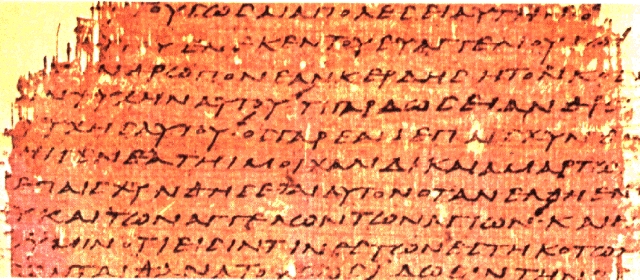


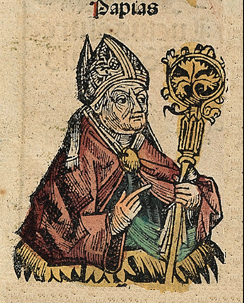


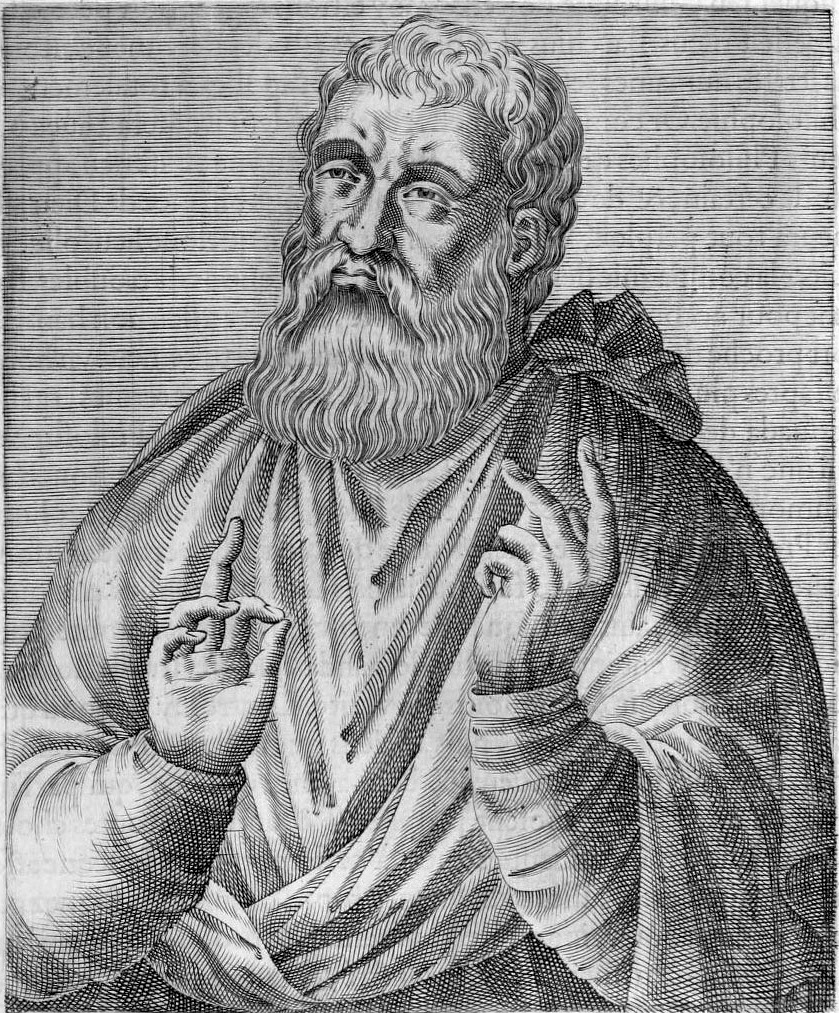




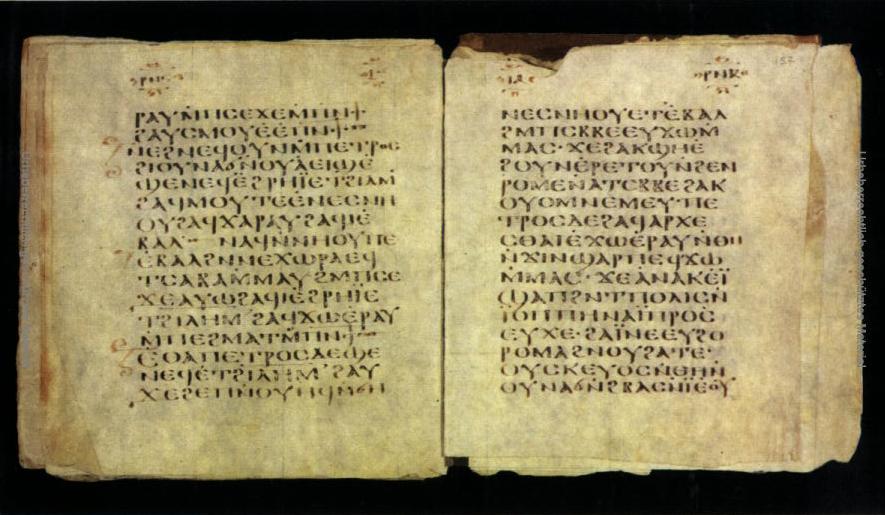


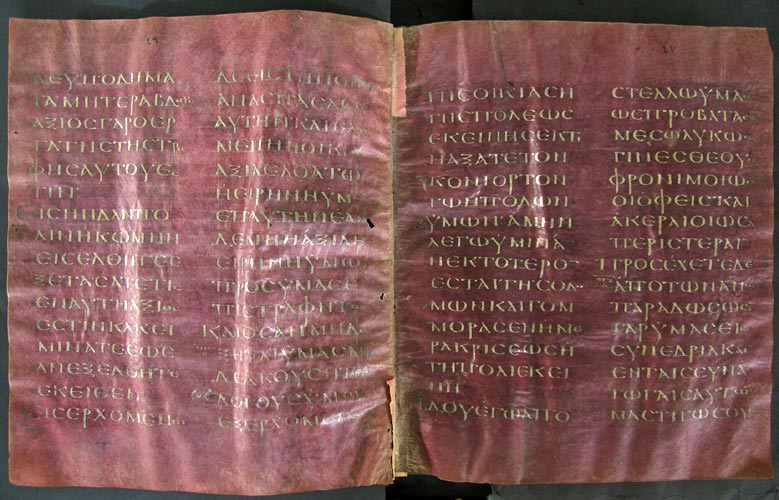


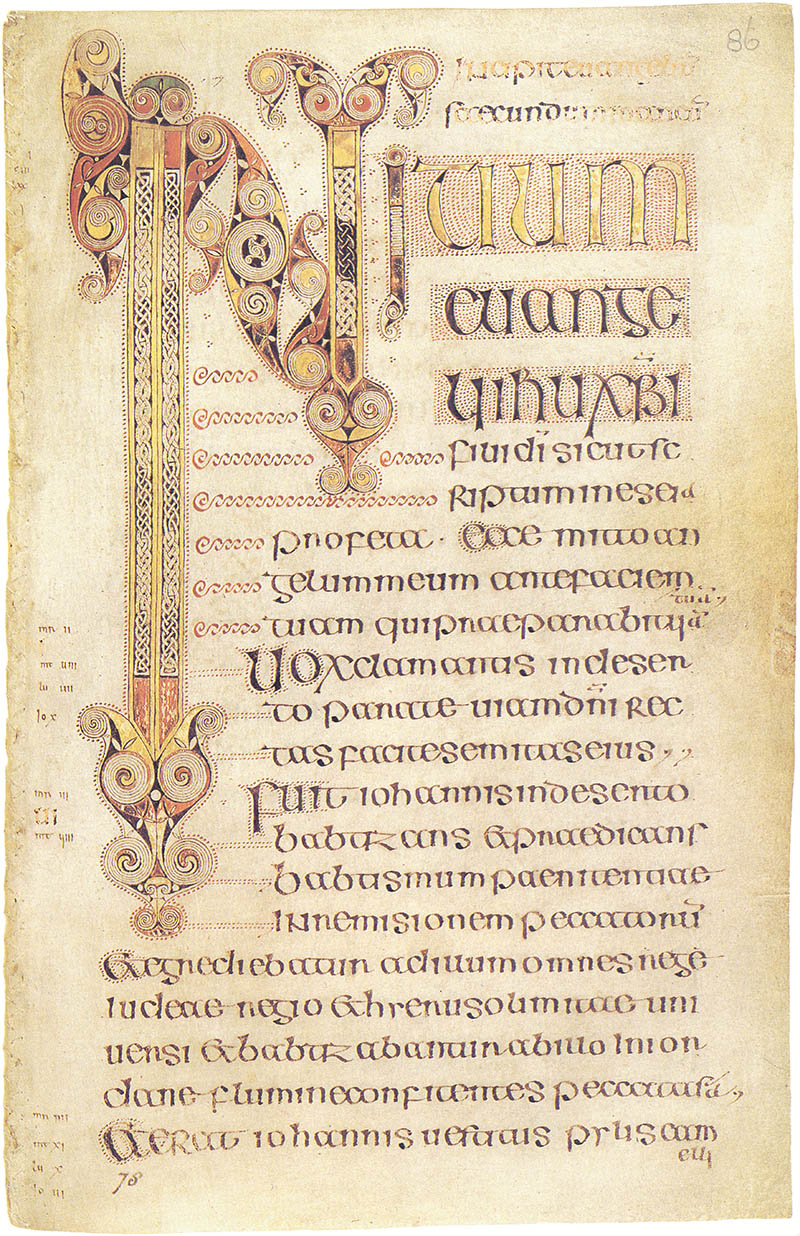


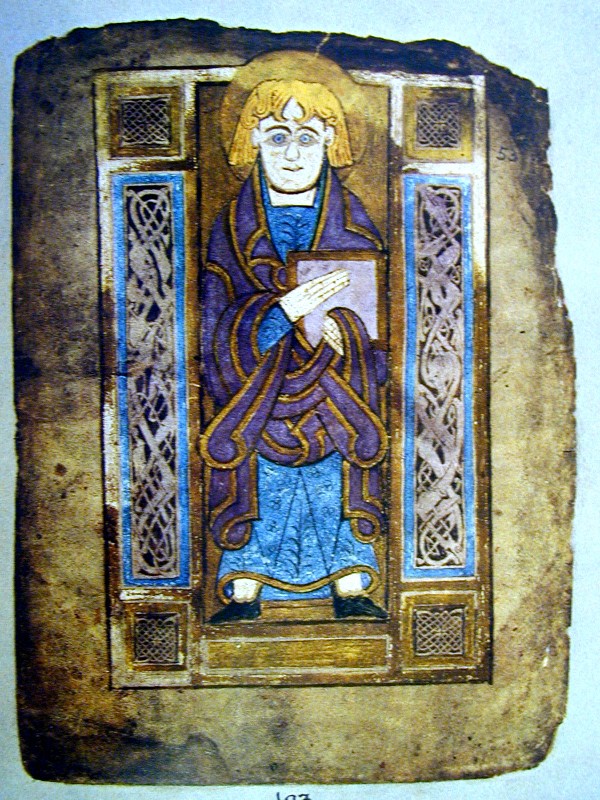


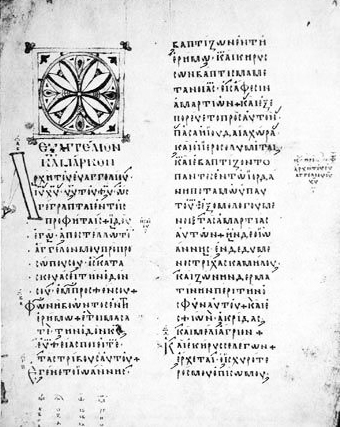


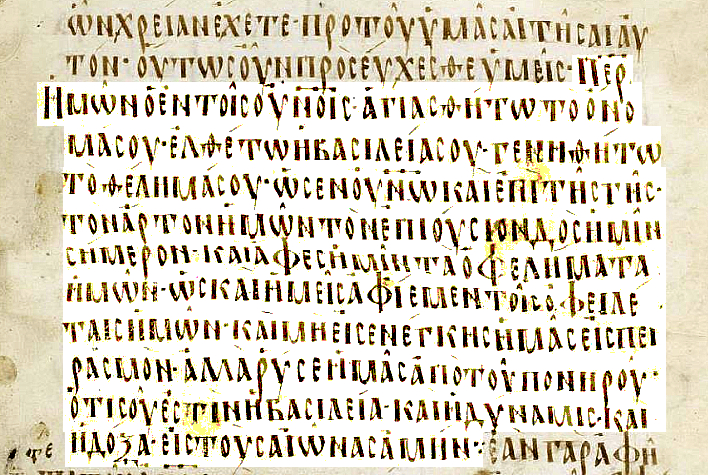


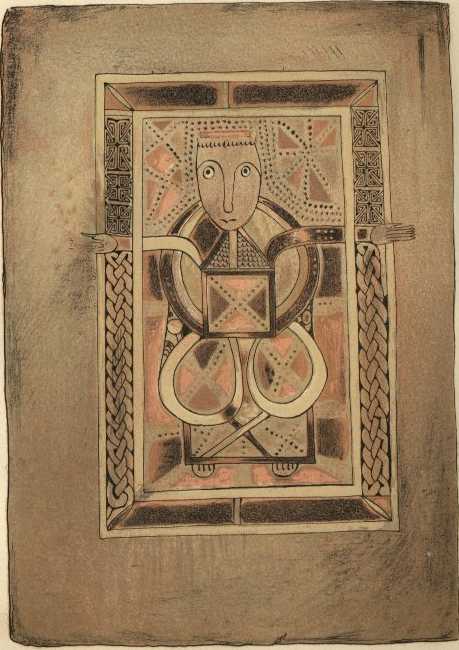


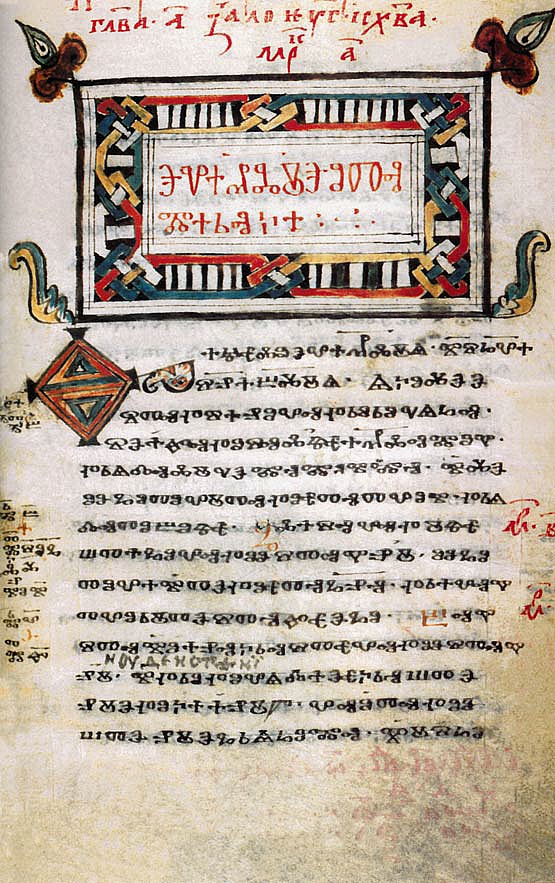


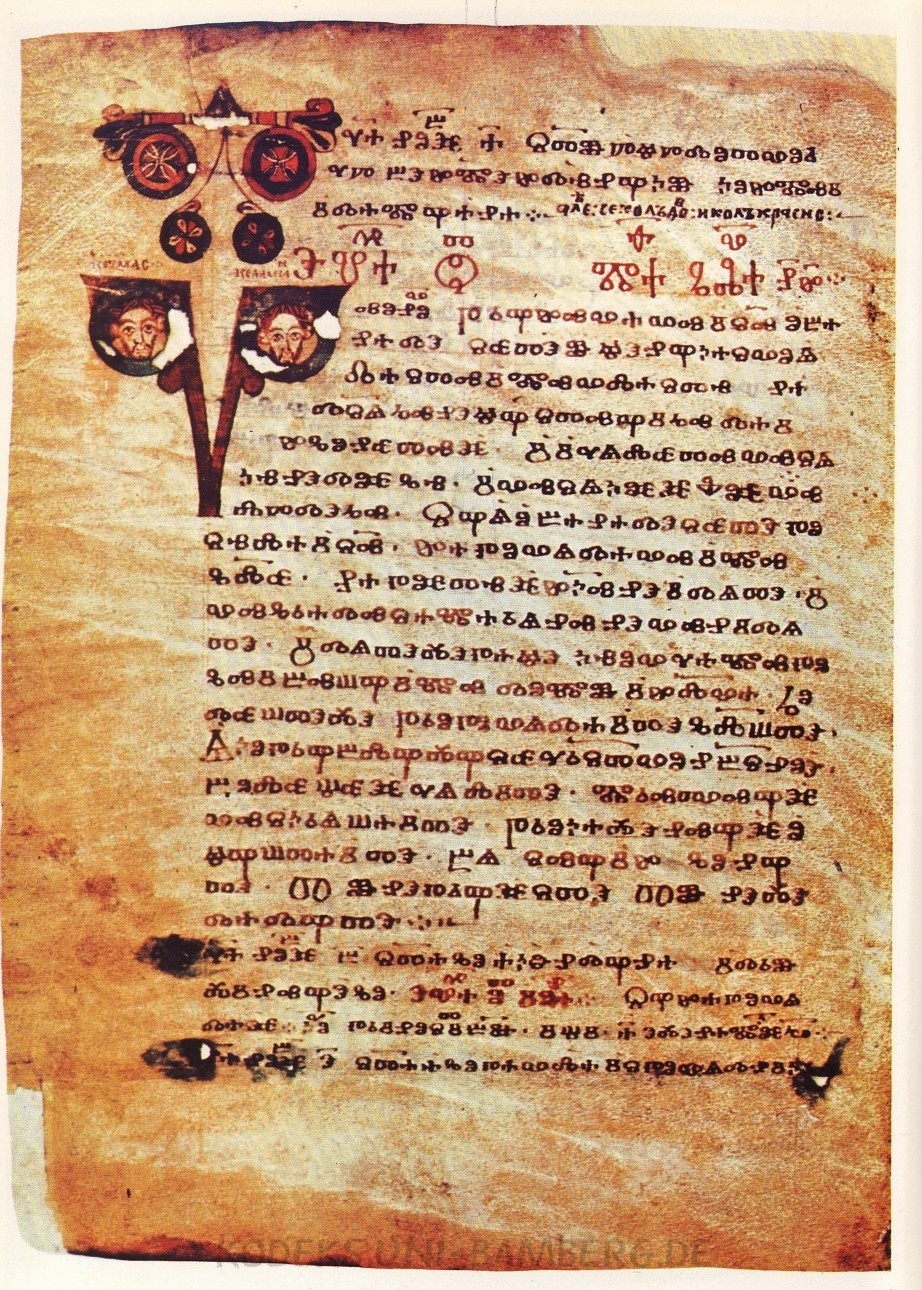


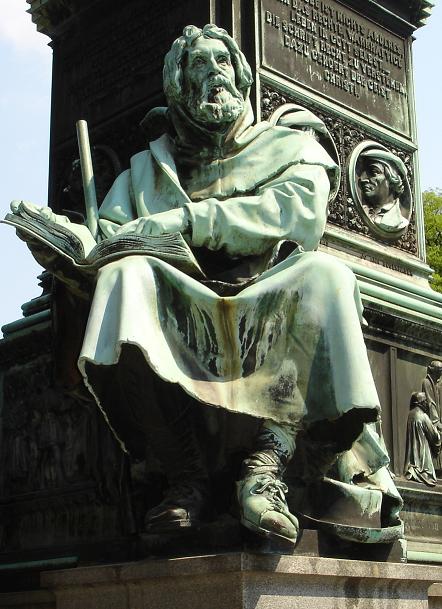

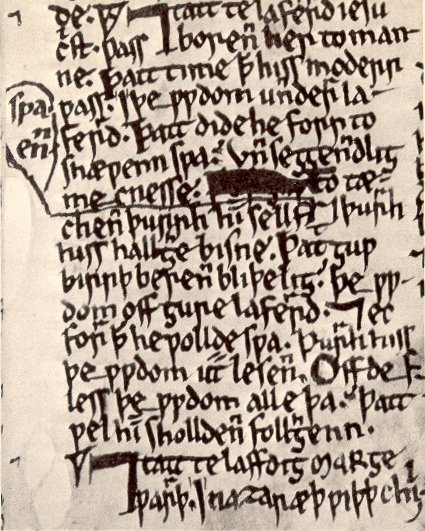



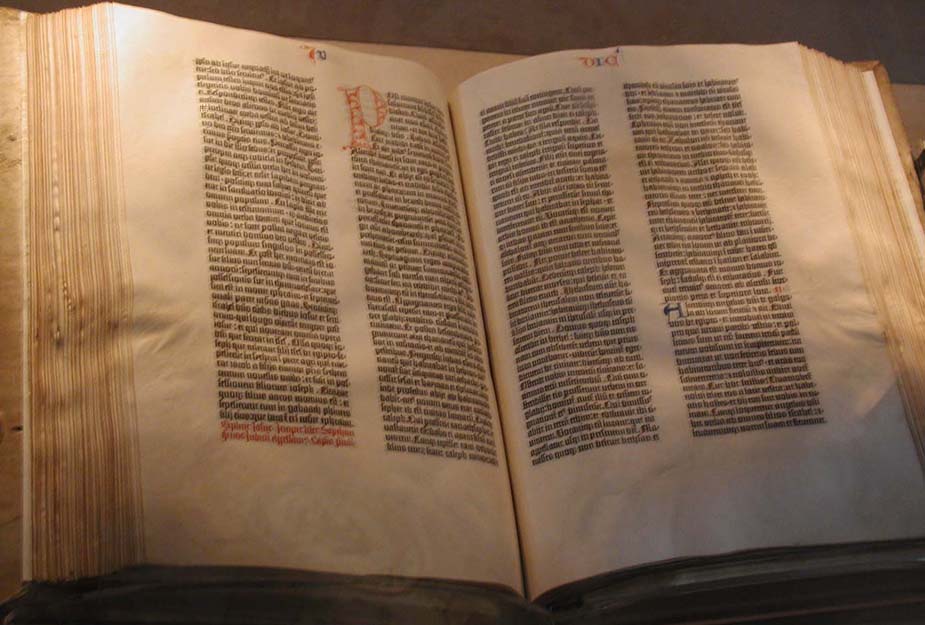


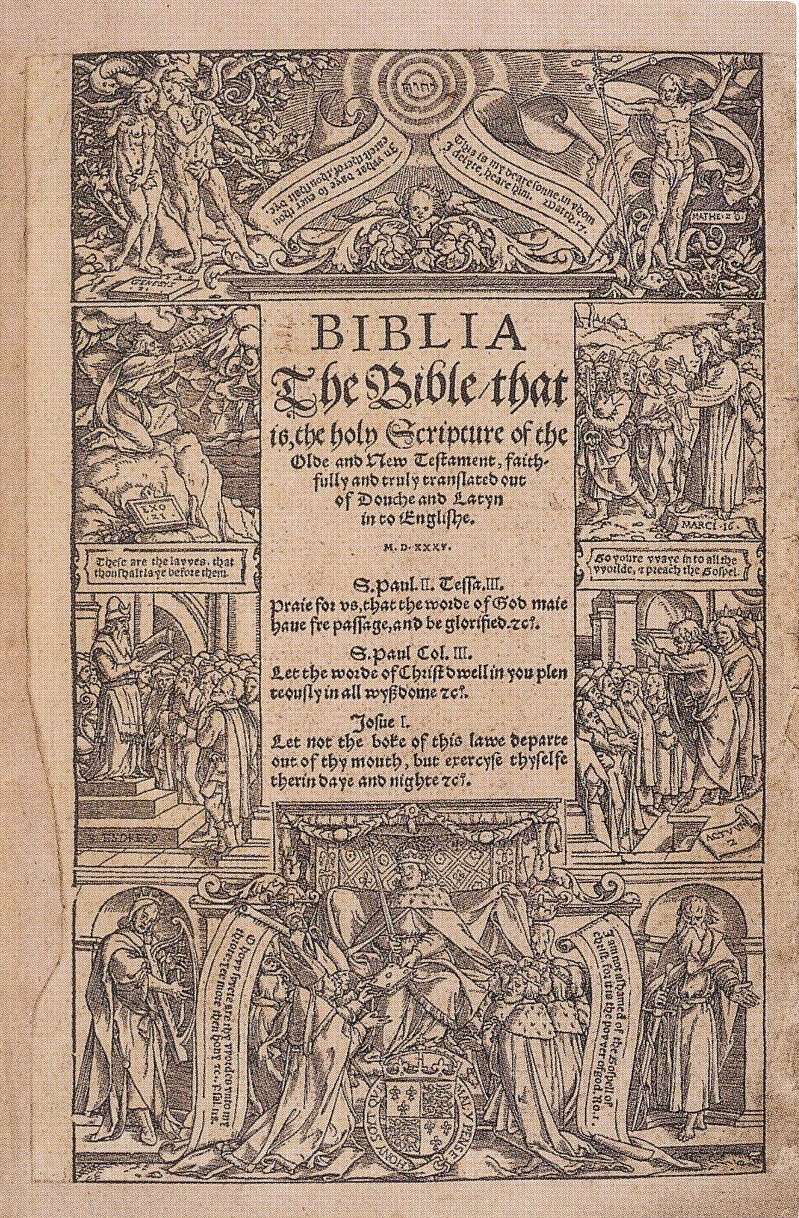


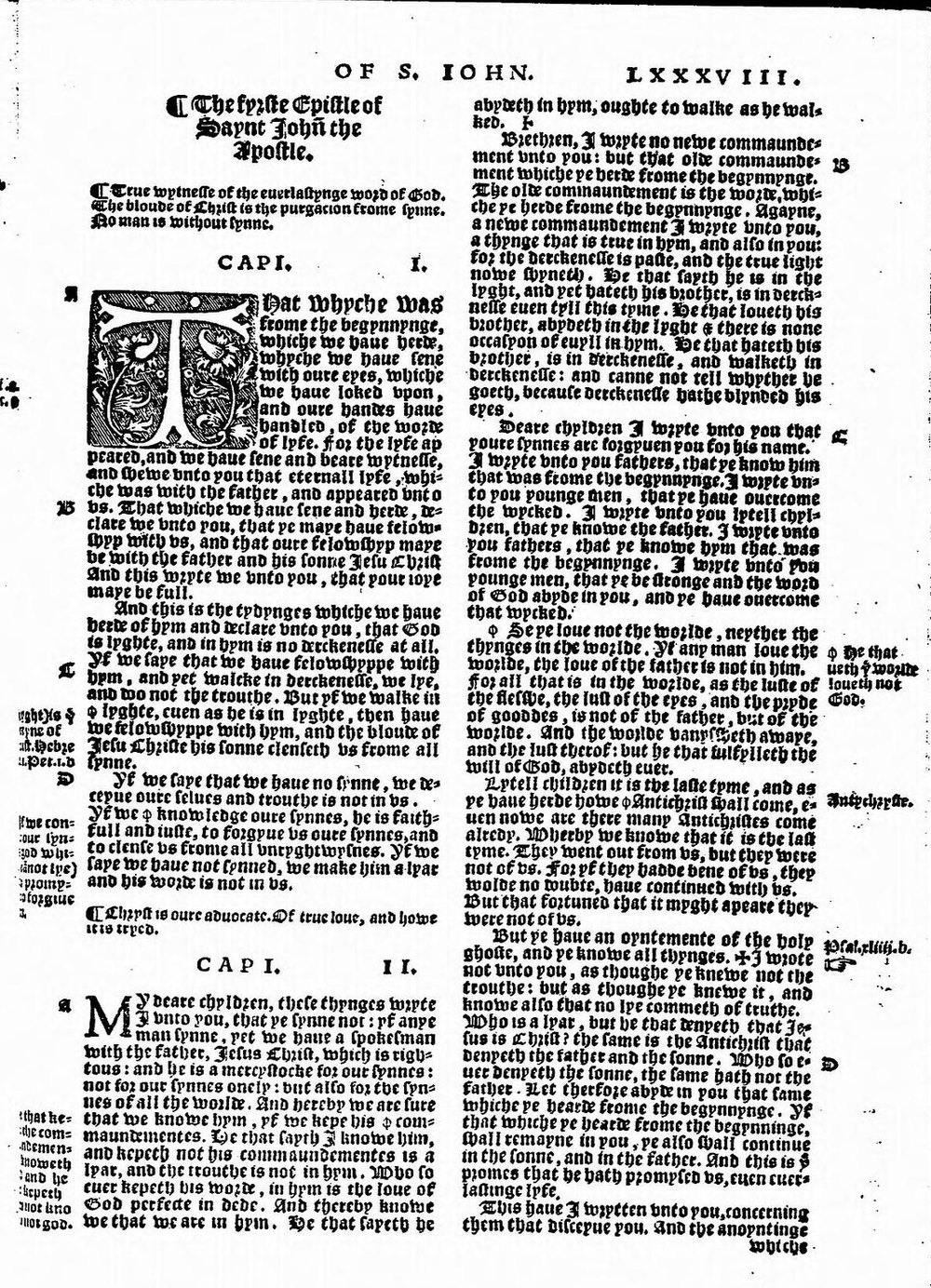


![Title page, “La Bibbia. Cioè, i libri del Vecchio, e del Nuovo Testamento… da Giovanni Diodati”, [Geneva]: Jean de Tournes, 1607, via Wikimedia Commons](https://thumb.wikimedia.org/wikipedia/commons/thumb/3/38/Diodati_Bibbia_Titelblatt.jpg/960px-Diodati_Bibbia_Titelblatt.jpg)

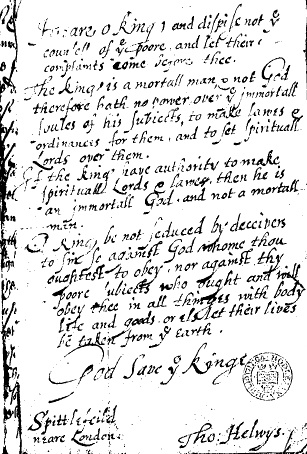


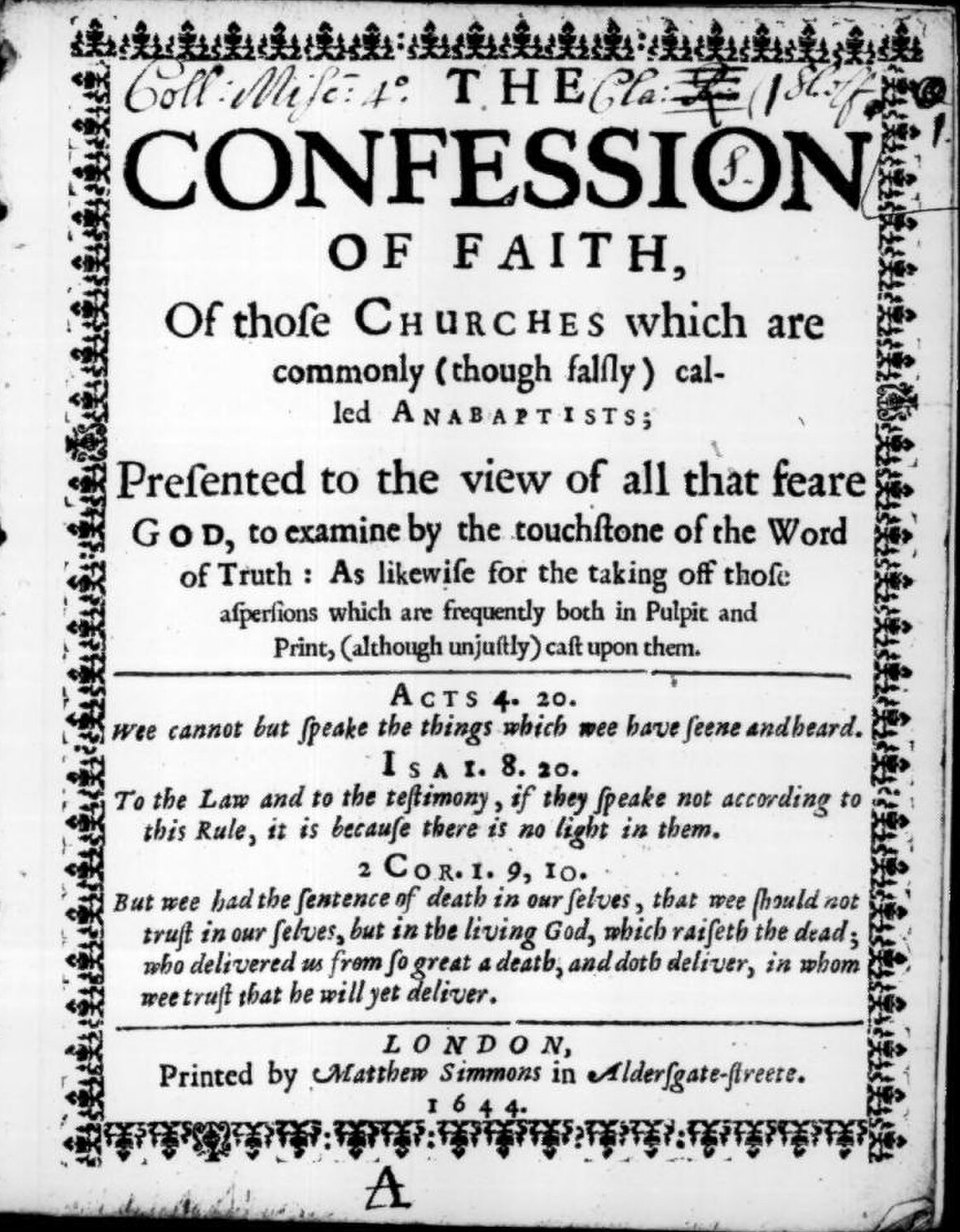


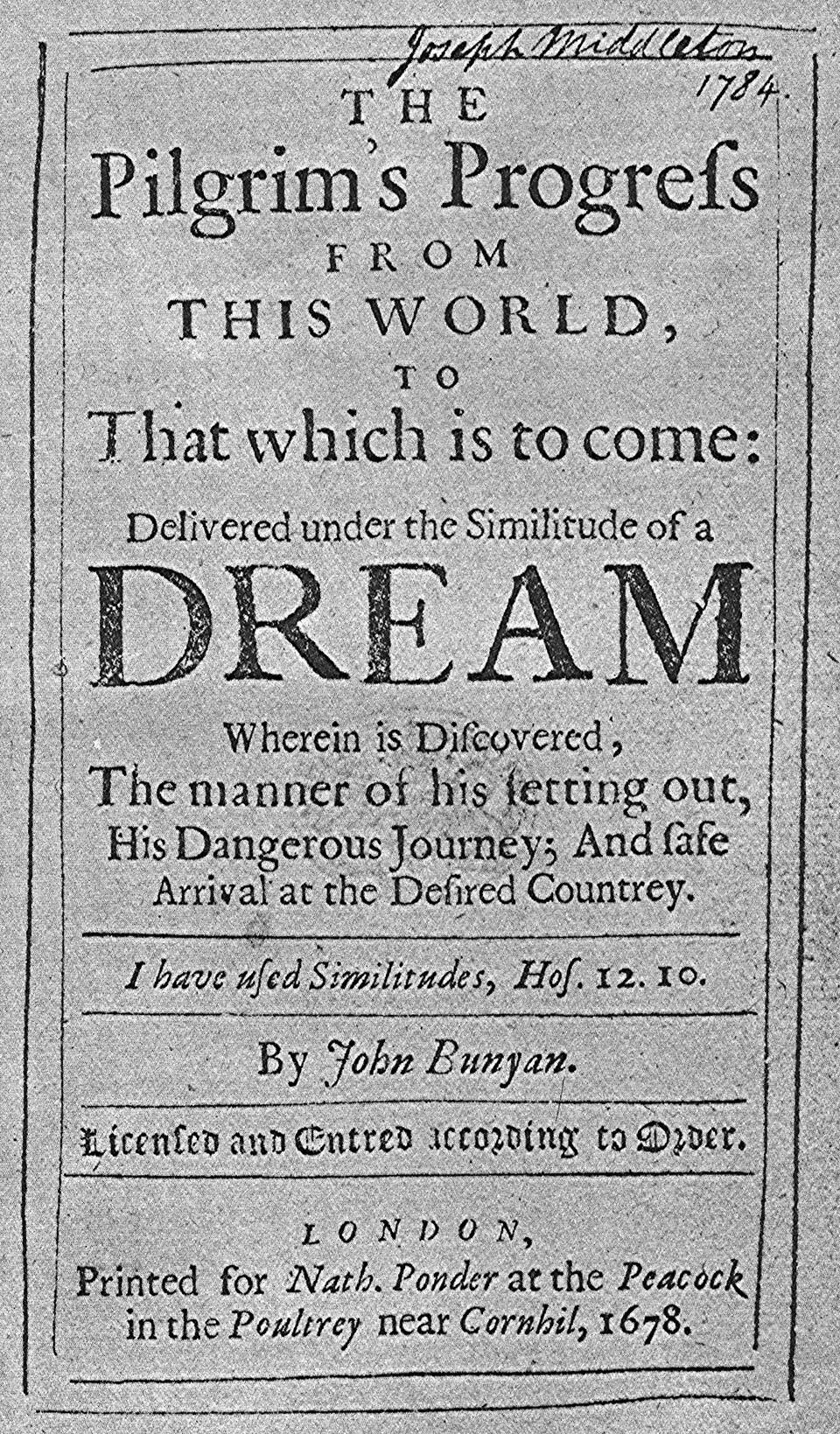

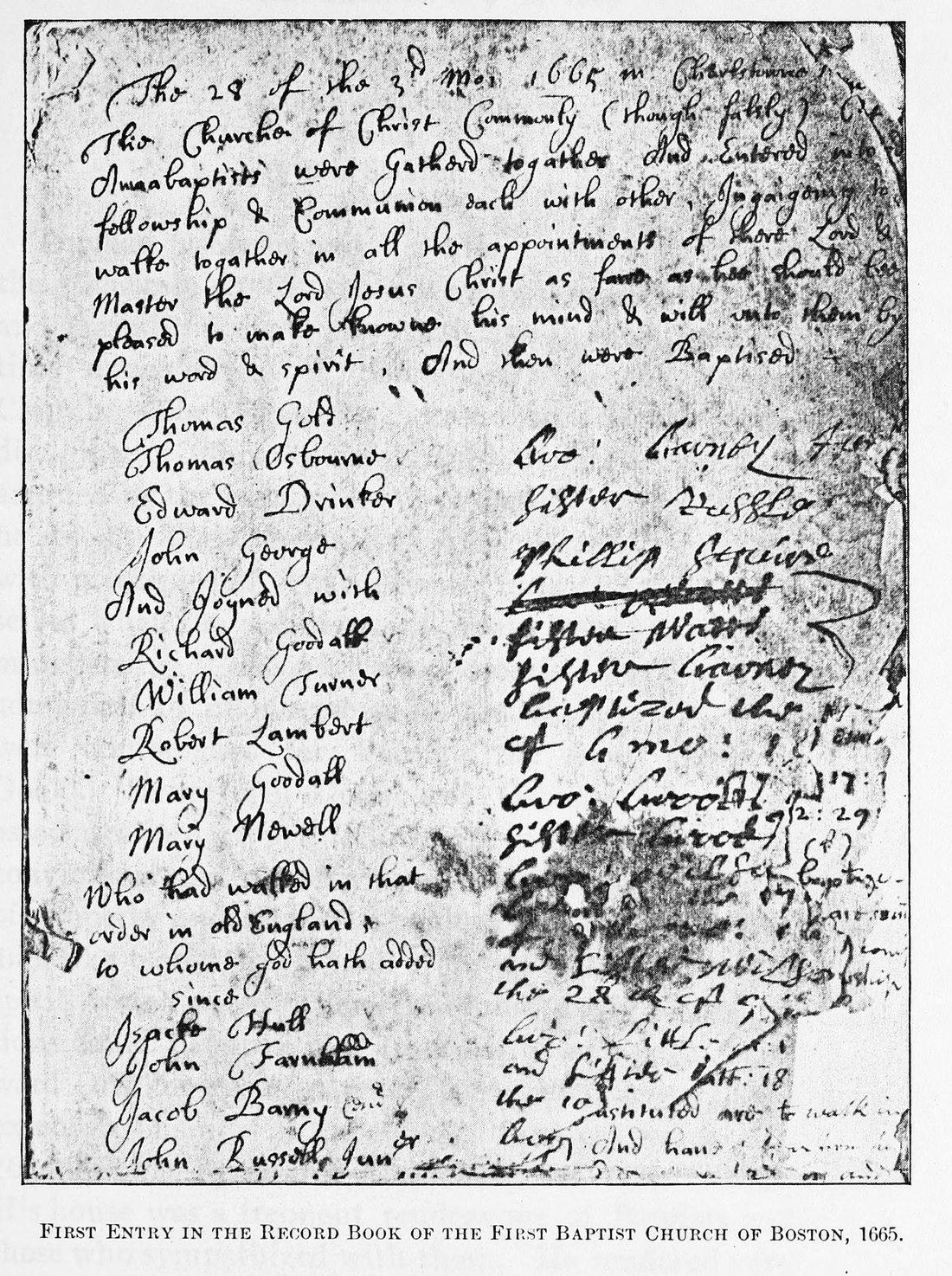
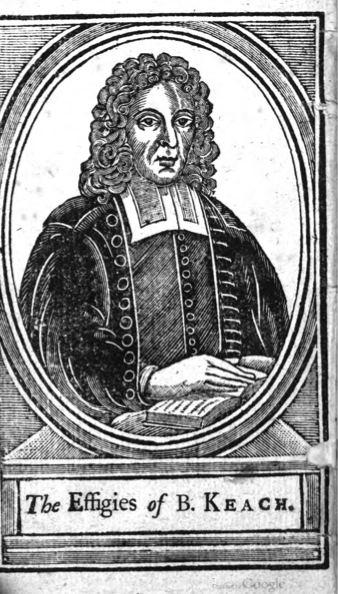















_fol._158r_Eph_6,_20%E2%80%93Gal_1,_8.jpg)
_recto_1_Thess_1,_1-2,_1.jpg)
_verso_James_1,_10%E2%80%9312.jpg)
_front_and_recto_Eph_1,_11-13_(top-left);_19-21_(top-right);_2_Thess_1,_4-5_(bottom-left);_11-12_(bottom-right).jpg)
_fol._79v_1_Cor_2,_11%E2%80%933,_5.jpg)
_fol._142r_-_2_Corinthians_11,33-12,9.jpg)
_Plate_1_%E2%80%94_Fragments_a_%26_b_Romans_3,_21%E2%80%9326_recto.jpg)

_recto_Eph_4,_16-29.jpg)
_recto_Philippians_3,_10%E2%80%9317.jpg)

_Fragment_1_recto_Hebrews_4,2-12.jpg)
_recto_Titus_1,_11-15.jpg)
_verso_1_Peter_2,_20-3,_1.jpg)
_Ending_of_1_Peter_-_Beginning_of_2_Peter.jpg)

_recto_Matt_21,_34-37.jpg)
_-_Fragment_D_Luke_6,_4%E2%80%9316.jpg)
_recto_%26_verso_Acts_2,30-37;_2,_46-3,2.jpg)
_verso_Jude_1,_4-5;_1,_7-8.jpg)
_recto_John_18,_36-19,_1.jpg)
_recto_Rev_1,_13-2,_1.jpg)


.jpg)


,_RP-P-1896-A-19368-1267.jpg)
_fol._157v_Eph_6,_8%E2%80%9318.jpg)


.jpg)


_Ending_of_2_Peter.jpg)


.jpg)


.jpg)


.JPG)
.jpg)


.jpg)


.jpg)

_Vatican_Library.jpg)


_f._91_r.JPG)


,_Mk_1.JPG)


.jpg)
.jpg)
,_f.161v_-_BL_Harley_MS_2788.jpg)


.jpg)
.jpg)


.jpg)


_Matt_1.jpg)
.jpg)
._The_Bury_Bible,_fol._281v._Vison_of_Ezekiel.jpg)
.jpg)


.jpg)


_1352_150cm,_treviso,_ex_convento_di_san_niccol%C3%B2,_sala_del_capitolo_(cropped).jpg)


,_vol.1,_f.3_-_BL_Royal_MS_19_D_III.jpg)

,_f.67v_-_BL_Royal_MS_2_B_VII.jpg)
_of_Nicholas_of_Lyra_MET_DP245798.jpg)
.png)


,_Bethlehem_Chapel_in_Prague.jpg)
_School_-_Thomas_Arundel_(1353–1414),_Archbishop_of_Canterbury_(copy_of_a_15th-century_portrait)_-_0055_1_-_Lambeth_Palace.jpg)


_01.JPG)

,_title_page.jpg)


.jpg)


_Icones_virorum_nostra_patrumq._memoria_illustrium_(serietitel),_RP-P-OB-55.218.jpg)


.jpg)


.jpg)
.jpg)


.jpg)
.png)
_%E2%80%93_Genesis,_Chapter_1.jpg)


.jpg)

_-_Dr_Andrew_Gifford_(1700%E2%80%931784),_Assistant_Librarian_(1756%E2%80%931784)_-_Painting.13_-_British_Museum.jpg)


.jpg)


.jpg)


.jpg)


.jpg)


.jpg)
.jpg)

.jpg)


.png)
.jpg)
