Baptist Militia A library & museum of the Whole Armour of God Visit
Find

Hall III · The Timeline

The Late Middle Ages

“But the word of the Lord endureth for ever. And this is the word which by the gospel is preached unto you.”1 Peter 1:25, KJV

How the Scriptures were received, carried into the English tongue, and confessed by the Baptist churches. Each date is linked to its source, so that you may test every word.

  • Scripture & Canon (16)
  • The English Bible (4)
  1. The Late Middle Ages1300-1515

    Scripture & Canon

    The Mokvi Gospels: the four Gospels in Georgian, with 157 pictures on gold

    The Mokvi Gospels (1300): the Transfiguration, fol. 59v. National Centre of Manuscripts, Tbilisi, Q-902, via Wikimedia Commons
    The Mokvi Gospels (1300): the Transfiguration, fol. 59v. National Centre of Manuscripts, Tbilisi, Q-902, via Wikimedia Commons · Public domain

    In 1300 a monk named Ephraim copied the four Gospels in Georgian at the monastery of Mokvi, in western Georgia, at the command of Daniel, Archbishop of Mokvi, and the book was given to the cathedral there. The text is written in the Georgian nuskhuri script in two columns on large parchment pages, and it is illustrated with 157 scenes from the Gospels and four portraits of the Evangelists, all painted on gold leaf, with ten canon tables. Art historians think Ephraim trained in Constantinople and brought the Byzantine style of painting home to Georgia. In the 1880s the book was moved for its protection to the library of Gelati Monastery near Kutaisi. In 1921 the historian Ekvtime Takaishvili had it carried to France for safekeeping with other Georgian national treasures, and it came back in 1945 to what is now the National Centre of Manuscripts in Tbilisi. It was conserved in 2015 and is listed in UNESCO’s Memory of the World Register. The page shown here pictures the Transfiguration. “This is my beloved Son: hear him” (Mark 9:7, KJV).

    Source en.wikipedia.org: Wikipedia, “Mokvi Gospels” (Georgian, nuskhuri; 1300; monk Ephraim at Mokvi, for Archbishop Daniel; 157 miniatures + 4 Evangelists on gold leaf, 10 canon tables; Naumann/Belting: trained in Constantinople; Gelati 1880s; Takaishvili to France 1921, returned 1945; Q-902, Tbilisi; conserved 2015; UNESCO MoW). Mark 9:7 KJV verified.

  2. Scripture & Canon

    The Queen Mary Psalter: the Psalms, with the whole Bible story told in pictures

    Queen Mary Psalter, fol. 67v: the Tree of Jesse. British Library, Royal MS 2 B VII, via Wikimedia Commons
    Queen Mary Psalter, fol. 67v: the Tree of Jesse. British Library, Royal MS 2 B VII, via Wikimedia Commons · CC0

    The Queen Mary Psalter, probably made in London about 1310-1320, is one of the most fully illustrated psalters ever produced in Western Europe, and unusually for so rich a book it is the work of one main scribe and a single artist, known today as the Queen Mary Master. The Latin Psalms are preceded by an Old Testament cycle of 223 scenes, each captioned in Anglo-Norman French, and accompanied by more than 800 further pictures, among them initials of David, large paintings of the life of Christ, and drawings along the foot of every page. Some captions show the influence of Comestor’s Historia scholastica (already on this timeline). Its name comes from Mary I, who gained the book in 1553; George II gave the Old Royal Library, with this book, to the British Museum in 1757, and it is now in the British Library. Honesty: its first owner is unknown; Queen Isabella of France has been proposed, but there is no agreement. “And there shall come forth a rod out of the stem of Jesse, and a Branch shall grow out of his roots” (Isaiah 11:1, KJV).

    Source en.wikipedia.org: Wikipedia, “Queen Mary Psalter” (BL Royal MS 2 B.vii; c. 1310-1320, prob. London; one main scribe, single artist “Queen Mary Master”; “one of the most extensively illustrated psalters”; OT cycle of 223 scenes with Anglo-Norman captions; 800+ illustrations; Historia scholastica influence; Mary I 1553; George II 1757; patron disputed, Isabella proposed). Isa 11:1 KJV verified.

  3. Scripture & Canon

    Nicholas of Lyra and the plain, literal sense of Scripture

    Elevation of Solomon’s Temple, a leaf from a manuscript of Nicholas of Lyra’s Postilla litteralis, France, c. 1360-80. The Metropolitan Museum of Art (The Cloisters), via Wikimedia Commons
    Elevation of Solomon’s Temple, a leaf from a manuscript of Nicholas of Lyra’s Postilla litteralis, France, c. 1360-80. The Metropolitan Museum of Art (The Cloisters), via Wikimedia Commons · CC0

    Nicholas of Lyra (c. 1270-1349), a Franciscan who became a doctor at the Sorbonne by 1309, wrote a running commentary on the whole Bible, the Postillae perpetuae. In its second prologue he held that the literal sense of Scripture is the foundation of every other reading, and he lamented that the plain meaning had been choked by piled-up allegories, copyists’ carelessness and places where the Latin Vulgate departs from the Hebrew, which he urged should be used to correct it. He learned Hebrew and drew heavily on the Jewish commentator Rashi. It was the first Bible commentary ever printed (Rome, 1471), became the most-consulted manual of interpretation until the 16th century, and Martin Luther leaned on it in his lectures on Genesis. Honesty requires two notes. Nicholas submitted all he wrote to the correction of the Roman Church, and he also wrote a polemical tract against the Jewish faith that Luther later drew on in his notorious treatise against the Jews. “Study to shew thyself approved unto God, a workman that needeth not to be ashamed, rightly dividing the word of truth” (2 Timothy 2:15, KJV).

    Source en.wikipedia.org: Wikipedia, “Nicholas of Lyra” (c. 1270-1349; Sorbonne by 1309; Postillae, first printed commentary, Rome 1471; literal sense; correct from Hebrew; Rashi; most consulted to 16th c.; Luther, Lectures on Genesis; submission to the Church; tract used in On the Jews and Their Lies). Also Catholic Encyclopedia (1911), newadvent.org/cathen/11063a.htm (second prologue). 2 Tim 2:15 KJV verified.

  4. Scripture & Canon

    The Velislav Bible: the Scriptures told in 747 pictures

    Velislav Bible (detail): the canon Velislav kneeling in prayer; artist unknown. National Library of the Czech Republic, Prague (Kramerius), via Wikimedia Commons
    Velislav Bible (detail): the canon Velislav kneeling in prayer; artist unknown. National Library of the Czech Republic, Prague (Kramerius), via Wikimedia Commons · CC BY-SA 4.0

    The Velislav Bible is a picture Bible made by several artists between about 1325 and 1349, probably for Velislav, a canon of the church who served as notary to King John of Bohemia and his son Charles IV. Its 188 parchment leaves hold 747 pictures, most drawn in ink with touches of colour, running through the Old and New Testaments. The words are kept to short titles and descriptions of each picture, so it is a “Bible of pictures” of the Biblia pauperum kind, though with far more images than usual. It is now in the National Library of the Czech Republic in Prague. Honesty: it is a picture book with captions, not a translation, and besides the Scriptures it also pictures writings about the Antichrist and legends of the saints, especially St Wenceslas; those are not Scripture. The plate shows Velislav himself kneeling in prayer. “And beginning at Moses and all the prophets, he expounded unto them in all the scriptures the things concerning himself” (Luke 24:27, KJV).

    Source en.wikipedia.org: Wikipedia, “Velislai biblia picta” (Velislavova bible; 1325-1349; picture-book Bible; brief titles; 747 pictures from OT, NT, Antichrist writings, saints’ legends esp. Wenceslas; a Biblia pauperum in atypical form; mostly ink, some colour; 188 ff., 307 × 245 mm; Czech National Library, Prague; probably for Velislav the Canon, d. 1367, notary to John of Bohemia and Charles IV). Luke 24:27 KJV verified.

  5. Scripture & Canon

    The Holkham Bible Picture Book: Genesis and the life of Christ in pictures with French captions

    The Holkham Bible is a picture book made in England in the decades before 1350, probably for a Dominican friar: 42 parchment leaves carrying 231 pen drawings, usually two to a page, tinted with colour washes and captioned in Anglo-Norman French, sometimes in verse. The pictures run from the Creation to the Flood, through two Jesse Trees and the four evangelists, then through the life of Christ from the Annunciation to the Ascension, and end with the signs before the Second Coming and the Last Judgment. Its opening page shows a friar telling the artist to do the work well, since it will be shown to important people. The artist set the stories in the England of his own day, so the book is also a record of medieval English life. Honesty: it mixes biblical scenes with apocryphal legends, such as tales of Christ’s childhood, which are not Scripture. It was bought for Holkham Hall in Norfolk in 1816 and entered the British Library in 1952. “Write the vision, and make it plain upon tables, that he may run that readeth it” (Habakkuk 2:2, KJV).

    Source en.wikipedia.org: Wikipedia, “Holkham Bible” (BL Add MS 47682; England, decades before 1350; for an unidentified Dominican friar; 42 ff., 231 tinted drawings; Anglo-Norman captions, sometimes verse; Genesis to Flood, Jesse Trees, evangelists, Life of Christ, Last Things; f. 1r friar and artist; contemporary English settings; biblical and apocryphal stories; Coke of Holkham 1816; BL 1952). Hab 2:2 KJV verified. No plate: candidates rejected on tone/provenance.

  6. The English Bible

    Richard Rolle’s English Psalter

    Richard Rolle of Hampole (c. 1300-1349) was a Yorkshire hermit who left Oxford young to live a life of prayer, and wrote in both Latin and English. His English works all appear to date from after about 1340. Among them is a commentary on the Psalms with a translation of the Latin Psalter into English. He made it for Margaret Kirkby, an anchoress, to help her understand the Psalms she chanted. It survives in about twenty manuscripts. Decades before the Wycliffite Bible, part of the Scriptures was already being read in English. After the Constitutions of Arundel of 1409 restricted English Scripture, Rolle’s Psalter remained for nearly two hundred years the only authorised English rendering of any portion of the Bible, needing no bishop’s licence. Rolle died at Hampole in 1349.

    Source en.wikipedia.org: Wikipedia, “Richard Rolle” (dates; Oxford; English works after c. 1340; the English Psalter for Margaret Kirkby; c. 20 MSS; its status after the Constitutions of Arundel; death at Hampole 1349). No plate: no licensed image of the Psalter was found this run.

  7. Scripture & Canon

    The Gospels of Tsar Ivan Alexander: the four Gospels in 366 pictures

    The Gospels of Tsar Ivan Alexander, f. 88r: the opening of St Mark’s Gospel. British Library, Add MS 39627, via Wikimedia Commons
    The Gospels of Tsar Ivan Alexander, f. 88r: the opening of St Mark’s Gospel. British Library, Add MS 39627, via Wikimedia Commons · Public domain

    This Gospel book was written in 1355-56 in Church Slavonic for Tsar Ivan Alexander of the Second Bulgarian Empire, probably for his own chapel. The whole text is in the hand of a monk named Simeon, who gives his name at the end. It holds the four Gospels on 286 parchment leaves, with 366 miniatures following Byzantine tradition, so many that it has been called the most celebrated work of art made in medieval Bulgaria; at least three artists painted them. It is a true Gospel book, not a lectionary, though the reading passages for the church year are marked. Its original red leather binding survives. After Tarnovo fell in 1393 the book was carried to Moldavia, and it later came to the monastery of St Paul on Mount Athos. In 1837 the abbot gave it to the English traveller Robert Curzon, which probably saved it from the fire that burned the monastery library in 1905. Curzon’s family lent it to the British Museum in 1876 and gave it in 1917; it is now British Library Add MS 39627. One leaf, probably with a Last Judgment, was cut out and stolen in modern times. In 2017 it was added to UNESCO’s Memory of the World Register. The page shown opens the Gospel of Mark. “The beginning of the gospel of Jesus Christ, the Son of God” (Mark 1:1, KJV).

    Source en.wikipedia.org: Wikipedia, “Gospels of Tsar Ivan Alexander” (1355-56; scribe the monk Simeon, colophon f. 275; 286 folios, 366 miniatures; ≥3 artists; Gospel book with lectionary markings; original binding; Moldavia after 1393; Agiou Pavlou, Athos; Curzon 1837; fire 1905; BM loan 1876, gift 1917; BL Add MS 39627; f. 74 stolen; UNESCO MoW 2017). Mark 1:1 KJV verified.

  8. Scripture & Canon

    The Leskovec-Dresden Bible: the first whole Bible in Czech, and in any Slavic tongue

    The Leskovec-Dresden Bible, often simply called the Dresden Bible, was the oldest known manuscript of the complete Bible translated from Latin into Czech, and the oldest complete Bible in any Slavic language. It is usually dated to about 1365-1375. Honesty: that date is uncertain, because the emperor Charles IV, who ruled from Prague in those years, had forbidden the translating of Scripture. The manuscript itself is lost. It was destroyed by fire at Leuven, in Belgium, in 1914, where it had been sent to be photographed, and only about a third of its text survives, in black-and-white photographs and copies; a facsimile was published from those photographs in 1993. The Bible of Kralice, already on this timeline, belongs to the later history of the Czech Bible. No plate is hung: no licensed image of the lost manuscript was found. “And how hear we every man in our own tongue, wherein we were born?” (Acts 2:8, KJV).

    Source en.wikipedia.org: Wikipedia, “Leskovec-Dresden Bible” (Bible leskovecko-drážďanská; oldest known MS of the complete Bible in Czech, from Latin; oldest complete Bible in any Slavic language; c. 1365-1375, date uncertain because Charles IV forbade translating Scripture; destroyed by fire in Leuven 1914 while sent to be photographed; about one third survives in photographs; facsimile Rothe/Kyas/Scholz, Paderborn 1993). Acts 2:8 KJV verified. No plate.

  9. The English Bible

    The Wycliffite Bible: the whole Bible in English, copied by hand

    Opening of the Gospel of John in a pocket-sized late-14th-century copy of the Wycliffite translation (“In þe bigynnyng was þe word”), Glasgow University Library, MS Hunter 191, fol. 2v, via Wikimedia Commons
    Opening of the Gospel of John in a pocket-sized late-14th-century copy of the Wycliffite translation (“In þe bigynnyng was þe word”), Glasgow University Library, MS Hunter 191, fol. 2v, via Wikimedia Commons · Public domain

    Between about 1382 and 1395 a sequence of Middle English translations of the whole Bible appeared, made from the Latin Vulgate and circulated in handwritten copies. Scholars identify a word-for-word Early Version and a more readable Later Version. They are the earliest known translations of the entire Bible into English. The work bears John Wycliffe’s name, but historians now treat his personal share in it as uncertain.

    Source en.wikipedia.org: Wikipedia, “Wycliffe’s Bible” (citing Daniell, The Bible in English, 2003; Kelly, 2023).

  10. Scripture & Canon

    The Wenceslas Bible: a German Bible for a king, made in the teeth of a ban

    The opening of Genesis in German, Wenceslas Bible, Prague, 1390s. Austrian National Library, Vienna, via Wikimedia Commons
    The opening of Genesis in German, Wenceslas Bible, Prague, 1390s. Austrian National Library, Vienna, via Wikimedia Commons · Public domain

    About 1375-1380 Martin Rotlev, a wealthy citizen of Prague, commissioned a translation of the Latin Vulgate into German. In the 1390s King Wenceslas IV of Bohemia and Queen Sophia had it copied as a lavishly painted book, the oldest German deluxe Bible manuscript, with an inscription in the book recording their patronage. They did so although Wenceslas’s father, the Emperor Charles IV, had in 1369 forbidden translating the Bible from Latin into the common tongue as heresy; the book reflects the Bohemian court’s ties to the reform movement then stirring in Bohemia. Honesty: it was never finished. Daniel, the Minor Prophets and Maccabees are missing and the New Testament was never begun; 654 paintings were completed, with space left for more than 900 others. It is a translation of the Latin, not of the Hebrew and Greek. It is now in the Austrian National Library in Vienna. The plate shows the opening of Genesis in German. “In the beginning God created the heaven and the earth” (Genesis 1:1, KJV).

    Source en.wikipedia.org: Wikipedia, “Wenceslas Bible” (German translation from the Vulgate commissioned by Martin Rotlev c. 1375-1380; made in Prague in the 1390s for Wenceslas IV and Sophia; Charles IV’s 1369 prohibition; unfinished: Daniel, Minor Prophets, Maccabees lacking, NT not begun; 654 miniatures, 900+ spaces; Austrian National Library). Gen 1:1 KJV verified.

  11. Scripture & Canon

    Jan Hus preaches in the common tongue at the Bethlehem Chapel, Prague

    The Bethlehem Chapel, Prague, drawing by Nelly Erichsen for Count Lützow, The Story of Prague (1902), via Wikimedia Commons
    The Bethlehem Chapel, Prague, drawing by Nelly Erichsen for Count Lützow, The Story of Prague (1902), via Wikimedia Commons · Public domain

    The Bethlehem Chapel in Prague was founded in 1391 for preaching solely in the Czech language. It could hold about three thousand people. In March 1402 Jan Hus, a master of the University of Prague who had been reading John Wycliffe, became its preacher. Hus also wrote in Czech, both the basics of the faith and sermons, for priests whose Latin was poor, and his writings helped reform the spelling of the Czech language. He was excommunicated, and when the Council of Constance assembled he went there to give an account of his teaching. There he was imprisoned and told to recant. He refused, protesting that he wished only to be convinced from Scripture. He was burned as a heretic on 6 July 1415. His teaching later had a strong influence on Martin Luther. “Sanctify them through thy truth: thy word is truth” (John 17:17, KJV).

    Source en.wikipedia.org: Wikipedia, “Jan Hus” (Bethlehem preacher 1402; Czech writings and orthography; Constance; the wish to be convinced from Scripture is paraphrased from its account; 6 July 1415; influence on Luther); “Bethlehem Chapel” (founded 1391, Czech only, c. 3,000, Hus preacher March 1402). The later wars are deliberately omitted. John 17:17 KJV verified.

  12. The English Bible

    The Constitutions of Arundel restrict new English translations of Scripture

    Thomas Arundel (1353-1414), Archbishop of Canterbury, 19th-century copy of a 15th-century portrait, British (English) School. Lambeth Palace, via Art UK and Wikimedia Commons
    Thomas Arundel (1353-1414), Archbishop of Canterbury, 19th-century copy of a 15th-century portrait, British (English) School. Lambeth Palace, via Art UK and Wikimedia Commons · Public domain

    After the disturbances that followed John Wycliffe’s teaching, Archbishop Thomas Arundel issued a set of constitutions to govern the use of Scripture in lectures and preaching. They were drawn up at Oxford in 1407 and extended to the province of Canterbury in 1409. One of them banned teaching Wycliffe’s writings unless they had been approved. Another, known as Periculosa, ruled that no one should make a new translation of Scripture into English “in the form of a book, booklet or tract” without prior permission, and that even recent translations were to be used only with the approval of the bishop or a provincial council. What Periculosa actually forbade has long been disputed. Its text does not outlaw owning an English Bible, yet by the 1500s many believed it did, and later writers such as John Foxe, Thomas More and William Tyndale each read it differently. The first printed English New Testament, William Tyndale’s, would not come until 1526.

    Source en.wikipedia.org: Wikipedia, “Constitutions of Oxford” (1407 Oxford convocation, extended 1408-09; nos. 5-7; Periculosa quoted as translated there; the competing interpretations of Foxe, More, the Rheims preface and Tyndale per Daniell). The Wycliffite and Tyndale entries on this timeline carry their own sources.

  13. The English Bible

    Constance condemns Wycliffe; his remains are burned and cast into the Swift

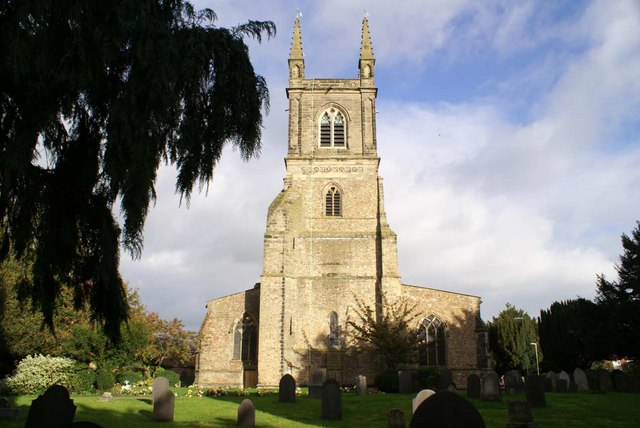
    St Mary’s parish church, Lutterworth, Leicestershire, where Wycliffe held the living from 1374, seen from the west. Photograph by Chris Stafford, geograph.org.uk, via Wikimedia Commons
    St Mary’s parish church, Lutterworth, Leicestershire, where Wycliffe held the living from 1374, seen from the west. Photograph by Chris Stafford, geograph.org.uk, via Wikimedia Commons · CC BY-SA 2.0

    John Wycliffe held the living of St Mary’s, Lutterworth, in Leicestershire from 1374. In his last years he argued ever more strongly that the Scriptures are the authoritative centre of the Christian faith. He suffered a stroke while saying Mass there on 28 December 1384, died a few days later, and was buried at Lutterworth. On 4 May 1415 the Council of Constance declared him a heretic and banned his writings. It ordered his books burned and his bones removed from consecrated ground. Pope Martin V confirmed the order, and Richard Fleming, bishop of Lincoln, was charged with carrying it out, though he delayed it for more than a decade. In 1428 the grave was opened. The body taken up was Wycliffe’s, or perhaps a neighbour’s, and unusually, on the bishop’s orders, the remains were burned and the ashes thrown into the River Swift, which flows through Lutterworth. “The grass withereth, the flower fadeth: but the word of our God shall stand for ever” (Isaiah 40:8, KJV).

    Source en.wikipedia.org: Wikipedia, “John Wycliffe” (Lutterworth living 1374; Scripture as authoritative centre; stroke 28 Dec 1384; Constance 4 May 1415, Martin V, exhumation 1428, “Wycliffe’s corpse, or a neighbour’s”, ashes in the Swift); “Richard Fleming (bishop)” (entrusted with the decree, delayed over a decade). Isa 40:8 KJV verified.

  14. Scripture & Canon

    Queen Sophia’s Bible: the first complete Bible in Polish

    Bible of Queen Sophia, a surviving leaf: Isaiah 48:6-49:1 in Old Polish. University of Wrocław Library, via Wikimedia Commons
    Bible of Queen Sophia, a surviving leaf: Isaiah 48:6-49:1 in Old Polish. University of Wrocław Library, via Wikimedia Commons · Public domain

    Sophia of Halshany, queen of Poland and wife of King Władysław Jagiełło, did not read Latin and wished for a Bible she could read herself. Her chaplain, Andrzej of Jaszowice, led the translation, which began in 1433 and ended in 1455. The Bible of Queen Sophia is the first complete translation of the Bible into Polish and the oldest surviving Old Testament in the language, the largest monument of medieval Polish. Honesty: the book has suffered almost total loss. It was kept at Sárospatak in Hungary from at least 1708 (hence its other name, the Sárospatak Bible); the second volume had already been cut up for bindings, and the first was lost in the First World War. A facsimile was published in 1930 and a printed edition in 1871, so the text is known through reproductions; today only two and a half leaves survive, at the University of Wrocław and in Prague. The plate shows one of the Wrocław leaves, Isaiah 48:6-49:1. “Thus saith the LORD, thy Redeemer, the Holy One of Israel; I am the LORD thy God which teacheth thee to profit” (Isaiah 48:17, KJV).

    Source en.wikipedia.org: Wikipedia, “Bible of Queen Sophia” (oldest surviving Polish OT, first complete Polish Bible; Sophia of Halshany, no Latin; begun 1433, ceased 1455; chaplain Andrzej z Jaszowic; Sárospatak from 1708; vol. 2 used for bindings; vol. 1 lost WWI; Bernacki facsimile 1930; Małecki ed. 1871; 2½ pages remain, Wrocław + Prague). Isa 48:17 KJV verified.

  15. Scripture & Canon

    The Gutenberg Bible: the first great book printed from movable metal type

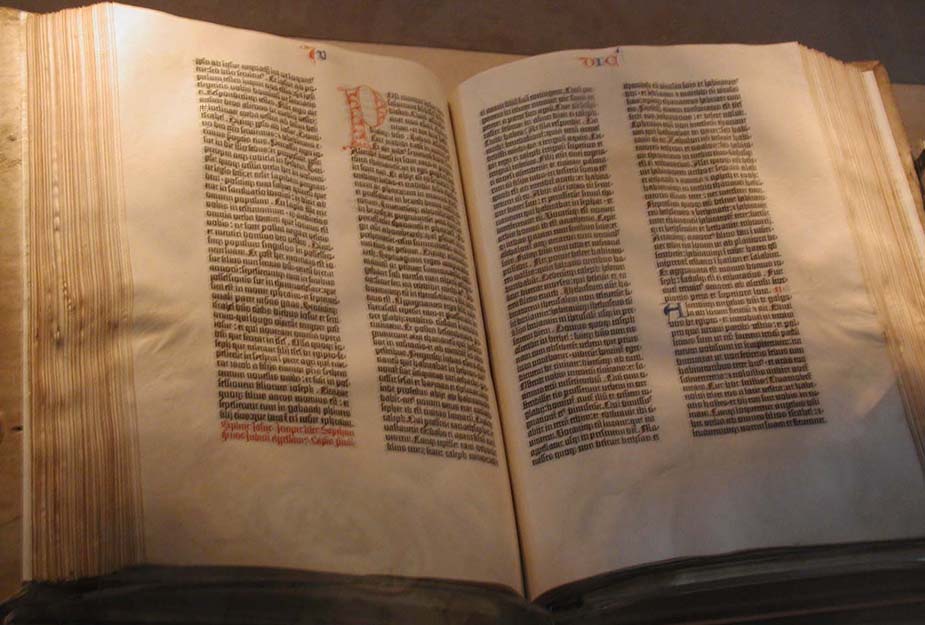
    The Library of Congress copy of the Gutenberg Bible
    The Library of Congress copy of the Gutenberg Bible. Photo: Moses et al., via Wikimedia Commons · CC BY-SA 3.0

    The printing of the Gutenberg Bible was probably completed late in 1455 at Mainz, Germany. It is the first great book printed in Western Europe from movable metal type, and the Library of Congress calls it a turning point in bookmaking. Its text is the Latin Vulgate, set in double columns of mostly forty-two lines to a page. From this press onward, the Scriptures could be multiplied as never before.

    Source loc.gov: Library of Congress, “The Gutenberg Bible,” Library of Congress Bible Collection exhibition.

  16. Scripture & Canon

    Johannes Mentelin prints the first Bible in German

    The beginning of Genesis in the Mentelin Bible, Strasbourg, 1466. Bayerische Staatsbibliothek copy (digitale-sammlungen.de), via Wikimedia Commons
    The beginning of Genesis in the Mentelin Bible, Strasbourg, 1466. Bayerische Staatsbibliothek copy (digitale-sammlungen.de), via Wikimedia Commons · Public domain

    Johannes Mentelin of Sélestat had been a calligrapher and notary at Strasbourg before he set up the first printing house there, probably by about 1458. His oldest known work is a Latin Bible of 49 lines to the page, dated 1460. In 1466 he printed and published the first Bible in the German language, seventeen years before Martin Luther was born. Its text was a High German translation of the Vulgate made in the fourteenth century, probably in the region of Nuremberg, from a manuscript that no longer survives. By 1518 it had been reprinted at least thirteen times. Within about a decade of the Gutenberg Bible, then, the Scriptures were being printed in a language the people spoke. “The entrance of thy words giveth light; it giveth understanding unto the simple” (Psalm 119:130, KJV).

    Source en.wikipedia.org: Wikipedia, “Johannes Mentelin” (Strasbourg, c. 1458, B49 Latin Bible 1460, first German Bible 1466); “Bible translations into German” (14th-c. Nuremberg-area translation of the Vulgate, lost MS, at least 13 reprints by 1518). Ps 119:130 KJV verified.

  17. Scripture & Canon

    Nicolò Malermi’s Bible, the first printed Bible in Italian

    The Malermi Bible, Venice: Lucantonio Giunta, 15 October 1490, vol. II: John 20-21. The Metropolitan Museum of Art, via Wikimedia Commons
    The Malermi Bible, Venice: Lucantonio Giunta, 15 October 1490, vol. II: John 20-21. The Metropolitan Museum of Art, via Wikimedia Commons · CC0

    Nicolò Malermi (c. 1422-1481), a Venetian who became a Camaldolese monk late in life, translated the Bible from Latin into Italian in 1471 at the hermitage of San Matteo near Murano, working with two collaborators and finishing in eight months. Printed at Venice that same year, it was the first printed translation of the Bible in Italian, and it was reprinted many times, including an illustrated edition of 1490 with woodcuts in the text. Honesty: Malermi worked from the Latin Vulgate, not from the Hebrew and Greek; he included the deuterocanonical books; and to finish quickly he adapted earlier 14th-century translations, at some cost to its style. A translation from the original tongues was not made for Italian readers until Giovanni Diodati’s Bible of 1603/1607 (already on this timeline). The plate shows a page of the 1490 edition: the close of John 20 and the opening of John 21. “But these are written, that ye might believe that Jesus is the Christ, the Son of God; and that believing ye might have life through his name” (John 20:31, KJV).

    Source en.wikipedia.org: Wikipedia, “Nicolò Malermi” (c. 1422-1481; Camaldolese c. 1470; translated 1471 at San Matteo near Murano; first printed Italian Bible, from the Latin; deuterocanonical books; eight months, with Lorenzo da Venezia and Squarciafico; adapted 14th-c. versions; illustrated 1490 Venice edition). Plate: MET, 1490 ed., vol. II, John 20-21 (CC0). John 20:31 KJV verified.

  18. Scripture & Canon

    Soncino: the first complete Hebrew Bible is printed

    The Soncino Hebrew Bible of 1488, the first complete printed edition. Biblioteca Medicea Laurenziana, Florence (D’Elci 862). Photograph by Sailko, via Wikimedia Commons
    The Soncino Hebrew Bible of 1488, the first complete printed edition. Biblioteca Medicea Laurenziana, Florence (D’Elci 862). Photograph by Sailko, via Wikimedia Commons · CC BY 3.0

    In the small Lombard town of Soncino, a Jewish family of printers took its name from the town. On 22 April 1488 the typesetter Abraham ben Hayyim finished printing, for Joshua Solomon Soncino, the whole of the Law, the Prophets and the Writings. It was the first complete Hebrew Bible ever printed, and it was issued without commentary. Perhaps two to three hundred copies were issued, at a high price. Three years earlier a Soncino typesetter had anticipated it by adapting Isaiah 2:3: “Out of Zion shall go forth the Law, and the word of the Lord from Soncino.” The text of the prophet reads, “for out of Zion shall go forth the law, and the word of the LORD from Jerusalem” (KJV). Luther later worked from a Soncino family Bible, the Brescia edition of 1494, when he translated the Old Testament into German.

    Source historyofinformation.com: Jeremy Norman, HistoryofInformation.com #334 (22 April 1488, Abraham ben Hayyim for Joshua Solomon Soncino, 200-300 copies; ISTC ib00525500). Wikipedia, “Soncino family” (the 1485 parody, quoted from there), “Naples Bible” (first complete, no commentary), and “Early editions of the Hebrew Bible” (Luther’s 1494 Brescia copy). Isa 2:3 KJV verified.

  19. Scripture & Canon

    Gennady’s Bible: the first complete Bible in Church Slavonic

    Gennady’s Bible (Biblia Gennadiana), 1499, beginning of the Book of Genesis. State Historical Museum, Moscow, via Wikimedia Commons
    Gennady’s Bible (Biblia Gennadiana), 1499, beginning of the Book of Genesis. State Historical Museum, Moscow, via Wikimedia Commons · Public domain

    Before 1499 the Slavonic-speaking churches had the Scriptures only in separate and incomplete translations of various books. Gennady, archbishop of Novgorod and Pskov from 1484 to 1504, set out to gather every Biblical translation that could be found, partly in answer to a dissenting movement then troubling the Russian church. With his helpers, among them the monk Veniamin, he assembled existing Slavonic books and translated the missing ones from the Latin Vulgate. The result, completed in 1499, was the first full manuscript Bible in Church Slavonic. It is kept today in the State Historical Museum in Moscow, and it became the main source of the printed Ostrog Bible of 1581. Honesty requires a note: it follows the Latin Bible’s contents and so includes the Apocrypha (Tobit, Judith, the Maccabees and others) alongside the canonical books. “Thy word is a lamp unto my feet, and a light unto my path” (Psalm 119:105, KJV).

    Source en.wikipedia.org: Wikipedia, “Gennady’s Bible” (first full manuscript translation of the Bible into Church Slavonic, 1499; State Historical Museum, Moscow; Gennady archbishop of Novgorod and Pskov r. 1484-1504; response partly to the Judaizers; earlier only separate, incomplete translations; missing books translated from the Vulgate with the monk Veniamin incl. Tobit, Judith, 1-2 Maccabees; main source of the Ostrog Bible). Ostrog date 1581: Wikipedia “Ostrog Bible”. Ps 119:105 KJV verified.

  20. Scripture & Canon

    The Complutensian Polyglot: the first printed Greek New Testament

    Complutensian Polyglot Bible, vol. 5 (the New Testament in Greek and Latin), title page, Alcalá, 1514, with the arms of Cardinal Cisneros. Library of Congress / World Digital Library, via Wikimedia Commons
    Complutensian Polyglot Bible, vol. 5 (the New Testament in Greek and Latin), title page, Alcalá, 1514, with the arms of Cardinal Cisneros. Library of Congress / World Digital Library, via Wikimedia Commons · Public domain

    At Alcalá de Henares (Latin Complutum) in Spain, Cardinal Francisco Jiménez de Cisneros gathered scholars of Hebrew, Aramaic, Greek and Latin to set the Scriptures in their original tongues side by side. Among them were Diego López de Zúñiga, the converted Jewish scholar Alfonso de Zamora, and Demetrius Ducas of Crete. The New Testament volume was printed in 1514, the first Greek New Testament ever printed, and the Old Testament was finished in 1517. Cisneros died that July without seeing it published. Pope Leo X sanctioned the work in 1520, and it was published that year and distributed from 1521, so Erasmus’s Greek New Testament of 1516 reached readers first. Of some 600 six-volume sets printed, 123 are known to survive. Erasmus himself acknowledged using the Complutensian in his edition of 1527. “The words of the LORD are pure words … Thou shalt keep them, O LORD, thou shalt preserve them from this generation for ever” (Psalm 12:6-7, KJV).

    Source en.wikipedia.org: Wikipedia, “Complutensian Polyglot Bible” (Cisneros, Alcalá, editors, NT printed 1514, OT 1517, Cisneros d. July 1517, Leo X 1520, distribution delayed, 600 sets / 123 surviving, Erasmus 1527). The Matthew 1 page hangs in the Gallery, Room II. Ps 12:6-7 KJV verified.

Plates are hung only where a genuine image of the subject could be found under a public-domain or open licence. Each carries its credit and links to its licence record. Entries without a plate are awaiting one that meets that standard. More entries are being prepared, and each will be added only with its citation.

Provenance

Every entry on this page was checked, when it was added, against the source linked beneath it; notes name the underlying scholarship where the source cites it. Where historians disagree (for example, over John Wycliffe’s own share in the Bible that bears his name), the entry says so. Scripture is quoted verbatim from the King James Version. Plates are reproduced almost entirely from Wikimedia Commons: public-domain works, works dedicated to the public domain (CC0), or photographs under Creative Commons Attribution (CC BY 2.0-3.0) or Attribution-ShareAlike (CC BY-SA 2.0-4.0) licences. Each plate’s licence is stated beneath it, with a link to the record where it was confirmed.