Baptist Militia A library & museum of the Whole Armour of God Visit
Find

Hall III · The Timeline

The Early Middle Ages

“But the word of the Lord endureth for ever. And this is the word which by the gospel is preached unto you.”1 Peter 1:25, KJV

How the Scriptures were received, carried into the English tongue, and confessed by the Baptist churches. Each date is linked to its source, so that you may test every word.

  • Scripture & Canon (75)
  • The English Bible (9)
  1. The Early Middle Ages6th-10th centuries

    Scripture & Canon

    The Garima Gospels: the four Gospels in Ethiopic

    The Garima Gospels, fol. 3v: a canon table under an arch with birds and flowers. Abba Garima Monastery, Ethiopia, via Wikimedia Commons
    The Garima Gospels, fol. 3v: a canon table under an arch with birds and flowers. Abba Garima Monastery, Ethiopia, via Wikimedia Commons · Public domain

    In the monastery of Abba Garima in northern Ethiopia are kept three ancient books of the four Gospels in Geʽez, the classical language of Ethiopia. Monastic tradition ascribes them to Abba Garima, said to have come to Ethiopia in 494 and to have written the Gospels in a single day. That is a tradition. Western scholars once dated the books to about 1100, but radiocarbon tests have moved them back to late antiquity: samples from Garima 2 gave about 390-570, and from Garima 1 about 530-660. They are the oldest surviving Ethiopian manuscripts of any kind, Garima 2 is believed to be the earliest surviving complete illuminated Christian book, and together they are the chief witness to the Ethiopic version of the Gospels. Their text was translated from the Greek, and they are counted among the earliest versional witnesses to the Byzantine form of the Gospel text. The books are not known ever to have left the monastery.

    Source en.wikipedia.org: Wikipedia, “Garima Gospels” (Geʽez; tradition of Abba Garima, 494, one day; earlier c. 1100 dating; radiocarbon Garima 2 c. 390-570 and Garima 1 c. 530-660; oldest Ethiopian MSS; earliest complete illuminated Christian MS; Greek text-base; early Byzantine text-type; never left the monastery). Year filed as c. 500 for ordering only.

  2. Scripture & Canon

    Codex Marchalianus: the Prophets copied in Egypt and kept for fourteen centuries

    Codex Marchalianus, 6th century: Ezekiel 1:28-2:6. Vatican Library, via Wikimedia Commons
    Codex Marchalianus, 6th century: Ezekiel 1:28-2:6. Vatican Library, via Wikimedia Commons · Public domain

    Codex Marchalianus is a 6th-century Greek copy of the Prophets, written on vellum in bold uncial letters in Egypt. It holds the Twelve Minor Prophets, Isaiah, Jeremiah with Lamentations, Ezekiel and Daniel, together with the additions found in the Greek Bible of that age (Baruch, the Epistle of Jeremiah, Susanna and Bel). From Egypt it was carried to southern Italy, then to the Abbey of Saint-Denis near Paris; it takes its name from a later owner, René Marchal, and is now in the Vatican Library. Its greatest value lies in its margins: early readers noted there the readings of other Greek translations from Origen’s Hexapla, so that one book preserves several witnesses side by side. Honesty: scholars place its main text in the Hesychian family, one of the recensions of the Greek Old Testament, and the King James translators worked from the Hebrew, not from the Greek. The plate shows Ezekiel 1:28-2:6. “Write the vision, and make it plain upon tables, that he may run that readeth it” (Habakkuk 2:2, KJV).

    Source en.wikipedia.org: Wikipedia, “Codex Marchalianus” (siglum Q; 6th c.; Egypt; Prophets incl. Baruch, Lamentations, Ep. Jer., Susanna, Bel; Hesychian family; Hexaplaric marginal notes; Egypt → S. Italy → St Denys; René Marchal; Vatican Library). Plate: Ezekiel 1:28-2:6 (low resolution, 413px). Hab 2:2 KJV verified.

  3. Scripture & Canon

    Codex Zacynthius: St Luke hidden under a later book, and kept by a Bible Society

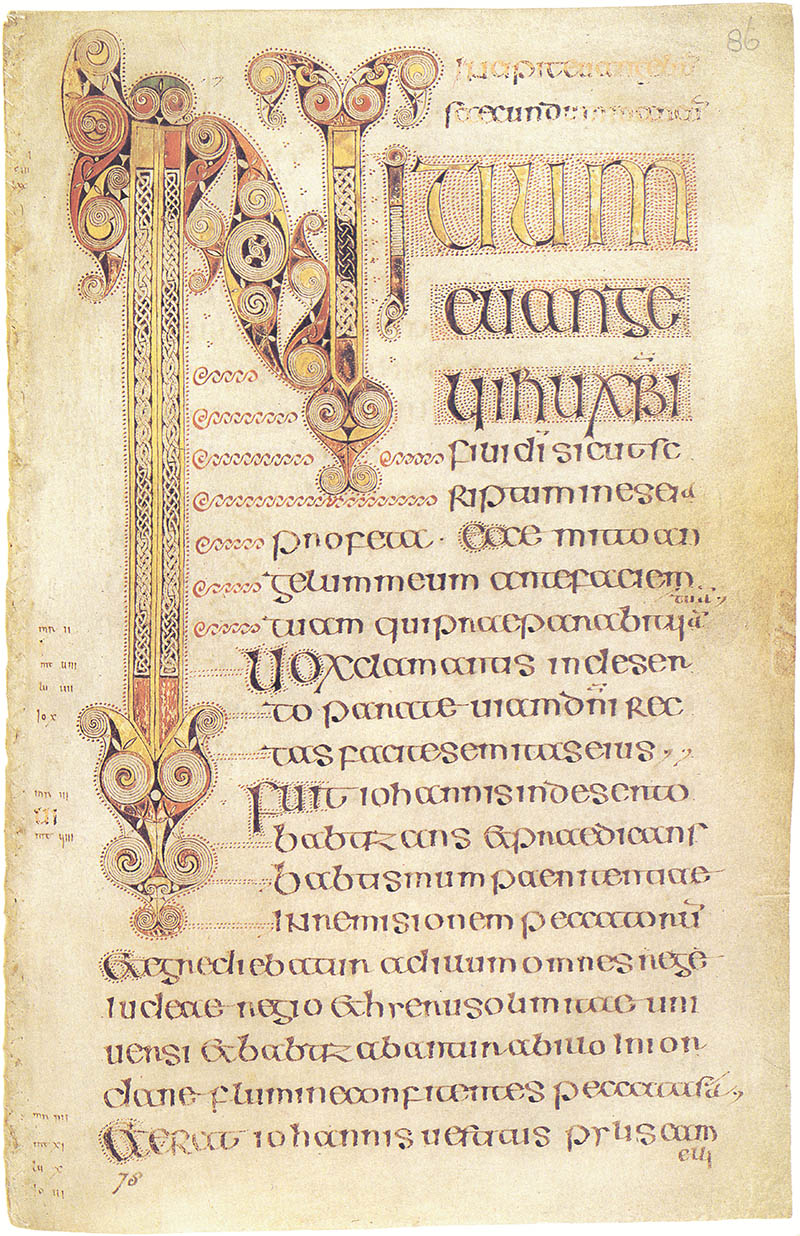
    Codex Zacynthius: Luke 3:7-8 with commentary in the lower writing, beneath a later lectionary text of Matthew 26. Cambridge University Library, via Wikimedia Commons
    Codex Zacynthius: Luke 3:7-8 with commentary in the lower writing, beneath a later lectionary text of Matthew 26. Cambridge University Library, via Wikimedia Commons · Public domain

    Codex Zacynthius is a palimpsest: a book whose first writing was washed off so that the parchment could be used again. The later, upper writing, of the 12th or 13th century, is a book of weekday Gospel readings. Beneath it lies the older text, portions of Luke 1:1-11:33 in Greek capitals, surrounded on three sides by a commentary of sayings from nine church fathers, among them Origen, Basil, Cyril of Alexandria and Chrysostom. It is the only known codex in which both the Bible text and its commentary are written in capitals. Its Gospel text is a mixed one. The date is debated: Tregelles thought it 8th-century; Hatch in 1937 argued for the 6th, which most scholars accept; Parker in 2004 proposed the 7th. In 1821 it was brought from the Greek island of Zakynthos to England by General Colin Macaulay, who gave it to the British and Foreign Bible Society, which kept it in its London library. Samuel P. Tregelles deciphered much of the hidden text and published it in 1861. The Society lent it to Cambridge University Library in 1985, and in 2014, when the Society chose to sell it, a public appeal raised £1.1 million and the Library bought it; multispectral imaging in 2018 made the lower writing fully readable. “Bring forth therefore fruits worthy of repentance” (Luke 3:8, KJV).

    Source en.wikipedia.org: Wikipedia, “Codex Zacynthius” (Ξ/040; palimpsest; upper text lectionary ℓ299, 12th/13th c.; lower text Luke 1:1-11:33 with a catena of nine fathers, all in uncials; Tregelles 8th c., Hatch 6th (majority), Parker 7th; Macaulay 1821 → BFBS; Tregelles ed. 1861; Cambridge loan 1985, purchase 2014 after £1.1m appeal; MSI 2018). Luke 3:8 KJV verified.

  4. Scripture & Canon

    Codex Beratinus: Matthew and Mark in silver on purple

    Codex Purpureus Beratinus: a purple leaf with Matthew 6:30-7:2 in silver capitals. National Archives of Albania, Tirana, via Wikimedia Commons
    Codex Purpureus Beratinus: a purple leaf with Matthew 6:30-7:2 in silver capitals. National Archives of Albania, Tirana, via Wikimedia Commons · Public domain

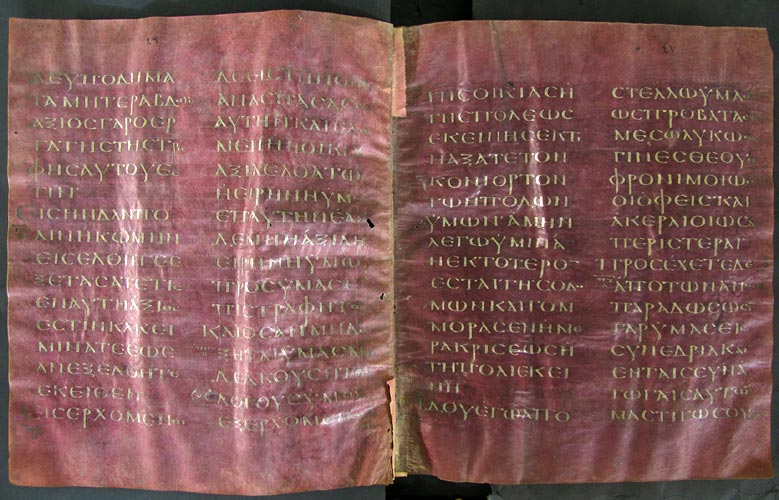
    Codex Purpureus Beratinus is a Gospel book of the 6th century, written in large, regular Greek capitals in silver ink on parchment dyed purple, with the title and first line of Mark in gold. It is one of the “purple uncials,” a small family of luxurious Gospel books from the same age. What survives are the Gospels of Matthew and Mark, with gaps, on 190 leaves about the size of those of Codex Alexandrinus. The text is marked with the ancient chapter numbers and chapter titles, and Old Testament quotations are flagged in the margin. Its text is generally of the Byzantine type, with a few readings shared with Codex Bezae and the Old Syriac. It takes its name from the town of Berat in Albania, where it was kept in the church of St George and where it is recorded from 1356. Pierre Batiffol published its text in 1887. Since 1971 it has been preserved in the National Archives of Albania in Tirana, and in 2005 it was inscribed on UNESCO’s Memory of the World Register. The page shown holds Matthew 6:30-7:2. “But seek ye first the kingdom of God, and his righteousness; and all these things shall be added unto you” (Matthew 6:33, KJV).

    Source en.wikipedia.org: Wikipedia, “Codex Beratinus” (Φ/043; 6th c.; silver on purple, gold for Mark’s title; purple uncial; Matthew and Mark with lacunae, 190 leaves, same size as Alexandrinus; kephalaia/titloi; OT quotations marked; generally Byzantine; St George, Berat, from 1356; Batiffol 1887; National Archives of Albania since 1971; UNESCO MoW 2005). Plate caption per Commons (Mt 6:30-7:2). Matt 6:33 KJV verified.

  5. Scripture & Canon

    The Vienna Genesis: Genesis in silver on purple

    Vienna Genesis, Rebecca and Eliezer at the well (Genesis 24). Austrian National Library, cod. theol. gr. 31, via Wikimedia Commons
    Vienna Genesis, Rebecca and Eliezer at the well (Genesis 24). Austrian National Library, cod. theol. gr. 31, via Wikimedia Commons · Public domain

    The Vienna Genesis (Austrian National Library, cod. theol. gr. 31), probably made in Syria in the first half of the 6th century, is one of the oldest well-preserved illustrated biblical books. Its text is the Book of Genesis in the Greek Septuagint, written in silver ink on calfskin dyed purple; twenty-four leaves survive of perhaps ninety-six, each with a painting at the foot of the page. It belongs with the Rossano and Sinope Gospels, already on this timeline. Honesty requires two notes: the text is often abbreviated, and some pictures include incidents and people not in Genesis, drawn from popular retellings or Jewish commentary. The plate shows Rebecca at the well with Abraham’s servant, from Genesis 24. “Blessed be the LORD God of my master Abraham, who hath not left destitute my master of his mercy and his truth” (Genesis 24:27, KJV).

    Source en.wikipedia.org: Wikipedia, “Vienna Genesis” (ÖNB cod. theol. gr. 31; probably Syria, first half 6th c.; LXX Genesis, abbreviated; 24 of c. 96 folios; silver on purple; non-biblical incidents from popular elaborations or Jewish commentaries; Rebecca and Eliezer at the well). Gen 24:27 KJV verified.

  6. Scripture & Canon

    Codex Laudianus: the Acts of the Apostles that Bede read

    Codex Laudianus: a facsimile of a page of Acts, Latin and Greek in parallel columns, from The S.S. Teacher’s Edition of the Holy Bible (1890s), via Wikimedia Commons
    Codex Laudianus: a facsimile of a page of Acts, Latin and Greek in parallel columns, from The S.S. Teacher’s Edition of the Holy Bible (1890s), via Wikimedia Commons · Public domain

    Codex Laudianus is a copy of the Acts of the Apostles in Latin and Greek, set side by side in two narrow columns on each page, Latin on the left, in very short lines of one to three words. Its 227 parchment leaves hold almost all of Acts. It was probably written in Sardinia after 534, and it must be older than 716, because the Venerable Bede used it in his revised commentary on Acts; it had come to England, perhaps with Theodore of Tarsus in 668 or with Abbot Ceolfrith of Wearmouth-Jarrow. English missionaries likely carried it to the Continent, where it was kept at Hornbach Abbey in the Rhineland. During the Thirty Years’ War it came to Archbishop William Laud, who gave it to the Bodleian Library in Oxford in 1636, where it still is. Its Greek text is mixed, most often agreeing with the Byzantine text. It is the earliest known manuscript to contain Acts 8:37, the Ethiopian’s confession of faith. “And Philip said, If thou believest with all thine heart, thou mayest. And he answered and said, I believe that Jesus Christ is the Son of God” (Acts 8:37, KJV).

    Source en.wikipedia.org: Wikipedia, “Codex Laudianus” (E-a/08; Latin-Greek diglot of Acts, 227 leaves, lacuna 26:29-28:26; Sardinia after 534; used by Bede before 716; Theodore 668 or Ceolfrith; Hornbach; Laud → Bodleian 1636, MS. Laud Gr. 35; mixed, usually Byzantine text; earliest known MS with Acts 8:37). Acts 8:37 KJV verified.

  7. Scripture & Canon

    Cassiodorus founds Vivarium and sets monks to copying the Scriptures

    Cassiodorus, an imagined portrait: hand-coloured woodcut, Nuremberg Chronicle, 1493, fol. 143v, via Wikimedia Commons
    Cassiodorus, an imagined portrait: hand-coloured woodcut, Nuremberg Chronicle, 1493, fol. 143v, via Wikimedia Commons · Public domain

    Cassiodorus (c. 485-c. 585), once a high official at the Ostrogothic court in Italy, turned in later life wholly to Christian learning. On his family estates on the shores of the Ionian Sea at Squillace he founded the monastery of Vivarium. For its monks he wrote the Institutiones (composed over the 530s-550s), a guide to study whose first part guided the reading of Scripture and Christian writings. Secular learning was meant chiefly to help in understanding Scripture, which he held far above every other writing. He had a complete Bible made in the Old Latin version, the Codex Grandior, and a complete Greek Bible as well. Through his example the copying of manuscripts, once left to the weak or unskilled, became a regular and valued monastic labour. His library was later scattered: the Codex Grandior was bought in Italy about 679-80 by Ceolfrith and carried to Wearmouth-Jarrow, where it served as a model for the Codex Amiatinus (see 692 · 716 on this timeline). “But his delight is in the law of the LORD; and in his law doth he meditate day and night” (Psalm 1:2, KJV).

    Source en.wikipedia.org: Wikipedia, “Cassiodorus” (c. 485-c. 585; Vivarium near Squillace; Institutiones 530s-550s, first book on Christian texts; secular arts as aids to Scripture; Codex Grandior (Vetus Latina pandect) + Greek pandect; copying made regular; Grandior bought by Ceolfrith 679-80, model for Codex Amiatinus). Political career omitted. Ps 1:2 KJV verified. No plate: the Amiatinus Ezra page is already used at 692.

  8. Scripture & Canon

    Codex Fuldensis: a Latin New Testament corrected by its bishop, kept at Fulda since 745

    Codex Fuldensis, a spread of the first Epistle to the Corinthians (printed page 297 at right; 1 Cor 15:3-4 in Latin). Fulda University and State Library (Codex Bonifatianus 1), via Wikimedia Commons
    Codex Fuldensis, a spread of the first Epistle to the Corinthians (printed page 297 at right; 1 Cor 15:3-4 in Latin). Fulda University and State Library (Codex Bonifatianus 1), via Wikimedia Commons · Public domain

    Between 541 and 546 a Latin New Testament was written at Capua, in southern Italy, for its bishop, Victor. It was corrected until 2 May 546 according to Wikipedia; another description gives May 547 for Victor’s own correction. Victor (died 554) reported that he had found an Old Latin harmony of the Gospels arranged after Tatian’s Diatessaron, and the codex gives the Gospel story in that single consecutive form in place of the four separate Gospels. It holds the rest of the New Testament in Jerome’s Latin, with his prologue. Honesty requires two notes: it also contains the Epistle to the Laodiceans, which is not among the 27 books of our canon, and its Gospels are a harmony, not the four books as the KJV gives them. Boniface acquired the codex and in 745 gave it to the monastery library at Fulda, in Germany, where it remains, as Codex Bonifatianus 1. The plate shows a spread from the first Epistle to the Corinthians; on the right-hand page the Latin reads of Christ who died for our sins and rose the third day, the words of 1 Corinthians 15:3-4: “how that Christ died for our sins according to the scriptures; And that he was buried, and that he rose again the third day according to the scriptures” (KJV).

    Source en.wikipedia.org: Wikipedia, “Codex Fuldensis” (made 541-546; corrected until 2 May 546; Victor of Capua; Boniface gave it to Fulda in 745). The May 547 correction and the one-column uncial hand are from historyofinformation.com/detail.php?id=4054. Dates differ between sources; both are given.

  9. Scripture & Canon

    The Rossano Gospels: Matthew and Mark in silver on purple

    The Rossano Gospels (Codex Purpureus Rossanensis), 6th century. Archiepiscopal Treasury, Rossano Cathedral, Calabria, via Wikimedia Commons
    The Rossano Gospels (Codex Purpureus Rossanensis), 6th century. Archiepiscopal Treasury, Rossano Cathedral, Calabria, via Wikimedia Commons · Public domain

    The Rossano Gospels (Codex Purpureus Rossanensis) is a 6th-century Greek Gospel book of 188 leaves of calfskin parchment dyed purple and written in silver ink. It holds the Gospel of Matthew and nearly all of Mark (a companion volume is thought to be lost), and it is among the oldest surviving illustrated manuscripts of the New Testament, perhaps the oldest, with fourteen painted scenes. Its lavish materials have led scholars to suggest it was made in an imperial workshop at Constantinople. Its text is Byzantine: Kurt Aland placed it in his Category V, for manuscripts with “a purely or predominantly Byzantine text”, the family from which the Received Text descends. Long kept at Rossano Cathedral in Calabria, it was brought to scholars’ attention in 1879 by Oskar von Gebhardt and Adolf Harnack, and in 2015 UNESCO entered it on its Memory of the World register. “The book of the generation of Jesus Christ, the son of David, the son of Abraham” (Matthew 1:1, KJV).

    Source en.wikipedia.org: Wikipedia, “Rossano Gospels” (042/Σ; 6th c.; purple parchment, silver ink; 188 folios; Matthew and most of Mark, companion volume lost; oldest or among oldest illuminated NT MSS, 14 illuminations; possibly imperial scriptorium, Constantinople; Byzantine text-type, Aland Category V; Rossano Cathedral; rediscovered 1879 by von Gebhardt and Harnack; UNESCO Memory of the World 2015). Matt 1:1 KJV verified.

  10. Scripture & Canon

    Codex Petropolitanus Purpureus: the Gospels in silver and gold on purple

    Codex Petropolitanus Purpureus, Gospel of Matthew 10:10-17, silver on purple parchment, 6th century, via Wikimedia Commons
    Codex Petropolitanus Purpureus, Gospel of Matthew 10:10-17, silver on purple parchment, 6th century, via Wikimedia Commons · Public domain

    Codex Petropolitanus Purpureus (N) is a 6th-century Greek book of the four Gospels, written in large uncial letters in silver ink on parchment dyed purple, with gold ink for the sacred names of Jesus, God, Lord, Son and Saviour. It is one of the group known as the Purple Uncials, alongside the Rossano Gospels, and is thought to have come from the imperial workshop at Constantinople. The book, which once had about 462 leaves, was later broken up and its leaves scattered; in 1896 the greater part of it was bought for the Imperial Public Library in St Petersburg, and other leaves are kept elsewhere. Its text is counted a representative of the Byzantine text, the family from which the Received Text descends, with a number of earlier readings; Kurt Aland placed it in his Category V. Honesty requires a note: the copyist often confused like-sounding letters, and the surviving book has many gaps. “But these are written, that ye might believe that Jesus is the Christ, the Son of God; and that believing ye might have life through his name” (John 20:31, KJV).

    Source en.wikipedia.org: Wikipedia, “Codex Petropolitanus Purpureus” (N/022; 6th c. by palaeography; silver ink on purple vellum, gold nomina sacra; Purple Uncials with Rossano, Sinope, Beratinus; imperial scriptorium of Constantinople; c. 462 leaves originally, 231 in St Petersburg; bought 1896 for the Imperial Public Library; Byzantine with pre-Byzantine readings, Aland Category V; iotacisms; many gaps). John 20:31 KJV verified.

  11. Scripture & Canon

    The Sinope Gospels: Matthew in gold on purple

    Sinope Gospels, fol. 11r, Matthew in gold on purple parchment, with the miniature of the five thousand fed, 6th century. Bibliothèque nationale de France, Suppl. grec 1286 (Gallica), via Wikimedia Commons
    Sinope Gospels, fol. 11r, Matthew in gold on purple parchment, with the miniature of the five thousand fed, 6th century. Bibliothèque nationale de France, Suppl. grec 1286 (Gallica), via Wikimedia Commons · Public domain

    The Sinope Gospels (Codex Sinopensis, O) are 44 surviving leaves of a 6th-century Greek book of the Gospels, written in very large uncial letters in silver and gold on parchment dyed purple, and illustrated with five small paintings at the foot of the page, among them the feeding of the five thousand and the feeding of the four thousand. The leaves that survive are all from the Gospel of Matthew. The style of the paintings points to Syria or Palestine. The leaves were bought at Sinope on the Black Sea in 1899 and published in 1901, and 43 of them are now in the Bibliothèque nationale de France in Paris. Scholars have classed its text differently: B. H. Streeter and Bruce Metzger counted it a witness of the “Caesarean” text, while Kurt Aland placed it in his Category V, the Byzantine text, the family from which the Received Text descends. Recent study found real gold and ultramarine in its colours. “And they did all eat, and were filled: and they took up of the fragments that remained twelve baskets full” (Matthew 14:20, KJV).

    Source en.wikipedia.org: Wikipedia, “Sinope Gospels” (O/023; 6th c.; 44 folios, Matthew only; purple vellum, silver and gold writing, very large uncials; five miniatures incl. five thousand fed (f. 11r); Syria or Palestine by style; bought at Sinope 1899, published by Omont 1901; 43 leaves BnF Suppl. Grec 1286; Streeter/Metzger Caesarean, Aland Category V; ultramarine, gold). Matt 14:20 KJV verified.

  12. Scripture & Canon

    Codex Brixianus: a Latin Gospel book in silver and gold, beside the Gothic Bible

    Codex Brixianus, a purple leaf written in silver. Biblioteca Civica Queriniana, Brescia, via Wikimedia Commons
    Codex Brixianus, a purple leaf written in silver. Biblioteca Civica Queriniana, Brescia, via Wikimedia Commons · Public domain

    Codex Brixianus, kept in the Queriniana Library at Brescia, is a 6th-century Latin book of the four Gospels, probably made at Ravenna. It is written in silver and gold ink on 419 purple-dyed leaves, with the Eusebian section numbers in the margin and an arcade painted at the foot of each page, much like the Gothic Codex Argenteus of Ulfilas’s Bible. Its text is Jerome’s Vulgate with many Old Latin readings, and some readings seem to follow the Gothic translation. The Gospels stand in the old “Western” order: Matthew, John, Luke, Mark. A preface discusses the difficulty of translating between Greek, Latin and Gothic, and appears to criticise Jerome’s rendering. Here, in one book, the Word is seen crossing three languages at once. “The entrance of thy words giveth light; it giveth understanding unto the simple” (Psalm 119:130, KJV).

    Source en.wikipedia.org: Wikipedia, “Codex Brixianus” (VL 10, siglum f; 6th c.; probably Ravenna; Biblioteca Queriniana, Brescia; 419 purple folios, silver and gold ink; Western order; Vulgate with Old Latin readings, Gothic influence; preface on translation, critical of Jerome; arcades like Codex Argenteus). Ps 119:130 KJV verified.

  13. Scripture & Canon

    The Rabbula Gospels: the Syriac Peshitta Gospels, signed by their scribe in 586

    Rabbula Gospels, fol. 13v: the Ascension. Biblioteca Medicea Laurenziana, Florence (Plut. I.56), via Wikimedia Commons
    Rabbula Gospels, fol. 13v: the Ascension. Biblioteca Medicea Laurenziana, Florence (Plut. I.56), via Wikimedia Commons · Public domain

    In 586 a scribe named Rabbula finished copying the four Gospels in Syriac at the monastery of St John of Zagba, now thought to have stood between Antioch and Apamea in Syria. The text is the Peshitta, the Syriac version already on this timeline. The book opens with the Eusebian canon tables (also on this timeline), set in arcades of flowers and birds, and it carries some of the earliest large Christian miniatures to survive, among them the Crucifixion, the Ascension and Pentecost; its Crucifixion is the earliest known in an illuminated manuscript. It passed through Lebanon in the Middle Ages and reached the Laurentian Library in Florence around 1500, where it remains. Honesty: recent scholarship proposes that the miniatures came from at least one other manuscript and were bound with the 586 text only in the 15th century, and that some were later overpainted. “This same Jesus, which is taken up from you into heaven, shall so come in like manner as ye have seen him go into heaven” (Acts 1:11, KJV).

    Source en.wikipedia.org: Wikipedia, “Rabbula Gospels” (Florence, Laurenziana Plut. I.56; completed 586 at St John of Zagba, prob. between Antioch and Apamea; scribe Rabbula; Peshitta text; canon tables; earliest surviving MS Crucifixion; Ascension, Pentecost; Byblos 11th c., Qannubin, Florence late 15th/early 16th c.; miniatures possibly from another MS, bound 15th c., overpainted). Acts 1:11 KJV verified.

  14. Scripture & Canon

    The St Augustine Gospels: the Gospel book of the mission to the English

    St Augustine Gospels, fol. 129v, portrait of St Luke. Corpus Christi College, Cambridge, MS 286
    St Augustine Gospels, fol. 129v, portrait of St Luke. Corpus Christi College, Cambridge, MS 286. Photo: Gennadii Saus i Segura, via Wikimedia Commons · CC BY-SA 4.0

    This Latin Gospel book, copied in Italy in the 6th century in Jerome’s Vulgate text, is by tradition one of the books brought to England by Augustine of Canterbury’s mission in 597, or sent after him by Gregory the Great in 601. Honesty: that link is tradition, not proof, though scholars such as Kurt Weitzmann see “no reason to doubt” it; it was certainly in England by about 700, when corrections were added in an English hand. It is the oldest surviving illustrated Latin Gospel book and one of the oldest books in Europe. For much of the Middle Ages it lay on the altar of St Augustine’s Abbey, Canterbury; since 1575 it has been kept in the Parker Library of Corpus Christi College, Cambridge, and it is still carried to Canterbury Cathedral for the enthronement of each new archbishop. The plate shows its portrait of St Luke, framed by small scenes from his Gospel. “How beautiful are the feet of them that preach the gospel of peace, and bring glad tidings of good things!” (Romans 10:15, KJV).

    Source en.wikipedia.org: Wikipedia, “St Augustine Gospels” (Cambridge, Corpus Christi College MS 286; 6th-c. Italian uncial, Vulgate; 597/601 tradition, Weitzmann quoted; insular corrections c. 700; oldest surviving illustrated Latin Gospel book; on the altar at St Augustine’s Abbey; Parker Library since 1575; archbishops’ enthronements). Plate: fol. 129v, St Luke. Rom 10:15 KJV verified.

  15. Scripture & Canon

    The Ashburnham Pentateuch: the Books of Moses in Latin, painted scene by scene

    Ashburnham Pentateuch, fol. 76r: Moses receives the Law on Sinai. Bibliothèque nationale de France, via Wikimedia Commons
    Ashburnham Pentateuch, fol. 76r: Moses receives the Law on Sinai. Bibliothèque nationale de France, via Wikimedia Commons · Public domain

    The Ashburnham Pentateuch is a Latin manuscript of the first books of the Old Testament, made in the late sixth or early seventh century. It once held all five books of Moses; Deuteronomy and parts of the others are now lost. Its 142 surviving leaves carry 19 miniatures, out of perhaps 68 full-page pictures at first, some showing one scene (Noah’s ark) and others a whole story in bands of colour (Cain and Abel). A frontispiece lists the Latin names of the books beside Latin spellings of their Hebrew names. Its pictures later served as the model for wall paintings in the church of St Julian at Tours. Honesty: no one knows where it was made; scholars have proposed Spain, North Africa, Syria or Italy. It was stolen from the library at Tours in 1842, sold to the Earl of Ashburnham, and returned to France in 1888; it is now in the Bibliothèque nationale de France. “Two tables of testimony, tables of stone, written with the finger of God” (Exodus 31:18, KJV).

    Source en.wikipedia.org: Wikipedia, “Ashburnham Pentateuch” (BnF nouv. acq. lat. 2334; late 6th/early 7th c.; Deuteronomy lost; 142 ff., 19 miniatures of perhaps 68; Noah f. 9r, Cain and Abel; frontispiece of Latin/Hebrew book names; origin Spain, N. Africa, Syria or Italy; St Julian, Tours; stolen 1842 by Libri, Ashburnham 1847, BnF 1888). Exod 31:18 KJV verified.

  16. Scripture & Canon

    The Springmount tablets: the Psalms learned on wax in Ireland

    In 1914 a man cutting peat in the Springmount bog, near Clough in County Antrim, found about four feet down a little book of six yew-wood tablets, bound along one edge with a leather thong. Their inner faces had been hollowed and filled with wax, making a book of ten writing pages, and on the wax someone had written with a stylus parts of Psalms 30 to 32 in Latin (31 to 33 in the numbering of the English Bible), in Jerome’s Gallican version and in the Irish majuscule script. They are considered the earliest surviving example of Irish writing in the Latin alphabet. They were dated from the handwriting to the late 7th century; in 1963 David H. Wright suggested about 600, which has been generally accepted. They probably came from a nearby monastery, and were most likely used to teach reading and to learn the Psalms by heart. They are in the National Museum of Ireland in Dublin. “Blessed is he whose transgression is forgiven, whose sin is covered” (Psalm 32:1, KJV).

    Source en.wikipedia.org: Wikipedia, “Springmount Bog Tablets” (found 1914 near Clough, Co. Antrim, about four feet down; six yew tablets, leather thong, ten wax pages; Vulgate Pss 30-32 (31-33 modern), Gallican version, Irish majuscule; earliest Irish writing in Latin script; late 7th c. palaeographically, Wright 1963 c. 600 generally accepted; teaching/memorising; NMI S.A. 1914.2). No plate (none on Commons). Ps 32:1 KJV verified.

  17. Scripture & Canon

    Codex Usserianus Primus: perhaps the oldest surviving Irish book

    Codex Usserianus Primus, fol. 149v: the end of Luke and the opening of Mark, with a dotted cross between alpha and omega. Trinity College Dublin MS 55, via Wikimedia Commons
    Codex Usserianus Primus, fol. 149v: the end of Luke and the opening of Mark, with a dotted cross between alpha and omega. Trinity College Dublin MS 55, via Wikimedia Commons · Public domain

    Trinity College Dublin MS 55 is a Gospel book in the Old Latin version, the Latin read in the West before Jerome’s Vulgate. Dated from its handwriting to the 6th or 7th century, most likely the early 7th, it is now thought to have been written in Ireland, and so may be the earliest surviving Irish codex. It keeps the Gospels in the old Western order: Matthew, John, Luke, Mark. About 180 vellum leaves survive, damaged and discoloured and now remounted on paper, and some passages are lost. Its one remaining ornament stands at the end of Luke (fol. 149v): a cross drawn in black dots between the Greek letters alpha and omega, set between the closing words of Luke and the opening words of Mark, within a frame of dots. That dotting around letters would become a mark of the later Insular Gospel books. Its name, “the first book of Ussher”, honours Archbishop James Ussher, though it is doubtful he ever owned it; T. K. Abbott collated its text in 1884. It can be read online through Trinity College’s digital collections. “I am Alpha and Omega, the beginning and the ending, saith the Lord, which is, and which was, and which is to come, the Almighty” (Revelation 1:8, KJV).

    Source en.wikipedia.org: Wikipedia, “Codex Usserianus Primus” (TCD MS 55; Old Latin Gospels, siglum r; 6th/7th c., early 7th; probably Irish, possibly earliest Irish codex; Western order Mt-Jn-Lk-Mk; c. 180 folios remounted; cross between alpha and omega at end of Luke, fol. 149v; dotting motif; Ussher name doubtful; Abbott 1884; TCD Digital Collections). Rev 1:8 KJV verified.

  18. Scripture & Canon

    Thomas of Harqel completes the Harklean Syriac New Testament

    Thomas of Harqel was educated in Greek at the monastery of Qenneshre and became bishop of Mabbug in Syria, but was deposed before 602. He went into exile at the Enaton, a Coptic monastery near Alexandria in Egypt. There, at the request of the patriarch Athanasios I, he worked on a Syriac translation of the Greek Bible. His New Testament, known as the Harklean version or Harclensis, was completed in 616. It revised the earlier Philoxenian version of 508 and was in part a new and very literal translation from the Greek, and scholars note its close affinity with the Byzantine text. According to the account followed here, it was at this time that 2 Peter, 2 John, 3 John, Jude and Revelation were added to the Syriac Bible, having been left out of it until then. So the Syriac-speaking churches, who read the Scriptures in a form of Aramaic, received all twenty-seven books of the New Testament.

    Source en.wikipedia.org: Wikipedia, “Harklean version” (616, Enaton, Byzantine affinities, partly based on the Philoxenian); “Thomas of Harqel” (Qenneshre, Mabbug, exile, Athanasios I, the five books added); “Philoxenian version” (508). No plate: no licensed image of a Harklean manuscript was found on Commons.

  19. Scripture & Canon

    The Syro-Hexapla: Origen’s Greek Old Testament in Syriac

    The Syro-Hexapla: a page of the Codex Syro-Hexaplaris Ambrosianus (Milan, C. 313 Inf.) in A. M. Ceriani’s photolithographic facsimile, Milan 1874
    The Syro-Hexapla: a page of the Codex Syro-Hexaplaris Ambrosianus (Milan, C. 313 Inf.) in A. M. Ceriani’s photolithographic facsimile, Milan 1874. Via Wikimedia Commons · Public domain

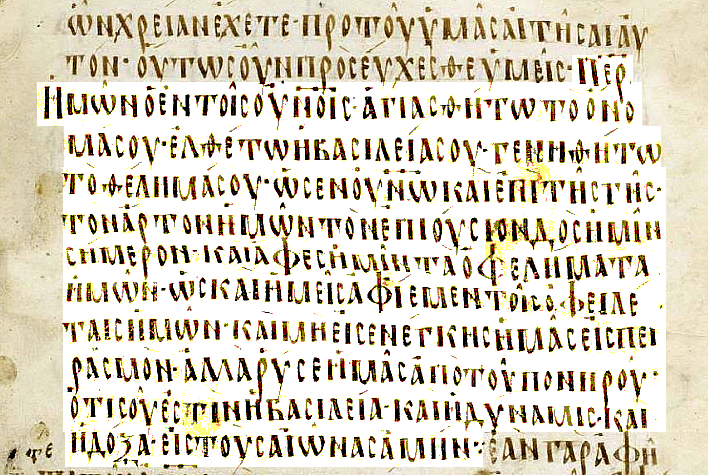
    Around 617, at the monastery of the Enaton in Egypt, Bishop Paul of Tella translated into Syriac the Greek Old Testament as it stood in the fifth column of Origen’s Hexapla, the six-column edition compiled before 240. Origen had used signs to mark where the Greek differed from the Hebrew, and Henry Swete believed the Syriac often keeps them. Because many later Greek copies dropped those signs, the Syro-Hexapla is one of the main ways scholars can still trace Origen’s work. It is distinct from the Peshitta, the older Syriac Old Testament translated directly from the Hebrew. It was used most in the West Syrian church: Jacob of Edessa drew on it when revising the Peshitta, and the East Syriac scholar Ishodad of Merv used it in his commentaries. Its chief manuscript is in the Ambrosian Library, Milan (C. 313 Inf.), which Antonio Ceriani published in photolithographic facsimile in 1874. “The words of the LORD are pure words: as silver tried in a furnace of earth, purified seven times” (Psalm 12:6, KJV).

    Source en.wikipedia.org: Wikipedia, “Syro-Hexaplar version” (Paul of Tella, monastery of the Enaton, Egypt, c. 617; fifth column of the Hexapla; Swete on Origen’s signs; distinct from the Peshitta; West Syrian use; Jacob of Edessa; Ishodad of Merv; Codex Ambrosianus C. 313 Inf.). Facsimile: A. M. Ceriani, Monumenta sacra et profana VII, Milan 1874 (Commons file record). Ps 12:6 KJV verified.

  20. Scripture & Canon

    Alopen brings the Scriptures to China

    The head of the Xi’an Stele (781), with the cross and its title, “Memorial of the propagation in China of the luminous religion from Daqin”: drawing published by Henri Havret, 1895
    The head of the Xi’an Stele (781), with the cross and its title, “Memorial of the propagation in China of the luminous religion from Daqin”: drawing published by Henri Havret, 1895. Via Wikimedia Commons · Public domain

    In 635 a missionary of the Church of the East (long called “Nestorian”) named Alopen, probably a Syriac speaker, reached Chang’an, the capital of Tang China, most likely by the Silk Road. He is the first recorded Christian missionary to have reached China. According to a stone monument set up in 781, he brought sacred books and images; the Emperor Taizong received him, had the writings translated in the imperial library, found their teaching acceptable and allowed it to be spread, and in 638 issued a decree protecting the church and built its first church in China. That monument, the Xi’an Stele, is a limestone block 279 centimetres high, inscribed in Chinese and Syriac and composed by the monk Adam (Jingjing), and it records some 150 years of Christian communities in China. It was probably buried during the persecution of 845, was found again between 1621 and 1625, and now stands in the Forest of Steles at Xi’an. “Go ye into all the world, and preach the gospel to every creature” (Mark 16:15, KJV).

    Source en.wikipedia.org: Wikipedia, “Alopen” (Church of the East; probably Syriac-speaking; Chang’an 635; sacred books and images; translation in the Imperial Library; 638 decree, first church) and “Xi’an Stele” (781; limestone, 279 cm; Chinese and Syriac; composed by Adam/Jingjing; 150 years; buried 845; rediscovered 1621-25; Stele Forest). Mark 16:15 KJV verified.

  21. The English Bible

    Cædmon sings the Scriptures in English

    Cædmon’s Hymn in the Moore Bede, 8th century. Cambridge University Library, MS Kk.5.16, fol. 128r, via Wikimedia Commons
    Cædmon’s Hymn in the Moore Bede, 8th century. Cambridge University Library, MS Kk.5.16, fol. 128r, via Wikimedia Commons · Public domain

    At the abbey of Streonæshalch, now Whitby, while Hilda was abbess (657-680), a lay brother named Cædmon looked after the animals. By Bede’s account he could not sing, and when the others sang at the feast he slipped away to sleep with the animals. One night, in a dream, he was bidden to sing of the beginning of created things, and he woke with a hymn of praise to God the Creator. The abbess had her scholars teach him the Scripture history. Bede wrote that “whatever was interpreted to him out of scripture, he soon after put the same into poetical expressions of much sweetness and humility in Old English.” He was not a translator in the strict sense; he retold the Bible in English verse for people who could not read Latin. His nine-line Hymn is among the oldest surviving poems in the English language. The plate shows it written in the margin of the Moore Bede, an eighth-century copy of Bede’s History.

    Source en.wikipedia.org: Wikipedia, “Cædmon” (Bede, Ecclesiastical History IV.24, the sole source; Hilda’s abbacy 657-680; the Bede quotation as translated there), and “Old English Bible translations” (not a translator per se).

  22. Scripture & Canon

    The Echternach Gospels: a Gospel book carried to the mission field

    Echternach Gospels, the Man, symbol of St Matthew. Bibliothèque nationale de France, MS lat. 9389, via Wikimedia Commons
    Echternach Gospels, the Man, symbol of St Matthew. Bibliothèque nationale de France, MS lat. 9389, via Wikimedia Commons · Public domain

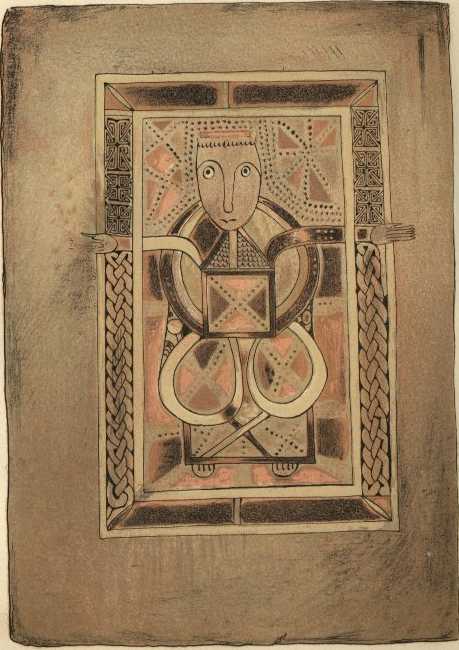
    The Echternach Gospels are a Latin Gospel book made, presumably at Lindisfarne in Northumbria, around the year 690; the scribe is believed to be the same master who wrote the Durham Gospels. Each Gospel is introduced by a page showing its evangelist’s symbol drawn in the flat, patterned Insular style, like the Man for Matthew shown here. The book was probably carried by Willibrord, a Northumbrian missionary, to the abbey he founded in 698 at Echternach, in present-day Luxembourg, and it takes its name from there. Books like it served both for reading in worship and for teaching those who were hearing the Gospel for the first time, and Echternach became the leading centre for Insular book-making on the Continent. The manuscript is now in the Bibliothèque nationale de France in Paris (MS lat. 9389). “How beautiful are the feet of them that preach the gospel of peace, and bring glad tidings of good things!” (Romans 10:15, KJV).

    Source en.wikipedia.org: Wikipedia, “Echternach Gospels” (Paris BnF MS lat. 9389; presumably Lindisfarne c. 690; same scribe as Durham Gospels; evangelist symbols in Hiberno-Saxon style; probably taken by Willibrord to Echternach, founded 698; teaching and liturgical use; Echternach the leading continental centre). Rom 10:15 KJV verified.

  23. Scripture & Canon

    The Codex Amiatinus: a whole Bible made at Jarrow

    Ezra the scribe, frontispiece of the Codex Amiatinus, fol. 5r, Monkwearmouth-Jarrow, c. 700. Biblioteca Medicea Laurenziana, Florence, via Wikimedia Commons
    Ezra the scribe, frontispiece of the Codex Amiatinus, fol. 5r, Monkwearmouth-Jarrow, c. 700. Biblioteca Medicea Laurenziana, Florence, via Wikimedia Commons · Public domain

    In 692 Ceolfrith, abbot of the twin monastery of Monkwearmouth-Jarrow in Northumbria, commissioned three great single-volume Bibles. The land to raise the two thousand cattle needed for their vellum was granted that year, and the young Bede was very likely involved in the work. One of the three survives whole. It stands 49 centimetres tall, weighs over 34 kilograms, and is the earliest complete one-volume Latin Bible to survive except for one palimpsest. It is considered the best-preserved manuscript of Jerome’s Vulgate and the most reliable witness to its text for the New Testament and most of the Old. In 716 Ceolfrith set out to carry it to Rome as a gift, but he died on the way, at Langres, on 29 September 716. The book reached Italy, lay for centuries at the abbey of Monte Amiata, and is now in the Laurentian Library at Florence. Its famous frontispiece shows Ezra the scribe at work before a cupboard of the sacred books.

    Source en.wikipedia.org: Wikipedia, “Codex Amiatinus” (commission 692; size; earliest complete one-volume Latin Bible save the León palimpsest; Ceolfrith’s death 29 Sept 716; Monte Amiata; Laurentian Library, Amiat. 1; de Rossi 1888 identification), and “Bede.”

  24. Scripture & Canon

    The Book of Durrow: the oldest complete illuminated Gospel book of Britain and Ireland

    Book of Durrow, opening of the Gospel of Mark, c. 700. Library of Trinity College Dublin, MS 57, via Wikimedia Commons
    Book of Durrow, opening of the Gospel of Mark, c. 700. Library of Trinity College Dublin, MS 57, via Wikimedia Commons · Public domain

    The Book of Durrow is a Latin book of the four Gospels, dated to about 700, written in Insular majuscule on 248 vellum leaves. Its text is Jerome’s Vulgate with some Irish variations, preceded by Jerome’s letter, prefaces, summaries, a glossary of names and the canon tables that let a reader find parallel passages across the Gospels. It is counted the oldest surviving complete illuminated Gospel book in the Insular style, more than a century older than the Book of Kells, with carpet pages and a full page for each Gospel’s symbol. Where it was made is debated: most scholars now think it was written in Ireland, at or near the abbey of Durrow in County Offaly, rather than in Northumbria, and records suggest it was at Durrow by 916. Badly worn and many times rebound, it is kept today in the Library of Trinity College Dublin (MS 57). “The beginning of the gospel of Jesus Christ, the Son of God” (Mark 1:1, KJV).

    Source en.wikipedia.org: Wikipedia, “Book of Durrow” (c. 700; Vulgate Gospels “with some Irish variations”; Insular majuscule; 248 folios; Jerome’s letter, prefaces, summaries, glossary, canon tables; oldest surviving complete illuminated Insular gospel book, predating Kells by over a century; origin debated, probably Ireland at/near Durrow; probably at Durrow by 916; TCD MS 57). Mark 1:1 KJV verified.

  25. Scripture & Canon

    The St Cuthbert Gospel: the oldest intact European book is the Gospel of John

    St Cuthbert Gospel, fol. 1, the opening of the Gospel of John, Northumbria, early 8th century. British Library, Add MS 89000, via Wikimedia Commons
    St Cuthbert Gospel, fol. 1, the opening of the Gospel of John, Northumbria, early 8th century. British Library, Add MS 89000, via Wikimedia Commons · Public domain

    The St Cuthbert Gospel is a pocket-sized copy of the Gospel of John in Latin, only 138 by 92 millimetres, written in a plain and elegant uncial hand on 94 vellum leaves and still in its original tooled red leather binding, the earliest Western bookbinding known to survive. The British Library calls it “the earliest surviving intact European book”. It was probably written at the twin monastery of Monkwearmouth-Jarrow and placed in the coffin of Cuthbert of Lindisfarne (died 687), where it was found when his remains were moved at Durham in 1104. It was long treasured as Cuthbert’s own Gospel, but it is now dated after his death, between about 700 and 730. After the Dissolution of the Monasteries it passed to collectors and came at last to Stonyhurst College; in 2012 the British Library bought it, and it is now Add MS 89000. “In the beginning was the Word, and the Word was with God, and the Word was God” (John 1:1, KJV).

    Source en.wikipedia.org: Wikipedia, “St Cuthbert Gospel” (early 8th-c. pocket Gospel of John in Latin; 138 × 92 mm; 94 vellum folios; earliest known surviving Western bookbinding; probably written at Monkwearmouth-Jarrow; placed in Cuthbert’s coffin; removed 1104 at Durham; once thought Cuthbert’s own; 2015 research dates it c. 700-730; Stonyhurst College; BL purchase 2012, Add MS 89000; BL quotation). John 1:1 KJV verified.

  26. Scripture & Canon

    Jacob of Edessa: faithful in the smallest marks of the text

    Jacob of Edessa (c. 640-708), a Syriac bishop and scholar, was trained in both Greek and Syriac at the monastery of Qenneshre. After resigning his see he spent eleven years at the monastery of Eusebona teaching Greek, instructing his students in the Psalms and training them to read the Scriptures in Greek. He then moved with seven students to the Great Convent of Tel ʿAde, where he spent nine years revising the Peshitta, the Syriac Old Testament, by comparing it with the Greek versions. William Wright later called the result “a curious eclectic or patchwork text”; five volumes of it survive in Europe, and it was the last attempt at an Old Testament revision in his church. He is counted the principal founder of the Syriac Massorah, the careful system for preserving the biblical text, and he gave Syriac writing five vowel signs adapted from Greek, still used in West Syriac today. In his Letter to George, bishop of Serugh, he insisted that copyists must be faithful even in the smallest details of spelling. Later interpreters called him “the Interpreter of the Scriptures.” He was recalled as bishop of Edessa in 708 and died four months later. “For verily I say unto you, Till heaven and earth pass, one jot or one tittle shall in no wise pass from the law, till all be fulfilled” (Matthew 5:18, KJV).

    Source en.wikipedia.org: Wikipedia, “Jacob of Edessa” (c. 640-708; Qenneshre; Eusebona 11 years; Tel ʿAde, nine years revising the Peshitta OT with the Greek; Wright’s phrase quoted; five volumes; last OT revision; Syriac Massorah; five vowel signs; Letter to George of Serugh; “Interpreter of the Scriptures”; recalled 708, died four months later). No plate (none of his own manuscripts on Commons). Matt 5:18 KJV verified.

  27. The English Bible

    The Lindisfarne Gospels, and the oldest English Gospels between their lines

    Lindisfarne Gospels, fol. 27r, the opening of Matthew, “Liber generationis,” early 8th century. British Library, Cotton MS Nero D.IV, via Wikimedia Commons
    Lindisfarne Gospels, fol. 27r, the opening of Matthew, “Liber generationis,” early 8th century. British Library, Cotton MS Nero D.IV, via Wikimedia Commons · Public domain

    On Holy Island, off the coast of Northumberland, a monk named Eadfrith, bishop of Lindisfarne from 698 until his death in 721, is believed to have written and painted a Latin book of the four Gospels in honour of God and of St Cuthbert. Current scholarship dates it about 715, though some argue it was made before 698. It is one of the finest books of the age and its text survives complete. When the community left the island about 875, they carried the book with them. At Chester-le-Street, between about 950 and 970, a priest named Aldred wrote an Old English translation word for word between the Latin lines, and a colophon naming the men who made the book. That gloss is the oldest surviving translation of the Gospels into the English language. The book is now in the British Library.

    Source en.wikipedia.org: Wikipedia, “Lindisfarne Gospels” (BL Cotton MS Nero D.IV; Eadfrith; c. 715 vs. pre-698; Aldred’s gloss and colophon; oldest extant English Gospels), and “Old English Bible translations” (gloss dated 950-970).

  28. Scripture & Canon

    The Lichfield (St Chad) Gospels: the Gospels, and the oldest written Welsh

    Portrait of St Luke (p. 218), St Chad Gospels, c. 730. Lichfield Cathedral; image: College of Arts & Sciences, University of Kentucky, via Wikimedia Commons
    Portrait of St Luke (p. 218), St Chad Gospels, c. 730. Lichfield Cathedral; image: College of Arts & Sciences, University of Kentucky, via Wikimedia Commons · CC BY-SA 3.0

    The Lichfield Gospels, also called the St Chad Gospels, are a Latin Gospel book of the 8th century, dated by the art historian Peter Lord to about 730 and by style to between 698 and 800. 236 pages survive, eight of them illuminated, including portraits of Mark and Luke and a cross-carpet page. In its margins are some of the earliest known examples of written Old Welsh: notes showing that in the 9th century the book belonged to the church of St Teilo in Wales. By the late 10th century it was at Lichfield, where it has remained ever since and is still kept in the cathedral. Where it was made is debated; scholars have argued for Ireland, Northumbria, Wales and Lichfield itself. More than eight centuries before the Welsh had the whole Bible in their own tongue, their earliest writing was set down beside the words of the Gospels. “That thou mightest know the certainty of those things, wherein thou hast been instructed” (Luke 1:4, KJV).

    Source en.wikipedia.org: Wikipedia, “Lichfield Gospels” (8th-c. Insular Gospel book; 236 pages, 8 illuminated; Old Welsh marginalia among the earliest known; Peter Lord dates c. 730, style 698-800; at St Teilo’s church in the 9th c.; at Lichfield by the late 10th c.; origin debated: Ireland, Northumbria, Wales, Lichfield). Luke 1:4 KJV verified.

  29. The English Bible

    Bede translates the Gospel of John as he dies

    The Venerable Bede, an imagined portrait, woodcut from the Nuremberg Chronicle, 1493, fol. CLVIIIv, via Wikimedia Commons
    The Venerable Bede, an imagined portrait, woodcut from the Nuremberg Chronicle, 1493, fol. CLVIIIv, via Wikimedia Commons · Public domain

    Bede (c. 672-735), the monk of Jarrow and father of English history, spent his last weeks of Lent and Easter in 735 teaching his pupils, singing the Psalms and giving thanks, though he was short of breath. His pupil Cuthbert wrote that in those days Bede translated the Gospel of St John into English “as far as the words: ‘But what are these among so many,’” that is, John 6:9, which in the King James Bible reads “but what are they among so many?” He did it “for the benefit of the Church.” On Ascension Day, 26 May 735 by the reckoning of his time, he was still dictating to a boy named Wilberht, and when the boy said the last sentence was written he answered, “It is well, you have said the truth. It is ended.” He died soon after on the floor of his cell, singing “Glory be to the Father, and to the Son, and to the Holy Ghost.” His English John is lost; we know of it only from Cuthbert’s letter. The plate is not a true likeness but a woodcut imagined for the Nuremberg Chronicle in 1493.

    Source en.wikisource.org: Cuthbert’s letter to Cuthwin on the death of Bede, tr. J. A. Giles (public domain), Wikisource; Wikipedia, “Bede” (dates; the boy Wilberht) and “Old English Bible translations” (translation lost). John 6:9 KJV verified on bible-api.com.

  30. Scripture & Canon

    The Codex Aureus of Canterbury: the Gospels written in gold

    Codex Aureus of Canterbury, fols. 9v-10r: St Matthew and the opening of Matthew 1:18, mid-8th century. National Library of Sweden, MS A. 135, via Wikimedia Commons
    Codex Aureus of Canterbury, fols. 9v-10r: St Matthew and the opening of Matthew 1:18, mid-8th century. National Library of Sweden, MS A. 135, via Wikimedia Commons · Public domain

    Made in southern England, probably at Canterbury, in the middle of the 8th century, this Latin Gospel book alternates purple-dyed leaves written in gold, silver and white with plain leaves written in black and red. Purple parchment had been reserved in the Roman world for the grandest books, and here it was spent on the words of Christ. It is the oldest surviving manuscript with initials decorated in gold leaf, and its art joins the knotwork of the British Isles to Italian painting. An inscription asks prayers for four men: the goldsmith Wulfhelm, and Ceolhard, Niclas and Ealhhun, probably the monks who made it. Now in the National Library of Sweden, Stockholm (MS A. 135), 193 of its leaves survive. The plate shows St Matthew facing the opening of Matthew 1:18. “More to be desired are they than gold, yea, than much fine gold: sweeter also than honey and the honeycomb” (Psalm 19:10, KJV).

    Source en.wikipedia.org: Wikipedia, “Stockholm Codex Aureus” (MS A. 135; mid-8th c., Southumbria/Canterbury; alternating purple and plain leaves; gold, silver, white; oldest gold-leaf initials; Insular + Italian; inscription naming Wulfhelm, Ceolhard, Niclas, Ealhhun; 193 folios). Plate: fols. 9v-10r. Ps 19:10 KJV verified.

  31. Scripture & Canon

    Codex Basilensis: the common Gospel text, waiting in Basel

    Codex Basilensis (E/07): a page with Mark 2:9-14, the healing of the man sick of the palsy. Basel University Library, via Wikimedia Commons
    Codex Basilensis (E/07): a page with Mark 2:9-14, the healing of the man sick of the palsy. Basel University Library, via Wikimedia Commons · Public domain

    Codex Basilensis, known to scholars as E (07), is a Greek Gospel book of 318 parchment leaves, written in one column of capital letters, with its initials picked out in green, blue and vermilion. Most scholars (Scrivener, Gregory, Nestle, Aland, Metzger) date it to the 8th century; Cataldi Palau has argued for the 9th, suggesting it was copied in Italy by a non-Greek, probably Latin, scribe. Its errors are remarkably few. Its text is the Byzantine text, the common text read in the Greek churches, and it is probably the oldest nearly complete manuscript of the Gospels with a purely Byzantine text. It was probably brought to Basel by Cardinal Ragusio, who may have obtained it in Constantinople, and in 1559 it passed to the University Library of Basel, where it remains. It was in the city when Erasmus prepared his first printed Greek New Testament there, though he did not consult it; later John Mill used it, and it has been cited in printed Greek New Testaments since the 18th century. “I say unto thee, Arise, and take up thy bed, and go thy way into thine house” (Mark 2:11, KJV).

    Source en.wikipedia.org: Wikipedia, “Codex Basilensis A. N. III. 12” (E/07; 318 leaves; decorated initials; 8th c. per Scrivener, Gregory, Nestle, Aland, Metzger; Cataldi Palau 9th c., Italy, few errors; Byzantine text, probably oldest with pure Byzantine text; Cardinal Ragusio; Basel University Library 1559; available to Erasmus but unused; used by Mill). Mark 2:11 KJV verified.

  32. Scripture & Canon

    The Book of Dimma: an Irish pocket Gospel book from the abbey of Roscrea

    Book of Dimma: the eagle, symbol of St John. Trinity College Dublin, via Wikimedia Commons
    Book of Dimma: the eagle, symbol of St John. Trinity College Dublin, via Wikimedia Commons · Public domain

    The Book of Dimma is an eighth-century Irish pocket Gospel Book from the abbey of Roscrea in County Tipperary, founded by St Crónán. Small enough to carry, it holds the four Gospels together with an order for anointing the sick and giving them communion. It is decorated with initials, three Evangelist portraits and a page bearing the eagle, the symbol of John. John’s Gospel was copied by a different scribe from the others, in a neat book hand, and a scribe signed himself Dimma MacNathi at the end of each Gospel. In the 12th century it was sealed in a metalwork book-shrine, which is still kept with it. After passing through several hands it came to Trinity College Dublin in 1836. Honesty: a well-known legend says Dimma copied it in a single day that lasted forty; that is legend, not history. The old identification of Dimma with a seventh-century bishop cannot be sustained. “And the Word was made flesh, and dwelt among us” (John 1:14, KJV).

    Source en.wikipedia.org: Wikipedia, “Book of Dimma” (TCD MS A.IV.23 [MS 59]; 8th-c. Irish pocket Gospel Book from Roscrea, founded by St Crónán; Gospels + order for Unction and Communion of the Sick; initials, three Evangelist portraits, eagle of John; John by a different scribe; signed Dimma MacNathi; bishop identification cannot be sustained; one-day/forty-days legend; 12th-c. cumdach; TCD 29 March 1836). John 1:14 KJV verified.

  33. Scripture & Canon

    The Lorsch Gospels: a golden Gospel book of Charlemagne’s age, now in three countries

    Codex Aureus of Lorsch, carved ivory cover (c. 810): Christ treading on the beasts, between archangels. Vatican (Bibliotheca Laureshamensis digital), via Wikimedia Commons
    Codex Aureus of Lorsch, carved ivory cover (c. 810): Christ treading on the beasts, between archangels. Vatican (Bibliotheca Laureshamensis digital), via Wikimedia Commons · Public domain

    The Codex Aureus of Lorsch is a Latin Gospel Book written in gold letters between about 778 and 820, during and just after Charlemagne’s reign. It was recorded in 830 in the library catalogue of Lorsch Abbey in Germany as a Gospel “written with gold” with ivory panels; in the 10th and 11th centuries Lorsch’s library was among the finest in the world. In the 16th century it was taken to Heidelberg; in 1622 it was split in two and its covers were removed. Today Matthew, Mark and the canon tables are in the Batthyaneum Library at Alba Iulia, Romania; Luke and John are in the Vatican Library; and the carved ivory covers are divided between the Vatican Museums and the Victoria and Albert Museum in London. One ivory cover shows Christ standing on the beasts, a picture of Psalm 91. “Thou shalt tread upon the lion and adder: the young lion and the dragon shalt thou trample under feet” (Psalm 91:13, KJV).

    Source en.wikipedia.org: Wikipedia, “Codex Aureus of Lorsch” (Latin Gospel Book 778-820; Lorsch catalogue 830 under Abbot Adelung “Evangelium scriptum cum auro…”; Heidelberg 16th c.; split and covers torn off 1622; Alba Iulia: Matthew, Mark, canon tables; Vatican: Luke, John; ivories: Vatican Museums and V&A; Christ treading on the beasts). Ps 91:13 KJV verified.

  34. Scripture & Canon

    The Godescalc Evangelistary: the Gospel readings in gold and silver on purple

    Godescalc Evangelistary, 781-783: Christ in Majesty holding the book. Bibliothèque nationale de France (Gallica), via Wikimedia Commons
    Godescalc Evangelistary, 781-783: Christ in Majesty holding the book. Bibliothèque nationale de France (Gallica), via Wikimedia Commons · Public domain

    The Frankish scribe Godescalc began this book on 7 October 781, at the order of Charlemagne and his wife Hildegard, and finished it on 30 April 783; he tells of the commission in a dedication poem at the end, which marks the king’s journey to Italy and the baptism of his son Pepin. It is the earliest known book from the scriptorium of Charlemagne’s Court School. It holds the Gospel passages appointed to be read through the church year, written in gold and silver ink on 127 pages of purple parchment, and it is the earliest example of the Carolingian style of illumination; the dedication poem is written in Caroline minuscule, the script from which our lower-case letters descend. Six pictures open the book: the four evangelists, Christ in Majesty holding a book, and the Fountain of Life, an old symbol of the Gospels as the fountain of eternal life. It was made in the years when Charlemagne’s scholars were correcting the Psalters and Gospel books of his realm. “For with thee is the fountain of life: in thy light shall we see light” (Psalm 36:9, KJV).

    Source en.wikipedia.org: Wikipedia, “Godescalc Evangelistary” (BnF nouv. acq. lat. 1203; commissioned by Charlemagne and Hildegard 7 Oct 781, completed 30 Apr 783; earliest from the Court School; dedication poem; gold and silver ink, 127 pp. purple parchment; Caroline minuscule; 4 evangelists, Christ in Majesty, Fountain of Life; correction of Psalters and Gospel books). Ps 36:9 KJV verified.

  35. Scripture & Canon

    The Book of Mulling: a pocket Gospel book in the high Irish hand

    Book of Mulling, fol. 193: St John. Trinity College Dublin, via Wikimedia Commons
    Book of Mulling, fol. 193: St John. Trinity College Dublin, via Wikimedia Commons · Public domain

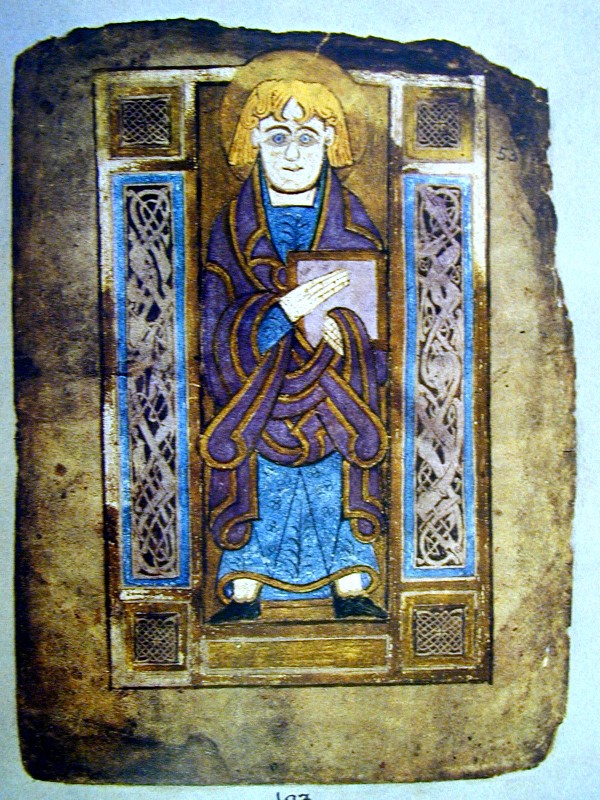
    The Book of Mulling is an Irish pocket Gospel Book of the late eighth or early ninth century, now in Trinity College Dublin. It holds the four Gospels, a short service that includes the Apostles’ Creed, and a colophon with a drawing thought to be a plan of St Moling’s monastery, set within two circles. Three portraits survive, of Matthew, Mark and John; John stands facing the reader with his hand over a book held to his heart. It is one of the last books written in the high style of Irish minuscule, and its jewelled shrine is also kept at Trinity. Honesty: a note at the end of John names the scribe as Mulling, and the book was long thought to be the work of St Moling, who died in 697, but its script is later and shows three scribes. It may still have been copied from a book St Moling wrote. “Thy word have I hid in mine heart, that I might not sin against thee” (Psalm 119:11, KJV).

    Source en.wikipedia.org: Wikipedia, “Book of Mulling” (TCD MS 60 (A. I. 15); Irish pocket Gospel Book, late 8th/early 9th c.; four Gospels, liturgical service with Apostles’ Creed; colophon with supposed monastery plan in two circles; “Nomen scriptoris Mulling dicitur”; St Moling d. 697; three scribes; possibly copied from Moling’s autograph; Irish minuscule; portraits of Matthew, Mark, John; cumdach at TCD). Ps 119:11 KJV verified.

  36. Scripture & Canon

    The Dagulf Psalter: the Psalms written wholly in gold for a gift to Rome

    Dagulf Psalter, ivory front cover (before 795): David directs the writing of the Psalms, then sings them. Musée du Louvre (MR 370); photo Jebulon, via Wikimedia Commons
    Dagulf Psalter, ivory front cover (before 795): David directs the writing of the Psalms, then sings them. Musée du Louvre (MR 370); photo Jebulon, via Wikimedia Commons · Public domain

    The scribe Dagulf wrote this Psalter in about 793-795 at Charlemagne’s court, as a gift from the king to Pope Adrian I; two dedicatory poems open the book, and in the second Dagulf names himself. Its 161 leaves carry the Psalms and a set of canticles, all in gold Caroline minuscule, twenty-three lines to a page, with ornamental initial pages but no portraits or pictures. Its ivory covers tell the story of the book itself: on the front, King David chooses men to write down the Psalms and then sings them among musicians; on the back, Jerome is asked to put the Psalms into Latin and dictates his translation to a scribe. Honesty: the gift was made during a dispute between king and pope over the Second Council of Nicaea, and because Adrian died in 795 it probably never reached Rome. The leaves are now in the Austrian National Library in Vienna and the ivories in the Louvre. “The Spirit of the LORD spake by me, and his word was in my tongue” (2 Samuel 23:2, KJV).

    Source en.wikipedia.org: Wikipedia, “Dagulf Psalter” (scribe Dagulf, 793-795, Charlemagne’s gift to Adrian I; 161 ff. in gold Carolingian minuscule; Psalms + canticles, 23 lines; no portraits; dedicatory poems; ivories: David and the Psalms, Jerome’s Latin translation; Nicaea II/Libri Carolini context; Adrian d. 795; Vienna ÖNB; ivories Louvre). 2 Sam 23:2 KJV verified.

  37. Scripture & Canon

    The Ada Gospels: the book that gives Charlemagne’s court school its name

    Ada Gospels: St Matthew. Stadtbibliothek Trier (Codex 22); The Yorck Project, via Wikimedia Commons
    Ada Gospels: St Matthew. Stadtbibliothek Trier (Codex 22); The Yorck Project, via Wikimedia Commons · Public domain

    The Ada Gospels is a Carolingian Gospel Book of the late eighth or early ninth century, written on vellum in the clear new Caroline minuscule and now kept in the city library of Trier in Germany. It takes its name from a dedication to Ada, named in it as Charlemagne’s sister. It has an ornate opening page for Matthew and portraits of Matthew, Mark and Luke, drawing on Insular, Italian and Byzantine models and showing a sure grasp of classical style. Modern scholars group about ten manuscripts from the same circle of scribes and painters as the “Ada School”, among them the Godescalc Evangelistary and the Lorsch Gospels already on this timeline, and the Harley Golden Gospels and the Soissons Gospels that follow. In 1499 the book was given a rich gold binding. “One jot or one tittle shall in no wise pass from the law, till all be fulfilled” (Matthew 5:18, KJV).

    Source en.wikipedia.org: Wikipedia, “Ada Gospels” (Trier, Stadtbibliothek, Codex 22; late 8th/early 9th c. Carolingian Gospel Book; dedication to Charlemagne’s sister Ada; vellum, Carolingian minuscule; 36.8 × 24.5 cm; “Ada School”, about ten MSS incl. Soissons, Harley Golden, Godescalc, Lorsch; Matthew initial page, portraits of Matthew, Mark, Luke; Insular, Italian, Byzantine influences; gold binding 1499). Matt 5:18 KJV verified.

  38. Scripture & Canon

    Alcuin of York corrects the Latin Bible at Tours

    The story of Adam and Eve (Genesis 2-3), Moutier-Grandval Bible, Tours, c. 830-840. British Library, Add MS 10546, fol. 5v, via Wikimedia Commons
    The story of Adam and Eve (Genesis 2-3), Moutier-Grandval Bible, Tours, c. 830-840. British Library, Add MS 10546, fol. 5v, via Wikimedia Commons · Public domain

    Alcuin of York, a scholar in the service of Charlemagne, was made abbot at Tours in 796. By his time copies of Jerome’s Latin Vulgate had gathered many variant readings, and Alcuin took up the work of correcting its text. Dedicatory poems show that four Bibles were prepared by him or under his direction at Tours, probably in 799-801. His aim, as the cited article puts it, was to recover Jerome’s original text as far as possible, and his changes were not far-reaching. One of the one-volume Bibles later made at Tours from his revised text, the Moutier-Grandval Bible of about 830-840, now in the British Library, is shown here. Alcuin’s monks at Tours also worked to perfect the clear Carolingian minuscule script, ancestor of modern Roman typefaces. “Every word of God is pure: he is a shield unto them that put their trust in him” (Proverbs 30:5, KJV).

    Source en.wikipedia.org: Wikipedia, “Alcuin” (abbot at Tours 796; textual criticism of the Vulgate with many variants; four Bibles by dedicatory poems, probably 799-801; aim to recover Jerome’s text, changes not far-reaching; Carolingian minuscule); “Moutier-Grandval Abbey” (Bible of c. 840, probably written at Tours, BL Add MS 10546). Prov 30:5 KJV verified.

  39. Scripture & Canon

    The Book of Kells: the four Gospels in Latin

    The Book of Kells, fol. 34r: the Chi Rho page, opening Matthew 1:18, c. 800. Trinity College Library, Dublin, MS A. I. 58, via Wikimedia Commons
    The Book of Kells, fol. 34r: the Chi Rho page, opening Matthew 1:18, c. 800. Trinity College Library, Dublin, MS A. I. 58, via Wikimedia Commons · Public domain

    The Book of Kells is a Latin book of the four Gospels, made about 800 by Columban monks. It was probably begun on Iona and finished at Kells in Ireland, though scholars still debate where it was made. Its Gospel text is largely the Vulgate, with passages from the older Latin versions. Its opening pages carry the canon tables of Eusebius. It is counted the summit of Insular book-painting, and its most lavish page, folio 34r, gives the whole leaf to the first word of Matthew 1:18, the Greek letters chi and rho that stand for “Christ”: “Now the birth of Jesus Christ was on this wise” (KJV). In 1007 the Annals of Ulster recorded that “the great Gospel of Columkille” had been stolen for its jewelled cover; it was found months later “under a sod,” without the cover. Since 1661 it has been kept at Trinity College, Dublin.

    Source en.wikipedia.org: Wikipedia, “Book of Kells” (c. 800; Columban origin, Iona/Kells debated; Vulgate text with Old Latin readings; Eusebian canon tables; fol. 34r Chi Rho at Matt 1:18; Annals of Ulster 1007 as quoted there; Trinity College Dublin since 1661). Matt 1:18 KJV verified.

  40. The English Bible

    The Macregol (Rushworth) Gospels: an Irish Gospel book given an English gloss by Farman and Owun

    Ornament from the Macregol Gospels (Bodleian MS Auct. D. 2. 19): an early 20th-century teaching slide, KU Leuven EuroPhot collection, via Wikimedia Commons
    Ornament from the Macregol Gospels (Bodleian MS Auct. D. 2. 19): an early 20th-century teaching slide, KU Leuven EuroPhot collection, via Wikimedia Commons · Public domain

    This Latin Gospel book was written and illuminated in Ireland, at Birr, by a scribe who signed himself Macregol, probably the abbot of Birr who died in 822; a second scribe copied part of it. At the end Macregol asks whoever reads the Gospel to pray for the scribe. By about 950-970 the book had come to England, where an Old English translation was written between its Latin lines. Farman, a priest at Harewood, glossed Matthew and part of John in the Mercian dialect; for the rest, Northumbrian glosses were carried over from the Lindisfarne Gospels. A second glossator, Owun, names himself beside Farman. Their closing note asks the reader to pray for Owun who glossed the book and for Farman the priest. John Rushworth owned it by 1665 and gave it to the Bodleian Library in Oxford, perhaps in 1681, where it remains as MS Auct. D. 2. 19. Honesty: like the other Old English glosses, it renders the Latin, not the Greek. “The entrance of thy words giveth light; it giveth understanding unto the simple” (Psalm 119:130, KJV).

    Source medieval.bodleian.ox.ac.uk: Bodleian, Medieval Manuscripts: MS. Auct. D. 2. 19 (Birr, before 822; scribes A “Macregol” and B; Macregol prob. abbot of Birr d. 822; OE gloss 10th c.; glossators Owun and Farman “preoste æt harawuda”; Rushworth 1665, to Bodleian perhaps 1681). Also Wikipedia, “Old English Bible translations” (c. 950-970; Farman: Matthew + some of John). Plate: KU Leuven lantern slide. Ps 119:130 KJV verified.

  41. Scripture & Canon

    Codex Campianus: a Gospel book in minute capitals, given to a king

    Codex Campianus (M/021), fol. 91r: the beginning of the Gospel of Mark. Bibliothèque nationale de France, Gr. 48, via Wikimedia Commons
    Codex Campianus (M/021), fol. 91r: the beginning of the Gospel of Mark. Bibliothèque nationale de France, Gr. 48, via Wikimedia Commons · Public domain

    Codex Campianus, known as M (021), holds the complete text of all four Gospels on 257 parchment leaves, in two columns of what Scrivener called a “very elegant and minute uncial” script, in brown ink, with accents and reading marks added in red. It was made for reading aloud in church: the beginnings and endings of the lessons are marked in the text, and a harmony of the Gospels runs along the foot of each page, pointing the reader to the same event in the other Gospels. Before each Gospel stands a small picture of its evangelist. Its early history is unknown. It takes its name from the Abbé François de Camps, who gave it to King Louis XIV of France (the year is given as 1706 or 1707), and it is now in the National Library of France in Paris (Gr. 48). Its text is Byzantine. Kuster used it in 1710 in his reprint of John Mill’s Greek New Testament, and 19th-century editors praised it (Tregelles found in it “many good readings”), though 20th-century critical editions came to set it aside. “The beginning of the gospel of Jesus Christ, the Son of God;” (Mark 1:1, KJV).

    Source en.wikipedia.org: Wikipedia, “Codex Campianus” (M/021; 9th c. per INTF; 257 leaves, 2 cols; Scrivener’s description quoted; lection marks; harmony at foot of pages; evangelist miniatures; Abbé de Camps to Louis XIV, 1706/1707; Kuster 1710 for Mill; Tregelles quoted; later neglect; BnF Gr. 48). Mark 1:1 KJV verified.

  42. Scripture & Canon

    Codex Mosquensis II: from Mount Athos to Moscow

    Codex Mosquensis II (V/031): a page with Matthew 1:10-18, the close of the genealogy of Christ. State Historical Museum, Moscow, via Wikimedia Commons
    Codex Mosquensis II (V/031): a page with Matthew 1:10-18, the close of the genealogy of Christ. State Historical Museum, Moscow, via Wikimedia Commons · Public domain

    Codex Mosquensis II, known as V (031), is a small Greek Gospel book of 220 parchment leaves, each about 16 by 11.5 centimetres, written in one column of small, fine capital letters. Before the Gospels it carries Eusebius’s Letter to Carpianus and his canon tables, the ancient system that let a reader find the same story in each Gospel, and the section numbers stand in its margins. The capital-letter hand runs as far as John 8:39; from there a 13th-century scribe completed the book in a smaller hand. Its text is Byzantine, akin to Codex Campianus. It was kept at the Vatopedi monastery on Mount Athos until 1655, when the monk Arsenius brought it to Moscow at the suggestion of Patriarch Nikon. Christian Frederick Matthaei collated it in 1779 and 1783 and judged its scribe diligent, and Scrivener counted it among the best manuscripts Matthaei collated. Some leaves have been lost since his day. It is now in the State Historical Museum in Moscow. “And she shall bring forth a son, and thou shalt call his name JESUS: for he shall save his people from their sins” (Matthew 1:21, KJV).

    Source en.wikipedia.org: Wikipedia, “Codex Mosquensis II” (V/031; 9th c.; 220 leaves, 15.7 × 11.5 cm; Epistle to Carpianus + Eusebian tables; uncial to John 8:39, 13th-c. minuscule after; Byzantine, resembles M; Vatopedi → Moscow 1655, Arsenius, Nikon; Matthaei 1779/1783; Scrivener; State Historical Museum V. 9). Matt 1:21 KJV verified.

  43. Scripture & Canon

    Codex Petropolitanus: a small Gospel book from Smyrna

    Codex Petropolitanus (Π/041), fols. 164v-165r: the beginning of the Gospel of Luke. National Library of Russia, Gr. 34, via Wikimedia Commons
    Codex Petropolitanus (Π/041), fols. 164v-165r: the beginning of the Gospel of Luke. National Library of Russia, Gr. 34, via Wikimedia Commons · Public domain

    Codex Petropolitanus, known as Π (041), is a Greek Gospel book of 350 parchment leaves, each only about 14.5 by 10.5 centimetres. It is written in one column of small capital letters with breathings and accents, and it has a table of chapters before each Gospel, with the section numbers and Eusebian canon references in the margins. It holds almost the whole of the four Gospels; a few gaps remain, and the last verses of Mark and of John were supplied by a later hand in the 12th century. Its text is Byzantine, and it gives its name to a family of related manuscripts that includes Codex Cyprius. The book belonged to the Parodi family in Smyrna until Constantin von Tischendorf brought it to St Petersburg in 1859; it is now in the National Library of Russia (Gr. 34). The page shown opens the Gospel of Luke, who wrote so that his reader might be sure of what he had been taught. “That thou mightest know the certainty of those things, wherein thou hast been instructed” (Luke 1:4, KJV).

    Source en.wikipedia.org: Wikipedia, “Codex Petropolitanus (New Testament)” (Π/041; 9th c.; 350 leaves, 14.5 × 10.5 cm; kephalaia, Ammonian sections, Eusebian canons; Mark 16:18-20 and John 21:22-25 supplied 12th c.; Byzantine, family Π with Codex Cyprius; Parodi family, Smyrna; Tischendorf 1859; NLR Gr. 34). Luke 1:4 KJV verified.

  44. Scripture & Canon

    Codex Boreelianus: a Gospel book carried home to Holland

    Codex Boreelianus (F/09): the beginning of the Gospel of Mark, with its decorated headpiece and initial. Utrecht University Library, Ms. 1, via Wikimedia Commons
    Codex Boreelianus (F/09): the beginning of the Gospel of Mark, with its decorated headpiece and initial. Utrecht University Library, Ms. 1, via Wikimedia Commons · Public domain

    Codex Boreelianus, known as F (09), is a Greek Gospel book written in the larger late capital-letter hand, two columns to the page, by what Jodocus Heringa called an “elegant and careful” hand. Its headings are written in gold and red, and here and there decorated initials in red or gold mark the text. It was divided for reading by the Ammonian sections, with a table of chapters before each Gospel and lesson marks in the margin. Its text is the Byzantine text, the common text of the Greek churches; Metzger called it a typical Byzantine text. It takes its name from Johannes Boreel (1577-1629), Dutch ambassador at the court of James I, who is believed to have brought it back from the East. Wettstein cited it from a partial collation in his Greek New Testament of 1751. For almost two centuries it passed through private hands and many leaves were lost, until the Utrecht professor Jodocus Heringa identified it in 1823. It has been in Utrecht University Library since 1830 (Ms. 1), was digitised in 2007, and is still cited in the Nestle-Aland Greek New Testament. The page shown opens the Gospel of Mark. “The voice of one crying in the wilderness, Prepare ye the way of the Lord, make his paths straight.” (Mark 1:3, KJV).

    Source en.wikipedia.org: Wikipedia, “Codex Boreelianus” (F/09; 204 leaves, 2 cols, 19 lines; late uncial, “elegant and careful” hand per Heringa; gold and red headings; Ammonian sections, kephalaia tables, lectionary marks; Byzantine, “typical” per Metzger; Aland Cat. V; Johannes Boreel 1577-1629, ambassador to James I; Wettstein 1751; Heringa identified 1823; Utrecht University Ms. 1 since 1830; digitised 2007; in Nestle-Aland; dated 8th (Deane), 9th (INTF), 10th (Tregelles)). Mark 1:3 KJV verified.

  45. Scripture & Canon

    Codex Seidelianus I: a Gospel book that reached Wolf, Wettstein and the Harleian library

    Codex Seidelianus I (G/011): an opening of the manuscript, two pages written in two columns. British Library, Harley MS 5684, via Wikimedia Commons
    Codex Seidelianus I (G/011): an opening of the manuscript, two pages written in two columns. British Library, Harley MS 5684, via Wikimedia Commons · Public domain

    Codex Seidelianus I, known as G (011) and also called Codex Wolfii A, is a Greek Gospel book of 252 parchment leaves, written two columns to the page in capital letters, dated by its handwriting to the 9th or 10th century. It is divided by the Ammonian sections with references to the Eusebian canons, and it carries the chapter titles at the head of the pages. In the genealogy of Luke 3 each new name is set on a line of its own. Its text is chiefly Byzantine, the common text of the Greek churches. The scholar Andreas Erasmus Seidel brought it from the East to Germany; after his death in 1718 it passed through the Berlin royal librarian Mathurin Veyssière de La Croze to Johann Christoph Wolf, who published extracts from it in 1723. Wettstein and Griesbach cited it under the letter G. It was cut apart in 1721 so that pieces could be sent to Richard Bentley; most of it was later bought for the library of Edward Harley and is now in the British Library (Harley MS 5684), with one leaf at Trinity College, Cambridge. Tregelles found further fragments in 1845 and collated it in 1847. “Which was the son of Enos, which was the son of Seth, which was the son of Adam, which was the son of God.” (Luke 3:38, KJV).

    Source en.wikipedia.org: Wikipedia, “Codex Seidelianus I” (G/011, Wolfii A; 9th/10th c.; 252 leaves, 2 cols, 21 lines; Ammonian sections + Eusebian canons, titloi; Luke 3 genealogy one name per line (Scrivener); secondary Byzantine, Aland Cat. V; Seidel († 1718) → La Croze → J. C. Wolf, extracts 1723; mutilated 1721 for Bentley; Wettstein and Griesbach siglum G; Tregelles 1845/1847; British Library Harley MS 5684, one leaf Trinity College Cambridge B. XVII. 20). Luke 3:38 KJV verified.

  46. Scripture & Canon

    Codex Macedoniensis: a small, carefully written Gospel book

    Codex Macedoniensis (Y/034): the subscription at the close of the Gospel of Luke. Cambridge University Library, Add. MS 6594, via Wikimedia Commons
    Codex Macedoniensis (Y/034): the subscription at the close of the Gospel of Luke. Cambridge University Library, Add. MS 6594, via Wikimedia Commons · Public domain

    Codex Macedoniensis, known as Y (034), is a small Greek Gospel book of 309 parchment leaves, each about 18 by 13 centimetres, written in one column of capital letters in black and brown ink, with accents, breathings and punctuation. Its first describer, the historian William C. Braithwaite, called it “very carefully written.” Chapter lists stand before Mark, Luke and John, ornamented headpieces open Mark, Luke and John, and the chapter titles, section numbers and the signs marking the beginning and end of each church reading are picked out in carmine. Its text is Byzantine, the common text of the Greek churches. Its early history is unknown. In 1901 the stockbroker Joseph Bevan Braithwaite acquired it from Macedonia and gave it to his brother William, who described it in the Expository Times and dated it to the 9th century, the date it still bears. Metzger judged that it “deserves to be studied more thoroughly than has hitherto been the case.” It is now in Cambridge University Library (Add. MS 6594), where it has been digitised. The page shown is the close of the Gospel of Luke. “And were continually in the temple, praising and blessing God. Amen.” (Luke 24:53, KJV).

    Source en.wikipedia.org: Wikipedia, “Codex Macedoniensis” (Y/034; 9th c.; 309 leaves, 18 × 13 cm, 1 col; black and brown ink; Braithwaite “very carefully written”; kephalaia lists, ornamented headpieces, carmine lection marks; Byzantine, Aland Cat. V; J. B. Braithwaite acquired from Macedonia 1901 → W. C. Braithwaite, Expository Times 13; Metzger quoted; Cambridge University Library Add. MS 6594; digitised at Cambridge Digital Library and CSNTM). Luke 24:53 KJV verified.

  47. Scripture & Canon

    Codex Athous Dionysiou: a Gospel book still kept on Mount Athos

    Codex Athous Dionysiou (Ω/045): a page with John 21:15-22. Dionysiou monastery, Mount Athos, Ms. 55, via Wikimedia Commons
    Codex Athous Dionysiou (Ω/045): a page with John 21:15-22. Dionysiou monastery, Mount Athos, Ms. 55, via Wikimedia Commons · Public domain

    Codex Athous Dionysiou, known as Ω (045), is a Greek Gospel book of 259 thick parchment leaves, each about 22 by 16 centimetres, written in two columns of large capital letters in brown ink, with the first lines in red. It holds almost the whole text of the four Gospels; only a few verses of Luke 1 are missing. It was fully furnished for use in the church: tables of chapters before each Gospel, the Ammonian sections and Eusebian canons, lesson marks in the margins, a calendar of readings for the year (the Synaxarion and Menologion), and at the end of each Gospel a subscription with its count of lines. Its text is Byzantine, the common text of the Greek churches, with some readings of other families. Hermann von Soden counted it among the three oldest manuscripts of the earliest form of the Byzantine text, and Kurt Aland placed it in his Category V. It was collated by Mary W. Winslow and published by Kirsopp Lake and Silva New in 1932. It is kept today in the library of the Dionysiou monastery on Mount Athos (Ms. 55). The page shown carries John 21:15-22, where the risen Lord gives Peter his charge. “So when they had dined, Jesus saith to Simon Peter, Simon, son of Jonas, lovest thou me more than these? He saith unto him, Yea, Lord; thou knowest that I love thee. He saith unto him, Feed my lambs.” (John 21:15, KJV).

    Source en.wikipedia.org: Wikipedia, “Codex Athous Dionysiou” (Ω/045; 9th c.; 259 thick leaves, 22 × 16 cm, 2 cols; brown ink, first lines red; lacuna Luke 1:15-28; kephalaia, sections, canons, lection marks, Synaxarion, Menologion, stichoi; Byzantine, some Alexandrian readings; von Soden: among 3 oldest early-Byzantine; Aland Cat. V; Winslow, ed. Lake and New 1932; Dionysiou (10) 55). Plate passage per Commons. John 21:15 KJV verified.

  48. Scripture & Canon

    The Book of Armagh: an Irish New Testament, with Patrick’s Confession

    Book of Armagh, fol. 32v: the symbols of the four evangelists (man, lion, calf, eagle), c. 807. Trinity College Dublin, MS 52, via Wikimedia Commons
    Book of Armagh, fol. 32v: the symbols of the four evangelists (man, lion, calf, eagle), c. 807. Trinity College Dublin, MS 52, via Wikimedia Commons · Public domain

    The Book of Armagh, now in the Library of Trinity College Dublin (MS 52), is one of the earliest manuscripts from the insular (Irish and British) churches to hold a near-complete copy of the New Testament. It was once reputed to be the work of St Patrick’s own hand; research has shown that its first part was written by the scribe Ferdomnach of Armagh in 807 or 808 for Torbach, abbot of Armagh, with two other scribes assisting. It is a small book, written in two columns of fine Irish minuscule. Its New Testament follows the Vulgate, but with many Old Latin readings in Acts and the letters of Paul. Beside it are early Lives of Patrick, an abbreviated form of Patrick’s own Confessio, and some of the oldest surviving continuous prose in Old Irish. On folio 32v the four living creatures are drawn as the symbols of the evangelists: a man, a lion, a calf and an eagle. Honesty: most of the prefaces to Paul’s letters in the book are by Pelagius. “And the first beast was like a lion, and the second beast like a calf, and the third beast had a face as a man, and the fourth beast was like a flying eagle” (Revelation 4:7, KJV).

    Source en.wikipedia.org: Wikipedia, “Book of Armagh” (TCD MS 52; near-complete NT; once thought Patrick’s hand; Ferdomnach 807/808 for Torbach; 2 cols insular minuscule; Vulgate with Vetus Latina readings in Acts and Paul; Lives by Muirchú and Tírechán; Confessio abbreviated; Old Irish prose; f. 32v evangelists’ symbols; Pauline prefaces mostly Pelagius). Rev 4:7 KJV verified.

  49. Scripture & Canon

    The Harley Golden Gospels: the four Gospels written in gold ink

    Harley Golden Gospels, fol. 161v: St John. British Library, Harley MS 2788, via Wikimedia Commons
    Harley Golden Gospels, fol. 161v: St John. British Library, Harley MS 2788, via Wikimedia Commons · CC0

    The Harley Golden Gospels is a Carolingian Gospel Book made in about 800-825, probably at Aachen, and one of the manuscripts of the Ada School. Like the other “golden books” of the age, its text is written in gold ink. It opens with canon tables, which let a reader find the parallel passages in the four Gospels, and it has full-page portraits of the four Evangelists, each paired with a decorated opening page. It is now in the British Library in London, where it is catalogued as Harley MS 2788. “More to be desired are they than gold, yea, than much fine gold: sweeter also than honey and the honeycomb” (Psalm 19:10, KJV).

    Source en.wikipedia.org: Wikipedia, “Harley Golden Gospels” (British Library, Harley MS 2788; Carolingian Gospel Book c. 800-825, probably Aachen; Ada School; four pairs of full-page Evangelist portraits and Incipit pages; canon tables; text in gold ink). Plate f. 161v (John), CC0. Ps 19:10 KJV verified.

  50. Scripture & Canon

    The Utrecht Psalter: a drawing for every psalm

    Utrecht Psalter, Psalm 150 (detail): men playing and blowing an organ, labelled “et organo.” Utrecht University Library, via Wikimedia Commons
    Utrecht Psalter, Psalm 150 (detail): men playing and blowing an organ, labelled “et organo.” Utrecht University Library, via Wikimedia Commons · Public domain

    The Utrecht Psalter, now in the university library at Utrecht, is a Latin Psalter of the 9th century and a masterpiece of Carolingian art. It is famous for its 166 lively pen drawings in brown ink, one for each psalm and for each of the other texts in the book, among them the canticles and the Athanasian Creed. It is written in old-fashioned rustic capitals, which once led scholars to date it to the 6th century. It was made near Reims and is usually dated between 816 and 835, because it may have been sponsored by Ebbo, Archbishop of Reims. One suggestion is that it served young monks learning the Psalms by heart together. By about the year 1000 it had reached Canterbury, where it was copied three times in the Middle Ages; the second copy is the Eadwine Psalter, already on this timeline. It stayed in England until about 1640, came to the Netherlands soon after, and has been in Utrecht University Library since 1716. The plate shows the drawing for the last psalm, labelled “et organo.” “Let every thing that hath breath praise the LORD. Praise ye the LORD” (Psalm 150:6, KJV).

    Source en.wikipedia.org: Wikipedia, “Utrecht Psalter” (Utrecht UB MS 32; 9th c.; 166 pen illustrations; canticles, Te Deum, Athanasian Creed; imitation rustic capitals, once dated 6th c.; near Reims, perhaps sponsored by Ebbo, so usually 816-835; Canterbury by c. 1000; copied 3 times incl. Eadwine Psalter; in England c. 1000-1640; Utrecht 1716). Ps 150:6 KJV verified.

  51. Scripture & Canon

    The Gospels of Saint-Médard de Soissons: the Fountain of Life in a court Gospel book

    Gospels of Saint-Médard de Soissons, fol. 6v: the Fountain of Life. Bibliothèque nationale de France (lat. 8850), via Wikimedia Commons
    Gospels of Saint-Médard de Soissons, fol. 6v: the Fountain of Life. Bibliothèque nationale de France (lat. 8850), via Wikimedia Commons · Public domain

    The Gospels of Saint-Médard de Soissons is a Gospel Book of the Ada School, made before 827, when Louis the Pious and his wife Judith gave it to the abbey of Saint-Médard at Soissons in France. It stayed there until the French Revolution and is now in the Bibliothèque nationale de France in Paris. It holds the Latin Vulgate text of the four Gospels, with the Eusebian canon tables (already on this timeline) across twelve decorated pages and other prefaces. Its 239 surviving leaves carry six full-page miniatures and four decorated pages. One of them shows the Fountain of Life, a picture modelled on the one in the Godescalc Evangelistary. “But the water that I shall give him shall be in him a well of water springing up into everlasting life” (John 4:14, KJV).

    Source en.wikipedia.org: Wikipedia, “Gospels of Saint-Médard de Soissons” (BnF MS lat. 8850; 9th c.; Court/Ada School; given before 827 by Louis the Pious and Judith to Saint-Médard; at Soissons until the Revolution; Vulgate Gospels, Eusebian canon tables, prefaces; 239 ff., 362 × 267 mm; 12 decorated canon-table pages, 6 full-page miniatures, 4 decorative pages; Fountain of Life after Godescalc). John 4:14 KJV verified.

  52. Scripture & Canon

    The Stuttgart Psalter: every psalm illustrated, page by page

    Stuttgart Psalter, fol. 2r: the opening of Psalm 1, “Beatus vir”. Württembergische Landesbibliothek, Cod. bibl. fol. 23, via Wikimedia Commons
    Stuttgart Psalter, fol. 2r: the opening of Psalm 1, “Beatus vir”. Württembergische Landesbibliothek, Cod. bibl. fol. 23, via Wikimedia Commons · Public domain

    The Stuttgart Psalter is one of the most important illustrated books of the Carolingian age. Bernhard Bischoff’s study of its handwriting in the 1960s placed it at the royal abbey of Saint-Germain-des-Prés in Paris around 820; who first owned it is not known. Written in Carolingian minuscule, it gives the Psalms in the Latin Gallican version, with 162 decorated initials and 316 small pictures set into the text, two or three to a psalm. Some pictures show the words of the psalm itself, some show the Old Testament history a psalm recalls, and some show a psalm as speaking of Christ. It was sold to Charles Eugene, Duke of Württemberg, in 1787, was recorded in the ducal library at Stuttgart by 1818, and is now in the Württemberg State Library, which has put every page online. The plate is the opening of Psalm 1, “Beatus vir”. “But his delight is in the law of the LORD; and in his law doth he meditate day and night” (Psalm 1:2, KJV).

    Source en.wikipedia.org: Wikipedia, “Stuttgart Psalter” (WLB Bibl. fol. 23; Bischoff: Saint-Germain-des-Prés c. 820; owner unknown; Carolingian minuscule; Gallican Psalter; 316 images, 162 initials; literal / historical / Christological pictures; 1787 sale to Charles Eugene; in Stuttgart by 1818; full scans at WLB). Ps 1:2 KJV verified.

  53. The English Bible

    The Vespasian Psalter: the oldest English rendering of any part of the Bible

    The Vespasian Psalter, fol. 30v: King David the psalmist with his musicians, 8th century. British Library, Cotton MS Vespasian A I, via Wikimedia Commons
    The Vespasian Psalter, fol. 30v: King David the psalmist with his musicians, 8th century. British Library, Cotton MS Vespasian A I, via Wikimedia Commons · Public domain

    The Vespasian Psalter is a Latin book of the Psalms, with hymns and canticles, made in southern England, probably at Canterbury, in the second quarter of the eighth century. Some time later a scribe wrote an Old English word-for-word translation between the lines of the Latin. The hand of that gloss is typical of Canterbury scriptoria of about 820 to 850. It is the oldest surviving English translation of any portion of the Bible. It is not yet a free-standing English Psalter, but it puts the words of the Psalms into the tongue of the English people more than five hundred years before the Wycliffite Bible. The manuscript passed through the hands of Archbishop Matthew Parker and Sir Robert Cotton and is now in the British Library. “For ever, O LORD, thy word is settled in heaven” (Psalm 119:89, KJV).

    Source en.wikipedia.org: Wikipedia, “Vespasian Psalter” (BL Cotton Vespasian A.i; southern England, 2nd quarter 8th c.; interlinear Old English gloss “the oldest extant English translation of any portion of the Bible”; gloss script typical of Canterbury c. 820-850; Parker and Cotton). Ps 119:89 KJV verified.

  54. Scripture & Canon

    The Old High German Tatian: the four Gospels as one story, in Latin and German side by side

    The Old High German Tatian, St. Gallen, Stiftsbibliothek, Cod. Sang. 56, p. 25: Luke 1:1 in Latin (left) and Old High German (right), via e-codices and Wikimedia Commons
    The Old High German Tatian, St. Gallen, Stiftsbibliothek, Cod. Sang. 56, p. 25: Luke 1:1 in Latin (left) and Old High German (right), via e-codices and Wikimedia Commons · Public domain

    Around 830, at the abbey of Fulda under the direction of Rabanus Maurus, scribes made a German translation of the Gospel harmony that goes back to Tatian’s Diatessaron of about AD 170, which weaves the four Gospels into one continuous account. They copied it from a Latin text of the harmony, and set Latin and Old High German in two columns, line matching line and word following word. It is one of the most important translations of the Carolingian age. Six scribes wrote it. Only one copy survives, at the Abbey Library of St Gall since the 10th century (Codex Sangallensis 56). It seems to have served two ends: to bring the faith in their own tongue to people who knew little or no Latin, and to help clergy in training come to the Gospels themselves. The plate shows the page where Luke’s preface begins, “Quoniam quidem multi”. “That thou mightest know the certainty of those things, wherein thou hast been instructed” (Luke 1:4, KJV).

    Source en.wikipedia.org: Wikipedia, “Old High German Tatian” (Fulda under Rabanus Maurus c. 830; Diatessaron c. 170; Latin/OHG in two columns, same line and word order; six scribes; sole MS Cod. Sang. 56 at St Gall since 10th c.; two purposes: faith in the vernacular and clergy training). Library record: e-codices csg-0056. Luke 1:4 KJV verified.

  55. Scripture & Canon

    The Heliand: the life of Christ, “the Saviour”, sung in Old Saxon verse

    The Heliand, Munich manuscript: Bayerische Staatsbibliothek, Cgm 25, fol. 5r, via Wikimedia Commons
    The Heliand, Munich manuscript: Bayerische Staatsbibliothek, Cgm 25, fol. 5r, via Wikimedia Commons · Public domain

    The Heliand, whose name means “Saviour”, is a poem of about 6,000 lines in Old Saxon that tells the life of Jesus in the alliterative verse of the Germanic peoples. It was written in the first half of the 9th century, probably around 830, for the Saxons, who had lately become Christian. The poet drew not straight on the four Gospels but on a Latin Gospel harmony of the Tatian kind, and he knew the commentaries of Bede, Alcuin and Rabanus Maurus. A Latin preface, printed by Matthias Flacius in 1562 and generally held to be genuine, says the emperor Louis the Pious wished his people to have the word of God in their own tongue and asked a Saxon poet to put the Scriptures into verse. It is the largest work to survive in Old Saxon. Two nearly complete copies survive, one in the British Library and one in Munich, where marks above the words suggest the poem was sung, and pieces of four more have been found, the latest at Leipzig in 2006. “The entrance of thy words giveth light; it giveth understanding unto the simple” (Psalm 119:130, KJV).

    Source en.wikipedia.org: Wikipedia, “Heliand” (Old Saxon, first half of 9th c., probably c. 830 at Louis the Pious’s request; c. 6,000 lines; based on the pseudo-Tatian harmony; knew Alcuin, Bede, Rabanus; Praefatio printed by Flacius 1562, generally authentic; Cotton and Munich MSS, neumes in Munich; four fragments, Leipzig 2006). The Saxon-wars and “warrior” readings are deliberately not used. Ps 119:130 KJV verified.

  56. Scripture & Canon

    The Uspenski Gospels: the oldest dated manuscript of the New Testament

    The Uspenski Gospels (Minuscule 461, AD 835): the opening of St Mark’s Gospel, Mark 1:1-6. National Library of Russia, via Wikimedia Commons
    The Uspenski Gospels (Minuscule 461, AD 835): the opening of St Mark’s Gospel, Mark 1:1-6. National Library of Russia, via Wikimedia Commons · Public domain

    Greek scribes of the early Middle Ages seldom wrote down when they finished a book, so most New Testament manuscripts are dated only by the style of their handwriting. The Uspenski Gospels are the exception that begins the list. At the end of the book the scribe, a monk named Nicholas, wrote in the same hand and ink that he had finished this holy book in the year 835, and asked all who read it to remember him, that he might find mercy in the day of judgment. The book holds all four Gospels on 344 small leaves, written in the compact minuscule (lower-case) hand; before it was known, scholars thought that hand was not yet in use in the 9th century. Its text is of the Byzantine type, in its oldest form, and it carries marginal notes for reading in church, such as the note that Mark 1:1-8 is read on the Sunday before the Feast of Lights (Epiphany). It was probably written in Constantinople and later belonged to the monastery of Mar Saba in Palestine; in 1844 Porphyrius Uspensky took it to Russia, and it is now in the National Library of Russia in St Petersburg. Because of its date it is cited in the Nestle-Aland Greek New Testament. “The voice of one crying in the wilderness, Prepare ye the way of the Lord, make his paths straight” (Mark 1:3, KJV).

    Source en.wikipedia.org: Wikipedia, “Uspenski Gospels” (Minuscule 461; colophon of 835 by the monk Nicholas; oldest known dated NT MS; 344 leaves; minuscule; Byzantine, family K1; Mark 1:1-8 lection note; Constantinople → Mar Saba → Uspensky 1844 → NLR Gr. 219; cited in NA). Mark 1:3 KJV verified.

  57. Scripture & Canon

    Codex Tischendorfianus IV: one Gospel book kept in two cities

    Codex Tischendorfianus IV (Γ/036): a page with Matthew 8:11-18. Bodleian Library, Oxford, via Wikimedia Commons
    Codex Tischendorfianus IV (Γ/036): a page with Matthew 8:11-18. Bodleian Library, Oxford, via Wikimedia Commons · Public domain

    Codex Tischendorfianus IV, known as Γ (036), is a Greek Gospel book of 257 parchment leaves, each about 30 by 23 centimetres, written in one column of large capital letters that lean to the left, with breathings and accents. Its Gospels stand in the Western order: Matthew, John, Luke and Mark. Luke and John are complete; there are gaps in Matthew and Mark. Before each Gospel is a table of chapters, the margins carry chapter numbers, Ammonian sections and Eusebian canons, together with lesson marks and musical notes for reading in worship. Gregory noted that it is free of the common spelling errors of its age. At the end of John the scribe recorded that the book was finished on 27 November, on a Thursday; Tischendorf reckoned that the only such year between 800 and 950 was 844, though 979 is also possible, and its handwriting is usually dated to the 10th century. Its text is Byzantine, the common text of the Greek churches. Tischendorf found one part in an eastern monastery in 1853 and another in 1859, so the book is now divided: 158 leaves in the Bodleian Library, Oxford, and 99 in the National Library of Russia, St Petersburg. “That it might be fulfilled which was spoken by Esaias the prophet, saying, Himself took our infirmities, and bare our sicknesses.” (Matthew 8:17, KJV).

    Source en.wikipedia.org: Wikipedia, “Codex Tischendorfianus IV” (Γ/036; 10th c., 9th possible; 257 leaves, 30 × 23 cm, 1 col, 24 lines; Western order Mt-Jn-Lk-Mk; lacunae in Matthew and Mark, Luke and John complete; kephalaia, sections, canons, lection marks, musical notes; no itacisms (Gregory); colophon 27 Nov, Thursday → 844 (Tischendorf) or 979; Byzantine, Aland Cat. V; found by Tischendorf 1853 and 1859; Bodleian Auct. T. inf. 2. 2 (158 leaves), NLR Gr. 33 (99 leaves)). Matt 8:17 KJV verified.

  58. Scripture & Canon

    The Vivian Bible: a whole Bible from the scriptorium of Tours

    Vivian Bible (First Bible of Charles the Bald), fol. 367v: initial P opening the Acts of the Apostles. Bibliothèque nationale de France, Latin 1 (Gallica), via Wikimedia Commons
    Vivian Bible (First Bible of Charles the Bald), fol. 367v: initial P opening the Acts of the Apostles. Bibliothèque nationale de France, Latin 1 (Gallica), via Wikimedia Commons · Public domain

    In 845 Count Vivian, lay abbot of Saint-Martin at Tours, commissioned a complete illuminated Bible, and in 846 it was presented to King Charles the Bald on a visit to the church; it is also called the First Bible of Charles the Bald (Bibliothèque nationale de France, Latin 1). It has 423 vellum leaves, nearly half a metre tall, and is thought to be the third great illuminated Bible made at Tours, after the Bamberg Bible and the Moutier-Grandval Bible, the scriptorium where Alcuin’s revised Vulgate was copied (see 799). Among its paintings is a frontispiece to the Psalms showing David playing the lyre. The plate shows the great initial P that opens the Acts of the Apostles, the “former treatise” continued. “The former treatise have I made, O Theophilus, of all that Jesus began both to do and teach” (Acts 1:1, KJV).

    Source en.wikipedia.org: Wikipedia, “First Bible of Charles the Bald” (BnF Lat. 1; commissioned 845 by Count Vivian, lay abbot of Saint-Martin de Tours; presented 846; 495×345 mm, 423 folios; third Tours Bible after Bamberg and Moutier-Grandval; David frontispiece). Plate: fol. 367v, initial to Acts (Gallica btv1b8455903b). Acts 1:1 KJV verified.

  59. Scripture & Canon

    Codex Koridethi: a Greek Gospel book kept in the mountains of Georgia

    Codex Koridethi (Θ, 9th century): Mark 6:19-21, from the facsimile in Beermann and Gregory, Die Koridethi-Evangelien (Leipzig, 1913), via Wikimedia Commons
    Codex Koridethi (Θ, 9th century): Mark 6:19-21, from the facsimile in Beermann and Gregory, Die Koridethi-Evangelien (Leipzig, 1913), via Wikimedia Commons · CC BY-SA 3.0

    Codex Koridethi, marked Θ, is a Greek manuscript of the four Gospels on 249 parchment leaves, written in the 9th century in a rough hand by a scribe who seems not to have known Greek well. Notes in the book show it belonged from about 965 to a monastery at Koridethi, near the Black Sea in what is now Georgia, where it was rebound. It was later carried to a church at Kala, high in the Caucasus, and a visitor found it there in 1853, after it had probably lain there for centuries. Gustav Beermann and Caspar René Gregory published it in full in 1913. Its text is mixed: Byzantine in Matthew 1-14, Luke and John, closer to the Alexandrian type in the rest of Matthew, and in Mark it stands apart, and it became the chief witness for what B. H. Streeter called the “Caesarean” text, a grouping that later scholars such as Kurt and Barbara Aland have questioned. Parts of the first five chapters of Matthew are lost. It is kept today at the Georgian National Centre of Manuscripts in Tbilisi. “Heaven and earth shall pass away: but my words shall not pass away” (Mark 13:31, KJV).

    Source en.wikipedia.org: Wikipedia, “Codex Koridethi” (Θ/038; 9th c.; 249 leaves; scribe unfamiliar with Greek; Koridethi notes from c. 965, rebound; Kala, found 1853; Beermann & Gregory 1913; Byzantine in Mt 1-14, Lk, Jn; Mark “Caesarean” per Streeter, contested by the Alands; gaps in Mt 1-5; Tbilisi Gr. 28). Mark 13:31 KJV verified.

  60. Scripture & Canon

    Codex Nanianus: the Gospels written “carefully and luxuriously” in gold-lettered capitals

    Codex Nanianus (U, 9th century): the opening of St Matthew’s Gospel, Matt 1:1-5. Biblioteca Marciana, Venice, via Wikimedia Commons
    Codex Nanianus (U, 9th century): the opening of St Matthew’s Gospel, Matt 1:1-5. Biblioteca Marciana, Venice, via Wikimedia Commons · Public domain

    Codex Nanianus, marked U, is a complete Greek manuscript of the four Gospels on 291 parchment leaves, written in the 9th century in two columns of tall, rounded capitals. The 19th-century scholar F. H. A. Scrivener described it as written “carefully and luxuriously”; its initial letters are in gold and it is ornamented in gold and colours, with a picture of the baptism of Jesus before Mark and of John, with Prochorus writing, before John’s Gospel. It carries Eusebius’s letter to Carpianus and his canon tables, a table of contents before each Gospel, and the old chapter divisions. Its text is of the Byzantine type, with a small number of other readings. It takes its name from Giovanni Nanni (1432-1502), and it is now in St Mark’s Library in Venice. Tischendorf collated it in 1843 and Samuel Tregelles in 1846, and the two compared their work at Leipzig to correct each other. “The book of the generation of Jesus Christ, the son of David, the son of Abraham” (Matthew 1:1, KJV).

    Source en.wikipedia.org: Wikipedia, “Uncial 030” (Codex Nanianus, U; 9th c.; complete Gospels, 291 leaves, 2 cols; Scrivener “carefully and luxuriously”; gold initials, pictures before Mark and John; Carpianus, canons, kephalaia; Byzantine, Aland V; named for Giovanni Nanni; Venice, Marciana; Tischendorf 1843, Tregelles 1846). Matt 1:1 KJV verified.

  61. Scripture & Canon

    Codex Cyprius: a complete Gospel book brought from Cyprus to Paris

    Codex Cyprius (K): the page with the Lord’s Prayer. Bibliothèque nationale de France; photograph by the Center for the Study of New Testament Manuscripts (CSNTM), via Wikimedia Commons
    Codex Cyprius (K): the page with the Lord’s Prayer. Bibliothèque nationale de France; photograph by the Center for the Study of New Testament Manuscripts (CSNTM), via Wikimedia Commons · CC BY-SA 4.0

    Codex Cyprius, marked K, is one of the few Greek manuscripts in capital letters that holds the complete text of all four Gospels, on 267 parchment leaves. Its history before the 17th century is unknown; in 1673 it was brought from Cyprus to the Colbert library in Paris, and it is now in the Bibliothèque nationale de France. Its date is disputed. Tischendorf, Gregory and Tregelles placed it in the 9th century, which is the date most often given; Frederic Kenyon and Silva Lake argued for the 11th. It is laid out for use in church, with a calendar of readings, Eusebius’s canon tables and lesson markings in the margins. Its text is mainly Byzantine, with a good many readings of its own; William Hatch called it one of the more important of the later uncial manuscripts of the Gospels. Richard Simon made extracts from it for John Mill, who used its readings in his edition of the Greek New Testament, and Tischendorf and Tregelles each collated it and compared their results at Leipzig in 1850. “After this manner therefore pray ye: Our Father which art in heaven, Hallowed be thy name” (Matthew 6:9, KJV).

    Source en.wikipedia.org: Wikipedia, “Codex Cyprius” (K/017; complete Gospels, 267 leaves; Cyprus → Colbert library 1673 → BnF; 9th c. per Tischendorf/Gregory/Tregelles, 11th per Kenyon/Lake; Synaxarion, Menologion, canons; mainly Byzantine; Hatch; Simon’s extracts used by Mill; collations 1842/1849, compared 1850). Matt 6:9 KJV verified.

  62. Scripture & Canon

    Codex Augiensis: Paul’s letters in Greek and Latin, side by side, from Reichenau

    Codex Augiensis (F, 9th century): Ephesians 1:12-19, Greek and Latin in parallel columns. Trinity College, Cambridge, B.17.1, via Wikimedia Commons
    Codex Augiensis (F, 9th century): Ephesians 1:12-19, Greek and Latin in parallel columns. Trinity College, Cambridge, B.17.1, via Wikimedia Commons · Public domain

    Codex Augiensis, marked F, is a 9th-century manuscript of the letters of Paul written in two parallel columns, Greek beside Latin, on 136 parchment leaves. It is named after the monastery of Augia Dives, Reichenau, on Lake Constance. The Greek lacks the opening of Romans and a few other passages, and the Epistle to the Hebrews is given in Latin only. Its Greek text is almost the same as that of Codex Boernerianus, copied at St Gall, though the Latin differs; Tischendorf held that both were copied from the same manuscript, and scholars tend to prefer the readings of Augiensis. Its Greek text is of the Western type. In 1718 the Cambridge scholar Richard Bentley owned it, and it is now in the library of Trinity College, Cambridge. F. H. A. Scrivener edited its Greek text in 1859, and Tischendorf examined and collated it. The page shown here holds Ephesians 1:12-19, Paul’s prayer that the saints might know “the exceeding greatness of his power.” “In whom ye also trusted, after that ye heard the word of truth, the gospel of your salvation” (Ephesians 1:13, KJV).

    Source en.wikipedia.org: Wikipedia, “Codex Augiensis” (F/010; 9th c.; Greek-Latin Paul in parallel columns; 136 leaves; Greek gaps incl. Rom 1:1-3:19; Hebrews Latin only; Western text; Greek almost the same as Boernerianus, Tischendorf: common exemplar, Augiensis preferred; named for Augia Dives; Bentley 1718; Trinity College B.17.1; Scrivener 1859; Tischendorf). Eph 1:13 and 1:19 KJV verified.

  63. Scripture & Canon

    Codex Boernerianus: an Irish monk at St Gall reads Paul in Greek

    Codex Boernerianus (G, 9th century): folio 1, Greek with interlinear Latin, as digitised by the Saxon State and University Library (SLUB), Dresden, 2008, via Wikimedia Commons
    Codex Boernerianus (G, 9th century): folio 1, Greek with interlinear Latin, as digitised by the Saxon State and University Library (SLUB), Dresden, 2008, via Wikimedia Commons · Public domain

    Codex Boernerianus, marked G, holds the letters of Paul (without Hebrews) on 99 small vellum leaves, in Greek with a word-for-word Latin translation written above each line. It was probably written between 850 and 900 by an Irish monk at the abbey of St Gall in Switzerland: the Latin letters are of Anglo-Saxon form, and the same kind of interlinear layout is found in the St Gall Gospels, Codex Sangallensis 48, which some scholars think was once part of the same book. Its Greek text is of the Western type, close to Codex Augiensis. At the foot of one page a verse in Old Irish reflects on pilgrimage to Rome, and it concludes, in Whitley Stokes and John Strachan’s translation of 1903, that “the King whom thou seekest here, unless thou bring him with thee, thou findest him not.” The codex was at Leiden by 1670 and takes its name from the Leipzig professor Christian Frederick Boerner, who bought it in 1705. It was badly damaged by water during the Second World War, so the facsimile of 1909 is now its most legible text. It is kept in the Saxon State Library in Dresden. “For whatsoever things were written aforetime were written for our learning, that we through patience and comfort of the scriptures might have hope” (Romans 15:4, KJV).

    Source en.wikipedia.org: Wikipedia, “Codex Boernerianus” (G/012; Pauline epistles without Hebrews; 99 leaves; Greek + interlinear Latin; Irish monk, St Gall, 850-900; Anglo-Saxon letter forms; linked to Δ 037; Western text; Old Irish verse, trans. Stokes & Strachan 1903; Junius, Leiden 1670; Boerner 1705; WWII water damage; 1909 facsimile; SLUB A 145b). Rom 15:4 KJV verified.

  64. Scripture & Canon

    Cyril and Methodius: the Gospels in Slavonic

    Codex Zographensis, fol. 77r: the Gospels in Glagolitic Old Church Slavonic, late 10th or early 11th century. National Library of Russia, via Wikimedia Commons
    Codex Zographensis, fol. 77r: the Gospels in Glagolitic Old Church Slavonic, late 10th or early 11th century. National Library of Russia, via Wikimedia Commons · Public domain

    In 862 Prince Rastislav of Great Moravia asked Constantinople for teachers for his Slavic people. The brothers Constantine (later called Cyril) and Methodius of Thessalonica were sent. In 863 they began translating the Gospels and the essential service books into the language now called Old Church Slavonic. For this they devised the Glagolitic alphabet, the first used for Slavonic writing, whose successor, Cyrillic, is still used by many languages today. German clergy opposed a Slavic liturgy, but Pope Adrian II authorised it. How much the brothers translated cannot be known exactly: the New Testament and the Psalms seem to have come first, followed by Old Testament lessons. One of the classic early Old Church Slavonic manuscripts is the Codex Zographensis, a Glagolitic book of the four Gospels from the end of the tenth or beginning of the eleventh century. “And how hear we every man in our own tongue, wherein we were born?” (Acts 2:8, KJV).

    Source en.wikipedia.org: Wikipedia, “Cyril and Methodius” (Rastislav’s request 862; translation of the Gospels begun 863; Glagolitic; German opposition; Adrian II’s authorisation; extent of translation uncertain), and “Codex Zographensis” (Glagolitic Tetraevangelium, late 10th/early 11th c.). Acts 2:8 KJV verified.

  65. Scripture & Canon

    Otfrid of Weissenburg puts the Gospel into German verse

    Otfrid’s Evangelienbuch, Manuscript P, fol. 19v: the song of Mary, c. 870. Universitätsbibliothek Heidelberg, Cod. Pal. lat. 52, via Wikimedia Commons
    Otfrid’s Evangelienbuch, Manuscript P, fol. 19v: the song of Mary, c. 870. Universitätsbibliothek Heidelberg, Cod. Pal. lat. 52, via Wikimedia Commons · Public domain

    Otfrid, a monk of Weissenburg in Alsace who had studied at Fulda under Hrabanus Maurus, spent most of his life teaching novices and copying commentaries on the books of the Bible. As an old man he wrote the Evangelienbuch, a harmony of the four Gospels in 7,104 rhymed couplets of Old High German, finished between about 863 and 871. It is the first substantial literary work in German and the first German poem in rhyme, and Otfrid is the first German poet known by name. He opened it with a chapter explaining why he had written the book in his own tongue rather than in Latin, so that his people might have the Gospel story in the words they spoke. The plate shows the chapter on the song of Mary, with the Latin cues of the Magnificat in the margin beside the German lines. “And Mary said, My soul doth magnify the Lord” (Luke 1:46, KJV).

    Source en.wikipedia.org: Wikipedia, “Otfrid of Weissenburg” (c. 800-after 870; Weissenburg; Fulda under Hrabanus Maurus; Evangelienbuch, 7,104 couplets, 863-871; first rhyme in German; first named German poet; chapter “Cur scriptor hunc librum theotisce dictaverit”). Plate: Heidelberg, Cod. Pal. lat. 52, fol. 19v (read this run). Luke 1:46 KJV verified.

  66. Scripture & Canon

    Codex Sangallensis 48: the four Gospels in Greek, with the Latin above each word

    Codex Sangallensis 48 (Δ, 9th century): folio 3r, the opening of Jerome’s letter to Damasus. Abbey Library of St Gall, Cod. Sang. 48, via Wikimedia Commons
    Codex Sangallensis 48 (Δ, 9th century): folio 3r, the opening of Jerome’s letter to Damasus. Abbey Library of St Gall, Cod. Sang. 48, via Wikimedia Commons · Public domain

    Codex Sangallensis 48, marked Δ, holds the four Gospels on 198 parchment leaves, lacking only John 19:17-35. The Greek is written in large letters with every word marked off by a dot, and a Latin translation is written above it word by word, often offering two Latin words for one Greek, as “wife or spouse.” It was probably written in the 9th century by an Irish monk at St Gall, and it cannot be earlier than 868, since its margins refer to the teachings of Gottschalk of Orbais, who died that year. It carries Jerome’s letter to Pope Damasus about his translation of the Gospels (the page shown here), the Eusebian canon tables, and tables of contents in Greek and Latin before each Gospel. Its Greek text is mixed: close to the Alexandrian type in Mark, Byzantine in the other Gospels. Some scholars have thought it was once part of the same book as Codex Boernerianus. It is kept in the Abbey Library of St Gall, where its shelf number is 48. “And beginning at Moses and all the prophets, he expounded unto them in all the scriptures the things concerning himself” (Luke 24:27, KJV).

    Source en.wikipedia.org: Wikipedia, “Codex Sangallensis 48” (Δ/037; 198 leaves, lacks Jn 19:17-35; Latin interlinear, alternative renderings e.g. uxorem vel coniugem; Irish monk at St Gall, 9th c.; not before 868 (Gottschalk notes); Jerome to Damasus, canons, kephalaia; Alexandrian in Mark, Byzantine elsewhere; Rettig: same book as G; St Gall Cod. Sang. 48). Luke 24:27 KJV verified.

  67. Scripture & Canon

    The Codex Aureus of St Emmeram: the four Gospels in gold, under a cover bearing John 14:6

    Codex Aureus of St Emmeram, 870: the jewelled upper cover with Christ enthroned. Early 20th-century lantern slide (Franz Stoedtner, Berlin), KU Leuven collection, via Wikimedia Commons
    Codex Aureus of St Emmeram, 870: the jewelled upper cover with Christ enthroned. Early 20th-century lantern slide (Franz Stoedtner, Berlin), KU Leuven collection, via Wikimedia Commons · Public domain

    The Codex Aureus of St Emmeram, now in the Bavarian State Library at Munich (Clm 14000), is a book of the four Gospels made in 870 for the Carolingian ruler Charles the Bald at his Palace School. The monks Liuthard and Beringer wrote it out in gold uncial letters, with every page framed; it has twelve canon tables (see the Eusebian tables, above on this timeline), ten illuminated initials, and seven full-page pictures, among them the four evangelists and Christ in Majesty. Its cover of gold, set with sapphires, emeralds and pearls, can be dated to 870 and is one of the very few treasure bindings of that age to survive. At its centre Christ is seated in majesty, holding on His knee a book inscribed with His own words from John 14:6. The book takes its name from the abbey of St Emmeram at Regensburg in Bavaria, where it was kept for most of its history. “Jesus saith unto him, I am the way, the truth, and the life: no man cometh unto the Father, but by me” (John 14:6, KJV).

    Source en.wikipedia.org: Wikipedia, “Codex Aureus of Saint Emmeram” (BSB Clm 14000; Gospel Book for Charles the Bald, 870, Palace School; Liuthard and Beringer; gold uncials; 12 canon tables, 10 initials, 7 full-page miniatures; cover dated 870, gems, Christ in Majesty with book inscribed John 14:6; St Emmeram’s Abbey, Regensburg). John 14:6 KJV verified.

  68. Scripture & Canon

    Codex S1 (Sassoon 1053): an almost complete Hebrew Bible a century older than Leningrad

    A page of Codex S1 (Sassoon 1053), Hebrew Bible, late 9th or 10th century (photograph Ardon Bar-Hama; National Library of Israel), via Wikimedia Commons
    A page of Codex S1 (Sassoon 1053), Hebrew Bible, late 9th or 10th century (photograph Ardon Bar-Hama; National Library of Israel), via Wikimedia Commons · Public domain

    Codex S1, long known as Codex Sassoon 1053 after its owner David Solomon Sassoon, is an almost complete Masoretic codex of all twenty-four books of the Hebrew Bible. It is written in three columns to the page, and only twelve of its leaves are wholly missing, though hundreds more are partly lost. It is dated to the 10th century, or perhaps the late 9th; carbon dating points to the late 9th or early 10th. That makes it about as old as the Aleppo Codex and a century older than the Leningrad Codex (both already on this timeline); and where Aleppo lost some 40 per cent of its leaves, S1 lost few. Its notes of ownership show it passing from hand to hand in the Middle East, and in the 13th century it was dedicated to a synagogue at Makisin, in today’s north-eastern Syria. Sassoon bought it in 1929. Since 2023 it has belonged to ANU Museum of the Jewish People in Tel Aviv, and the National Library of Israel publishes it in colour online. Honesty: its scribe was “unusually sloppy,” often leaving out vowels and accents, and where the Masoretic traditions differ it agrees with Ben Asher only 40 per cent of the time. “The grass withereth, the flower fadeth: but the word of our God shall stand for ever” (Isaiah 40:8, KJV).

    Source en.wikipedia.org: Wikipedia, “Codex Sassoon 1053” / Codex S1 (almost complete, 24 books, 12 leaves missing; 10th c. or late 9th, carbon-dated late 9th-early 10th; vs Aleppo 40% missing and Leningrad 1008; 3 cols; “unusually sloppy” scribe; Ben Asher 40%, Ben Naphtali 20%; Makisin synagogue 13th c.; Sassoon 1929; sold 2023 to American Friends of ANU; NLI images). Isa 40:8 KJV verified.

  69. Scripture & Canon

    Saadia Gaon puts the Torah into Arabic for readers in the Arabic-speaking world

    Saadia ben Joseph, called Saadia Gaon, was born in the Faiyum in Egypt in 892, studied at Tiberias, and in 928 became head of the Jewish academy of Sura in Babylonia; he died in 942. He was the first important rabbinic figure to write extensively in Judeo-Arabic, Arabic written in Hebrew letters. He translated the five books of Moses (and some other books of the Hebrew Bible, among them the Psalms) into Judeo-Arabic, adding a commentary. His translation, the Tafsir, set the Scriptures before the unlearned in clear and consistent language. For centuries it served Jews living in Arabic-speaking lands, and the Jews of Yemen copied it into nearly all their handwritten Bibles. He also laid foundations for the study of Hebrew grammar and made an early Hebrew dictionary. Honesty: his identifications of places, animals and the stones of the high priest’s breastplate were disputed, and Abraham ibn Ezra criticised them sharply. “The entrance of thy words giveth light; it giveth understanding unto the simple” (Psalm 119:130, KJV).
    Source en.wikipedia.org: Wikipedia, “Saadia Gaon” (892-942; born Dilaz, Faiyum; Tiberias 915; gaon of Sura; first important rabbinic figure to write extensively in Judeo-Arabic; Tafsir of the Pentateuch + other books incl. Psalms, with commentary; copied by Yemenite Jews in nearly all codices; Scriptures for the unlearned; grammar, Agron; ibn Ezra’s criticism). No licensed plate found. Ps 119:130 KJV verified.

  70. The English Bible

    King Alfred sets the Ten Commandments before his laws

    The Alfred Jewel, inscribed “AELFRED MEC HEHT GEWYRCAN” (Alfred ordered me made), late 9th century; believed to be the handle of an æstel, a reading pointer like those Alfred sent out with his English Pastoral Care. Ashmolean Museum, Oxford
    The Alfred Jewel, inscribed “AELFRED MEC HEHT GEWYRCAN” (Alfred ordered me made), late 9th century; believed to be the handle of an æstel, a reading pointer like those Alfred sent out with his English Pastoral Care. Ashmolean Museum, Oxford. Photo: Giles Watson, via Wikimedia Commons · CC BY-SA 2.0

    Alfred, king of the West Saxons (849-899), gathered the older law codes of Kent, Wessex and Mercia into one book of “dooms,” or judgments, about 893. Before the laws he set a long prologue in English: a version of the Ten Commandments and passages from the law of Moses in Exodus, followed by the Christian teaching of mercy, so that the laws of the realm stood upon Scripture. In this way Alfred circulated passages of the Ten Commandments and the books of Moses in the English tongue. Alfred is also said to have had the Psalms translated, though scholars are divided on whether the prose version of the first fifty Psalms in the Paris Psalter is his own work.

    Source en.wikipedia.org: Wikipedia, “Doom book” (c. 893; the three prior codes; the Mosaic prologue; Treschow on mercy), and “Old English Bible translations” (Ten Commandments and Pentateuch passages prefixed to the laws; Paris Psalter debate).

  71. Scripture & Canon

    Codex Cairensis: the Hebrew Prophets with their vowels and Masorah

    Codex Cairensis, p. 12: the opening of Joshua (reproduction from the facsimile)
    Codex Cairensis, p. 12: the opening of Joshua (reproduction from the facsimile). Via Wikimedia Commons · Public domain

    Codex Cairensis, the Cairo Codex of the Prophets, holds the complete Hebrew text of the Former Prophets (Joshua, Judges, Samuel and Kings) and the Latter Prophets (Isaiah, Jeremiah, Ezekiel and the Twelve) in 575 pages, with vowel points and the notes of the Masoretes. Its colophon says it was written and pointed by Moses ben Asher in Tiberias in the year that answers to AD 895, and for generations it was described as the oldest dated Hebrew codex of the Bible. It was long kept by the Karaite community in Cairo, which deposited it in 1983 at the Hebrew University of Jerusalem. A team of Spanish scholars published its text and Masorah in full between 1979 and 1992. Honesty: modern study, including radiocarbon testing, points to the 11th century rather than 895, and finds that the scribe and the one who added the vowels were different people; in its pointing it stands nearer to ben Naphtali than to Aaron ben Asher of the Aleppo Codex (already on this timeline). The plate shows its first page of Joshua. “This book of the law shall not depart out of thy mouth; but thou shalt meditate therein day and night” (Joshua 1:8, KJV).

    Source en.wikipedia.org: Wikipedia, “Codex Cairensis” (complete Nevi’im; 575 pp.; colophon: Moses ben Asher, Tiberias, 895; “oldest dated Hebrew Codex” claim; Karaites of Cairo, deposited 1983 at Hebrew University; radiocarbon → 11th c., scribe ≠ vocaliser; nearer ben Naphtali; Pérez Castro ed. 1979-92). Plate: p. 12, Joshua 1. Josh 1:8 KJV verified.

  72. Scripture & Canon

    The Adishi Gospels: the four Gospels in Georgian

    The Adishi Gospels (897): two openings with Mark 7:11-8:2, plate 15 of the 1916 facsimile edition, photographed by Dmitri Yermakov
    The Adishi Gospels (897): two openings with Mark 7:11-8:2, plate 15 of the 1916 facsimile edition, photographed by Dmitri Yermakov. Via Wikimedia Commons · Public domain

    The Bible was first translated into Georgian as early as the fifth century. The oldest dated manuscript of the Georgian Gospels is the Adishi Gospels, written in 897 by a scribe named Mikaeli at the Shatberdi monastery in Klarjeti, in the south-west of medieval Georgia (now in north-eastern Turkey). It was later taken for safekeeping to the remote village of Adishi, high in the mountains of Svaneti. Its first five leaves are illuminated. The Georgian scholar Ekvtime Takaishvili published it in 1916, and it has been studied by Georgian and Western scholars, among them Robert Pierpont Blake of Harvard. It is kept today in the Mestia Ethnographic Museum in Georgia. “And he said unto them, Go ye into all the world, and preach the gospel to every creature” (Mark 16:15, KJV).

    Source en.wikipedia.org: Wikipedia, “Adysh Gospels” (897; Mikaeli; Shatberdi, Klarjeti; Adishi, Svaneti; five illuminated folios; Takaishvili 1916; Blake; Mestia museum) and “Bible translations into Georgian” (as early as the 5th c.). Mark 16:15 KJV verified.

  73. Scripture & Canon

    The Damascus Pentateuch: the Five Books of Moses with the Masorah, a thousand years old

    Damascus Pentateuch (NLI Ms. Heb. 24°5702), a page in three columns with Masoretic notes. National Library of Israel, via Wikimedia Commons
    Damascus Pentateuch (NLI Ms. Heb. 24°5702), a page in three columns with Masoretic notes. National Library of Israel, via Wikimedia Commons · Public domain

    The Damascus Pentateuch (Codex Sassoon 507) is a tenth-century Hebrew codex of almost the whole Torah, written in three columns in a large square script and surrounded by the Masorah, the scribal notes that guarded the text letter by letter: the large Masorah above and below, the small Masorah between the columns. It is counted among the oldest Bible codices in existence, with the Aleppo and Leningrad codices (both already on this timeline). The collector David Solomon Sassoon bought it in Damascus early in the 20th century, and the National Library of Israel acquired it in 1975. Honesty: it begins at Genesis 9:26 and lacks Exodus 18:1-23; its text agrees with Aaron ben Asher’s readings only about half the time, and Sassoon judged that its notes follow ben Asher while its vowels follow ben Naphtali. It is not the 13th-century Spanish “Damascus Crown”, a different manuscript. “Ye shall not add unto the word which I command you, neither shall ye diminish ought from it” (Deuteronomy 4:2, KJV).

    Source en.wikipedia.org: Wikipedia, “Damascus Pentateuch” (Codex Sassoon 507; 10th c.; almost complete Torah; begins Gen 9:26, lacks Exod 18:1-23; NLI 1975; facsimile 1978; not the Damascus Keter; bought by D. S. Sassoon in Damascus; ranks with Aleppo and Leningrad; ben Asher agreement up to 52%; three columns, Masora magna/parva; Sassoon: Masora ben Asher, text ben Naphtali). Deut 4:2 KJV verified.

  74. Scripture & Canon

    The Mac Durnan Gospels: an Armagh Gospel book dedicated to God, then carried to Canterbury

    Mac Durnan Gospels, fol. 170v: St John. Lambeth Palace Library (MS 1370), via Wikimedia Commons
    Mac Durnan Gospels, fol. 170v: St John. Lambeth Palace Library (MS 1370), via Wikimedia Commons · Public domain

    The Mac Durnan Gospels is an illuminated Gospel Book made in Ireland in the ninth or tenth century and now in Lambeth Palace Library, London. It holds the four Gospels of the Latin Vulgate in Irish minuscule, without the usual prologues, in a text very close to the Echternach Gospels and the Book of Armagh (both already on this timeline). It opens with a cross framing the symbols of the four Evangelists, and each Gospel begins with a full-page portrait of its writer. A Latin verse inscription added later in the 10th century, possibly by Koenwald, afterwards bishop of Worcester, says the book was written or commissioned by Máel Brigte mac Tornáin, abbot of Armagh (died 927), who dedicated it to God, and that the English king Æthelstan later gave it to Christ Church, Canterbury. In the 16th century it belonged to Archbishop Matthew Parker. Honesty: its later history is patchy, and it does not appear in the Lambeth catalogues until 1932. “The words of the LORD are pure words: as silver tried in a furnace of earth, purified seven times” (Psalm 12:6, KJV).

    Source en.wikipedia.org: Wikipedia, “Mac Durnan Gospels” (Lambeth Palace MS 1370; Ireland, 9th or 10th c.; four Gospels, Vulgate, Irish minuscule, no prologues; text close to Echternach and Armagh; cross with Evangelist symbols; four portraits; f. 3v inscription: Máel Brigte mac Tornáin, abbot of Armagh from 888, d. 927, dedicated it to God; Æthelstan gave it to Christ Church, Canterbury; Parker by 1574; Lambeth catalogues 1932). Ps 12:6 KJV verified.

  75. Scripture & Canon

    The Aleppo Codex: the Masoretic Hebrew Bible in one volume

    Joshua 1:1 in the Aleppo Codex, 10th century, scanned by aleppocodex.org, via Wikimedia Commons
    Joshua 1:1 in the Aleppo Codex, 10th century, scanned by aleppocodex.org, via Wikimedia Commons · Public domain

    For centuries Jewish scholars called Masoretes guarded the Hebrew text, adding vowel signs, accents and marginal notes that fixed how every word was to be read. About 920, at Tiberias, the scribe Shlomo ben Buya’a copied the consonants of the whole Hebrew Bible into one codex. The text was then checked, pointed and given its Masoretic notes in the tradition of Aaron ben Moses ben Asher, the most prominent of the Tiberian Masoretes, and ben Asher’s tradition became the accepted one for the Hebrew Bible. Maimonides consulted the codex in Egypt and relied on it when he set down the rules for writing Torah scrolls, describing it as trusted by all. It was later kept for five centuries in the synagogue at Aleppo. After the synagogue was burned in 1947 the codex went missing, and when it reached Jerusalem in 1958 about forty per cent was lost, including most of the Torah. Umberto Cassuto doubted in 1943 that it was the codex Maimonides used, but Moshe Goshen-Gottstein’s later study of the surviving Torah pages seems to have confirmed it. It is kept today in the Shrine of the Book. “The words of the LORD are pure words: as silver tried in a furnace of earth, purified seven times” (Psalm 12:6, KJV).

    Source en.wikipedia.org: Wikipedia, “Aleppo Codex” (Tiberias c. 920; consonants by Shlomo ben Buya’a; verified, vocalized and annotated in the ben Asher tradition; Maimonides’ use for Hilkhot Sefer Torah; Aleppo five centuries; 1947 fire; c. 40% missing on arrival 1958; Cassuto 1943; Goshen-Gottstein; Shrine of the Book). Riots, Crusader ransom and lawsuit deliberately omitted. Ps 12:6 KJV verified.

  76. Scripture & Canon

    Codex Vaticanus 354: the only dated Gospel book in capital letters

    Codex Vaticanus 354 (S, AD 949): Luke 17:34-18:8, beginning the parable of the unjust judge. Vatican Library, Vat. gr. 354, via Wikimedia Commons
    Codex Vaticanus 354 (S, AD 949): Luke 17:34-18:8, beginning the parable of the unjust judge. Vatican Library, Vat. gr. 354, via Wikimedia Commons · Public domain

    Codex Vaticanus 354, known to scholars as S, holds the four Gospels on 235 large leaves in two columns of the older capital (uncial) script. A note by its scribe gives the very day it was finished: a monk named Michael completed it on the fifth day of March, at the sixth hour, in the year 6457 from the creation by the Byzantine reckoning, that is, AD 949. It is one of the four oldest New Testament manuscripts dated in this way, and the only uncial so dated, It opens with Eusebius’s letter to Carpianus and his canon tables, gives each Gospel a table of contents and a closing note, and carries neumes, signs for chanting the text, which make it one of the oldest manuscripts to have them. Its text is of the Byzantine type, standing close to Codex Mosquensis II and to Codex Washingtonianus. Constantin von Tischendorf corrected its earlier collation in 1866. It is kept in the Vatican Library. “And he spake a parable unto them to this end, that men ought always to pray, and not to faint” (Luke 18:1, KJV).

    Source en.wikipedia.org: Wikipedia, “Codex Vaticanus 354” (S/028; 235 leaves, 2 cols; colophon: the monk Michael, 5 March, 6th hour, AM 6457 = 949; one of 4 oldest dated NT MSS, only dated uncial; Epistle to Carpianus, kephalaia, neumes; Byzantine, close to V and W; Birch 1781-83, Tischendorf 1866; Vat. gr. 354). Luke 18:1 KJV verified.

  77. Scripture & Canon

    The Book of Deer: a pocket Gospel book whose margins hold Scotland’s oldest Gaelic writing

    Book of Deer, fol. 29v: the evangelist Luke. Cambridge University Library (MS Ii.6.32), via Wikimedia Commons
    Book of Deer, fol. 29v: the evangelist Luke. Cambridge University Library (MS Ii.6.32), via Wikimedia Commons · Public domain

    The Book of Deer is a small tenth-century Latin Gospel Book, 86 leaves of about six inches by four, of the Irish “pocket Gospel” kind made for private reading rather than church services. It holds the whole Gospel of John and parts of Matthew, Mark and Luke in a Vulgate text with Irish peculiarities, together with part of an office for visiting the sick and the Apostles’ Creed, written by a single scribe in Irish minuscule. It may be the oldest surviving manuscript made in Scotland. Honesty: its origin is uncertain; most scholars argue for Scotland, though its scribe was certainly Irish. The Gaelic notes in its blank spaces, which tell of the founding of the monastery at Deer in Aberdeenshire and record gifts of land to it, were added in the early 12th century; they are the earliest Gaelic writing to survive from Scotland. Cambridge University Library has held the book since 1715. “But these are written, that ye might believe that Jesus is the Christ, the Son of God” (John 20:31, KJV).

    Source en.wikipedia.org: Wikipedia, “Book of Deer” (CUL MS Ii.6.32; 10th-c. Latin Gospel Book; additions early 12th c.; earliest surviving Gaelic from Scotland; Irish pocket gospel for private use; 86 ff., 157×108 mm; John complete, parts of Mt, Mk, Lk; Visitation of the Sick; Apostles’ Creed; Vulgate with Irish peculiarities; one scribe; Scottish origin argued; Cambridge since 1715). John 20:31 KJV verified.

  78. Scripture & Canon

    The Gero Codex: an early Ottonian Gospel book from Reichenau

    Gero Codex, fol. 4v: the evangelist John. Universitäts- und Landesbibliothek Darmstadt, Cod. 1948, via Wikimedia Commons
    Gero Codex, fol. 4v: the evangelist John. Universitäts- und Landesbibliothek Darmstadt, Cod. 1948, via Wikimedia Commons · Public domain

    The Gero Codex is a Gospel book probably made at the island abbey of Reichenau, on Lake Constance, between about 950 and 970. It is one of the first and finest of the early Ottonian illuminated books. It has portraits of the four evangelists, and two dedication pictures: the monk-scribe Anno giving the book to Gero, probably Gero of Cologne, and Gero offering it to the apostle Peter. Its paintings resemble those of the 9th-century Lorsch Gospels, a book already on this timeline, above all its Christ in majesty, which was copied from a Carolingian model. It is kept today in the University and State Library at Darmstadt (Cod. 1948). The plate is the portrait of St John, at the head of his Gospel. “In the beginning was the Word, and the Word was with God, and the Word was God” (John 1:1, KJV).

    Source en.wikipedia.org: Wikipedia, “Gero Codex” (probably Reichenau, 950-970; among the first and finest of the Eburnant group; four evangelists; Anno → Gero (probably of Cologne) → St Peter; Christ in Majesty copied from a Carolingian model, cf. Lorsch Gospels; Darmstadt Cod. 1948). John 1:1 KJV verified.

  79. The English Bible

    The Junius manuscript: Genesis, Exodus and Daniel in Old English verse

    Junius manuscript, page 1: the opening of the Old English Genesis. Bodleian Library, MS Junius 11, via Digital Bodleian and Wikimedia Commons
    Junius manuscript, page 1: the opening of the Old English Genesis. Bodleian Library, MS Junius 11, via Digital Bodleian and Wikimedia Commons · Public domain

    The Junius manuscript is one of the four great books of Old English poetry, and its subject is the Bible. It holds four long poems in the English of the Anglo-Saxons. Modern editors call them Genesis, Exodus, Daniel, and Christ and Satan; the manuscript itself gives them no titles. Genesis retells the book from the Creation to the test of Abraham’s faith in chapter 22. Exodus tells of Israel’s flight from Egypt and the crossing of the Red Sea. Daniel follows the first five chapters of that book, dwelling on the three young men in the fiery furnace. The poets are unknown. It was long called the Cædmon manuscript, after the belief that Cædmon wrote the poems, but that view is no longer held. It is dated to c. 960-1000. It was illustrated with line drawings in the Winchester style, a scheme that was never finished, and that scheme suggests the book was meant for devotion or teaching. The scholar Franciscus Junius published it in 1655 and bequeathed it to Oxford, where it remains in the Bodleian Library (MS Junius 11). The page shown is the opening of Genesis. “In the beginning God created the heaven and the earth.” (Genesis 1:1, KJV).

    Source en.wikipedia.org: Wikipedia, “Junius manuscript” (Bodleian MS Junius 11; poems Genesis, Exodus, Daniel, Christ and Satan (modern titles); anonymous; Cædmon attribution discarded; c. 1000 by palaeography, 960-1000 for Liber I per recent work (Lockett 2002); Winchester-style drawings, unfinished; Junius ed. 1655, bequeathed to Oxford). Gen 1:1 KJV verified.

  80. The English Bible

    The Vercelli Book: English sermons and the Dream of the Rood

    Vercelli Book, fol. 80v: the opening of Homily XV, on the Day of Judgement. Biblioteca Capitolare, Vercelli, via the Digital Vercelli Book and Wikimedia Commons
    Vercelli Book, fol. 80v: the opening of Homily XV, on the Day of Judgement. Biblioteca Capitolare, Vercelli, via the Digital Vercelli Book and Wikimedia Commons · Public domain

    The Vercelli Book is one of the oldest of the four great books of Old English poetry. It was copied in the late 10th century in a careful Anglo-Saxon hand, and it is an anthology of religious writing in the people’s own tongue. Its 135 leaves hold twenty-three prose homilies, sermons for teaching and warning, and a life of Saint Guthlac. Six poems are set among them, including the Dream of the Rood, in which the cross itself tells of the crucifixion of Christ. Elaine Treharne suggests it was gathered by someone in a monastery for private devotion, with a special interest in repentance and the last things. How it came to northern Italy is not known for certain. One explanation is a hospice for English pilgrims founded by Guala Bicchieri, bishop of Vercelli, who had been papal legate in England in 1216-18. Friedrich Blume found it in 1822 in the Chapter Library of Vercelli, where it is still kept. The page shown opens Homily XV, on the Day of Judgement (fol. 80v). “But God forbid that I should glory, save in the cross of our Lord Jesus Christ, by whom the world is crucified unto me, and I unto the world.” (Galatians 6:14, KJV).

    Source en.wikipedia.org: Wikipedia, “Vercelli Book” (Biblioteca Capitolare, Vercelli; late 10th c.; 135 ff.; 23 homilies, prose Guthlac, six poems incl. Dream of the Rood; Anglo-Saxon square minuscule; compiled for private inspiration, penitential/eschatological themes (Treharne); Guala Bicchieri hospice; found by Blume 1822). Gal 6:14 KJV verified.

  81. Scripture & Canon

    The León Bible of 960: a Bible of both Testaments finished on a known day in Christian Spain

    León Bible of 960, Sanctus and Florentius: the opening initial of Genesis. Basilica of San Isidoro, León, via Wikimedia Commons
    León Bible of 960, Sanctus and Florentius: the opening initial of Genesis. Basilica of San Isidoro, León, via Wikimedia Commons · Public domain

    The León Bible of 960 (Codex Biblicus Legionensis) is a Latin Bible of both Testaments copied and illuminated at the monastery of Valeránica, at Tordómar in northern Spain. Its colophon records that it was finished on 19 June 960 by a scribe named Sanctus and his master Florentius. It is written in two columns of Visigothic minuscule, the book-hand of Spain in that age, and its margins carry many glosses in Latin and in Arabic, a sign of the Mozarabic world in which Christians of Spain lived and read. It opens with Christ in majesty among the four Gospel symbols and tables tracing His descent from Adam; some eighty small pictures illustrate the Old Testament passages beside them. The monastery that made it disappeared by the end of the 10th century, and the Bible has long been kept at the Basilica of San Isidoro in León. Honesty: how it came to León is not known; it may have been given in the 11th century by King Ferdinand I and Queen Sancha, the basilica’s chief patrons. The plate shows the great initial that opens Genesis. “In the beginning God created the heaven and the earth” (Genesis 1:1, KJV).

    Source en.wikipedia.org: Wikipedia, “León Bible of 960” (Codex Biblicus Legionensis; Valeránica, Tordómar; colophon 19 June 960, Sanctus and Florentius; Visigothic minuscule, 2 cols; Latin + Arabic glosses; Christ in majesty + genealogy tables; ~80 OT images; San Isidoro, route unknown, perhaps Ferdinand I and Sancha). Plate: Genesis initial. Gen 1:1 KJV verified.

  82. Scripture & Canon

    The Glagolitic Gospels: Codex Zographensis and Codex Marianus

    Codex Zographensis: the first page of the Gospel of Mark in Glagolitic, late 10th or early 11th century. National Library of Russia, via Wikimedia Commons
    Codex Zographensis: the first page of the Gospel of Mark in Glagolitic, late 10th or early 11th century. National Library of Russia, via Wikimedia Commons · Public domain

    A century after Cyril and Methodius gave the Slavs an alphabet and began to translate the Scriptures (already on this timeline), two books of the four Gospels in their Glagolitic letters stand among the oldest witnesses to the Old Church Slavonic language. Codex Zographensis belonged to the Bulgarian Zograf Monastery on Mount Athos; it has 304 leaves, the first 288 holding Matthew, Mark, Luke and John in Glagolitic, and it is dated to the end of the 10th or the beginning of the 11th century. The monks gave it to the Russian emperor in 1860, and it is now in the National Library of Russia at St Petersburg. Codex Marianus, dated to the beginning of the 11th century, was found by Victor Grigorovich in a hermitage of the Monastery of the Mother of God on Athos in 1844-45 and is now in the Russian State Library at Moscow. Both use the rounded Glagolitic script, the oldest recorded Slavic alphabet. The plate is the opening of the Gospel of Mark in Codex Zographensis. “The beginning of the gospel of Jesus Christ, the Son of God” (Mark 1:1, KJV).

    Source en.wikipedia.org: Wikipedia, “Codex Zographensis” (304 ff., 288 Glagolitic Gospels; end 10th/start 11th c.; Zograf Monastery, Athos; Mihanović 1843; given to Alexander II 1860; National Library of Russia) + “Codex Marianus” (early 11th c.; Grigorovich 1844-45; Russian State Library; with Zographensis among oldest OCS witnesses; round Glagolitic). Mark 1:1 KJV verified.

  83. Scripture & Canon

    The Codex Egberti: the Gospel readings of the church year, pictured for Egbert of Trier

    Codex Egberti, fol. 27v: Christ rescues Peter from the sea. Stadtbibliothek Trier (Cod. 24), via Wikimedia Commons
    Codex Egberti, fol. 27v: Christ rescues Peter from the sea. Stadtbibliothek Trier (Cod. 24), via Wikimedia Commons · Public domain

    The Codex Egberti was made for Egbert, archbishop of Trier (977-993). It is a book of Gospel readings, the passages read in services through the church year, and besides portraits of the four Evangelists it carries fifty-one miniatures of events told in those readings, the oldest and most extensive series of pictures of the life of Christ in a single book. Where it was made is told two ways: Wikipedia credits the scriptorium of Reichenau monastery, while Trier’s own tourist office credits a scriptorium Egbert set up at St Maximin’s in Trier, with the gifted painter known as the Master of the Registrum Gregorii among its artists. Egbert later gave the book to the church of St Paulinus in Trier, where it was used into the eighteenth century; it is now in Trier’s city library (Cod. 24), and since 2004 it has been listed in UNESCO’s Memory of the World. The plate shows Peter sinking and caught by the Lord’s hand (Matthew 14). “And immediately Jesus stretched forth his hand, and caught him, and said unto him, O thou of little faith, wherefore didst thou doubt?” (Matthew 14:31, KJV).

    Source en.wikipedia.org: Wikipedia, “Codex Egberti” (Reichenau for Egbert of Trier 980-993; Trier city library Cod. 24; lectionary; Evangelist portraits + 51 miniatures; oldest, most extensive Life of Christ cycle; UNESCO Memory of the World 2004). Trier-info.de, “Codex Egberti” (St Maximin scriptorium; Master of the Registrum Gregorii; to St Paulinus, used into 18th c.). Matt 14:31 KJV verified.

  84. The English Bible

    The Wessex Gospels and Ælfric’s Old Testament

    The Old English Hexateuch, 11th century, a page of the illustrated manuscript that used Ælfric’s translations. British Library, Cotton MS Claudius B IV, fol. 60r, via Wikimedia Commons
    The Old English Hexateuch, 11th century, a page of the illustrated manuscript that used Ælfric’s translations. British Library, Cotton MS Claudius B IV, fol. 60r, via Wikimedia Commons · Public domain

    About 990 a full, free-standing translation of the four Gospels appeared in the West Saxon dialect of Old English. It is known as the Wessex Gospels, and seven manuscript copies survive. It gives the most familiar Old English form of the Lord’s Prayer, beginning “Fæder ure þu þe eart on heofonum.” At about the same time Ælfric, a monk trained at Winchester and later abbot of Eynsham (c. 955-c. 1010), was asked by the nobleman Æthelweard to translate Genesis into English. He did so reluctantly, and wrote a preface warning readers not to take the customs of ancient Israel as rules for Christians. His translations of the books of Moses, Joshua and Judges were used for the illustrated Old English Hexateuch. Ælfric translated by the sense and not word for word. It was among the first translations of the Old Testament from Latin into Old English. After the Norman Conquest of 1066, Old English gave way to Middle English, and the next whole English Bible would not come until Wycliffe’s day.

    Source en.wikipedia.org: Wikipedia, “Wessex Gospels” (c. 990; seven MSS; Lord’s Prayer), “Ælfric of Eynsham” (Æthelweard’s request; preface to Genesis; sense-for-sense), and “Old English Bible translations” (Hexateuch; 1066).

Plates are hung only where a genuine image of the subject could be found under a public-domain or open licence. Each carries its credit and links to its licence record. Entries without a plate are awaiting one that meets that standard. More entries are being prepared, and each will be added only with its citation.

Provenance

Every entry on this page was checked, when it was added, against the source linked beneath it; notes name the underlying scholarship where the source cites it. Where historians disagree (for example, over John Wycliffe’s own share in the Bible that bears his name), the entry says so. Scripture is quoted verbatim from the King James Version. Plates are reproduced almost entirely from Wikimedia Commons: public-domain works, works dedicated to the public domain (CC0), or photographs under Creative Commons Attribution (CC BY 2.0-3.0) or Attribution-ShareAlike (CC BY-SA 2.0-4.0) licences. Each plate’s licence is stated beneath it, with a link to the record where it was confirmed.