“But the word of the Lord endureth for ever. And this is the word which by the gospel is preached unto you.”1 Peter 1:25, KJV
How the Scriptures were received, carried into the English tongue, and confessed by the Baptist churches. Each date is linked to its source, so that you may test every word.
Scripture & Canon (14)
Baptist Witness (6)
The English Bible (8)
Nothing in the Timeline matches that. Try a single word, such as a name, a place or a year.
Title page of Erasmus’s 1516 Greek New Testament. Photo: Concord, via Wikimedia Commons · CC BY-SA 3.0
In 1516 Johann Froben of Basel printed Desiderius Erasmus’s Novum Instrumentum omne: the Greek text of the New Testament beside a new Latin translation, with notes. The Complutensian Polyglot’s Greek New Testament had been printed in Spain in 1514, but Erasmus’s edition was published first. Its Greek text became the basis of most Protestant New Testament translations of the sixteenth to nineteenth centuries, including Luther’s, Tyndale’s and the King James Version.
Sourcebridwell.omeka.net: Bridwell Library, Southern Methodist University, “The First Published New Testament in Greek”; influence per Wikipedia, “Novum Instrumentum omne.”
Title page, “Das Newe Testament Deutzsch”, Wittenberg, September 1522. Württembergische Landesbibliothek Stuttgart copy, via Wikimedia Commons · Public domain
While he was sequestered at the Wartburg Castle, from May 1521 to March 1522, Martin Luther translated the New Testament into German, producing the first version in eleven weeks. He worked from the Greek as well as the Latin, and among his texts was the Greek New Testament that Erasmus had published with annotations (1519 edition). His colleague Philip Melanchthon, a scholar of Greek, encouraged and helped him. The translation was printed at Wittenberg in September 1522, and so became known as the September Testament. It was not the first German Bible, since Mentelin had printed one in 1466, but earlier versions followed the Latin Vulgate word for word. Luther translated more freely, phrase by phrase, into idiomatic German, and his Bible did much to shape the modern High German language. “The just shall live by faith” (Romans 1:17, KJV).
Sourceen.wikipedia.org: Wikipedia, “Luther Bible” (Wartburg 4 May 1521-3 March 1522; eleven weeks; earlier translations literal from the Vulgate, Luther phrase-by-phrase; Greek and Latin sources incl. Erasmus 1519; Melanchthon; printed September 1522; earlier German Bibles, Mentelin 1466; influence on High German). Rom 1:17 KJV verified.
A page of the Second Rabbinic Bible, vol. 1, ed. Jacob ben Hayyim ibn Adonijah (Venice: Bomberg, 1524), from the archive.org scan, via Wikimedia Commons · Public domain
The Christian printer Daniel Bomberg of Venice first published a “Rabbinic Bible” (Mikraot Gedolot) in 1516-17. It printed the Hebrew text with an Aramaic Targum and Jewish commentaries on the same page, but it was full of errors. A second edition, in four volumes, was prepared by the Masoretic scholar Jacob ben Hayyim ibn Adonijah and issued in 1524-25. It carried the Masoretic text together with the Masoretic notes, a Targum and the commentaries. Scholars have debated how good his manuscripts were: some say he did not always have the best, while C. D. Ginsburg and others held that his text fairly represents the ben Asher tradition. His edition became the textual model for nearly all later printed Hebrew Bibles until modern times. It was the Hebrew source for the Old Testament of the King James Version of 1611 and for the Spanish Reina-Valera. “Unto them were committed the oracles of God” (Romans 3:2, KJV).
Sourceen.wikipedia.org: Wikipedia, “Mikraot Gedolot” (Bomberg 1516-17, Felix Pratensis, errors; second edition by Jacob ben Hayyim, four volumes, Masoretic notes; Ginsburg on the ben Asher text; model for nearly all later editions; source for the KJV Hebrew Bible and Reina Valera). Rom 3:2 KJV verified.
The Book of Acts sets the order plainly: “But when they believed Philip preaching the things concerning the kingdom of God, and the name of Jesus Christ, they were baptized, both men and women” (Acts 8:12); “Then they that gladly received his word were baptized” (Acts 2:41). In Zürich in 1525 a circle of young men who had studied Scripture with Zwingli came to think the same, and to doubt that infants could be baptized. Wikipedia’s account of Conrad Grebel reports that a public debate on 17 January 1525 went against Grebel, Felix Manz and George Blaurock, and that the council ordered unbaptized infants brought for baptism within eight days. On 21 January the group met at the home of Felix Manz, and, in the words of that article, “George Blaurock asked Grebel to baptize him upon a confession of faith.” Afterward Blaurock baptized the others present. William R. Estep, writing for the Mennonite World Conference, gives the same scene and records the sentence “Conrad baptized him, since at that time there was no ordained minister.” They are called the Swiss Brethren, and their opponents named them Anabaptists, “re-baptizers.” Baptists have differed over how this stands to their own story. Wikipedia, citing the Baptist historian Bruce Gourley, sets out four views: the present scholarly consensus traces Baptists to seventeenth-century English Dissenters with little or no Anabaptist influence; a minority view, taught by A. C. Underwood and by Estep, links them to the Anabaptist movement begun in 1525; and two further views hold to an unbroken succession since Christ. It adds that many Baptists, even in the eighteenth century, called themselves “the Christians commonly—though falsely—called Anabaptists.” This page therefore places the Zürich baptisms as a sixteenth-century witness to believers’ baptism, not as a proven link in a chain; the English story begins at Smyth (1609) and Helwys (1611), both on this timeline.
Sourceen.wikipedia.org: Wikipedia, “Conrad Grebel” (17 and 21 Jan 1525); W. R. Estep, “Teach the gospel and hold the faith”, Mennonite World Conference (mwc-cmm.org/en/?p=8097); Wikipedia, “Baptists” (Origins: Gourley’s four views). Baptist descent from the Anabaptists is disputed and is not asserted here. KJV: Acts 8:12; 2:41.
The Ethiopian asked, “See, here is water; what doth hinder me to be baptized?” and Philip answered, “If thou believest with all thine heart, thou mayest” (Acts 8:36-37); the Lord Himself said, “He that believeth and is baptized shall be saved” (Mark 16:16). Balthasar Hubmaier, working at Waldshut, came to the same reading. Wikipedia reports that Wilhelm Reublin, driven out of Zürich, reached Waldshut in 1525 and that “In April Reublin baptized Hubmaier and sixty others.” The same article lists among his writings “The Christian Baptism of Believers (1525)” and says he rejected infant baptism as unscriptural, holding that “baptism is an ordinance for those who respond to the gospel.” His treatise on the baptism of believers belongs to this same year. Wikipedia continues that his Anabaptist views brought the disfavour of the Austrian prince, that he fled, and that after a period in Zürich he “journeyed to Nikolsburg in Moravia.” Britannica gives his death as 10 March 1528 at Vienna, and Wikipedia says he was put to death by burning there. As on the Zürich entry, how Baptists stand to the sixteenth-century Anabaptists is disputed: this page sets Hubmaier beside the English story that begins with Smyth (1609) and Helwys (1611) as a witness to the same Scripture-first reading of baptism, not as a proven link in a chain.
Sourceen.wikipedia.org: Wikipedia, “Balthasar Hubmaier” (April 1525 baptism; 1525 treatise; Nikolsburg; death); Britannica, “Balthasar Hubmaier” (died 10 March 1528, Vienna). Baptist descent from the Anabaptists is disputed and is not asserted here. KJV: Acts 8:36-37; Mark 16:16.
William Tyndale, portrait from Foxe’s Book of Martyrs. Via Wikimedia Commons · Public domain
William Tyndale’s New Testament of 1526 was the first printed New Testament in English. Printed at Worms in Germany, copies were smuggled into England and read in secret; copies found by the authorities were burned, many at St Paul’s. Tyndale was executed near Brussels in 1536. Only three copies of the first edition are known to survive. St Paul’s Cathedral holds one of them. Estimates of how much of the King James New Testament is Tyndale’s wording vary widely; Ronald Mansbridge’s word-count of nine sample chapters found “more than 81%” of the King James words taken direct from Tyndale, and judged “80% as a rough figure.”
Sourcetyndale.org: Ronald Mansbridge, “The Percentage of Words in the Geneva and King James Versions taken from Tyndale’s translation,” Tyndale Society Journal 3 (tyndale.org; a nine-chapter sample, margin of error 2-3%, other estimates range from two-thirds to 90%). Surviving-copies and St Paul’s copy: St Paul’s Cathedral, “Tyndale’s New Testament” (stpauls.co.uk). Printer (Peter Schöffer, Worms) per worms.de.
“Thy word is a lamp unto my feet, and a light unto my path” (Ps. 119:105). Cathcart’s Encyclopedia calls Ludwig Haetzer a Hebraist, “an able polemical writer, a hymnist, and an Anabaptist.” In 1523 he was “earnestly supporting Zwingli,” and when the Anabaptists came forward in 1524 he sympathized “with them in their efforts to secure” pure churches. Cathcart records that “in 1526, in connection with Hans Denk” he “published a meritorious translation of some of the prophetical books of the Old Testament.” Driven from Switzerland, he “labored in Augsburg, Strasburg, and Constance,” and was beheaded at Constance in 1529.
Sourcearchive.org: William Cathcart (ed.), The Baptist Encyclopedia (Philadelphia: Everts, 1881), vol. 1, s.v. “Haetzer, Ludwig.” (public domain; Internet Archive scan). Quotations verbatim, contiguous fragments only, machine-matched against the scan’s text (OCR line-end hyphenation normalised). KJV: Psalm 119:105.
The Lord commissioned His disciples, “Go ye therefore, and teach all nations, baptizing them in the name of the Father, and of the Son, and of the Holy Ghost” (Matthew 28:19), and Paul wrote that “we are buried with him by baptism into death: that like as Christ was raised up from the dead by the glory of the Father, even so we also should walk in newness of life” (Romans 6:4). On 24 February 1527 a conference of the Swiss Brethren at Schleitheim adopted seven articles, the Christian History Institute reports, and the document is “largely from the hand of Michael Sattler, a former prior.” Wikipedia adds that Sattler, once a Benedictine monk at the Abbey of St Peter in the Black Forest, “chaired a meeting of the Swiss Brethren at Schleitheim, at which time the Schleitheim Confession was adopted.” The seven articles take up, in order, baptism, the ban, the breaking of bread, separation from evil, pastors in the church, the sword, and oaths. The first sets baptism for those who have learned repentance and believe that Christ has taken away their sins, and so sets aside the baptism of infants. Wikipedia gives Sattler’s death as 20 May 1527, near Rottenburg am Neckar, a few months after the meeting. As on the Zürich and Waldshut entries, how Baptists stand to the sixteenth-century Anabaptists is disputed: this page sets the Schleitheim Articles beside the English story that begins with Smyth (1609) and Helwys (1611) as a witness to the same Scripture-first reading of baptism, not as a proven link in a chain. The article text is not quoted here because the widely circulated English translation is under copyright.
Sourcechristianhistoryinstitute.org: Christian History Institute, “Schleitheim Confession” (adopted by a Swiss Brethren conference, 24 February 1527; seven articles; chiefly Michael Sattler); Wikipedia, “Michael Sattler” (chaired the February 1527 meeting; Benedictine background; death 20 May 1527). Baptist descent from the Anabaptists is disputed and is not asserted here. KJV: Matthew 28:19; Romans 6:4.
A copy of the 1534 Luther Bible, “Biblia, das ist die gantze Heilige Schrifft Deudsch”, in the Lutherhaus, Wittenberg. Photograph by Torsten Schleese, released into the public domain, via Wikimedia Commons · Public domain
In 1534 Hans Lufft of Wittenberg printed the whole Bible in Luther’s German. It had 1,824 pages in two volumes, with woodcut illustrations, and was first offered for sale at the Michaelmas fair. It was a team effort. Luther worked with Johannes Bugenhagen, Justus Jonas, Caspar Creuziger, Philip Melanchthon, Matthäus Aurogallus and Georg Rörer, and for the Old Testament they worked from the Hebrew Masoretic text as printed by Soncino, alongside the ancient versions. Luther gathered the books of the Apocrypha into a separate section between the Testaments, headed (as Wikipedia translates it) “Apocrypha: These Books Are Not Held Equal to the Scriptures, but Are Useful and Good to Read.” He kept revising the text until his death in 1546. By then about 200,000 copies had been printed, and Lufft alone printed over 100,000 between 1534 and 1574. They were bought chiefly by churches, pastors and schools. “Let the word of Christ dwell in you richly in all wisdom” (Colossians 3:16, KJV).
Sourceen.wikipedia.org: Wikipedia, “Luther Bible” (1534 complete Bible; Lufft, Michaelmas fair, 1,824 pp. in two volumes, woodcuts, per W. Gordon Campbell; the translation team; Soncino Masoretic text; Apocrypha heading as translated there; revisions to 1546; c. 200,000 copies; Lufft 100,000+ 1534-74). Col 3:16 KJV verified.
Title page, “La Bible Qui est toute la Saincte escripture”, Neuchâtel, 1535. Bibliothèque nationale de France (Gallica), via Wikimedia Commons · Public domain
On 12 September 1532 the Waldenses, the movement that traces its beginnings to Valdes of Lyon (c. 1173), met at Chanforan in the Val d’Angrogne, in the Piedmont. Among other things they resolved to have the Bible translated into French, the tongue of their people. The work was done by Pierre Robert Olivétan (c. 1506-1538), a Waldensian by faith and a cousin of John Calvin, who wrote a Latin preface for it. Building on the work of his teacher Jacques Lefèvre d’Étaples, Olivétan became the first to translate the Bible into French from the Hebrew and Greek rather than from the Latin. It was printed by Pierre de Vingle at Neuchâtel and published on 4 June 1535, probably in about 900 copies. It sold poorly at first, but it was reprinted and revised many times, the Geneva Bible among them, and it is counted the first French Protestant Bible. “From a child thou hast known the holy scriptures, which are able to make thee wise unto salvation through faith which is in Christ Jesus” (2 Timothy 3:15, KJV).
Sourceen.wikipedia.org: Wikipedia, “Pierre Robert Olivétan” (Waldensian, Calvin’s cousin and preface, first French translation from Hebrew and Greek, Lefèvre, Neuchâtel 1535); “Synod of Chanforan” (12 Sept 1532, Val d’Angrogne, decision to print a French Bible); “Waldensians” (founding attributed to Valdes/Peter Waldo, c. 1173); French Wikipedia, “Bible d’Olivétan” (4 June 1535, Pierre de Vingle, c. 900 copies, poor sales, later revisions incl. the Geneva Bible). 2 Tim 3:15 KJV verified.
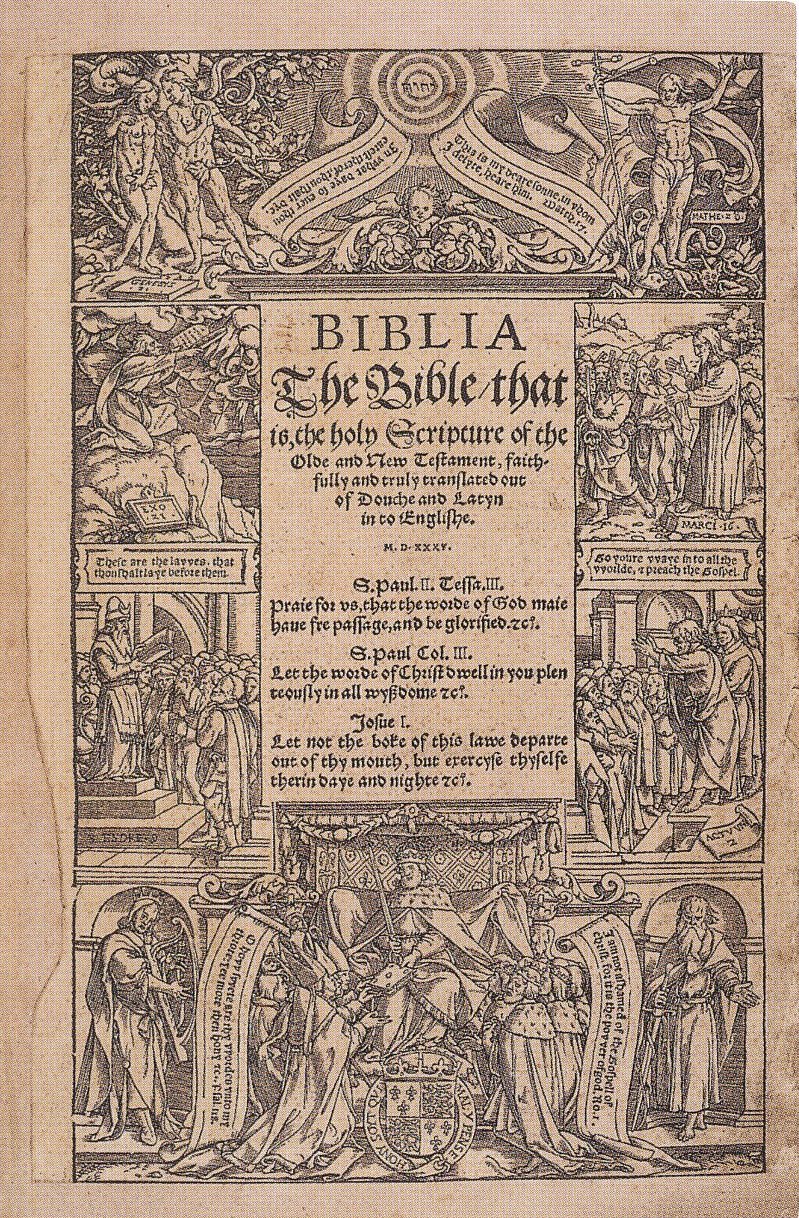
Title page of the Coverdale Bible, 1535; woodcut by Hans Holbein the Younger. British Library, via Wikimedia Commons · Public domain
Compiled by Myles Coverdale and published in 1535, this was the first complete printed translation of the Bible into English. It was printed in Antwerp. Coverdale based his New Testament and Pentateuch on Tyndale’s work and translated the rest largely from German and Latin versions. Its editions of 1537 were the first complete Bibles printed in England, and the 1537 folio carried the royal licence.
Sourceen.wikipedia.org: Wikipedia, “Coverdale Bible” (printer identified by Guido Latré, 1997; cites Herbert, Historical Catalogue of Printed Editions of the English Bible, 1968).
After his New Testament (first printed at Worms in 1526), William Tyndale turned to the Old Testament. His Pentateuch was issued at Marburg in 1530, “each of the five books being separately published and circulated,” as Britannica puts it, and he was still translating when, in 1535, he was betrayed by Henry Phillips and seized at the English House in Antwerp. He was held in the castle of Vilvoorde (Filford) near Brussels, tried for heresy, and condemned. John Foxe records that he was “tied to þe stake, and then strangled first by the hangman, and afterward with fire consumed in the morning at the towne of Filford, an. 1536. crieng thus at the stake with a feruente zeale, and a loud voyce: Lord open the King of Englands eyes.” The traditional date is 6 October 1536, the day Foxe gives for his commemoration; records of his imprisonment suggest he may have died some weeks earlier, and his biographer David Daniell gives only “one of the first days of October 1536.” The next year the Matthew Bible, built on his translations, was licensed by Henry VIII, and in 1539 the Great Bible, revised from it, was appointed to be read in the churches. Britannica calls the English style he created the model for future English versions “for nearly 400 years, beginning with the King James Version of 1611.” His prayer echoes the psalmist’s: “Open thou mine eyes, that I may behold wondrous things out of thy law.” (Psalm 119:18).
Sourcebritannica.com: Britannica, “William Tyndale” (date, Vilvoorde, Pentateuch 1530, KJV influence). Wikipedia, “William Tyndale” (Henry Phillips, Antwerp, the date question, Daniell) and “Great Bible” (Matthew Bible licensed). Westminster Abbey, “William Tyndale” (October 1536, Vilvorde). Foxe, Acts and Monuments (1583), Bk 8 p. 1079, original spelling as transcribed by The Acts and Monuments Online (via Wikiquote, “John Foxe”). KJV: Psalm 119:18.
Title page of the Matthew Bible, 1537 (from the Internet Archive scan). Via Wikimedia Commons · Public domain
After William Tyndale was betrayed and executed in 1536, John Rogers, chaplain to the English merchants at Antwerp, brought together Tyndale’s New Testament, Tyndale’s Old Testament translation (complete through 2 Chronicles) and Myles Coverdale’s translation of the remaining books. The complete Bible was printed in 1537 under the name “Thomas Matthew,” a pseudonym that probably protected Rogers from Tyndale’s fate, and was soon sold in England. Rogers added prefaces and notes, which Britannica calls the first English commentary on the Bible. The Matthew Bible became the basis of the Great Bible (1539), and through it of the Bishops’ Bible and the King James Version. Rogers himself was burned at Smithfield on 4 February 1555, the first Protestant martyr under Mary I.
Sourcebritannica.com: Encyclopaedia Britannica, “John Rogers.” Contents and later influence also per Wikipedia, “Matthew Bible” (citing A. S. Herbert, Historical Catalogue of Printed Editions of the English Bible, 1968).
Coloured title page of the Great Bible, 1539, probably Henry VIII’s own copy. Via Wikimedia Commons · Public domain
Prepared by Myles Coverdale under the commission of Thomas Cromwell, the Great Bible of 1539 was the first royally authorized edition of the Bible in English, appointed by Henry VIII to be read aloud in the services of the Church of England. In 1538 the clergy had been directed to set up “one book of the Bible of the largest volume in English” where parishioners could resort to it and read it. The Great Bible took much of its text from Tyndale’s work, and its size gave it its name. It was printed partly in Paris and completed in London, and more than 9,000 copies had been printed by 1541.
Sourceen.wikipedia.org: Wikipedia, “Great Bible” (citing Herbert, Darlow & Moule, Historical Catalogue of Printed Editions of the English Bible, 1968; Kenyon in Hastings’ Dictionary of the Bible, 1909). Date and royal order also per Encyclopaedia Britannica, “Great Bible.”
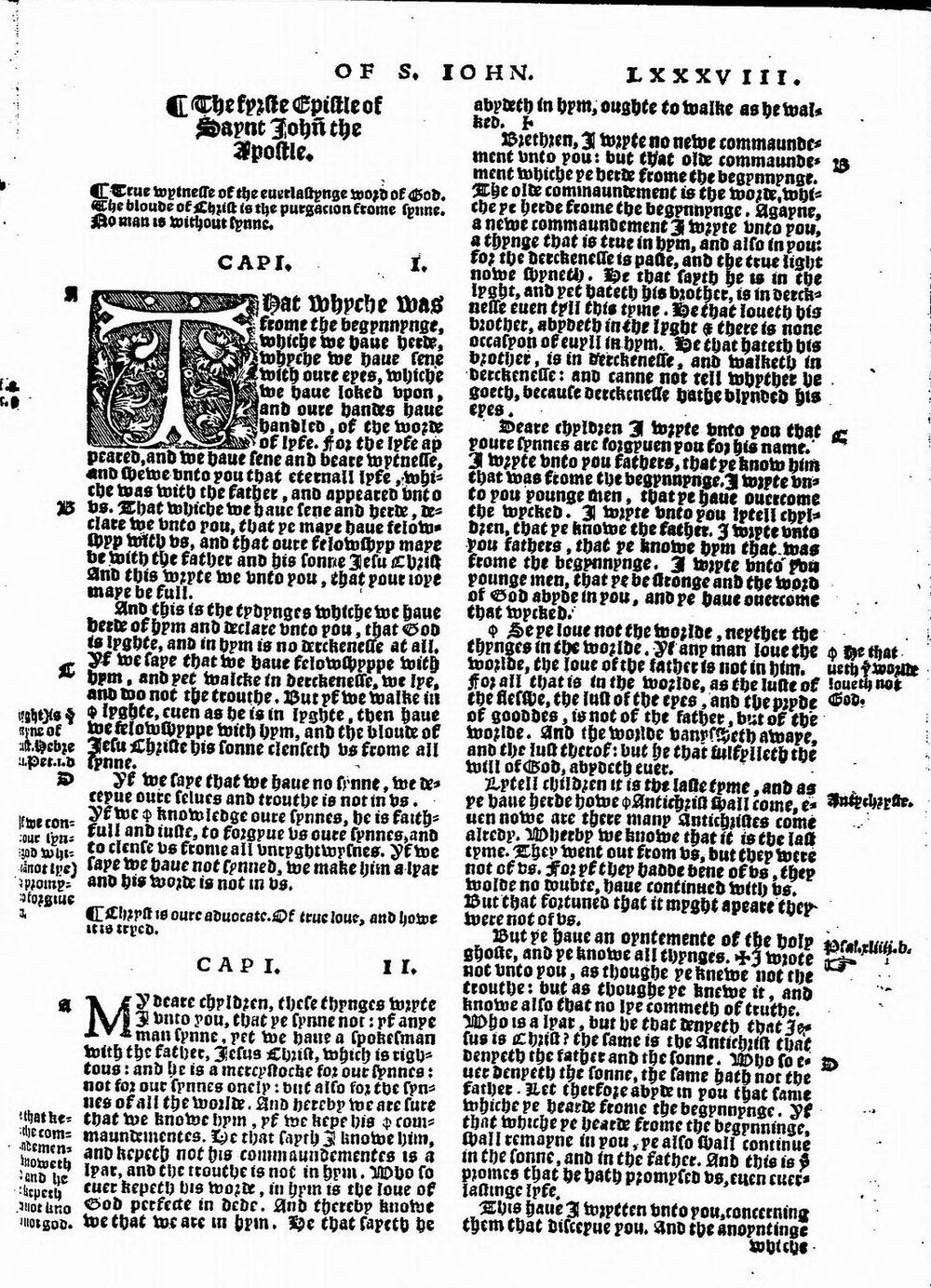
Taverner’s Bible (1539), fol. LXXXVIII, the opening of 1 John. Internet Archive item 1539TavernerBible (Public Domain Mark 1.0), via Wikimedia Commons; cropped to the leaf · Public domain
In 1539, the year of the Great Bible, a rival folio came from a London press: “The most Sacred Byble … translated into English and newly recognised with great diligence after moost faythful exemplars by Rycharde Taverner,” printed by “John Byddell for Thomas Barthlet.” Richard Taverner (1505?-1575) had been master of Greek at Cambridge, studied law at the Inner Temple, and from 1536 served Thomas Cromwell as clerk of the privy seal. His Bible, says the Dictionary of National Biography, “was really a revised edition of Matthew’s, in which the latter’s marginal notes were largely incorporated, with others added by Taverner himself.” The 1911 Encyclopaedia Britannica calls him “perhaps, the first purist among the Biblical translators, endeavouring, whenever possible, to substitute a word of native origin for the foreign expression of his predecessors.” So his page at 1 John 2:1 reads “yf anye man synne, yet we haue a spokesman with the father, Iesus Christ, which is rightous,” where the King James translators kept the older word: “And if any man sin, we have an advocate with the Father, Jesus Christ the righteous” (1 John 2:1). The fall of Cromwell in 1540 “put a stop to Taverner’s literary activity.” His revision had little influence on later translators, though a few phrases in the King James Bible can be traced to it. Though a layman, he was licensed to preach in 1552, and he died at Wood Eaton, Oxfordshire, on 14 July 1575.
Sourceen.wikisource.org: DNB (1898), “Taverner, Richard” (title, printer, Cromwell, revision of Matthew’s, 1540, licence to preach, death). Wikipedia, “Taverner’s Bible” (influence on KJV). EB1911, “Bible, English” (“first purist”). 1539 wording read from the plate (Gallery). KJV: 1 John 2:1.
“Fear none of those things which thou shalt suffer: … be thou faithful unto death, and I will give thee a crown of life.” (Revelation 2:10). Cathcart’s Encyclopedia describes Joan Boucher as one who “was a lady of Kent, England,” who was “accustomed to take Bibles into the palace for distribution, concealed under her apparel,” and who “visited the persecuted in prison, and contributed to their support and encouragement.” Because “she was an Anabaptist, and she must recant or be burned,” she was condemned; Cathcart records that “She passed through the flames to paradise May 2, 1550, in Smithfield, London,” and that “Her death was marked by perfect fearlessness and by the full peace of God.” Honest note: Cathcart calls her a “firm Baptist” and says she held a peculiar view of the origin of Christ’s body, which he judges did not impugn his divinity or humanity; later historians know her also as Joan Bocher or Joan of Kent and class her among the English Anabaptists of the Reformation, not as a member of a Baptist church as the term later came to mean. The sentence of death for conscience’ sake is recorded here as history, not as a precedent to be followed.
Sourcearchive.org: William Cathcart, ed., The Baptist Encyclopedia (Philadelphia: Everts, 1881), vol. 1, s.v. “Boucher, Joan” (public domain; Internet Archive scan). Quotations verbatim, contiguous fragments only, machine-matched against the scan’s text. Name variants and the date of 2 May 1550 at Smithfield agree with Wikipedia, “Joan Bocher”. The classification note is the compiler’s, not Cathcart’s. KJV: Revelation 2:10.
Robertus Stephanus (Robert Estienne), engraved portrait from a series of famous reformers, c. 1599. Rijksmuseum, Amsterdam (RP-P-OB-55.218), via Wikimedia Commons · CC0
Robert Estienne of Paris, known in Latin as Stephanus, was the royal printer in Latin, Hebrew and Greek. His Greek New Testaments of 1546, 1549 and 1550 were printed in Claude Garamond’s royal Greek type, and the 1550 “Royal Edition” became a standard text of the Textus Receptus. Censured by the theologians of the Sorbonne, he moved to Geneva around 1550. There in 1551 he issued a fourth edition, with the Greek between Erasmus’s Latin and the Vulgate, and in it he divided the chapters of the New Testament into numbered verses. His French Bible of 1553 used the same system. Estienne’s numbering was widely adopted, and it is found in almost all modern Bibles. William Whittingham’s English New Testament of 1557 was the first in English to use it, and the Geneva Bible of 1560 the first whole English Bible with both chapters and verses. “Thy word is true from the beginning” (Psalm 119:160, KJV).
Sourceen.wikipedia.org: Wikipedia, “Robert Estienne” (printer to the king; Garamond grecs du roi; 1546/1549/1550 editions, the 1550 Editio Regia; the Sorbonne; Geneva c. 1550; 1551 with Erasmus’s Latin and the Vulgate; first to number the NT verses); “Chapters and verses of the Bible” (1551 Greek NT; 1553 French Bible; system in almost all modern Bibles; Whittingham 1557; Geneva Bible 1560); “Textus Receptus” (1551 in Geneva; Stephanus and Beza the two standard texts). Ps 119:160 KJV verified.
“If thou believest with all thine heart, thou mayest” (Acts 8:37). Cathcart, citing Foxe’s Acts and Monuments, writes that on May 18, 1556, “a complaint was made against a considerable number of persons who favored the gospel in Ipswich, before Queen Mary’s council, sitting in commission at Beccles, in Suffolk.” Among the charges, Mother Fenkel, Joan Ward, and Mother Beriff, a midwife, “refused to have children dipped in the fonts.” Cathcart notes there is no hint in Foxe that they preferred sprinkling or pouring, and concludes: “They were Baptists undoubtedly.” That is his reading; Foxe records only the names and the charge.
Sourcearchive.org: William Cathcart (ed.), The Baptist Encyclopedia (Philadelphia: Everts, 1881), vol. 1, s.v. “Immersion” (public domain; Internet Archive scan). Quotations verbatim, contiguous fragments only, machine-matched against the scan’s text (OCR line-end hyphenation normalised). KJV: Acts 8:37.
Title page of the 1560 Geneva Bible, showing the Israelites before the Red Sea. Library of Congress, via Wikimedia Commons · Public domain
English Protestant scholars in exile in Geneva during the reign of Mary I published the New Testament in 1557 and the whole Bible in 1560. According to Britannica, the Geneva Bible was the first Bible in English to number its verses. Imported into England, it soon surpassed the Great Bible in public favour, and it was an important influence on the translators of the King James Version.
Wikipedia records that the Brest Bible, printed at Brest-Litovsk in 1563, was commissioned by the Lithuanian magnate Mikołaj “the Black” Radziwiłł. Its translators were chosen and authorised at the Calvinist synods of 1559 and 1560 at Pińczów, and Polish and foreign theologians laboured on it for six years. They worked from the Hebrew and the Greek and consulted the ancient versions and several modern Latin ones, and the page names Bernard Wojewodka as its printer. Its renderings were noted for their contextual and phraseological, rather than word-for-word, character. Some copies survived the burning of the edition by a later Radziwiłł. A second page on Polish Bible translations adds that the Brest Bible was in time superseded by the so-called Gdańsk Bible (New Testament 1606, whole Bible 1632), compiled by Martin Janicki and revisers including Daniel Mikołajewski and Jan Turnowski, who compared it with the Brest and Bohemian Bibles, Pagnini’s Latin and the Vulgate. That Gdańsk Bible became, in the words of the page, the Bible of all Evangelical Poles. Like the other vernacular Bibles of the Reformation, it stands in the line of Paul’s word to Timothy: “And that from a child thou hast known the holy scriptures, which are able to make thee wise unto salvation through faith which is in Christ Jesus” (2 Timothy 3:15, KJV). No licensed plate has been verified, so none is shown.
Sourceen.wikipedia.org: Wikipedia, “Brest Bible” (Radziwiłł patron; translators chosen at the 1559-60 Pińczów synods; printed 1563 at Brest; printer Wojewodka; Hebrew and Greek with Vulgate and French as aids); Wikipedia, “Bible translations into Polish” (six years’ work; superseded by the Gdańsk Bible, NT 1606, whole 1632; Janicki, Mikołajewski, Turnowski). 2 Tim 3:15 KJV verified on bible-api.com.
Theodorus Beza, engraved portrait, 16th century, artist unknown. Bibliothèque municipale de Lyon (fonds des portraits), via Wikimedia Commons · Public domain
Theodore Beza (1519-1605), born at Vézelay in Burgundy, became John Calvin’s disciple and then his successor as the leading minister of Geneva. In 1565 he issued an edition of the Greek New Testament. The Greek was set in parallel columns with the Vulgate and his own Latin translation, and it came with his annotations, now greatly enlarged. Its Greek was Stephanus’s text with minor revisions, and further editions followed in 1582, 1588-89 and 1598. Beza owned two ancient manuscripts, the Codex Bezae, which he later gave to the University of Cambridge, and the Codex Claromontanus. He made very little use of them in his text. The translators of the 1611 King James Bible did not follow any single Greek edition. They drew on Erasmus, Stephanus and Beza, but they favoured the later editions of Beza. At the thirteen places where their margin records a variant reading from Greek manuscripts, the note almost always reproduces one of Beza’s. “Heaven and earth shall pass away, but my words shall not pass away” (Matthew 24:35, KJV).
Sourceen.wikipedia.org: Wikipedia, “Theodore Beza” (b. Vézelay 1519, d. 1605; succeeded Calvin; 1565 Greek NT with Vulgate and his own Latin, annotations; 1582; Codex Bezae to Cambridge, Claromontanus); “Textus Receptus” (editions 1565-1598; little use of his MSS; KJV drew on Erasmus, Stephanus, Beza); “King James Version” (the 1611 translators favoured the later editions of Beza; of 13 NT margin notes recording Greek variants, almost all reproduce Beza’s notes). Matt 24:35 KJV verified.
William Salesbury on the Translators’ Memorial (Gofeb y Cyfieithwyr), St Asaph. Photo: Llywelyn2000, via Wikimedia Commons · CC BY-SA 4.0
In 1563 an Act of Parliament told the bishops of Wales and Hereford to see that the Bible and the Book of Common Prayer were translated into Welsh. The New Testament was translated from the Greek at the bishop’s palace in Carmarthen by Richard Davies, bishop of St David’s, his cantor Thomas Huet, and above all William Salesbury. Davies translated 1 Timothy, Hebrews, James and 1 and 2 Peter; Huet translated the Revelation; and Salesbury did most of the rest. Salesbury had already published in 1551 the Gospel and Epistle readings for Sundays and holy days in Welsh. The Welsh Psalms, translated from the Hebrew, appeared with the Prayer Book on 6 May 1567, and the New Testament followed on 7 October 1567, printed in London by Henry Denham. “So likewise ye, except ye utter by the tongue words easy to be understood, how shall it be known what is spoken?” (1 Corinthians 14:9, KJV).
Sourceen.wikipedia.org: Wikipedia, “Bible translations into Welsh” (Salesbury’s Kynniver llith a ban 1551; the 1563 Act, 5 Eliz. 1 c. 28; Davies, Huet, Salesbury at Carmarthen, NT from Greek; who translated which books; Psalms from Hebrew with the BCP 6 May 1567; NT 7 Oct 1567; Humphrey Toy, printed by Henry Denham). 1 Cor 14:9 KJV verified.
Frontispiece of the Bishops’ Bible, 1568: Queen Elizabeth I between the figures of Faith and Charity. Engraving attributed to Franz Hogenberg. Via Wikimedia Commons · Public domain
Commissioned by Matthew Parker, Archbishop of Canterbury, and first published in 1568, the Bishops’ Bible revised the Great Bible. Many of its translators were bishops, which gave it its name. According to Britannica, it was sanctioned for public use by Convocation in 1571, and so became the second authorized English Bible. It was later revised, and an edition of it was the base text that the King James translators were instructed to follow.
Sourcebritannica.com: Encyclopaedia Britannica, “Bishops’ Bible” (drawing on “Biblical literature: The Bishops’ Bible”). Its use as the KJV base text is also stated in Wikipedia, “Bishops’ Bible.”
The opening of Genesis in Casiodoro de Reina’s Biblia del Oso (Basel, 1569), from the archive.org scan of the 1569 edition, via Wikimedia Commons · Public domain
Casiodoro de Reina (c. 1520-1594) studied the Bible from his youth and became a monk of the Order of St Jerome at the monastery of San Isidoro del Campo near Seville. Around 1557 he embraced the Reformation and fled Spain with about a dozen other monks when the Inquisition grew suspicious of them. Condemned at home, he spent years in exile in Geneva, London, Antwerp and Frankfurt, and there he translated the Scriptures into Spanish. For the Old Testament he used Bomberg’s Hebrew text of 1525, and for the New the Greek of Stephanus’s 1550 edition. His Bible was published at Basel on 28 September 1569, the first complete Bible printed in Spanish. Its title page showed a bear reaching for a honeycomb hanging from a tree, so it has been called the Biblia del Oso, the “Bear Bible”. In 1602 his student Cipriano de Valera published a revision at Amsterdam, placing the Apocrypha in a separate section between the Testaments. Revised many times since, notably in 1909 and 1960, the Reina-Valera remains in print today. “How sweet are thy words unto my taste! yea, sweeter than honey to my mouth!” (Psalm 119:103, KJV).
Sourceen.wikipedia.org: Wikipedia, “Reina–Valera” (28 Sept 1569, Basel; first complete Bible printed in Spanish; bear and honeycomb title page; Bomberg 1525 and Stephanus 1550; Valera 1602 Amsterdam, Apocrypha between the Testaments; later revisions); “Casiodoro de Reina” (b. c. 1520, Hieronymite at San Isidoro, flight c. 1557, exile in Geneva, London, Antwerp, Frankfurt; d. 1594). The Inquisition’s sentence is summarized, not detailed. Ps 119:103 KJV verified.
Immanuel Tremellius, engraved portrait (probably 16th century). Austrian National Library portrait collection (portraitindex.de), via Wikimedia Commons · Public domain
Immanuel Tremellius (1510-1580), born a Jew at Ferrara, came to faith in Christ and became one of the leading Hebrew scholars of the Reformation, teaching Hebrew at Strasbourg, as Regius Professor at Cambridge, and at Heidelberg. With his son-in-law Franciscus Junius he translated the Old Testament into Latin directly from the Hebrew, published at Frankfurt in five parts between 1575 and 1579, and in London in 1580. Later folio editions added Tremellius’s own copious marginal notes, a Latin rendering of the Syriac New Testament, and Beza’s Latin New Testament from the Greek. The version was used by John Milton, by John Donne, and by Archbishop Ussher in compiling his Annals of the World. His biographer records that Tremellius died exclaiming, “Not Barabbas, but Jesus!” “Much every way: chiefly, because that unto them were committed the oracles of God” (Romans 3:2, KJV).
Sourceen.wikipedia.org: Wikipedia, “Immanuel Tremellius” (1510-9 Oct 1580; Ferrara; convert; Strasbourg, Cambridge Regius Professor 1549, Heidelberg 1561; OT with Junius, Frankfurt 1575-79, London 1580; folio notes, Syriac NT, Beza NT; used by Milton, Donne, Ussher; dying words per Morison). Rom 3:2 KJV verified.
The opening of Luke 1:5 (“In the days of Herod, the king of Judaea…”) in the Bible of Kralice, vol. 6 (1593), from the Münchener DigitalisierungsZentrum copy, via Wikimedia Commons · Public domain
The Unity of the Brethren (Unitas Fratrum), a church that grew out of the fifteenth-century Bohemian Reformation, gave the Czech people their Bible. Jan Blahoslav had already translated the New Testament from the Greek and published it in 1564. Then the Brethren translated the whole Bible from its original languages. It was printed at Kralice nad Oslavou in six volumes between 1579 and 1593, and it was the first complete Czech translation from the Hebrew and Greek. Its New Testament followed the Textus Receptus. The third edition, of 1613, became the classic, and the Bible of Kralice remains the most widely known and most often used Czech Bible to this day. “For ever, O LORD, thy word is settled in heaven” (Psalm 119:89, KJV).
Sourceen.wikipedia.org: Wikipedia, “Bible of Kralice” (Unity of the Brethren; Kralice nad Oslavou; six volumes 1579-1593; first complete Czech translation from the original languages; Blahoslav NT 1564; 1613 third edition, still the most widely known); “Textus Receptus” (TR the Greek base of the Kralice Bible); “Unity of the Brethren” (Unitas Fratrum, from the Bohemian Reformation of the 15th c.). Ps 119:89 KJV verified.
Title page of the first Welsh Bible, translated by William Morgan, 1588. National Library of Wales, via Wikimedia Commons · CC0
William Morgan (c. 1545-1604), a Cambridge scholar who had spent seven years studying the Bible in Greek, Hebrew and Aramaic, made the first translation of the whole Bible into Welsh from the Greek and Hebrew while he was vicar of Llanrhaeadr-ym-Mochnant. He translated the Old Testament and revised Salesbury’s New Testament, and the complete Bible, Y Beibl cyssegr-lan, was published in 1588. The first printing had a number of printing errors, and Morgan began a revision; after his death Bishop Richard Parry and Dr John Davies completed it, bringing the text into closer agreement with the King James Version of 1611. This 1620 revision, still known as William Morgan’s Bible, remained the standard Welsh Bible until the late 20th century, and it is counted a great monument of the Welsh language: the Welsh could read the Bible in their own tongue at about the same time as their English neighbours. “We do hear them speak in our tongues the wonderful works of God” (Acts 2:11, KJV).
Sourceen.wikipedia.org: Wikipedia, “William Morgan (Bible translator)” (c. 1545-1604; St John’s, Cambridge; seven years of Biblical study in Greek, Hebrew, Aramaic; vicar of Llanrhaeadr-ym-Mochnant; first whole Welsh Bible from Greek and Hebrew, 1588; 1620 revision by Parry and Davies) and “Bible translations into Welsh” (1620 brought into conformity with the KJV; standard until the late 20th c.). Plate: National Library of Wales. Acts 2:11 KJV verified.
Title page of the second part (“Az Szent Biblianac masodic resze”) of the Vizsoly Bible, 1590. Scan by the University of Szeged, via Wikimedia Commons · Public domain
Gáspár Károli, the Reformed (Calvinist) pastor of Gönc, began translating the Bible in 1586 and finished three years later. At least four people seem to have worked with him, but the New Testament is entirely his. In his preface he names his sources, which included the Hebrew and Greek texts. Printing began on 28 February 1589 in the village of Vizsoly, where the printer Bálint Mantskovit had moved his press. Students from Gönc carried Károli’s manuscript to him page by page, and the work was completed on 20 July 1590 in some 700-800 copies. The finished Bible has three volumes and 2,412 pages and weighs about six kilograms. It was the first Bible printed in the Hungarian language, and a copy is still on display in Vizsoly. “So then faith cometh by hearing, and hearing by the word of God” (Romans 10:17, KJV).
Sourceen.wikipedia.org: Wikipedia, “Vizsoly Bible” (Károli at Gönc, 1586-89, at least four translators, NT by Károli; sources incl. Hebrew and Greek; printing 28 Feb 1589-20 July 1590 by Mantskovit; students from Gönc; 700-800 copies; 3 vols, 2,412 pp., c. 6 kg; first Bible printed in Hungarian; copy on display). The official accusations against the press are omitted. Rom 10:17 KJV verified.
Plates are hung only where a genuine image of the subject could be found under a public-domain or open licence. Each carries its credit and links to its licence record. Entries without a plate are awaiting one that meets that standard. More entries are being prepared, and each will be added only with its citation.
Every entry on this page was checked, when it was added, against the source linked beneath it; notes name the underlying scholarship where the source cites it. Where historians disagree (for example, over John Wycliffe’s own share in the Bible that bears his name), the entry says so. Scripture is quoted verbatim from the King James Version. Plates are reproduced almost entirely from Wikimedia Commons: public-domain works, works dedicated to the public domain (CC0), or photographs under Creative Commons Attribution (CC BY 2.0-3.0) or Attribution-ShareAlike (CC BY-SA 2.0-4.0) licences. Each plate’s licence is stated beneath it, with a link to the record where it was confirmed.