“But the word of the Lord endureth for ever. And this is the word which by the gospel is preached unto you.”1 Peter 1:25, KJV
How the Scriptures were received, carried into the English tongue, and confessed by the Baptist churches. Each date is linked to its source, so that you may test every word.
Scripture & Canon (6)
The English Bible (4)
Baptist Witness (54)
Nothing in the Timeline matches that. Try a single word, such as a name, a place or a year.
Title page, “La Bibbia. Cioè, i libri del Vecchio, e del Nuovo Testamento… da Giovanni Diodati”, [Geneva]: Jean de Tournes, 1607, via Wikimedia Commons · Public domain
Giovanni Diodati was born at Geneva on 3 June 1576 into a family from Lucca in Italy that had gone into exile for its Protestant faith. On the recommendation of Theodore Beza he was made professor of Hebrew at Geneva when he was only twenty-one. He later succeeded Beza as professor of theology. Diodati translated the whole Bible into Italian from the original languages. It appeared in 1603, was issued again with his notes in 1607, and was revised in 1641. His notes were also published in English, in London in 1643, as Pious and Learned Annotations upon the Holy Bible. The Diodati Bible became the standard version of Italian Protestants. “Search the scriptures; for in them ye think ye have eternal life: and they are they which testify of me” (John 5:39, KJV).
Sourceen.wikipedia.org: Wikipedia, “Giovanni Diodati” (b. Geneva 3 June 1576, Lucchese exiles; professor of Hebrew at 21 on Beza’s recommendation; succeeded Beza in theology; Italian Bible 1603, with notes 1607, revised 1641; Annotationes, English 1643; reference version of Italian Protestants). John 5:39 KJV verified.
Held 14-18 January 1604 and chaired by James I, the Hampton Court Conference brought leading bishops together with Puritan representatives. It followed the Millenary Petition of 1603 and met to discuss reform of the Church of England. One of its most important outcomes was the King’s decision to commission a new English translation of the Bible: the work that became the King James Version.
Sourcehrp.org.uk: Historic Royal Palaces, “The Hampton Court Conference of 1604.”
John Smyth, a Separatist minister from Gainsborough, went with his congregation to Amsterdam in 1608 to escape persecution. Adopting Baptist principles there, and holding that church membership and baptism belong to believers, Smyth baptized first himself and then others, including Thomas Helwys. Britannica calls Smyth generally considered the founder of the organized Baptists of England. Smyth later sought to join the Dutch Mennonites, and Helwys led the congregation on without him.
Sourcebritannica.com: Encyclopaedia Britannica, “John Smyth”; date (January 1609) per Wikipedia, “Thomas Helwys.”
Title page of the first edition of the King James Bible, 1611. Via University of Pennsylvania Libraries and Wikimedia Commons · Public domain
In 1611 Robert Barker, printer to King James I, printed the first edition of the King James Bible in London, the fruit of the translation approved at Hampton Court. Barker bore the whole cost of the printing. Errors in the first printing were corrected in later ones. It became one of the most influential books ever printed in the English language.
Sourceen.wikipedia.org: Wikipedia, “Robert Barker (printer)” (citing House, review of Norton, A Textual History of the King James Bible, 2004).
After John Smyth departed from the Baptist position, Thomas Helwys took leadership of the remaining congregation of about twelve members in Amsterdam. In 1611 he set out its beliefs in A Declaration of Faith of English People Remaining at Amsterdam in Holland, reckoned the earliest Baptist confession of faith and known as the Twenty-Seven Articles. Its tenth article defines the church: “That the church of Christ is a company of faithful people, separated from the world by the word and Spirit of God, being knit unto the Lord, and one unto another, by baptism, upon their own confession of the faith, and sins.” Its fourteenth gives the reason for believer’s baptism, from Romans 6: “That baptism, or washing with water, is the outward manifestation of dying unto sin, and walking in newness of life; and therefore in nowise appertaineth to infants.” The articles are quoted as E. B. Underhill reprinted them in 1854, in modern spelling; he took his text from Thomas Crosby’s History of the English Baptists, having found no original printed copy.
Sourceen.wikipedia.org: Wikipedia, “Thomas Helwys” (citing Briggs, A Dictionary of European Baptist Life and Thought, 2009, p. 467). Articles 10 and 14 quoted from E. B. Underhill (ed.), Confessions of Faith (Hanserd Knollys Society, 1854), pp. 6-7, read on the page images of the Internet Archive scan (confessionsfaith00undeuoft); see the Reading Room.
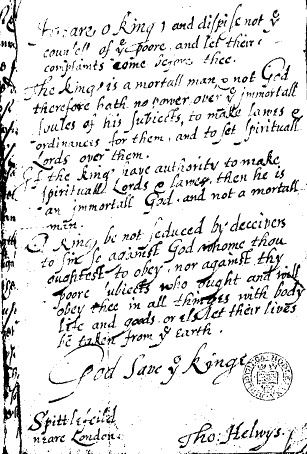
Thomas Helwys’s handwritten inscription to King James I in A Short Declaration of the Mistery of Iniquity (1612), signed “Tho: Helwys”. Bodleian Library, Oxford, via Early English Books Online and Wikimedia Commons · Public domain
In 1612 Helwys and about twelve others returned from exile and settled their church at Spitalfields, in the east of London. It is considered the first Baptist church in England. Helwys inscribed a copy of his A Short Declaration of the Mistery of Iniquity by hand to King James, pleading for liberty of conscience: “The King is a mortall man, and not God therefore hath no power over ye immortall soules of his subjects, to make lawes and ordinances for them, and to set spirituall Lords over them.” In the same note he promised that the King’s subjects would “obey thee in all thinges with body life and goods”, and he signed it “God Save ye King” from “Spittlefeild neare London”. Whether the book reached the King is not known. Helwys was imprisoned in Newgate, where he died by about 1616. The inscribed copy is preserved in the Bodleian Library, Oxford.
Sourceen.wikipedia.org: Wikipedia, “Thomas Helwys” (citing Cairns, Christianity Through the Centuries, 2009, p. 331; Oxford DNB). Inscription quoted from J. H. Rushbrooke’s transcription, Baptist Quarterly 8.1 (January 1936), pp. 18-19 (gospelstudies.org.uk PDF), checked against the plate; the leaf itself writes “&” and “subiects”.
“Thy word is a lamp unto my feet, and a light unto my path” (Psalm 119:105). Cathcart’s Encyclopedia says Rev. John Gosnold “was born in England in 1625,” that he “received his education in the University of Cambridge, and became a clergyman of the Established Church,” and that “he made the Bible his only guide to truth, and consequently he became a Baptist.” It records that “he was chosen pastor of a church at Barbican, in London, where he soon had a congregation of nearly 3000,” that he “baptized the celebrated Israelite, Du Veil, who joined the Baptists from the Episcopal ministry,” and that “he was beloved by all good men.” It adds that he “belonged to the General Baptists, but he associated much with the Particular denomination.”
Sourcearchive.org: William Cathcart, ed., The Baptist Encyclopedia (Philadelphia: Everts, 1881), vol. 1, s.v. “Gosnold, Rev. John” (public domain; Internet Archive scan). Quotations verbatim, contiguous fragments only, machine-matched against the scan’s text (line-end hyphenation joined; first letters of “He” and “Mr. Gosnold” clause adjusted for running prose). KJV: Psalm 119:105.
The King James Bible of 1611 was printed in London by the King’s Printer, and until 1629 every reprint came from the King’s Printers. Compositors varied the spelling and punctuation freely, and over the years about 1,500 misprints crept in. The first careful revision of the printed text came from Cambridge. The University’s printers issued two folio Bibles, Thomas and John Buck’s in 1629 and Thomas Buck and Roger Daniel’s in 1638. Their editors went through the text, the italics and the margin from beginning to end. They put back words and clauses overlooked in 1611, amended plain oversights, and made the italic type for supplied words more consistent. Over 200 readings were changed, most often by bringing into the text a more literal rendering the translators had set in the margin. The men behind 1629 are unknown; a note in the Jesus College copy, in the hand of its Master, Richard Sterne, names the editors of 1638: “Dr Goad of Hadley, Dr Ward, Mr Boyse, and Mr Mead.” The Victorian editor F. H. A. Scrivener, who compared the editions reading by reading, judged that “their corrections command our assent by their simple truth.” F. S. Parris at Cambridge (1760) and Benjamin Blayney at Oxford (1769) kept most of the Cambridge readings, so they stand in the King James Bible read today. “Every word of God is pure: he is a shield unto them that put their trust in him.” (Proverbs 30:5, KJV).
Sourcebiblia.com: F. H. A. Scrivener, The Cambridge Paragraph Bible (1873, PD), Introduction §I (King’s Printers only until 1629; Buck 1629, Buck & Daniel 1638; scope of the revision; Sterne’s note naming the 1638 editors; “their corrections command our assent…”). Wikipedia, “King James Version” (~1,500 misprints; over 200 revisions; Parris 1760 and Blayney 1769 kept most). Prov 30:5 KJV verified.
Novum Testamentum graece (Leiden: Elzevir, 1633), preface, p. 3, with the words “textum … ab omnibus receptum”. Via Wikimedia Commons · Public domain
At Leiden, the printers Bonaventure Elzevir and his nephew Abraham issued a Greek New Testament in 1633 whose preface told the reader, in Latin, that he now held “the text, now received by all, in which [is] nothing corrupt.” From the words textum … receptum came the name Textus Receptus, the Received Text, a name later applied to the whole line of printed Greek New Testaments that began with Erasmus in 1516 and ran through Stephanus and Beza (see 1516, 1551, 1565). That line of editions was the main Greek basis of the King James Version and of many Reformation Bibles, among them the Reina-Valera, the Kralice Bible, the Statenvertaling and the Portuguese Almeida. Honesty: many modern textual critics regard it as an inferior text; those who hold it the most authentic do so on the doctrine of God’s providential preservation of Scripture. “Thou shalt keep them, O LORD, thou shalt preserve them from this generation for ever” (Psalm 12:7, KJV).
Sourceen.wikipedia.org: Wikipedia, “Textus Receptus” (Elzevir brothers section: 1633 Leiden edition, preface Latin and translation quoted; term derived from textum/receptum; lineage Erasmus-Stephanus-Beza-Elzevir; base for KJV, Reina-Valera, Kralice, Almeida, Statenvertaling; modern critics vs providential preservation). Plate also in the Gallery. Ps 12:7 KJV verified.
Title page of the Statenvertaling (States Bible), printed by Paulus Aertsz. van Ravensteyn by order of the States General, 1637. Nederlands Bijbelgenootschap, via Wikimedia Commons · Public domain
Earlier Dutch Bibles, beginning with Jacob van Liesvelt’s at Antwerp in 1526, had been translated from other translations. In 1618 the Synod of Dort resolved that a new Dutch Bible should be made “accurately based on the original languages”, and asked the States General of the Netherlands to commission it; the translation was published in 1637. The synod gave the translators plain rules: keep carefully to the original text; add as few words as possible, and print any added word in a different type and within brackets, so the reader can tell it from the text; and give short summaries and brief notes on hard passages. The Apocrypha were translated but set after the New Testament with a warning to the reader, not as part of the canon. Where the Hebrew has the name of God, the translation reads HEERE (“LORD”) in capitals, much as the King James Bible prints LORD. “The words of the LORD are pure words: as silver tried in a furnace of earth, purified seven times” (Psalm 12:6, KJV).
Sourceen.wikipedia.org: Wikipedia, “Statenvertaling” (first Dutch translation from the original Hebrew, Aramaic and Greek; ordered by the Synod of Dordrecht 1618, financed by the States General, published 1637; Liesvelt 1526 and other Dutch Bibles were translations of translations; guidelines of 20 Nov 1618; Apocrypha after NT with a warning; HEERE for YHWH). Title page: Commons, printed by Paulus Aertsz. van Ravensteyn. Ps 12:6 KJV verified.
Henry Jessey, engraving by P. Rothwell, 18th century. National Library of Wales, Welsh Portrait Collection. Via Wikimedia Commons · Public domain
In 1616 Henry Jacob gathered a congregation in Southwark. It was independent in government and “bound by covenant to follow the divine directions ‘as he had made them known, or should make them known.’” From that one church came much of the first Particular Baptist witness in England. At midsummer 1637 Henry Jessey (or Jacie) became its pastor. He was a Yorkshire rector’s son, born at West Rounton in 1601 (some sources give 1603), and a Cambridge graduate whose “favourite studies” were “Hebrew and rabbinical literature.” In 1634 he had been deprived of his Yorkshire vicarage “for disusing the ceremonies and for removing a crucifix.” The church was a persecuted one: on 21 February 1638 at Queenhithe “the whole congregation was carried off by the bishop’s pursuivants.” The question of baptism ran through it. “In 1633 there had been a baptist secession from it,” and another followed in 1638. Jessey studied the matter, and “while deciding for infant baptism, held immersion to be imperative.” When the controversy revived in 1644 he came at last to Baptist convictions, and in June 1645 he was immersed by Hanserd Knollys. “He did not, however, make baptism a term of communion.” His knowledge of the Bible was famous: “His memory for scripture was so minute and accurate that he was termed a living concordance.” He “projected a revised translation of the Bible, and made some progress in it,” and in 1652 he was named one of nine whose approval was required before any new translation could be published. In the summer of 1653 he visited some thirty-six congregations in the eastern counties and “found them ‘sound in the faith,’ though differing about baptism and the use of hymns.” A hearer in 1654 judged that he was “no Boanerges,” but “there was a crowded congregation.” In 1657, for the distressed Jews of Jerusalem, he collected “a sum of 300l., which he forwarded with good wishes for their conversion,” and at home “some thirty families are said to have been dependent on his bounty.” After the Restoration he lost his Southwark pulpit and was arrested three times between December 1660 and March 1663. He died unmarried on 4 September 1663, and his funeral (7 September per the DNB; 8 September per later sources) “was attended … by four or five thousand persons.” “Let the word of Christ dwell in you richly in all wisdom” (Colossians 3:16).
Sourceen.wikisource.org: DNB vol. 29 (1892), “Jessey, Henry”, by Alexander Gordon (Wikisource; US PD), all quoted spans verbatim; Wikipedia “Henry Jessey” for the 1603 birth year and 8 Sept burial (sources differ; both given). War, “triers” and Fifth-monarchy matters omitted. Col 3:16 KJV verified (bible-api × getBible).
In 1638 Roger Williams, founder of Providence (1636), gathered the congregation that became the First Baptist Church in America: the oldest Baptist church in the land. The church itself records that it was founded on religious liberty, soul freedom and the separation of church and state. For some sixty years the congregation met in homes or outdoors, and its present meeting house dates from 1774-75.
Sourcefirstbaptistchurchinamerica.org: The First Baptist Church in America, “History”; early meetings and building dates per Wikipedia, “First Baptist Church in America.”
“Portrait of a Clergyman,” attributed to Guilliam de Ville, c. 1659. Redwood Library, Newport; believed, not proven, to depict John Clarke. Via Wikimedia Commons · Public domain
John Clarke (1609-1676), an English physician, came to Massachusetts Bay in 1637 and joined Anne Hutchinson and the others whom the colony had exiled. In 1638 he founded the church at Newport, Rhode Island, the second Baptist church in America. Unlike Roger Williams, he never left his Baptist convictions. In 1651 he was arrested at Lynn, Massachusetts, with Obadiah Holmes and John Crandall for holding worship in a private home. In London in 1652 he published Ill News from New England, pleading that no man has dominion over another’s conscience in the worship of God. While in England he helped negotiate the Rhode Island Royal Charter of 1663 from Charles II, which permitted the colony “to hold forth a livlie experiment” that a civil state could flourish “with a full libertie in religious concernements.”
Sourcefirstamendment.mtsu.edu: John R. Vile, “John Clarke,” The First Amendment Encyclopedia (Middle Tennessee State University, 2024), citing J. Clarke, Ill News from New England (1652) and the 1663 Charter; charter spelling as quoted there. Vile also notes T. D. Bozeman’s caution (Church History 75, 2006) that Clarke’s later views were more complicated than the heroic portrait.
John Spilsbury (1593-c. 1668) was, by Wikipedia’s account, a London cobbler at Aldersgate who belonged to a Separatist congregation and held to the baptism of believers. The scholar Gordon Belyea traces that congregation to the church Henry Jacob gathered in Southwark in 1616, later pastored by John Lathrop and Henry Jessey, whose members divided in amicable splits during the 1630s. Some of them, he writes, “seceded from The JLJ Church by 1638 to join a group led by John Spilsbury”; the so-called Kiffin Manuscript records that Mr Tho: Wilson, Mr Pen and H. Pen and three more, “being convinced that Baptism was not for Infants, but professed Believers joined with Mr lo: Spilsbury”. Belyea calls the Spilsbury church “the first that can be categorically identified as Calvinist Baptist”, and notes it kept an amicable relationship with the Jessey church. The dating is honestly uncertain: Wikipedia has Spilsbury leaving the Separatist church in 1633 and founding the congregation in 1638, while Belyea allows that a Calvinistic church of Baptist practice may have existed as early as 1633 but is certain of it only by 1638. Later, he writes, the church adopted immersion as the form of baptism “simply on biblical authority” rather than by any claimed succession. Spilsbury was a signatory to the First London Confession of 1644 and, Belyea adds, “held by some to have been its principal author”; that authorship is a scholarly opinion, not a settled fact. He published A Treatise Concerning the Lawfull Subject of Baptisme (1643; second edition 1652) and God’s Ordinance, the Saints Privilege (1646). He died about 1668. The Scripture at the heart of the question: “But when they believed Philip preaching the things concerning the kingdom of God, and the name of Jesus Christ, they were baptized, both men and women.” (Acts 8:12, KJV).
Sourcethegospelcoalition.org: Gordon L. Belyea, “Origins of the Particular Baptists”, Themelios 32.3 (TGC); quoted phrases verbatim, including the Kiffin Manuscript extract as Belyea prints it. Cross-checked: Wikipedia “John Spilsbury (Baptist minister)” (cobbler, 1633/1638, 1643/1652/1646 works). Belyea’s authorship remark is attributed to “some”. KJV: Acts 8:12.
Title page, The Records of a Church of Christ, Meeting in Broadmead, Bristol, 1640-1687, ed. E. B. Underhill for the Hanserd Knollys Society (London, 1847). Cornell University Library scan via Internet Archive and Wikimedia Commons · Public domain
Dorothy Kelly and her husband Anthony, a grocer, kept a shop in the High Street of Bristol and gathered a small Separatist company for prayer and Scripture. They were mocked for it, and their house was attacked by those who opposed their meetings. By 1640 Anthony had died, and Dorothy married Matthew Hazzard, a Puritan preacher who later held the living of Christ Church. As a vicar’s wife she was troubled in conscience about staying in the parish church, and she settled the matter from Scripture, from Revelation 14:9-10, and left the Church of England. That same year, 1640, she and four men, among them Mr Atkins, Mr Moone and the minister Mr Bacon, formed the first dissenting church in Bristol. It met in her house and in Bacon’s. The congregation was persecuted and moved from place to place. In 1671 it secured four rooms at the end of Broadmead and made them into one meeting room, and in time it became a Baptist church. Its own record book, 1640-1687, was printed in 1847 by the Hanserd Knollys Society. Broadmead Baptist Church still meets in Bristol today. Dorothy Hazzard died there in 1674.
Sourceen.wikipedia.org: Wikipedia, “Dorothy Hazzard” (citing the Oxford DNB, “Hazzard [other married name Kelly], Dorothy (d. 1674), Baptist leader,” and J. G. Fuller, The Rise and Progress of Dissent in Bristol, 1840, p. 21), and “Broadmead Baptist Church” (citing Fuller, p. 49, for the 1671 rooms). Sources differ on the fourth founder’s name (Poole or Cole), so he is left unnamed.
The Particular Baptists of London did not begin with immersion; they came to it by a question about the Word. Gordon Belyea tells how the Southwark church founded by Henry Jacob divided in May 1640 between Henry Jessey and Praise-God Barebone, and how Richard Blunt, who had earlier left, “returned to the Jessey church at this time, and began to raise questions about the mode of baptism, ‘being convinced of Baptism yt also it ought to be by dipping ye Body into ye Water, resembling burial & riseing again’”, citing Colossians 2:12 and Romans 6:4. Because the church knew no one in England who practised immersion, it sent the Dutch-speaking Blunt to Holland, to the small group at Rijnsburg (the Collegiants, founded in 1619, who, Wikipedia says, baptised by immersion). On his return, Belyea writes, Blunt baptised Mr Blacklock, who baptised “the rest of their friends that were so minded”, “forty-one in all”. Belyea is candid that “it is not clear whether Blunt was baptized in Holland, or baptized himself, or whether he and Blacklock baptized each other”, and that the question of succession troubled both Blunt and, later, Barebone. The group formed two churches, under Blunt and Thomas Kilcop, and shortly afterwards the Spilsbury church also adopted immersion; unlike the Jessey group, Belyea says, it recovered the practice “simply on biblical authority”. By the First London Confession of 1644 there were seven such gatherings, and the Confession laid down, for the first time by any Baptists, that immersion belongs to proper baptism. “Therefore we are buried with him by baptism into death” (Romans 6:4, KJV); “Buried with him in baptism” (Colossians 2:12, KJV).
Sourcethegospelcoalition.org: Gordon L. Belyea, “Origins of the Particular Baptists”, Themelios 32.3 (TGC); quoted phrases verbatim. Cross-check: Wikipedia “Collegiants” (Rijnsburg; immersion). Belyea’s doubts about Blunt’s own baptism and the succession debate are stated as his. KJV: Rom 6:4; Col 2:12.
“We ought to obey God rather than men” (Acts 5:29). Cathcart’s Encyclopedia records that Samuel Howe was pastor of “the church meeting in Deadman’s Place, London, for about seven years.” He was “imprisoned and excommunicated,” and, dying in jail, “he was refused burial in consecrated ground.” After his death his people, by Thomas Fuller’s account, met “on Jan. 18, 1641, to the number of 80” at St. Saviour’s, Southwark. Crosby states that they “were arrested while at their place of worship and committed to the Clink prison.” Before the House of Lords they admitted that “they owned no other head of the church but Jesus Christ, that no prince had power to make laws to bind the consciences of men, and that laws made contrary to the law of God were of no force.” Crosby counts the church Independent; Cathcart reads its principles as “emphatically the doctrines of the Baptists.” Roger Williams remembered “that despised and yet beloved Samuel Howe.”
Sourcearchive.org: William Cathcart (ed.), The Baptist Encyclopedia (Philadelphia: Everts, 1881), vol. 1, s.v. “Howe, Rev. Samuel” (public domain; Internet Archive scan). Quotations verbatim, contiguous fragments only, machine-matched against the scan’s text (OCR line-end hyphenation normalised). KJV: Acts 5:29 (clause).
“But when they believed Philip preaching the things concerning the kingdom of God, and the name of Jesus Christ, they were baptized, both men and women” (Acts 8:12). Cathcart’s Encyclopedia says Hanserd Knollys reached Boston in 1638, where he “had to work with a hoe to secure his daily bread,” and soon went to Dover, “then called Piscataway, in New Hampshire,” to preach. It records that “Mr. Lechford, an Episcopalian, visited Dover in April, 1641,” and found Knollys and an opponent at odds; in Lechford’s words the two “fell out about baptizing children, receiving of members.” Cotton Mather, Cathcart notes, later counted among the first ministers in New England “some godly Anabaptists; as namely Mr. Hanserd Knollys, of Dover.” Cathcart holds that “The Baptists taught by Knollys, to escape persecution from Massachusetts, to which Dover was recently united, removed, in 1641, to Long Island,” and later settled near New Brunswick, N. J., naming their home Piscataway. That line of descent is his reading, not a settled fact.
Sourcearchive.org: William Cathcart (ed.), The Baptist Encyclopedia (Philadelphia: Everts, 1881), vol. 1, s.v. “Knollys, Rev. Hanserd, A.M.” (public domain; Internet Archive scan). Quotations verbatim, contiguous fragments only, machine-matched against the scan’s text (OCR line-end hyphenation normalised; OCR misreadings corrected only outside quotation marks). KJV: Acts 8:12.
In the year the London Baptists recovered immersion, a tradesman put the argument into print. The title page of Edward Barber’s pamphlet reads: “A Small Treatise of BAPTISM, OR, DIPPING. WHEREIN Is Clearly showed that the Lord CHRIST Ordained Dipping for those only that profess Repentance and FAITH”, promising proof “by Scriptures”, “By Arguments”, “A Parallel betwixt Circumcision and Dipping”, and answers to objections; it is dated “Printed in the Year. 1641.” In his preface Barber speaks of the Lord raising up “me, a poor Tradesman” to publish this truth, and he begins from the Great Commission, citing Matthew 28:18-20 and reading its command as teaching first and then dipping those who believe, with Mark 16 and Luke 24 beside it. Barber renders the Greek word as “dipping” where the King James Version of Matthew 28:19 has “baptizing them in the name of the Father, and of the Son, and of the Holy Ghost”; this page quotes him as he wrote and gives the KJV beside him. Wikipedia adds that he was minister of a church at Bishopsgate Street in Spitalfields, London, and died about 1674. His pamphlet belongs beside the entries for Richard Blunt and John Spilsbury as one of the first printed English arguments that the ordinance follows faith and is performed by immersion.
Sourcedistantreader.org: Edward Barber, A Small Treatise of Baptism, or Dipping (1641), EarlyPrint/TCP A78120 full text; title page, preface and opening quoted verbatim. Cross-check: Wikipedia “Edward Barber (minister)” (church; d. c. 1674). KJV: Matt 28:19. “Among the first” is this site’s cautious wording, not a claim from the sources.
Henry Denne was educated at Cambridge and in 1630 was ordained by the Bishop of St. David’s. He was presented to the living of Pyrton in Hertfordshire, where the Dictionary of National Biography says he was “being a more frequent and lively preacher than most of the clergy in his neighbourhood, was greatly beloved and respected by his parishioners”. Soon after the outbreak of the civil troubles he “became convinced of the unscriptural nature of the baptism of infants,” and “publicly professing himself a baptist was received into that community by immersion in 1643”. His change of mind brought “considerable persecution upon him”: in 1644 he was apprehended in Cambridgeshire for preaching against infant baptism, was held in Cambridge gaol and then in London, and was released after his case was investigated. He then challenged Dr. Daniel Featley, author of The Dippers Dipt, to a disputation, and wrote The Foundation of Children’s Baptism discovered and rased (1645), which the DNB says “shows great learning and ingenuity, and was for a considerable time a standard authority among the baptists.” Later, at Eltisley in Cambridgeshire, officials tried to stop his preaching at St. Ives, and he preached to a great congregation in a churchyard instead. In 1658 he held a two-day public dispute on infant baptism with Dr. Gunning at St. Clement Danes. The DNB judges that “his preaching is said to have been persuasive and affectionate”, though his controversial writings show that he “lacked discretion and charity”. His death is “supposed to have taken place soon after the Restoration”. The question his ministry turned on is the Ethiopian’s: “And Philip said, If thou believest with all thine heart, thou mayest. And he answered and said, I believe that Jesus Christ is the Son of God” (Acts 8:37, KJV).
Sourceen.wikisource.org: A. C. Bickley, “Denne, Henry”, DNB vol. 14 (1888, PD), Wikisource; quoted phrases verbatim. DNB puts his 1643 baptism at Bell Alley; Wikipedia says Coleman Street church. Heading prints “d. 1600?”; death date uncertain (c. 1660). Army service omitted. KJV: Acts 8:37.
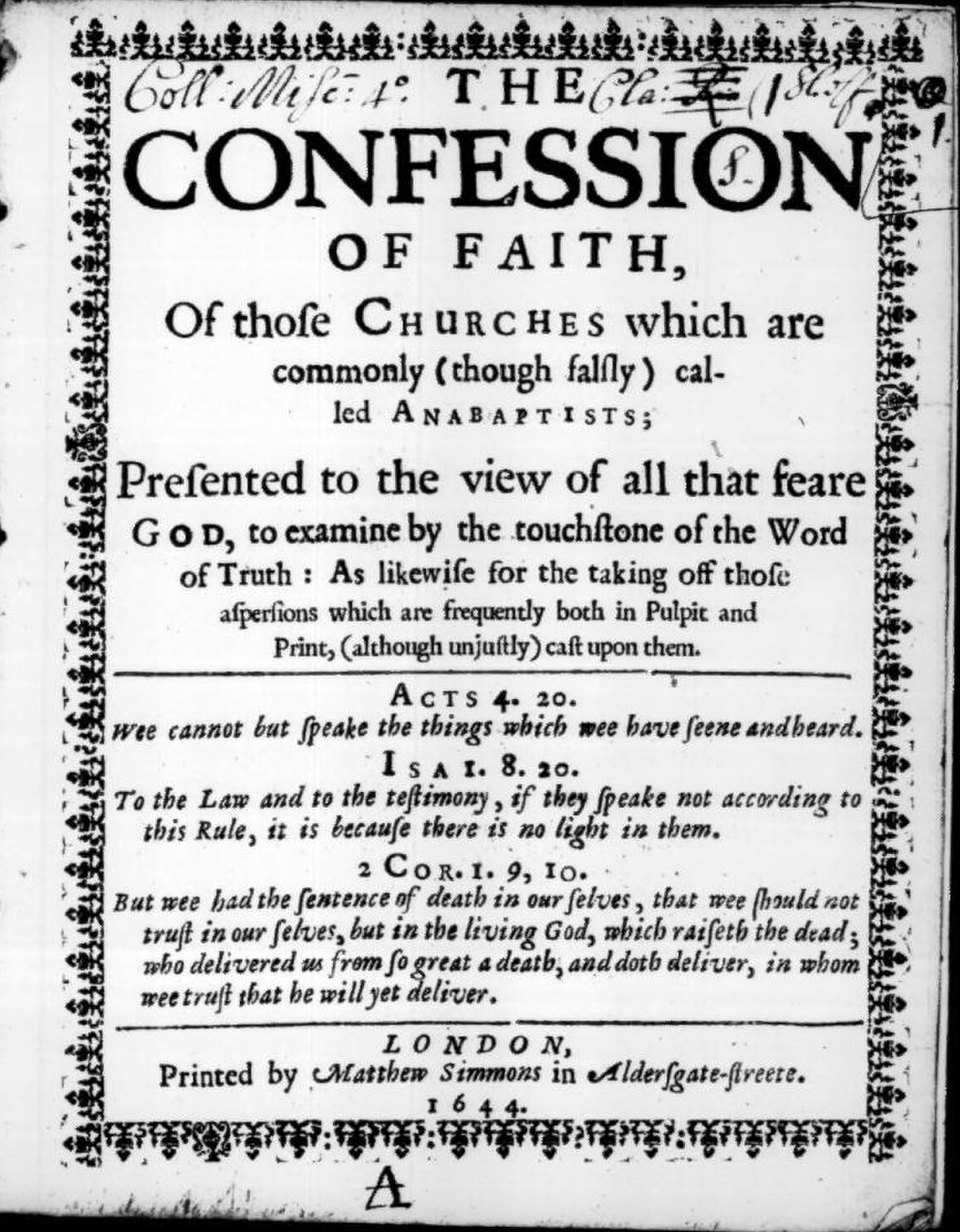
Title page of the first edition: “The Confession of Faith, Of those Churches which are commonly (though falsly) called Anabaptists”, “London, Printed by Matthew Simmons in Aldersgate-streete. 1644.” Microfilm scan (Early English Books 1641-1700) via the Internet Archive and Wikimedia Commons · Public domain
In October 1644 seven Particular Baptist congregations in London jointly issued The Confession of Faith, of those Churches which are commonly (though falsly) called Anabaptists, as its title page reads. It set out their doctrine of Christ, of salvation, and of a church of believers baptized on profession of faith. A corrected and enlarged second impression followed early in 1646 under a new title, A Confession of Faith of Seven Congregations or Churches of Christ in London, which are commonly (but unjustly) called Anabaptists. That edition is generally taken as the authoritative text. In its own words (E. B. Underhill’s 1854 reprint of the 1646 text, spelling modernised): on Scripture, Article VIII says the rule of faith and obedience is “only the word of God contained in the holy scriptures, in which is plainly recorded whatsoever is needful for us to know, believe, and practise, which are the only rule of holiness and obedience for all saints, at all times, in all places to be observed.” On baptism, Article XXXIX says it is “given by Christ, to be dispensed upon persons professing faith, or that are made disciples,” and Article XL that the way of it “is dipping or plunging the body under water; it being a sign, [it] must answer the thing signified, which is, that interest the saints have in the death, burial, and resurrection of Christ.” The 1644 title page offers the confession “to examine by the touchstone of the Word of Truth” and sets three texts before the reader: Acts 4:20, Isaiah 8:20 and 2 Corinthians 1:9-10. It prints Isaiah 8:20 in its own wording, “if they speake not according to this Rule”; in the King James Version the verse reads: “To the law and to the testimony: if they speak not according to this word, it is because there is no light in them.” In the preface the confession is “Subscribed in the Names of seven Churches in London.” Underhill notes that of the signers of the 1646 edition only William Kiffin and John Spilsbery had signed the earlier editions.
Sourceen.wikipedia.org: Wikipedia, “Confession of Faith (1644)” (citing Bingham, JEH 68.3, 2017); title pages from the Angus Library scans (london1644.info) and Oxford Text Archive A80328. Quotations: E. B. Underhill (ed.), Confessions of Faith (Hanserd Knollys Society, 1854), pp. 26-27, 30, 41-42, page images read (archive.org confessionsfaith00undeuoft); KJV Isa 8:20.
Title page of The Bloudy Tenent of Persecution, 1644. Library of Congress, via Wikimedia Commons · Public domain
In 1644, while in England to obtain a charter for the Providence colony, Roger Williams published The Bloudy Tenent of Persecution, for Cause of Conscience, written as a dialogue between Truth and Peace in answer to John Cotton of Boston. Williams argued that the civil power may not compel the conscience in matters of worship, and he pointed Christians to the spiritual weapons of Ephesians 6 and 2 Corinthians 10 rather than the sword of the magistrate. Many copies were burned by order of Parliament. Williams had joined in gathering the Baptist church at Providence in 1638-39, but he left it within months and became a “Seeker” who belonged to no church. His plea for soul liberty was nonetheless taken up by Baptists after him.
Sourceen.wikipedia.org: Wikipedia, “The Bloudy Tenent of Persecution for Cause of Conscience” (citing J. P. Byrd, The Challenges of Roger Williams, 2002; R. Groves ed., 2001). Williams’s later course as a Seeker per Encyclopedia.com, “Roger Williams.”
William Kiffin, portrait by an unknown artist, 1667 (Art UK record 223112). Via Wikimedia Commons · Public domain
William Kiffin (1616-1701), orphaned by the London plague of 1625, became a Baptist in 1641-42 in Henry Jessey’s congregation and was imprisoned in 1641 for attending a Southwark conventicle. When seven London Baptist churches issued their Confession of Faith in 1644, his name headed the signatories. He built a prosperous woollen trade and, from the 1640s until 1692, ministered to the Baptist congregation that opened its meeting house at Devonshire Square in 1667. After the Restoration he was arrested more than once and prosecuted for keeping conventicles. His standing with Charles II let him plead for his brethren, and he obtained a pardon for twelve Baptists of Aylesbury who had been sentenced to death under the Religion Act of 1592. He resigned his charge in 1692 and was buried at Bunhill Fields.
Sourceen.wikipedia.org: Wikipedia, “William Kiffin” (incorporating A. Gordon, Dictionary of National Biography, 1885-1900, public domain; citing Crosby, History of the English Baptists, 1738-40, and Kiffin’s own Remarkable Passages, ed. W. Orme, 1823).
“These were more noble than those in Thessalonica, in that they received the word with all readiness of mind, and searched the scriptures daily, whether those things were so.” (Acts 17:11). Cathcart’s Encyclopedia records that Christopher Blackwood, born in 1606 and educated at Cambridge, was a clergyman in Kent when, in 1644, “the Rev. Francis Cornwell, in preaching a sermon at Cranbrook, in Kent,” questioned infant baptism and the ministers present agreed to examine the subject. “Mr. Blackwood studied the subject thoroughly, and felt compelled to renounce infant baptism forever.” Opponents wrote against him “because of his advocacy of liberty of conscience.” Cathcart adds: “He gathered a Baptist church at Spilshill, near Staplehurst,” and says of him that “Mr. Blackwood received the whole counsel of God, and he would neither hide the truth nor promote discord.” He was regarded as “a very learned man,” “better acquainted with the early Christian fathers than most men in his day.”
Sourcearchive.org: William Cathcart, ed., The Baptist Encyclopedia (Philadelphia: Everts, 1881), vol. 1, s.v. “Blackwood, Rev. Christopher” (public domain; Internet Archive scan). Quotations verbatim, contiguous fragments only, machine-matched against the scan’s text (OCR typography and line-end hyphenation normalised). Birth year and Cambridge education paraphrased from the same entry. KJV: Acts 17:11.
“Buried with him in baptism” (Colossians 2:12). Dr. John Lightfoot, a Presbyterian member of the Westminster Assembly, kept a journal of its debates, and Cathcart quotes his entry for Aug. 7, 1644: “And here fell we upon a large and long discourse, whether dipping were essential, or used in the first institution, or in the Jews’ custom.” The proposed Directory for public worship read, “The minister shall take water and sprinkle or pour it with his hand upon the face or forehead of the child,” and the count came out “the twenty-four for the reserving of dipping and the twenty-five against it.” Lightfoot wrote: “And there grew a great heat upon it; and when we had done all, we concluded upon nothing in it; but the business was recommitted.” Cathcart adds: “The next day dipping was effectually voted down as one of the modes of baptism in the Presbyterian Church.”
Sourcearchive.org: William Cathcart (ed.), The Baptist Encyclopedia (Philadelphia: Everts, 1881), vol. 1, s.v. “Dipping in the Westminster Assembly of Divines” and “Immersion” (public domain; Internet Archive scan). Quotations verbatim, contiguous fragments only, machine-matched against the scan’s text (OCR line-end hyphenation normalised). KJV: Colossians 2:12.
Thomas Patient (also spelled Patience) was an English minister who, the Dictionary of National Biography says, “went out with other godly ministers to New England” between 1630 and 1635. Soon afterwards he began to doubt infant baptism. In the preface to his own book he recalled that he “knew not a single soul who opposed infant baptism”, yet, “searching many authors night and day”, he came to believe that “true repentance was wrought in” him. A warrant was out to bring him before the general court of New England, and when the colony passed its first law against Baptists on 13 November 1644 he returned to England. He was at once chosen assistant to William Kiffin at the Baptist church in Devonshire Square, London, and signed the First London Confession of 1644, and the preface to its second edition (1646). In 1654 he published The Doctrine of Baptism and the Distinction of the Covenants, an argument against infant baptism. He later pastored a Baptist congregation in Dublin, and about 1660 returned to England and went to Bristol as assistant at the Baptist church in the Pithay. There, on 4 October 1663, he was sent to prison with Thomas Ewins and Edward Terrill for preaching, and stayed at least three months. On 28 June 1666 he was set apart as co-pastor with Kiffin at Devonshire Square, Hanserd Knollys and Kiffin laying on hands. The plague was raging round the meeting-house, and on 29 July 1666 he died of it; the church book records his death and burial on the next day. The apostle’s word on the ordinance, which Baptists have always set beside this story, is Romans 6:4: “Therefore we are buried with him by baptism into death: that like as Christ was raised up from the dead by the glory of the Father, even so we also should walk in newness of life.”
Sourceen.wikisource.org: C. Fell Smith, “Patient, Thomas”, Dictionary of National Biography vol. 44 (1895, PD), Wikisource; quoted phrases verbatim. Cross-check: Wikipedia, “Thomas Patient” (same facts; d. 29 July 1666). Army, state and political episodes omitted. Rom 6:4 per KJV.
John Tombes was born at Bewdley, Worcestershire, about 1603, studied at Magdalen Hall, Oxford, and was ordained, becoming a popular preacher and, from 1630, vicar of Leominster. The Dictionary of National Biography notes that “as early as 1627 he began to have doubts on the subject of infant baptism.” He laid his scruples before the Westminster Assembly of divines “but got no satisfaction,” and “declining to baptise infants” he lost his London parish in 1645, though he was soon made master of the Temple on condition that he not preach on baptism. In December 1645 he published Two Treatises and an Appendix concerning Infant Baptisme, the first of a long line of works on the subject, among them Antipædobaptism (1652-57), which answered twenty-three contemporary writers. At Bewdley he organised a baptist church that, in Richard Baxter’s reckoning, “never exceeded twenty-two members.” On 1 January 1650 he and Baxter debated baptism before a crowded chapel from nine in the morning till five at night; the DNB records Anthony Wood’s verdict that Tombes “got the better of Baxter by far” and Baxter’s own, that he “had still the advantage of a good cause.” Tombes’s place in Baptist history is a careful one: he held the baptist position all his life yet never made a break with the Church of England, and the DNB says plainly that after the Restoration he “conformed in a lay capacity” and “communicated as an Anglican.” It also calls him “always a courteous disputant, and a man of exceptional capacity and attainments.” He died at Salisbury on 22 May 1676. The text on which the argument turned is the Great Commission: “Go ye therefore, and teach all nations, baptizing them in the name of the Father, and of the Son, and of the Holy Ghost:” (Matthew 28:19).
Sourceen.wikisource.org: A. Gordon, “Tombes, John”, DNB vol. 57 (1899, PD), Wikisource. All quoted phrases verbatim from the DNB. Birth year uncertain (1602 or 1603). He never joined a Baptist denomination as such; the Bewdley church was his own gathering. Matt 28:19 per KJV.
Hanserd Knollys, engraved portrait, from C. K. Bolton, Portraits of the Founders (Internet Archive: foundersportrai02bolt), p. 124. Via Wikimedia Commons · Public domain
Hanserd Knollys (c. 1598-1691), born at Cawkwell in Lincolnshire and educated at Cambridge, was ordained in the Church of England in 1620. Scruples about its ceremonies led him to resign his living, and in 1636 he renounced his orders and went to New England to escape the Court of High Commission. There he preached at Dover, New Hampshire, and came to hold the baptism of believers. Back in London from December 1641 he kept school, learned Hebrew and published The Rudiments of the Hebrew Grammar in English (1648). He baptized Henry Jessey in 1645 and in 1646 gathered a church that met in one place after another. He signed the 1646 edition of the London Confession and pleaded for liberty of conscience. On 10 May 1670 he was arrested at his meeting in George Yard under the Conventicle Act, preached to his fellow prisoners, and was discharged at the next sessions. He lived to see the Toleration Act of 1689 and, in extreme old age, laboured for the consolidation of the Baptist churches. He died on 19 September 1691 in his ninety-third year and was buried in Bunhill Fields.
Sourceen.wikipedia.org: Wikipedia, “Hanserd Knollys” (incorporating A. Gordon, Dictionary of National Biography, 1892, public domain; citing K. G. C. Newport, Oxford DNB, 2004). See also D. C. Bustin, Paradox and Perseverance (2006).
“And he said unto them, Go ye into all the world, and preach the gospel to every creature.” (Mark 16:15). Cathcart’s Encyclopedia records that Vavasor Powell was born in Radnorshire, Wales, in 1617, and that through reading Puritan books and hearing their sermons he “was led to the Saviour.” In 1646, with a testimonial to his “able gifts for the work of the ministry,” he returned to Wales, where, Cathcart says, “He proclaimed Jesus at fairs, markets, and wherever there was a gathering of people” and “preached the glorious gospel upon mountains, in jails.” The Encyclopedia states that “Before 1660 Mr. Powell had formed more than twenty churches,” calls him “properly designated the Whitefield of that principality,” and says plainly, “He was also a Baptist.” It records that he “spent eight years in thirteen prisons” and died in the Fleet jail, London, on 27 October 1671, adding that “Mr. Powell was an ardent lover of the Bible.”
Sourcearchive.org: William Cathcart, ed., The Baptist Encyclopedia (Philadelphia: Everts, 1881), vol. 2, s.v. “Powell, Vavasor” (public domain; Internet Archive scan). Quotations verbatim, contiguous fragments only. Nothing beyond the entry is asserted; the entry’s remarks on civil politics are not reproduced here. KJV: Mark 16:15.
“Stand fast therefore in the liberty wherewith Christ hath made us free, and be not entangled again with the yoke of bondage.” (Galatians 5:1). William Dell was educated at Cambridge, and after Episcopal ordination “he became a clergyman of the Established Church.” Cathcart’s Encyclopedia counts him among those who in the seventeenth-century awakening came to Baptist views on baptism and on the church. “He denounced all compulsion in matters of religion”, and wrote against uniformity enforced by law. “In 1645 he was appointed a chaplain in the army”, attending Sir Thomas Fairfax, and “preached at headquarters, where he exerted a powerful influence with leading men against Presbyterian legal intolerance, and in favor of religious liberty.” On November 25, 1646, he was appointed to preach before the House of Commons at a public fast. “His subject was Reformation, and in treating this popular topic he showed the folly and wickedness of trying to secure it by persecution.” Many hearers took offense, but “his conscience compelled him to tell these legislators some wholesome truths.” In 1649 he was made master of Caius College, Cambridge, and Cathcart records that he lost his rectory and college “through his fidelity to Baptist principles by the Act of Uniformity in 1662.”
Sourcearchive.org: William Cathcart (ed.), The Baptist Encyclopedia (Philadelphia: Everts, 1881), vol. 1, s.v. “Dell, Rev. William, A.M.” (public domain; Internet Archive scan). Quotations verbatim, contiguous fragments only, machine-matched against the scan’s text (OCR line-end hyphenation normalised). KJV: Galatians 5:1.
Benjamin Cox (also Coxe or Cockes) was born in Oxfordshire about 1595, took his M.A. at Oxford in 1617, and was ordained and held a living in Devonshire. The Dictionary of National Biography records that he later became a minister at Bedford and there “openly preached the invalidity of infant baptism.” Invited in 1643 to form a congregation at Coventry, he was drawn into a public dispute with Richard Baxter, after which the presbyterians ordered him to leave the town and, when he did not, imprisoned him. On his release he went to London and preached to a congregation of Baptists, and in 1645 joined Hanserd Knollys and others in a declaration about a public dispute on infant baptism at Aldermanbury that had been forbidden. His name, spelled Benjamin Cockes, stands among the signers of the London Confession of the seven churches. In 1646 he published An Appendix to a Confession of Faith, “A more full declaration of the faith and judgement of baptized beleevers,” written because godly persons in the country had asked what those churches believed, and published “for the further clearing of the Truth, and discovery of their mistake who have imagined a dissent in fundamentals where there is none.” Its opening sets the tone: “It is therefore our duty, in meekness and love, to give an answer to those godly persons which desire to be fully informed of our judgment.” Against the charge that such doctrine left nothing to preach, it answers: “through the goodness of God we know and preach to sinners this precious gospel”, and quotes John 3:16. Cox conformed in 1662 but afterwards gave up his living and, the DNB says, “continued a baptist until his death at an advanced age.” The Appendix opens on the apostle’s word in 1 Peter 3:15: “But sanctify the Lord God in your hearts: and be ready always to give an answer to every man that asketh you a reason of the hope that is in you with meekness and fear.”
Sourceen.wikisource.org: W. Hunt, “Cox, Benjamin”, DNB vol. 12 (1887, PD), Wikisource. Appendix quoted verbatim from Underhill, Confessions of Faith (1854, PD; archive.org confessionsfaith00undeuoft). Underhill puts his name on the 1646 Confession; the DNB says 1647. 1 Pet 3:15 per KJV.
Readers who follow a column of references from one verse of the King James Bible to another walk a path that John Canne (d. 1667?) helped to lay. Canne was a Separatist pastor who became the successor of Henry Ainsworth over the congregation of English independents at Amsterdam, where he worked as a printer as well as a preacher. Visiting Bristol in 1640, he preached to the newly gathered Broadmead congregation, and its records call him “a baptized man by them called an anabaptist”. His lasting work was a King James Bible with notes and references in the margin. The Dictionary of National Biography dates the first known edition to Amsterdam in 1647 and calls it “the best work of its kind that had then appeared”; that edition already speaks of additions “to the former notes in the margin”, and the historian Anderson named a quarto of 1644, so the first printing is not certainly known. An edition of 1664, “no doubt printed abroad, perhaps at Amsterdam”, carries the title-page promise “with marginal notes shewing the Scripture to be the best interpreter of Scripture”. Darlow and Moule’s catalogue of the Bible Society’s library (1903) judged that his edition “was the first to contain a full apparatus of carefully selected marginal references”, and the DNB adds that it “was used in the preparation of Bagster’s ‘Comprehensive Bible,’ of which it is indeed the basis”. Canne also wrote on the public controversies of the Commonwealth, which lie outside this museum’s subject; he is believed to have died in Amsterdam in 1667. “Which things also we speak, not in the words which man’s wisdom teacheth, but which the Holy Ghost teacheth; comparing spiritual things with spiritual.” (1 Corinthians 2:13, KJV).
Sourceen.wikisource.org: DNB vol. 8 (Axon, 1886, PD), “Canne, John”, Wikisource, read in full. Darlow & Moule, Historical Catalogue of the Printed Editions of Holy Scripture I (1903, PD; Internet Archive historicalcatal00librgoog), no. 540 (1664; “full apparatus”; Anderson’s 1644 quarto); post-1611 entries give the King James text. 1664 title per Morgan Library PML 16002.1. Cross-check: Wikipedia. Not claimed as a Baptist; political writings omitted on purpose. KJV: 1 Cor 2:13.
The First Baptist Church in Swansea, Massachusetts: the Greek Revival chapel of 1848, fifth home of the congregation Myles brought from Ilston. Photograph by Marc N. Belanger, 2009, via Wikimedia Commons · Public domain
John Myles (c. 1621-1683) was a Welshman educated at Brasenose College, Oxford. In London he attended the Glasshouse Church, one of the earliest Baptist churches there, and became convinced of the baptism of believers. Returning to Wales, he gathered a Baptist church at Ilston, on the Gower peninsula near Swansea, on 1 October 1649. It is the earliest Welsh Baptist church of which records survive, and its register, the Ilston Book, lists 261 members up to 1660, drawn from across South Wales. After the Restoration, when in 1662 every minister was required to conform to the Book of Common Prayer, Myles and a company from Ilston crossed to New England, taking the book with them. In 1663, in the house of John Butterworth at Rehoboth in Plymouth Colony, seven men covenanted together as a church: the first Baptist church in Massachusetts. In July 1667 the Plymouth court fined Myles and James Brown “for their breach of order, in setting up of a public meeting without the knowledge and approbation of the Court.” Before the year was out, on 30 October 1667, land at Wannamoisett was set apart for them, and there Myles led the church to found a town they named Swansea after their home in Wales. The First Baptist Church in Swansea is the oldest Baptist congregation in Massachusetts. The Ilston Book is kept today in the library of Brown University.
Sourceen.wikipedia.org: Wikipedia, “Ilston Book” (citing B. G. Owens, ed., The Ilston Book, NLW, 1996), “John Myles (minister)” and “First Baptist Church in Swansea.” The date 1 October 1649, the Butterworth meeting, its seven members and the Plymouth court records of 2 July and 30 October 1667 per H. M. King, Rev. John Myles and the Founding of the First Baptist Church in Massachusetts (1905), baptisthistoryhomepage.com/myles.john.by.king.html. Public domain.
In July 1651 John Clarke, Obadiah Holmes and John Crandall of the Baptist church in Newport visited an elderly member of their congregation in Lynn, Massachusetts, and were arrested for their worship. Friends paid the fines of Clarke and Crandall. Holmes refused, as a matter of conscience, to let his be paid, and on 5 September 1651 he was publicly whipped in Boston. He returned to Newport and served as pastor of its Baptist church for some thirty years, until his death in 1682.
Sourceen.wikipedia.org: Wikipedia, “Obadiah Holmes” (citing J. T. Holmes, 1915; Austin, 1887; Bicknell, 2005). Image intentionally omitted.
“They that go down to the sea in ships, that do business in great waters” (Ps. 107:23). Cathcart’s Encyclopedia counts the Commonwealth admiral Sir John Lawson, born near Scarborough, among the Baptists. It says that on June 2, 1653, when the English fleet attacked the Dutch off Flanders, “Lawson charged through the Dutch fleet with forty ships,” and the Dutch were routed the next day. When the army set itself against the recalled Parliament after Richard Cromwell fell, Lawson brought the fleet into the Thames and declared for the Parliament. Cathcart quotes Lord Clarendon, no friend of Baptists, calling him “an excellent seaman, but then a notorious Anabaptist,” and “incomparably the modestest and the wisest man.” Wounded in the knee in the battle of June 3, 1665, he died a few days later on shore, “rejoicing in the blessed Saviour whom he was going to meet.”
Sourcearchive.org: William Cathcart (ed.), The Baptist Encyclopedia (Philadelphia: Everts, 1881), vol. 2, s.v. “Lawson, Admiral Sir John” (public domain; Internet Archive scan). Quotations verbatim, contiguous fragments only, machine-matched against the scan’s text (OCR line-end hyphenation normalised; OCR misreadings corrected only outside quotation marks). KJV: Ps. 107:23.
Henry Dunster, born near Bury in Lancashire and trained at Magdalene College, Cambridge (B.A. 1630, M.A. 1634), was known as a fine Hebrew scholar. He came to Massachusetts in 1640 and on 27 August 1640 was made the first president of the newly founded Harvard College. For fourteen years he taught, held the college together through hard times, secured its charter of 1650, and helped revise the psalter used by the New England churches. Then, in 1653-54, he came to reject the baptism of infants and to hold that baptism belongs to believers. He did not bring his own infant son to be baptized and spoke openly for his view. Efforts to change his mind failed, and on 24 October 1654 he gave up the presidency. The Dictionary of National Biography says he “was persuaded” to resign; modern accounts describe him as forced out. He withdrew to Scituate in Plymouth Colony and preached there until his death on 27 February 1658/9. The same dictionary records: “He bequeathed legacies to the very persons who had clamoured the loudest for his removal from the college.” Neither source calls him a Baptist, but the historian William Brackney names him “an important precursor” of the Baptists in America, and his friend Thomas Goold of Charlestown went on to gather the First Baptist Church of Boston. The pattern he held to is the New Testament one (Acts 2:41, KJV): “Then they that gladly received his word were baptized: and the same day there were added unto them about three thousand souls.”
Sourceen.wikisource.org: Dictionary of National Biography (1885-1900), vol. 16, “Dunster, Henry,” by Gordon Goodwin (1888, PD), via Wikisource, life, presidency, resignation 24 Oct 1654, Scituate, death; the legacies sentence is quoted verbatim. Cross-checked: Wikipedia, “Henry Dunster” (1653-54 change of view, unbaptized son, Brackney’s phrase). Paraphrased otherwise. Acts 2:41 per KJV.
William Gurnall, rector of Lavenham in Suffolk from 1644, preached through the close of Ephesians 6 in his regular ministry and published the sermons as The Christian in Complete Armour, in three volumes dated 1655, 1658 and 1662. He was not a Baptist: at the Restoration he conformed to the Church of England and remained at Lavenham until his death on 12 October 1679. The Dictionary of National Biography (1890) says he was born in 1617 in the parish of Walpole St Peter, near Lynn; the Encyclopaedia Britannica (1911) says King’s Lynn. The Britannica judged that “The work is more practical than theological”. Gurnall opens with the apostle writing from his chains: “Paul was Nero’s prisoner, but Nero was much more God’s.” He bids the faint-hearted be strong in the Lord, “on whose performance lies the stress of the battle, and not on your skill or strength.” Of the shield of faith he writes: “A grace of graces it is, and here fitly placed in the midst of the other her companions. It stands, methinks, among them, as the heart in the midst of the body.” “Finally, my brethren, be strong in the Lord, and in the power of his might” (Ephesians 6:10, KJV).
Sourceen.wikisource.org: Dictionary of National Biography (1890), “Gurnall, William” (Lavenham 1644; volumes 1655, 1658, 1662; conformed; d. 12 Oct 1679; b. Walpole St Peter); Encyclopaedia Britannica (1911), “Gurnall, William” (b. King’s Lynn; “more practical than theological”). Quotations: The Christian in Complete Armour, London: Tegg, 1845 (public domain), checked against the 1862 and 1658 printings. KJV: Eph 6:10.
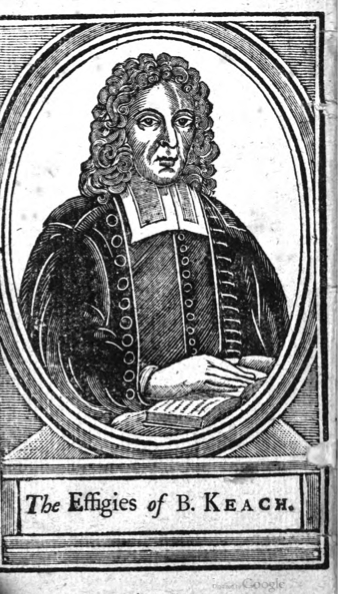
“And Philip said, If thou believest with all thine heart, thou mayest. And he answered and said, I believe that Jesus Christ is the Son of God” (Acts 8:37). Cathcart’s Encyclopedia records that Benjamin Keach “was born in Stokehaman, England, Feb. 29, 1640,” and “found peace through Christ in his fifteenth year.” Being “unable to discover infant baptism or baptism by sprinkling in the Bible, and being fully satisfied that every believer should be immersed, he was baptized after the Saviour’s example by John Russel, and united with a neighboring Baptist church.” That community, perceiving his gifts, encouraged him “when he was eighteen years old, to exercise his gifts as a minister.” (His later pastorate at Horsleydown appears in a separate entry.)
Sourcearchive.org: William Cathcart, ed., The Baptist Encyclopedia (Philadelphia: Everts, 1881), vol. 1, s.v. “Keach, Rev. Benjamin” (public domain; Internet Archive scan). Quotations verbatim, contiguous fragments only, machine-matched against the scan’s text (OCR typography and line-end hyphenation normalised). Years 1655 and 1658 are computed from the entry’s birth year (1640) and the stated ages fifteen and eighteen. KJV: Acts 8:37.
In 1656 the Particular Baptist churches of the Western Association, gathered in Somerset and the counties adjacent (Wiltshire, Devon, Gloucestershire and Dorset), issued a confession of their own: “A Confession of the Faith of Several Congregations of Christ in the County of Somerset, and Some Churches in the Counties Near Adjacent.” The accounts consulted for this entry place its approval at the Association’s meeting at Bridgwater on 5-6 September 1656. E. B. Underhill, who reprinted it in 1854, read the records differently: at a meeting at Bridgwater in November 1656 the Association already answered a question by referring to “the forty-fourth article of the confession of the faith of the churches in these parts,” so he judged it “probable” that the confession had been adopted at Wells the April before. Both views are given here. It has forty-six articles. Its epistle is signed for sixteen churches: eleven in Somerset, among them Bridgwater, Taunton, Chard, Wells and Wincanton, with North Bradley in Wiltshire, Luppit in Devon, Sedbury and Bristol in Gloucestershire, and “in and near Lime” in Dorset. Thomas Collier’s name follows the signers, and Underhill took it to be “the production of his pen.” The churches say they first wrote it not for public view “but did it rather for a trial of our unity in the faith,” and published it being “very sensible of the great distractions and divisions that are amongst professing people in this nation.” Of Christ as prophet, Article XVIII confesses: “As he is our prophet, so he hath given us the scriptures, the Old and New Testament, as a rule and direction unto us both for faith and practice.” The last article says that a church so believing and so walking, “though despised and of low esteem,” is still, to its Lord, “Black, yet comely,” “Kept by the Lord,” “Graven on the palms of his hands,” and that “The gates of hell shall not prevail against it.” It holds the doctrines of grace, believer’s baptism by immersion, and the order of the gathered church, and one account observes that the Calvinism of the Western Association “was not of a rigid type.” Its appeal is to Scripture: “To the law and to the testimony: if they speak not according to this word, it is because there is no light in them” (Isaiah 8:20); its concern for fellowship echoes “Endeavouring to keep the unity of the Spirit in the bond of peace” (Ephesians 4:3). Quotations follow Underhill’s reprint, in modern spelling. No licence-verified title-page plate has yet been found, so none is shown.
Sourcebaptisthistoryhomepage.com: E. B. Underhill (ed.), Confessions of Faith (Hanserd Knollys Society, 1854), pp. xi, 63-64, 73-74, 83, 106, read on the Internet Archive page images (confessionsfaith00undeuoft); see the Reading Room. Also: Baptist History Homepage, Somerset Association page; reformedreader.org “Somerset Confession of 1656” intro (Bridgwater, 5-6 Sept 1656; Collier); A. J. Westlake, Baptist Quarterly 13:3; KJV Isa 8:20, Eph 4:3.
“earnestly contend for the faith which was once delivered unto the saints” (Jude 3). William Jeffery, born about 1616, was at Seven-Oaks in Kent “one of the chief supporters, if he was not the founder, of the Baptist church.” With help from others he “was instrumental in founding more than twenty churches.” He wrote The Whole Faith of Man, “the second edition of which was issued in 1659.” Cathcart calls him “a very decided Baptist, never inviting controversy.” Once the magistrates “arrested all the men in his congregation while they were at worship, and kept them in prison an entire night.” Released the next day, the men came back to find the women, who “had continued in fasting and prayer for their release.” Later “Mr. Jeffery was imprisoned after the restoration of Charles II., and subjected to many hardships.”
Sourcearchive.org: William Cathcart (ed.), The Baptist Encyclopedia (Philadelphia: Everts, 1881), vol. 1, s.v. “Jeffery, Rev. William” (public domain; Internet Archive scan). Quotations verbatim, contiguous fragments only, machine-matched against the scan’s text (OCR line-end hyphenation normalised). KJV: Jude 3.
In the first month of 1660 (March, by the old reckoning), at a moment of “scandal and reproach,” a company of General Baptist elders, deacons and brethren met at London and issued A Brief Confession or Declaration of Faith, “set out by many of us, who are (falsely) called Anabaptists, to inform all men … of our innocent belief and practice.” It is the confession later called the Standard Confession, and its twenty-five articles speak for the General (Arminian) Baptists, who held that Christ died for all, as distinct from the Particular Baptists of the 1644 and 1689 confessions. Underhill says it was presented to Charles II on 26 July 1660 by Thomas Grantham and Joseph Wright. It was adopted by the General Assembly in 1663, reissued by Grantham in 1678, and reaffirmed in the 1690s. Its authorship is debated: a recent study by Stephen Holmes argues for Matthew Caffyn, Joseph Wright and John Parsons the elder, where earlier accounts left it anonymous. In its own words (Underhill’s 1854 reprint, spelling modernised): on Scripture, Article 23 says “the holy scriptures is the rule whereby saints, both in matters of faith and conversation, are to be regulated,” and it cites 2 Timothy 3:15-17, “that the man of God may be perfect, throughly furnished unto all good works.” On baptism, Article 11 says the church is gathered by first preaching the gospel and then to “baptize (that is in English, to dip)” only such “as profess repentance towards God, and faith towards our Lord Jesus Christ.” On the Atonement, Article 3 confesses the Lord Jesus “gave himself a ransom for all” (1 Timothy 2:6) and “tasting death for every man” (Hebrews 2:9), a conviction that Calvinistic Baptists did not share, and the museum records the difference as plainly as the confession does. On conscience, Article 24 holds that all men should have “the free liberty of their own conscience in matters of religion, or worship, without the least oppression or persecution.” The title page sets beneath it the apostle’s words of Acts 24:14 (KJV): “after the way which they call heresy, so worship I the God of my fathers, believing all things which are written in the law and in the prophets.” Its own purpose was a calm, public answer to slander, offered in a spirit of patient suffering.
Sourcearchive.org: E. B. Underhill (ed.), Confessions of Faith (Hanserd Knollys Society, 1854), pp. xi-xii, 109-119 (title page, Arts. 3, 11, 23, 24; archive.org confessionsfaith00undeuoft, text matched). Authorship/editions: S. R. Holmes, note on the 1660 Standard Confession, St Andrews Research Portal; Wikipedia, “General Baptists.” KJV 1 Tim 2:6, Heb 2:9, 2 Tim 3:15-17, Acts 24:14.
Thomas Grantham (1634-1692) was born at Halton Holegate, near Spilsby, Lincolnshire. The Dictionary of National Biography records that he belonged to the “poor kindred” of an old county family; tradition makes him a tailor and afterwards a farmer. In 1651 four persons had left a nonconformist congregation in the South Marsh, “having become baptists.” Grantham joined them, “was baptised at Boston in 1653, and in 1656 was chosen their pastor.” On 26 July 1660 he and Joseph Wright of Westby were admitted to present to Charles II the “narrative and complaint” of the Lincolnshire General Baptists, “with a copy of the ‘brief confession’ and a petition for toleration.” Of the confession itself the DNB says only: “It is not clear that Grantham had any direct hand in preparing” it. “Twice in 1662 he was arrested.” Because his Arminian preaching had started a rumour that he was “a papist and a jesuit,” he was arrested again at Boston, “thrown into Lincoln gaol, and kept there some fifteen months.” He was released at the spring assize of 1663, after a petition that he had drawn up himself. While in Lincoln Castle he wrote The Baptist against the Papist (dated 10 January 1662, that is 1663). In 1666 he became a “messenger,” and “Grantham developed the office into an itinerant ministry-at-large to ‘plant churches.’” Under the Conventicle Act of 1670 he lay six months in prison at Louth, and in 1678 he gathered his teaching in Christianismus Primitivus. In 1685 or 1686 he moved to Norwich and founded congregations there, at Yarmouth and at King’s Lynn. The same article states plainly: “His later theology was of a Sabellian type, with a strong leaning to the quaker doctrine of the inner light.” The museum records this as written, without commendation. When John Willet admitted that his slander of Grantham had no foundation, “Grantham paid Willet’s costs, and saved him from gaol.” The DNB dates his death “Sunday, 17 Oct. 1692” (some modern accounts give 17 January). He was buried in St. Stephen’s, Norwich, where his friend the vicar John Connould said: “This day has a very great man fallen in Israel.” “Wherein I suffer trouble, as an evil doer, even unto bonds; but the word of God is not bound” (2 Timothy 2:9).
Sourceen.wikisource.org: DNB vol. 22 (1890), Grantham, Thomas (1634-1692), by Alexander Gordon (Wikisource), citing Grantham’s Christianismus Primitivus (1678), Crosby and Kennett. The death date is cross-checked with Wikipedia, “Thomas Grantham (Baptist)”, which gives 17 January 1692. No plate: no image with clear rights was found. 2 Tim 2:9 KJV verified.
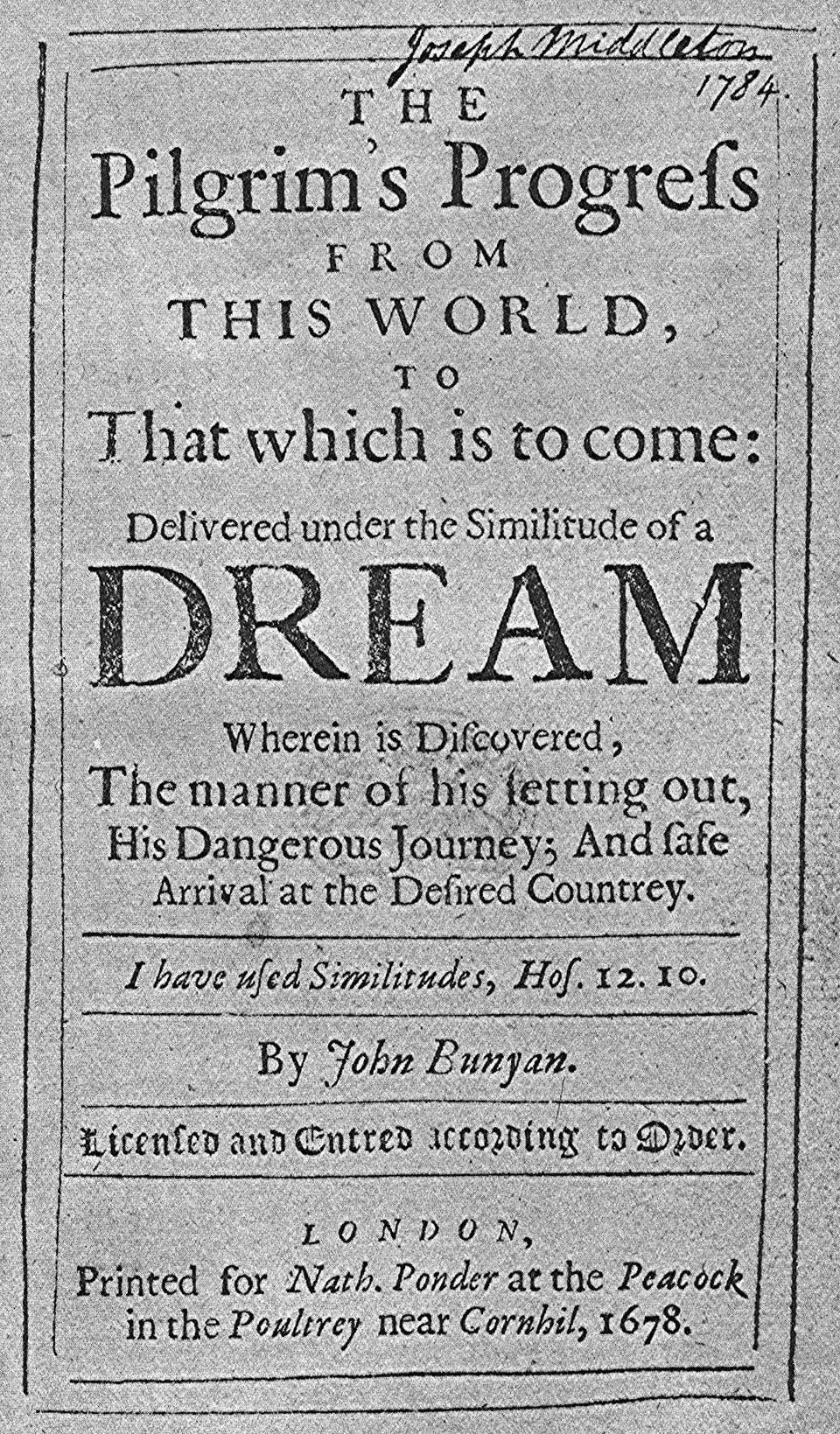
Title page of the first edition of The Pilgrim’s Progress, “By John Bunyan”, “Printed for Nath. Ponder at the Peacock in the Poultrey near Cornhil, 1678”, with “I have used Similitudes, Hos. 12. 10.” and an owner’s signature dated 1784. Copy not identified; via Wikimedia Commons · Public domain
John Bunyan (1628-1688), a brasier or tinker of Elstow near Bedford, was awakened, the Dictionary of National Biography records, by the talk of a few poor women at Bedford, “sitting at a door in the sun and talking about the things of God.” In 1653 he joined their nonconformist congregation, the Bedford meeting under “holy Mr. Gifford”; in 1657 he was set apart to preach “after solemn prayer and fasting”, and people came “by hundreds, and that from all parts” to hear him. After the Restoration, preaching outside the established church was again forbidden. On 12 November 1660 he was arrested at Lower Samsell, near Harlington, while about to hold a service in a private house; he could have escaped the warrant but would not. He refused to give up public preaching, answering that the law “had provided two ways of obeying”: to obey actively, or else to suffer its penalty. The county gaol at Bedford was his “close and uncomfortable” home for twelve years (with a brief release in 1666). There he made long tagged laces to support his family, preached to fellow prisoners, at one time as many as sixty, and wrote, among much else, Grace Abounding to the Chief of Sinners (1666). Freed in 1672, he had already been called (21 January) as pastor of the Bedford congregation and received a licence to preach dated 9 May. In 1673 he published Difference of Judgment about Water Baptism no Bar to Communion, arguing, as its title says, that a difference over water baptism need not divide believers at the Lord’s table; that is why he is described here, as elsewhere in this museum, as a nonconformist pastor commonly counted among the Baptists. The Pilgrim’s Progress followed in 1678; Bunyan himself says it was dreamed in “the gaol”, though whether in the long imprisonment or a shorter one about 1675 is debated (the DNB weighs both). He died in London on 31 August 1688 and was buried in Bunhill Fields. Paul’s own request at the close of the armour passage: “For which I am an ambassador in bonds: that therein I may speak boldly, as I ought to speak.” (Ephesians 6:20, KJV).
Sourceen.wikisource.org: Dictionary of National Biography, vol. 7 (1886), “Bunyan, John” by Edmund Venables (public domain, Wikisource), read in full; quoted phrases verbatim. Cross-checked: Wikipedia “John Bunyan” (Lower Samsell near Harlington, twelve years, freed May 1672, Pilgrim’s Progress 1678, 31 Aug 1688, Bunhill Fields). KJV: Eph. 6:20.
“Blessed are ye, when men shall revile you, and persecute you” (Matthew 5:11). John James “was pastor of the Baptist church meeting in Bulstake Alley, Whitechapel, London.” Cathcart records that late in 1661 officers of the law twice interrupted him while he preached to his own people and dragged him from the pulpit; on the charge of a journeyman pipe-maker that he had spoken treason against the king he was sent to the Tower, and “On the 14th of November” he was brought before Chief-Justice Forster at Westminster Hall. He pleaded “not guilty, neither in matter nor form.” When his wife petitioned Charles II for mercy, “the door was shut against her.” Hearing his sentence, he said, “Blessed be God, whom man hath condemned God hath justified.” He was hanged, drawn and quartered at Tyburn, and “his head was set upon a pole opposite his meeting-house.” Cathcart adds that “Mr. James was a Seventh-Day Baptist.”
Sourcearchive.org: William Cathcart (ed.), The Baptist Encyclopedia (Philadelphia: Everts, 1881), vol. 1, s.v. “James, Rev. John” (public domain; Internet Archive scan). Quotations verbatim, contiguous fragments only, machine-matched against the scan’s text (OCR line-end hyphenation normalised). KJV: Matthew 5:11.
“Yea, and all that will live godly in Christ Jesus shall suffer persecution.” (2 Timothy 3:12). Cathcart’s Encyclopedia tells of Francis Bampfield, a Devonshire-born minister who as a parish clergyman “spent his entire income from the church in Bibles and religious books for the poor,” and who was ejected from Sherborne in 1662 by the Act of Uniformity. He kept on preaching and was imprisoned; “In this prison he preached almost daily, and was enabled to gather a church within its walls.” He later formed a church at Pinner’s Hall, London, “on the 5th of March, 1675.” Cathcart says he “departed for the eternal rest from the prison of Newgate, Feb. 16, 1683” (a date reckoned in the old-style year), “from the injury inflicted on his health by his prolonged imprisonments,” and writes: “Francis Bampfield was, above all things, a living servant of Jesus.” He belonged to the Seventh-Day Baptists.
Sourcearchive.org: William Cathcart, ed., The Baptist Encyclopedia (Philadelphia: Everts, 1881), vol. 1, s.v. “Bampfield, Rev. Francis, M.A.” (public domain; Internet Archive scan). Quotations verbatim, contiguous fragments only, machine-matched against the scan’s text (OCR typography and line-end hyphenation normalised). Dates as Cathcart gives them; the year of death is old-style (modern reckoning: 1684). Political paragraph omitted. KJV: 2 Timothy 3:12.
Title page of Mamusse Wunneetupanatamwe Up-Biblum God (Cambridge, Mass.: Samuel Green and Marmaduke Johnson, 1663), a copy bearing the John Carter Brown Library stamp. Via Internet Archive and Wikimedia Commons · Public domain
In 1663 two printers at Cambridge, Massachusetts, Samuel Green and Marmaduke Johnson, finished the whole Bible in Massachusett, the language of the Algonquian people of eastern New England. It was the first Bible printed in North America in any language. Its title, Mamusse Wunneetupanatamwe Up-Biblum God, means word for word “The Whole Holy His-Bible God”. The translator was John Eliot (1604-1690), minister at Roxbury, who from 1646 preached to the Massachusett in their own language and held that they should hear and read the Scriptures in it. The language had never been written, so he had to learn it and become its grammarian. Native men worked beside him: Cockenoe and John Sassamon as translators; John Nesutan (also recorded as Job Nesuton), a preacher, in the translation; and James Printer, a young Nipmuc apprenticed to Green, at both the translation and the press. The New Testament came out in 1661, and the whole Bible, about 1,000 copies of some 1,180 pages, in 1663. The cost was met by gifts gathered in England and Wales through the Society for the Propagation of the Gospel in New England. Most copies were lost in the war of 1675-76. Eliot, then seventy-two, began again, and a corrected second edition appeared in 1685. “And how hear we every man in our own tongue, wherein we were born?” (Acts 2:8, KJV).
Sourcemasshist.org: Massachusetts Historical Society, Collections Online, “Witness to America’s Past” (first Bible printed in any language in North America; NT 1661, Bible 1663; Eliot at Roxbury, preaching from 1646; Nesutan, James Printer; Society for the Propagation of the Gospel; copies lost 1675-76; second edition 1685). Wikipedia, “Eliot Indian Bible” (title meaning; previously unwritten language; Cockenoe, Sassamon; 1,000 copies, 1,180 pp.; English and Welsh gifts). Acts 2:8 KJV verified.
“searched the scriptures daily, whether those things were so” (Acts 17:11). John Hutchinson, born at Nottingham in 1616 and educated at Cambridge, held Nottingham for the Parliament in the civil war, when “he was made governor of the castle and town of Nottingham.” Cathcart states plainly: “He was one of the judges that tried Charles I., and signed his death-warrant.” In the memoir by his widow, Lucy, which Cathcart quotes at length, notes “concerning Pedobaptism” found in the castle led first her and then him to the Scriptures; he “diligently searched the Scriptures alone, and could find in them no ground at all for that practice,” and when the ministers could not answer him, “the infant was not baptized.” For this the couple were “called fanatics and anabaptists.” Cathcart, who counts them Baptists, adds that he “abhorred all persecution for conscience’ sake” and protected George Fox when Fox was imprisoned at Nottingham. Arrested after the Restoration, he was taken to the Tower and then to Sandown Castle, in Kent, “where he died Sept. 10, 1664.”
Sourcearchive.org: William Cathcart (ed.), The Baptist Encyclopedia (Philadelphia: Everts, 1881), vol. 1, s.v. “Hutchinson, Gov. John” (public domain; Internet Archive scan). Quotations verbatim, contiguous fragments only, machine-matched against the scan’s text (OCR line-end hyphenation normalised). KJV: Acts 17:11.
“Blessed are the peacemakers: for they shall be called the children of God.” (Matthew 5:9). Cathcart’s Encyclopedia says Chad Brown, ancestor of the Brown family of Rhode Island, “was born in England about 1610,” and is said to have been among those who fled Massachusetts with Roger Williams. The lot assigned to him at Providence “included within it what is now the college grounds of Brown University.” “Mr. Brown may be regarded as the first” elder, or regular minister, “of the First Baptist church in Providence, the church founded by Roger Williams.” When a controversy over the laying on of hands (Hebrews 6:1, 2) stirred the town and colony, “Mr. Brown was earnest in maintaining the obligatoriness of the rite, as being one of divine authority.” He died about 1665. Dr. Guild wrote that his death “was regarded by the colonists as a public calamity, for he had been the successful arbitrator of many differences,” and Roger Williams spoke of him “as that wise and godly soul, now with God.”
Sourcearchive.org: William Cathcart (ed.), The Baptist Encyclopedia (Philadelphia: Everts, 1881), vol. 1, s.v. “Brown, Rev. Chad” (public domain; Internet Archive scan). Quotations verbatim, contiguous fragments only, machine-matched against the scan’s text (OCR line-end hyphenation normalised). KJV: Matthew 5:9.
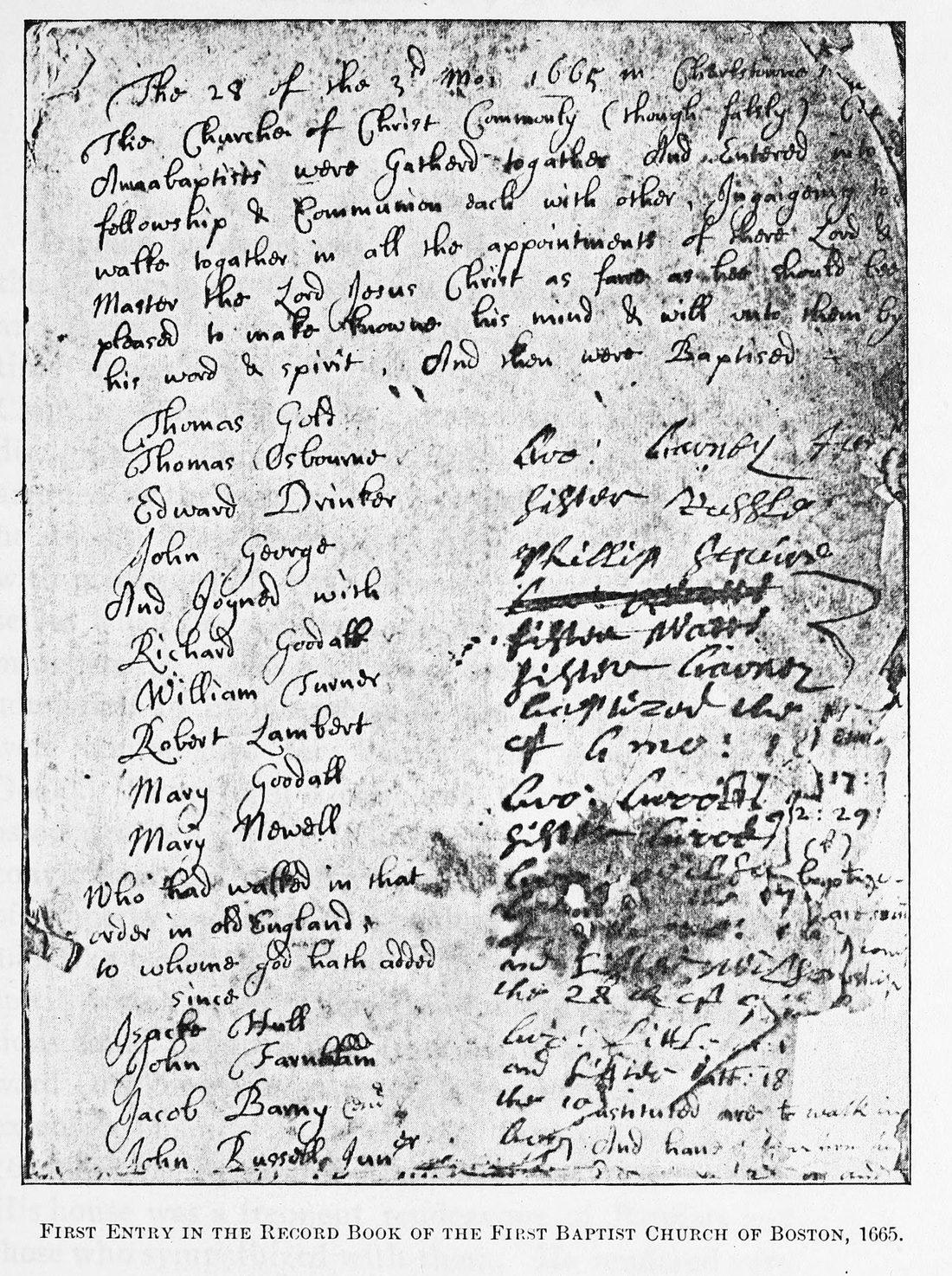
“First Entry in the Record Book of the First Baptist Church of Boston, 1665.” Facsimile plate facing p. 56 in N. E. Wood, The History of the First Baptist Church of Boston (Philadelphia, 1899); scan from the Allen County Public Library copy, Internet Archive · Public domain
Thomas Goold of Charlestown, Massachusetts, a friend of Henry Dunster, the Harvard president who had been forced out for refusing infant baptism, would not bring his own infant child to be baptized. From 1655 the Charlestown church put him under admonition, and for nearly ten years those who held Baptist views met, against the law, in private houses. The church’s own book records how they were at last gathered: “The 28 of the 3d mo. 1665 in Charlestowne, Massachusetts, the Churche of Christ, commonly (though falsely) called Anabaptiste were gathered togather And entered into fellowship & communion each with other, Ingaigeing to walke togather in all the appointments of there Lord & Master the Lord Jesus Christ as farre as hee should bee pleased to make known his mind & will unto them by his word & Spirit.” (Wood gives the date as 7 June 1665, new style.) Fines, imprisonment and banishment followed. They met sometimes in Charlestown, sometimes in Boston and sometimes on Noddle’s Island in the harbour. On 14-15 April 1668 Goold, Farnum and Osborn were brought out of jail to answer six ministers at a public disputation in Boston. Goold died on 27 October 1675. In 1679 the church built a meeting-house; a law against such houses was passed after it was built, and the Council ordered its doors nailed up. The notice nailed to the door read: “All Psons are to take notice yt by orde of ye Court ye dores of this howse are shutt up & yt they are Inhibitted to hold any meeting therein … dated in boston 8th march 1680.” The church book records what they did: “Our dores being now shutt we were Expected the next lords day to meete out In ye yard Itt being a cold wind yt day butt through grace none sustained any harm.” A week later they found the doors set open, went in, “& mett with noe disturbance yt day.” Charleston’s First Baptist Church (1682/1696, also on this timeline) grew from a branch of this church gathered at Kittery, Maine. “Not forsaking the assembling of ourselves together, as the manner of some is” (Hebrews 10:25, KJV).
Sourcearchive.org: N. E. Wood, The History of the First Baptist Church of Boston (1665-1899) (American Baptist Publication Society, 1899; PD), read from the page images: p. 56 (first church-book entry), pp. 139-141 (the 1680 account and the Council’s order, transcribed from the church records), with pp. 29-30, 55, 64, 78-79 and 122 for the narrative. Superscript letters in the 17th-century spelling are printed on the line here (e.g. “yt”, “orde”). The Maine link per Wikipedia, “First Baptist Church (Boston)”.
Benjamin Keach, woodcut portrait. Via Wikimedia Commons · Public domain
Benjamin Keach (1640-1704), a Buckinghamshire tailor baptized as a believer at fifteen, began preaching at eighteen. In 1664, under the penal laws against Nonconformists, he was tried at Aylesbury for publishing a children’s catechism, The Child’s Instructor. He was fined, imprisoned and set in the pillory at Aylesbury and at Winslow. In 1668 he became pastor of the Baptist church at Horsleydown, Southwark, and served it for thirty-six years. That congregation later worshipped at New Park Street and the Metropolitan Tabernacle under Spurgeon. His church was probably the first in England to sing hymns rather than psalms alone, and his hymnbook of 1691 was debated at the 1692 Assembly of Particular Baptists. Keach helped to call the 1689 General Assembly that endorsed the Second London Confession. The catechism that bears his name was probably compiled at least in part by William Collins.
Sourceen.wikipedia.org: Wikipedia, “Benjamin Keach” (incorporating A. Gordon, Dictionary of National Biography, vol. 30, 1892; citing T. Armitage, A History of the Baptists, 1887; C. Johnson, Gloria Deo Journal, 2021).
Baptist churches first published the Second London Confession anonymously in 1677, during the persecution of Nonconformists. It was modeled on the Westminster Confession and the Savoy Declaration, to show their unity with the Reformed churches. After greater freedom came to dissenting ministers in 1689, it was republished and signed at a general assembly in London. It is known ever since as the 1689 Baptist Confession of Faith.
Sourcethe1689confession.com: The 1689 Baptist Confession of Faith (the1689confession.com), “About the Confession.”
In the old-style year 1678, which the Baptist Quarterly article dates to 30 January 1679 by the modern calendar, General Baptist churches of Buckinghamshire, Hertfordshire and the counties around them put their names to “An Orthodox Creed” at Aylesbury. It runs to fifty articles, and the churches’ messenger Thomas Monck is named as its chief drafter. The article counts about fifty-four subscribers of note, some forty-four of them from Buckinghamshire. Its stated purpose was to unite orthodox Baptists in the face of teaching on the Person of Christ that was troubling the General Baptists of Kent and Sussex, associated with Matthew Caffyn; the preface to the Creed itself calls it a “little Manual, or Orthodox Confession of our Faith,” offered to all sober persons. Its article on the creeds says that “the three creeds, viz. Nicene Creed, Athanasius’s Creed, and the Apostles Creed, as they are commonly called, ought throughly to be received, and believed,” as holding in brief what must be known for salvation. The Creed was printed later in 1679. Its doctrine of grace sits between the Calvinist and Arminian camps, and it rejects what its preface calls irrespective reprobation of particular persons. That mediating place is exactly why it matters beside the Calvinist London Confessions of 1644 and 1677/89: Baptists confessed their faith in more than one voice. Scripture is its measure: “Hold fast the form of sound words, which thou hast heard of me, in faith and love which is in Christ Jesus” (2 Timothy 1:13), and “earnestly contend for the faith which was once delivered unto the saints” (Jude 3). Scholars differ on how much weight the three creeds carry in Baptist practice today; the Creed itself places them under the Word. No portrait or title-page plate has yet been licence-verified, so none is shown.
Sourcegospelstudies.org.uk: The Orthodox Confession of 1679 (Baptist Quarterly 17:1, gospelstudies.org.uk/biblicalstudies/pdf/bq/17-1_035.pdf: 50 articles, Aylesbury, signed 30 Jan 1679, Monck, ~54 subscribers, printed 1679); preface and text, SWBTS Journal 48.2 (swbts.edu/wp-content/uploads/2024/04/48.2_Monck.pdf: “little Manual, or Orthodox Confession,” Aylesbury 1678); Wikipedia, “Orthodox Creed”; creeds article quoted at secundumscripturas.com “Baptists and the Creeds”; KJV 2 Tim 1:13, Jude 3.
“Put on the whole armour of God, that ye may be able to stand against the wiles of the devil” (Ephesians 6:11). John Bunyan, the Bedford Baptist, published the first part of The Pilgrim’s Progress in 1678, and in it Christian is led at the House Beautiful “into the armoury, where they showed him all manner of furniture, which their Lord had provided for pilgrims, as sword, shield, helmet, breastplate, ALL-PRAYER, and shoes that would not wear out.” Before he leaves, “they harnessed him from head to foot with what was of proof, lest, perhaps, he should meet with assaults in the way.” Later, in the Valley of the Shadow of Death, he “was forced to put up his sword, and betake himself to another weapon called All-prayer,” and Bunyan margins the place with Ephesians 6:18. The museum sets Ephesians 6:13 beside it: “Wherefore take unto you the whole armour of God, that ye may be able to withstand in the evil day, and having done all, to stand.”
Sourcegutenberg.org: John Bunyan, The Pilgrim’s Progress from this world to that which is to come, Project Gutenberg eBook #131 (PD), the armoury scenes (paragraphs 135 and 138) and the Valley of the Shadow of Death (paragraph 161; the Eph. 6:18 marginal reference is Bunyan’s). Date: licensed and entered in the Term Catalogue, 18 February 1678, taken as first publication (Wikipedia, “The Pilgrim’s Progress”). KJV: Eph 6:11, 6:13.
Title page of Hercules Collins, An Orthodox Catechism (London, 1680). British Museum copy, digitised by the Internet Archive. Via Wikimedia Commons · Public domain
Hercules Collins (1647-1702) “had not the advantage of a learned education,” says the Dictionary of National Biography, yet he became one of the most prolific Particular Baptist writers of his day. For about twenty-five years he was pastor of the baptized congregation at Wapping, in east London. The Baptist historian Thomas Crosby wrote of him: “He began to be religious at an early age, and continued faithful to the last, and was not shock’d by the fury of the persecutors.” In 1680 he published An Orthodox Catechism: Being the Sum of Christian Religion, Contained in the Law and Gospel, “Published For preventing the Canker and Poison of Heresy and Error.” It was his edition of the sixteenth-century Heidelberg Catechism. He revised its teaching on baptism and added the Nicene and Athanasian Creeds, to show that the Particular Baptists held the historic faith. The preface is addressed “Unto the Church of Christ, who upon Confession of Faith have bin Baptised, Meeting in Old-Gravil-Lane London,” and its author writes as one “not knowing but my Staff standeth next the Door ready to depart.” The title page bears the words “Search the Scriptures” (the printer gives the reference as “John 14. 39”; the words are John 5:39). In 1684 two of his books came from George Larkin’s press “for the Author,” both signed from prison. A Voice from the Prison is a set of meditations on Revelation 3:11, “Tending To the Establishment of Gods Little Flock, In An Hour of Temptation. By Hercules Collins, Prisoner in Newgate.” Counsel for the Living, Occasioned from the Dead is a discourse on Job 3:17-18, arising from the deaths of Francis Bampfield and Zachary Ralphson, and written by “their Fellow Prisoner in Newgate.” In 1689 the ministers and messengers of “upwards of one Hundred Baptized Congregations in England and Wales” met in London and recommended their Confession of Faith “as containing the Doctrine of our Faith and Practice.” Hercules Collins was among those who signed. He died on 4 October 1702. “Behold, I come quickly: hold that fast which thou hast, that no man take thy crown” (Revelation 3:11).
Sourceen.wikisource.org: DNB vol. 11 (1887), “Collins, Hercules”, T. Cooper (Wikisource; US PD), quoting Crosby iii. 129. Title pages + preface quoted from page images: Orthodox Catechism 1680, Voice from the Prison 1684, Counsel for the Living 1684 (IA/Commons, PD). 1689 signers: Confession 4th ed., 1719 (IA). Wikipedia “Hercules Collins” for b. 1647, the ~25-year Wapping pastorate and the Heidelberg revision. Rev 3:11, John 5:39 KJV verified (bible-api × getBible).
O Novo Testamento, translated by João Ferreira de Almeida, title page of the first edition, 1681. Via Wikimedia Commons · CC BY-SA 4.0
João Ferreira de Almeida (1628-1691) was born in Portugal, became a Protestant at fourteen and began translating the Bible into Portuguese at sixteen. Trained in the Dutch Reformed tradition, he served Reformed churches in Java and preached in Goa. His New Testament was first printed in 1681, with further editions in 1693 and 1711. He translated the whole New Testament and most of the Old before he died at Batavia in 1691; the Old Testament was completed by his friend Jacobus op den Akker. He translated by formal equivalence, following the form of the original, on the basis of the Textus Receptus, with help from Beza’s Latin and other versions. His Bible remains the translation most used by Portuguese-speaking evangelicals, especially in Brazil. “And how hear we every man in our own tongue, wherein we were born?” (Acts 2:8, KJV).
Sourceen.wikipedia.org: Wikipedia, “João Ferreira de Almeida” (1628-1691; convert at 14, translating at 16; Dutch Reformed; Java and Goa; NT 1681, 1693, 1711; OT completed by Jacobus op den Akker; formal equivalence; Textus Receptus basis, Beza’s Latin; most-used Portuguese evangelical Bible). Acts 2:8 KJV verified.
First Baptist Church, Church Street, Charleston: the Robert Mills sanctuary of c. 1820-22, which succeeded the 1701 meeting house. Photo: ProfReader, 2013, via Wikimedia Commons · CC BY-SA 3.0
William Screven (c. 1629-1713), a Somerset man baptized in Boston in the 1670s, was ordained by the First Baptist Church of Boston in January 1682 to gather a church at Kittery in the Province of Maine. He did so on 25 September 1682, but the little church was pressed hard by New England’s Congregationalist authorities. The Charleston church’s own history records that late in 1696 Screven and twenty-eight members of the Kittery congregation removed to Charleston, South Carolina. The church has worshipped on Church Street ever since and is the oldest Baptist church in the South. Screven asked that any future pastor own the confession put forth by the London brethren in 1689.
Sourcefbcharleston.org: First Baptist Church of Charleston, “History.” Screven’s ordination and baptism per Wikipedia, “William Screven,” citing the church’s archived history and T. Nettles, Founders Journal 19/20 (1995) and H. A. Tupper, Two Centuries of the First Baptist Church of South Carolina (1889). Some sources give 26 rather than 28 members; the church’s own figure is used.
“Blessed are they which are persecuted for righteousness’ sake: for theirs is the kingdom of heaven.” (Matthew 5:10). Cathcart’s Encyclopedia says the First Baptist church of Charleston “was probably founded in Kittery, Me., by Rev. William Screven, Deacon Humphrey Churchwood, and eight other brethren, with some sisters, in September, 1682.” Of the leaders’ removal it records: “Persecutions in Maine” are said by some to have dissolved the community, and it adds that they “drove away the leaders and others from that territory.” Of Screven himself it says he “was the founder and first pastor of the Charleston” church, “a native of England, where he was born about the year 1629”, and that “The sufferings which he and his brethren endured in that place drove them to seek an asylum in the more tranquil regions of the South.” It notes that “He wrote ‘An Ornament for Church Members,’ which was printed after his death,” and that in his later years he removed to Georgetown, “where he died in peace in 1718.”
Sourcearchive.org: William Cathcart, ed., The Baptist Encyclopedia (Philadelphia: Everts, 1881), vol. 2, s.vv. “Screven, Rev. Wm.” and “South Carolina, The Baptists of” (public domain; Internet Archive scan). Quotations verbatim, contiguous fragments only (column-set OCR; hyphenated line-breaks rejoined). Nothing beyond the entry is asserted. KJV: Matthew 5:10.
Thomas Delaune (d. 1685) was born at Brinny, near Cork, to Catholic parents. The Dictionary of National Biography records that, after renouncing Catholicism, he settled in England, married Hanna, daughter of Edward Hutchinson, “late baptist minister at Ormonde,” and earned his living in London by translating and “by keeping a grammar school”; he “was an active member of the baptist body.” When Dr. Benjamin Calamy published a sermon on a scrupulous conscience, Delaune “accepted the challenge he understood to be contained therein,” and wrote his Plea for the Non-Conformists. Part of it “was construed into a libel.” On 29 November 1683 he was apprehended, and he was later removed by warrant to Newgate and “lodged among the felons.” Convicted in January 1684, he was fined a hundred marks and sentenced “to have his books publicly burnt by the hangman.” Unable to pay, he stayed in Newgate, where his wife and children joined him. After “the death of his wife and two children from want of air and sufficient nourishment,” his own health gave way, and he died “having been in Newgate about fifteen months.” His Plea “was for many years a standard baptist apology”; it was reprinted seven times by 1706, when Daniel Defoe wrote a preface for it. The reprint of 1704 names its author on the title page as the man “who died in Newgate during his Imprisonment for this Book.” “But sanctify the Lord God in your hearts: and be ready always to give an answer to every man that asketh you a reason of the hope that is in you with meekness and fear” (1 Peter 3:15).
Sourceen.wikisource.org: DNB (1888), Delaune, Thomas, by A. C. Bickley (Wikisource), citing Crosby, Hist. of the Baptists ii. 366; title page of De Laune’s Plea for the Non-Conformists (London, 1704), read on the Internet Archive scan (bim_eighteenth-century_de-launes-plea-for-the-_de-laune-thomas_1704; ſ modernised). No plate: no image with clear rights was found. 1 Pet 3:15 KJV verified.
“I was in prison, and ye came unto me” (Matthew 25:36). Cathcart’s Encyclopedia records that Elizabeth Gaunt of London, in the reign of James II, “was a member of a Baptist church, and a lady of great benevolence.” She “was accustomed to visit the jails” and to relieve the prisoners of every persecuted denomination. When she took in a fugitive rebel named Burton, he went to the authorities and denounced her. She was tried and, “without the required number of witnesses was illegally condemned,” and she was burned at Tyburn on October 23, 1685. Bishop Burnet, as Cathcart quotes him, records her telling the crowd “that charity was a part of her religion, as well as faith.”
Sourcearchive.org: William Cathcart (ed.), The Baptist Encyclopedia (Philadelphia: Everts, 1881), vol. 1, s.v. “Gaunt, Mrs. Elizabeth” (public domain; Internet Archive scan). Quotations verbatim, contiguous fragments only, machine-matched against the scan’s text (OCR line-end hyphenation normalised). KJV: Matthew 25:36.
Title page of Joseph Stennett, Hymns in Commemoration of the Sufferings of Our Blessed Saviour Jesus Christ (London, 1697), digitised by the Internet Archive (Early English Books). Via Wikimedia Commons · Public domain
Joseph Stennett (1663-1713) was born at Abingdon, Berkshire, the son of Edward Stennett, and was taught by his father and his elder brother Jehudah, “both of whom wrote Hebrew grammars.” In 1685 he settled in London as a schoolmaster, and on 28 September 1686 he joined in reviving a seventh-day baptist congregation (one that kept the seventh day as its Sabbath) at Pinners’ Hall, Old Broad Street, with his father as pastor. On 4 March 1690/91 he was himself ordained pastor at Pinners’ Hall by Hanserd Knollys and others. He also preached on Sundays to the General Baptist congregation in Paul’s Alley, Barbican. The Dictionary of National Biography says that “on several public occasions he was the trusted representative of the whole body of baptists,” and that “the general baptist association, in 1704, deputed him to write a history of baptism; he collected materials, but his health gave way.” “He was a fluent preacher with a silvery voice,” it adds, yet “he is now best known as a hymn-writer, and is the earliest English baptist whose hymns are still sung.” His hymns were first printed between 1697 and 1712. In 1697 a London bookseller issued his Hymns In Commemoration Of the Sufferings Of Our Blessed Saviour Jesus Christ. Compos’d For the Celebration of his Holy Supper. Its title page sets them under Matthew 26:30, the hymn the Lord and His disciples sang after the first Supper. When the DNB was written in the 1890s, the hymnologist John Julian counted eight of Stennett’s hymns still “in common use.” He died at Knaphill, near Hughenden, Buckinghamshire, on 11 July 1713, and was buried in Hughenden churchyard. His works and hymns were collected, with a Life, in 1732. The gift passed down his family. His grandson Samuel Stennett (1728-1795), pastor at Little Wild Street, London, also wrote hymns, and thirty-eight of them were taken into John Rippon’s Selection of 1787. Samuel’s son Joseph was “the fifth in a succession of ministers from father to son.” “And when they had sung an hymn, they went out into the mount of Olives” (Matthew 26:30).
Sourceen.wikisource.org: DNB vol. 54 (1898), “Stennett, Joseph”, A. Gordon (Wikisource; US PD), quoted verbatim; it covers the family, Pinners’ Hall, the 1691 ordination, Julian’s eight hymns and Samuel Stennett. Title page of Hymns … Holy Supper (London: J. Darby for A. Bell, 1697) read from the page image (IA/Commons, PD); long s modernised. Matt 26:30 KJV verified (bible-api × getBible).
The church’s own history says that Elias Keach arrived in Pennsylvania in 1686 as “a twenty-year old young man in whose suitcase was a black robe and a white band.” Morgan Edwards, the early Baptist historian, wrote that he “arrived in this country a very wild spark about the year 1686” and that “on his landing he dressed in black and wore a band in order to pass for a minister.” Preaching to a gathering of Welsh settlers, he “performed well enough till he had advanced pretty far in the sermon. Then, stopping short, looked like a man astonished.” He confessed the imposture “with tears in his eyes and much trembling,” and Edwards adds, “from this time dated he his conversion.” He was baptized and ordained by the Baptist minister Thomas Dungan of Cold Spring, Bucks County, and then, in Edwards’s words, “came to Pennepek and settled a church there.” The church’s history gives 1688 for its founding, calling it the eighth Baptist church begun in America, and in 1707 Pennepack joined four others in forming the Philadelphia Baptist Association. Edwards records that Keach and his family sailed for England in the spring of 1692. The apostle’s words fit such a turning: “This is a faithful saying, and worthy of all acceptation, that Christ Jesus came into the world to save sinners; of whom I am chief” (1 Timothy 1:15). The church and Edwards agree on the outline. No licence-verified plate has yet been found, so none is shown.
Sourcepennepackbaptist.org: Pennepack Baptist Church, own history page (1686 arrival, imposture, Dungan, 1688 founding, eighth Baptist church in America, 1707 association); Morgan Edwards, account of Elias Keach, Baptist History Homepage baptisthistoryhomepage.com/keach.watts.morgan.by.edwards.html (c. 1686, conversion, baptized and ordained, Pennepek, 1692 departure; quoted); KJV 1 Tim 1:15 (bible-api.com).
“I will speak of thy testimonies also before kings, and will not be ashamed” (Psalm 119:46). Cathcart’s Encyclopedia says John Holme of Philadelphia “is supposed to have been the first Baptist, of any prominence at least, in the colony.” He “gave one-half of the lot on which the First Baptist meeting-house was erected,” and “John Holme was appointed justice in the County Court in 1690; and he represented the city of Philadelphia in the Assembly of 1692.” Sitting with six Quaker judges at the trials of George Keith and of William Bradford, the colony’s first printer, he dissented: “Mr. Holme maintained that the whole affair was essentially a religious dispute,” and “was not fit to be adjudicated by a civil tribunal.” Cathcart adds that he “persistently dissented from the majority of the bench, and it is said actually resigned his office rather than seem to be made a party in any degree to what he regarded a case of religious persecution, and of the infringement of the liberty of the press.” He died a judge at Salem, New Jersey, in 1703, “one of the constituent members of the Baptist church in Salem.”
Sourcearchive.org: William Cathcart (ed.), The Baptist Encyclopedia (Philadelphia: Everts, 1881), vol. 1, s.v. “Holme, Judge John” (public domain; Internet Archive scan). Quotations verbatim, contiguous fragments only, machine-matched against the scan’s text (OCR line-end hyphenation normalised). KJV: Psalm 119:46.
“Search the scriptures; for in them ye think ye have eternal life: and they are they which testify of me” (John 5:39). Cathcart’s Encyclopedia says that in the early history of William Penn’s colony a controversy broke out among the Quakers about “the sufficiency of what every man naturally has within himself for the purpose of his own salvation.” Some denied this sufficiency and “exalted Christ and the Scriptures” more than Robert Barclay had done. George Keith, “an impetuous and talented Scotchman,” led them, and “in 1691 it led to a division and the establishment of separate meetings in Pennsylvania and New Jersey.” Keith himself “soon turned Episcopalian”, but “many became Baptists, Seventh-Day and Regular.” They were called Quaker Baptists “because they retained the language, dress, and manners of the Quakers.”
Sourcearchive.org: William Cathcart (ed.), The Baptist Encyclopedia (Philadelphia: Everts, 1881), vol. 1, s.v. “Keithian Quaker Baptists” (public domain; Internet Archive scan). Quotations verbatim, contiguous fragments only, machine-matched against the scan’s text (OCR line-end hyphenation normalised; OCR misreadings corrected only outside quotation marks). KJV: John 5:39.
The Apostle bids believers go on “Speaking to yourselves in psalms and hymns and spiritual songs, singing and making melody in your heart to the Lord” (Ephesians 5:19), and “teaching and admonishing one another in psalms and hymns and spiritual songs, singing with grace in your hearts to the Lord” (Colossians 3:16). In 1691 Benjamin Keach, pastor at Horsleydown, Southwark, printed a book of hymns for his people: the Dictionary of National Biography lists “Spiritual Melody … Psalms and Hymns from the Old and New Testament” (1691, “nearly three hundred pieces”) and, the next year, “A Feast of Fat Things … Spiritual Songs” (1692, “one hundred pieces”). The same article says his church is “said to have been the first baptist church which introduced (about 1688) the practice of conjoint singing”, that the London General Baptist association condemned it in 1689 as a “carnal formality”, and that Keach’s advocacy of congregational singing and his issue of “a collection of original hymns (1691), caused a rupture in his church.” Wikipedia adds that the hymnbook “provoked heated debate” at the 1692 Assembly of Particular Baptists because it conflicted with the position of exclusive psalmody, and dates an earlier secession over congregational singing to 1673; the sources do not agree on the first dates, so this page gives both. What the dispute turned on was how Scripture’s own commands about singing were to be obeyed together, and Baptists went on to sing: John Rippon’s Selection (1787) is on this timeline.
Sourceen.wikisource.org: Dictionary of National Biography vol. 30 (1892, public domain), “Keach, Benjamin” (Wikisource), quoted verbatim; cross-check Wikipedia “Benjamin Keach” (1692 Assembly; exclusive psalmody; 1673 secession). Dates of first congregational singing differ between sources; both are given. KJV: Eph 5:19; Col 3:16.
Plates are hung only where a genuine image of the subject could be found under a public-domain or open licence. Each carries its credit and links to its licence record. Entries without a plate are awaiting one that meets that standard. More entries are being prepared, and each will be added only with its citation.
Every entry on this page was checked, when it was added, against the source linked beneath it; notes name the underlying scholarship where the source cites it. Where historians disagree (for example, over John Wycliffe’s own share in the Bible that bears his name), the entry says so. Scripture is quoted verbatim from the King James Version. Plates are reproduced almost entirely from Wikimedia Commons: public-domain works, works dedicated to the public domain (CC0), or photographs under Creative Commons Attribution (CC BY 2.0-3.0) or Attribution-ShareAlike (CC BY-SA 2.0-4.0) licences. Each plate’s licence is stated beneath it, with a link to the record where it was confirmed.