
Baptist Witness
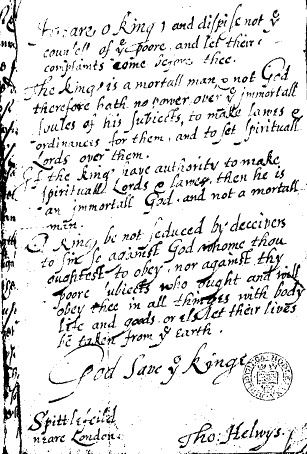

In 1612 Helwys and about twelve others returned from exile and settled their church at Spitalfields, in the east of London. It is considered the first Baptist church in England. Helwys inscribed a copy of his A Short Declaration of the Mistery of Iniquity by hand to King James, pleading for liberty of conscience: “The King is a mortall man, and not God therefore hath no power over ye immortall soules of his subjects, to make lawes and ordinances for them, and to set spirituall Lords over them.” In the same note he promised that the King’s subjects would “obey thee in all thinges with body life and goods”, and he signed it “God Save ye King” from “Spittlefeild neare London”. Whether the book reached the King is not known. Helwys was imprisoned in Newgate, where he died by about 1616. The inscribed copy is preserved in the Bodleian Library, Oxford.
Source en.wikipedia.org: Wikipedia, “Thomas Helwys” (citing Cairns, Christianity Through the Centuries, 2009, p. 331; Oxford DNB). Inscription quoted from J. H. Rushbrooke’s transcription, Baptist Quarterly 8.1 (January 1936), pp. 18-19 (gospelstudies.org.uk PDF), checked against the plate; the leaf itself writes “&” and “subiects”.