Baptist Militia A library & museum of the Whole Armour of God Visit
Find

Hall III · The Timeline

The High Middle Ages

“But the word of the Lord endureth for ever. And this is the word which by the gospel is preached unto you.”1 Peter 1:25, KJV

How the Scriptures were received, carried into the English tongue, and confessed by the Baptist churches. Each date is linked to its source, so that you may test every word.

  • Scripture & Canon (28)
  • The English Bible (7)
  • Baptist Witness (1)
  1. The High Middle Ages11th-13th centuries

    Scripture & Canon

    Notker of St Gall puts the Psalms into German for his pupils

    Notker’s Psalter in Latin and Old High German, 12th-century copy. St. Gallen, Stiftsbibliothek, Cod. Sang. 21, p. 244 (Stiftsbibliothek St. Gallen), via Wikimedia Commons
    Notker’s Psalter in Latin and Old High German, 12th-century copy. St. Gallen, Stiftsbibliothek, Cod. Sang. 21, p. 244 (Stiftsbibliothek St. Gallen), via Wikimedia Commons · CC BY-SA 4.0

    Notker, called the German (Teutonicus), was a monk and schoolmaster at the Abbey of St Gall in present-day Switzerland, where he died in 1022. So that his pupils could understand what they read, he translated Latin texts into their own Old High German, and the greatest of these was the Book of Psalms, given verse by verse with a German translation and explanation, about the year 1000. He also spent more than five years on the Book of Job, which is now lost. In doing so he worked out the first systematic way of spelling German, and his Psalter is among the chief witnesses to the German of his day. Honesty: Notker translated from the Latin Psalter, not from the Hebrew, and mixed commentary with the text; his own copy does not survive, and the only complete copy is a 12th-century manuscript made at Einsiedeln, now in St Gall. The plate shows a page of that copy, Latin verses followed by German. “The entrance of thy words giveth light; it giveth understanding unto the simple” (Psalm 119:130, KJV).

    Source e-codices.unifr.ch: e-codices, St. Gallen, Stiftsbibliothek, Cod. Sang. 21 (Old High German translation and commentary on the Psalms by Notker, c. 1000; only extant complete copy, 12th c., Einsiedeln). Also Wikipedia, “Notker Labeo” (c. 950-1022; Psalter; lost Job; first systematic OHG orthography). Ps 119:130 KJV verified.

  2. Scripture & Canon

    The Hitda Codex: a Cologne Gospel book of Christ’s miracles, made for the abbess of Meschede

    Christ in Majesty, from the Hitda Codex. Universitäts- und Landesbibliothek Darmstadt (Hs 1640), via Wikimedia Commons
    Christ in Majesty, from the Hitda Codex. Universitäts- und Landesbibliothek Darmstadt (Hs 1640), via Wikimedia Commons · Public domain

    The Hitda Codex is an evangeliary, a book of selected passages from the four Gospels for reading in worship, commissioned by Hitda, abbess of Meschede, about 1000-1020. It is a high point of the Cologne school of painting in the later Ottonian period and holds the only surviving cycle of pictures of the life of Christ made in Cologne at that time, many of them showing His miracles of healing: Peter’s wife’s mother, the man with the withered hand, and those possessed by devils. Each picture is paired with a full-page framed inscription drawing out its meaning, an arrangement found in no other manuscript. It is now kept in the University and State Library at Darmstadt (Hs 1640). The plate shows Christ in majesty, surrounded by the four living creatures, with a book in His hand. “Jesus Christ the same yesterday, and to day, and for ever” (Hebrews 13:8, KJV).

    Source en.wikipedia.org: Wikipedia, “Hitda Codex” (evangeliary; commissioned by Hitda, abbess of Meschede, c. 1020; Darmstadt, Hessische Landesbibliothek MS 1640; Cologne school, late Ottonian; only surviving Cologne Life of Christ cycle; healing miniatures listed; image-and-inscription pairing unique). Commons dates the plate 1000-1040. Heb 13:8 KJV verified.

  3. Scripture & Canon

    The Leningrad Codex: the oldest complete Hebrew Bible

    Carpet page (fol. 474a) of the Leningrad Codex, Cairo, 1008. Scan by USC Dornsife West Semitic Research Project, via Wikimedia Commons
    Carpet page (fol. 474a) of the Leningrad Codex, Cairo, 1008. Scan by USC Dornsife West Semitic Research Project, via Wikimedia Commons · Public domain

    According to its colophon, this codex was copied in Cairo in 1008 (or possibly 1009) from manuscripts written by Aaron ben Moses ben Asher. Unusually, one man, Samuel ben Jacob, wrote the consonants, the vowels and the Masoretic notes. Because much of the Aleppo Codex has been lost since 1947, the Leningrad Codex is the oldest complete manuscript of the Hebrew Bible in the Masoretic tradition to survive intact. Scholars count it, after Aleppo, the most faithful witness to ben Asher’s pointing. Honesty requires a note: its letter-text is not flawless, and in hundreds of places it contradicts its own Masoretic notes. It was sold in Fustat in 1134, came to Odessa in 1838 with the Karaite collector Abraham Firkovich, and has been in the national library at St Petersburg since 1863. It is the Hebrew text printed in Biblia Hebraica (1937) and its successors. Sixteen pages carry decorative geometric designs, like the “carpet page” shown here. “But the word of the Lord endureth for ever. And this is the word which by the gospel is preached unto you” (1 Peter 1:25, KJV).

    Source en.wikipedia.org: Wikipedia, “Leningrad Codex” (colophon: Cairo 1008 or 1009, from ben Asher MSS; Samuel ben Jacob wrote consonants, vowels and masora; oldest complete Tiberian codex surviving intact; most faithful after Aleppo; contradicts its masora in hundreds of places; sold Fustat 1134; Firkovich, Odessa 1838; St Petersburg 1863; Biblia Hebraica 1937, BHS, BHQ; sixteen decorated pages). 1 Pet 1:25 KJV verified.

  4. Scripture & Canon

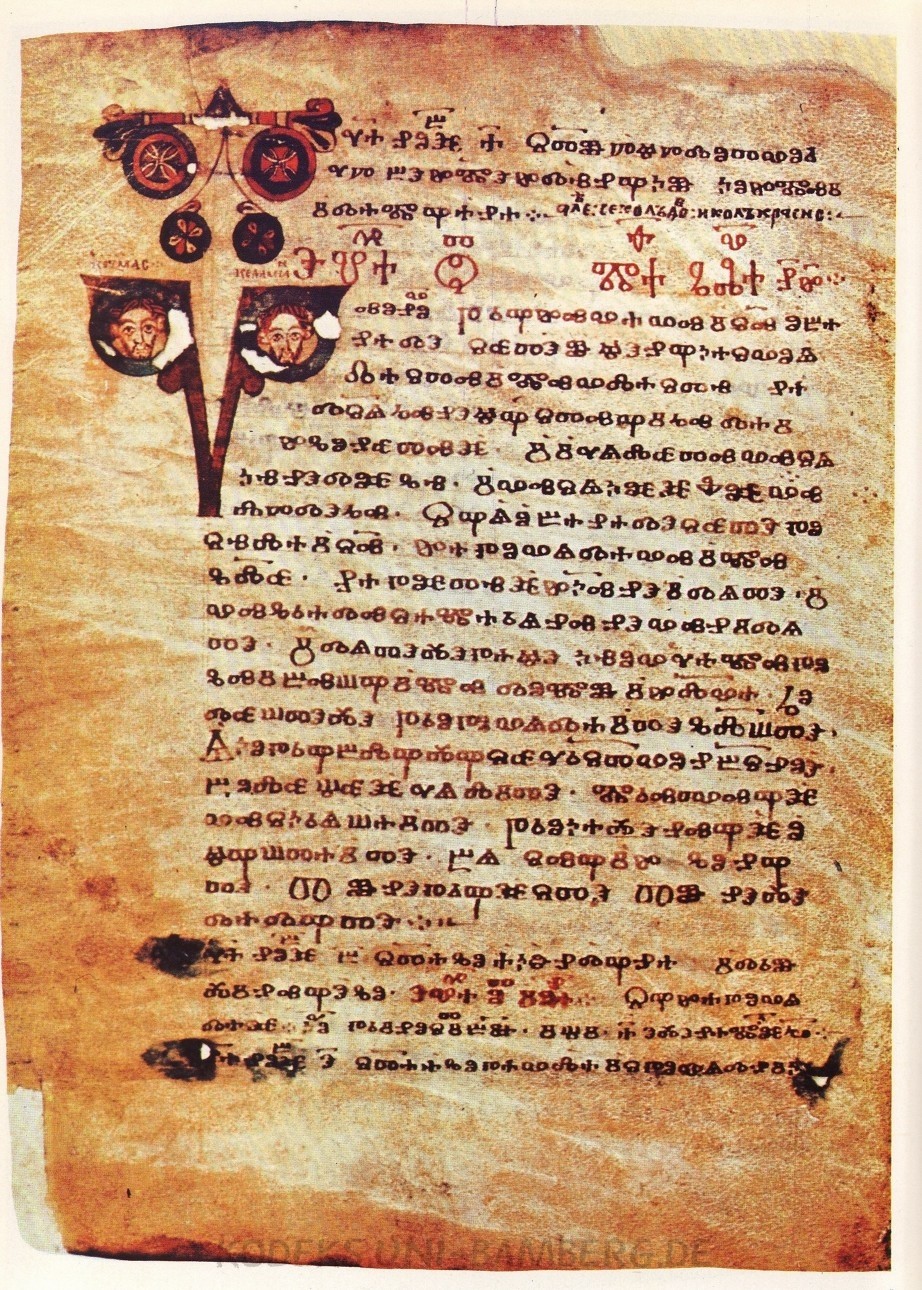
    Codex Assemanius: the Gospel lessons in Glagolitic letters, beginning with John

    Codex Assemanius (Vatican, Cod. Vat. Slav. 3), a Glagolitic page with an ornamented initial, via Wikimedia Commons
    Codex Assemanius (Vatican, Cod. Vat. Slav. 3), a Glagolitic page with an ornamented initial, via Wikimedia Commons · Public domain

    Codex Assemanius is a Gospel lectionary in Old Church Slavonic, written in the rounded Glagolitic script on 158 illuminated parchment leaves in the early 11th century and linked with the literary school of Ohrid in Macedonia. It is an aprakos Gospel: rather than the four Gospels in order, it gives the passages read in church through the year, beginning with the opening of the Gospel of John, followed by readings for saints’ days. Many hold it to be the most beautiful Old Church Slavonic book. Its language shares Macedonian features with Codex Marianus, and like the Zographensis and Marianus Gospels (already on this timeline) it keeps the Slavonic Gospels in the Glagolitic alphabet. The Maronite scholar Giuseppe Simone Assemani bought it in Jerusalem in 1736, and his nephew gave it to the Vatican Library, where it remains. “In the beginning was the Word, and the Word was with God, and the Word was God” (John 1:1, KJV).

    Source en.wikipedia.org: Wikipedia, “Codex Assemanius” (rounded Glagolitic OCS evangeliary, 158 illuminated ff., early 11th c.; Ohrid Literary School; bought by G. S. Assemani in Jerusalem 1736, nephew donated to Vatican Library; aprakos lectionary beginning with John; menologium; “most beautiful” OCS book; Macedonian traits shared with Marianus). John 1:1 KJV verified.

  5. Scripture & Canon

    The Uta Codex: the Gospel readings in gold at Regensburg, grouped under each evangelist

    The evangelist John, from the Uta Codex, Regensburg, c. 1020-1025. Bavarian State Library, Munich (Clm 13601), via Wikimedia Commons
    The evangelist John, from the Uta Codex, Regensburg, c. 1020-1025. Bavarian State Library, Munich (Clm 13601), via Wikimedia Commons · Public domain

    About 1025 Abbess Uta of Niedermünster in Regensburg, Bavaria, had a book of Gospel readings made for her community in the scriptorium of St Emmeram’s Abbey, the abbey that also kept the golden Codex Aureus of 870 (already on this timeline). It holds the passages of the Gospels read in the church’s services, but unlike most such lectionaries it does not arrange them by the calendar: it groups them under the evangelist who wrote them, each section opening with that evangelist’s portrait. It is written on 119 leaves of parchment, about 38 by 27 centimetres, and its case of gold set with gems bears a relief of Christ in Majesty. The art historian Georg Swarzenski called it “perhaps the most significant work of Western illumination of its time.” It is now in the Bavarian State Library at Munich as Clm 13601. Honesty: like the other Ottonian Gospel books, it carries the Latin Vulgate, and its opening pages include dedication and devotional images of the abbey’s own tradition, which are not shown here. The plate is its portrait of John, the eagle above him. “And the Word was made flesh, and dwelt among us, (and we beheld his glory, the glory as of the only begotten of the Father,) full of grace and truth” (John 1:14, KJV).

    Source en.wikipedia.org: Wikipedia, “Uta Codex” (Clm 13601, BSB Munich; gospel lectionary grouped by evangelist, not calendar; commissioned c. 1025 by Abbess Uta of Niedermünster; St Emmeram scriptorium; 119 leaves, 382 × 274 mm; gem-set gold case with Christ in Majesty; evangelist portraits; Swarzenski quoted). Commons dates the plate ca. 1020. John 1:14 KJV verified.

  6. The English Bible

    The Old English Hexateuch: Genesis to Joshua in English, illustrated

    The building of the Tower of Babel (Genesis 11), Old English Illustrated Hexateuch, British Library Cotton MS Claudius B.iv, 11th century. The Yorck Project, via Wikimedia Commons
    The building of the Tower of Babel (Genesis 11), Old English Illustrated Hexateuch, British Library Cotton MS Claudius B.iv, 11th century. The Yorck Project, via Wikimedia Commons · Public domain

    In the late Anglo-Saxon period a group of translators, presumably under the editorship of Abbot Ælfric of Eynsham (d. c. 1010), rendered the first six books of the Old Testament, Genesis through Joshua, into Old English. It was the first English vernacular translation of those books, and it was probably meant for lay readers. The text survives in seven manuscripts, most of them fragments. The best known, British Library Cotton MS Claudius B.iv, was probably compiled in the second quarter of the eleventh century at St Augustine’s Abbey, Canterbury, and includes Ælfric’s own preface and translations. It carries 394 drawings with about 550 scenes, showing the patriarchs in the dress and houses of eleventh-century England. It is the earliest illustrated manuscript of a large part of the Bible in any vernacular language. Five centuries before Tyndale, English readers could already turn the pages of Moses and Joshua in their own tongue. “This book of the law shall not depart out of thy mouth; but thou shalt meditate therein day and night” (Joshua 1:8, KJV).

    Source en.wikipedia.org: Wikipedia, “Old English Hexateuch” (collaborative; presumably edited by Ælfric of Eynsham, d. c. 1010; first English vernacular translation of Genesis-Joshua; probably for lay people; seven MSS; Cotton Claudius B.iv, 2nd quarter 11th c., St Augustine’s Canterbury; 394 drawings, c. 550 scenes; earliest illustrated MS of a large part of the Bible in any vernacular). Josh 1:8 KJV verified (first half quoted).

  7. Scripture & Canon

    The Codex Aureus of Echternach: the Gospels written entirely in gold

    Codex Aureus of Echternach, folio 24: text in gold with painted initials. Germanisches Nationalmuseum, Nuremberg, via Wikimedia Commons
    Codex Aureus of Echternach, folio 24: text in gold with painted initials. Germanisches Nationalmuseum, Nuremberg, via Wikimedia Commons · Public domain

    At the Abbey of Echternach, under Abbot Humbert, a Gospel book was made in about 1030-1050 whose whole text is written in gold ink. It is now in the Germanisches Nationalmuseum, Nuremberg. It contains Jerome’s Vulgate of the four Gospels with the Eusebian canon tables, and more than sixty decorated pages: sixteen full-page miniatures, evangelist portraits, and pages of narrative scenes covering the life, miracles and parables of Christ, the parables of the labourers in the vineyard, the wicked husbandmen, the great supper, and the rich man and Lazarus each fill a page. One historian remarked that its planner “was in no hurry to bring his reader to the text”; yet all that gold was spent to honour the text itself. The same abbey had produced the Echternach Gospels some three centuries before (see c. 690). “More to be desired are they than gold, yea, than much fine gold: sweeter also than honey and the honeycomb” (Psalm 19:10, KJV).

    Source en.wikipedia.org: Wikipedia, “Codex Aureus of Echternach” (c. 1030-1050, cover c. 980s; Germanisches Nationalmuseum; Abbot Humbert; Vulgate Gospels + canon tables; entire text in gold; 16 full-page miniatures; parable pages; “in no hurry” quote). Ps 19:10 KJV verified.

  8. Scripture & Canon

    Rashi of Troyes explains “the plain sense of Scripture”

    The Book of the Prophets with Rashi’s commentary, France (?), late 13th century, MS. Opp. 2, fol. 207a. Image via The Jewish Museum, New York, and Wikimedia Commons
    The Book of the Prophets with Rashi’s commentary, France (?), late 13th century, MS. Opp. 2, fol. 207a. Image via The Jewish Museum, New York, and Wikimedia Commons · Public domain

    Shlomo Yitzchaki of Troyes in France (c. 1040-1105), known as Rashi, wrote comprehensive commentaries on the Hebrew Bible and the Talmud and is generally counted a leading biblical interpreter of the Middle Ages. He was concerned, he wrote, “with the plain sense of Scripture”: he explained hard Hebrew words, clarified grammar and syntax, and often gave the French word of his day for a difficult term. His commentary on the five books of Moses became the first dated Hebrew printed book, at Reggio di Calabria on 18 February 1475. It also reached Christian readers. The French scholar Nicholas of Lyra relied on Rashi so heavily that he was called “the ape of Rashi,” and Lyra’s Postillae (already on this timeline) were among the primary sources used in Luther’s translation of the Bible; Christian Hebraists went on studying Rashi for the meaning of the Hebrew. Honesty: Rashi wrote as a Jewish teacher, and his comments also draw on rabbinic tradition where he judged it fitted the words. “So they read in the book in the law of God distinctly, and gave the sense, and caused them to understand the reading” (Nehemiah 8:8, KJV).

    Source en.wikipedia.org: Wikipedia, “Rashi” (c. 1040-1105, Troyes; commentaries on Tanakh and Talmud; “plain sense of Scripture” with Agadoth that fit the words; grammar and syntax; Old French glosses; first dated Hebrew printed book, Reggio 18 Feb 1475; Nicholas de Lyra “ape of Rashi”, Postillae a primary source for Luther; Christian Hebraists). Neh 8:8 KJV verified.

  9. The English Bible

    The Paris Psalter: the whole Psalter in Latin and Old English

    In the middle of the eleventh century a scribe who signed himself Wulfwinus, surnamed Cada, copied a complete psalm book in two languages. The Latin runs beside the West Saxon dialect of Old English. Psalms 1-50 are in English prose, and Psalms 51-150 are in English verse. The prose psalms have been credibly attributed to King Alfred the Great (d. 899), who is said to have had the Psalms put into English, though scholars are divided on how much he did himself. The book is now in Paris (Bibliothèque nationale, MS latin 8824), which gives it its name. Old English was one of very few early medieval vernaculars in the West into which the Bible was translated, and the Paris Psalter is one of the translations that was meant to be circulated. “Thy word is a lamp unto my feet, and a light unto my path” (Psalm 119:105, KJV).

    Source en.wikipedia.org: Wikipedia, “Paris Psalter (Anglo-Saxon)” (BnF lat. 8824, scribe Wulfwinus Cada, prose 1-50 / metrical 51-150, prose credibly attributed to Alfred); “Old English Bible translations” (Alfred said to have directed a Psalter translation, scholars divided; Paris Psalter meant for circulation). Ps 119:105 KJV verified. No plate: none found on Commons.

  10. The English Bible

    The Tiberius Psalter: the Psalms with an English word written over every line, at Winchester

    Tiberius Psalter, the opening of Psalm 1 (“Beatus vir”). British Library, Cotton MS Tiberius C VI, via Wikimedia Commons
    Tiberius Psalter, the opening of Psalm 1 (“Beatus vir”). British Library, Cotton MS Tiberius C VI, via Wikimedia Commons · Public domain

    The Tiberius Psalter is one of at least four Latin Psalters made at the New Minster, Winchester, in the years around the Norman Conquest. Between the lines of the Latin Psalms runs a continuous Old English gloss, so that an English reader could follow the sense of every verse, with other English material besides. It also has the earliest known cycle of pictures set before a Psalter, pairing scenes from the life of David with the life of Christ, a pattern many later Psalters followed. Its date has been placed at the middle of the eleventh century, or, by the British Library, in its third quarter. The book was damaged in the Cotton Library fire of 1731, which burned away the top corners of its first pages, and it was rebound in 1894 with each leaf mounted separately; it is British Library Cotton MS Tiberius C VI. The plate is the opening of Psalm 1, “Beatus vir,” “Blessed is the man.” “But his delight is in the law of the LORD; and in his law doth he meditate day and night” (Psalm 1:2, KJV).

    Source en.wikipedia.org: Wikipedia, “Tiberius Psalter” (BL Cotton MS Tiberius C.vi; one of ≥4 Gallican psalters from New Minster, Winchester, around the Conquest; continuous interlinear OE gloss; earliest known prefatory miniature cycle, David and Christ; dated mid-11th c. / c. 1050 / 3rd quarter per BL 2016; Cotton fire 1731; rebound 1894). Ps 1:2 KJV verified.

  11. Scripture & Canon

    The Ostromir Gospels: the oldest dated book of the Eastern Slavs

    St Luke the Evangelist, miniature from the Ostromir Gospels, Novgorod, 1056-57. National Library of Russia, St Petersburg, via Wikimedia Commons
    St Luke the Evangelist, miniature from the Ostromir Gospels, Novgorod, 1056-57. National Library of Russia, St Petersburg, via Wikimedia Commons · Public domain

    In 1056 or 1057 the deacon Gregory finished a Gospel book for his patron Ostromir, the posadnik (chief magistrate) of Novgorod, probably as a gift to a monastery, and recorded the circumstances of its making in a note at the end. The Ostromir Gospels are a lectionary, holding the Gospel readings for Sundays and feast days, written in a large uncial hand in two columns on 294 parchment leaves, with three surviving full-page portraits of the Evangelists. They are the oldest dated book of Kievan Rus’, written in Church Slavonic with early Russian features, two centuries after Cyril and Methodius first gave the Slavs the Scriptures in their own tongue. The book came to St Petersburg in the 18th century and has been kept in the Imperial Public Library, now the National Library of Russia, since the early 19th century; it was first published in 1843. “Forasmuch as many have taken in hand to set forth in order a declaration of those things which are most surely believed among us” (Luke 1:1, KJV).

    Source en.wikipedia.org: Wikipedia, “Ostromir Gospels” (oldest dated book of Kievan Rus’; 1056 or 1057 (6564 Byzantine); deacon Gregory for Ostromir, posadnik of Novgorod, probably a gift for a monastery; Gospel lectionary, Sunday and feast-day readings; uncial, two columns, 294 sheets; three Evangelist portraits; Church Slavonic with Russian features; National Library of Russia; Vostokov edition 1843). Luke 1:1 KJV verified.

  12. Scripture & Canon

    The Stavelot Bible: four years of labour for one great book

    Christ in Majesty, Stavelot Bible, 1093-1097. British Library, Add MS 28106-28107, via Wikimedia Commons
    Christ in Majesty, Stavelot Bible, 1093-1097. British Library, Add MS 28106-28107, via Wikimedia Commons · Public domain

    The Stavelot Bible is a two-volume Latin Bible made between 1093 and 1097 for the Benedictine abbey of Stavelot, in what is now Belgium. Its scribes were two monks, Brother Ernesto and Brother Goderannus, and a colophon records that the work took four years, including its paintings and a precious binding. It was probably the abbey’s main Bible for worship, kept on the altar or in the sacristy rather than in the library; each page measures 58 by 39 centimetres. It is now in the British Library (Add MS 28106-28107). The plate is its most famous painting, Christ in Majesty, by an artist sometimes called the Master of the Holy Majesty. Honesty: it is the Latin Vulgate, made for monks and for the altar, not for ordinary readers in their own tongue. “I am Alpha and Omega, the beginning and the ending, saith the Lord, which is, and which was, and which is to come, the Almighty” (Revelation 1:8, KJV).

    Source en.wikipedia.org: Wikipedia, “Stavelot Bible” (1093-1097; two volumes; Stavelot abbey; scribes Ernesto and Goderannus; colophon: four years; main liturgical Bible; 581 × 390 mm; British Library Add MS 28106-28107; Christ in Majesty by a different hand). Rev 1:8 KJV verified.

  13. Scripture & Canon

    Minuscule 2: the Gospel manuscript Erasmus sent to the printer

    Minuscule 2 (Codex Basiliensis A. N. IV. 1), first page of Matthew. Universitätsbibliothek Basel, via Wikimedia Commons
    Minuscule 2 (Codex Basiliensis A. N. IV. 1), first page of Matthew. Universitätsbibliothek Basel, via Wikimedia Commons · Public domain

    Minuscule 2 (Codex Basiliensis A. N. IV. 1) is a Greek manuscript of the four Gospels, complete, on 248 parchment leaves, written in the standard minuscule hand of the 11th or 12th century and kept today at the University Library in Basel. Its text is Byzantine: Kurt Aland placed it in Category V, for manuscripts with “a purely or predominantly Byzantine text.” When Erasmus prepared his Greek New Testament at Basel in 1516, this manuscript was used for the Gospels and became the basis of the Received Text there. Red chalk marks on its pages show how the printer laid out the type, and Erasmus’s own corrections run faintly between its lines. Honesty requires a note: the copyist often confused like-sounding letters, and Erasmus corrected these so often that in some places he changed a right spelling to a wrong one. “For verily I say unto you, Till heaven and earth pass, one jot or one tittle shall in no wise pass from the law, till all be fulfilled” (Matthew 5:18, KJV).

    Source en.wikipedia.org: Wikipedia, “Codex Basiliensis A. N. IV. 1” (Minuscule 2; 11th or 12th c.; complete Gospels, 248 leaves; Basel University Library; used by Erasmus and “became the basis for the Textus Receptus in the Gospels”; red chalk printer’s marks; Erasmus’s notes; itacism errors, Erasmus sometimes mis-corrected; Byzantine, Aland Category V). Matt 5:18 KJV verified.

  14. Scripture & Canon

    The Mstislav Gospel: the four Gospels in Old Church Slavonic for Novgorod

    Luke the Evangelist, miniature from the Mstislav Gospel, early 12th century. State Historical Museum, Moscow, via Wikimedia Commons
    Luke the Evangelist, miniature from the Mstislav Gospel, early 12th century. State Historical Museum, Moscow, via Wikimedia Commons · Public domain

    The Mstislav Gospel is a 12th-century book of the four Gospels in Old Church Slavonic, written on 213 parchment leaves. It was commissioned by Prince Mstislav the Great and written by a scribe named Alexa for one of the churches of Novgorod. Its miniatures, headpieces and initials are painted in several colours with a great deal of gold; the portrait of the evangelist Luke is shown here. In 1551 the book was given a new treasure binding set with Byzantine and Russian miniatures, and it later came to the Kremlin in Moscow. It is kept today in the State Historical Museum in Moscow. With the older Ostromir Gospels, it shows the Gospels read in the Slavonic tongue that Cyril and Methodius had first given to the Slavs. “But he said, Yea rather, blessed are they that hear the word of God, and keep it” (Luke 11:28, KJV).

    Source en.wikipedia.org: Wikipedia, “Mstislav Gospel” (12th-c. four Gospels in Old Church Slavonic on 213 parchment leaves; commissioned by Mstislav the Great; scribe Alexa; for a Novgorod church; miniatures with gold; treasure binding 1551 with Byzantine and Russian miniatures; later in the Kremlin; State Historical Museum, Moscow). Luke 11:28 KJV verified.

  15. Scripture & Canon

    The Bury Bible: Master Hugo’s giant Bible for the abbey of Bury St Edmunds

    The Vision of Ezekiel, Bury Bible, fol. 281v. Cambridge, Corpus Christi College, MS 2. Photograph by Gennadii Saus i Segura, via Wikimedia Commons
    The Vision of Ezekiel, Bury Bible, fol. 281v. Cambridge, Corpus Christi College, MS 2. Photograph by Gennadii Saus i Segura, via Wikimedia Commons · CC BY-SA 4.0

    Between about 1121 and 1148 the abbey of Bury St Edmunds in Suffolk commissioned a giant Latin Bible from an artist known as Master Hugo; it is the only major work of his that survives. Its pages stand over half a metre tall. It is recorded that no suitable calf-skin could be found locally, so the paintings were made on vellum bought from Ireland and fixed into the book. Only the first half of the original two-volume Bible survives, now bound as three volumes; six of its twelve full-page pictures and 42 of its 44 painted initials remain. Since 1575 it has been kept in the Parker Library of Corpus Christi College, Cambridge. The plate shows the prophet Ezekiel’s vision. Honesty: like the other great Bibles of its age it is the Latin Vulgate, made for reading aloud in the abbey church. “This was the appearance of the likeness of the glory of the LORD. And when I saw it, I fell upon my face” (Ezekiel 1:28, KJV).

    Source en.wikipedia.org: Wikipedia, “Bury Bible” (Bury St Edmunds, 1121-1148; Master Hugo; vellum from Ireland; first part only survives, 3 vols, 357 folios; 6 of 12 pictures, 42 of 44 initials; Parker Library CCCC MS 2 since 1575). Plate: vol. 3, fol. 281v, Vision of Ezekiel. Ezek 1:28 KJV verified.

  16. Baptist Witness

    St. Bernard Sent Against Henry and the Henricians, 1147

    “Thy word is a lamp unto my feet, and a light unto my path” (Psalm 119:105). Cathcart’s Encyclopedia describes Henry, a twelfth-century monk and preacher who “denounced prayers for the dead, the invocation of saints, the vices of the clergy,” and drew hearers at Le Mans, in Provence and around Toulouse. “Henry’s great arsenal was the Bible, and all opposition melted away before it.” Pope Eugene III sent a cardinal against him, who “took with him, in 1147, the celebrated St. Bernard.” Bernard himself wrote of these dissenters, “They mock us because we baptize infants, because we pray for the dead.” Cathcart concludes, “The Henricians were Baptists, and their founder perished in prison.” That classification is Cathcart’s judgment, resting on Bernard’s testimony; historians differ on how to name the medieval dissenters.

    Source archive.org: William Cathcart (ed.), The Baptist Encyclopedia (Philadelphia: Everts, 1881), vol. 1, s.v. “Henricians, The” (public domain; Internet Archive scan). Quotations verbatim, contiguous fragments only, machine-matched against the scan’s text (OCR line-end hyphenation normalised). KJV: Psalm 119:105.

  17. Scripture & Canon

    The Glossa Ordinaria: the Bible with the fathers in its margins

    The Book of Job with the Glossa Ordinaria, Latin manuscript of the 13th-14th century. Bibliothèque nationale de France, Latin 100, via Wikimedia Commons
    The Book of Job with the Glossa Ordinaria, Latin manuscript of the 13th-14th century. Bibliothèque nationale de France, Latin 100, via Wikimedia Commons · Public domain

    The Glossa Ordinaria (“the ordinary gloss”) is a body of comments on the whole Bible, written around the text in the margins and between the lines, drawn mostly from the early church fathers. It was not the work of one author: its chief impulse came from the school of Anselm of Laon (died 1117) and his brother Ralph, with other scholars adding to it, and it reached a more or less standard form at Paris in the second half of the 12th century. For centuries it was wrongly credited to the 9th-century monk Walafrid Strabo. It became the standard reference for reading Scripture in the medieval schools, later joined by the commentaries of Hugh of Saint-Cher and Nicholas of Lyra, and it was first printed at Strasbourg in 1480-81. Honesty requires a note: it gathers the fathers’ readings, including their allegories, rather than the plain sense alone. “So they read in the book in the law of God distinctly, and gave the sense, and caused them to understand the reading” (Nehemiah 8:8, KJV).

    Source en.wikipedia.org: Wikipedia, “Glossa Ordinaria” (commentaries in the form of glosses drawn mostly from the Church Fathers, arranged in the 12th c.; not one coherent work; school of Anselm of Laon (d. 1117) and Ralph; Gilbert the Universal; standard form at Paris in second half of 12th c.; misattributed to Walafrid Strabo; standard reference into Early Modern period, supplemented by Hugh of St Cher and Lyra; first printed Strasbourg 1480/1). Neh 8:8 KJV verified.

  18. Scripture & Canon

    The Winchester Bible: the largest English Bible of the 12th century, written by one hand

    Winchester Bible, opening of the Book of Hosea, c. 1160-75. Winchester Cathedral Library; image via Web Gallery of Art and Wikimedia Commons
    Winchester Bible, opening of the Book of Hosea, c. 1160-75. Winchester Cathedral Library; image via Web Gallery of Art and Wikimedia Commons · Public domain

    Probably commissioned by Henry of Blois, bishop of Winchester, this great Latin Bible was made at Winchester between about 1150 and 1175. Its 468 leaves of calf-skin (the hides of some 250 calves) measure nearly two feet tall, making it the largest surviving English Bible of its century. The whole text was written by a single scribe with a goose quill, each book beginning on the same page where the last one ends to save costly parchment. Six artists are thought to have worked on its painted initials, and many were never finished, so the book still shows every stage of the work, from first drawing to burnished gold. Honesty: like other Bibles copied from the Latin Vulgate, it contains the Apocrypha alongside the Old and New Testaments, and two versions of the Psalms. It is on display in Winchester Cathedral. The plate shows the opening of Hosea. “The entrance of thy words giveth light; it giveth understanding unto the simple” (Psalm 119:130, KJV).

    Source en.wikipedia.org: Wikipedia, “Winchester Bible” (Winchester, 1150-1175; probably for Henry of Blois; 468 leaves, c. 250 calves; largest surviving 12th-c. English Bible; one scribe; six artists; unfinished art; full Vulgate with two Psalters and Apocrypha; Winchester Cathedral). Plate: opening of Hosea (Hos 1:1 read this run). Ps 119:130 KJV verified.

  19. Scripture & Canon

    The Lambeth Bible: a giant Bible parted for centuries and matched again

    The Tree of Jesse, Lambeth Bible, 12th century. Lambeth Palace Library, MS 3
    The Tree of Jesse, Lambeth Bible, 12th century. Lambeth Palace Library, MS 3. Via Web Gallery of Art and Wikimedia Commons · Public domain

    The Lambeth Bible, made about 1150-1170, is among the finest of the giant Bibles of 12th-century England. Its first volume, Genesis to Job on 328 leaves of vellum, has been in Lambeth Palace Library since the library was founded in 1610; its second, incomplete volume, Psalms to Revelation, is in Maidstone Museum. For many years the Lambeth volume was paired with the wrong companion; only in 1924 was the Maidstone book recognised as its true second half. Honesty: no one knows for certain where it was made. Scholars have argued for Christ Church or St Augustine’s Abbey in Canterbury, and Christopher de Hamel has linked it to Faversham Abbey; its painter clearly learned from Master Hugo of the Bury Bible. The plate is its Tree of Jesse, the prophecy of Isaiah drawn as a family tree with Christ at the summit. “And there shall come forth a rod out of the stem of Jesse, and a Branch shall grow out of his roots” (Isaiah 11:1, KJV).

    Source en.wikipedia.org: Wikipedia, “Lambeth Bible” (c. 1150-1170; Lambeth Palace MS 3, Genesis-Job, 328 leaves, since 1610; Maidstone Museum MS P.5, Psalms-Revelation; correct pairing found 1924; provenance debated: Christ Church / St Augustine’s Canterbury, Faversham per de Hamel; influence of Master Hugo). Isa 11:1 KJV verified.

  20. The English Bible

    The Eadwine Psalter: the Psalms in Latin, Old English and French on one page

    Eadwine the scribe at work, Eadwine Psalter, Christ Church, Canterbury, 12th century. Trinity College, Cambridge, MS R.17.1
    Eadwine the scribe at work, Eadwine Psalter, Christ Church, Canterbury, 12th century. Trinity College, Cambridge, MS R.17.1. Via Wikimedia Commons · Public domain

    About 1155-1160 the monks of Christ Church, Canterbury, made one of the most ambitious books of 12th-century England: a great Psalter that sets three Latin versions of the Psalms side by side, with translations into Old English and into Anglo-Norman French. Its pictures are adapted from the Carolingian Utrecht Psalter, then at Canterbury. It is named after the scribe Eadwine, who seems to have overseen the work and who appears in a famous full-page portrait at work, possibly a portrait of himself. The book is now in the Wren Library of Trinity College, Cambridge (MS R.17.1). Nearly a century after the Norman Conquest, the Psalms were still being given in English as well as sung in Latin. Honesty: the date is approximate; the book was perhaps made in two campaigns of work, in the 1150s and the decade after. The plate is that portrait of Eadwine. “My heart is inditing a good matter: I speak of the things which I have made touching the king: my tongue is the pen of a ready writer” (Psalm 45:1, KJV).

    Source en.wikipedia.org: Wikipedia, “Eadwine Psalter” (Christ Church, Canterbury; Trinity College Cambridge MS R.17.1, Wren Library; three Latin versions with Old English and Anglo-Norman translations; “most ambitious” English MS of 12th c.; images after the Utrecht Psalter; Eadwine portrait; c. 1155-60). Ps 45:1 KJV verified.

  21. Scripture & Canon

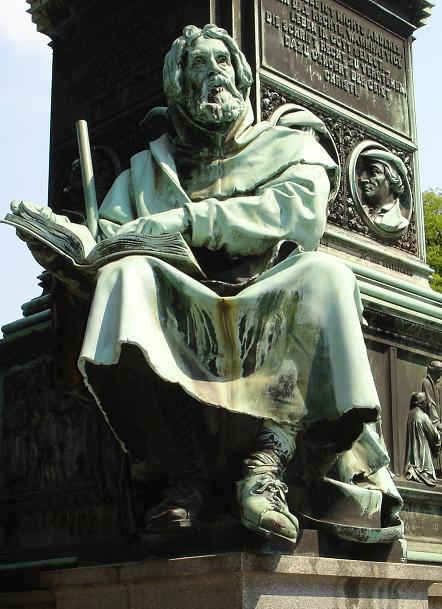
    Valdes of Lyon has the Scriptures put into the common tongue

    Valdes (Peter Waldo) with an open book: bronze from Ernst Rietschel’s Luther Monument at Worms, unveiled 1868, via Wikimedia Commons
    Valdes (Peter Waldo) with an open book: bronze from Ernst Rietschel’s Luther Monument at Worms, unveiled 1868, via Wikimedia Commons · Public domain

    Valdes, remembered as Peter Waldo, was a wealthy merchant of Lyon. About 1173 he gave away his property to follow Christ in poverty. He had clerics of Lyon translate the Gospels and other parts of the New Testament into the Franco-Provençal tongue of the people, one of the first translations of Scripture into a modern European language. His followers, the Poor of Lyon, went about preaching from the Scriptures as laymen. In 1179 Waldo went to Rome, where Pope Alexander III approved his vow of poverty but forbade him and his followers to preach, because they were laymen. They kept preaching, and in 1184, at Verona, Pope Lucius III excommunicated them. The Waldenses survived centuries of persecution in the Alpine valleys; in 1532 they joined the Reformed churches, and their vernacular New Testament fed into Olivétan’s French Bible of 1535. Some Baptist writers of the nineteenth century claimed an unbroken succession through the Waldenses from the apostles; modern scholars have largely rejected that claim, and this museum does not make it. What Baptists do share with Valdes is the conviction, in the words of their 1689 Confession, that the Scriptures are “to be translated into the vulgar language of every nation unto which they come.”

    Source en.wikipedia.org: Wikipedia, “Waldensians” (c. 1173; translation 1175-1185; 1179 Rome and Third Lateran; 1184 Verona; Chanforan 1532; Olivétan 1535; Baptist successionism “largely rejected”), and “Peter Waldo.” Britannica, “Waldenses,” agrees on 1173, the clerics’ translation and the 1184 ban. Confession: 2LCF ch. 1 §8.

  22. Scripture & Canon

    Peter Comestor’s Historia Scholastica: the “popular Bible” of the medieval schools, and its limits

    A page of Peter Comestor’s Historia Scholastica, France, late 12th century. Boston Public Library, via DPLA and Wikimedia Commons
    A page of Peter Comestor’s Historia Scholastica, France, late 12th century. Boston Public Library, via DPLA and Wikimedia Commons · Public domain

    About 1173 Peter Comestor, a master at the cathedral school of Notre-Dame in Paris, finished the Historia Scholastica, a Latin retelling of the whole sacred history of the Bible for students. It became a required school text at Paris and Oxford and was sometimes called the medieval popular Bible; more than 800 manuscripts survive from 1175 to the end of the 15th century, and it was among the earliest printed books, about 1470. Through later verse versions and translations into Dutch, German and French it reached far beyond the schools: the French Bible historiale (already on this timeline) was built upon it. Honesty is essential here: the Historia is not Scripture. It is a paraphrase that weaves the Bible together with the Church Fathers and classical historians, so that readers often met the holy history mixed with other men’s words. That is why a whole, faithful translation matters. The plate is a page from a French copy of the late 12th century. “Every word of God is pure: he is a shield unto them that put their trust in him. Add thou not unto his words, lest he reprove thee, and thou be found a liar” (Proverbs 30:5-6, KJV).

    Source en.wikipedia.org: Wikipedia, “Historia scholastica” (Petrus Comestor; c. 1173; Notre-Dame school, Paris; “Medieval Popular Bible”; draws on Bible, classical scholars and Fathers; curriculum at Paris and Oxford; 800+ MSS 1175-15th c.; basis of Bible historiale, Rijmbijbel, Weltchronik; printed c. 1470). Plate: Boston Public Library MS via DPLA, France, 1175-1199. Prov 30:5-6 KJV verified.

  23. The English Bible

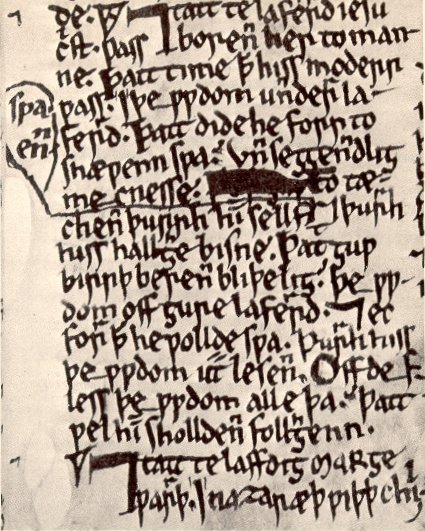
    The Ormulum: the Gospel readings explained in English verse

    A page of the Ormulum (lines 3607-3623), Orrm’s own manuscript, showing his revisions. Bodleian Library, Oxford, MS Junius 1, via Wikimedia Commons
    A page of the Ormulum (lines 3607-3623), Orrm’s own manuscript, showing his revisions. Bodleian Library, Oxford, MS Junius 1, via Wikimedia Commons · Public domain

    The Ormulum is a work of Bible teaching written in early Middle English verse by an Augustinian canon who names himself Orrm, at the request of his brother Walter, a fellow canon; it was most likely written at Bourne Abbey in Lincolnshire. After a preface, it sets out the Gospel passages read at the mass through the church year and explains each one in English, at a time when many local priests may have spoken Norman French. Orrm devised his own careful spelling so that readers would pronounce the English rightly, which has made the work precious to scholars of the language. Only about a fifth of what he planned survives, in a single manuscript that is his own copy, now in the Bodleian Library at Oxford (MS Junius 1). Scholars cannot fix the date exactly; about 1180 is usual, and it may have been begun as early as 1150. Honesty requires a note: even its admirers agree it is tedious and repetitive when read straight through. “The entrance of thy words giveth light; it giveth understanding unto the simple” (Psalm 119:130, KJV).

    Source en.wikipedia.org: Wikipedia, “Ormulum” (12th-c. biblical exegesis by the Augustinian canon Orrm, just under 19,000 lines of early Middle English verse; for Brother Walter; homilies on the mass texts of the year; phonemic orthography; many priests may have spoken Anglo-Norman; about a fifth survives; single autograph MS, Bodleian MS Junius 1; Bourne Abbey widely accepted; date c. 1180, perhaps begun 1150; “tedious and repetitive”). Ps 119:130 KJV verified.

  24. The English Bible

    The Hatton Gospels: the four Gospels in Old English, still being copied more than a century after the Conquest

    Long after the Norman Conquest, English scribes were still copying the Gospels in their own tongue. The Hatton Gospels, made in the late twelfth or early thirteenth century and probably at Canterbury, contain all four Gospels in the West Saxon translation of about 990, written in a late Kentish form of the language. The book was copied from another surviving manuscript, itself a copy of an earlier one, and the Gospels run in an unusual order: Mark, Luke, Matthew, John. Only one passage is lacking, Luke 16:12 to 17:1, for which a replacement leaf was later supplied, probably for John Parker, son of Archbishop Matthew Parker. The book later belonged to Christopher, Lord Hatton, was used by Francis Junius for his printed edition of the Old English Gospels in 1665, and was bought by the Bodleian Library in 1671; it is MS Hatton 38. Honesty: like all the Old English Gospels, it was translated from the Latin Vulgate, not from the Greek. “Then opened he their understanding, that they might understand the scriptures” (Luke 24:45, KJV).

    Source en.wikipedia.org: Wikipedia, “Hatton Gospels” (late 12th/early 13th c.; West Saxon OE Gospels; prob. Canterbury; copied from an extant MS itself a copy; from the Vulgate; lacks Luke 16:12-17:1, fol. 62 supplied via John Parker; Hatton; Bodleian 1671). Order Mk-Lk-Mt-Jn and Junius 1665 per Bodleian/EM1060 and “Old English Bible translations”. No plate. Luke 24:45 KJV verified.

  25. Scripture & Canon

    The Miroslav Gospel: the Gospel readings in the Serbian form of Church Slavonic

    Miroslav Gospel, first page, c. 1180. National Museum of Serbia, Belgrade, via Wikimedia Commons
    Miroslav Gospel, first page, c. 1180. National Museum of Serbia, Belgrade, via Wikimedia Commons · Public domain

    The Miroslav Gospel is a richly decorated Gospel book of 362 parchment pages, one of the oldest surviving works written in the Serbian form of Church Slavonic, in Cyrillic letters. It was commissioned about 1180 by Prince Miroslav of Hum, brother of the Serbian ruler Stefan Nemanja, and was copied at Kotor, on the Adriatic, between about 1186 and 1190 from an earlier text. Most of it is by an unknown scribe of Zeta, and the last pages are signed by Grigorije the scribe. Its language stands at the turn from Old Church Slavonic to a recognisably Serbian tongue, and its lettering and ornament are counted a masterpiece. It was long kept at the Hilandar monastery on Mount Athos; in 1845 Porphyrius Uspensky cut one leaf out of it, and that leaf was first shown in public at Kiev in 1874. The book was given to King Alexander I of Serbia in 1896 and is now in the National Museum of Serbia in Belgrade. In 2005 UNESCO entered it in the Memory of the World register. “But these are written, that ye might believe that Jesus is the Christ, the Son of God; and that believing ye might have life through his name” (John 20:31, KJV).

    Source en.wikipedia.org: Wikipedia, “Miroslav Gospel” (362 pp.; Serbian recension of Church Slavonic, Cyrillic; commissioned 1180 by Prince Miroslav of Hum, brother of Stefan Nemanja; transcribed in Kotor 1186-1190; scribe from Zeta + Grigorije; Hilandar; leaf cut 1845 by Porphyrius Uspensky; given to Alexander I 1896; National Museum of Serbia; UNESCO Memory of the World 2005). John 20:31 KJV verified.

  26. Scripture & Canon

    The Gospels of Henry the Lion: a Romanesque masterpiece of the four Gospels

    Gospels of Henry the Lion: St Mark, at the opening of his Gospel (“Secundum Marcum”). Herzog August Bibliothek, Wolfenbüttel, via Web Gallery of Art and Wikimedia Commons
    Gospels of Henry the Lion: St Mark, at the opening of his Gospel (“Secundum Marcum”). Herzog August Bibliothek, Wolfenbüttel, via Web Gallery of Art and Wikimedia Commons · Public domain

    The Gospels of Henry the Lion were made at the Benedictine abbey of Helmarshausen for Henry, Duke of Saxony, to be given to the altar of the Virgin in St Blaise’s church at Brunswick, now Brunswick Cathedral. Scholars once dated the book to about 1175, but most now place it about 1188, when that altar was dedicated. It holds the text of the four Gospels on 266 pages, with 50 full-page paintings, and is counted a masterpiece of 12th-century Romanesque book painting. It has survived complete. In 1983 it was bought at auction in London for £8.14 million, with money raised by the German government, two federal states, a cultural foundation and private donors, many of them from Brunswick; for some years it was the most expensive book ever sold. It is kept at the Herzog August Library in Wolfenbüttel and, to protect it, is shown only once every two years. The plate is the opening of St Mark’s Gospel. “The beginning of the gospel of Jesus Christ, the Son of God” (Mark 1:1, KJV).

    Source en.wikipedia.org: Wikipedia, “Gospels of Henry the Lion” (Helmarshausen; altar of the Virgin, St Blaise Brunswick, dedicated 1188; early dating c. 1175 vs late dating c. 1188 (current balance); 266 pp., 50 full-page miniatures; Sotheby’s 6 Dec 1983, £8,140,000; most expensive book until 1994; Herzog August Bibliothek, shown once every two years). The coronation page is not used. Mark 1:1 KJV verified.

  27. Scripture & Canon

    The Vukan Gospel: the Gospel readings of the year, written at Ras

    The Vukan Gospel: a text page in two columns of Serbian Cyrillic, with an interlaced initial. National Library of Russia, St Petersburg, via Wikimedia Commons
    The Vukan Gospel: a text page in two columns of Serbian Cyrillic, with an interlaced initial. National Library of Russia, St Petersburg, via Wikimedia Commons · Public domain

    The Vukan Gospel is a complete aprakos, a Gospel book arranged as the readings for the church year, written on parchment in Church Slavonic of the Serbian recension about 1200. Several scribes wrote it in two columns of uncial Cyrillic; the chief of them was the elder monk Simeon. His note on the last leaf says it was made at Ras, the capital of Rascia (Raška), for Prince Vukan, a son of Stefan Nemanja; the National Library of Russia notes that this part of the note was revised, and researchers think it first named Vukan’s brother Stefan. It is the oldest aprakos Gospel of the Serbian recension. It has two pictures, St John the Evangelist writing his Gospel and Christ Emmanuel, and many initial letters, some woven with wolf heads (Vukan means “wolf”). In 1883 it came to the Imperial Public Library in St Petersburg, now the National Library of Russia, with the collection of Archbishop Porfiry Uspensky; one leaf is in the Library of the Academy of Sciences. “In the beginning was the Word, and the Word was with God, and the Word was God” (John 1:1, KJV).

    Source nlr.ru: National Library of Russia, exhibition “Ostromir Gospel and the Manuscript Tradition”: Vukan Gospel (complete aprakos, c. 1200, Serbian recension; I+189 leaves; 2 cols, several hands, Monk Simeon; St John fol. 1v, Emmanuel fol. 76r; wolf-head initials; note fol. 189v, revised; oldest Rascian aprakos; to Imperial Public Library 1883 via Porfiry Uspensky; F.п.I.82). Ras/Nemanja also per Wikipedia “Vukan Gospel”. John 1:1 KJV verified.

  28. Scripture & Canon

    Stephen Langton divides the Bible into the chapters still used today

    The seal of Stephen Langton as Archbishop of Canterbury (1207-1228), from W. de Gray Birch, Catalogue of Seals in the Department of Manuscripts in the British Museum (1887), via Wikimedia Commons
    The seal of Stephen Langton as Archbishop of Canterbury (1207-1228), from W. de Gray Birch, Catalogue of Seals in the Department of Manuscripts in the British Museum (1887), via Wikimedia Commons · Public domain

    The ancient Hebrew scrolls were divided only by open and closed paragraphs, and early Greek copies of the New Testament by topical sections called kephalaia. Neither matches the chapters we know. Stephen Langton, an Englishman who studied at the University of Paris and lectured there on theology until 1206, is credited with dividing the Latin Bible into the arrangement of chapters used today. One account dates his scheme to 1205. His contemporary Cardinal Hugo de Sancto Caro devised another system in the 1240s, but it is Langton’s that remains. Langton became Archbishop of Canterbury in 1207 and died in 1228. His chapters were later carried into printed Greek New Testaments in the sixteenth century, and they stand in every King James Bible. “So they read in the book in the law of God distinctly, and gave the sense, and caused them to understand the reading” (Nehemiah 8:8, KJV).

    Source en.wikipedia.org: Wikipedia, “Chapters and verses of the Bible” (parashot and kephalaia; Langton 1205; Hugo de Sancto Caro; chapters inserted into Greek MSS in the 16th c.); “Stephen Langton” (Paris, lectured until 1206; Archbishop 1207-1228; credited with the modern chapter arrangement; Hugo 1244-48). His political career is deliberately omitted. Neh 8:8 KJV verified.

  29. Scripture & Canon

    The Bible moralisée: God with the compass, and Scripture paired with pictures

    Bible moralisée, Vienna, ÖNB Cod. 2554, fol. 1v: God as architect of creation, with compasses (c. 1220-1230). Austrian National Library, via Wikimedia Commons
    Bible moralisée, Vienna, ÖNB Cod. 2554, fol. 1v: God as architect of creation, with compasses (c. 1220-1230). Austrian National Library, via Wikimedia Commons · Public domain

    The Bibles moralisées are the grandest picture Bibles of the Middle Ages: very large, very costly illuminated books of the 13th century, made for the personal use of the French royal family. Each page sets short passages of Scripture beside medallion pictures, pairing an Old Testament episode with a New Testament one and adding a written moral or allegorical reading. Seven fully illustrated copies survive; four were made in the early 13th century, and the smallest, Vienna 2554 (131 leaves), thought to be among the earliest, is famous for its frontispiece of God as the architect of creation, measuring out the world with a pair of compasses. Honesty: these books carry only selections of the Bible, and much of their text is commentary, not Scripture; their allegories are a medieval reading laid over the text. Their dates are debated (one theory places Vienna 2554 as early as 1208-1215), and the many artists who made them are unknown. “When he prepared the heavens, I was there: when he set a compass upon the face of the depth” (Proverbs 8:27, KJV).

    Source en.wikipedia.org: Wikipedia, “Bible moralisée” (13th-c. picture Bibles for the French royal family; selections of Scripture with commentary and paired OT/NT medallions; seven fully illustrated survivors, four early 13th c.; Vienna 2554, 131 ff., frontispiece of God with compasses; one theory dates it 1208-1215; artists unknown). Plate dated c. 1220-30 on Commons. Prov 8:27 KJV verified.

  30. Scripture & Canon

    The Council of Toulouse forbids the Scriptures to laymen

    In 1229 Folquet, bishop of Toulouse, called a local council to act against the Albigensian (Cathar) movement then spreading in southern France. Among its decrees was a ban on lay people having the Scriptures at all: “We prohibit also that the laity should be permitted to have the books of the Old and the New Testament.” A layman could keep a Psalter or a Breviary for his devotions, but, it went on, “we most strictly forbid their having any translation of these books.” Unauthorised and vernacular copies were to be destroyed. In 1234 a council at Tarragona went further: no one was to possess the books of the Old and New Testaments, and anyone who did was to hand them to the bishop within eight days to be burned. Toulouse was a local council, but it shows how far some were willing to go to keep the Word from the people. “The entrance of thy words giveth light; it giveth understanding unto the simple” (Psalm 119:130, KJV).

    Source en.wikipedia.org: Wikipedia, “Council of Toulouse” (1229; called by Folquet de Marselha against the Albigensian/Cathar movement; canon quoted verbatim as translated there; Tarragona 1234 restatement). Ps 119:130 KJV verified.

  31. Scripture & Canon

    Hugh of Saint-Cher and the first concordance of the Bible

    Tommaso da Modena, portrait of Hugh of Saint-Cher (painted 1352), chapter house of the former convent of San Nicolò, Treviso, via Wikimedia Commons
    Tommaso da Modena, portrait of Hugh of Saint-Cher (painted 1352), chapter house of the former convent of San Nicolò, Treviso, via Wikimedia Commons · Public domain

    Hugh of Saint-Cher (c. 1200-1263), a Dominican friar and master of theology at Paris, directed the compilation of the first concordance of the Bible, an index of the words of the Latin Vulgate, completed by the usual account in 1230. For the first time a reader could find every place a word stood in Scripture and compare passage with passage. Hugh, or scholars working under him, also compiled the first known “correctorium”, a collection of variant readings of the Latin Bible, and his preface says he compared Latin copies, commentaries and Hebrew manuscripts. His running commentary on the whole Bible read it in four senses, literal, allegorical, anagogical and moral. The portrait here was painted nearly ninety years after his death and gives him spectacles, which did not yet exist in his lifetime. “These were more noble than those in Thessalonica, in that they received the word with all readiness of mind, and searched the scriptures daily, whether those things were so” (Acts 17:11, KJV).

    Source en.wikipedia.org: Wikipedia, “Hugh of Saint-Cher” (c. 1200-1263; Dominican, Paris, Master of Theology 1230; “directed the compilation of the first Bible concordance (of the Vulgate), completed in 1230”; first correctorium, Correctio Biblie, collated Latin versions, commentaries and Hebrew MSS; Postillae juxta quadruplicem sensum). Portrait: Commons description (Tommaso da Modena 1352, anachronistic spectacles). Acts 17:11 KJV verified.

  32. Scripture & Canon

    The Paris Bible: the whole Bible in one volume, in the order we still read it

    Leaf from a Paris Bible with St Paul writing, late 13th century. The Walters Art Museum, Baltimore, MS W.51, fol. 477v, via Wikimedia Commons
    Leaf from a Paris Bible with St Paul writing, late 13th century. The Walters Art Museum, Baltimore, MS W.51, fol. 477v, via Wikimedia Commons · CC0

    Until the early 13th century there was no single order for the books of the Bible, and a Latin Bible was often bound in four volumes. In Paris, scribes began to produce complete Bibles in one volume, with the books in a uniform order close to the one in printed Bibles today, divided into chapters, with running headings, prologues mostly drawn from Jerome and a guide to the meaning of Hebrew names. Between about 1230 and 1280 these Bibles were copied more often and spread more widely across Europe than any other form of the Bible. Many were small enough to carry, made for travelling preachers and for students in the new universities; some 20,000 small Bibles of this kind are estimated to have been made in the 13th century alone. Honesty requires a note: they included the deuterocanonical books (the Apocrypha), and their chapters did not yet have numbered verses. “All scripture is given by inspiration of God, and is profitable for doctrine, for reproof, for correction, for instruction in righteousness” (2 Timothy 3:16, KJV).

    Source en.wikipedia.org: Wikipedia, “Paris Bible” (standardised one-volume Vulgate, 13th c.; no single order before; often in 4 volumes; uniform order similar to modern Bible; 1230-1280 copied and spread more widely than any other; pocket Bibles for friars; universities; c. 20,000 small-format Paris Bibles in 13th c.; Deuterocanonical books; 64 prologues mostly from Jerome; Interpretation of Hebrew Names; chapters but no numbered verses; running headers). 2 Tim 3:16 KJV verified.

  33. The English Bible

    The Story of Genesis and Exodus: the first books of Moses sung in English verse in Norfolk

    About 1250 an unknown writer in Norfolk retold the books of Genesis and Exodus in English rhyming verse, 4,162 lines running from the creation of the world to the death of Moses. He opens with a prayer to God, “Almighty Lord,” to help him show “this world’s beginning,” to God’s honour, “whetherso I read or sing,” His Victorian editor observed that such religious works in English were composed for the unlearned, who knew no other language than the one they spoke. The poem survives in a single small manuscript of about 1300 at Corpus Christi College, Cambridge (MS 444). Richard Morris edited it for the Early English Text Society in 1865, and it is now free to read on Project Gutenberg. It also holds the earliest known use of the word firmament in English. Honesty: this is a verse retelling, not a translation; Morris notes that the Bible narrative is “here and there varied” by medieval legends, though its author is “far less bold” with them than many later writers. It shows that more than a century before the Wycliffite Bible, English people were hearing the history of the Law in their own tongue. “In the beginning God created the heaven and the earth” (Genesis 1:1, KJV).

    Source gutenberg.org: Richard Morris, ed., The Story of Genesis and Exodus, an Early English Song, about A.D. 1250 (EETS, 1865; Project Gutenberg 50685; phrases quoted from his introduction and his translation of the opening prayer). Also Wikipedia, “Middle English Story of Genesis and Exodus” (Norfolk c. 1250; 4,162 lines; creation to Moses’ death; earliest “firmament”). No plate. Gen 1:1 KJV verified.

  34. Scripture & Canon

    The T’oros Roslin Gospels: the Armenian Gospels at their most splendid

    T’oros Roslin Gospels, fol. 163r: the Transfiguration. Walters Art Museum, Baltimore (W.539), via Wikimedia Commons
    T’oros Roslin Gospels, fol. 163r: the Transfiguration. Walters Art Museum, Baltimore (W.539), via Wikimedia Commons · CC0

    In 1262, at Hromkla, the seat of the Armenian Catholicos in Cilicia, the illuminator T’oros Roslin made this Gospel book for a priest also named T’oros, nephew of the Catholicos Constantine I. It is one of seven known manuscripts signed by Roslin and the most sumptuous of them, with 15 full miniatures and 67 smaller pictures; Roslin widened the art of the Gospel book beyond the traditional portraits of the four Evangelists into a narrative of the life of Christ, from the Nativity and the Baptism to the Transfiguration, the Passion and Pentecost. A long colophon records how it was made. The book was long cherished in the Armenian church, and in the 17th century it still served scribes as a model. It was kept at Sebastia (Sivas) from 1604 into the early 20th century; the Walters Art Museum records that it may have been removed from Armenian lands during the First World War and the Armenian Genocide. It was bought by Henry Walters by 1929, and Sadie Walters gave it to the Walters Art Museum in Baltimore in 1935. The picture shows the Transfiguration. “This is my beloved Son, in whom I am well pleased; hear ye him” (Matthew 17:5, KJV).

    Source art.thewalters.org: Walters Art Museum, W.539, “T’oros Roslin Gospels” (1262, Hromkla; for the priest T’oros, nephew of Catholicos Constantine I; 1 of 7 signed MSS, most sumptuous, 15 miniatures + 67 smaller; narrative cycle; colophon fol. 406v; model for 17th-c. scribes; provenance: Sebastia 1604-c. 1914, “may have been removed … during World War I and the Armenian Genocide”, Kelekian, Henry Walters c. 1929, gift 1935). Matt 17:5 KJV verified.

  35. Scripture & Canon

    Jacob van Maerlant’s Rijmbijbel: Bible history in Dutch verse

    Maerlant, Rijmbijbel, Utrecht 1332 (Museum Meermanno, The Hague, MMW 10 B 21, fol. 9v): the building of the tower of Babel
    Maerlant, Rijmbijbel, Utrecht 1332 (Museum Meermanno, The Hague, MMW 10 B 21, fol. 9v): the building of the tower of Babel. Via Wikimedia Commons · Public domain

    The Flemish poet Jacob van Maerlant, who was born near Bruges and is believed to have served as town clerk at Damme, put the Bible’s history into Middle Dutch rhyming verse and finished the work on 25 March 1271. In the oldest surviving copy it runs to about 27,000 lines. He did not translate the Bible itself: he adapted, with many omissions and additions, Peter Comestor’s Historia scholastica (already on this timeline), the Paris schools’ handbook of Bible history, and he called his work “the Scolastica in Dutch.” Maerlant laid more weight than Comestor on reading the Old Testament as a mirror of the New. Honesty: the name Rijmbijbel (“rhyme Bible”) is a later one and, strictly, a misnomer, since this is a verse paraphrase and not Scripture. Later scribes divided it into numbered chapters, turning a book for reading aloud into a reference book; the copy completed at Utrecht in 1332 is now in the Museum Meermanno in The Hague. “Therefore is the name of it called Babel; because the LORD did there confound the language of all the earth” (Genesis 11:9, KJV).

    Source nl.wikipedia.org: Wikipedia (nl), “Rijmbijbel” (adaptation of Comestor’s Historia scholastica; c. 27,081 lines in KB Brussel Ms. 15001; completed 25 March 1271; Maerlant’s own title “Scolastica in dietschen”; name a misnomer; typology stressed; later chapter divisions). Also en.wikipedia “Jacob van Maerlant” (Bruges, Damme). Plate: MMW 10 B 21 (Utrecht 1332). Gen 11:9 KJV verified.

  36. Scripture & Canon

    The Bible historiale: the Bible most French lay readers knew, and its limits

    The Creation, with the opening of Genesis 1, Bible historiale, c. 1411, vol. 1, f. 3. British Library, Royal MS 19 D III, via Wikimedia Commons
    The Creation, with the opening of Genesis 1, Bible historiale, c. 1411, vol. 1, f. 3. British Library, Royal MS 19 D III, via Wikimedia Commons · CC0

    Between 1291 and 1295 Guyart des Moulins, a priest and canon of Aire-sur-la-Lys, translated large parts of the Latin Vulgate into French, woven together with Peter Comestor’s Historia Scholastica, a 12th-century retelling of the Bible’s history. It became the predominant French Bible of the Middle Ages; 144 manuscripts survive, many richly painted. Honesty requires its limits to be stated: Guyart did not translate the whole Bible; by his own account he left out portions that he judged “should not, according to reason, be translated”, rearranged the rest, and mixed in commentary and even stories from pagan history. From 1317 Paris booksellers began filling it out with other translated books until it matched the whole Vulgate. It shows both how hungry ordinary readers were for the Bible in their own tongue, and why a whole, faithful translation matters. The plate shows the Creation, from a copy of about 1411. “Ye shall not add unto the word which I command you, neither shall ye diminish ought from it” (Deuteronomy 4:2, KJV).

    Source en.wikipedia.org: Wikipedia, “Bible Historiale” (Guyart des Moulins, 1291-1295; Vulgate + Comestor’s Historia Scholastica; predominant medieval French Bible; portions censored/omitted, quoted; pagan “incidents”; 144 MSS; from 1317 expanded to the full Vulgate). Plate: BL Royal MS 19 D III, f. 3. Deut 4:2 KJV verified.

Plates are hung only where a genuine image of the subject could be found under a public-domain or open licence. Each carries its credit and links to its licence record. Entries without a plate are awaiting one that meets that standard. More entries are being prepared, and each will be added only with its citation.

Provenance

Every entry on this page was checked, when it was added, against the source linked beneath it; notes name the underlying scholarship where the source cites it. Where historians disagree (for example, over John Wycliffe’s own share in the Bible that bears his name), the entry says so. Scripture is quoted verbatim from the King James Version. Plates are reproduced almost entirely from Wikimedia Commons: public-domain works, works dedicated to the public domain (CC0), or photographs under Creative Commons Attribution (CC BY 2.0-3.0) or Attribution-ShareAlike (CC BY-SA 2.0-4.0) licences. Each plate’s licence is stated beneath it, with a link to the record where it was confirmed.