Baptist Militia A library & museum of the Whole Armour of God Visit
Find

Hall III · The Timeline

The Early Church

“But the word of the Lord endureth for ever. And this is the word which by the gospel is preached unto you.”1 Peter 1:25, KJV

How the Scriptures were received, carried into the English tongue, and confessed by the Baptist churches. Each date is linked to its source, so that you may test every word.

  • Scripture & Canon (83)
  1. The Early Church1st-5th centuries

    Scripture & Canon

    Paul writes to the churches of Galatia: “not after man … but by the revelation of Jesus Christ”

    Papyrus 46, fol. 158r (c. 175-225): the close of Ephesians (6:20 ff.), then the heading “To the Galatians” and Galatians 1:1-8. University of Michigan (P. Mich. inv. 6238), via Wikimedia Commons
    Papyrus 46, fol. 158r (c. 175-225): the close of Ephesians (6:20 ff.), then the heading “To the Galatians” and Galatians 1:1-8. University of Michigan (P. Mich. inv. 6238), via Wikimedia Commons · Public domain

    The Epistle to the Galatians is Paul’s letter “unto the churches of Galatia” (1:2) in Asia Minor, written when the great question before the young churches was whether Gentile believers must keep the law of Moses, circumcision above all, to be saved. Paul answers that they need not: a man is justified by faith in Christ, and the law’s place is to be understood in the light of Christ. That the letter shows no sign of a developed church order and turns on this early dispute places it within Paul’s own lifetime. Honesty: a majority of scholars date it between the late 40s and early 50s; some place it as early as AD 48, before the council at Jerusalem (Acts 15), others in the 50s. Scholars also differ over whether “Galatia” means the Roman province in the south, where Paul preached on his first journey, or the Celtic Galatians further north. Its oldest near-complete copy is in Papyrus 46 (c. AD 200), where it follows Ephesians, as the plate shows. “But I certify you, brethren, that the gospel which was preached of me is not after man. For I neither received it of man, neither was I taught it, but by the revelation of Jesus Christ” (Galatians 1:11-12, KJV).

    Source en.wikipedia.org: Wikipedia, “Epistle to the Galatians” (Paul to churches of Galatia; Gentiles and the Mosaic law, circumcision; early stage, no developed organisation; majority late 40s-early 50s, some c. 50-60, Jordan argues 48 before the Jerusalem council; south province vs north ethnic Galatia; P46 c. 200 earliest near-complete copy). Plate: P46 fol. 158r. Gal 1:2, 1:11-12 KJV verified.

  2. Scripture & Canon

    Paul writes 1 Thessalonians: the word received “not as the word of men, but as it is in truth, the word of God”

    Papyrus 65, a 3rd-century copy of 1 Thessalonians 1:3-2:1 in Greek. Papyrological Institute, Florence (PSI XIV 1373), via Wikimedia Commons
    Papyrus 65, a 3rd-century copy of 1 Thessalonians 1:3-2:1 in Greek. Papyrological Institute, Florence (PSI XIV 1373), via Wikimedia Commons · Public domain

    Paul had preached the gospel at Thessalonica, in Macedonia, and gathered a church there, many of whom had “turned to God from idols” (1:9). He wrote back to them, most scholars think from Corinth only months later, during the eighteen months he spent in that city on his second journey; notes added in many early manuscripts, Codex Alexandrinus among them, say instead that it was written from Athens after Timothy returned with news. The letter thanks God for their faith and love, reminds them how Paul worked so as not to burden them, and comforts those grieving their dead with the hope of the resurrection and the Lord’s return (4:13-18). A majority of scholars date it to AD 49-51, and it is widely agreed to be one of the first books of the New Testament written; many count it the earliest surviving Christian writing, though some place Galatians earlier. An inscription naming the proconsul Gallio, before whom Paul was brought at Corinth (Acts 18:12-17), anchors this part of Paul’s life. Most scholars accept it as Paul’s own. “For this cause also thank we God without ceasing, because, when ye received the word of God which ye heard of us, ye received it not as the word of men, but as it is in truth, the word of God, which effectually worketh also in you that believe” (1 Thessalonians 2:13, KJV).

    Source en.wikipedia.org: Wikipedia, “First Epistle to the Thessalonians” (converts turned from idols; most scholars: from Corinth months after leaving; subscriptions in Alexandrinus etc. say Athens; majority 49-51 during 18 months at Corinth; among first NT books, earliest extant Christian text; Gallio inscription; most regard as authentic). Plate: P65, 3rd c. 1 Thess 1:9, 2:13 KJV verified.

  3. Scripture & Canon

    The Epistle of James: “be ye doers of the word, and not hearers only”

    Papyrus 23 (P. Oxy. X 1229), early 3rd century: James 1:10-12 in Greek. Spurlock Museum, University of Illinois, via Wikimedia Commons
    Papyrus 23 (P. Oxy. X 1229), early 3rd century: James 1:10-12 in Greek. Spurlock Museum, University of Illinois, via Wikimedia Commons · Public domain

    The Epistle of James is written by “James, a servant of God and of the Lord Jesus Christ” to “the twelve tribes which are scattered abroad” (1:1). It is a letter of practical wisdom: patience in trials, asking God for wisdom, bridling the tongue, no favour to the rich over the poor, prayer for the sick, and the teaching that faith without works is dead. By tradition its writer is James the brother of the Lord, the leader of the church at Jerusalem, and if so it was written before his death, which Josephus places in AD 62; some who hold this view place it very early, even before the Jerusalem council of Acts 15. Honesty: many modern scholars think it was written in his name by a later hand, because of its polished Greek, and it is dated anywhere from the mid-first to the mid-second century. It was little cited in the early church, Eusebius lists it among the disputed books, it was widely received only by the late fourth century, and Martin Luther criticised it for its teaching on faith and works; it has always remained in the New Testament. The plate is Papyrus 23 (Spurlock Museum, Illinois), early 3rd century, with James 1:10-12. “But be ye doers of the word, and not hearers only, deceiving your own selves” (James 1:22, KJV).

    Source en.wikipedia.org: Wikipedia, “Epistle of James” (1:1; wisdom themes, faith without works is dead; traditionally James the brother of Jesus; modern pseudepigraphy view; mid-1st to mid-2nd c.; Josephus: James died 62; some place it before Acts 15; disputed, sparsely cited, received by late 4th c.; Eusebius “disputed”; Luther) and “Papyrus 23” (early 3rd c.). Jas 1:22 KJV verified.

  4. Scripture & Canon

    Paul writes 2 Thessalonians: “stand fast, and hold the traditions which ye have been taught”

    Papyrus 92 (P. Narmuthis inv. 69.39a + 69.229a): Ephesians 1:11-13, 19-21 and 2 Thessalonians 1:4-5, 11-12 in Greek. Egyptian Museum, Cairo, via Wikimedia Commons
    Papyrus 92 (P. Narmuthis inv. 69.39a + 69.229a): Ephesians 1:11-13, 19-21 and 2 Thessalonians 1:4-5, 11-12 in Greek. Egyptian Museum, Cairo, via Wikimedia Commons · Public domain

    The Second Epistle to the Thessalonians opens in the names of Paul, Silvanus and Timothy, and is addressed to the same young church as 1 Thessalonians. It encourages believers who were suffering for their faith, corrects the report that the day of the Lord had already come, and warns against idleness: those who will not work should not eat. It was received early: it stood in Marcion’s list and in the Muratorian fragment, and Irenaeus names it. Honesty on authorship: it has been traditionally held to be Paul’s, but critical commentators are roughly evenly divided, because its style and teaching differ from 1 Thessalonians. A 2011 survey of 111 scholars at the British New Testament Conference found 63 in favour of Paul’s authorship, 13 against and 35 uncertain. Those who hold it is Paul’s date it to about AD 51-52, soon after the first letter; those who do not date it to about 80-115. The plate, Papyrus 92 (Egyptian Museum, Cairo), holds a few verses of Ephesians and of 2 Thessalonians 1. “Therefore, brethren, stand fast, and hold the traditions which ye have been taught, whether by word, or our epistle” (2 Thessalonians 2:15, KJV).

    Source en.wikipedia.org: Wikipedia, “Second Epistle to the Thessalonians” (Paul, Silvanus, Timothy; authorship disputed, Dunn “roughly even split”; 2011 BNTC survey 63/13/35; authentic view 51-52, later view c. 80-115; in Marcion’s canon and the Muratorian fragment, named by Irenaeus). Plate: Papyrus 92 (Commons dates it 4th c.). 2 Thess 2:15 KJV verified.

  5. Scripture & Canon

    Paul writes 1 Corinthians from Ephesus: “not in the words which man’s wisdom teacheth, but which the Holy Ghost teacheth”

    Papyrus 46, fol. 79v (c. 175-225): 1 Corinthians 2:11-3:5 in Greek. University of Michigan (P. Mich. inv. 6238), via Wikimedia Commons
    Papyrus 46, fol. 79v (c. 175-225): 1 Corinthians 2:11-3:5 in Greek. University of Michigan (P. Mich. inv. 6238), via Wikimedia Commons · Public domain

    Paul had planted the church at Corinth, and while he was at Ephesus word and questions reached him from it (7:1). He answered in the letter we call 1 Corinthians. It deals with divisions in the church, moral disorder, marriage, food offered to idols, the right ordering of worship and spiritual gifts, and, in chapter 15, the resurrection of Christ and of those who are His. Scholars agree that Paul wrote it; Sosthenes is named with him in the greeting (1:1), and Paul signs the closing greeting in his own hand (16:21). Most date it to his stay at Ephesus, usually placed between AD 53 and 57, and most likely to the longer stay described in Acts 19. Despite its name it was not his first letter to them, for he refers back to an earlier one (5:9) that has not survived. Its oldest copy is in Papyrus 46 (c. AD 200); the plate shows the leaf with chapter 2, where Paul says the gospel he preached came not by human wisdom. “Which things also we speak, not in the words which man’s wisdom teacheth, but which the Holy Ghost teacheth; comparing spiritual things with spiritual” (1 Corinthians 2:13, KJV).

    Source en.wikipedia.org: Wikipedia, “First Epistle to the Corinthians” (issues: divisions, immorality, marriage, idol food, worship, gifts, resurrection; Pauline authorship undisputed; Sosthenes co-sender; own-hand greeting; written at Ephesus, usually 53-57, more likely the extended stay; 5:9 earlier letter). Plate: P46 fol. 79v. 1 Cor 2:13 KJV verified.

  6. Scripture & Canon

    Paul writes 2 Corinthians from Macedonia: “My grace is sufficient for thee”

    Papyrus 46, fol. 142r (c. 175-225): 2 Corinthians 11:33-12:9 in Greek. University of Michigan (P. Mich. inv. 6238), via Wikimedia Commons
    Papyrus 46, fol. 142r (c. 175-225): 2 Corinthians 11:33-12:9 in Greek. University of Michigan (P. Mich. inv. 6238), via Wikimedia Commons · Public domain

    After 1 Corinthians, Paul made a sorrowful visit to Corinth, and would not come again “in heaviness” (2:1); he then wrote to them “with many tears” (2:4). Then, having left Ephesus for Macedonia (Acts 20), probably writing from Philippi or Thessalonica, he sent the letter we call 2 Corinthians, with Timothy named beside him, to the church at Corinth and the believers throughout Achaia. It is the most personal of his letters: comfort in affliction, the ministry of the new covenant, the collection for the poor saints at Jerusalem (chapters 8-9), and a defence of his apostleship in which he boasts only of his weakness. There is little doubt among scholars that Paul wrote it. Honesty: scholars debate whether it was first one letter or several of Paul’s letters to Corinth joined together, since the tone changes sharply at chapter 10 and the subject shifts at chapters 8-9; others hold that it is a single letter. Its date follows Paul’s three years at Ephesus, roughly AD 53-57. Papyrus 46 (c. AD 200) preserves it; the plate shows the leaf where the Lord answers Paul’s prayer. “And he said unto me, My grace is sufficient for thee: for my strength is made perfect in weakness” (2 Corinthians 12:9, KJV).

    Source en.wikipedia.org: Wikipedia, “Second Epistle to the Corinthians” (Paul with Timothy, to Corinth and Achaea; little doubt Paul is author; one vs composite letter, chs 8-9 and 10-13; painful visit, letter of tears; written after leaving Ephesus for Macedonia, Philippi or Thessalonica; Ephesus c. 53-57). Plate: P46 fol. 142r. 2 Cor 12:9 KJV verified.

  7. Scripture & Canon

    Paul writes to the Romans from Corinth: “the power of God unto salvation to every one that believeth”

    Papyrus 40, 3rd century: fragments of Romans 3:21-26, “the righteousness of God … by faith of Jesus Christ”. Institut für Papyrologie, Heidelberg (P. Heid. inv. G 645), via Wikimedia Commons
    Papyrus 40, 3rd century: fragments of Romans 3:21-26, “the righteousness of God … by faith of Jesus Christ”. Institut für Papyrologie, Heidelberg (P. Heid. inv. G 645), via Wikimedia Commons · Public domain

    The Epistle to the Romans, the longest of Paul’s thirteen letters, sets out the gospel of salvation through Jesus Christ. Scholars agree that Paul wrote it, most likely while staying in the house of Gaius at Corinth (16:23), with Tertius writing it down at his dictation (16:22), in late 55 to early 57. Paul had preached around the Aegean and meant to carry the gospel on to Spain, visiting Rome on the way (15:24), so the letter prepares the church there, of both Jewish and Gentile believers, for his coming. Some early manuscripts add a closing note naming Corinth and Phoebe, a servant of the church at Cenchrea (16:1), as its bearer. Honesty: versions with only fourteen or fifteen chapters circulated early, though the letter in its final form has sixteen; and Christians have read its teaching on justification differently, both those who hold to faith alone and the Roman Catholic view claiming support from it. William Tyndale, in the prologue to his 1526 Romans (drawn largely from Luther’s), called it “the principal and most excellent part of the new testament.” “For I am not ashamed of the gospel of Christ: for it is the power of God unto salvation to every one that believeth; to the Jew first, and also to the Greek” (Romans 1:16, KJV).

    Source en.wikipedia.org: Wikipedia, “Epistle to the Romans” (longest of 13 Pauline epistles; consensus Paul; house of Gaius, Corinth; amanuensis Tertius; late 55-early 57; 14/15-chapter recensions; subscripts naming Corinth + Phoebe; Spain via Rome; sola fide and RC readings; Tyndale prologue from Luther, quoted). Plate: P40, 3rd c. Rom 1:16, 15:24, 16:1, 16:22-23 KJV verified.

  8. Scripture & Canon

    Paul writes to Philemon: “not now as a servant, but … a brother beloved”

    Papyrus 87 (P. Col. theol. 12), early 3rd or late 2nd century: Philemon 13-15 in Greek. University of Cologne, via Wikimedia Commons
    Papyrus 87 (P. Col. theol. 12), early 3rd or late 2nd century: Philemon 13-15 in Greek. University of Cologne, via Wikimedia Commons · Public domain

    The Epistle to Philemon is a short personal letter, only 335 words in Greek and the shortest of Paul’s surviving letters, written from prison to Philemon, a Christian in whose house a church met at Colossae. It is among the letters that nearly all scholars accept as Paul’s own. By the usual reading, Onesimus was Philemon’s slave who had run away, had come to Paul, and had become a Christian through him; Paul now sends him back with this letter and asks Philemon to receive him as a brother in Christ, offering to repay anything Onesimus owed. The letter does not directly condemn slavery, but it sets master and servant on the ground of brotherhood in the Lord, and that it was kept at all suggests Paul’s plea was granted. Honesty: some scholars, such as Allen Dwight Callahan, question whether Onesimus was a slave at all. It was written about AD 57-62, from Caesarea or from Rome, and probably at the same time as Colossians. The plate is Papyrus 87 (University of Cologne), early 3rd or late 2nd century, the earliest known copy of Philemon. “Not now as a servant, but above a servant, a brother beloved, specially to me, but how much more unto thee, both in the flesh, and in the Lord?” (Philemon 16, KJV).

    Source en.wikipedia.org: Wikipedia, “Epistle to Philemon” (prison letter; church in Philemon’s house at Colossae; undisputed; 335 Greek words, shortest; Onesimus, runaway-slave reading and Callahan’s dissent; offer to repay; not explicitly condemning slavery; c. 57-62 from Caesarea or Rome; often with Colossians) and “Papyrus 87”. Phlm 16 KJV verified.

  9. Scripture & Canon

    Paul writes to the Ephesians, “an ambassador in bonds”: the letter that names the whole armour of God

    Papyrus 49, a 3rd-century copy of Ephesians 4:16-29 in Greek. Beinecke Library, Yale University (P. CtYBR inv. 415), via Wikimedia Commons
    Papyrus 49, a 3rd-century copy of Ephesians 4:16-29 in Greek. Beinecke Library, Yale University (P. CtYBR inv. 415), via Wikimedia Commons · Public domain

    The Epistle to the Ephesians, tenth book of the New Testament, is the letter in which the Christian is told to “put on the whole armour of God” (6:11). It opens by naming Paul as its writer (1:1), and he calls himself a prisoner (3:1; 4:1). By tradition it was written from his imprisonment in Rome about AD 62, close in time to Colossians, which it closely resembles, and Philemon. Its first half sets out the blessings of the gospel and the making of Jew and Gentile into one body in Christ; its second half teaches holy living, and it closes with the armour of God and the sending of Tychicus (6:10-24). Honesty: since the nineteenth century many critical scholars have doubted that Paul wrote it and date it to AD 70-100; others, from Westcott and Hort to F. F. Bruce and John Stott, have defended Paul’s authorship, and Harold Hoehner’s survey of 279 commentaries (1519-2001) found 54% for Paul. The early canon lists, the Muratorian fragment among them, count it as Paul’s. “For which I am an ambassador in bonds: that therein I may speak boldly, as I ought to speak” (Ephesians 6:20, KJV).

    Source en.wikipedia.org: Wikipedia, “Epistle to the Ephesians” (traditionally Paul, Rome, c. AD 62; resembles Colossians; Philemon same period; 1:1 names Paul; 6:10-24 armour + Tychicus; many modern scholars dispute authorship, date 70-100; defenders incl. Westcott, Hort, Bruce, Stott; Hoehner 2002 survey of 279 commentaries: 54% for, 39% against, 7% uncertain; Muratorian fragment attributes it to Paul). Plate: 𝔓49, 3rd c. Eph 6:20 KJV verified.

  10. Scripture & Canon

    Paul writes to the Philippians from his bonds: “I press toward the mark”

    Papyrus 16 (P. Oxy. 1009), 3rd or 4th century: Philippians 3:10-17 in Greek. Found at Oxyrhynchus; Alexandria Antiquities Museum, via Wikimedia Commons
    Papyrus 16 (P. Oxy. 1009), 3rd or 4th century: Philippians 3:10-17 in Greek. Found at Oxyrhynchus; Alexandria Antiquities Museum, via Wikimedia Commons · Public domain

    Paul first came to Philippi, in Macedonia, on his second journey, around AD 50-52 (Acts 16). Years later, writing as a prisoner, he sent the believers there a letter of thanks and joy, with Timothy named beside him: thanks for the gift they had sent by Epaphroditus, a call to be of one mind, the great passage on Christ who “humbled himself, and became obedient unto death” (2:8), and his own resolve to count all things loss for Christ. That Paul wrote it is generally agreed. Honesty: where he was held is uncertain. Ephesus (52-55) and Caesarea (57-59) have both been proposed, but the most likely place is Rome, around AD 62. Many scholars since the 1960s also read it as more than one of Paul’s letters to Philippi joined together, while agreeing that the material is Paul’s own, written in the 50s or early 60s. A 3rd-century copy survives in Papyrus 16; the plate shows its fragment of chapter 3. “I press toward the mark for the prize of the high calling of God in Christ Jesus” (Philippians 3:14, KJV).

    Source en.wikipedia.org: Wikipedia, “Epistle to the Philippians” (Paul with Timothy; first visit on 2nd journey c. 50-52; written in custody; Ephesus 52-55 or Caesarea 57-59 possible, most likely Rome c. 62; composite-fragments view since 1960s; material authentically Pauline, 50s or early 60s). Plate: P16, 3rd/4th c. Phil 1:1, 3:14 KJV verified.

  11. Scripture & Canon

    Paul writes to the Colossians: “Let the word of Christ dwell in you richly”

    Papyrus 46 (P. Chester Beatty II), fol. 15 + 90, c. 175-225: a bifolio with Romans, the end of Philippians and the beginning of Colossians in Greek. Chester Beatty Library, Dublin, via Wikimedia Commons
    Papyrus 46 (P. Chester Beatty II), fol. 15 + 90, c. 175-225: a bifolio with Romans, the end of Philippians and the beginning of Colossians in Greek. Chester Beatty Library, Dublin, via Wikimedia Commons · Public domain

    The Epistle to the Colossians opens in the names of Paul and Timothy and was written to the church at Colossae, a small city in Phrygia near Laodicea, about a hundred miles from Ephesus. It proclaims Christ as supreme over all creation, the one by whom and for whom all things were made and in whom all the fulness of the Godhead dwells, and it warns the church not to be drawn from Him by philosophy and the traditions of men. It was carried, with Philemon and Ephesians, by Tychicus and Onesimus. The early church held it to be Paul’s (Irenaeus, Clement of Alexandria, Tertullian, Origen, Eusebius). Honesty: since the 19th century many scholars have questioned that, on grounds of vocabulary, style and theology, while others still defend it; a 2011 survey of 109 scholars at the British New Testament Conference found 56 in favour, 17 against and 36 uncertain. If Paul wrote it, he probably wrote it in prison in Rome about AD 62 (Bruce Metzger places it in the 60s); if not, it may date to the late first century. The plate is Papyrus 46 (c. AD 200), a leaf from the Chester Beatty Library holding the end of Philippians and the opening of Colossians. “Let the word of Christ dwell in you richly in all wisdom; teaching and admonishing one another in psalms and hymns and spiritual songs, singing with grace in your hearts to the Lord” (Colossians 3:16, KJV).

    Source en.wikipedia.org: Wikipedia, “Epistle to the Colossians” (Paul and Timothy; Colossae near Laodicea, ~100 mi from Ephesus; Christ pre-eminent; Tychicus and Onesimus with Philemon and Ephesians; early Fathers held Pauline; 2011 BNTC survey 56/17/36; Metzger 60s in prison; Rome c. 62, or late 1st c.). Plate: P46, Chester Beatty BP II fol. 15 + 90. Col 3:16 KJV verified.

  12. Scripture & Canon

    The Epistle to the Hebrews: the word of God “sharper than any twoedged sword”

    Papyrus 13, fragment 1 (c. 225-250): Hebrews 4:2-12 in Greek. British Library (Inv. 1532v), via Wikimedia Commons
    Papyrus 13, fragment 1 (c. 225-250): Hebrews 4:2-12 in Greek. British Library (Inv. 1532v), via Wikimedia Commons · Public domain

    Hebrews was written to believers who were tempted, under persecution, to turn back from Christ to the old system of the law. It answers by showing Christ as better than the angels, than Moses, and than the Levitical priesthood: the great High Priest after the order of Melchisedec, whose one sacrifice finished what the tabernacle only foreshadowed. Its Greek is the most polished in the New Testament. Honesty on authorship: the text does not name its writer. Most Greek manuscripts, the Syriac Peshitta and some Old Latin copies place it among Paul’s letters, and the King James Version heads it “The Epistle of Paul the Apostle to the Hebrews”; but doubts were voiced in the early church, and most modern scholars regard the author as unknown. Origen held that the thoughts were the apostle’s, commended any church that received it as Paul’s, and said, “But who wrote the epistle, in truth, God knows.” On date, because it speaks of the tabernacle service as still going on, the Catholic Encyclopedia placed it in late 63 or early 64, before the Temple fell; some scholars prefer AD 70-100. A 3rd-century copy survives in Papyrus 13; the plate shows the fragment that holds chapter 4. “For the word of God is quick, and powerful, and sharper than any twoedged sword, piercing even to the dividing asunder of soul and spirit, and of the joints and marrow, and is a discerner of the thoughts and intents of the heart” (Hebrews 4:12, KJV; compare the sword of the Spirit, Ephesians 6:17).

    Source en.wikipedia.org: Wikipedia, “Epistle to the Hebrews” (anonymous; placed with Paul in most Greek MSS, Peshitta, some Old Latin; modern view author unknown; polished Greek; exhortation to persevere; Cath. Encyc. late 63/early 64; Attridge, Aitken 70-100). Origen quoted from Eusebius HE VI.25.14, NPNF (newadvent.org/fathers/250106.htm). Plate: P13. Heb 4:12 KJV verified.

  13. Scripture & Canon

    Paul writes 1 Timothy: “give attendance to reading, to exhortation, to doctrine”

    The First Epistle to Timothy is addressed to Paul’s younger fellow-labourer, whom he had left at Ephesus (1:3). It gives counsel for the ordering of the church: prayer and worship, the qualifications of bishops (overseers) and deacons, the care of widows, and faithfulness to sound doctrine against false teaching. The church received it as Paul’s: the Muratorian fragment (c. 170-180) ascribes all three Pastoral Epistles to him, Irenaeus quotes them and names Paul, Eusebius counts them among the undisputed letters, and Polycarp very probably knew 1 and 2 Timothy. By the traditional account it was written after Paul’s release from his first Roman imprisonment, when he had gone on into Macedonia; older reference works such as Easton’s (1897) put it about AD 66 or 67, while others place Paul’s death earlier. Honesty: since the 19th century most modern scholars have held that the Pastoral Epistles were written after Paul’s death, in the late first or first half of the second century, because of their vocabulary, style and church order, and Marcion’s list (c. 140) left them out; a smaller number of scholars still defend Paul’s authorship. “Till I come, give attendance to reading, to exhortation, to doctrine” (1 Timothy 4:13, KJV).

    Source en.wikipedia.org: Wikipedia, “First Epistle to Timothy” (counsels on church order; most modern scholars post-Pauline, “small and declining number” defend Paul; Marcion excluded Pastorals; Muratorian, Irenaeus, Eusebius “undisputed”; Polycarp probably knew 1-2 Tim; late 1st, first half 2nd c.). Traditional date: Easton’s Bible Dictionary (1897), “Timothy, First Epistle to” (A.D. 66 or 67, from Macedonia). 1 Tim 4:13 KJV verified.

  14. Scripture & Canon

    Paul writes to Titus in Crete: “Holding fast the faithful word”

    Papyrus 32 (Rylands Gr. P. 5), c. AD 200: Titus 1:11-15 in Greek. John Rylands Library, University of Manchester, via Wikimedia Commons
    Papyrus 32 (Rylands Gr. P. 5), c. AD 200: Titus 1:11-15 in Greek. John Rylands Library, University of Manchester, via Wikimedia Commons · Public domain

    The Epistle to Titus is addressed to Paul’s companion Titus, who had gone up to Jerusalem with Paul and Barnabas (Galatians 2:1) and was later left on the island of Crete to set the churches in order. In three short chapters it describes the kind of men to be ordained as elders, how each part of the church should live, and the godly life that answers to God’s grace. By the traditional account it was written about the same time as 1 Timothy, after Paul’s release from his first imprisonment and a visit to Crete, and the two letters are closely alike in subject and wording. Honesty: many scholars regard it, with 1 and 2 Timothy, as the work of a later follower of Paul, and most of those date it between AD 80 and 100; others still hold that Paul wrote it, perhaps using a secretary. The plate is Papyrus 32 (John Rylands Library, Manchester), dated about AD 200, one of the earliest surviving copies of any of the Pastoral Epistles; it holds Titus 1:11-15. “Holding fast the faithful word as he hath been taught, that he may be able by sound doctrine both to exhort and to convince the gainsayers” (Titus 1:9, KJV).

    Source en.wikipedia.org: Wikipedia, “Epistle to Titus” (Titus in Gal 2; left in Crete; requirements of elders; critics mostly 80-100; amanuensis view; close affinity with 1 Tim) and “Papyrus 32” (Titus 1:11-15; 2:3-8; c. AD 200). Traditional date: Easton (1897), “Titus, Epistle to” (about the same time as 1 Tim, after Paul’s release and visit to Crete). Titus 1:9 KJV verified.

  15. Scripture & Canon

    Peter writes to the scattered churches: “the word of the Lord endureth for ever”

    Papyrus 81, 4th century: 1 Peter 2:20-3:1 in Greek. Private collection of S. Daris, Trieste, via Wikimedia Commons
    Papyrus 81, 4th century: 1 Peter 2:20-3:1 in Greek. Private collection of S. Daris, Trieste, via Wikimedia Commons · Public domain

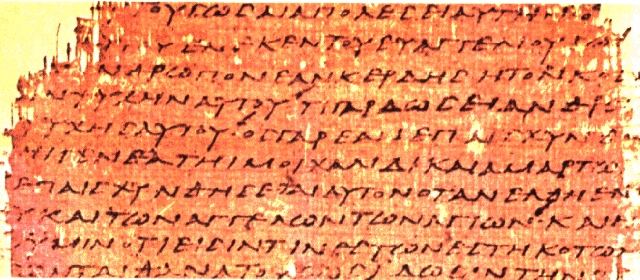
    The First Epistle of Peter is written in the name of “Peter, an apostle of Jesus Christ” to the “strangers scattered throughout Pontus, Galatia, Cappadocia, Asia, and Bithynia” (1:1), Christians in Asia Minor who were suffering for their faith. It calls them to follow the suffering Christ, who rose from the dead and is now in glory; to repay evil with good; to love one another; and to live so honestly that no charge against them could stand. It names Silvanus as the one by whom it was written (5:12) and sends greetings from “Babylon”, generally taken to mean Rome (5:13). By tradition Peter wrote it before his death in the 60s under Nero. Honesty: most modern scholars think it came from the church at Rome in Peter’s name, pointing to its polished Greek; Britannica says the question “has not been solved”, notes that its simple picture of church order points to an early date, and suggests a secretary may have done the writing, while dating the Letters of Peter perhaps to the early 2nd century. Others, such as Karen Jobes, lean towards Peter as the author. The plate is Papyrus 81 (4th century, Trieste), with 1 Peter 2:20-3:1. “But the word of the Lord endureth for ever. And this is the word which by the gospel is preached unto you” (1 Peter 1:25, KJV).

    Source en.wikipedia.org: Wikipedia, “First Epistle of Peter” (addressees in five provinces; Babylon = Rome; Silvanus 5:12; most scholars: Roman tradition associated with Peter; Jobes leans to Peter) and Britannica, “Letters of Peter” (authorship “has not been solved”; primitive church order suggests early composition; possibly a secretary; perhaps early 2nd c.). Tradition: Peter died in the 60s under Nero (Wikipedia, “Second Epistle of Peter”). Plate: “Papyrus 81” (4th c.). 1 Pet 1:25 KJV verified.

  16. Scripture & Canon

    Paul’s farewell to Timothy: “All scripture is given by inspiration of God”

    The Second Epistle to Timothy is addressed to Paul’s younger fellow-labourer, Timothy, and has long been held to be the last letter Paul wrote before his death, which is usually placed around AD 64-65. It reads as a farewell: “For I am now ready to be offered, and the time of my departure is at hand” (4:6). It charges Timothy to “hold fast the form of sound words” (1:13), to endure hardness as a good soldier of Jesus Christ, and to preach the word; and it holds the New Testament’s plainest statement of what Scripture is. Honesty: since the early 19th century many scholars have judged 2 Timothy and the other Pastoral Epistles (1 Timothy, Titus) to be the work of a follower of Paul, written perhaps between AD 90 and 140, because their themes and their picture of church order differ from his other letters; a number of scholars still defend Paul’s authorship, and some who doubt the other two hold that 2 Timothy is his. “All scripture is given by inspiration of God, and is profitable for doctrine, for reproof, for correction, for instruction in righteousness: That the man of God may be perfect, throughly furnished unto all good works” (2 Timothy 3:16-17, KJV).

    Source en.wikipedia.org: Wikipedia, “Second Epistle to Timothy” (traditionally Paul’s last letter before his death; critical view: unknown follower, 90-140; some defend Paul, Murphy-O’Connor holds 2 Tim authentic) and “Paul the Apostle” (died c. 64/65). No plate. 2 Tim 3:16-17, 4:6 KJV verified.

  17. Scripture & Canon

    The Second Epistle of Peter: “holy men of God spake as they were moved by the Holy Ghost”

    Papyrus 72 (P. Bodmer VIII), 3rd-4th century: the end of 1 Peter and the beginning of 2 Peter in Greek. Vatican Apostolic Library, via Wikimedia Commons
    Papyrus 72 (P. Bodmer VIII), 3rd-4th century: the end of 1 Peter and the beginning of 2 Peter in Greek. Vatican Apostolic Library, via Wikimedia Commons · Public domain

    The Second Epistle of Peter is written in the name of “Simon Peter, a servant and an apostle of Jesus Christ” (1:1), who says that he must shortly put off this tabernacle (1:14) and calls this his second letter to the same readers (3:1). It recalls that he was an eyewitness of Christ’s majesty on the holy mount, declares that no prophecy of Scripture came by the will of man, warns against false teachers, and explains that the Lord is not slack concerning His promise, for one day is with the Lord as a thousand years. It also sets Paul’s letters beside “the other scriptures” (3:15-16). Taken at its word, it was written about AD 64-68, before Peter’s death. Honesty: its authorship was doubted as early as the 3rd century, it was among the last books to be widely received, and most critical scholars today regard it as written in Peter’s name by a follower; proposed dates run from about AD 60 to 150. The plate is Papyrus 72 (Bodmer VIII, 3rd-4th century, now in the Vatican Library), the earliest known copy of 1 and 2 Peter, at the page where 1 Peter ends and 2 Peter begins. “For the prophecy came not in old time by the will of man: but holy men of God spake as they were moved by the Holy Ghost” (2 Peter 1:21, KJV).

    Source en.wikipedia.org: Wikipedia, “Second Epistle of Peter” (1:1, 1:14, 3:1; taken literally c. 64-68; scholars 60-150, list of proposed dates; most critical scholars pseudepigraphal; refers to Pauline epistles) and Britannica, “Letters of Peter” (Second Coming, 1,000 years as a day, false teachers; doubts from the 3rd century). 2 Pet 1:21 and 3:15-16 KJV verified.

  18. Scripture & Canon

    The Gospel according to Mark: “my words shall not pass away”

    Papyrus 45 (P. Chester Beatty I), early 3rd century: a fragment of Mark 8:35-9:1 in Greek. Chester Beatty Library, Dublin, via Wikimedia Commons
    Papyrus 45 (P. Chester Beatty I), early 3rd century: a fragment of Mark 8:35-9:1 in Greek. Chester Beatty Library, Dublin, via Wikimedia Commons · Public domain

    The Gospel of Mark tells the ministry of Jesus from His baptism by John to the cross, the burial and the empty tomb, and most scholars hold that it was the first of the four Gospels written. The text does not name its writer, as was usual for ancient lives, but every surviving manuscript titles it “according to Mark”, and the earliest Christian tradition, recorded by Papias of Hierapolis (see his entry on this timeline), says that Mark, Peter’s companion and interpreter, wrote down what Peter preached. Some scholars accept John Mark as the author; others doubt it. It was probably written in Greek at Rome for Gentile believers. Its date is usually reckoned from the Lord’s words about the Temple in chapter 13: most scholars place it in the years just before AD 70 (65-70), while a large number place it just after (71-75). The cited page notes that this dating does not rest on denying that Jesus could foretell the Temple’s fall, and that either way it was written while eyewitnesses were still living. Its early copies include Papyrus 45 (early 3rd century), the oldest surviving book of the four Gospels and Acts together, shown in the plate at Mark 8:35-9:1. “Heaven and earth shall pass away: but my words shall not pass away” (Mark 13:31, KJV).

    Source en.wikipedia.org: Wikipedia, “Gospel of Mark” (baptism to empty tomb; most scholars earliest gospel; anonymous but uniform superscription; Papias: Mark, Peter’s interpreter; authorship debated; Rome, Gentile audience; Mark 13 dating, most 65-70, plurality 71-75; eyewitness lifetime) and “Papyrus 45”. Mark 13:31 KJV verified.

  19. Scripture & Canon

    The Gospel according to Matthew: “one jot or one tittle shall in no wise pass from the law”

    Papyrus 104 (P. Oxy. 4404), 2nd century: Matthew 21:34-37 in Greek. Oxyrhynchus papyri, Oxford, via Wikimedia Commons
    Papyrus 104 (P. Oxy. 4404), 2nd century: Matthew 21:34-37 in Greek. Oxyrhynchus papyri, Oxford, via Wikimedia Commons · Public domain

    The Gospel of Matthew, placed first in the New Testament, tells of the birth of Jesus, His ministry and teaching (including the Sermon on the Mount), His death, His resurrection and the Great Commission. It presents Him as the Messiah promised in the Hebrew Scriptures, the Son of David and the Son of God, and again and again shows prophecy fulfilled in Him. Papias of Hierapolis gives the first attribution to Matthew the apostle, and the Gospel was ascribed to him very early and was loved in the early church. Honesty: most modern scholars regard it as anonymous, the work of a Jewish believer skilled in the Law, written in the last quarter of the first century and probably using Mark; but the traditional authorship still has defenders, and some scholars, such as N. T. Wright and John Wenham, argue that it was written in the 40s-50s. It was probably written for Greek-speaking Jewish believers in Syria, perhaps at Antioch. Papyrus 104, shown in the plate, is one of the earliest surviving copies of Matthew; it is dated to the 2nd century and holds part of the parable of the husbandmen (21:34-37). “For verily I say unto you, Till heaven and earth pass, one jot or one tittle shall in no wise pass from the law, till all be fulfilled” (Matthew 5:18, KJV).

    Source en.wikipedia.org: Wikipedia, “Gospel of Matthew” (birth to Great Commission; Messiah, Son of David, Son of God; Papias first attribution; most scholars anonymous Jewish author, last quarter 1st c.; traditional view has defenders; Wright, Wenham 40s-50s; Syria/Antioch) and “Papyrus 104” (2nd c., among earliest texts of Matthew). Matt 5:18 KJV verified.

  20. Scripture & Canon

    The Gospel according to Luke: “that thou mightest know the certainty of those things”

    Papyrus 4, fragment D (dated from the late 2nd to the 4th century): Luke 6:4-16 in Greek. Bibliothèque nationale de France (Suppl. gr. 1120), via Wikimedia Commons
    Papyrus 4, fragment D (dated from the late 2nd to the 4th century): Luke 6:4-16 in Greek. Bibliothèque nationale de France (Suppl. gr. 1120), via Wikimedia Commons · Public domain

    The Gospel of Luke tells of the birth, ministry, death, resurrection and ascension of Jesus. With its second volume, the Acts of the Apostles, it makes up more than a quarter of the New Testament, the largest share from any one writer. It alone of the Gospels opens with a preface stating its method: the writer had followed all things carefully from the first and set them down in order for “most excellent Theophilus”, drawing on what eyewitnesses had handed down. The text does not name its author. A church tradition first recorded by Irenaeus identifies him as Luke, the physician and companion of Paul; critical opinion on that tradition has been roughly evenly divided, but most scholars hold that the writer, whatever his name, travelled with Paul. He used Mark, as most scholars agree. The most common dating is around AD 80-90. Papyrus 4, shown in the plate, is among the oldest copies of Luke; opinions on its age run from the late 2nd century to the 4th. “It seemed good to me also, having had perfect understanding of all things from the very first, to write unto thee in order, most excellent Theophilus, That thou mightest know the certainty of those things, wherein thou hast been instructed” (Luke 1:3-4, KJV).

    Source en.wikipedia.org: Wikipedia, “Gospel of Luke” (birth to ascension; with Acts 27.5% of NT; prologue to Theophilus; anonymous; Irenaeus: Luke, Paul’s companion; opinion evenly divided, most hold author met Paul; used Mark; most common date 80-90) and “Papyrus 4” (late 2nd-4th c.). Luke 1:3-4 KJV verified.

  21. Scripture & Canon

    The Acts of the Apostles: the Bereans “searched the scriptures daily”

    Papyrus 91 (P. Mil. Vogl. inv. 1224 + Macquarie inv. 360), mid-3rd century: Acts 2:30-37 and 2:46-3:2 in Greek. University of Milan, via Wikimedia Commons
    Papyrus 91 (P. Mil. Vogl. inv. 1224 + Macquarie inv. 360), mid-3rd century: Acts 2:30-37 and 2:46-3:2 in Greek. University of Milan, via Wikimedia Commons · Public domain

    The Acts of the Apostles is the second volume of Luke’s work. It begins with the ascension of Jesus and the coming of the Holy Spirit at Pentecost, tells of the first believers’ shared life, the church at Antioch, and the gospel carried from Jerusalem into the wider Mediterranean world, and follows Paul until it closes with him at Rome, preaching while he awaits trial. The name “Acts of the Apostles” is first found in Irenaeus, in the late 2nd century. As with Luke, church tradition names Luke, Paul’s companion, as the writer; scholars are divided on that, though most hold the writer knew Paul, and the “we” passages are most often read as resting on an eyewitness. Honesty on date: the earliest possible date is around AD 62, when its story ends with Paul imprisoned in Rome; most scholars date it to 80-90. Its text survives in two main forms, the Alexandrian and the longer Western. Papyrus 91 (mid-3rd century), shown in the plate, holds part of Peter’s sermon at Pentecost (2:30-37) and the life of the first church (2:46-3:2). “These were more noble than those in Thessalonica, in that they received the word with all readiness of mind, and searched the scriptures daily, whether those things were so” (Acts 17:11, KJV).

    Source en.wikipedia.org: Wikipedia, “Acts of the Apostles” (second part of Luke-Acts; ascension, Pentecost, Antioch, Paul to Rome; title first in Irenaeus; authorship divided, most hold author met Paul; “we” passages; earliest possible c. 62, most 80-90; Alexandrian vs Western text) and “Papyrus 91” (mid-3rd c.). Acts 17:11 KJV verified.

  22. Scripture & Canon

    The Epistle of Jude: “earnestly contend for the faith which was once delivered unto the saints”

    Papyrus 78 (P. Oxy. XXXIV 2684), 3rd-4th century: Jude 4-5 and 7-8 in Greek. Sackler Library, Oxford, via Wikimedia Commons
    Papyrus 78 (P. Oxy. XXXIV 2684), 3rd-4th century: Jude 4-5 and 7-8 in Greek. Sackler Library, Oxford, via Wikimedia Commons · Public domain

    The Epistle of Jude is a short letter of 25 verses from “Jude, the servant of Jesus Christ, and brother of James” (1:1). James is generally taken to be James the brother of the Lord, and so, by tradition, Jude was a brother of the Lord too; Clement of Alexandria said so. Jude meant to write of “the common salvation”, but instead urged his readers to contend earnestly for the faith once delivered to the saints: to hold fast the truth of the gospel against ungodly men who had crept in among them, a contending by faith and doctrine, not by force. It closes with one of the great doxologies of Scripture: “Now unto him that is able to keep you from falling.” Honesty: it quotes the Book of Enoch, which is not in the Bible, and Jerome wrote in 392 that for this reason it was rejected by many; Eusebius counted it among the disputed books. Yet the Muratorian fragment, Clement and Tertullian received it, and the Council of Carthage (397) listed it. It was most likely written in the late first century; many scholars think 2 Peter borrowed from it, and some consider it written in Jude’s name. The plate is Papyrus 78 (Sackler Library, Oxford), 3rd-4th century, with Jude 4-5 and 7-8. “Beloved, when I gave all diligence to write unto you of the common salvation, it was needful for me to write unto you, and exhort you that ye should earnestly contend for the faith which was once delivered unto the saints” (Jude 3, KJV).

    Source en.wikipedia.org: Wikipedia, “Epistle of Jude” (25 verses; brother of James; Clement of Alexandria; quotes Enoch; Jerome 392 “rejected by many”; Eusebius antilegomena; Muratorian, Clement, Tertullian, Carthage 397; most likely late 1st c.; most favour Jude before 2 Peter; doxology) and “Papyrus 78” (3rd/4th c.). Jude 3 KJV verified; Jude 24 checked.

  23. Scripture & Canon

    The Gospel according to John is written: the last of the four, “that ye might believe”

    Papyrus 90 (P. Oxy. 3523), late 2nd century: John 18:36-19:1, “my kingdom is not of this world” and Pilate’s question. Sackler Library, Oxford, via Wikimedia Commons
    Papyrus 90 (P. Oxy. 3523), late 2nd century: John 18:36-19:1, “my kingdom is not of this world” and Pilate’s question. Sackler Library, Oxford, via Wikimedia Commons · Public domain

    The fourth Gospel sets out seven signs of Jesus, rising to the raising of Lazarus, and then the last week of His life: the farewell discourse, His passion and His resurrection. It names as its witness “the disciple whom Jesus loved,” and says of him, “this is the disciple which testifieth of these things, and wrote these things” (21:24). Irenaeus of Lyons, writing about 180, gives the church’s earliest account of it: “John, the disciple of the Lord, who also had leaned upon His breast, did himself publish a Gospel during his residence at Ephesus in Asia.” Most scholars today agree that the Gospel was completed between AD 90 and 100. Honesty: many modern scholars continue to hold the traditional authorship by John the apostle, but most reject it, while still treating the beloved disciple as a real person and the source of much of the Gospel. Within a century or less of its writing it was being copied in Egypt, as Papyrus 52 (already on this timeline) and the plate here show. “To this end was I born, and for this cause came I into the world, that I should bear witness unto the truth. Every one that is of the truth heareth my voice” (John 18:37, KJV).

    Source en.wikipedia.org: Wikipedia, “Gospel of John” (seven signs to Lazarus; final week, farewell discourse; beloved disciple; most scholars: completed 90-100; traditional attribution first in Irenaeus, many affirm, most reject). Irenaeus, Against Heresies III.1.1 (ANF, newadvent.org/fathers/0103301.htm), quoted verbatim. Plate: P90, late 2nd c. John 18:37, 21:24 KJV verified.

  24. Scripture & Canon

    John on Patmos writes the Revelation to the seven churches of Asia: the last book of the Bible

    Papyrus 98, dated c. 150-250: Revelation 1:13-2:1, John’s vision of Christ among the seven candlesticks and the start of the letter to Ephesus. French Institute of Oriental Archaeology, Cairo (P. IFAO inv. 237b), via Wikimedia Commons
    Papyrus 98, dated c. 150-250: Revelation 1:13-2:1, John’s vision of Christ among the seven candlesticks and the start of the letter to Ephesus. French Institute of Oriental Archaeology, Cairo (P. IFAO inv. 237b), via Wikimedia Commons · Public domain

    The last book of the New Testament opens with its writer naming himself simply John, a servant of Jesus Christ, who was “in the isle that is called Patmos, for the word of God, and for the testimony of Jesus Christ” (1:9). It begins as a letter to seven churches of the province of Asia, cities close together near the coast across from Patmos, each given words of commendation, warning and promise from Christ (chapters 2-3), and it goes on to prophetic visions of the things to come before the Lord’s return. Irenaeus, about 180, says the vision “was seen … towards the end of Domitian’s reign,” and the book is commonly dated to about AD 95, the reign of Domitian (81-96). Some of its images have been read as pointing to Nero (reigned 54-68), which the cited scholarship notes does not require a date in the 60s. Honesty: Irenaeus names John the apostle as its author, and the church long received it so; modern scholars debate who this John was, and no consensus exists. “Blessed is he that readeth, and they that hear the words of this prophecy, and keep those things which are written therein: for the time is at hand” (Revelation 1:3, KJV).

    Source en.wikipedia.org: Wikipedia, “Book of Revelation” (author names himself John, on Patmos, 1:9; letters to the Seven Churches of Asia, close together near Patmos; commonly dated c. 95 under Domitian; Nero allusions do not imply 60s; Irenaeus tradition = John the apostle; no consensus). Irenaeus AH V.30.3 (ANF, newadvent 0103530), date phrase quoted. Plate: P98, 150-250. Rev 1:3, 1:9 KJV verified.

  25. Scripture & Canon

    The First Epistle of John: “that ye may know that ye have eternal life”

    Papyrus 9 (P. Oxy. III 402), 3rd century: 1 John 4:11-12, 14-17 in Greek. Houghton Library, Harvard University, via Wikimedia Commons
    Papyrus 9 (P. Oxy. III 402), 3rd century: 1 John 4:11-12, 14-17 in Greek. Houghton Library, Harvard University, via Wikimedia Commons · Public domain

    The First Epistle of John has no greeting or signature; it speaks to its readers as “little children” and teaches them how to know that their fellowship with God is real: by walking in the light, keeping His commandments, loving the brethren, and confessing that Jesus Christ is come in the flesh. It is traditionally held to have been written by John, the writer of the fourth Gospel, at Ephesus in his old age, and its thought and language are very close to that Gospel. Honesty: there is no scholarly consensus on its authorship; most scholars think the three letters of John share one author, but not all agree that he also wrote the Gospel. It is usually dated after the Gospel, probably between AD 95 and 110, though some, such as I. Howard Marshall, allow a date between the 60s and 90s. It was known early: the Muratorian fragment cites its opening verses, and Polycarp and Papias quote from the letters of John. The plate is Papyrus 9 (Houghton Library, Harvard), 3rd century, with 1 John 4:11-12, where John writes, “if God so loved us, we ought also to love one another.” “These things have I written unto you that believe on the name of the Son of God; that ye may know that ye have eternal life, and that ye may believe on the name of the Son of God” (1 John 5:13, KJV).

    Source en.wikipedia.org: Wikipedia, “First Epistle of John” (no epistolary opening; “little children”; traditionally John the Evangelist at Ephesus in old age; no consensus; probably Ephesus 95-110; Muratorian cites 1:1-3; P9 3rd c.) and “Third Epistle of John” (Marshall 60s-90s; Polycarp and Papias quote 1-2 John). 1 John 4:11 and 5:13 KJV verified.

  26. Scripture & Canon

    The Elder writes 2 and 3 John: “I have no greater joy than to hear that my children walk in truth”

    The Second and Third Epistles of John are the two shortest books of the Bible (3 John by words, 2 John by verses), each from a writer who calls himself only “the elder”. 2 John is written “unto the elect lady and her children”, which many read as a church and its members and others as a particular Christian woman; it urges them to walk in truth and love, and warns against deceivers “who confess not that Jesus Christ is come in the flesh.” 3 John is a personal letter to Gaius, commending his hospitality to travelling preachers of the gospel, commending Demetrius, and rebuking Diotrephes, “who loveth to have the preeminence”. 3 John is the only book of the New Testament in which the names “Jesus” and “Christ” do not appear, though it speaks of those who went forth “for his name’s sake.” By tradition both were written by the apostle John at Ephesus, near the end of the first century and soon after 1 John. Honesty: many modern scholars do not identify the elder with the apostle, and dates proposed run from the 60s (J. A. T. Robinson) to about 110. Being so brief, 3 John is not clearly mentioned until the 3rd century, and both letters were doubted by some before they were received with 1 John. “I have no greater joy than to hear that my children walk in truth” (3 John 4, KJV).

    Source en.wikipedia.org: Wikipedia, “Third Epistle of John” (the elder; Gaius, Demetrius, Diotrephes; hospitality; no “Jesus”/“Christ”; first reference mid-3rd c.; accepted by early 5th c.; Robinson c. 60-65, Dodd 96-110, Brown 100-110; Ephesus by tradition) and “Second Epistle of John” (elect lady: church or person; deceivers who deny Christ come in the flesh; most modern scholars not the apostle). 3 John 4 KJV verified; 2 John 1, 7 and 3 John 7, 9 checked.

  27. Scripture & Canon

    Clement of Rome: “Take up the epistle of the blessed Apostle Paul”

    A page of the Epistle of Clement as preserved at the end of the Codex Alexandrinus (5th century), from Roger Fenton’s photographic facsimile of 1856. Metropolitan Museum of Art, via Wikimedia Commons
    A page of the Epistle of Clement as preserved at the end of the Codex Alexandrinus (5th century), from Roger Fenton’s photographic facsimile of 1856. Metropolitan Museum of Art, via Wikimedia Commons · CC0

    Near the end of the first century the church at Rome wrote a long letter to the church at Corinth, where the congregation had put out its elders. The letter does not name its author, but it has always been attributed to Clement, a leader of the Roman church, and most scholars accept this. Most date it to about 96, at the end of the reign of Domitian, though some place it earlier. It is full of the Old Testament, and it sends the Corinthians back to the letter the apostle had written them a generation before: “Take up the epistle of the blessed Apostle Paul. What did he write to you at the time when the gospel first began to be preached? Truly, under the inspiration of the Spirit, he wrote to you concerning himself, and Cephas, and Apollos.” That is the quarrel of 1 Corinthians 1:12, “I am of Paul; and I of Apollos; and I of Cephas” (KJV). Within about forty years of its writing, Paul’s letter was being read at Corinth and known at Rome, and it was appealed to as written under the Spirit.

    Source newadvent.org: 1 Clement 47 (Ante-Nicene Fathers vol. 9, trans. John Keith, 1896, public domain; text at newadvent.org), quoted verbatim. Authorship and date: Wikipedia, “First Epistle of Clement” (internally anonymous; attributed to Clement, accepted by most scholars; most commonly c. 96 under Domitian, range to before 70). 1 Cor 1:12 KJV verified.

  28. Scripture & Canon

    The Chester Beatty papyri: the Law and the Prophets in early Christian books

    P. Chester Beatty VI: fragments of Deuteronomy, 2nd century (P. Mich. inv. 5554, recto). University of Michigan Library, via Wikimedia Commons
    P. Chester Beatty VI: fragments of Deuteronomy, 2nd century (P. Mich. inv. 5554, recto). University of Michigan Library, via Wikimedia Commons · Public domain

    The Chester Beatty biblical papyri are eleven Greek manuscripts of Christian origin, first announced on 19 November 1931 and published by Sir Frederic Kenyon between 1933 and 1958. Seven hold parts of the Old Testament in the Septuagint Greek: two copies of Genesis, Numbers with Deuteronomy, Isaiah, Jeremiah, and one book of Ezekiel, Daniel and Esther (Papyrus 967, already on this timeline). The oldest, P. Chester Beatty VI (Numbers and Deuteronomy), is dated to the first half of the 2nd century; about fifty of its 108 leaves survive in part. Every one of these books is a codex, a book with pages, which surprised the first scholars, who had thought Christians took up the papyrus codex widely only in the 4th century. In P. VI even the name Joshua is written as a sacred abbreviation, because it is the same name as Jesus. All but two come from before the Diocletian persecution, when Christian books are said to have been destroyed (already on this timeline). Honesty: the find was probably handled by dealers in illegal antiquities, so its exact place is unknown; the leaves are divided between Dublin, the University of Michigan and other holders. The plate shows Deuteronomy fragments of P. VI now in Michigan. “And these words, which I command thee this day, shall be in thine heart” (Deuteronomy 6:6, KJV).

    Source en.wikipedia.org: Wikipedia, “Chester Beatty Papyri” (11 MSS, Greek, Christian origin; announced 19 Nov 1931; Kenyon 1933-58; 7 OT MSS in the LXX; P. VI Numbers-Deuteronomy, first half 2nd c., c. 50 of 108 leaves; all codices; Joshua as nomen sacrum; pre-Diocletian; dealers; Dublin + Michigan). Plate: P. Mich. inv. 5554. Deut 6:6 KJV verified.

  29. Scripture & Canon

    Ignatius of Antioch writes to the Ephesians and names Paul’s letters

    Ignatius “Theophoros” holding a Gospel book: Byzantine glazed tile, 10th century. Walters Art Museum, Baltimore, via Wikimedia Commons
    Ignatius “Theophoros” holding a Gospel book: Byzantine glazed tile, 10th century. Walters Art Museum, Baltimore, via Wikimedia Commons · Public domain

    Ignatius, overseer of the church at Antioch, was condemned for his faith and taken under guard to Rome, where he died about 108. On the way he wrote a series of letters to churches, among them one to the church at Ephesus, the very congregation Paul had written to. Ignatius modelled his letters on the epistles of Paul, Peter and John, quoting and paraphrasing them freely; to the Ephesians he quotes 1 Corinthians 1:18 on the cross. Writing within living memory of the apostles, he honours Paul, who “in all his Epistles makes mention of you in Christ Jesus” (To the Ephesians 12, Ante-Nicene Fathers translation). Honesty requires two notes. Scholars have long debated which of the letters under his name are genuine: seven are commonly accepted, and some argue for fewer. His letters also press a high view of the bishop’s office, which Baptists, holding to Scripture alone, do not follow. Here he is a witness only to how early Paul’s letters were read and valued. “Paul, an apostle of Jesus Christ by the will of God, to the saints which are at Ephesus, and to the faithful in Christ Jesus” (Ephesians 1:1, KJV).

    Source en.wikipedia.org: Wikipedia, “Ignatius of Antioch” (bishop of Antioch; died c. 108 en route to Rome; seven letters incl. Ephesians; modelled on the epistles of Paul, Peter and John, “quoting or paraphrasing these apostles’ works freely”; quotes 1 Cor 1:18; authenticity debated, Ruis-Camps argues for four; role of bishops). Quotation from To the Ephesians 12, ANF trans., https://www.newadvent.org/fathers/0104.htm. Eph 1:1 KJV verified.
  30. Scripture & Canon

    Polycarp of Smyrna quotes Ephesians as “these Scriptures”

    Polycarp in the procession of saints: mosaic, Sant’Apollinare Nuovo, Ravenna, completed by c. 526, via Wikimedia Commons
    Polycarp in the procession of saints: mosaic, Sant’Apollinare Nuovo, Ravenna, completed by c. 526, via Wikimedia Commons · Public domain

    Polycarp, bishop of Smyrna, died about 155-167. His letter to the church at Philippi is his only writing to survive. Scholars generally accept it as genuine, and many think it joins two letters written at different times in the first half of the second century. It is woven through with phrases from the writings that became the New Testament. In one place Polycarp goes further than allusion. Writing “I trust that you are well versed in the Sacred Scriptures,” he goes on: “It is declared then in these Scriptures, Be angry, and sin not, and, Let not the sun go down upon your wrath.” The second phrase is Ephesians 4:26: “Be ye angry, and sin not: let not the sun go down upon your wrath” (KJV). So less than a century after Paul wrote it, the epistle of the whole armour of God was being quoted as Scripture.

    Source newadvent.org: Polycarp, Epistle to the Philippians 12 (Ante-Nicene Fathers vol. 1, trans. Roberts & Donaldson, 1885, public domain; text at newadvent.org), quoted verbatim. Authenticity, Harrison’s two-letter theory, dating and Polycarp’s death c. 155-167: Wikipedia, “Epistle of Polycarp to the Philippians”. Eph 4:26 KJV verified. No plate: no licensed manuscript image was found.

  31. Scripture & Canon

    Papias of Hierapolis: the earliest word on how Mark and Matthew came to be written

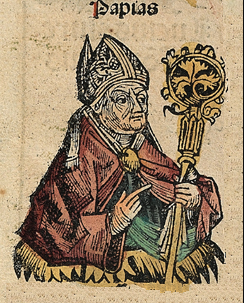
    Papias, an imagined portrait: hand-coloured woodcut by Michael Wolgemut and Wilhelm Pleydenwurff, Nuremberg Chronicle, 1493, via Wikimedia Commons
    Papias, an imagined portrait: hand-coloured woodcut by Michael Wolgemut and Wilhelm Pleydenwurff, Nuremberg Chronicle, 1493, via Wikimedia Commons · Public domain

    Papias, bishop of Hierapolis in Asia Minor, gathered what he could learn from men who had heard the apostles, and wrote it down in five books called the Exposition of the Sayings of the Lord, usually dated about 110. The books themselves are lost; only quotations survive in Irenaeus and Eusebius. Eusebius preserves his report of what “the presbyter” taught: “Mark, having become the interpreter of Peter, wrote down accurately, though not in order, whatsoever he remembered of the things said or done by Christ”, and he adds that Papias also wrote of Matthew’s Gospel and used testimonies from 1 John and 1 Peter. Honesty: Eusebius, who disliked Papias’s millennial views, thought little of him as an interpreter, and scholars still debate what Papias meant by some of his words. But within living memory of the apostles, the Gospels were already being received as faithful written witness. “Even as they delivered them unto us, which from the beginning were eyewitnesses, and ministers of the word” (Luke 1:2, KJV).

    Source en.wikipedia.org: Wikipedia, “Papias of Hierapolis” (c. 60-c. 130; five books; consensus date c. 110, range 100-120/130; known only from Irenaeus and Eusebius; Eusebius’s view of his millennialism). Quotation: Eusebius, Church History III.39.15-16, NPNF2 vol. 1, newadvent.org/fathers/250103.htm. No licensed likeness exists. Luke 1:2 KJV verified.

  32. Scripture & Canon

    Papyrus 52: the St John fragment, the earliest surviving piece of the New Testament

    Rylands Papyrus P52, recto (John 18:31-33). John Rylands Library, University of Manchester, via Wikimedia Commons
    Rylands Papyrus P52, recto (John 18:31-33). John Rylands Library, University of Manchester, via Wikimedia Commons · Public domain

    A scrap of papyrus about the size of a credit card, now in the John Rylands Library, Manchester, is generally accepted as the earliest surviving copy of any part of the New Testament. One side holds parts of John 18:31-33; the other, verses 37-38: Christ before Pilate. Because it is written on both sides it came from a codex, a bound book, not a scroll, and its large, careful letters suggest it may have been made for reading aloud in a congregation. It was bought in Egypt in 1920 by Bernard Grenfell and first published by C. H. Roberts in 1935. Honesty about the date: Roberts proposed the first half of the 2nd century (100-150); a recent re-dating proposes 125-175; a few scholars allow later still. Either way, John’s Gospel was being copied and carried far from where it was written within a few generations. “To this end was I born, and for this cause came I into the world, that I should bear witness unto the truth” (John 18:37, KJV).

    Source en.wikipedia.org: Wikipedia, “Rylands Library Papyrus P52” (P. Ryl. Gr. 457; John 18:31-33, 37-38; codex; 100-150 per Roberts, 125-175 per Orsini & Clarysse, later dates allowed by some; acquired 1920 by Grenfell; published 1935; possibly for congregational reading). Plate also hangs in the Gallery. John 18:37 KJV verified.

  33. Scripture & Canon

    Aquila of Sinope makes a word-for-word Greek translation of the Hebrew Bible

    Aquila’s column beside Symmachus and the Septuagint: specimen of the Hexapla at Psalm 45:1-4 (Greek numbering 44), after Klostermann’s Milan fragments. Dictionnaire de la Bible, via Wikimedia Commons
    Aquila’s column beside Symmachus and the Septuagint: specimen of the Hexapla at Psalm 45:1-4 (Greek numbering 44), after Klostermann’s Milan fragments. Dictionnaire de la Bible, via Wikimedia Commons · Public domain

    Aquila, a native of Sinope on the Black Sea and a convert to Judaism, flourished about the year 130 and is remembered as a disciple of Rabbi Akiva. He translated the Hebrew Bible into Greek so closely that his version came to be used in place of the Septuagint in Greek-speaking synagogues. Christians generally disliked it, saying that it rendered the Messianic passages incorrectly; yet both Origen and Jerome spoke in its praise for its faithfulness to the Hebrew, and Origen set it in a column of his Hexapla (already on this timeline). For centuries it was known only from the Hexapla excerpts copied into the margins of Greek manuscripts, until 1897, when palimpsest leaves from the Cairo Genizah reached Cambridge with parts of Kings and the Psalms in Aquila’s own words. Today an international Hexapla Project, one of whose directors, Peter J. Gentry, teaches at the Southern Baptist Theological Seminary, is re-editing these fragments. Honesty: the tradition that Aquila was once a Christian and a kinsman of Hadrian rests on the late account of Epiphanius and is left aside here. “The words of the LORD are pure words: as silver tried in a furnace of earth, purified seven times” (Psalm 12:6, KJV).

    Source en.wikipedia.org: Wikipedia, “Aquila of Sinope” (fl. 130; proselyte, disciple of Akiva; used in place of the LXX in Greek-speaking synagogues; Christians alleged Messianic passages mistranslated; praised by Origen and Jerome; in the Hexapla; Genizah fragments 1897, Burkitt 1897 / Taylor 1899; Hexapla Project, Gentry of SBTS). No licensed plate found. Ps 12:6 KJV verified.

  34. Scripture & Canon

    Marcion cuts down the Scriptures, and the churches hold to the whole

    St John with a figure identified by R. Eisler (1938) as Marcion. Italian manuscript, 11th century, Morgan Library MS M.748, fol. 150v
    St John with a figure identified by R. Eisler (1938) as Marcion. Italian manuscript, 11th century, Morgan Library MS M.748, fol. 150v. Via Wikimedia Commons · Public domain

    Marcion of Sinope, a shipowner from Pontus, came to Rome in the late 130s and taught that the God of the Old Testament was a different, lesser god from the Father of Jesus Christ. He was put out of the church at Rome about 144. He then published his own list of sacred books. It held no book of the Old Testament, only one Gospel that ancient writers describe as an edited Luke, and ten letters of Paul, without the letters to Timothy and Titus. It is the earliest record of a New Testament canon that survives, and it forced the churches to say plainly which books they had received. Justin Martyr, Irenaeus and Tertullian denounced his teaching, and the churches went on reading the Law and the Prophets together with the apostolic writings. Honesty: a few modern scholars have argued that Marcion’s Gospel came before Luke, a view that is contested. The plate, from an 11th-century Italian manuscript, shows St John with a second figure whom R. Eisler (1938) identified as Marcion; the identification is not certain. “And if any man shall take away from the words of the book of this prophecy, God shall take away his part out of the book of life” (Revelation 22:19, KJV).

    Source en.wikipedia.org: Wikipedia, “Marcion of Sinope” (c. 85-c. 160; distinct “vengeful” creator god; excommunicated at Rome c. 144; canon of ten Pauline epistles without the Pastorals + Gospel of Marcion, claimed edited Luke; earliest record of a NT canon; catalyst for the canon; Justin, Irenaeus, Tertullian; Klinghardt view contested). Plate: Morgan MS M.748 fol. 150v, ID per Eisler 1938. Rev 22:19 KJV verified.
  35. Scripture & Canon

    The Peshitta: the Scriptures in Syriac

    A parchment manuscript of the Peshitta, 9th century, displayed at the National Library of Israel, Jerusalem. Photograph by JHistory, via Wikimedia Commons
    A parchment manuscript of the Peshitta, 9th century, displayed at the National Library of Israel, Jerusalem. Photograph by JHistory, via Wikimedia Commons · CC BY-SA 4.0

    Syriac, a dialect of Aramaic centred on Edessa, became the language of the churches of the East. The general consensus of scholars is that the Old Testament was translated into Syriac, largely from the Hebrew, by or before the second century, and that the New Testament was translated from the Greek and had become a standard by the early fifth century. The name Peshitta is usually rendered “simple” or “common,” that is, the version for everyone. At first its New Testament left out five books that many churches then counted as disputed (2 Peter, 2 and 3 John, Jude and the Revelation). They were supplied in the Harklean version of 616. Its New Testament often reflects the Byzantine text-type, the family of Greek manuscripts that underlies the Received Text. From the fifth century it circulated widely across Asia, and by the eighth century the Syriac Scriptures had reached China.

    Source en.wikipedia.org: Wikipedia, “Peshitta” (consensus dating of OT and NT; the name; the five omitted books and the Harklean version of 616; Byzantine character of the NT; spread to China by the 8th c.), and “Byzantine text-type” (it underlies the Textus Receptus). Year filed as c. 150 for ordering only.

  36. Scripture & Canon

    Justin Martyr: the apostles and the prophets read aloud on the Lord’s day

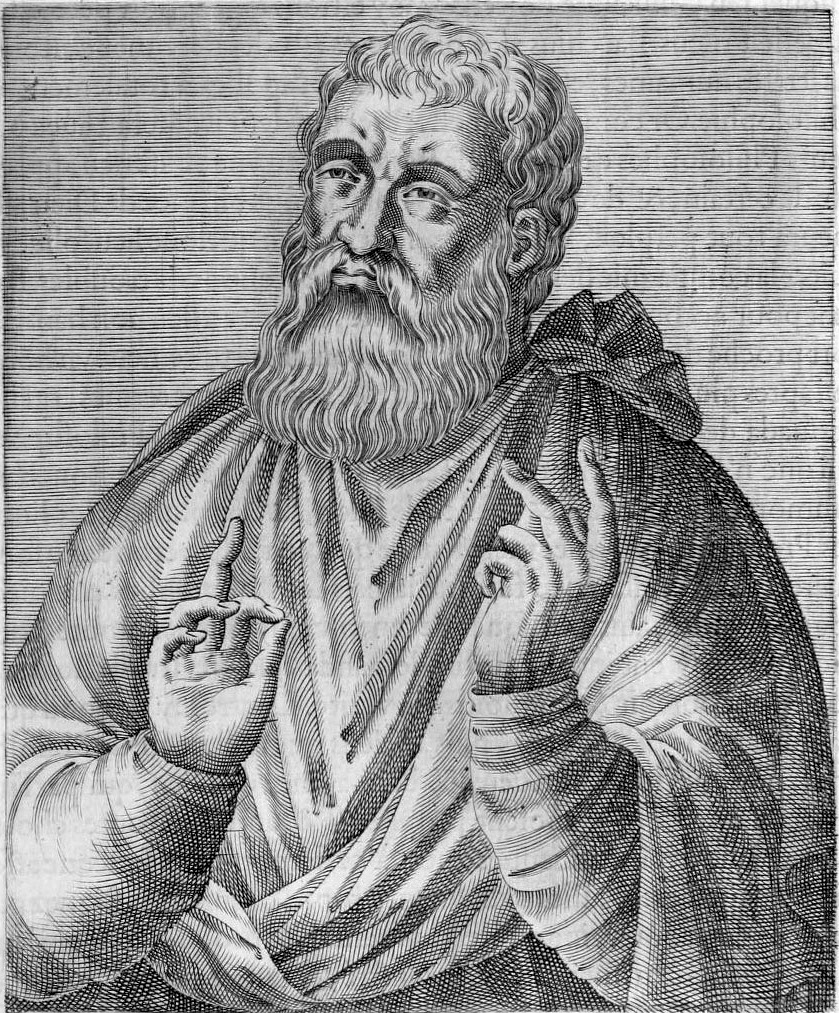
    Justin Martyr, an imagined portrait: engraving from André Thevet, Les vrais pourtraits et vies des hommes illustres (1584), via Wikimedia Commons
    Justin Martyr, an imagined portrait: engraving from André Thevet, Les vrais pourtraits et vies des hommes illustres (1584), via Wikimedia Commons · Public domain

    Justin, born at Flavia Neapolis (Nablus) in Samaria, came to Christ after a search through the schools of the philosophers. About 155-157 he addressed a defence of the Christians to the Emperor Antoninus Pius, dated by its mention of a recent prefect of Egypt. Near its close he describes how the churches met: “on the day called Sunday, all who live in cities or in the country gather together to one place, and the memoirs of the apostles or the writings of the prophets are read, as long as time permits; then, when the reader has ceased, the president verbally instructs, and exhorts to the imitation of these good things.” In the chapter before, he says these memoirs “are called Gospels.” Here, in the middle of the second century, the apostolic writings stand beside the prophets as the Scriptures read and preached to the gathered church. “Till I come, give attendance to reading, to exhortation, to doctrine” (1 Timothy 4:13, KJV).

    Source newadvent.org: Justin Martyr, First Apology 67 (Ante-Nicene Fathers vol. 1, trans. Dods & Reith, 1885, public domain; text at newadvent.org), quoted verbatim. Justin’s own term “called Gospels” is from First Apology 66, same source. Life and date (155-157, from the reference to Lucius Munatius Felix): Wikipedia, “First Apology of Justin Martyr”. 1 Tim 4:13 KJV verified. No plate.

  37. Scripture & Canon

    Tatian’s Diatessaron: the four Gospels woven into one

    Ephrem the Syrian’s Commentary on the Diatessaron, Syriac on parchment, Egypt, late 5th or early 6th century. Chester Beatty Library, Dublin (CBL Syc 709), via Wikimedia Commons
    Ephrem the Syrian’s Commentary on the Diatessaron, Syriac on parchment, Egypt, late 5th or early 6th century. Chester Beatty Library, Dublin (CBL Syc 709), via Wikimedia Commons · Public domain

    Tatian, born in “the land of the Assyrians”, became a Christian at Rome and a pupil of Justin Martyr. About 166-169 he composed the Diatessaron (Greek, “out of four”), the most prominent early harmony of the Gospels. It combined the material of the four Gospels, Matthew, Mark, Luke and John, into a single narrative, adding no significant words of its own. For three centuries it served as the standard Gospel text in parts of the Syriac-speaking church, and Ephrem the Syrian wrote a commentary on it. Honesty requires a note. Irenaeus reports that after Justin’s death Tatian was expelled from the church for Encratite (extreme ascetic) views. In the fifth century, Rabbula of Edessa ordered that every church have the four separate Gospels, and Theodoret removed more than two hundred copies of the harmony from his churches. The original text is lost and is known through later translations and Ephrem’s commentary. “But these are written, that ye might believe that Jesus is the Christ, the Son of God; and that believing ye might have life through his name” (John 20:31, KJV).

    Source en.wikipedia.org: Wikipedia, “Diatessaron” (c. 166-169; four gospels into one narrative; no significant added wording; standard in some Syriac churches for three centuries; Ephrem’s commentary, Chester Beatty Syriac MS 709; Theodoret; original lost); “Tatian” (Assyria; Rome; pupil of Justin; expelled after 165 per Irenaeus for Encratite views; Rabbula ordered separate Gospels). John 20:31 KJV verified.

  38. Scripture & Canon

    The Muratorian fragment: an early list of New Testament books

    The Muratorian fragment, 8th-century copy. Biblioteca Ambrosiana, Milan, Cod. J 101 sup., via Wikimedia Commons
    The Muratorian fragment, 8th-century copy. Biblioteca Ambrosiana, Milan, Cod. J 101 sup., via Wikimedia Commons · Public domain

    In 1740 the Italian historian Ludovico Antonio Muratori published eighty-five lines of Latin that he had found in the Ambrosian Library at Milan, in a manuscript bound about the eighth century at the abbey of Bobbio. They are a copy of perhaps the oldest known list of most of the books of the New Testament. The beginning is lost and the end breaks off, and the Latin is poor, apparently translated from a Greek original. Because it speaks of Hermas writing The Shepherd “most recently in our time,” while Pius (bishop c. 140-155) led the church at Rome, it is traditionally dated to the late second century. Some scholars argue for the fourth century instead, though that is not the consensus. The list receives four Gospels (the names of the first two are lost, though Luke and John are named third and fourth), the Acts, thirteen letters of Paul, Jude, two letters of John and the Revelation. It rejects letters “forged in Paul’s name” to further Marcion’s heresy, and says The Shepherd may be read but not publicly in church. It does not mention Hebrews, James or the letters of Peter, and it also names the Wisdom of Solomon and an Apocalypse of Peter, which some of its churches would not allow to be read. It shows that, long before any council, the churches were already distinguishing the apostolic writings from all others.

    Source en.wikipedia.org: Wikipedia, “Muratorian fragment” (discovery, manuscript, contents, dating debate: Metzger and Hill for the 2nd century, Sundberg 1973 for the 4th). Words in quotation marks are from the fragment as translated there.

  39. Scripture & Canon

    Melito of Sardis: the earliest Christian list of the Old Testament books

    Melito, bishop of Sardis, teaching the Christian faith: an imagined likeness in a Dutch book illustration of 1698. Rijksmuseum, Amsterdam (RP-P-1896-A-19368-1267), via Wikimedia Commons
    Melito, bishop of Sardis, teaching the Christian faith: an imagined likeness in a Dutch book illustration of 1698. Rijksmuseum, Amsterdam (RP-P-1896-A-19368-1267), via Wikimedia Commons · CC0

    Melito, bishop of Sardis in Asia Minor (died c. 180), wrote to a brother named Onesimus who had asked for “an accurate statement” of the ancient books “as regards their number and their order.” Melito answered that he had gone “East” to “the place where these things were preached and done” and had there “learned accurately the books of the Old Testament.” His list, preserved by Eusebius in his Church History (IV.26), is the earliest Christian list of the Old Testament canon known. It names the books of Moses, the histories, the Psalms, the writings of Solomon, Job, and the prophets. Honesty requires two notes: Esther is not named, and scholars debate whether the words “Wisdom also” are another name for Proverbs or a separate book. From these books Melito made six volumes of extracts “concerning the Saviour.” “And beginning at Moses and all the prophets, he expounded unto them in all the scriptures the things concerning himself” (Luke 24:27, KJV).

    Source newadvent.org: Eusebius, Church History IV.26.13-14, tr. A. C. McGiffert, NPNF 2nd ser. vol. 1 (1890), via New Advent (letter to Onesimus quoted). Wikipedia, “Melito of Sardis” (died c. 180; first Christian OT canon list; Esther absent; Wisdom/Proverbs debate). Plate: Rijksmuseum RP-P-1896-A-19368-1267, 1698 print, an imagined likeness. Luke 24:27 KJV verified.

  40. Scripture & Canon

    Papyrus 46: the earliest book of Paul’s letters, Ephesians 6 included

    Papyrus 46, folio 157 verso (Ephesians 6:8-18). University of Michigan Papyrology Collection, via Wikimedia Commons
    Papyrus 46, folio 157 verso (Ephesians 6:8-18). University of Michigan Papyrology Collection, via Wikimedia Commons · Public domain

    Papyrus 46, part of the Chester Beatty Papyri (with some leaves at the University of Michigan), is a single-quire papyrus codex of Paul’s epistles, dated by its handwriting to about 175-225. It holds, in this order, the last eight chapters of Romans, Hebrews, 1 and 2 Corinthians, Ephesians, Galatians, Philippians, Colossians and part of 1 Thessalonians, and among them the armour passage of Ephesians 6, which this museum is built around. Unusually, every page is numbered, and a later reader added small marks to divide the text for reading, perhaps in worship. Honesty requires two notes: the last seven leaves are lost, and scholars still debate whether the codex ever held the pastoral epistles; and textual scholars class its text as Alexandrian. “And take the helmet of salvation, and the sword of the Spirit, which is the word of God” (Ephesians 6:17, KJV).

    Source en.wikipedia.org: Wikipedia, “Papyrus 46” (P. Chester Beatty II + Michigan leaves; 175-225 or early 3rd c.; contents and order; numbered pages; reader’s marks; seven lost leaves and the Kenyon/Duff debate on the pastorals). Plate: fol. 157v, Eph 6:8-18, also in the Gallery. Eph 6:17 KJV verified.

  41. Scripture & Canon

    Irenaeus of Lyons: “neither more nor less” than four Gospels

    Title page of the first printed edition of Irenaeus, Against Heresies, edited by Erasmus and printed by Johann Froben, Basel, 1526. Biblioteca Nazionale Centrale, Rome, via Wikimedia Commons
    Title page of the first printed edition of Irenaeus, Against Heresies, edited by Erasmus and printed by Johann Froben, Basel, 1526. Biblioteca Nazionale Centrale, Rome, via Wikimedia Commons · Public domain

    About the year 180 Irenaeus, bishop of Lyon in Gaul, wrote five books against the Gnostic teachers of his day. The work is dated by its mention of Eleutherus as the current bishop of Rome. Against them Irenaeus appealed to the Gospels the churches already held. He wrote that “it is not possible that the Gospels can be either more or fewer in number than they are.” He showed how each sect that twisted one Gospel could be answered from that same Gospel. His reasons for the number four, drawn from the four winds and the four faces of the cherubim, are figures of speech. His witness is plain: within a century of the apostles, the churches of Gaul knew the four Gospels as a closed and settled number. He called the Gospel “the pillar and ground” of the Church, taking the words of 1 Timothy 3:15, “the pillar and ground of the truth” (KJV). The Greek original survives only in fragments, but an early Latin translation is nearly complete, and Erasmus printed it at Basel in 1526.

    Source newadvent.org: Irenaeus, Against Heresies III.11.8 (Ante-Nicene Fathers vol. 1, trans. Roberts & Rambaut, 1885, public domain; text at newadvent.org), quoted verbatim. Dating and textual survival: Wikipedia, “Against Heresies” (c. 180, from the reference to Eleutherus; Greek fragments; early Latin version). 1 Tim 3:15 KJV verified.

  42. Scripture & Canon

    Theophilus of Antioch names John among the inspired writers, and first uses the word “Trinity”

    Theophilus of Antioch, an imagined likeness from the Nuremberg Chronicle (1493), woodcut by Michael Wolgemut and Wilhelm Pleydenwurff
    Theophilus of Antioch, an imagined likeness from the Nuremberg Chronicle (1493), woodcut by Michael Wolgemut and Wilhelm Pleydenwurff. Via Wikimedia Commons · Public domain

    Theophilus, bishop of Antioch from about 169, was born a pagan and, by his own account, was led to Christ by reading the Holy Scriptures, especially the prophets. His one surviving work, To Autolycus, written for a learned pagan friend soon after 180, argues that the books of Moses and the prophets are older than all Greek wisdom and divinely inspired. In it he quotes the opening of John’s Gospel and names its writer as one of the inspired men: the holy writings teach us, he says, and “all the spirit-bearing [inspired] men, one of whom, John, says, In the beginning was the Word.” It is also the earliest surviving Christian work to use the word Trinity (Greek trias), which he gives as “God, and His Word, and His wisdom.” Honesty: his quotations from the New Testament are few, and he does not name Jesus in the work. “In the beginning was the Word, and the Word was with God, and the Word was God” (John 1:1, KJV).

    Source en.wikipedia.org: Wikipedia, “Theophilus of Antioch” (bishop c. 169-183; converted by reading Scripture; To Autolycus; John 1:1-3 cited naming the evangelist; earliest extant use of “Trinity”; sparse NT citation). Quotations: To Autolycus II.22 and II.15, ANF vol. 2, newadvent.org/fathers/02042.htm. Plate is an imagined 1493 likeness. John 1:1 KJV verified.

  43. Scripture & Canon

    Theodotion’s Greek version, whose Daniel the churches came to read

    Specimens of Origen’s columns after Field’s Hexapla; the top row sets Daniel 9:26 in Aquila, Symmachus, the Septuagint and Theodotion. Dictionnaire de la Bible, via Wikimedia Commons
    Specimens of Origen’s columns after Field’s Hexapla; the top row sets Daniel 9:26 in Aquila, Symmachus, the Septuagint and Theodotion. Dictionnaire de la Bible, via Wikimedia Commons · Public domain

    Theodotion is remembered, beside Aquila and Symmachus, as one of the three Jewish translators who put the Hebrew Bible into Greek in the second century. Irenaeus calls him a proselyte from Asia Minor, probably Ephesus; Epiphanius places him in the reign of Commodus, about 190. His style stands between Aquila’s word-for-word rendering and Symmachus’s free Greek, and he often kept Hebrew words untranslated. His version survives mostly in quotations and in marginal notes drawn from Origen’s Hexapla (already on this timeline), where it filled a column of its own. Its Daniel superseded the Septuagint Daniel in church use. Honesty: readings called “Theodotionic” appear in texts a century older than he, including the New Testament, where 1 Corinthians 15:54 quotes Isaiah 25:8 in a form matching his; many scholars therefore trace that text to an earlier Hebraizing revision of the Septuagint (the “kaige” recension), and who Theodotion was is still debated. His Daniel also carried the Greek additions (Susanna, Bel and the Dragon), which are not in the Hebrew. “Death is swallowed up in victory” (1 Corinthians 15:54, KJV).

    Source en.wikipedia.org: Wikipedia, “Theodotion” (one of three 2nd-c. translators with Aquila and Symmachus; Irenaeus Adv. haer. III.23: proselyte, prob. Ephesus; Epiphanius: Commodus c. 190; style between Aquila and Symmachus; transliteration; survives via Hexapla; his Daniel superseded the LXX in church use; proto-Theodotionic problem, kaige; 1 Cor 15:54 / Isa 25:8). No licensed plate found. 1 Cor 15:54 KJV verified.

  44. Scripture & Canon

    Pantaenus of Alexandria finds the Gospel of Matthew already in “India”

    Pantaenus of Alexandria, with his school below: an imagined likeness, Dutch print of 1698. Rijksmuseum, Amsterdam (RP-P-1896-A-19368-1268), via Wikimedia Commons
    Pantaenus of Alexandria, with his school below: an imagined likeness, Dutch print of 1698. Rijksmuseum, Amsterdam (RP-P-1896-A-19368-1268), via Wikimedia Commons · CC0

    Pantaenus, a Sicilian-born Stoic philosopher who became a Christian, led the catechetical school of Alexandria from about 180 and was the teacher of Clement of Alexandria; none of his writings survive. Eusebius, writing in the early fourth century, records what was said of him: that he showed such zeal “for the divine Word” that he was sent as a herald of the gospel to the nations of the East, “as far as India.” There, “it is reported,” he found the Gospel according to Matthew had arrived before him: the apostle Bartholomew had preached to them “and left with them the writing of Matthew in the Hebrew language, which they had preserved till that time.” Honesty: Eusebius gives this as report, not as something he saw, and Jerome’s later account appears to rest on Eusebius alone. Some writers suggest Pantaenus mistook the Aramaic “Mar Thoma” (St Thomas, whom the Indian churches honour) for “Bar Tolmai” (Bartholomew), and some think the book may have been the Gospel of the Hebrews. “And this gospel of the kingdom shall be preached in all the world for a witness unto all nations” (Matthew 24:14, KJV).

    Source newadvent.org: Eusebius, Church History V.10.1-3 (NPNF2 vol. 1, tr. McGiffert, via New Advent; quotations verbatim). Also Wikipedia, “Pantaenus” (Sicilian, Stoic, head of the school c. 180; teacher of Clement; no writings extant; Mar Thoma / Bar Tolmai suggestion; Gospel of the Hebrews possibility; Jerome dependent on Eusebius). Plate imagined (1698). Matt 24:14 KJV verified.

  45. Scripture & Canon

    The Coptic versions: the Scriptures in the tongue of Egypt

    Papyrus Bodmer III, fol. 77r: Genesis 2:16-19 in Bohairic Coptic, 4th century. Bodmer Lab, University of Geneva, via Wikimedia Commons
    Papyrus Bodmer III, fol. 77r: Genesis 2:16-19 in Bohairic Coptic, 4th century. Bodmer Lab, University of Geneva, via Wikimedia Commons · CC BY-SA 4.0

    In Upper Egypt, where Greek was less well understood, the Scriptures were put into Coptic, the language of the Egyptian Christians. The first translation into the southern (Sahidic) dialect is thought to have been made at the end of the second century, and it was the first great literary work in Coptic. Other versions followed in several dialects, among them the northern Bohairic, which later became the only one in church use. The Old Testament books were translated from the Greek Septuagint. Some early copies survive in substantial part, such as Papyrus Bodmer III, a fourth-century Bohairic manuscript of the Gospel of John and the opening of Genesis. Together these versions are among the earliest translations of the Bible into any language.

    Source en.wikipedia.org: Wikipedia, “Bible translations into Coptic” (dialects; Sahidic at the end of the 2nd century in Upper Egypt; OT from the Septuagint; Bodmer III, John + Gen 1:1-4:2, 4th c., Bohairic; “some of the earliest translations into any language”). Year filed as c. 190 for ordering only.

  46. Scripture & Canon

    Symmachus renders the Hebrew into elegant Greek, and Jerome weighs his “young woman”

    Symmachus flourished in the late second century and translated the Hebrew Bible into Greek with an aim opposite to Aquila’s: where Aquila followed the Hebrew word for word, Symmachus sought idiomatic, even elegant Greek, while still trying to keep the sense of the Hebrew more exactly than the Septuagint. Origen placed his version in the Hexapla (already on this timeline), and Jerome admired it and used it in making the Vulgate. Jerome also faulted him on a point that mattered to Christians: in Isaiah 7:14 Symmachus wrote the Greek word for “young woman” where the Septuagint and the Gospel of Matthew have “virgin.” Honesty: little is known of the man. Eusebius called him an Ebionite, but that is now generally thought unreliable, and Epiphanius’s account that he was a Samaritan who became a Jew is given more credence. His version survives only in fragments of the Hexapla. “Behold, a virgin shall conceive, and bear a son, and shall call his name Immanuel” (Isaiah 7:14, KJV).

    Source en.wikipedia.org: Wikipedia, “Symmachus (translator)” (fl. late 2nd c.; in Origen’s Hexapla and Tetrapla; idiomatic, elegant Greek, per Metzger the opposite of Aquila’s method; admired and used by Jerome for the Vulgate; Jerome faulted neanis for parthenos in Isa 7:14; Eusebius’s “Ebionite” now thought unreliable; Epiphanius: Samaritan convert). No licensed plate found. Isa 7:14 KJV verified.

  47. Scripture & Canon

    Papyrus 47: the oldest surviving copy of the Book of Revelation

    Papyrus 47, folio 7 recto (Revelation 13:16-14:4), early 3rd century. Chester Beatty Library, Dublin, via Wikimedia Commons
    Papyrus 47, folio 7 recto (Revelation 13:16-14:4), early 3rd century. Chester Beatty Library, Dublin, via Wikimedia Commons · Public domain

    Among the Chester Beatty Papyri, now in the Chester Beatty Library in Dublin, is a single-quire papyrus codex of the Book of Revelation, dated by its handwriting to the early 3rd century. Ten leaves survive, holding parts of Revelation 9 to 17; from the way the leaves are folded, scholars reckon the whole book once filled some 30 to 32 leaves and held Revelation alone. Sir Frederic Kenyon, who first published it, described the writing as rough, “with no pretensions to calligraphy”, a working copy, made to be read. Honesty: textual scholars class its text as Alexandrian and not the strongest witness to Revelation. Even so, it shows the last book of the Bible being copied and read within about a century and a half of John’s exile on Patmos. The plate shows Revelation 13:16-14:4. “And I looked, and, lo, a Lamb stood on the mount Sion, and with him an hundred forty and four thousand, having his Father’s name written in their foreheads” (Revelation 14:1, KJV).

    Source en.wikipedia.org: Wikipedia, “Papyrus 47” (P. Chester Beatty III; early 3rd c.; Rev 9:10-17:2 in 10 leaves of a single quire; est. 30-32 leaves; Kenyon quoted; Alexandrian text, Aland Category I). Plate: fol. 7r, Rev 13:16-14:4. Rev 14:1 KJV verified.

  48. Scripture & Canon

    Papyrus 967: Ezekiel, Daniel and Esther in one early Greek book

    Papyrus 967, P. Köln Theol. 37v: the close of Susanna and the scribe’s blessing, 3rd century
    Papyrus 967, P. Köln Theol. 37v: the close of Susanna and the scribe’s blessing, 3rd century. Via Wikimedia Commons · Public domain

    Found in Egypt and first made known in the 1930s, Papyrus 967 is a 3rd-century papyrus codex of the Greek Old Testament that once held Ezekiel, Daniel and Esther in 59 sheets. Its surviving leaves are now scattered between Dublin (the Chester Beatty Library), Princeton, Cologne, Barcelona and Madrid. For Ezekiel it is an important early witness in Greek; for Daniel it preserves the older Greek translation that, by the end of the 4th century, had been almost wholly replaced in the churches by the version of Theodotion. At the close of Daniel the scribe wrote a short blessing, “Peace to him who wrote and to those who read.” Honesty: this Greek Daniel orders some chapters differently and includes the stories of Susanna and of Bel and the Dragon, which are not part of the Hebrew book, the text the King James translators followed. The plate shows the end of Susanna and that closing blessing. “But I will shew thee that which is noted in the scripture of truth” (Daniel 10:21, KJV).

    Source en.wikipedia.org: Wikipedia, “Papyrus 967” (3rd c.; discovered 1931; 59 sheets; Ezekiel, Daniel, Esther; Old Greek Daniel superseded by Theodotion by end of 4th c.; Susanna and Bel; closing wish quoted; five present locations). Plate: P. Köln Theol. 37v, Susanna 62a-b + subscriptio. Dan 10:21 KJV verified.

  49. Scripture & Canon

    The Magdalen papyrus: scraps of Matthew 26 from an early Gospel codex

    Papyrus 64 (the Magdalen papyrus), fragments of Matthew 26. Magdalen College, Oxford, via Wikimedia Commons
    Papyrus 64 (the Magdalen papyrus), fragments of Matthew 26. Magdalen College, Oxford, via Wikimedia Commons · Public domain

    In 1901 the Reverend Charles Huleatt bought small Greek fragments in Luxor, Egypt, recognised them as verses from Matthew 26, and gave them to Magdalen College, Oxford, where they are kept as Papyrus 64. They are written on both sides, so they come from a codex, a bound book, not a scroll. Further fragments in Barcelona (Papyrus 67), published in 1956, are agreed to come from the same book. When Colin Roberts published the Oxford pieces in 1953 he dated them to about 200, and three other leading papyrologists agreed. Honesty: there is no consensus on the date, and estimates have run from the first century to the fourth. In 1994 Carsten Thiede proposed a date before AD 70, which drew wide publicity, but nearly all papyrologists and biblical scholars have rejected it. “Heaven and earth shall pass away, but my words shall not pass away” (Matthew 24:35, KJV).

    Source en.wikipedia.org: Wikipedia, “Magdalen papyrus” (P. Magdalen Greek 17 = 𝔓64; bought in Luxor 1901 by C. B. Huleatt; Matt 26:23, 31; codex, written both sides; 𝔓67 Barcelona, 1956, same codex; Roberts 1953 c. 200, confirmed by Bell, Skeat, Turner; estimates 1st-4th c.; Thiede 1994 mid-1st c., viewed with scepticism by nearly all). Matt 24:35 KJV verified.

  50. Scripture & Canon

    Tertullian: the apostles’ own writings read in the churches they founded

    Tertullian of Carthage (c. 155-c. 220) was the first Christian author to write extensively in Latin, and has been called the father of Latin Christianity; he is the first Latin writer known to use the word trinity. In his Prescription against Heretics, one of his earlier works, he answered teachers who claimed a hidden tradition by pointing to the open one: the churches the apostles themselves had founded, “in which their own authentic writings are read.” He named them for his readers: Corinth in Achaia, Philippi and the Thessalonians in Macedonia, and, across the sea in Asia, “you get Ephesus”, the church to which Paul sent the letter that describes the whole armour of God. He also wrote that the church he knew joined the law and the prophets in one volume with the writings of the evangelists and apostles. In later life Tertullian sided with the New Prophecy (Montanism), though most scholars now doubt that he left the church. His witness here is plain: around 200 the apostles’ letters were already being read aloud, as Scripture, in the congregations that first received them. “And when this epistle is read among you, cause that it be read also in the church of the Laodiceans” (Colossians 4:16, KJV).

    Source newadvent.org: Tertullian, Prescription against Heretics ch. 36 (tr. Peter Holmes, ANF vol. 3, 1885, public domain), via New Advent; two short phrases quoted verbatim. Life, “trinity”, Montanism and Kaye’s pre-Montanist placement of the work: Wikipedia, “Tertullian”. No plate (none suitable). Col 4:16 KJV verified.

  51. Scripture & Canon

    Papyrus 66: St John’s Gospel in a little codex

    Papyrus 66 (P. Bodmer II): the title and opening of St John’s Gospel (John 1:1 ff.). Bibliotheca Bodmeriana, via Wikimedia Commons
    Papyrus 66 (P. Bodmer II): the title and opening of St John’s Gospel (John 1:1 ff.). Bibliotheca Bodmeriana, via Wikimedia Commons · Public domain

    In 1952 a near-complete little book of the Gospel of John was found at Jabal Abu Mana, near Dishna in Upper Egypt. Published in 1956 as Papyrus Bodmer II, it is known to scholars as 𝔓66, and its publication was called the most important for the New Testament since the Chester Beatty papyri of 1933-34. It holds most of John’s Gospel on pages about 14 by 16 centimetres, and its first 26 leaves were so well preserved that even the stitching of the binding remained. Its first editor dated it from the handwriting to about AD 200; Herbert Hunger argued for the middle or early part of the 2nd century; and Brent Nongbri, weighing its format and construction as well, has argued for the early or middle 4th century. Its scribe wrote the sacred names in the short forms called nomina sacra, and in at least ten places in chapter 19 used the staurogram, a monogram that pictures the cross within the word. It is kept at the Bibliotheca Bodmeriana at Cologny, near Geneva. “In the beginning was the Word, and the Word was with God, and the Word was God” (John 1:1, KJV).

    Source en.wikipedia.org: Wikipedia, “Papyrus 66” (P. Bodmer II; found 1952 at Jabal Abu Mana near Dishna; published 1956; first 26 leaves intact with stitching; 14.2 × 16.2 cm; dating: editor c. 200, Hunger mid/early 2nd c., Nongbri early/mid 4th c.; nomina sacra; staurogram at least ten times, ch. 19; Bibliotheca Bodmeriana). John 1:1 KJV verified.

  52. Scripture & Canon

    Papyrus 1: the opening of Matthew, “the book of the generation of Jesus Christ”

    Papyrus 1, recto: Matthew 1 in Greek. Penn Museum, University of Pennsylvania (E 2746), via Wikimedia Commons
    Papyrus 1, recto: Matthew 1 in Greek. Penn Museum, University of Pennsylvania (E 2746), via Wikimedia Commons · Public domain

    Papyrus 1 is a single folded sheet from a Greek codex of the Gospel of Matthew, dated by its handwriting to the early third century and found at Oxyrhynchus in Egypt. It preserves most of Matthew chapter 1, the genealogy of Christ from Abraham through David, and it stands first in the standard numbered list of New Testament papyri. The words run on without spaces, and the sacred names (Jesus, Christ, Son, Spirit, Lord) are written in the short forms early Christian scribes kept for them. Scholars reckon the whole book may have been a single large gathering of about 23 folded sheets. It is now in the Penn Museum at the University of Pennsylvania. Honesty: its text is classed as Alexandrian and is usually said to agree closely with Codex Vaticanus; the scholar Herman Hoskier, who counted many differences, denied that close agreement. Most of its variants are spellings of names in the genealogy. “The book of the generation of Jesus Christ, the son of David, the son of Abraham” (Matthew 1:1, KJV).

    Source en.wikipedia.org: Wikipedia, “Papyrus 1” (𝔓1, Gregory-Aland; ε 01 von Soden; early 3rd c. by palaeography; Oxyrhynchus; Penn Museum E 2746; one bifolium; Matt 1:1-9, 12, 13, 14-20; no word division; nomina sacra ΙΣ ΧΣ ΥΣ ΠΝΑ ΚΣ; perhaps one quire of 23 bifolia; Alexandrian, Aland Cat. I; close to Vaticanus, denied by Hoskier; ten variants are name spellings). Matt 1:1 KJV verified.

  53. Scripture & Canon

    Origen’s Hexapla: the Old Testament in six columns

    Facsimile of a hexaplaric text from the Codex Barberini, from Vigouroux, Dictionnaire de la Bible, vol. III (1912), art. “Hexaples,” via Wikimedia Commons
    Facsimile of a hexaplaric text from the Codex Barberini, from Vigouroux, Dictionnaire de la Bible, vol. III (1912), art. “Hexaples,” via Wikimedia Commons · Public domain

    Origen of Alexandria learned Hebrew in his youth. Troubled that the copies of the Greek Old Testament disagreed, he compiled, sometime before 240, an immense edition in six parallel columns. It set out the Hebrew text, the Hebrew transliterated into Greek letters, three later Greek translations (Aquila, Symmachus and Theodotion), and the Septuagint. He marked the Septuagint with an obelus where it had words not found in the Hebrew, and with an asterisk where it lacked words the Hebrew had. The Hebrew was the standard by which the Greek was checked. The whole work is lost, and only fragments survive in later manuscripts and in a Syriac translation of its Septuagint column. They are still being edited by an international team that includes scholars at two Baptist seminaries. Origen held views Baptists do not share, and he is shown here only for his care over the text.

    Source en.wikipedia.org: Wikipedia, “Hexapla” (compiled before 240; six columns; Origen’s own statement of purpose on the obelus and asterisk; survival in fragments and in the Syro-Hexaplar; the Hexapla Institute editorial board incl. Meade, Midwestern BTS, and Gentry, Southern BTS).

  54. Scripture & Canon

    Dura-Europos: the earliest known house church, and its baptistery

    Women approaching a great tomb, most likely the women at Christ’s tomb: wall painting from the Dura-Europos house church, c. 240-256. Yale University Art Gallery; photograph via Wikimedia Commons
    Women approaching a great tomb, most likely the women at Christ’s tomb: wall painting from the Dura-Europos house church, c. 240-256. Yale University Art Gallery; photograph via Wikimedia Commons · Public domain

    At Dura-Europos, a town on the Euphrates in Syria, a private house built around a courtyard (an inscription in its plaster gives the year 232/233) was converted, probably in 240/241, into a meeting place for Christians. It is the earliest identified house church. A wall between two rooms was taken down to make an assembly room with a raised platform at its east end, where a reader could be seen and heard. A smaller room was made into a baptistery: a basin about 1.6 metres wide and nearly a metre deep was set against the west wall under a vaulted canopy painted with white stars on a blue ground. Its walls carry what are acknowledged as the earliest church wall paintings yet found, among them the Good Shepherd, the healing of the paralytic, Christ and Peter walking on the water, and women approaching a great tomb, most likely the women at Christ’s tomb. Before the town was abandoned in 256, an earth embankment raised along the city wall buried the building and so preserved it. It was excavated in 1931-32 by a French-American team, and its paintings are kept at the Yale University Art Gallery. “Therefore we are buried with him by baptism into death: that like as Christ was raised up from the dead by the glory of the Father, even so we also should walk in newness of life” (Romans 6:4, KJV).

    Source en.wikipedia.org: Wikipedia, “Dura-Europos church” (earliest identified house church; plaster inscription 232/233; conversion probably 240/241; assembly room with raised platform; baptistery basin 1.63 m wide, 0.95 m deep, under a vaulted ciborium with white stars on blue; earliest church wall paintings; buried by embankment before the town was abandoned in 256; excavated 1931-32; paintings at Yale). Rom 6:4 KJV verified.

  55. Scripture & Canon

    The Vetus Latina: the Old Latin Bible before Jerome

    Codex Vercellensis (Old Latin Gospels, codex a), fols 196v and 181r. Museo del Tesoro del Duomo e Archivio Capitolare, Vercelli, via Wikimedia Commons
    Codex Vercellensis (Old Latin Gospels, codex a), fols 196v and 181r. Museo del Tesoro del Duomo e Archivio Capitolare, Vercelli, via Wikimedia Commons · Public domain

    Before Jerome made the Vulgate, the Latin-speaking churches of North Africa and Europe already read the Scriptures in Latin. There was no single Old Latin Bible. Instead there were many translations, made from the Greek Septuagint and the Greek New Testament. Scholars group them into text-types, the earliest being the “Old African,” from about 250. More than eighty manuscripts and fragments of Old Latin New Testament books survive, around fifty of them Gospels. The copies differ so much from one another that Bruce Metzger counted at least twenty-seven variant readings in a single passage of Luke. The earliest surviving Old Latin Gospel book is thought to be the Codex Vercellensis. By a respectable tradition it was written under Bishop Eusebius of Vercelli, which would place it in the later fourth century.

    Source en.wikipedia.org: Wikipedia, “Vetus Latina” (no single Bible; four text-types, Old African from c. 250; 80+ NT MSS, c. 50 Gospels; Metzger on Luke 24:4-5; revised into the Vulgate), and “Codex Vercellensis” (earliest Old Latin Gospels; tradition of Eusebius of Vercelli, late 4th c.).

  56. Scripture & Canon

    Dura Parchment 24: the four Gospels woven into one account

    Dura Parchment 24 (0212), 3rd century: a Greek harmony of the Gospel accounts of the women at the cross and Joseph of Arimathea. Beinecke Rare Book & Manuscript Library, Yale; archival photograph via Wikimedia Commons
    Dura Parchment 24 (0212), 3rd century: a Greek harmony of the Gospel accounts of the women at the cross and Joseph of Arimathea. Beinecke Rare Book & Manuscript Library, Yale; archival photograph via Wikimedia Commons · CC0

    On 5 March 1933, in the same embankment at Dura-Europos that had buried the house church, excavators found a small parchment leaf, about 10.5 by 9.5 centimetres; Susan M. Hopkins was the first to recognise it as Gospel text. It weaves together phrases from all four Gospels (Matthew 27:56-57, Mark 15:40 and 42, Luke 23:49-51 and John 19:38) into one account of the women who watched the crucifixion and of Joseph of Arimathea. Carl Kraeling, who published it in 1935, judged it a copy of Tatian’s Diatessaron, the 2nd-century harmony of the four Gospels. Some scholars have argued against that identification and others have defended it; Mina Monier and Joan E. Taylor conclude that it is a genuine attempt at copying Tatian’s work, though not a perfect copy of any master text. It is dated from its handwriting to the 3rd century. The scribe wrote the sacred names as nomina sacra and spelled the town’s name Erinmathea. The leaf is kept at the Beinecke Library, Yale. “And, behold, there was a man named Joseph, a counsellor; and he was a good man, and a just” (Luke 23:50, KJV).

    Source en.wikipedia.org: Wikipedia, “Dura Parchment 24” (Uncial 0212; found 5 March 1933 under the embankment that covered the church; S. M. Hopkins; 10.5 × 9.5 cm; Matt 27:56-57, Mark 15:40, 42, Luke 23:49-51, John 19:38; Kraeling 1935; identification disputed; Monier & Taylor; 3rd c.; nomina sacra; “Erinmathea”; Beinecke Dura Parch. 10). Luke 23:50 KJV verified.

  57. Scripture & Canon

    Papyrus 72: the earliest complete copy of 1 and 2 Peter and Jude

    Papyrus 72 (P. Bodmer VIII), bifolio with the ending of 2 Peter. Biblioteca Apostolica Vaticana, via Wikimedia Commons
    Papyrus 72 (P. Bodmer VIII), bifolio with the ending of 2 Peter. Biblioteca Apostolica Vaticana, via Wikimedia Commons · Public domain

    The Bodmer Miscellaneous Codex, bought on the antiquities market in Egypt by the Swiss collector Martin Bodmer and now in the Vatican Library, contains the letters of Jude and 1 and 2 Peter copied by one scribe. Together they are catalogued as Papyrus 72, dated by handwriting to the 3rd or 4th century. It is the earliest known manuscript of these three epistles in their entirety. It uses the reverent abbreviations (nomina sacra) for the names of God, Jesus, the Lord and the Spirit. Textual scholars class its text as Alexandrian, “normal” in Peter and “free” in Jude, in the Alands’ words. That 2 Peter stood in a Christian book this early is itself a witness to the letter’s reception. “For the prophecy came not in old time by the will of man: but holy men of God spake as they were moved by the Holy Ghost” (2 Peter 1:21, KJV).

    Source en.wikipedia.org: Wikipedia, “Papyrus 72” (P. Bodmer VII-VIII; Jude, 1-2 Peter; one scribe; 3rd or 4th c.; earliest in entirety; nomina sacra; Alexandrian, Aland “normal”/“free”). Plate: P. Bodmer VIII, ending of 2 Peter, Vatican Library (digi.vatlib.it). 2 Pet 1:21 KJV verified.

  58. Scripture & Canon

    Diocletian’s edict: the Scriptures ordered to be burned

    Marble head of Diocletian, found at Nicomedia, late 3rd century. Istanbul Archaeology Museums
    Marble head of Diocletian, found at Nicomedia, late 3rd century. Istanbul Archaeology Museums. Photo: Yair Haklai, via Wikimedia Commons · CC BY-SA 4.0

    On 23 February 303 the emperor Diocletian ordered the new church at Nicomedia to be razed, its Scriptures burned and its treasures seized. The next day his first edict against the Christians was published. It forbade them to assemble for worship and ordered the destruction of their Scriptures, their service books and their places of worship across the empire. Harsher edicts followed, especially in the East. Christians tried to keep their Scriptures as far as they could, and some refused to surrender them at the cost of their lives. Those who handed them over were called traditores, and the churches of North Africa were split for a century over whether they could be restored. Enough copies survived that early biblical papyri run on unbroken through this period. Historians caution that many later martyr stories were embellished, but the edict itself is well attested. It was the last and most severe persecution of Christians under Rome. Its end is traditionally dated to the Edict of Milan in 313, and the Book the emperors had sought to burn was still being read.

    Source en.wikipedia.org: Wikipedia, “Diocletianic Persecution” (first edict, 23-24 Feb 303; its terms; traditores and the Donatist schism; de Ste Croix on the survival of biblical papyri; Barnes and Curran on embellished martyr tales; 311 Serdica, 313 Milan).

  59. Scripture & Canon

    Lucian of Antioch: the Greek text read at Antioch and Constantinople

    Lucian of Antioch was a presbyter of Antioch, remembered for his scholarship and his plain, disciplined life. He is credited with a careful revision of the Greek Old Testament, which he compared with the Hebrew, and of the Greek New Testament. The text linked with his name became the text in common use in Syria, Asia Minor and Constantinople; it was later read by John Chrysostom and the Greek fathers who followed him, and the 1913 Catholic Encyclopedia, which Wikipedia follows here, says it “lies at the basis of the textus receptus.” Honesty requires the other side: Jerome spoke slightingly of the copies that bore Lucian’s name, and the same source concludes that, “in the absence of definite information,” the merits of his work cannot be decided. Later Arian leaders claimed him as their teacher, but what Lucian himself believed is disputed. He would not deny Christ under the persecution of Maximinus Daia and died a martyr at Nicomedia; tradition gives the date as 7 January 312. “Every word of God is pure: he is a shield unto them that put their trust in him” (Proverbs 30:5, KJV).

    Source en.wikipedia.org: Wikipedia, “Lucian of Antioch” (c. 240-7 Jan 312; presbyter of Antioch; recension of the LXX and Greek NT, popular in Syria, Asia Minor and Constantinople, used by Chrysostom, “lies at the basis of the textus receptus” (text incorporated from Catholic Encyclopedia 1913); Jerome’s criticism; merits undecidable; Arian claims, theology disputed; refused to renounce the faith under Maximinus Daia). Prov 30:5 KJV verified.

  60. Scripture & Canon

    Eusebius sets the four Gospels side by side: the canon tables

    The London Canon Tables: Eusebian canon tables on gold-stained vellum, Byzantine, 6th or 7th century. British Library, Add MS 5111, via Wikimedia Commons
    The London Canon Tables: Eusebian canon tables on gold-stained vellum, Byzantine, 6th or 7th century. British Library, Add MS 5111, via Wikimedia Commons · Public domain

    Before chapters (13th century) and verses (16th century), the Gospels were divided into short numbered sections, about 1,165 in all: some 355 in Matthew, 235 in Mark, 343 in Luke and 232 in John. Eusebius of Caesarea explained in his letter to Carpianus that Ammonius of Alexandria, early in the 3rd century, had set the parallel passages of the other Gospels beside the text of Matthew; this gave Eusebius the idea of ten tables (kanones). The first nine list, in parallel columns, the sections shared by all four Gospels, by three, or by two; the tenth lists what each Gospel alone records. A reader could see at a glance where the evangelists agree. From the 5th century the section numbers were written in the margins of nearly all Greek and Latin Gospel books, and the tables themselves, framed in painted arches, became the opening pages of great Gospel books, their form hardly changing down to the Romanesque age. Honesty: the sections were long credited to Ammonius; they are now ascribed to Eusebius, who was always credited with the tables. “It seemed good to me also … to write unto thee in order” (Luke 1:3, KJV).

    Source en.wikipedia.org: Wikipedia, “Eusebian Canons” (c. 1165 sections: Matt 355, Mark 235, Luke 343, John 232; letter to Carpianus; Ammonius c. 220; ten tables; margins from 5th c.; sections now ascribed to Eusebius). Plate: London Canon Tables, BL Add MS 5111, 6th-7th c. (Wikipedia “London Canon Tables”: numbers differ from other copies). Luke 1:3 KJV verified.

  61. Scripture & Canon

    Eusebius sums up the New Testament: accepted, disputed, rejected

    Rabbula Gospels (Syriac, completed 586), fol. 4v: the Eusebian canon tables for the four Gospels. Biblioteca Medicea Laurenziana, Florence, Plut. I.56, via Wikimedia Commons
    Rabbula Gospels (Syriac, completed 586), fol. 4v: the Eusebian canon tables for the four Gospels. Biblioteca Medicea Laurenziana, Florence, Plut. I.56, via Wikimedia Commons · Public domain

    Eusebius, bishop of Caesarea, wrote the first full history of the Church. It was completed in its present form at the end of 323 or in 324, after the persecutions had ended. In Book III he summed up the writings of the New Testament as the churches received them. “First then must be put the holy quaternion of the Gospels,” then the Acts, the epistles of Paul, 1 John and 1 Peter. These were the accepted books. He placed the Revelation with them “if it really seem proper,” noting that some rejected it. Among the “disputed writings, which are nevertheless recognized by many,” he named James, Jude, 2 Peter, and 2 and 3 John. Other books, such as the Shepherd of Hermas and the Epistle of Barnabas, he reckoned “among the rejected writings.” His lists show that the churches had been weighing these books for generations before any council ruled. Eusebius also drew up the Gospel canon tables, which show where the four Gospels run parallel.

    Source newadvent.org: Eusebius, Church History III.25 (Nicene and Post-Nicene Fathers 2nd ser. vol. 1, trans. McGiffert, 1890, public domain; text at newadvent.org), quoted verbatim. Dating: Wikipedia, “Ecclesiastical History (Eusebius)” (end of 323 or 324). Canon tables: Wikipedia, “Eusebian Canons”.

  62. Scripture & Canon

    The Council of Nicaea, 325, and the myth that it chose the books of the Bible

    The bishops who met at Nicaea in 325 confessed the full deity of the Son of God against Arius and framed the first form of the Nicene Creed; they also settled the date of Easter and issued church rules. A popular modern story, spread by novels such as The Da Vinci Code, says that the council, under the emperor Constantine, decided which books would be in the Bible. John D. Meade, professor at Midwestern Baptist Theological Seminary and co-director of the Text & Canon Institute, answers that there is no historical basis for it: no early record of the council and no eyewitness who attended, such as Eusebius or Athanasius, mentions any decision on the canon, and canon lists show the question discussed both before and after 325. Jerome did say the council “is read” to have counted Judith among the Scriptures, but the earliest Nicene writers, Jerome included, left Judith out of their lists. The story traces instead to a late ninth-century Greek summary, the Synodicon Vetus, printed in 1601, which tells of the true books staying on the altar while the false fell beneath it, a legend Voltaire later popularised. The churches recognised the books God gave; they did not make them. “My sheep hear my voice, and I know them, and they follow me” (John 10:27, KJV).

    Source textandcanon.org: John D. Meade, “Did Nicaea Really Create the Bible?”, Text & Canon Institute (MBTS), 2021; first at The Gospel Coalition (no basis for the claim; no council record or eyewitness (Eusebius, Athanasius) mentions it; lists disputed before and after; Jerome’s Judith preface; Synodicon Vetus, ed. Pappus 1601; Voltaire). Council’s work per Wikipedia, “First Council of Nicaea”. No plate: icons show Arius struck down. John 10:27 KJV verified.

  63. Scripture & Canon

    Cyril of Jerusalem: “Read the Divine Scriptures”

    Cyril of Jerusalem, an imagined likeness: engraving by Francesco Bartolozzi after a painting by Domenichino, via Wikimedia Commons
    Cyril of Jerusalem, an imagined likeness: engraving by Francesco Bartolozzi after a painting by Domenichino, via Wikimedia Commons · Public domain

    Around 348-350 Cyril of Jerusalem, bishop there from about 350, gave a course of lectures to people preparing for baptism. Each lecture was built on a text of Scripture, and in the fourth he told his hearers which books to read: “Read the Divine Scriptures, the twenty-two books of the Old Testament,” and “Study earnestly these only which we read openly in the Church,” having “nothing to do with the apocryphal writings.” He then recited the books by name: the five books of Moses, the histories, the five books in verse, and the prophets; and for the New Testament, “the four Gospels only,” the Acts, the seven general epistles, and “as a seal upon them all” the fourteen epistles of Paul. Honesty requires two notes: Cyril counted Baruch and the Epistle within Jeremiah, and his list does not include the Revelation. Nearly twenty years before Athanasius’s letter of 367, a pastor was already teaching new believers to know the books of God and read no others as Scripture. “And that from a child thou hast known the holy scriptures, which are able to make thee wise unto salvation through faith which is in Christ Jesus” (2 Timothy 3:15, KJV).

    Source newadvent.org: Cyril of Jerusalem, Catechetical Lecture 4.33-36, tr. E. H. Gifford, NPNF 2nd ser. vol. 7 (1894), via New Advent (quoted). Wikipedia, “Cyril of Jerusalem” (lectures c. 350 or 348; each based on a text of Scripture). Plate: engraving by Francesco Bartolozzi after Domenichino, an imagined likeness. 2 Tim 3:15 KJV verified.

  64. Scripture & Canon

    The Synod of Laodicea: only the canonical books read in church

    The Western Theatre at Laodicea on the Lycus in Phrygia, the city where the synod met
    The Western Theatre at Laodicea on the Lycus in Phrygia, the city where the synod met. Photo: Basak, 2021, via Wikimedia Commons · CC0

    About 363-364 some thirty clergy of Asia Minor met at Laodicea in Phrygia and set down sixty rules for the order of the churches. The 59th canon reads: “No psalms composed by private individuals nor any uncanonical books may be read in the church, but only the Canonical Books of the Old and New Testaments.” A 60th canon gives a list of the books, but it is missing from various Greek manuscripts and from the Latin versions, and its genuineness is doubted; that list also leaves out the Revelation. The certain decision is the 59th: in the worship of the churches, the canonical Scriptures alone were to be read as the Word of God. It was to the church at this same city that Paul had asked his letter to the Colossians to be sent on. “And when this epistle is read among you, cause that it be read also in the church of the Laodiceans” (Colossians 4:16, KJV).

    Source newadvent.org: Synod of Laodicea, Canon 59, tr. H. R. Percival, NPNF 2nd ser. vol. 14 (1900), via New Advent (quoted; Canon 60 marked “of most questionable genuineness”). Wikipedia, “Council of Laodicea” (c. 363-364; about thirty clerics; sixty canons; Canon 60 doubtful, missing from Greek MSS and Latin versions; omits Revelation). Col 4:16 KJV verified.

  65. Scripture & Canon

    Athanasius lists the twenty-seven books of the New Testament

    Athanasius holding a book: icon from Sozopol, late 17th century, tempera on wood. National Art Gallery, Sofia, via Wikimedia Commons
    Athanasius holding a book: icon from Sozopol, late 17th century, tempera on wood. National Art Gallery, Sofia, via Wikimedia Commons · Public domain

    In his Thirty-Ninth Festal Letter, Athanasius, bishop of Alexandria, listed the books of the Old and New Testaments received as canonical. His New Testament list is identical with the twenty-seven books in the Bible today, and the letter has been regarded as the first authoritative statement of the New Testament canon. He wrote it to end disputes over writings such as the Shepherd of Hermas and the Epistle of Barnabas. Historians note that recognition of the canon was a process, not the decision of one bishop.

    Source christianhistoryinstitute.org: Carsten Peter Thiede, “367 Athanasius Defines the New Testament,” Christian History, Issue 28 (1990).

  66. Scripture & Canon

    Ulfilas and the Gothic Bible

    Codex Argenteus (the Silver Bible), fol. 97, Gothic Gospels, c. 500. Uppsala University Library, via Wikimedia Commons
    Codex Argenteus (the Silver Bible), fol. 97, Gothic Gospels, c. 500. Uppsala University Library, via Wikimedia Commons · Public domain

    Ulfilas (c. 311-383), also called Wulfila, was descended in part from Christian captives carried off from Asia Minor by the Goths, and was raised a Christian among them. Consecrated bishop in 336 or 341, he preached among the Goths north of the Danube until persecution in 348 drove him and his followers into the Roman province of Moesia. There he is credited with devising a Gothic alphabet, largely from Greek letters, and with overseeing the translation of the Bible from Greek into Gothic. Tradition dates its completion to about 369. Analysis of the text suggests a team of translators, possibly under his direction. Its most famous surviving copy is the Codex Argenteus, the “Silver Bible,” written about 500 in silver and gold ink on purple vellum and now at Uppsala. Ulfilas held the Homoian, or Arian, view of Christ, which Nicene Christians rejected and which Baptists reject; he is remembered here for the Scriptures he gave a people in their own tongue.

    Source en.wikipedia.org: Wikipedia, “Ulfilas” (life; c. 369 traditional date; team-of-translators view; Homoian creed; citing Heather & Matthews 1991 and Wolfram 1988), and “Codex Argenteus” (Uppsala; UNESCO Memory of the World, 2011).

  67. Scripture & Canon

    Jerome and the Latin Vulgate

    Codex Sangallensis 1395, Vulgate Gospels, John 16:30-17:8, 5th or 6th century. Stiftsbibliothek St. Gallen, via Wikimedia Commons
    Codex Sangallensis 1395, Vulgate Gospels, John 16:30-17:8, 5th or 6th century. Stiftsbibliothek St. Gallen, via Wikimedia Commons · Public domain

    In 382 Damasus, bishop of Rome, asked the scholar Jerome to revise the Old Latin Gospels then in use from the best Greek manuscripts. Jerome finished the Gospels by 384 and then, on his own initiative, went on to translate the books of the Hebrew Bible directly from the Hebrew; his Psalter from the Hebrew dates from about 390-398. He called it the “Hebrew truth,” and he preferred it to the Greek Septuagint. His contemporary Augustine wrote that Jerome had made his translation “not from Greek but directly from the original Hebrew.” The rest of the New Testament in the Vulgate was revised by others. For more than a thousand years, from about 400 until the Reformation, this Latin Bible was the Scripture of Western Europe. It was from the Vulgate that the Wycliffite Bible of 1382 was translated. The plate shows one of the oldest surviving Vulgate Gospel manuscripts, now at St. Gall.

    Source en.wikipedia.org: Wikipedia, “Vulgate” (Damasus 382; Gospels by 384; Hebrew Psalter c. 390-398; Hebraica veritas; Augustine, City of God XVIII.43, as quoted there; c. 400-1530 dominance). “Codex Sangallensis 1395” for the plate (5th-century Vulgate NT).

  68. Scripture & Canon

    John Chrysostom preaches on the whole armour of God

    John Chrysostom, icon, Novgorod school, 15th century. National Museum of Art, Architecture and Design, Oslo (NG.M.01522), via Wikimedia Commons
    John Chrysostom, icon, Novgorod school, 15th century. National Museum of Art, Architecture and Design, Oslo (NG.M.01522), via Wikimedia Commons · Public domain

    John of Antioch (c. 347-407), later called Chrysostom, “golden-mouthed”, gave his early years to such strict devotion that he committed the Bible to memory; as a presbyter at Antioch (386-397) he became famous for preaching verse by verse through the Scriptures, and he died as the exiled archbishop of Constantinople. Some 600 of his sermons survive, among them a full series on Ephesians. When he reaches chapter 6 he treats the armour as a whole outfitting of the soul: we must first be armed within, he says, and if this is so with soldiers, “much more is it with spiritual soldiers.” Of the sword of the Spirit, the word of God, he writes: “by this we cut off even the serpent’s head.” Honesty requires one plain sentence: his early sermons against the Jews and Judaizing Christians are rightly condemned, and they did lasting harm. His expositions of Paul were nonetheless read and reprinted for centuries. “Wherefore take unto you the whole armour of God, that ye may be able to withstand in the evil day, and having done all, to stand” (Ephesians 6:13, KJV).

    Source en.wikipedia.org: Wikipedia, “John Chrysostom” (c. 347-407; Bible memorised; Antioch 386-397; archbishop of Constantinople; c. 600 sermons; Homilies on Ephesians; Adversus Judaeos 386-387). Quotations: Homilies on Ephesians 23 and 24, NPNF1 vol. 13, newadvent.org/fathers/230123.htm and 230124.htm. Eph 6:13 KJV verified.

  69. Scripture & Canon

    Augustine in Milan: “Take up and read”

    Benozzo Gozzoli, St Augustine reading the Epistle of St Paul (“Tolle lege”), fresco, 1464-65, Sant’Agostino, San Gimignano. A later depiction, via Wikimedia Commons
    Benozzo Gozzoli, St Augustine reading the Epistle of St Paul (“Tolle lege”), fresco, 1464-65, Sant’Agostino, San Gimignano. A later depiction, via Wikimedia Commons · Public domain

    In late August of 386, in a garden in Milan, Augustine of Hippo, then a thirty-one-year-old teacher of rhetoric, came to faith in Christ through one sentence of Scripture. He told the story himself about ten years later in his Confessions (Book VIII, chapter 12). Weeping under a fig tree, he heard a child’s voice from a neighbouring house “chanting, and oft repeating, Take up and read; take up and read.” He went back to where he had left “the volume of the apostles” and read the first words his eyes fell on, Romans 13:13-14. “No further would I read, nor did I need; for instantly, as the sentence ended,—by a light, as it were, of security infused into my heart,—all the gloom of doubt vanished away.” He was baptised in Milan at Easter 387. He became bishop of Hippo in North Africa and one of the most influential writers in the history of the Western church. The picture is not from his time: it is Benozzo Gozzoli’s fresco of 1464-65 in San Gimignano, imagining Augustine reading the epistle. “But put ye on the Lord Jesus Christ, and make not provision for the flesh, to fulfil the lusts thereof.” (Romans 13:14, KJV).

    Source ccel.org: Augustine, Confessions VIII.12.28-29 (NPNF1 vol. 1, tr. J. G. Pilkington, 1886, PD; CCEL, cross-checked on New Advent 110108). Date, age, and baptism at Easter 387: Wikipedia, “Augustine of Hippo”. Rom 13:13-14 KJV verified.

  70. Scripture & Canon

    The Synods of Hippo and Carthage list the canon

    The Roman ruins of Hippo Regius (Annaba, Algeria); the basilica on the hill behind is 19th-century
    The Roman ruins of Hippo Regius (Annaba, Algeria); the basilica on the hill behind is 19th-century. Photo: Carole Raddato, 2022, via Wikimedia Commons · CC BY-SA 2.0

    In 393 a synod of North African bishops met at Hippo Regius, in modern Algeria. Augustine of Hippo attended some of these synods. It was the first time a council of bishops listed and approved a canon of Scripture, and the list was confirmed at Carthage in 397. Its New Testament is the same twenty-seven books Athanasius had named in 367 and that stand in our Bibles today: the four Gospels, Acts, fourteen epistles of Paul, two of Peter, three of John, James, Jude and the Revelation. Its Old Testament list, however, also included Tobit, Judith, Wisdom, Ecclesiasticus and the two books of Maccabees, which Protestants, Baptists among them, class as Apocrypha. Baptists confess that the authority of Scripture “dependeth not upon the testimony of any man or church, but wholly upon God,” and that the Apocrypha, “not being of divine inspiration, are no part of the canon.” The councils did not make the canon; they recognised it.

    Source en.wikipedia.org: Wikipedia, “Synod of Hippo” (393; Canon XXIV list; confirmed at Carthage 397). Baptist words quoted verbatim from the Second London Confession (1677/1689), ch. 1 §§3-4, as printed by The Reformed Reader (reformedreader.org/ccc/1689lbc/english/Chapter01.htm).

  71. Scripture & Canon

    Codex Washingtonianus: the four Gospels in an early Greek book

    Washington Manuscript III, the Four Gospels (Codex Washingtonensis), ink on parchment, Egypt, late 4th-early 5th century. Freer Gallery of Art, Smithsonian Institution, via Wikimedia Commons
    Washington Manuscript III, the Four Gospels (Codex Washingtonensis), ink on parchment, Egypt, late 4th-early 5th century. Freer Gallery of Art, Smithsonian Institution, via Wikimedia Commons · Public domain

    Among the manuscripts bought by the American industrialist Charles Lang Freer early in the 20th century was a Greek book of the four Gospels, written on 187 parchment leaves with painted wooden covers and first published by Henry A. Sanders. Dated by its handwriting to the 4th or 5th century, it is counted the third-oldest parchment codex of the Gospels in the world. Its copyist has been described as “generally a careful worker”. Honesty requires a note on its text, which is a mixture: in Matthew and in Luke from 8:13 to the end it reads with the Byzantine text, the family from which the Received Text descends, while other parts follow other textual families. Scholars have suggested it was assembled from several older copies, possibly ones that survived Diocletian’s destruction of the Scriptures. It is kept today at the Freer Gallery of Art in Washington. “Heaven and earth shall pass away, but my words shall not pass away” (Matthew 24:35, KJV).

    Source en.wikipedia.org: Wikipedia, “Codex Washingtonianus” (W/032; 4th or 5th c. by palaeography; 187 leaves, painted wooden covers; Freer, early 20th c.; Sanders; third oldest Gospel parchment codex; copyist “generally a careful worker”; Byzantine text in Matt 1-28 and Luke 8:13-24:53, other sections Western/Caesarean/Alexandrian; possibly pieced together from MSS that survived Diocletian). Matt 24:35 KJV verified.

  72. Scripture & Canon

    Codex Glazier: the Acts of the Apostles in the Coptic of Middle Egypt

    Codex Glazier: a page opening of the Coptic Acts. Morgan Library & Museum, New York, via Wikimedia Commons
    Codex Glazier: a page opening of the Coptic Acts. Morgan Library & Museum, New York, via Wikimedia Commons · Public domain

    Codex Glazier is a small parchment book, about 12 by 10 centimetres, holding the Acts of the Apostles from 1:1 to 15:3 in Coptic, in the dialect of Middle Egypt. It is dated by its handwriting to the late 4th or early 5th century. The text runs in a single column with wide margins, the chapter numbers are written in the margin, and the sacred names are abbreviated in the ancient manner. At the end, on an added leaf, is a painted cross with a loop at its head in yellow, red and brown, a motif also found in Coptic textiles and carvings. Its text belongs to the so-called Western family and is very close to the Greek of Codex Bezae, and scholars value it because it lets them tell the older readings of that family from later ones. Among the passages it contains is Acts 8:37, the Ethiopian’s confession of faith before his baptism. It came to the Morgan Library in New York in 1983 with the collection of the banker William S. Glazier, and its text was edited by Hans-Martin Schenke in 1991. “And Philip said, If thou believest with all thine heart, thou mayest. And he answered and said, I believe that Jesus Christ is the Son of God” (Acts 8:37, KJV).

    Source en.wikipedia.org: Wikipedia, “Codex Glazier” (copG67; Acts 1:1-15:3, Middle Egyptian Coptic, parchment, 12.1 × 10.4 cm; late 4th/early 5th c.; crux ansata leaf; Western text close to Bezae; Acts 8:37 included; Glazier Collection to the Morgan 1983; Schenke ed. 1991). The page’s conflicting Berlin line is not used. Acts 8:37 KJV verified.

  73. Scripture & Canon

    The Old Syriac Gospels: the Curetonian manuscript

    The Curetonian Gospels: a facsimile page in Estrangela script, from The S.S. Teacher’s Edition of the Holy Bible (1890s), via Wikimedia Commons
    The Curetonian Gospels: a facsimile page in Estrangela script, from The S.S. Teacher’s Edition of the Holy Bible (1890s), via Wikimedia Commons · Public domain

    Before the Peshitta became the standard Syriac Bible, the churches of the Syriac-speaking East read the four Gospels in an older translation, now called the Old Syriac version. Only two manuscripts of it survive. One is the Curetonian Gospels, a 5th-century book written in the old Estrangela script without vowel points; the other is a palimpsest found at St Catherine’s Monastery on Mount Sinai in 1892. The Curetonian manuscript was among a great mass of books brought to England in 1842 from the Syrian monastery of St Mary Deipara in the Wadi Natrun in Egypt, and it is kept in the British Library; a few more of its leaves, bound into another book, are in Berlin. William Cureton published it in 1858 and argued that it preserved an Aramaic Gospel not translated from Greek; Henry Harman concluded in 1885 that its original had been Greek from the outset. Its Gospels run in an unusual order: Matthew, Mark, John, Luke. Its text may go back as early as the 2nd century. “But these are written, that ye might believe that Jesus is the Christ, the Son of God; and that believing ye might have life through his name” (John 20:31, KJV).

    Source en.wikipedia.org: Wikipedia, “Curetonian Gospels” (syr-cur; Old Syriac with the Sinaitic palimpsest; 5th-c. MS per Cureton; Estrangela, unpointed; from St Mary Deipara, Wadi Natrun, 1842; British Library Add 14451, Berlin leaves; Cureton 1858 vs Harman 1885; order Mt-Mk-Jn-Lk). Sinai find 1892 per “Syriac Sinaiticus”. John 20:31 KJV verified.

  74. Scripture & Canon

    The Cotton Genesis: a Greek Genesis that came through fire

    Cotton Genesis, fragment 26v: Abraham and the angels (Genesis 18), a leaf scorched in the fire of 1731. British Library, Cotton MS Otho B VI, via Wikimedia Commons
    Cotton Genesis, fragment 26v: Abraham and the angels (Genesis 18), a leaf scorched in the fire of 1731. British Library, Cotton MS Otho B VI, via Wikimedia Commons · Public domain

    The Cotton Genesis is one of the oldest illustrated Bible books to survive. It is a Greek copy of the book of Genesis in the Septuagint version, written in capital letters in one column, and Tischendorf dated it to the 5th century. It was a luxury book: from what remains, it seems to have had more than 440 pages and about 340 to 360 framed pictures set into the text. Kessler and Weitzmann argued that it was made in Alexandria. It appears to have been in Venice in the 1220s, when its pictures seem to have served as the pattern for the Genesis mosaics in the porch of St Mark’s. Two Greek bishops later brought it from Philippi and gave it to Henry VIII. It passed to Sir Robert Cotton, and until the mid-19th century it was thought to be the oldest manuscript of the Septuagint; Thomas Hartwell Horne counted it the most correct as well as the most ancient. In 1731 fire swept the Cotton library, and the book was reduced to charred and shrunken scraps. Most of those fragments are now in the British Library (Cotton MS Otho B VI). Tischendorf (1857) and Gotch (1881) deciphered them, and in 2026 the British Library imaged them in infrared and ultraviolet light. The fragment shown pictures Abraham and the three visitors of Genesis 18. “Is any thing too hard for the LORD?” (Genesis 18:14, KJV).

    Source en.wikipedia.org: Wikipedia, “Cotton Genesis” (BL Cotton MS Otho B VI; Greek LXX Genesis, uncial, one column; 4th or 5th c., Tischendorf 5th; c. 165 leaves, 340-360 miniatures; Alexandria per Kessler/Weitzmann; basis of St Mark’s narthex mosaics, 1220s; from Philippi to Henry VIII; Cotton; 1731 Ashburnham House fire; Tischendorf 1857, Gotch 1881; BL multispectral imaging 2026; Horne on its correctness). Gen 18:14 KJV verified.

  75. Scripture & Canon

    Codex Veronensis: the Gospels in silver on purple, as the West read them before Jerome

    Codex Veronensis, a purple leaf written in silver and gold. Biblioteca Capitolare, Verona, via Wikimedia Commons
    Codex Veronensis, a purple leaf written in silver and gold. Biblioteca Capitolare, Verona, via Wikimedia Commons · Public domain

    Codex Veronensis, known as b, is a 5th-century Latin book of the four Gospels. It is written on parchment dyed purple, in silver ink with some gold, in one column of eighteen lines to the page. The Gospels stand in the old Western order. The first page of each Gospel is written in gold, and so are the sacred names of God and of Christ wherever they occur. Its text is the Old Latin, the Latin the Western churches read before Jerome’s Vulgate, in its European or Italian form. It is one of the chief witnesses to that text. F. C. Burkitt judged that it represents the kind of text Jerome used as the basis of the Vulgate. Some leaves have been lost. It takes its name from Verona, where Giuseppe Bianchini examined it in the mid-18th century, and it is still kept in the Chapter Library of Verona Cathedral. It is cited by the letter b in the Nestle-Aland and UBS editions of the Greek New Testament. “Heaven and earth shall pass away, but my words shall not pass away.” (Matthew 24:35, KJV).

    Source en.wikipedia.org: Wikipedia, “Codex Veronensis” (VL 4, siglum b; 5th c.; purple vellum, silver and some gold ink, 1 col., 18 lines; Western order; gold first pages and nomina sacra; Old Latin, European/Italian recension; Burkitt on Jerome’s base; Bianchini mid-18th c.; Chapter Library, Verona). Matt 24:35 KJV verified.

  76. Scripture & Canon

    Codex Palatinus: Old Latin Gospels in gold and silver, kept in three cities

    Codex Palatinus, known as e, is a 5th-century book of the four Gospels in Latin, written on purple parchment in gold and silver ink. It has two columns of nineteen or twenty lines to the page, and its leaves measure about 35 by 26 centimetres. Its Gospels stand in the old Western order: Matthew, John, Luke, Mark. Its text is the Old Latin, the Latin of the churches before Jerome’s Vulgate. At root it is the African form of that text, strongly reshaped toward the European. It was probably made in northern Italy, and its earliest history is unknown. Much of it has been lost: of John, 1:1 to 18:11 survives, and of Luke most of the book from 1:1 to the end. It was acquired from Trent between 1800 and 1829 and kept in Vienna. Tischendorf published it in 1847. In 1919 it returned to Trent, where it is kept in the Library of the Buonconsiglio Castle (MS 1589). Two leaves separated from it in the 18th century are in Trinity College, Dublin, and the British Library. No licensed image of it has been found. “And the Word was made flesh, and dwelt among us, (and we beheld his glory, the glory as of the only begotten of the Father,) full of grace and truth.” (John 1:14, KJV).

    Source en.wikipedia.org: Wikipedia, “Codex Palatinus” (VL 2, siglum e; 5th c.; purple, gold and silver ink; 230 ff., 35.5×26 cm, 2 cols, 19-20 lines; Western order; African recension, Europeanized; probably N. Italy; acquired from Trent 1800-29; Tischendorf 1847; Vienna until 1919; Trent, Buonconsiglio MS 1589; leaves in TCD MS 1709 and BL Add. MS 40107). John 1:14 KJV verified.

  77. Scripture & Canon

    Codex Corbeiensis II: the Old Latin Gospels from the library of Corbie

    Codex Corbeiensis II, known as ff2, is a 5th-century Latin book of the four Gospels on 190 parchment leaves, written in a fine round capital hand. Its Gospels stand in the order Matthew, Luke, John, Mark. It has lost the first eleven chapters of Matthew and a few shorter passages. Its text is the Old Latin, the Latin of the Western churches before Jerome’s Vulgate, and it is close to the text of the Vercelli and Verona Gospels (Codex Vercellensis and Codex Veronensis). For centuries it belonged to the library of Corbie Abbey on the Somme, near Amiens. About 1638 it went with the best of that library to the abbey of Saint-Germain-des-Prés in Paris. Scholars from Sabatier and Bianchini onward quoted and collated it, and its full text was published by Belsheim, Buchanan (1907) and Jülicher. It is now in the National Library of France (Lat. 17225). No licensed image of it has been found. “Yea rather, blessed are they that hear the word of God, and keep it.” (Luke 11:28, KJV).

    Source en.wikipedia.org: Wikipedia, “Codex Corbeiensis II” (VL 8, siglum ff2; 5th c.; 190 ff.; round uncial; order Matt-Luke-John-Mark; lacunae incl. Matt 1:1-11:16; Old Latin, akin to a and b; Corbie Abbey → Saint-Germain-des-Prés c. 1638; Sabatier, Bianchini, Belsheim, Buchanan 1907, Jülicher; BnF Lat. 17225). Luke 11:28 KJV verified.

  78. Scripture & Canon

    Mesrop Mashtots: an alphabet made for the Bible in Armenian

    A page of an Armenian Gospel book written in 989, with ekphonetic (chanting) signs. Matenadaran, Yerevan, Ms. 2374, via Wikimedia Commons
    A page of an Armenian Gospel book written in 989, with ekphonetic (chanting) signs. Matenadaran, Yerevan, Ms. 2374, via Wikimedia Commons · Public domain

    About 405 the Armenian theologian and linguist Mesrop Mashtots (c. 362-440) invented the Armenian alphabet. The first monument of Armenian literature written in it was the version of the Holy Scriptures. According to Moses of Chorene, the catholicos Isaac (Sahak) made a first translation from the Syriac about 411. It was judged imperfect, and disciples were sent to Edessa and Constantinople, returning with authentic copies of the Greek text. From these the Bible was translated again from the Greek, following the Septuagint and Origen’s Hexapla, and the work was completed about 434. That version is still in use in the Armenian Church. Our chief source for Mesrop’s life is the biography written by his disciple Koriun.

    Source en.wikipedia.org: Wikipedia, “Mesrop Mashtots” (dates c. 362-440; alphabet c. 405; Koriun as chief source; the Scripture version: Isaac from Syriac c. 411 per Moses of Chorene, retranslation from Greek per LXX and Hexapla, completed c. 434).

  79. Scripture & Canon

    The Quedlinburg Itala: the oldest illustrated Bible leaves

    Quedlinburg Itala, a page of text in uncial script. Staatsbibliothek zu Berlin, Cod. theol. lat. fol. 485, via Wikimedia Commons
    Quedlinburg Itala, a page of text in uncial script. Staatsbibliothek zu Berlin, Cod. theol. lat. fol. 485, via Wikimedia Commons · Public domain

    The Quedlinburg Itala is what remains of a large and costly Latin Bible book made, probably in Rome, in the 420s or 430s. It carried an Old Latin (Itala) translation from before Jerome’s Vulgate, and it is the oldest illustrated biblical manuscript that survives. Only six leaves are left, each about 30 by 20 centimetres. The text is written in a fine uncial hand, and full pages of framed pictures carry the passages they illustrate on the other side of the leaf. There are fourteen miniatures in all, with gold used for highlights and captions, and among the scenes that survive is the story of Saul and Samuel. Where the paint has flaked away, the written instructions to the painter can still be read beneath. Kurt Weitzmann wrote that “it staggers the imagination” to picture what a fully illustrated book of Samuel and Kings must have looked like. The leaves were re-used in the bindings of 17th-century books in Quedlinburg, home of a great abbey. They were found there from 1865 onward and have been in the Berlin State Library since 1875-76 (Cod. theol. lat. fol. 485). The page shown is one of its pages of text. “Behold, to obey is better than sacrifice, and to hearken than the fat of rams.” (1 Samuel 15:22, KJV).

    Source en.wikipedia.org: Wikipedia, “Quedlinburg Itala fragment” (Berlin SBB-PK Cod. theol. lat. fol. 485; six folios, c. 305×205 mm; Old Latin 1 Samuel; probably Rome, 420s-430s; oldest surviving illustrated biblical MS; 14 miniatures; artist instructions visible; found in Quedlinburg bindings 1865-87; Berlin since 1875-76; Weitzmann quoted). 1 Sam 15:22 KJV verified.

  80. Scripture & Canon

    Codex Alexandrinus: the whole Greek Bible in one book

    Codex Alexandrinus, fol. 41v: the end of the Gospel of Luke with its decorative tailpiece, 5th century. British Library, Royal MS 1 D VIII, via Wikimedia Commons
    Codex Alexandrinus, fol. 41v: the end of the Gospel of Luke with its decorative tailpiece, 5th century. British Library, Royal MS 1 D VIII, via Wikimedia Commons · Public domain

    The Codex Alexandrinus is a fifth-century parchment manuscript of the Greek Bible, dated by its handwriting. It is one of the four great uncial codices, books that once held both Testaments entire. It survives in four volumes of 773 leaves, three of the Septuagint and one of the New Testament. In the Gospels its text is the oldest example of the Byzantine text-type, the form found in the largest number of surviving Greek manuscripts and underlying the Received Text of the Reformation Bibles. In the rest of the New Testament its text is Alexandrian. The Patriarch Cyril Lucaris brought it from Alexandria to Constantinople in 1621, and in 1627 it was given to King Charles I of England, sixteen years after the King James Bible. It is kept today in the British Library. A page from it hangs in our Gallery.

    Source en.wikipedia.org: Wikipedia, “Codex Alexandrinus” (5th c. by palaeography; 773 folios in four volumes; Byzantine in the Gospels, “the text-type’s oldest example,” Alexandrian elsewhere; Lucaris 1621; to Charles I 1627; British Library), and “Byzantine text-type” (majority of MSS; underlies the Textus Receptus).

  81. Scripture & Canon

    Codex Bezae: a Greek-Latin Gospel book that passed through Stephanus and Beza

    Codex Bezae Cantabrigiensis, Greek text of John 3:26-4:1, 5th century. Cambridge University Library, via Wikimedia Commons
    Codex Bezae Cantabrigiensis, Greek text of John 3:26-4:1, 5th century. Cambridge University Library, via Wikimedia Commons · Public domain

    Codex Bezae is a 5th-century manuscript of the four Gospels and Acts, with a fragment of 3 John, written with the Greek on each left-hand page and a Latin translation facing it. For centuries it was kept in the monastery library of St Irenaeus at Lyon. In the 16th century it was consulted for disputed readings at the Council of Trent and, at about the same time, collated for Stephanus’s edition of the Greek New Testament. Taken from the Lyon library in 1562 amid France’s religious strife, it came into the hands of the Reformed scholar Theodore Beza, Calvin’s friend and successor, who gave it in 1581 to the University of Cambridge, where it remains (Cambridge University Library, Nn. II 41). Honesty requires a note: its Greek text is the chief Greek witness of the so-called “Western” text, full of readings found in no other manuscript, and scholars generally treat it as unreliable on its own, though valuable where it agrees with other early copies. “That thou mightest know the certainty of those things, wherein thou hast been instructed” (Luke 1:4, KJV).

    Source en.wikipedia.org: Wikipedia, “Codex Bezae” (D/05; 5th c.; Greek left, Latin right; Gospels, Acts, 3 John fragment; St Irenaeus, Lyon; consulted at Trent; collated for Stephanus’s edition; taken from Lyon 1562; delivered to Beza, who gave it to Cambridge 1581; CUL Nn. II 41; principal Greek “Western” witness; “In general the Greek text is treated as an unreliable witness”). Luke 1:4 KJV verified.

  82. Scripture & Canon

    Codex Ephraemi Rescriptus: a whole Greek Bible hidden beneath sermons

    Codex Ephraemi Rescriptus: the opening of St Luke’s Gospel in the lower (5th-century) writing. Bibliothèque nationale de France, Grec 9, via Gallica and Wikimedia Commons
    Codex Ephraemi Rescriptus: the opening of St Luke’s Gospel in the lower (5th-century) writing. Bibliothèque nationale de France, Grec 9, via Gallica and Wikimedia Commons · Public domain

    Codex Ephraemi Rescriptus was written in the 5th century as a complete Greek Bible, Old and New Testaments together, and it is counted among the four great uncial Bibles, alongside such books as Codex Alexandrinus. In the 12th century its pages were washed and scraped, and Greek translations of 38 treatises by Ephrem the Syrian were written over them; that is why it is called “Ephraemi rescriptus,” Ephrem written again. Beneath the later writing the Bible text survived. Today 209 leaves remain, 145 of the New Testament and 64 of the Old; the New Testament leaves hold part of every book except 2 Thessalonians and 2 John. After 1453 the book was carried to Florence, and it came by way of Catherine de’ Medici to the French royal library, now the Bibliothèque nationale de France. A Protestant pastor, Pierre Allix, first noticed the older writing. In 1834-35 a chemical reagent was brushed on to raise the faded ink, and it stained the parchment. Constantin von Tischendorf read the lower text by eye and published the New Testament in 1843 and the Old in 1845; about 60 percent of the New Testament text has been recovered. “That thou mightest know the certainty of those things, wherein thou hast been instructed” (Luke 1:4, KJV).

    Source en.wikipedia.org: Wikipedia, “Codex Ephraemi Rescriptus” (C/04; one of the four great uncials; 209 leaves, 145 NT/64 OT; all NT books but 2 Thess & 2 John; overwritten 12th c. with 38 Ephrem treatises; Florence after 1453; Catherine de’ Medici → BnF Gr. 9; Allix; reagent 1834-35; Tischendorf 1843/1845). Date and “about 60 percent” from Britannica, “Codex Ephraemi Syri”. Luke 1:4 KJV verified.

  83. Scripture & Canon

    Codex Claromontanus: the letters of Paul in Greek and Latin, face to face

    Codex Claromontanus, leaf 468v: part of the inserted list of books with their line-counts. Bibliothèque nationale de France, via Wikimedia Commons
    Codex Claromontanus, leaf 468v: part of the inserted list of books with their line-counts. Bibliothèque nationale de France, via Wikimedia Commons · Public domain

    Codex Claromontanus holds the letters of Paul on 533 leaves of vellum, with the Greek on one page and the Latin on the facing page. It is dated by its handwriting to the 5th or 6th century, and at least nine correctors worked on it over the centuries. Its Greek text is an early form of the so-called Western text, and scholars use it as an outside witness when they compare the other great early copies of Paul. Its name comes from Clermont-en-Beauvaisis, north of Paris, where the Reformer Theodore Beza obtained it; Beza was the first to study it and noted some of its readings in his editions of the Greek New Testament. It is now in the Bibliothèque nationale de France. Bound into it, before Hebrews, is a separate list of the books of both Testaments with their lengths in lines, of uncertain date. That list omits Philippians, 1 and 2 Thessalonians and Hebrews, and includes some writings the churches did not receive as Scripture, such as the Shepherd of Hermas; the list is separate from the codex’s own contents, which include Hebrews. “And take the helmet of salvation, and the sword of the Spirit, which is the word of God” (Ephesians 6:17, KJV).

    Source en.wikipedia.org: Wikipedia, “Codex Claromontanus” (D-p/06; Greek-Latin diglot of Paul, 533 leaves; 5th/6th c.; ≥9 correctors; early Western text, used as an “outside mediator”; named from Clermont, procured and used by Beza; BnF Gr. 107; Catalogus Claromontanus inserted before Hebrews, uncertain date, its omissions and inclusions). Eph 6:17 KJV verified.

Plates are hung only where a genuine image of the subject could be found under a public-domain or open licence. Each carries its credit and links to its licence record. Entries without a plate are awaiting one that meets that standard. More entries are being prepared, and each will be added only with its citation.

Provenance

Every entry on this page was checked, when it was added, against the source linked beneath it; notes name the underlying scholarship where the source cites it. Where historians disagree (for example, over John Wycliffe’s own share in the Bible that bears his name), the entry says so. Scripture is quoted verbatim from the King James Version. Plates are reproduced almost entirely from Wikimedia Commons: public-domain works, works dedicated to the public domain (CC0), or photographs under Creative Commons Attribution (CC BY 2.0-3.0) or Attribution-ShareAlike (CC BY-SA 2.0-4.0) licences. Each plate’s licence is stated beneath it, with a link to the record where it was confirmed.