
Scripture & Canon
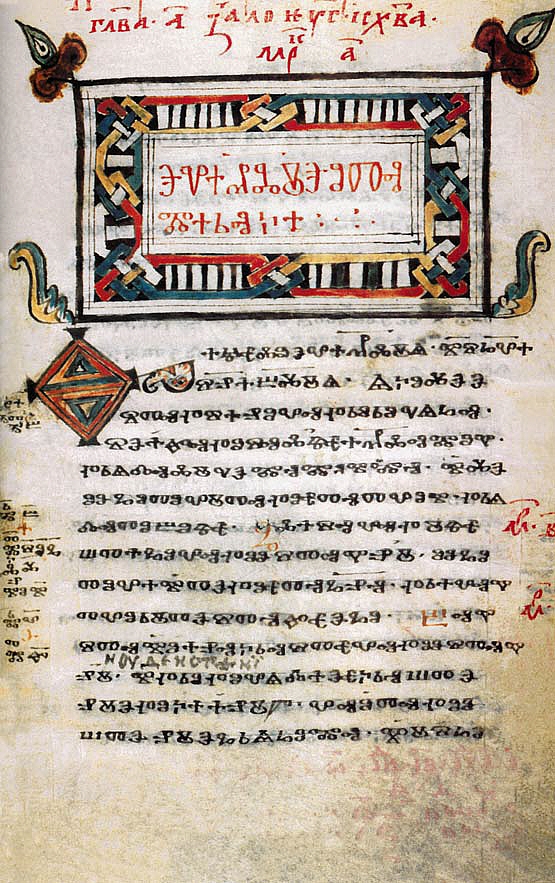

A century after Cyril and Methodius gave the Slavs an alphabet and began to translate the Scriptures (already on this timeline), two books of the four Gospels in their Glagolitic letters stand among the oldest witnesses to the Old Church Slavonic language. Codex Zographensis belonged to the Bulgarian Zograf Monastery on Mount Athos; it has 304 leaves, the first 288 holding Matthew, Mark, Luke and John in Glagolitic, and it is dated to the end of the 10th or the beginning of the 11th century. The monks gave it to the Russian emperor in 1860, and it is now in the National Library of Russia at St Petersburg. Codex Marianus, dated to the beginning of the 11th century, was found by Victor Grigorovich in a hermitage of the Monastery of the Mother of God on Athos in 1844-45 and is now in the Russian State Library at Moscow. Both use the rounded Glagolitic script, the oldest recorded Slavic alphabet. The plate is the opening of the Gospel of Mark in Codex Zographensis. “The beginning of the gospel of Jesus Christ, the Son of God” (Mark 1:1, KJV).
Source en.wikipedia.org: Wikipedia, “Codex Zographensis” (304 ff., 288 Glagolitic Gospels; end 10th/start 11th c.; Zograf Monastery, Athos; Mihanović 1843; given to Alexander II 1860; National Library of Russia) + “Codex Marianus” (early 11th c.; Grigorovich 1844-45; Russian State Library; with Zographensis among oldest OCS witnesses; round Glagolitic). Mark 1:1 KJV verified.