Baptist Militia A library & museum of the Whole Armour of God Visit
Find

Hall III · The Timeline

The Nineteenth Century

Page 6 of 45 · 1815 to 1819

“But the word of the Lord endureth for ever. And this is the word which by the gospel is preached unto you.”1 Peter 1:25, KJV

How the Scriptures were received, carried into the English tongue, and confessed by the Baptist churches. Each date is linked to its source, so that you may test every word.

  • Scripture & Canon (6)
  • Baptist Witness (886)
  • Missions (1)
  • The English Bible (2)
  1. The Nineteenth Century1800-1899

    Baptist Witness

    Samuel Spry Law Converted in His Forty-First Year, Sunbury, Ga., 1815

    Jesus said “the poor have the gospel preached to them” (Matthew 11:5). Cathcart’s Encyclopedia says Samuel Spry Law, born in Liberty County, Ga., in 1774, came of a cultivated and wealthy family. “For forty years he lived a worldly-minded man and a moralist, but was converted in his forty-first year, and joined the Sunbury Baptist church on the 30th of April, 1815.” He was ordained in December 1827, at fifty-three, and briefly followed Dr. C. O. Screven at Sunbury; then “he devoted his whole time to the colored people, and to the poor white churches of Liberty County.” He died on February 4, 1837. Cathcart writes that he “was well acquainted with the Scriptures, and was much gifted in prayer.” His son Josiah S. Law later served the Sunbury church for twenty years.

    Source archive.org: William Cathcart (ed.), The Baptist Encyclopedia (Philadelphia: Everts, 1881), vol. 2, s.v. “Law, Rev. Samuel Spry” (public domain; Internet Archive scan). Quotations verbatim, contiguous fragments only, machine-matched against the scan’s text (OCR line-end hyphenation normalised; OCR misreadings corrected only outside quotation marks). KJV: Matt. 11:5.

  2. Baptist Witness

    Esek Brown Is Ordained Pastor at Dudley, Massachusetts, 1815

    “And he said unto them, Go ye into all the world, and preach the gospel to every creature” (Mark 16:15). Cathcart’s Encyclopedia records that Esek Brown was born at “Warren, R. I., Sept. 17, 1787,” was “baptized by Rev. Ebenezer Burt in Hardwick, Mass., in 1809,” and was “ordained pastor of the church in Dudley, Mass., June 15, 1815.” He “commenced his labors in Lebanon, Conn., Sept. 18, 1818; here remained till his death.” The Encyclopedia calls him “a man of remarkable readiness; modest in deportment, untiring in zeal,” and notes that he “died at Lebanon, after a pastorate of fifteen years, Sept. 11, 1833.”

    Source archive.org: William Cathcart, ed., The Baptist Encyclopedia (Philadelphia: Everts, 1881), vol. 1, s.v. “Brown, Rev. Esek” (public domain; Internet Archive scan). Quotations verbatim, contiguous fragments only, machine-matched against the scan’s text (OCR typography and line-break hyphens normalised). KJV: Mark 16:15.

  3. Baptist Witness

    James Munro Is Ordained in 1816 and Serves Onslow, Nova Scotia, 1819-1838

    “How beautiful upon the mountains are the feet of him that bringeth good tidings, that publisheth peace; that bringeth good tidings of good, that publisheth salvation; that saith unto Zion, Thy God reigneth!” (Isaiah 52:7). Cathcart’s Encyclopedia says James Munro “was born in Scotland in 1784,” was converted in Nova Scotia and baptized in New York, and returned to preach in Halifax. He “evangelized with Rev. Joseph Crandall, in 1815, to the east of Halifax; ordained in 1816,” he travelled the eastern shores of New Brunswick and, in 1818, up the St. John River. He “became pastor at Onslow in 1819, and continued in this relation until his death, July 3, 1838.” The Encyclopedia’s verdict: “Possessing a keen, logical mind, sterling integrity, fervent piety, and sound theology, Mr. Munro’s ministry was highly useful.”

    Source archive.org: William Cathcart, ed., The Baptist Encyclopedia (Philadelphia: Everts, 1881), vol. 2, s.v. “Munro, Rev. James” (public domain; Internet Archive scan). Quotations verbatim, contiguous fragments only, machine-matched against the scan’s text (OCR typography and line-end hyphenation normalised; conversion, baptism and journeys paraphrased). KJV: Isaiah 52:7.

  4. Baptist Witness

    Howard Malcom Joins the Sansom Street Church, Philadelphia, 1816

    “It is good for me that I have been afflicted; that I might learn thy statutes” (Psalm 119:71). In 1815 young Howard Malcom was in a Philadelphia counting-house, aiming to be a merchant, when a hurt knee kept him in his room for three weeks. He wrote, “This was one of the most merciful providences of God to me,” and “I learnt more about the Bible than I knew before altogether.” Cathcart records, “On January 1, 1816, he related his experience before the Sansom Street Baptist church.” Within weeks he wrote that he “must shortly quit the counting-house and prepare to go out and proclaim the glad tidings.” He was licensed to preach in 1818.

    Source archive.org: William Cathcart (ed.), The Baptist Encyclopedia (Philadelphia: Everts, 1881), vol. 2, s.v. “Malcom, Howard” (public domain; Internet Archive scan). Quotations verbatim, contiguous fragments only, machine-matched against the scan’s text (OCR line-end hyphenation normalised; OCR misreadings corrected only outside quotation marks). KJV: Psalm 119:71.

  5. Scripture & Canon The Age of Missions

    The American Bible Society: “without note or comment”

    Elias Boudinot, first president of the American Bible Society; oil portrait by Charles Willson Peale, c. 1784 (Museum of the American Revolution)
    Elias Boudinot, first president of the American Bible Society; oil portrait by Charles Willson Peale, c. 1784 (Museum of the American Revolution). Via Wikimedia Commons · Public domain

    On 8 May 1816 delegates of Bible societies from New England to Kentucky and North Carolina met in the Garden Street Dutch Reformed Church in New York. They were ministers and laymen: Presbyterians, Congregationalists, Methodists, Episcopalians, Baptists, Quakers and Dutch Reformed. That afternoon, without a dissenting vote, they resolved to form a national Bible society. Its purpose, in the words Thomas Armitage quotes, was “The dissemination of the Scriptures in the received versions where they exist, and in the most faithful where they may be required.” Its managers could circulate only copies “without note or comment”, and in English only the version in common use, the King James Bible. On 11 May the first officers were elected. The president was Elias Boudinot (1740-1821), a former President of the Continental Congress. As head of the New Jersey Bible Society he had pressed longest for a national society, but illness kept him from the meeting. John Jay succeeded him in 1821. The Society’s first translation, in 1818, was the Gospel of John in the Delaware (Lenape) language. Baptists, Armitage wrote, “became at once its earnest and liberal supporters”; how that partnership broke over the translating of one Greek word is told under 1836. “The Lord gave the word: great was the company of those that published it.” (Psalm 68:11, KJV).

    Source ebsco.com: G. L. Swygart, “American Bible Society Is Founded”, EBSCO Research Starters (2023): 8 May meeting, place, denominations, unanimous vote, Boudinot’s role and illness, officers 11 May, Delaware John. Wikipedia, “American Bible Society” (used the KJV; Jay 1821; Lenape 1818). T. Armitage, A History of the Baptists (1887, PD), ch. 17 (purpose and “without note or comment”, quoted). Ps 68:11 KJV verified.

  6. Baptist Witness

    Stephen Davis Ordained for the Baptist Irish Society, July 11, 1816

    “But watch thou in all things, endure afflictions, do the work of an evangelist, make full proof of thy ministry.” (2 Timothy 4:5). Cathcart’s Encyclopedia says Stephen Davis was born at Andover, England, October 30, 1783; he “was converted under Dr. Rippon’s ministry, and was baptized in 1802.” The church at Devonshire Square recognized his gifts, and “he was ordained July 11, 1816.” “His first labors were given to the Baptist Irish Society, then recently formed to aid in reviving the ancient Baptist churches in Ireland, and to diffuse a knowledge of the gospel among the people.” After preaching some months in Dublin he went on to Clonmel, and “during seven years evangelized in the county of Tipperary with apostolic zeal.” “In the years 1832-33 he visited the United States”, raising support for the Irish work, and “In 1837 he became the traveling agent of the society”, which he served the rest of his life. “He fell asleep in Jesus Feb. 3, 1856, aged seventy-two.”

    Source archive.org: William Cathcart (ed.), The Baptist Encyclopedia (Philadelphia: Everts, 1881), vol. 1, s.v. “Davis, Rev. Stephen” (public domain; Internet Archive scan). Quotations verbatim, contiguous fragments only, machine-matched against the scan’s text (OCR line-end hyphenation normalised). KJV: 2 Timothy 4:5.

  7. Baptist Witness The Age of Missions

    John Mason Peck and the covered-wagon journey to St. Louis, 1817

    “Go ye into all the world, and preach the gospel to every creature.” (Mark 16:15). Cathcart’s Encyclopedia says John Mason Peck, D.D., “was born in the parish of Litchfield, South Farms, Conn., Oct. 31, 1789,” and that “he was baptized, Sept. 14, 1811.” It records: “On the next day, by invitation of the church, he preached his first sermon.” He was “appointed a missionary of the board of the Triennial Convention, to labor in St. Louis and vicinity.” The entry continues: “July 25, 1817, he set out, with his wife and three children, in a covered wagon, upon the long journey of 1200 miles to his field of labor, and on the 1st of December reached St. Louis.” At Rock Spring he “established a seminary for general and theological education.” Of the man it says he was “a born missionary, and a thorough-going Western man.” It gives his death as “He died at Rock Spring, March 24, 1857.”

    Source archive.org: William Cathcart, ed., The Baptist Encyclopedia (Philadelphia: Everts, 1881), vol. 2, s.v. “Peck, John Mason, D.D.” (public domain; Internet Archive scan). Quotations verbatim, contiguous fragments only (column-set OCR; hyphenated line-breaks rejoined). Nothing beyond the entry is asserted. KJV: Mark 16:15.

  8. Baptist Witness The Age of Missions

    Isaac McCoy Appointed Missionary to the Indians of Indiana and Illinois, 1817

    “But ye shall receive power, after that the Holy Ghost is come upon you: and ye shall be witnesses unto me both in Jerusalem, and in all Judaea, and in Samaria, and unto the uttermost part of the earth.” (Acts 1:8). Cathcart’s Encyclopedia calls Isaac McCoy “the great apostle to the American Indians”, and says he was “born in Fayette Co., Pa.,” on “June 13, 1784”. It records that he was “converted and joined the Buck Creek Baptist church”, was “licensed to preach by the mother of all Indiana Baptist churches,—Silver Creek”, and was “ordained by the Maria Creek church” in 1810. In 1817, it says, he “received an appointment as missionary to the Indians of Indiana and Illinois”. Of his labours it states that “Mr. McCoy rode hundreds of miles through the wilderness” and that he “went on horseback to Washington several times to interest Congress”; and it adds: “Many conversions occurred at the Carey mission.”

    Source archive.org: William Cathcart, ed., The Baptist Encyclopedia (Philadelphia: Everts, 1881), vol. 2, s.v. “McCoy, Rev. Isaac” (public domain; Internet Archive scan). Quotations verbatim, contiguous fragments only (column-set OCR; hyphenated line-breaks rejoined). Nothing beyond the entry is asserted. KJV: Acts 1:8.

  9. Baptist Witness

    Thomas Mercer Is Sent to the Creek Indians, 1817

    “How then shall they call on him in whom they have not believed? and how shall they believe in him of whom they have not heard? and how shall they hear without a preacher?” (Romans 10:14). Cathcart’s Encyclopedia describes Thomas Mercer as “an able and zealous Baptist minister” who “was an early laborer in spreading Baptist sentiments,” and says that “he compiled a collection of excellent hymns.” It records that “He aided in the formation of the Mississippi Association in 1806.” Then: “In 1817, Thomas Mercer and Benjamin Davis were requested by the Association to visit the Creek Indians and inquire what could be done towards the establishment of schools and the introduction of the gospel among them.” The Encyclopedia ends the entry plainly: “Upon this journey Mercer died, and was buried among strangers.”

    Source archive.org: William Cathcart, ed., The Baptist Encyclopedia (Philadelphia: Everts, 1881), vol. 2, s.v. “Mercer, Rev. Thomas” (public domain; Internet Archive scan). Quotations verbatim, contiguous fragments only, machine-matched against the scan’s text. Nothing beyond the entry is asserted. KJV: Romans 10:14.

  10. Baptist Witness

    George Angell: A Church Gathered at Smithbridge

    “Stand fast therefore in the liberty wherewith Christ hath made us free, and be not entangled again with the yoke of bondage.” (Galatians 5:1). Cathcart’s Encyclopedia records that Rev. George Angell “was born in Smithfield, R. I., March 24, 1786,” and “joined the First Baptist church in Providence in May, 1809.” He “was ordained as pastor of the Second Baptist church in Woodstock, Conn., Aug. 28, 1813,” and in 1816 removed to Smithbridge, Mass., where he “became pastor of a church which was gathered by his efforts and constituted in February, 1817,” with “the church growing from year to year in spiritual strength and numbers.” The entry closes: “Mr. Angell died Feb. 14, 1827.”

    Source archive.org: William Cathcart, ed., The Baptist Encyclopedia (Philadelphia: Everts, 1881), vol. 1, s.v. “Angell, Rev. George” (public domain; Internet Archive scan). Quotations verbatim, contiguous fragments only, machine-matched against the scan’s text (OCR typography and line-end hyphenation normalised). KJV: Galatians 5:1.

  11. Baptist Witness

    Caleb Evans Birt gives up the bar for conscience’ sake and is ordained at Derby (1817)

    Scripture records the apostles’ answer: “We ought to obey God rather than men” (Acts 5:29). Cathcart’s Encyclopedia tells that Caleb Evans Birt “was born at Devonport, England, on March 11, 1795,” and entered Cambridge University “with a view of studying for the bar.” Then “His conscience was aroused and agitated by the prospective necessity of signing the articles of the Church of England.” The entry says the conflict of mind “ended in his abandonment of the plan of life he had cherished,” and that “he determined to devote himself to the ministry of the gospel among his own people, the Baptists.” After his studies, “in 1816, he was invited to become pastor of a church in Derby, and was ordained in the following year.” He laboured later at Portsea, Bristol and Wantage, and died “Dec. 13, 1854, aged sixty years.”

    Source archive.org: William Cathcart (ed.), The Baptist Encyclopedia (Philadelphia: Everts, 1881), vol. 1, s.v. “Birt, Caleb Evans” (public domain; Internet Archive scan). Quotations verbatim, contiguous fragments only, machine-matched against the scan’s text (OCR typography and line-end hyphenation normalised). KJV: Acts 5:29.

  12. Baptist Witness

    Ferdinand Ellis, Pastor at Exeter, New Hampshire, from 1817

    “Preach the word; be instant in season, out of season; reprove, rebuke, exhort with all longsuffering and doctrine.” (2 Timothy 4:2). Cathcart’s Encyclopedia records that Ferdinand Ellis “was born in Medway, Mass., in 1780, and graduated at Brown University in the class of 1802.” For three years after college he was a tutor in the university, and then “he was ordained as a Baptist minister, and for a time was a colleague with Rev. Dr. Stillman, pastor of the First Baptist church in Boston.” After a time at Marblehead he moved “in 1817 to Exeter, N. H., where he was the pastor of the Baptist church for fifteen years.” He later preached for a short time in several New Hampshire towns and in Freeport, Maine, and returned to Exeter, where he died on February 20, 1858. Several of his sermons were published, and Cathcart closes with a plain verdict: he was a very useful minister of the Saviour.

    Source archive.org: William Cathcart (ed.), The Baptist Encyclopedia (Philadelphia: Everts, 1881), vol. 1, s.v. “Ellis, Rev. Ferdinand” (public domain; Internet Archive scan). Quotations verbatim, contiguous fragments only, machine-matched against the scan’s text (OCR line-end hyphenation normalised). KJV: 2 Timothy 4:2.

  13. Baptist Witness

    Leland Howard Is Ordained Pastor at Windsor, Vermont, 1817

    “Feed the flock of God which is among you” (1 Peter 5:2). Leland Howard “was born in Jamaica, Vt., Oct. 13, 1793,” and was “baptized when about seventeen years of age, by Rev. Isaiah Madison.” In 1814 Gen. Abner Forbes, “a wealthy citizen of Windsor, Vt.,” invited him there to study, “his board and tuition bills being paid by his kind friend.” He “was ordained pastor of the church in Windsor, Vt., in November, 1817,” and served Troy, Brooklyn, Newport and other churches before Rutland, Vt., “where his pastorate closed in 1852.” Cathcart writes that few men “have left a better record in the places where he labored as a minister of the gospel.”

    Source archive.org: William Cathcart (ed.), The Baptist Encyclopedia (Philadelphia: Everts, 1881), vol. 1, s.v. “Howard, Rev. Leland” (public domain; Internet Archive scan). Quotations verbatim, contiguous fragments only, machine-matched against the scan’s text (OCR line-end hyphenation normalised). KJV: 1 Peter 5:2 (clause).

  14. Baptist Witness The Age of Missions

    Thirteen men at Hamilton: the Baptist Education Society that became Colgate

    Colgate University’s bicentennial history records that Daniel Hascall, the Baptist pastor at Hamilton, New York, “dreamt of creating a seminary in the ‘West’ to prepare young men for the ministry.” With his friend Nathaniel Kendrick he gathered clergy and laymen, and on 24 September 1817, in the parlour of Jonathan Olmstead’s home, thirteen men (“six clergy and seven laymen”) prayed together, adopted the constitution of the Baptist Education Society of the State of New York, and each paid a membership fee of one dollar. The university says they “are said to have backed up their experiment in education with 13 dollars and 13 prayers.” Its first student, Jonathan Wade, studied Latin with Hascall in 1818 and, the university records, “went to Burma to become a missionary,” where he spent nearly fifty years; the official founding date is 5 March 1819, when the act of incorporation passed the New York legislature. Until 1839 the school was open, with a brief exception, only to students for the ministry. Its collegiate department was chartered as Madison University in 1846, and on 26 May 1890 it became Colgate University, honouring the New York soap-maker William Colgate, its “preeminent patron” from 1823 until his death in 1857, and his family; its theological seminary moved to Rochester in 1928. No licensed plate has been verified, so none is shown.

    Source 200.colgate.edu: Colgate at 200 Years, J. Leach, “What’s in a Name? Colgate’s Origins and Evolution,” citing H. D. Williams, A History of Colgate University 1819-1969 (1969): Hascall, 24 Sept 1817 meeting, 5 Mar 1819, 1839, 1846, 26 May 1890, 1928. Colgate University, History page (“13 dollars and 13 prayers”); Docter, “Jonathan Wade and Eugenio Kincaid” (Wade).

  15. Baptist Witness

    Jesse Babcock Worden Ordained, 1818: “A Very Faithful Pastor”

    “Moreover it is required in stewards, that a man be found faithful.” (1 Corinthians 4:2). Cathcart’s Encyclopedia says that Rev. Jesse Babcock Worden was “born in Washington Co., R. I., July 18, 1787.” It records: “He was converted and baptized in 1816 in North Woodstock, N. Y., and in 1818 he was ordained.” He “became co-pastor with the Rev. Davis Dimock in Montrose, Pa., in 1835,” and was “sole pastor of the church from 1838 until 1844.” Of his ministry it says: “Mr. Worden was an instructive preacher and a very faithful pastor,” and “his precepts and example made an indelible impression upon many in Northern Pennsylvania.” He “labored after 1844 in Susquehanna County, where he died Aug. 6, 1855.”

    Source archive.org: William Cathcart, ed., The Baptist Encyclopedia (Philadelphia: Everts, 1881), vol. 2, s.v. “Worden, Rev. Jesse Babcock” (public domain; Internet Archive scan). Quotations verbatim, contiguous fragments only, machine-matched against the scan’s text (OCR typography normalised). KJV: 1 Corinthians 4:2.

  16. Baptist Witness

    B. C. Grafton Ordained at Providence, 1818

    “Preach the word; be instant in season, out of season; reprove, rebuke, exhort with all longsuffering and doctrine” (2 Timothy 4:2). Cathcart’s Encyclopedia records that B. C. Grafton, born at Newport, Rhode Island, in 1785, was from his conversion “a cheerful, earnest Christian.” As a young man in business at Providence he befriended Dr. Gano, and “was wont to accompany that good man in his missionary tours,” helping with a prayer or a word of exhortation. He studied with Dr. Chapin and Dr. Benedict and “was ordained in Providence in August, 1818.” He served West Cambridge, then Plymouth, where he was pastor “in this old Pilgrim town for six and a half years,” and several more New England churches before his death at Cambridgeport in 1858. Cathcart calls him “a useful, happy Christian minister”.

    Source archive.org: William Cathcart (ed.), The Baptist Encyclopedia (Philadelphia: Everts, 1881), vol. 1, s.v. “Grafton, Rev. B. C.” (public domain; Internet Archive scan). Quotations verbatim, contiguous fragments only, machine-matched against the scan’s text (OCR line-end hyphenation normalised). KJV: 2 Timothy 4:2.

  17. Baptist Witness

    Nancy Hanks Lincoln, Abraham Lincoln’s Baptist Mother, Dies, 1818

    Of the virtuous woman Scripture says, “Her children arise up, and call her blessed” (Prov. 31:28). Cathcart’s Encyclopedia says Nancy Hanks Lincoln “was born in Virginia,” moved young to Kentucky, and “In 1806 she married Thomas Lincoln, of Hodgenville, Hardin Co., Ky.” Quoting a biographer, it describes the founders of that neighbourhood as “consistent and zealous members of the Baptist church,” and says that “In this Baptist settlement Abraham Lincoln, afterwards President of the United States, was born, Feb. 12, 1809.” She “died in 1818, when her son was only nine years old.” Cathcart records the President saying to Rev. Dr. A. D. Gillette of Washington, “All that I am on earth,” and, “I owe to my Baptist mother.” The saying is given here as Cathcart reports it.

    Source archive.org: William Cathcart (ed.), The Baptist Encyclopedia (Philadelphia: Everts, 1881), vol. 2, s.v. “Lincoln, Mrs. Nancy Hanks” (public domain; Internet Archive scan). Quotations verbatim, contiguous fragments only, machine-matched against the scan’s text (OCR line-end hyphenation normalised; OCR misreadings corrected only outside quotation marks). KJV: Prov. 31:28.

  18. Baptist Witness

    Six Churches Organize the Louisiana Baptist Association at Cheneyville, 1818

    “And so were the churches established in the faith, and increased in number daily” (Acts 16:5). Cathcart’s Encyclopedia says that west of the Mississippi “Joseph Willis continued for several years to labor alone, and organized churches at Cheneyville, Vermillion, Plaquemine Brulé, and Hickory Flat.” In 1816 Ezekiel O’Quinn and Isham Nettles joined him. Then: “On the 31st day of October, 1818, six churches met by delegates at Cheneyville, and organized the Louisiana Baptist Association, of which Joseph Willis was elected moderator.” Cathcart adds that other ministers were ordained and churches increased, “mainly through the zealous labors of Mr. Willis,” the licensed preacher who had first crossed the river to preach in 1804.

    Source archive.org: William Cathcart (ed.), The Baptist Encyclopedia (Philadelphia: Everts, 1881), vol. 2, s.v. “Louisiana” (public domain; Internet Archive scan). Quotations verbatim, contiguous fragments only, machine-matched against the scan’s text (OCR line-end hyphenation normalised; OCR misreadings corrected only outside quotation marks). KJV: Acts 16:5.

  19. Baptist Witness The Age of Missions

    Serampore College: the Brotherhood publish their plan, 15 July 1818

    “And the things that thou hast heard of me among many witnesses, the same commit thou to faithful men, who shall be able to teach others also” (2 Timothy 2:2). George Smith, in his Life of William Carey, records “the prospectus of their ‘College for the Instruction of Asiatic, Christian, and Other Youth in Eastern Literature and European Science,’ which they published on the 15th July 1818.” Crowning the plan, he says, was “a theological institute to equip the Eurasian and native Christian students, by a quite unsectarian course of study, in apologetics, exegetics, and the Bible languages, to be missionaries to the Brahmanical classes.” Of its opening he writes: “The Serampore College began with thirty-seven students, of whom nineteen were native Christians and the rest Hindoos.” The museum sets Paul’s charge to Timothy beside the college as its own thematic pairing; Smith does not cite it here.

    Source reformedreader.org: George Smith, Life of William Carey, Shoemaker & Missionary (this edition 1909; PD), ch. 14, “Carey as an Educator—The First Christian College in the East”; web text, reformedreader.org. KJV: 2 Tim 2:2. The pairing of 2 Tim 2:2 is the museum’s, not Smith’s.

  20. Scripture & Canon The Age of Missions

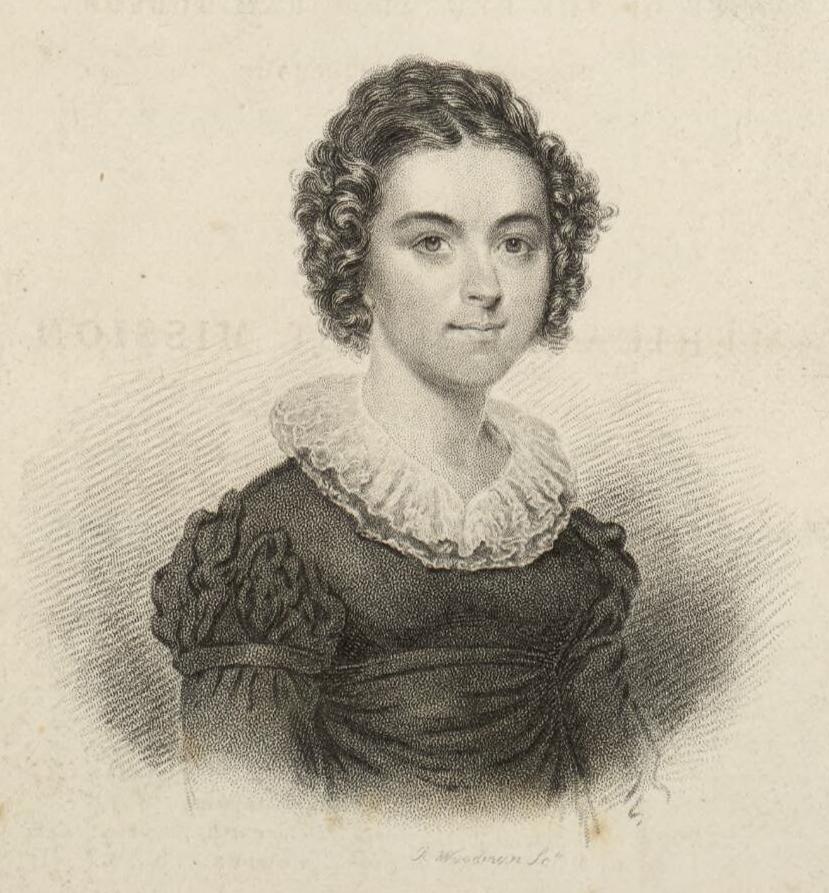
    Ann Hasseltine Judson: the first Scripture in Siamese

    Ann Hasseltine Judson. Engraving by Richard Woodman, c. 1826, Welsh Portrait Collection, National Library of Wales, via Wikimedia Commons
    Ann Hasseltine Judson. Engraving by Richard Woodman, c. 1826, Welsh Portrait Collection, National Library of Wales, via Wikimedia Commons · Public domain

    Ann Hasseltine was born at Bradford, Massachusetts, on 22 December 1789. She studied at Bradford Academy and taught school. In 1812 she married Adoniram Judson, and two weeks later they sailed for India as missionaries of the Congregational American Board. On the voyage they became convinced from Scripture of believer’s baptism, and they were baptised after reaching India. Barred from working there, they went on to Burma, and in 1814 American Baptists adopted them as their first foreign missionaries. Ann learned Burmese, taught children, took in orphan girls and wrote a Burmese catechism. She translated the books of Daniel and Jonah into Burmese, and in 1819 she translated the Gospel of Matthew into Siamese (Thai), the first part of the Bible ever put into that language. Home in 1822-23 to recover her health, she wrote A Particular Relation of the American Baptist Mission to the Burman Empire (1823), one of the earliest histories of an American mission. When war broke out in 1824 and Adoniram was imprisoned for seventeen months, she lived in a shack outside the prison, brought food to the prisoners and pressed the officials for their release. She died at Amherst, Burma, on 24 October 1826, aged thirty-six, soon after his release, and her last words were in Burmese. Her letters and the many biographies written of her kept the cause of missions alive among American Baptists.

    Source bu.edu: D. L. Robert, “Judson, Ann (‘Nancy’) (Hasseltine),” in G. H. Anderson, ed., Biographical Dictionary of Christian Missions (1998), 346, reprinted by the BU School of Theology History of Missiology. Birth, Bradford Academy, the seventeen months and the date of death per Wikipedia, “Ann Hasseltine Judson.” Sources differ on the cause of her death, so none is given.

Plates are hung only where a genuine image of the subject could be found under a public-domain or open licence. Each carries its credit and links to its licence record. Entries without a plate are awaiting one that meets that standard. More entries are being prepared, and each will be added only with its citation.

Provenance

Every entry in this hall was checked, when it was added, against the source linked beneath it; notes name the underlying scholarship where the source cites it. Where historians disagree (for example, over John Wycliffe’s own share in the Bible that bears his name), the entry says so. Scripture is quoted verbatim from the King James Version. Plates are reproduced almost entirely from Wikimedia Commons: public-domain works, works dedicated to the public domain (CC0), or photographs under Creative Commons Attribution (CC BY 2.0-3.0) or Attribution-ShareAlike (CC BY-SA 2.0-4.0) licences. Each plate’s licence is stated beneath it, with a link to the record where it was confirmed.