Baptist Militia A library & museum of the Whole Armour of God Visit
Find

Hall III · The Timeline

The Nineteenth Century

Page 32 of 45 · 1858 to 1859

“But the word of the Lord endureth for ever. And this is the word which by the gospel is preached unto you.”1 Peter 1:25, KJV

How the Scriptures were received, carried into the English tongue, and confessed by the Baptist churches. Each date is linked to its source, so that you may test every word.

  • Scripture & Canon (6)
  • Baptist Witness (886)
  • Missions (1)
  • The English Bible (2)
  1. The Nineteenth Century1800-1899

    Baptist Witness

    Henry C. Graves Ordained for the Bunker Hill Church, Charlestown, 1858

    “I have planted, Apollos watered; but God gave the increase” (1 Corinthians 3:6). Cathcart’s Encyclopedia records that Henry C. Graves, born in Deerfield, Massachusetts, graduated from Amherst College in 1856, “studied at Newton two years, and was ordained March 9, 1858”. “He was pastor of the Bunker Hill church, in Charlestown, Mass., five years”, then eleven years at the Brown Street church in Providence, Rhode Island, and from 1874 at the Second Baptist church of Fall River, Massachusetts. “In his fields of labor the Lord has greatly blessed his ministrations.”

    Source archive.org: William Cathcart (ed.), The Baptist Encyclopedia (Philadelphia: Everts, 1881), vol. 1, s.v. “Graves, Rev. Henry C.” (public domain; Internet Archive scan). Quotations verbatim, contiguous fragments only, machine-matched against the scan’s text (OCR line-end hyphenation normalised). KJV: 1 Corinthians 3:6.
  2. Baptist Witness

    Benjamin Griffith Becomes Secretary of the American Baptist Publication Society, 1858

    “Moreover it is required in stewards, that a man be found faithful” (1 Corinthians 4:2). Cathcart’s Encyclopedia records that Benjamin Griffith, born in Juniata County, Pennsylvania, in 1821, was baptized in Baltimore in 1839 and ordained in 1846 as a missionary at Cumberland, Maryland. “Here he organized a church, built a meeting-house, and enjoyed a successful pastorate of four years.” He then served the New Market Street church in Philadelphia, renamed the Fourth Baptist church. “In May, 1858, he became corresponding secretary of the American Baptist Publication Society.” “To the work of this grand denominational enterprise he has given the best years and energies of his life”. The society’s building at 1420 Chestnut Street, Cathcart says, “was the result of his wise counsel, unceasing toil, and great influence.” He also edited the Young Reaper for Sunday schools, and Cathcart calls him “a gifted preacher, a wise counselor”.

    Source archive.org: William Cathcart (ed.), The Baptist Encyclopedia (Philadelphia: Everts, 1881), vol. 1, s.v. “Griffith, Benjamin, D.D.” (public domain; Internet Archive scan). Quotations verbatim, contiguous fragments only, machine-matched against the scan’s text (OCR line-end hyphenation normalised). KJV: 1 Corinthians 4:2.

  3. Baptist Witness

    Jesse Boardman Hartwell Sails for China, 1858

    “Behold, these shall come from far: and, lo, these from the north and from the west; and these from the land of Sinim.” (Isa. 49:12). Cathcart’s Encyclopedia records that Jesse Boardman Hartwell, son of Jesse Hartwell, D.D., was born at Darlington, S.C., Oct. 17, 1835. “His father was an ardent friend of missions, and gave him to that work from his birth.” When Luther Rice called, the father met him at the door saying, “Brother Rice, my missionary has come,” and “that day the babe was dedicated as a missionary to the heathen.” In 1858 the Southern Baptist Foreign Mission Board appointed him a missionary to China, and he “sailed for his field in November.” After two years at Shanghai they labored “for many years at Tung Chau Foo, in the Shantung province of Northern China, where they opened the first mission, organized a church,” and his first convert there was ordained a minister.

    Source archive.org: William Cathcart (ed.), The Baptist Encyclopedia (Philadelphia: Everts, 1881), vol. 1, s.v. “Hartwell, Jesse Boardman, D.D.” (public domain; Internet Archive scan). Quotations verbatim, contiguous fragments only, machine-matched against the scan’s text (OCR line-end hyphenation normalised). KJV: Isaiah 49:12.

  4. Baptist Witness

    W. E. Hatcher Takes the Church at Manchester, Va., 1858

    “For who hath despised the day of small things?” (Zech. 4:10). Cathcart’s Encyclopedia records that William E. Hatcher, born in Bedford County, Va., in 1835, graduated from Richmond College in June 1858. “In August, 1858, he took charge of a very weak church in Manchester (opposite Richmond),” and by steady work “he added 400 to the church, and made it not only self-sustaining, but one of the most efficient in the State.” After a year at the Franklin Square church, Baltimore, “in October, 1868, he returned to his native State, and took charge of the First Baptist church in Petersburg.” “In 1875 he accepted the pastorate of the Grace Street church in Richmond.”

    Source archive.org: William Cathcart (ed.), The Baptist Encyclopedia (Philadelphia: Everts, 1881), vol. 1, s.v. “Hatcher, William E., D.D.” (public domain; Internet Archive scan). Quotations verbatim, contiguous fragments only, machine-matched against the scan’s text (OCR line-end hyphenation normalised). KJV: Zechariah 4:10.

  5. Baptist Witness

    William Hubbard, Raised Among Episcopalians, Dies at Lakeville After a Life of Baptist Pastorates, 1858

    “Precious in the sight of the LORD is the death of his saints” (Psalm 116:15). William Hubbard “was born in Boston, Mass., Jan. 28, 1778. His early associations were not with Baptists, his parents and friends being Episcopalians.” Seeking salvation, “he was brought under the ministry of Rev. Dr. Stillman, and he united with his church.” He “entered upon itinerant labors in Maine and Connecticut,” then served churches in western Massachusetts, at Martha’s Vineyard, “the Third Baptist church in Middleborough, and fourteen years were spent at Goshen.” Cathcart closes: “He died at Lakeville, Mass., Jan. 3, 1858.”

    Source archive.org: William Cathcart (ed.), The Baptist Encyclopedia (Philadelphia: Everts, 1881), vol. 1, s.v. “Hubbard, Rev. William” (public domain; Internet Archive scan). Quotations verbatim, contiguous fragments only, machine-matched against the scan’s text (OCR line-end hyphenation normalised). KJV: Psalm 116:15.

  6. Baptist Witness

    G. Inman, Ordained by the Hillsborough Church in Kentucky, Begins His Ministry, 1858

    “Wine is a mocker, strong drink is raging” (Proverbs 20:1). Cathcart records that G. Inman, “a native of Sumner Co., Tenn., was born in 1836,” was educated at Union University, Murfreesborough, and was “ordained by the Hillsborough Baptist church in Washington Co., Ky., where he began his ministry in 1858.” Pastorates followed at Clarksville and Spring Creek in Montgomery County, at the Central Baptist church in Nashville, at Decatur, Ill., and at Fox Lake. “He has baptized about 500 persons into the fellowship of the churches of which he has been pastor.” He was a leader in the temperance cause, and “His own pulpit is always a stronghold of total abstinence.”

    Source archive.org: William Cathcart (ed.), The Baptist Encyclopedia (Philadelphia: Everts, 1881), vol. 1, s.v. “Inman, Rev. G.” (public domain; Internet Archive scan). Quotations verbatim, contiguous fragments only, machine-matched against the scan’s text (OCR line-end hyphenation normalised). KJV: Proverbs 20:1.

  7. Baptist Witness

    Indianapolis Female Institute Founded, 1858

    “She openeth her mouth with wisdom” (Proverbs 31:26). Among the Baptist schools of Indiana, Cathcart writes, “The last to succumb was the Indianapolis Female Institute. This was founded in 1858.” G. Williams was its first principal, and “The total expended for site and buildings was $53,000.” Lack of endowment and the rise of public high schools, he says, “led to the suspension of all schools except the college at Franklin.” Of the Institute he records: “It suspended in 1872.”

    Source archive.org: William Cathcart (ed.), The Baptist Encyclopedia (Philadelphia: Everts, 1881), vol. 1, s.v. “Indiana, Educational Institutions of” (public domain; Internet Archive scan). Quotations verbatim, contiguous fragments only, machine-matched against the scan’s text (OCR line-end hyphenation normalised). KJV: Proverbs 31:26.

  8. Baptist Witness

    Halsey Wing Knapp, Seaman and Merchant, Ordained at New York, 1858

    “It is more blessed to give than to receive” (Acts 20:35). Cathcart’s Encyclopedia says Halsey Wing Knapp, son of the Baptist minister Henry R. Knapp, was born in New York in 1824 and spent a restless youth, “some years of which were spent at sea”. “He was converted in 1857, and in 1858 was ordained to the ministry by a Council of the Baptist churches of New York.” He served West Farms, Hudson City and New York churches while running a business, and “During nineteen years of pulpit service he has given away his entire salary” to religious and benevolent objects. He preached “every night in the week” in revival seasons “without any expense to the churches”, and “His donations are without ostentation”.

    Source archive.org: William Cathcart (ed.), The Baptist Encyclopedia (Philadelphia: Everts, 1881), vol. 1, s.v. “Knapp, Halsey Wing, D.D.” (public domain; Internet Archive scan). Quotations verbatim, contiguous fragments only, machine-matched against the scan’s text (OCR line-end hyphenation normalised; OCR misreadings corrected only outside quotation marks). KJV: Acts 20:35.

  9. Baptist Witness

    Aaron Brightwell Knight Settles in Shelby County and Takes Burk’s Branch Church, 1858

    “And that ye study to be quiet, and to do your own business, and to work with your own hands” (1 Thess. 4:11). Cathcart’s Encyclopedia says Aaron Brightwell Knight, born in Todd Co., Ky., in 1824, graduated from Centre College in 1845, studied three years at Princeton Theological Seminary and was ordained in 1850. “He received several flattering calls to city and village churches, but preferring the quiet of a country home” he “settled on a farm in Shelby Co., Ky., in 1858, where he still resides.” He was pastor of Burk’s Branch church from 1858 and of Simpsonville from 1871, “thirteen years moderator of Long Run Association, which includes the churches of Louisville”, and the first president of the Kentucky Female College at Shelbyville, chairman of its board “until it was destroyed by fire”.

    Source archive.org: William Cathcart (ed.), The Baptist Encyclopedia (Philadelphia: Everts, 1881), vol. 1, s.v. “Knight, Rev. Aaron Brightwell, A.M.” (public domain; Internet Archive scan). Quotations verbatim, contiguous fragments only, machine-matched against the scan’s text (OCR line-end hyphenation normalised; OCR misreadings corrected only outside quotation marks). KJV: 1 Thess. 4:11.

  10. Baptist Witness

    The Female Institute at Lewisburg Graduates Fifteen Before 1500 People, 1858

    The Psalmist prayed “that our daughters may be as corner stones, polished after the similitude of a palace” (Ps. 144:12). Cathcart’s Encyclopedia says the institute of the university at Lewisburg, Pa., “began its separate organization as a school in 1852,” and “In 1854 two young ladies, the first class of the institute, were graduated.” Under Miss Amanda Taylor, of Easton, Pa., the work went on, though “Strong prejudices existed in the community against the liberal education of women.” This “was gradually overcome by persistent effort, and in 1858 fifteen young ladies were graduated in the presence of an audience of 1500 people.” Miss Harriet E. Spratt, a graduate of the institute, later served as principal from 1869 to 1878; Cathcart says “hundreds mourned for her as for a sister.”

    Source archive.org: William Cathcart (ed.), The Baptist Encyclopedia (Philadelphia: Everts, 1881), vol. 2, s.v. “Lewisburg, Pa., the University at” (public domain; Internet Archive scan). Quotations verbatim, contiguous fragments only, machine-matched against the scan’s text (OCR line-end hyphenation normalised; OCR misreadings corrected only outside quotation marks). KJV: Ps. 144:12.

  11. Baptist Witness

    Justin R. Loomis Succeeds to the Presidency at Lewisburg, 1858

    Solomon wrote: “Wisdom is the principal thing; therefore get wisdom” (Prov. 4:7). Cathcart’s Encyclopedia says Justin R. Loomis was born in Bennington, Vt., in 1810, graduated from Brown University “with marked honor in 1835,” and became a professor at Waterville College. After a year of “scientific explorations through Bolivia, Peru, and Chili”, he “was elected Professor of Natural Science in the university at Lewisburg, Pa., and in 1858 succeeded to the presidency.” He held the office twenty years, retiring in January 1879. Cathcart says the Baptist church building at Lewisburg “was mainly erected by his own exertions,” and his books included “Principles of Geology”.

    Source archive.org: William Cathcart (ed.), The Baptist Encyclopedia (Philadelphia: Everts, 1881), vol. 2, s.v. “Loomis, Justin R., D.D., LL.D.” (public domain; Internet Archive scan). Quotations verbatim, contiguous fragments only, machine-matched against the scan’s text (OCR line-end hyphenation normalised; OCR misreadings corrected only outside quotation marks). KJV: Prov. 4:7.

  12. Baptist Witness The Age of Missions

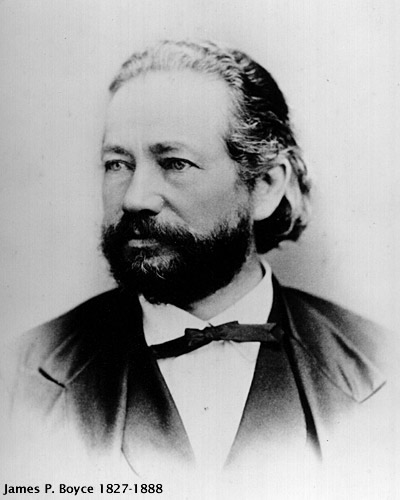
    The Southern Baptist Theological Seminary opens at Greenville, South Carolina

    James Petigru Boyce (1827-1888), contemporary photograph
    James Petigru Boyce (1827-1888), contemporary photograph. Via Wikimedia Commons · Public domain

    In 1856 James P. Boyce laid before the annual meeting of South Carolina Baptists his Three Changes in Theological Institutions. He proposed that men without Greek and Latin should study the Bible and theology in English beside those with a classical education, that the school should build a first-rate library for advanced study, and that it should hold a sound confession of faith. Since 1859 every professor has signed its Abstract of Principles. The seminary opened at Greenville in 1859 with twenty-six students and four professors: Boyce, John A. Broadus, Basil Manly Jr. and William Williams. Classes were suspended in the fall of 1862 during the Civil War and the endowment was lost. Broadus spoke for the faculty: “Suppose we quietly agree that the seminary may die, but we’ll die first.” The seminary reopened in 1865 and moved to Louisville, Kentucky, in 1877. The seminary itself says that no history of its founders is complete without an honest telling of their complicity in American slavery and racism.

    Source sbts.edu: The Southern Baptist Theological Seminary, “Founding: 1859–1878.” On the founders and slavery, see the seminary’s own Report on Slavery and Racism in the History of the Southern Baptist Theological Seminary (2018), linked from sbts.edu/history/southern-project.

  13. Baptist Witness Baptists in America

    John A. Broadus: a teacher of preachers

    John Albert Broadus was born in Culpeper County, Virginia, on 24 January 1827. The Baptist Encyclopedia (1881) records that he was “educated at the University of Virginia, where he took the degree of A.M. in 1850,” served there as a teacher of Latin and Greek, and was pastor of the Baptist church at Charlottesville. “In 1859,” it says, “he was elected to his present professorship” at the Southern Baptist Theological Seminary, as professor of homiletics and the interpretation of the New Testament. “In 1870 he published a book on the ‘Preparation and Delivery of Sermons,’ which was republished in England.” The Americana (1918) adds that the book was “still in use as a textbook in several theological seminaries,” lists his Commentary on Matthew (1886), and gives his death at Louisville, Kentucky, on 16 March 1895. His labour was the Baptist conviction in the classroom: “Preach the word; be instant in season, out of season; reprove, rebuke, exhort with all longsuffering and doctrine” (2 Timothy 4:2), for “it pleased God by the foolishness of preaching to save them that believe” (1 Corinthians 1:21). His story must also be told plainly: Southern Seminary’s own president wrote in 2018 that “the founding faculty of this school—all four of them—were deeply involved in slavery and deeply complicit in the defense of slavery,” and Broadus was one of the four. No licence-verified plate has yet been found, so none is shown.

    Source baptisthistoryhomepage.com: W. Cathcart, ed., The Baptist Encyclopedia (1881), “John Albert Broadus” (birth, A.M. 1850, Charlottesville, 1859 professorship, 1870 book; baptisthistoryhomepage.com); The Americana (1918) (textbook, Matthew 1886, d. 16 Mar 1895; baptisthistoryhomepage.com/broadus.john.a.americana.html); SBTS Southern Project page (sbts.edu/southern-project/), Mohler letter on the founding faculty; KJV 2 Tim 4:2, 1 Cor 1:21.

  14. Baptist Witness Baptists in America

    Basil Manly Jr. Is Elected an Original Professor of the Southern Baptist Theological Seminary, 1859

    “But let it be the hidden man of the heart, in that which is not corruptible, even the ornament of a meek and quiet spirit, which is in the sight of God of great price,” (1 Peter 3:4). Cathcart’s Encyclopedia says of Basil Manly Jr., son of Dr. Basil Manly of South Carolina, that he was born on “Dec. 19, 1825,” was ordained in Alabama in 1848, and in 1850 “accepted a call to the First Baptist church in Richmond, Va.” It records that “In 1859, when the Southern Baptist Theological Seminary was established at Greenville, S. C., he was elected one of its original professors.” It adds that he “collected money for the support of students, by means of which nearly a hundred young men were enabled to attend the institution,” that in 1871 he “accepted the presidency of Georgetown College,” and that he “is regarded as a man of extensive learning and critical scholarship.”

    Source archive.org: William Cathcart, ed., The Baptist Encyclopedia (Philadelphia: Everts, 1881), vol. 2, s.v. “Manly, Basil, Jr., D.D., LL.D.” (public domain; Internet Archive scan). Quotations verbatim, contiguous fragments only (column-set OCR; hyphenated line-breaks rejoined; OCR “8. C.” read as “S. C.”). Nothing beyond the entry is asserted. KJV: 1 Peter 3:4.

  15. Baptist Witness Baptists in America

    James P. Boyce Is Elected Professor and Chairman of the Faculty of the Southern Baptist Theological Seminary, 1858-59

    “And the things that thou hast heard of me among many witnesses, the same commit thou to faithful men, who shall be able to teach others also,” (2 Timothy 2:2). Cathcart’s Encyclopedia describes James Pettigru Boyce as “Professor of Systematic Theology, Church Government, and” “Pastoral Duties in the Southern Baptist Theological Seminary, and chairman of its faculty,” “born of Scotch-Irish parents at Charleston,” on “Jan. 11, 1827.” It says that he “entered Brown University, where he graduated in 1847,” that “In 1851 he was ordained pastor of the Baptist church in Columbia,” and that he “accepted a professorship of Theology in Furman University.” It records that “In 1858 and 1859, Dr. Boyce was elected professor in this institution, with the privilege of selecting his chair, and was also made chairman of its faculty,” and judges that “to him, more than to all others, the Southern Baptist Theological Seminary owes its existence.”

    Source archive.org: William Cathcart, ed., The Baptist Encyclopedia (Philadelphia: Everts, 1881), vol. 1, s.v. “Boyce, James Pettigru, D.D., LL.D.” (public domain; Internet Archive scan). Quotations verbatim, contiguous fragments only (column-set OCR; hyphenated line-breaks rejoined; the entry’s first sentence is split by a plate caption in the scan and is quoted in two parts). Nothing beyond the entry is asserted. KJV: 2 Timothy 2:2.

  16. Baptist Witness The Age of Missions

    The Baptist Mission to the Shans of Burma, 1859-1864

    “After this I beheld, and, lo, a great multitude, which no man could number, of all nations, and kindreds, and people, and tongues, stood before the throne, and before the Lamb” (Revelation 7:9). Cathcart’s Encyclopedia says “The Shans, with their kindred races, are spread over a large territory of Burmah,” and that “comparatively little was done to save them until 1859.” In that year “M. H. Bixby, who had been a missionary among the Burmans and Talings, was appointed to the new field of labor among the Shans.” The Encyclopedia records that “Having made Toungoo his headquarters, he commenced to preach and make himself better acquainted with the language, and many inquirers came to him to learn of Jesus.” It adds: “On Sunday, the 22d of May, 1864, Mr. Bixby baptized fifty-five converts in a deep gorge between two mountains, on the sides of which were two villages of the Shans,” and that “At the end of four years’ work he reports one hundred baptisms and the formation of three churches.” It notes that “he returned to the United States in the summer of 1868,” and that later Mr. Cushing “established a new station in Upper Burmah, at Bhamo, where he could come in contact with many of the Shans.”

    Source archive.org: William Cathcart, ed., The Baptist Encyclopedia (Philadelphia: Everts, 1881), vol. 2, s.v. “Shans, Mission to the” (public domain; Internet Archive scan). Quotations verbatim, contiguous fragments only; the entry’s spelling “Burmah” is kept inside quotations. Nothing beyond the entry is asserted. KJV: Revelation 7:9.

  17. Baptist Witness

    George C. Lorimer Is Ordained Pastor at Harrodsburg, Kentucky, 1859

    “How then shall they call on him in whom they have not believed? and how shall they believe in him of whom they have not heard? and how shall they hear without a preacher?” (Romans 10:14). Cathcart’s Encyclopedia says George C. Lorimer “was born near Edinburgh, Scotland, in 1838,” and that, “having been providentially led to the city of Louisville, Ky., he was brought under the influence of the preaching of the pastor of the Walnut Street Baptist church. That preaching was blessed to him, and he became a hopeful Christian.” It records that he “in 1859 was ordained pastor of the church at Harrodsburg, Ky.” Of his ministry it says, “He believes in a genial religion, and seeks to draw men to Christ by the sweet words of a Saviour’s love.”

    Source archive.org: William Cathcart, ed., The Baptist Encyclopedia (Philadelphia: Everts, 1881), vol. 2, s.v. “Lorimer, George C., D.D.” (public domain; Internet Archive scan). Quotations verbatim, contiguous fragments only, machine-matched against the scan’s text (OCR typography normalised); period wording is the encyclopedist’s. KJV: Romans 10:14.

  18. Baptist Witness

    James Huckins, Texas Missionary, Accepts the Wentworth Street Pulpit, Charleston, 1859

    “Comfort your hearts, and stablish you in every good word and work.” (2 Thessalonians 2:17). Cathcart’s Encyclopedia describes Rev. James Huckins as “one of the best men” its writer had known: born in New Hampshire in April, 1807, orphaned young, and baptized at fourteen. He “went among the first Baptist ministers to Texas” under the Home Mission Society and, after “incessant and successful labor as a missionary,” became pastor at Galveston. “In 1859 he accepted the pastorate of the Wentworth Street Baptist church, in Charleston,” where, Cathcart says, he “was ready for every good word and work, especially among the poor.”

    Source archive.org: William Cathcart, ed., The Baptist Encyclopedia (Philadelphia: Everts, 1881), vol. 1, s.v. “Huckins, Rev. James” (public domain; Internet Archive scan). Quotations verbatim, contiguous fragments only, machine-matched against the scan’s text (OCR typography and line-end hyphenation normalised). Birth, orphanhood and baptism paraphrased from the same entry. KJV: 2 Thessalonians 2:17.

  19. Baptist Witness

    Rev. O. F. Breland, Southeast Mississippi Minister, Ordained 1866

    “The harvest truly is great, but the labourers are few: pray ye therefore the Lord of the harvest, that he would send forth labourers into his harvest” (Luke 10:2). Cathcart’s Encyclopedia records that Rev. O. F. Breland “was a leading minister in Southeast Mississippi”; he “began to preach in 1859; ordained in 1866.” He “supplied a number of churches in Neshoba, Newton, and Leake Counties, from two to twelve years; baptized 300; assisted in organizing seven churches and in the ordination of three ministers; wrote the history of Mount Sinai church, and has preserved much historical material.”

    Source archive.org: William Cathcart (ed.), The Baptist Encyclopedia (Philadelphia: Everts, 1881), vol. 1, s.v. “Breland, Rev. O. F.” (public domain; Internet Archive scan). Quotations verbatim, contiguous fragments only, machine-matched against the scan’s text; birth details lost to OCR gap omitted. KJV: Luke 10:2.

  20. Baptist Witness

    William W. Everts Takes the First Church of Chicago, 1859

    “I have planted, Apollos watered; but God gave the increase.” (1 Corinthians 3:6). Cathcart’s Encyclopedia records that William W. Everts was born in Granville, New York, March 13, 1814, and was licensed to preach in 1830. “In 1837 he was ordained at Earlville, N. Y., as its pastor.” In New York City he led a colony out of the Tabernacle church and “founded the Laight Street church,” and in 1852 he went to the Walnut Street church in Louisville. “In 1859 he accepted the charge of the First church of Chicago.” The entry says that in his twenty years there “twenty Baptist church edifices were built in the city and vicinity,” and that the buildings of the Chicago University and Theological Seminary “were put up chiefly by the contributions of the First church.”

    Source archive.org: William Cathcart (ed.), The Baptist Encyclopedia (Philadelphia: Everts, 1881), vol. 1, s.v. “Everts, William W., D.D.” (public domain; Internet Archive scan). Quotations verbatim, contiguous fragments only, machine-matched against the scan’s text (OCR line-end hyphenation normalised). KJV: 1 Corinthians 3:6.

Plates are hung only where a genuine image of the subject could be found under a public-domain or open licence. Each carries its credit and links to its licence record. Entries without a plate are awaiting one that meets that standard. More entries are being prepared, and each will be added only with its citation.

Provenance

Every entry in this hall was checked, when it was added, against the source linked beneath it; notes name the underlying scholarship where the source cites it. Where historians disagree (for example, over John Wycliffe’s own share in the Bible that bears his name), the entry says so. Scripture is quoted verbatim from the King James Version. Plates are reproduced almost entirely from Wikimedia Commons: public-domain works, works dedicated to the public domain (CC0), or photographs under Creative Commons Attribution (CC BY 2.0-3.0) or Attribution-ShareAlike (CC BY-SA 2.0-4.0) licences. Each plate’s licence is stated beneath it, with a link to the record where it was confirmed.