Baptist Militia A library & museum of the Whole Armour of God Visit
Find

Hall III · The Timeline

The Nineteenth Century

Page 41 of 45 · 1871 to 1873

“But the word of the Lord endureth for ever. And this is the word which by the gospel is preached unto you.”1 Peter 1:25, KJV

How the Scriptures were received, carried into the English tongue, and confessed by the Baptist churches. Each date is linked to its source, so that you may test every word.

  • Scripture & Canon (6)
  • Baptist Witness (886)
  • Missions (1)
  • The English Bible (2)
  1. The Nineteenth Century1800-1899

    Baptist Witness

    Preston H. Leslie Elected Governor of Kentucky, 1871

    “Righteousness exalteth a nation” (Prov. 14:34). Cathcart’s Encyclopedia says Preston H. Leslie, born in Clinton County, Kentucky, on March 8, 1819, professed religion and joined a Baptist church as a young law student, and from then on made the Bible “his study and his guide.” Admitted to the bar in 1841, “he formed a resolution not to advocate knowingly an unjust cause for any consideration, and he determined never to neglect his duty to God for any worldly advantage however great.” He served in both houses of the Kentucky Legislature, became governor on the resignation of Governor Stevenson, and in 1871 “was elected governor by the extraordinary majority of 37,156.” “He superintended the Sunday-school at the Baptist church in Frankfort while he was governor,” and he was often moderator of the General Association of the Baptists. When his term closed in 1875 he went home to Glasgow and his law practice.

    Source archive.org: William Cathcart (ed.), The Baptist Encyclopedia (Philadelphia: Everts, 1881), vol. 2, s.v. “Leslie, Gov. Preston H.” (public domain; Internet Archive scan). Quotations verbatim, contiguous fragments only, machine-matched against the scan’s text (OCR line-end hyphenation normalised; OCR misreadings corrected only outside quotation marks). KJV: Prov. 14:34.

  2. Baptist Witness

    Freeman Loomis Appointed to the Chair of Modern Languages, 1871

    At Pentecost the hearers asked: “how hear we every man in our own tongue, wherein we were born?” (Acts 2:8). Cathcart’s Encyclopedia says Freeman Loomis was born in Waterville, Me., May 21, 1844, and graduated at Lewisburg in 1866, “taking the second honors of his class.” He led the academy and then the preparatory department, and in 1870 he “obtained leave of absence, and occupied himself for two years in the study of French and German in Berlin and Paris. During his absence, in 1871, the trustees appointed him to the chair of Modern Languages in the university.” Cathcart writes that “his instruction is faithfully given, and he is deservedly popular with his classes.”

    Source archive.org: William Cathcart (ed.), The Baptist Encyclopedia (Philadelphia: Everts, 1881), vol. 2, s.v. “Loomis, Prof. Freeman” (public domain; Internet Archive scan). Quotations verbatim, contiguous fragments only, machine-matched against the scan’s text (OCR line-end hyphenation normalised; OCR misreadings corrected only outside quotation marks). KJV: Acts 2:8.

  3. Baptist Witness

    Charles Manly Becomes President of Union University, Murfreesborough, 1871

    “The fear of the LORD is the beginning of wisdom” (Proverbs 9:10). Charles Manly, son of Dr. Basil Manly, was ordained pastor at Tuscaloosa, Alabama, in 1859. Cathcart records that he was “called to the pastorate of the church in Murfreesborough, Tenn., Sept. 24, 1871,” and served “as president, with Union University, Murfreesborough, Tenn., from September, 1871, to September, 1873.” He then went to Staunton, Virginia. Cathcart calls him “a polished and vigorous preacher.”

    Source archive.org: William Cathcart (ed.), The Baptist Encyclopedia (Philadelphia: Everts, 1881), vol. 2, s.v. “Manly, Charles, D.D.” (public domain; Internet Archive scan). Quotations verbatim, contiguous fragments only, machine-matched against the scan’s text (OCR line-end hyphenation normalised; OCR misreadings corrected only outside quotation marks). KJV: Proverbs 9:10.

  4. Baptist Witness

    Basil Manly Jr. Becomes President of Georgetown College, 1871

    “the ornament of a meek and quiet spirit, which is in the sight of God of great price” (1 Peter 3:4). After the Southern Baptist Theological Seminary was founded at Greenville in 1859 and had reopened after the war, Basil Manly Jr. turned to the college. Cathcart writes that “the presidency of Georgetown College, which position he occupied until 1879” was his from 1871, after which he returned to the seminary, now at Louisville. Cathcart says he was esteemed for “meek and quiet spirit” and “constant devotion to the cause of Christ.”

    Source archive.org: William Cathcart (ed.), The Baptist Encyclopedia (Philadelphia: Everts, 1881), vol. 2, s.v. “Manly, Basil, Jr., D.D., LL.D.” (public domain; Internet Archive scan). Quotations verbatim, contiguous fragments only, machine-matched against the scan’s text (OCR line-end hyphenation normalised; OCR misreadings corrected only outside quotation marks). KJV: 1 Peter 3:4.

  5. Baptist Witness The Age of Missions

    Isaac Taylor Tichenor Accepts the Presidency at Auburn, Alabama, 1872

    “Till I come, give attendance to reading, to exhortation, to doctrine.” (1 Timothy 4:13). Cathcart’s Encyclopedia says that Isaac Taylor Tichenor “was born in Spencer Co., Ky., Nov. 11, 1825”, “was baptized in 1838 by Rev. Wm. Vaughan, of Bloomfield”, and “Entered the ministry at Taylorsville in 1846.” It records that he “accepted the call of the First Baptist church in Montgomery, Ala., in 1852”, and that he “Accepted the presidency of the Agricultural and Mechanical College of Alabama at Auburn in 1872, a position which he still holds.” The Encyclopedia adds that “He is thoroughly acquainted with theology, history, and science”.

    Source archive.org: William Cathcart, ed., The Baptist Encyclopedia (Philadelphia: Everts, 1881), vol. 2, s.v. “Tichenor, Isaac Taylor, D.D.” (public domain; Internet Archive scan). Quotations verbatim, contiguous fragments only (column-set OCR; hyphenated line-breaks rejoined; “Rey.” in the OCR read as “Rev.”). Nothing beyond the entry is asserted. KJV: 1 Timothy 4:13.

  6. Baptist Witness

    Henry Allen Tupper Becomes Corresponding Secretary of the Foreign Mission Board, 1872

    “Go ye therefore, and teach all nations, baptizing them in the name of the Father, and of the Son, and of the Holy Ghost” (Matthew 28:19). Cathcart’s Encyclopedia records that Henry Allen Tupper “was born in Charleston, S. C., Feb. 29, 1828,” and that “He was baptized by Dr. R. Fuller in 1846.” It says that “On the death of Dr. J. B. Taylor, who had been the corresponding secretary of the Foreign Missionary Board of the Southern Baptist Convention from its origin, Dr. Tupper was invited to become his successor,” that “He entered upon his duties in 1872,” and that “A new interest in missions has been quickened, and the contributions enlarged.”

    Source archive.org: William Cathcart, ed., The Baptist Encyclopedia (Philadelphia: Everts, 1881), vol. 2, s.v. “Tupper, Henry Allen, D.D.” (public domain; Internet Archive scan). Quotations verbatim, contiguous fragments only (line-end hyphens rejoined). KJV: Matthew 28:19.

  7. Baptist Witness

    Alexis Caswell Resigns the Presidency of Brown University, 1872

    “Give instruction to a wise man, and he will be yet wiser: teach a just man, and he will increase in learning” (Proverbs 9:9). Cathcart’s Encyclopedia says that Alexis Caswell, born at Taunton, Mass., in 1799, “was received into the membership of the First Baptist church in Providence” in July, 1820, and that he “resigned his professorship, after having so ably filled the chair he had occupied for thirty-five years.” It continues that this was “followed in a few months by the election of Dr. Caswell to the office” of president of Brown University. Of him it says: “He was the model of Christian refinement and gentlemanly courtesy, and had a rare gift for commanding the respect and winning the affection of young men.” It records that “For nearly five years he discharged the duties which devolved on him as the head of an institution with which he had so long been connected,” and that “His resignation took place in September, 1872.” The Encyclopedia adds: “No one person has been so long and so closely identified with all that concerned its prosperity as Dr. Caswell.”

    Source archive.org: William Cathcart, ed., The Baptist Encyclopedia (Philadelphia: Everts, 1881), vol. 1, s.v. “Caswell, Alexis, D.D., LL.D.” (public domain; Internet Archive scan). Quotations verbatim, contiguous fragments only, machine-matched against the scan’s text; the election year is not stated in the entry and is not asserted. KJV: Proverbs 9:9.

  8. Baptist Witness

    George W. Gardner Becomes Corresponding Secretary of the American Baptist Missionary Union, 1872

    “Go ye into all the world, and preach the gospel to every creature” (Mark 16:15). Cathcart’s Encyclopedia records that George W. Gardner was born in Pomfret, Vermont, in 1828, and “At the early age of fourteen he was baptized into the fellowship of the Baptist church in Canaan, N. H.” As principal of the New London Institution, “about one hundred and fifty young men were prepared for college under his immediate instruction.” After eleven years as pastor of the First Baptist church in Charlestown, Massachusetts, “In September, 1872, he entered upon his duties as corresponding secretary” of the American Baptist Missionary Union, and served four years. He edited the Missionary Magazine, and in February 1881 he “was elected to the presidency of Central University, Iowa.”

    Source archive.org: William Cathcart (ed.), The Baptist Encyclopedia (Philadelphia: Everts, 1881), vol. 1, s.v. “Gardner, George W., D.D.” (public domain; Internet Archive scan). Quotations verbatim, contiguous fragments only, machine-matched against the scan’s text (OCR line-end hyphenation normalised). KJV: Mark 16:15 (words of Christ).

  9. Baptist Witness

    Thomas Goodman, Clipstone Deacon and Friend of Fuller, Hall and Carey, Dies at Chicago, 1872

    “They shall still bring forth fruit in old age” (Psalm 92:14). Cathcart’s Encyclopedia records that Thomas Goodman, born at Clipstone, England, on January 16, 1789, “was in his earlier life intimately acquainted with Andrew Fuller, Robert Hall, and William Carey”. For twenty-five years he served as deacon of the church at Clipstone. He died at Chicago, in the family of his son Edward Goodman of the Standard, on October 15, 1872, aged eighty-three, having been for sixty years “a consistent Christian and a useful member of Christ’s church”. To the end of his life, Cathcart writes, he “delighted in nothing so much as in what concerned the progress of Christ’s cause”.

    Source archive.org: William Cathcart (ed.), The Baptist Encyclopedia (Philadelphia: Everts, 1881), vol. 1, s.v. “Goodman, Thomas” (public domain; Internet Archive scan). Quotations verbatim, contiguous fragments only, machine-matched against the scan’s text (OCR line-end hyphenation normalised). KJV: Psalm 92:14.

  10. Baptist Witness

    H. P. Griffith Opens a High School at Woodruff, South Carolina, 1872

    “Train up a child in the way he should go” (Proverbs 22:6). Cathcart’s Encyclopedia records that H. P. Griffith, born in Laurens District, South Carolina, about 1835, was “baptized in 1860 by Dr. J. P. Boyce, and educated at Furman University.” He served as a captain in the war and was shot through the feet at the Wilderness. “In 1872, at the earnest solicitation of many leading citizens, he opened a high school at Woodruff, Spartanburg Co., five miles from his native place.” “The school ran up to 75 or 80 scholars, sometimes nearly 100.” Ill health forced him out after three years and the school declined, but he came back in February 1880. “Prosperity came with him.” Families moved to the village to educate their children, and Cathcart writes that “the whole community is flourishing, and all from the influence of the school.”

    Source archive.org: William Cathcart (ed.), The Baptist Encyclopedia (Philadelphia: Everts, 1881), vol. 1, s.v. “Griffith, Capt. H. P.” (public domain; Internet Archive scan). Quotations verbatim, contiguous fragments only, machine-matched against the scan’s text (OCR line-end hyphenation normalised). KJV: Proverbs 22:6.

  11. Baptist Witness

    Lewis P. Hornberger Organizes the Gethsemane Baptist Church, Philadelphia, 1872

    “I was glad when they said unto me, Let us go into the house of the LORD” (Psalm 122:1). Lewis P. Hornberger, born in Philadelphia in 1841 and a Madison graduate of 1865, took the Spring Garden Baptist church when it had “a membership of 279 and a debt of $7000.” In under seven years the debt was paid and “629 persons added to the membership, 415 of whom were baptized.” Then, “with a constituency of 257 persons,” he “organized, March 28, 1872, the Gethsemane Baptist church.” Its brownstone house at Eighteenth and Columbia Avenue was dedicated on April 30, 1874. In 1880, Cathcart reports, “the membership is 652.”

    Source archive.org: William Cathcart (ed.), The Baptist Encyclopedia (Philadelphia: Everts, 1881), vol. 1, s.v. “Hornberger, Rev. Lewis P.” (public domain; Internet Archive scan). Quotations verbatim, contiguous fragments only, machine-matched against the scan’s text (OCR line-end hyphenation normalised). KJV: Psalm 122:1.

  12. Baptist Witness

    Edwin D. Kelley Reaches Toungoo as a Missionary to the Shans, 1872

    “How then shall they call on him in whom they have not believed? and how shall they believe in him of whom they have not heard? and how shall they hear without a preacher?” (Romans 10:14). Cathcart’s Encyclopedia says Edwin D. Kelley, born at North Clarendon, Vermont, in 1846, graduated at the University of Michigan in 1866 and at Newton Theological Institution in 1871. “He was appointed a missionary to the Shans, and reached Toungoo Feb. 20, 1872.” He learned the language so well “that he was able to teach and to preach in it in less than one year, which was all the time that he had to devote to his missionary work.” He drowned in Shanland on January 1, 1873. The Missionary Magazine called him “a devout and earnest Christian.”

    Source archive.org: William Cathcart (ed.), The Baptist Encyclopedia (Philadelphia: Everts, 1881), vol. 1, s.v. “Kelley, Rev. Edwin D.” (public domain; Internet Archive scan). Quotations verbatim, contiguous fragments only, machine-matched against the scan’s text (OCR line-end hyphenation normalised; OCR misreadings corrected only outside quotation marks). KJV: Romans 10:14.

  13. Baptist Witness

    J. P. Kincaid Ordained at New Providence Church, Kentucky, 1872

    “Study to shew thyself approved unto God, a workman that needeth not to be ashamed, rightly dividing the word of truth.” (2 Timothy 2:15). Cathcart’s Encyclopedia says J. P. Kincaid was born in Garrard County, Kentucky, in 1848 and joined the Baptist church at Danville at thirteen. He was ordained at the New Providence church on “July 14, 1872,” and took the care of the Drake’s Creek church in Lincoln County: “About forty persons were added to the Drake’s Creek church during his first year’s labors there.” He went on to Covington and Durhamsville, Tennessee, and then Gallatin. Cathcart wrote that, “though a young man,” Kincaid stood among the first preachers of the state, one who knew how “rightly to divide the word of truth.”

    Source archive.org: William Cathcart (ed.), The Baptist Encyclopedia (Philadelphia: Everts, 1881), vol. 1, s.v. “Kincaid, Rev. J. P.” (public domain; Internet Archive scan). Quotations verbatim, contiguous fragments only, machine-matched against the scan’s text (OCR line-end hyphenation normalised; OCR misreadings corrected only outside quotation marks). KJV: 2 Timothy 2:15.

  14. Baptist Witness

    William Mangam Lawrence Takes the Spring Garden Church, Philadelphia, 1872

    “Be watchful, and strengthen the things which remain” (Revelation 3:2). Cathcart’s Encyclopedia records that William Mangam Lawrence, born in Washington, D. C., in 1848 and ordained at Amsterdam, N. Y., in August 1871, accepted “an urgent call from the Spring Garden church in Philadelphia” and began there in October 1872. “A large colony had just gone out to form the Gethsemane church in a new and rapidly-growing neighborhood.” The church needed a pastor who could hold what was left, and Cathcart says that in this work “he has, under God, been eminently successful.” In 1880 he became pastor of the Second Baptist church of Chicago.

    Source archive.org: William Cathcart (ed.), The Baptist Encyclopedia (Philadelphia: Everts, 1881), vol. 2, s.v. “Lawrence, William Mangam, D.D.” (public domain; Internet Archive scan). Quotations verbatim, contiguous fragments only, machine-matched against the scan’s text (OCR line-end hyphenation normalised; OCR misreadings corrected only outside quotation marks). KJV: Rev. 3:2.

  15. Baptist Witness

    Warren Leverett, Shurtleff Teacher of Ancient Languages, Dies at Upper Alton, 1872

    “Precious in the sight of the LORD is the death of his saints” (Ps. 116:15). Cathcart’s Encyclopedia says Warren Leverett, twin of Washington Leverett, graduated from Brown University in 1832 but was “compelled by broken health to travel, though engaged occasionally in teaching.” He opened a school at Greenville, Illinois, kept it a year and a half, then went to Upper Alton and Shurtleff College, where he stayed until 1868. His department was ancient languages, “in which studies he was a thorough, proficient, and an admirable instructor.” Licensed to preach while a member of the church in Cambridgeport, he “frequently during his life officiated as such with much acceptance.” “He died at Upper Alton in November, 1872.”

    Source archive.org: William Cathcart (ed.), The Baptist Encyclopedia (Philadelphia: Everts, 1881), vol. 2, s.v. “Leverett, Prof. Warren” (public domain; Internet Archive scan). Quotations verbatim, contiguous fragments only, machine-matched against the scan’s text (OCR line-end hyphenation normalised; OCR misreadings corrected only outside quotation marks). KJV: Ps. 116:15.

  16. Baptist Witness The Age of Missions

    Lottie Moon is appointed missionary to China

    Portrait of Lottie Moon, c. 1891. Scottsville Museum, via Wikimedia Commons
    Portrait of Lottie Moon, c. 1891. Scottsville Museum, via Wikimedia Commons · Public domain

    Charlotte Digges “Lottie” Moon (1840-1912), of Albemarle County, Virginia, was converted in 1859 under the preaching of John A. Broadus. She volunteered for missionary service in February 1873 and was appointed to China by the Foreign Mission Board of the Southern Baptist Convention on 7 July 1873. She served at Tengchow (Dengzhou) and Pingtu in Shandong for nearly forty years. In 1888 she wrote to the Baptist women of the South pleading for reinforcements, and the first Christmas offering that year sent three more missionaries. She died on Christmas Eve 1912 aboard ship in the harbour at Kobe, Japan. The Woman’s Missionary Union’s Christmas offering for foreign missions bears her name.

    Source sbhla.org: Southern Baptist Historical Library & Archives, “Lottie (Charlotte) Moon” (after C. Allen, The New Lottie Moon Story, 1980; U. R. Lawrence, Lottie Moon, 1927).

  17. The English Bible The Age of Missions

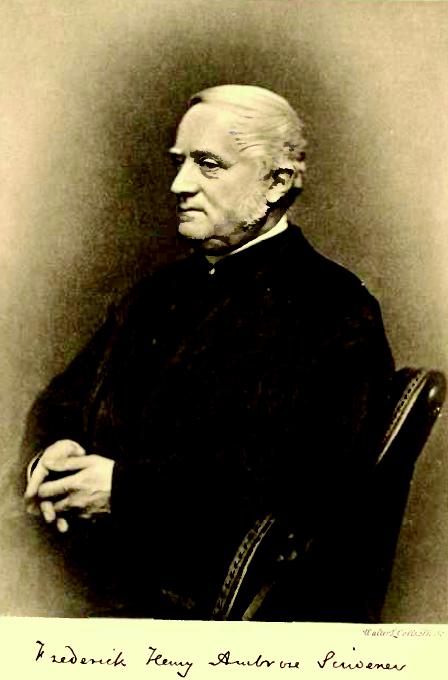
    F. H. A. Scrivener: the Cambridge Paragraph Bible and the Greek text behind the KJV

    F. H. A. Scrivener (1813-1891), frontispiece portrait from A Plain Introduction to the Criticism of the New Testament, vol. I (1894)
    F. H. A. Scrivener (1813-1891), frontispiece portrait from A Plain Introduction to the Criticism of the New Testament, vol. I (1894). Via Wikimedia Commons · Public domain

    Frederick Henry Ambrose Scrivener (1813-1891), a Cambridge-trained scholar and Anglican clergyman, spent his life on the text of the New Testament. He edited Codex Bezae, collated Codex Sinaiticus against the Received Text, and compared the editions of Stephanus (1550), Beza (1565) and the Elzevirs (1633), listing every difference; he was the first to distinguish the Textus Receptus from the Byzantine text, and he favoured the Byzantine text for translation. His magnum opus, the Cambridge Paragraph Bible of 1873, revised the King James text by collating its early editions and became the basis of most later English printings. In 1894 his Greek New Testament was published giving the readings the KJV translators followed, drawn from Erasmus, Stephanus, Beza and others. Honesty: he sat on the committee for the Revised Version, where he was often outvoted, and he doubted a few passages found in the Received Text. “But the word of the Lord endureth for ever” (1 Peter 1:25, KJV).

    Source en.wikipedia.org: Wikipedia, “Frederick Henry Ambrose Scrivener” (1813-1891; Codex Bezae; Sinaiticus collation; TR vs Stephanus/Beza/Elzevir; Byzantine advocate; Cambridge Paragraph Bible 1873; RV committee; doubted some passages) + “Textus Receptus” (Scrivener 1894 edition of the KJV translators’ readings). Plate: frontispiece, Plain Introduction (1894). 1 Pet 1:25 KJV verified.

  18. Baptist Witness

    Noah Knowles Davis Elected to the Chair of Moral Science, University of Virginia, 1873

    “Study to shew thyself approved unto God, a workman that needeth not to be ashamed, rightly dividing the word of truth” (2 Timothy 2:15). Cathcart’s Encyclopedia records of Noah Knowles Davis, “born in Philadelphia, Pa., May 15, 1830,” that “In 1873 he was elected to the chair of Moral Science in the University of Virginia.” It adds of his life there: “His religious convictions are strong, and his piety deep, genuine, and unobtrusive,” and that “he lectures on Sunday afternoons on select portions of the Bible.”

    Source archive.org: William Cathcart, ed., The Baptist Encyclopedia (Philadelphia: Everts, 1881), vol. 1, s.v. “Davis, Noah Knowles” (public domain; Internet Archive scan). Quotations verbatim, contiguous fragments only (line-end hyphens rejoined). Nothing beyond the entry is asserted. KJV: 2 Timothy 2:15.

  19. Baptist Witness

    Oliver W. Gates Takes the San Diego Pastorate, 1873

    “Remember now thy Creator in the days of thy youth” (Ecclesiastes 12:1). Cathcart’s Encyclopedia records that Oliver W. Gates, born at Preston, Connecticut, in 1830, was “converted at the age of twelve” and was leading religious meetings at eighteen. He graduated from Madison University in 1856, was ordained at Greeneville, Norwich, in 1857, and was pastor at Norwalk, Connecticut, from 1861 to 1873. In 1873 he moved to San Diego, California, and “served the San Diego church seven years.” Among his writings Cathcart lists “The Independence of Baptist Churches.”

    Source archive.org: William Cathcart (ed.), The Baptist Encyclopedia (Philadelphia: Everts, 1881), vol. 1, s.v. “Gates, Rev. Oliver W.” (public domain; Internet Archive scan). Quotations verbatim, contiguous fragments only, machine-matched against the scan’s text (OCR line-end hyphenation normalised). KJV: Ecclesiastes 12:1.

  20. Baptist Witness

    John W. Holman, Preacher, Poet and Physician, Dies at North Stonington, 1873

    “I have fought a good fight, I have finished my course, I have kept the faith” (2 Timothy 4:7). Cathcart’s Encyclopedia records that Rev. John W. Holman, M.D., was born in Canaan, Maine, in 1805 and converted in 1818. He preached first among the Christian denomination and then fifteen years among the Free-Will Baptists, and “united with the regular Baptists at Mystic River, Conn.” He “in forty-nine years preached over 5000 sermons and organized 11 churches,” and Cathcart calls him “a poet, a painter, and a physician; a man of rare talents and great labor.” While pastor of the Third Baptist church in North Stonington, Connecticut, he “was prostrated by sickness, and died May 16, 1873, aged sixty-eight years.” Cathcart closes: “All his four sons are Baptist ministers.”

    Source archive.org: William Cathcart (ed.), The Baptist Encyclopedia (Philadelphia: Everts, 1881), vol. 1, s.v. “Holman, Rev. John W., M.D.” (public domain; Internet Archive scan). Quotations verbatim, contiguous fragments only, machine-matched against the scan’s text (OCR line-end hyphenation normalised). KJV: 2 Timothy 4:7.

Plates are hung only where a genuine image of the subject could be found under a public-domain or open licence. Each carries its credit and links to its licence record. Entries without a plate are awaiting one that meets that standard. More entries are being prepared, and each will be added only with its citation.

Provenance

Every entry in this hall was checked, when it was added, against the source linked beneath it; notes name the underlying scholarship where the source cites it. Where historians disagree (for example, over John Wycliffe’s own share in the Bible that bears his name), the entry says so. Scripture is quoted verbatim from the King James Version. Plates are reproduced almost entirely from Wikimedia Commons: public-domain works, works dedicated to the public domain (CC0), or photographs under Creative Commons Attribution (CC BY 2.0-3.0) or Attribution-ShareAlike (CC BY-SA 2.0-4.0) licences. Each plate’s licence is stated beneath it, with a link to the record where it was confirmed.