Baptist Militia A library & museum of the Whole Armour of God Visit
Find

Hall III · The Timeline

The Early Middle Ages

Page 2 of 5 · 657 to 800

“But the word of the Lord endureth for ever. And this is the word which by the gospel is preached unto you.”1 Peter 1:25, KJV

How the Scriptures were received, carried into the English tongue, and confessed by the Baptist churches. Each date is linked to its source, so that you may test every word.

  • Scripture & Canon (75)
  • The English Bible (9)
  1. The Early Middle Ages6th-10th centuries

    The English Bible

    Cædmon sings the Scriptures in English

    Cædmon’s Hymn in the Moore Bede, 8th century. Cambridge University Library, MS Kk.5.16, fol. 128r, via Wikimedia Commons
    Cædmon’s Hymn in the Moore Bede, 8th century. Cambridge University Library, MS Kk.5.16, fol. 128r, via Wikimedia Commons · Public domain

    At the abbey of Streonæshalch, now Whitby, while Hilda was abbess (657-680), a lay brother named Cædmon looked after the animals. By Bede’s account he could not sing, and when the others sang at the feast he slipped away to sleep with the animals. One night, in a dream, he was bidden to sing of the beginning of created things, and he woke with a hymn of praise to God the Creator. The abbess had her scholars teach him the Scripture history. Bede wrote that “whatever was interpreted to him out of scripture, he soon after put the same into poetical expressions of much sweetness and humility in Old English.” He was not a translator in the strict sense; he retold the Bible in English verse for people who could not read Latin. His nine-line Hymn is among the oldest surviving poems in the English language. The plate shows it written in the margin of the Moore Bede, an eighth-century copy of Bede’s History.

    Source en.wikipedia.org: Wikipedia, “Cædmon” (Bede, Ecclesiastical History IV.24, the sole source; Hilda’s abbacy 657-680; the Bede quotation as translated there), and “Old English Bible translations” (not a translator per se).

  2. Scripture & Canon

    The Echternach Gospels: a Gospel book carried to the mission field

    Echternach Gospels, the Man, symbol of St Matthew. Bibliothèque nationale de France, MS lat. 9389, via Wikimedia Commons
    Echternach Gospels, the Man, symbol of St Matthew. Bibliothèque nationale de France, MS lat. 9389, via Wikimedia Commons · Public domain

    The Echternach Gospels are a Latin Gospel book made, presumably at Lindisfarne in Northumbria, around the year 690; the scribe is believed to be the same master who wrote the Durham Gospels. Each Gospel is introduced by a page showing its evangelist’s symbol drawn in the flat, patterned Insular style, like the Man for Matthew shown here. The book was probably carried by Willibrord, a Northumbrian missionary, to the abbey he founded in 698 at Echternach, in present-day Luxembourg, and it takes its name from there. Books like it served both for reading in worship and for teaching those who were hearing the Gospel for the first time, and Echternach became the leading centre for Insular book-making on the Continent. The manuscript is now in the Bibliothèque nationale de France in Paris (MS lat. 9389). “How beautiful are the feet of them that preach the gospel of peace, and bring glad tidings of good things!” (Romans 10:15, KJV).

    Source en.wikipedia.org: Wikipedia, “Echternach Gospels” (Paris BnF MS lat. 9389; presumably Lindisfarne c. 690; same scribe as Durham Gospels; evangelist symbols in Hiberno-Saxon style; probably taken by Willibrord to Echternach, founded 698; teaching and liturgical use; Echternach the leading continental centre). Rom 10:15 KJV verified.

  3. Scripture & Canon

    The Codex Amiatinus: a whole Bible made at Jarrow

    Ezra the scribe, frontispiece of the Codex Amiatinus, fol. 5r, Monkwearmouth-Jarrow, c. 700. Biblioteca Medicea Laurenziana, Florence, via Wikimedia Commons
    Ezra the scribe, frontispiece of the Codex Amiatinus, fol. 5r, Monkwearmouth-Jarrow, c. 700. Biblioteca Medicea Laurenziana, Florence, via Wikimedia Commons · Public domain

    In 692 Ceolfrith, abbot of the twin monastery of Monkwearmouth-Jarrow in Northumbria, commissioned three great single-volume Bibles. The land to raise the two thousand cattle needed for their vellum was granted that year, and the young Bede was very likely involved in the work. One of the three survives whole. It stands 49 centimetres tall, weighs over 34 kilograms, and is the earliest complete one-volume Latin Bible to survive except for one palimpsest. It is considered the best-preserved manuscript of Jerome’s Vulgate and the most reliable witness to its text for the New Testament and most of the Old. In 716 Ceolfrith set out to carry it to Rome as a gift, but he died on the way, at Langres, on 29 September 716. The book reached Italy, lay for centuries at the abbey of Monte Amiata, and is now in the Laurentian Library at Florence. Its famous frontispiece shows Ezra the scribe at work before a cupboard of the sacred books.

    Source en.wikipedia.org: Wikipedia, “Codex Amiatinus” (commission 692; size; earliest complete one-volume Latin Bible save the León palimpsest; Ceolfrith’s death 29 Sept 716; Monte Amiata; Laurentian Library, Amiat. 1; de Rossi 1888 identification), and “Bede.”

  4. Scripture & Canon

    The Book of Durrow: the oldest complete illuminated Gospel book of Britain and Ireland

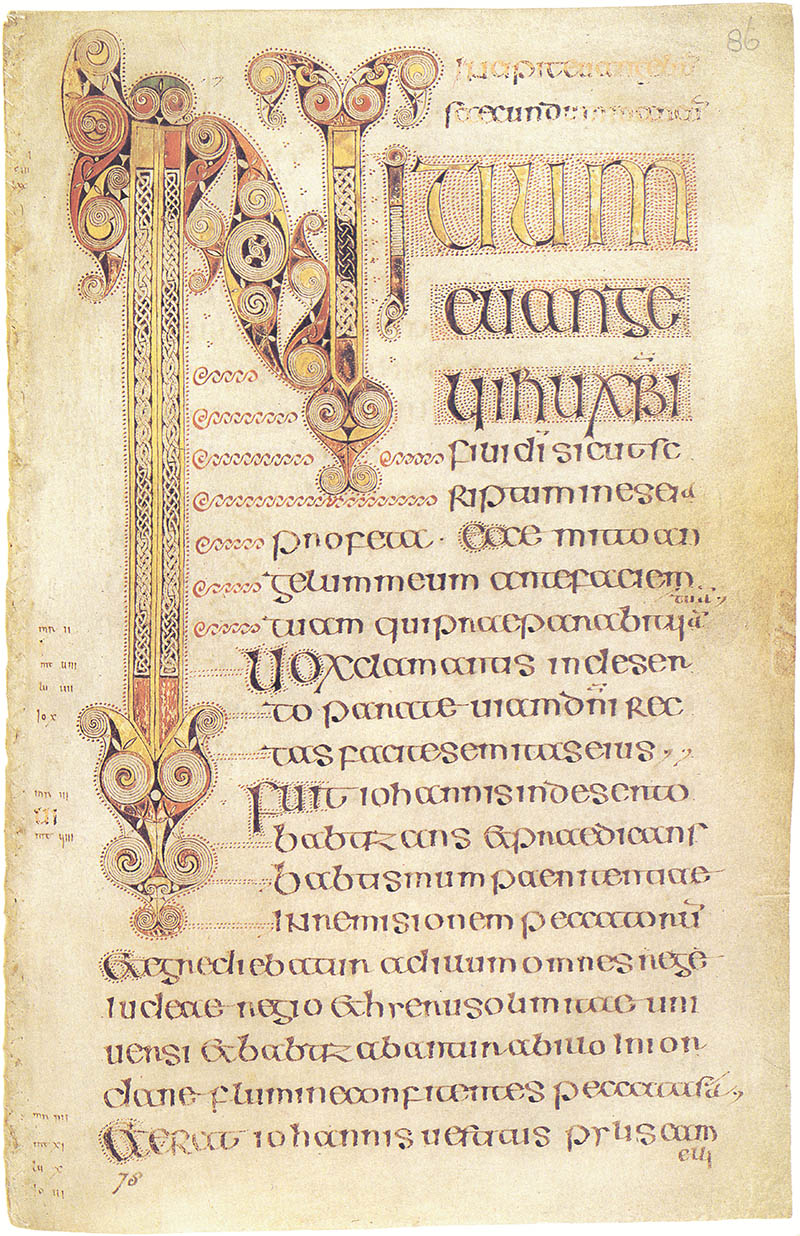
    Book of Durrow, opening of the Gospel of Mark, c. 700. Library of Trinity College Dublin, MS 57, via Wikimedia Commons
    Book of Durrow, opening of the Gospel of Mark, c. 700. Library of Trinity College Dublin, MS 57, via Wikimedia Commons · Public domain

    The Book of Durrow is a Latin book of the four Gospels, dated to about 700, written in Insular majuscule on 248 vellum leaves. Its text is Jerome’s Vulgate with some Irish variations, preceded by Jerome’s letter, prefaces, summaries, a glossary of names and the canon tables that let a reader find parallel passages across the Gospels. It is counted the oldest surviving complete illuminated Gospel book in the Insular style, more than a century older than the Book of Kells, with carpet pages and a full page for each Gospel’s symbol. Where it was made is debated: most scholars now think it was written in Ireland, at or near the abbey of Durrow in County Offaly, rather than in Northumbria, and records suggest it was at Durrow by 916. Badly worn and many times rebound, it is kept today in the Library of Trinity College Dublin (MS 57). “The beginning of the gospel of Jesus Christ, the Son of God” (Mark 1:1, KJV).

    Source en.wikipedia.org: Wikipedia, “Book of Durrow” (c. 700; Vulgate Gospels “with some Irish variations”; Insular majuscule; 248 folios; Jerome’s letter, prefaces, summaries, glossary, canon tables; oldest surviving complete illuminated Insular gospel book, predating Kells by over a century; origin debated, probably Ireland at/near Durrow; probably at Durrow by 916; TCD MS 57). Mark 1:1 KJV verified.

  5. Scripture & Canon

    The St Cuthbert Gospel: the oldest intact European book is the Gospel of John

    St Cuthbert Gospel, fol. 1, the opening of the Gospel of John, Northumbria, early 8th century. British Library, Add MS 89000, via Wikimedia Commons
    St Cuthbert Gospel, fol. 1, the opening of the Gospel of John, Northumbria, early 8th century. British Library, Add MS 89000, via Wikimedia Commons · Public domain

    The St Cuthbert Gospel is a pocket-sized copy of the Gospel of John in Latin, only 138 by 92 millimetres, written in a plain and elegant uncial hand on 94 vellum leaves and still in its original tooled red leather binding, the earliest Western bookbinding known to survive. The British Library calls it “the earliest surviving intact European book”. It was probably written at the twin monastery of Monkwearmouth-Jarrow and placed in the coffin of Cuthbert of Lindisfarne (died 687), where it was found when his remains were moved at Durham in 1104. It was long treasured as Cuthbert’s own Gospel, but it is now dated after his death, between about 700 and 730. After the Dissolution of the Monasteries it passed to collectors and came at last to Stonyhurst College; in 2012 the British Library bought it, and it is now Add MS 89000. “In the beginning was the Word, and the Word was with God, and the Word was God” (John 1:1, KJV).

    Source en.wikipedia.org: Wikipedia, “St Cuthbert Gospel” (early 8th-c. pocket Gospel of John in Latin; 138 × 92 mm; 94 vellum folios; earliest known surviving Western bookbinding; probably written at Monkwearmouth-Jarrow; placed in Cuthbert’s coffin; removed 1104 at Durham; once thought Cuthbert’s own; 2015 research dates it c. 700-730; Stonyhurst College; BL purchase 2012, Add MS 89000; BL quotation). John 1:1 KJV verified.

  6. Scripture & Canon

    Jacob of Edessa: faithful in the smallest marks of the text

    Jacob of Edessa (c. 640-708), a Syriac bishop and scholar, was trained in both Greek and Syriac at the monastery of Qenneshre. After resigning his see he spent eleven years at the monastery of Eusebona teaching Greek, instructing his students in the Psalms and training them to read the Scriptures in Greek. He then moved with seven students to the Great Convent of Tel ʿAde, where he spent nine years revising the Peshitta, the Syriac Old Testament, by comparing it with the Greek versions. William Wright later called the result “a curious eclectic or patchwork text”; five volumes of it survive in Europe, and it was the last attempt at an Old Testament revision in his church. He is counted the principal founder of the Syriac Massorah, the careful system for preserving the biblical text, and he gave Syriac writing five vowel signs adapted from Greek, still used in West Syriac today. In his Letter to George, bishop of Serugh, he insisted that copyists must be faithful even in the smallest details of spelling. Later interpreters called him “the Interpreter of the Scriptures.” He was recalled as bishop of Edessa in 708 and died four months later. “For verily I say unto you, Till heaven and earth pass, one jot or one tittle shall in no wise pass from the law, till all be fulfilled” (Matthew 5:18, KJV).

    Source en.wikipedia.org: Wikipedia, “Jacob of Edessa” (c. 640-708; Qenneshre; Eusebona 11 years; Tel ʿAde, nine years revising the Peshitta OT with the Greek; Wright’s phrase quoted; five volumes; last OT revision; Syriac Massorah; five vowel signs; Letter to George of Serugh; “Interpreter of the Scriptures”; recalled 708, died four months later). No plate (none of his own manuscripts on Commons). Matt 5:18 KJV verified.

  7. The English Bible

    The Lindisfarne Gospels, and the oldest English Gospels between their lines

    Lindisfarne Gospels, fol. 27r, the opening of Matthew, “Liber generationis,” early 8th century. British Library, Cotton MS Nero D.IV, via Wikimedia Commons
    Lindisfarne Gospels, fol. 27r, the opening of Matthew, “Liber generationis,” early 8th century. British Library, Cotton MS Nero D.IV, via Wikimedia Commons · Public domain

    On Holy Island, off the coast of Northumberland, a monk named Eadfrith, bishop of Lindisfarne from 698 until his death in 721, is believed to have written and painted a Latin book of the four Gospels in honour of God and of St Cuthbert. Current scholarship dates it about 715, though some argue it was made before 698. It is one of the finest books of the age and its text survives complete. When the community left the island about 875, they carried the book with them. At Chester-le-Street, between about 950 and 970, a priest named Aldred wrote an Old English translation word for word between the Latin lines, and a colophon naming the men who made the book. That gloss is the oldest surviving translation of the Gospels into the English language. The book is now in the British Library.

    Source en.wikipedia.org: Wikipedia, “Lindisfarne Gospels” (BL Cotton MS Nero D.IV; Eadfrith; c. 715 vs. pre-698; Aldred’s gloss and colophon; oldest extant English Gospels), and “Old English Bible translations” (gloss dated 950-970).

  8. Scripture & Canon

    The Lichfield (St Chad) Gospels: the Gospels, and the oldest written Welsh

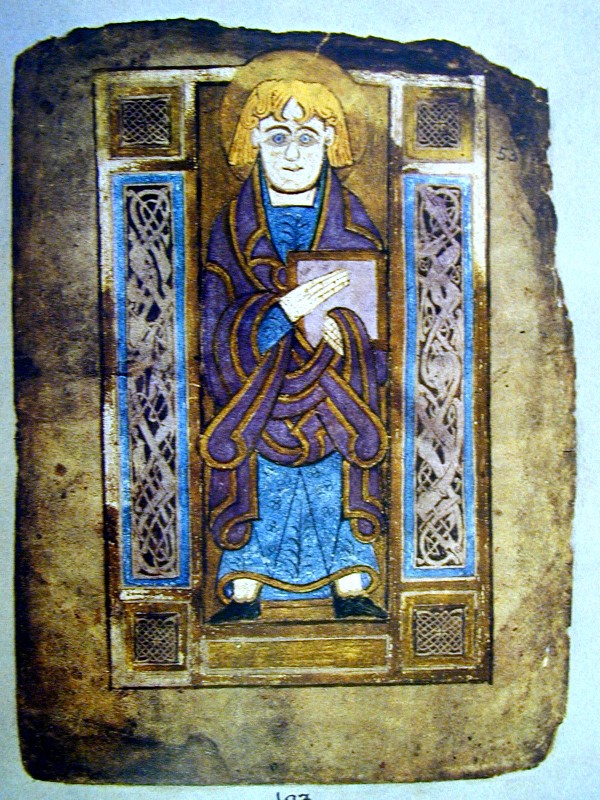
    Portrait of St Luke (p. 218), St Chad Gospels, c. 730. Lichfield Cathedral; image: College of Arts & Sciences, University of Kentucky, via Wikimedia Commons
    Portrait of St Luke (p. 218), St Chad Gospels, c. 730. Lichfield Cathedral; image: College of Arts & Sciences, University of Kentucky, via Wikimedia Commons · CC BY-SA 3.0

    The Lichfield Gospels, also called the St Chad Gospels, are a Latin Gospel book of the 8th century, dated by the art historian Peter Lord to about 730 and by style to between 698 and 800. 236 pages survive, eight of them illuminated, including portraits of Mark and Luke and a cross-carpet page. In its margins are some of the earliest known examples of written Old Welsh: notes showing that in the 9th century the book belonged to the church of St Teilo in Wales. By the late 10th century it was at Lichfield, where it has remained ever since and is still kept in the cathedral. Where it was made is debated; scholars have argued for Ireland, Northumbria, Wales and Lichfield itself. More than eight centuries before the Welsh had the whole Bible in their own tongue, their earliest writing was set down beside the words of the Gospels. “That thou mightest know the certainty of those things, wherein thou hast been instructed” (Luke 1:4, KJV).

    Source en.wikipedia.org: Wikipedia, “Lichfield Gospels” (8th-c. Insular Gospel book; 236 pages, 8 illuminated; Old Welsh marginalia among the earliest known; Peter Lord dates c. 730, style 698-800; at St Teilo’s church in the 9th c.; at Lichfield by the late 10th c.; origin debated: Ireland, Northumbria, Wales, Lichfield). Luke 1:4 KJV verified.

  9. The English Bible

    Bede translates the Gospel of John as he dies

    The Venerable Bede, an imagined portrait, woodcut from the Nuremberg Chronicle, 1493, fol. CLVIIIv, via Wikimedia Commons
    The Venerable Bede, an imagined portrait, woodcut from the Nuremberg Chronicle, 1493, fol. CLVIIIv, via Wikimedia Commons · Public domain

    Bede (c. 672-735), the monk of Jarrow and father of English history, spent his last weeks of Lent and Easter in 735 teaching his pupils, singing the Psalms and giving thanks, though he was short of breath. His pupil Cuthbert wrote that in those days Bede translated the Gospel of St John into English “as far as the words: ‘But what are these among so many,’” that is, John 6:9, which in the King James Bible reads “but what are they among so many?” He did it “for the benefit of the Church.” On Ascension Day, 26 May 735 by the reckoning of his time, he was still dictating to a boy named Wilberht, and when the boy said the last sentence was written he answered, “It is well, you have said the truth. It is ended.” He died soon after on the floor of his cell, singing “Glory be to the Father, and to the Son, and to the Holy Ghost.” His English John is lost; we know of it only from Cuthbert’s letter. The plate is not a true likeness but a woodcut imagined for the Nuremberg Chronicle in 1493.

    Source en.wikisource.org: Cuthbert’s letter to Cuthwin on the death of Bede, tr. J. A. Giles (public domain), Wikisource; Wikipedia, “Bede” (dates; the boy Wilberht) and “Old English Bible translations” (translation lost). John 6:9 KJV verified on bible-api.com.

  10. Scripture & Canon

    The Codex Aureus of Canterbury: the Gospels written in gold

    Codex Aureus of Canterbury, fols. 9v-10r: St Matthew and the opening of Matthew 1:18, mid-8th century. National Library of Sweden, MS A. 135, via Wikimedia Commons
    Codex Aureus of Canterbury, fols. 9v-10r: St Matthew and the opening of Matthew 1:18, mid-8th century. National Library of Sweden, MS A. 135, via Wikimedia Commons · Public domain

    Made in southern England, probably at Canterbury, in the middle of the 8th century, this Latin Gospel book alternates purple-dyed leaves written in gold, silver and white with plain leaves written in black and red. Purple parchment had been reserved in the Roman world for the grandest books, and here it was spent on the words of Christ. It is the oldest surviving manuscript with initials decorated in gold leaf, and its art joins the knotwork of the British Isles to Italian painting. An inscription asks prayers for four men: the goldsmith Wulfhelm, and Ceolhard, Niclas and Ealhhun, probably the monks who made it. Now in the National Library of Sweden, Stockholm (MS A. 135), 193 of its leaves survive. The plate shows St Matthew facing the opening of Matthew 1:18. “More to be desired are they than gold, yea, than much fine gold: sweeter also than honey and the honeycomb” (Psalm 19:10, KJV).

    Source en.wikipedia.org: Wikipedia, “Stockholm Codex Aureus” (MS A. 135; mid-8th c., Southumbria/Canterbury; alternating purple and plain leaves; gold, silver, white; oldest gold-leaf initials; Insular + Italian; inscription naming Wulfhelm, Ceolhard, Niclas, Ealhhun; 193 folios). Plate: fols. 9v-10r. Ps 19:10 KJV verified.

  11. Scripture & Canon

    Codex Basilensis: the common Gospel text, waiting in Basel

    Codex Basilensis (E/07): a page with Mark 2:9-14, the healing of the man sick of the palsy. Basel University Library, via Wikimedia Commons
    Codex Basilensis (E/07): a page with Mark 2:9-14, the healing of the man sick of the palsy. Basel University Library, via Wikimedia Commons · Public domain

    Codex Basilensis, known to scholars as E (07), is a Greek Gospel book of 318 parchment leaves, written in one column of capital letters, with its initials picked out in green, blue and vermilion. Most scholars (Scrivener, Gregory, Nestle, Aland, Metzger) date it to the 8th century; Cataldi Palau has argued for the 9th, suggesting it was copied in Italy by a non-Greek, probably Latin, scribe. Its errors are remarkably few. Its text is the Byzantine text, the common text read in the Greek churches, and it is probably the oldest nearly complete manuscript of the Gospels with a purely Byzantine text. It was probably brought to Basel by Cardinal Ragusio, who may have obtained it in Constantinople, and in 1559 it passed to the University Library of Basel, where it remains. It was in the city when Erasmus prepared his first printed Greek New Testament there, though he did not consult it; later John Mill used it, and it has been cited in printed Greek New Testaments since the 18th century. “I say unto thee, Arise, and take up thy bed, and go thy way into thine house” (Mark 2:11, KJV).

    Source en.wikipedia.org: Wikipedia, “Codex Basilensis A. N. III. 12” (E/07; 318 leaves; decorated initials; 8th c. per Scrivener, Gregory, Nestle, Aland, Metzger; Cataldi Palau 9th c., Italy, few errors; Byzantine text, probably oldest with pure Byzantine text; Cardinal Ragusio; Basel University Library 1559; available to Erasmus but unused; used by Mill). Mark 2:11 KJV verified.

  12. Scripture & Canon

    The Book of Dimma: an Irish pocket Gospel book from the abbey of Roscrea

    Book of Dimma: the eagle, symbol of St John. Trinity College Dublin, via Wikimedia Commons
    Book of Dimma: the eagle, symbol of St John. Trinity College Dublin, via Wikimedia Commons · Public domain

    The Book of Dimma is an eighth-century Irish pocket Gospel Book from the abbey of Roscrea in County Tipperary, founded by St Crónán. Small enough to carry, it holds the four Gospels together with an order for anointing the sick and giving them communion. It is decorated with initials, three Evangelist portraits and a page bearing the eagle, the symbol of John. John’s Gospel was copied by a different scribe from the others, in a neat book hand, and a scribe signed himself Dimma MacNathi at the end of each Gospel. In the 12th century it was sealed in a metalwork book-shrine, which is still kept with it. After passing through several hands it came to Trinity College Dublin in 1836. Honesty: a well-known legend says Dimma copied it in a single day that lasted forty; that is legend, not history. The old identification of Dimma with a seventh-century bishop cannot be sustained. “And the Word was made flesh, and dwelt among us” (John 1:14, KJV).

    Source en.wikipedia.org: Wikipedia, “Book of Dimma” (TCD MS A.IV.23 [MS 59]; 8th-c. Irish pocket Gospel Book from Roscrea, founded by St Crónán; Gospels + order for Unction and Communion of the Sick; initials, three Evangelist portraits, eagle of John; John by a different scribe; signed Dimma MacNathi; bishop identification cannot be sustained; one-day/forty-days legend; 12th-c. cumdach; TCD 29 March 1836). John 1:14 KJV verified.

  13. Scripture & Canon

    The Lorsch Gospels: a golden Gospel book of Charlemagne’s age, now in three countries

    Codex Aureus of Lorsch, carved ivory cover (c. 810): Christ treading on the beasts, between archangels. Vatican (Bibliotheca Laureshamensis digital), via Wikimedia Commons
    Codex Aureus of Lorsch, carved ivory cover (c. 810): Christ treading on the beasts, between archangels. Vatican (Bibliotheca Laureshamensis digital), via Wikimedia Commons · Public domain

    The Codex Aureus of Lorsch is a Latin Gospel Book written in gold letters between about 778 and 820, during and just after Charlemagne’s reign. It was recorded in 830 in the library catalogue of Lorsch Abbey in Germany as a Gospel “written with gold” with ivory panels; in the 10th and 11th centuries Lorsch’s library was among the finest in the world. In the 16th century it was taken to Heidelberg; in 1622 it was split in two and its covers were removed. Today Matthew, Mark and the canon tables are in the Batthyaneum Library at Alba Iulia, Romania; Luke and John are in the Vatican Library; and the carved ivory covers are divided between the Vatican Museums and the Victoria and Albert Museum in London. One ivory cover shows Christ standing on the beasts, a picture of Psalm 91. “Thou shalt tread upon the lion and adder: the young lion and the dragon shalt thou trample under feet” (Psalm 91:13, KJV).

    Source en.wikipedia.org: Wikipedia, “Codex Aureus of Lorsch” (Latin Gospel Book 778-820; Lorsch catalogue 830 under Abbot Adelung “Evangelium scriptum cum auro…”; Heidelberg 16th c.; split and covers torn off 1622; Alba Iulia: Matthew, Mark, canon tables; Vatican: Luke, John; ivories: Vatican Museums and V&A; Christ treading on the beasts). Ps 91:13 KJV verified.

  14. Scripture & Canon

    The Godescalc Evangelistary: the Gospel readings in gold and silver on purple

    Godescalc Evangelistary, 781-783: Christ in Majesty holding the book. Bibliothèque nationale de France (Gallica), via Wikimedia Commons
    Godescalc Evangelistary, 781-783: Christ in Majesty holding the book. Bibliothèque nationale de France (Gallica), via Wikimedia Commons · Public domain

    The Frankish scribe Godescalc began this book on 7 October 781, at the order of Charlemagne and his wife Hildegard, and finished it on 30 April 783; he tells of the commission in a dedication poem at the end, which marks the king’s journey to Italy and the baptism of his son Pepin. It is the earliest known book from the scriptorium of Charlemagne’s Court School. It holds the Gospel passages appointed to be read through the church year, written in gold and silver ink on 127 pages of purple parchment, and it is the earliest example of the Carolingian style of illumination; the dedication poem is written in Caroline minuscule, the script from which our lower-case letters descend. Six pictures open the book: the four evangelists, Christ in Majesty holding a book, and the Fountain of Life, an old symbol of the Gospels as the fountain of eternal life. It was made in the years when Charlemagne’s scholars were correcting the Psalters and Gospel books of his realm. “For with thee is the fountain of life: in thy light shall we see light” (Psalm 36:9, KJV).

    Source en.wikipedia.org: Wikipedia, “Godescalc Evangelistary” (BnF nouv. acq. lat. 1203; commissioned by Charlemagne and Hildegard 7 Oct 781, completed 30 Apr 783; earliest from the Court School; dedication poem; gold and silver ink, 127 pp. purple parchment; Caroline minuscule; 4 evangelists, Christ in Majesty, Fountain of Life; correction of Psalters and Gospel books). Ps 36:9 KJV verified.

  15. Scripture & Canon

    The Book of Mulling: a pocket Gospel book in the high Irish hand

    Book of Mulling, fol. 193: St John. Trinity College Dublin, via Wikimedia Commons
    Book of Mulling, fol. 193: St John. Trinity College Dublin, via Wikimedia Commons · Public domain

    The Book of Mulling is an Irish pocket Gospel Book of the late eighth or early ninth century, now in Trinity College Dublin. It holds the four Gospels, a short service that includes the Apostles’ Creed, and a colophon with a drawing thought to be a plan of St Moling’s monastery, set within two circles. Three portraits survive, of Matthew, Mark and John; John stands facing the reader with his hand over a book held to his heart. It is one of the last books written in the high style of Irish minuscule, and its jewelled shrine is also kept at Trinity. Honesty: a note at the end of John names the scribe as Mulling, and the book was long thought to be the work of St Moling, who died in 697, but its script is later and shows three scribes. It may still have been copied from a book St Moling wrote. “Thy word have I hid in mine heart, that I might not sin against thee” (Psalm 119:11, KJV).

    Source en.wikipedia.org: Wikipedia, “Book of Mulling” (TCD MS 60 (A. I. 15); Irish pocket Gospel Book, late 8th/early 9th c.; four Gospels, liturgical service with Apostles’ Creed; colophon with supposed monastery plan in two circles; “Nomen scriptoris Mulling dicitur”; St Moling d. 697; three scribes; possibly copied from Moling’s autograph; Irish minuscule; portraits of Matthew, Mark, John; cumdach at TCD). Ps 119:11 KJV verified.

  16. Scripture & Canon

    The Dagulf Psalter: the Psalms written wholly in gold for a gift to Rome

    Dagulf Psalter, ivory front cover (before 795): David directs the writing of the Psalms, then sings them. Musée du Louvre (MR 370); photo Jebulon, via Wikimedia Commons
    Dagulf Psalter, ivory front cover (before 795): David directs the writing of the Psalms, then sings them. Musée du Louvre (MR 370); photo Jebulon, via Wikimedia Commons · Public domain

    The scribe Dagulf wrote this Psalter in about 793-795 at Charlemagne’s court, as a gift from the king to Pope Adrian I; two dedicatory poems open the book, and in the second Dagulf names himself. Its 161 leaves carry the Psalms and a set of canticles, all in gold Caroline minuscule, twenty-three lines to a page, with ornamental initial pages but no portraits or pictures. Its ivory covers tell the story of the book itself: on the front, King David chooses men to write down the Psalms and then sings them among musicians; on the back, Jerome is asked to put the Psalms into Latin and dictates his translation to a scribe. Honesty: the gift was made during a dispute between king and pope over the Second Council of Nicaea, and because Adrian died in 795 it probably never reached Rome. The leaves are now in the Austrian National Library in Vienna and the ivories in the Louvre. “The Spirit of the LORD spake by me, and his word was in my tongue” (2 Samuel 23:2, KJV).

    Source en.wikipedia.org: Wikipedia, “Dagulf Psalter” (scribe Dagulf, 793-795, Charlemagne’s gift to Adrian I; 161 ff. in gold Carolingian minuscule; Psalms + canticles, 23 lines; no portraits; dedicatory poems; ivories: David and the Psalms, Jerome’s Latin translation; Nicaea II/Libri Carolini context; Adrian d. 795; Vienna ÖNB; ivories Louvre). 2 Sam 23:2 KJV verified.

  17. Scripture & Canon

    The Ada Gospels: the book that gives Charlemagne’s court school its name

    Ada Gospels: St Matthew. Stadtbibliothek Trier (Codex 22); The Yorck Project, via Wikimedia Commons
    Ada Gospels: St Matthew. Stadtbibliothek Trier (Codex 22); The Yorck Project, via Wikimedia Commons · Public domain

    The Ada Gospels is a Carolingian Gospel Book of the late eighth or early ninth century, written on vellum in the clear new Caroline minuscule and now kept in the city library of Trier in Germany. It takes its name from a dedication to Ada, named in it as Charlemagne’s sister. It has an ornate opening page for Matthew and portraits of Matthew, Mark and Luke, drawing on Insular, Italian and Byzantine models and showing a sure grasp of classical style. Modern scholars group about ten manuscripts from the same circle of scribes and painters as the “Ada School”, among them the Godescalc Evangelistary and the Lorsch Gospels already on this timeline, and the Harley Golden Gospels and the Soissons Gospels that follow. In 1499 the book was given a rich gold binding. “One jot or one tittle shall in no wise pass from the law, till all be fulfilled” (Matthew 5:18, KJV).

    Source en.wikipedia.org: Wikipedia, “Ada Gospels” (Trier, Stadtbibliothek, Codex 22; late 8th/early 9th c. Carolingian Gospel Book; dedication to Charlemagne’s sister Ada; vellum, Carolingian minuscule; 36.8 × 24.5 cm; “Ada School”, about ten MSS incl. Soissons, Harley Golden, Godescalc, Lorsch; Matthew initial page, portraits of Matthew, Mark, Luke; Insular, Italian, Byzantine influences; gold binding 1499). Matt 5:18 KJV verified.

  18. Scripture & Canon

    Alcuin of York corrects the Latin Bible at Tours

    The story of Adam and Eve (Genesis 2-3), Moutier-Grandval Bible, Tours, c. 830-840. British Library, Add MS 10546, fol. 5v, via Wikimedia Commons
    The story of Adam and Eve (Genesis 2-3), Moutier-Grandval Bible, Tours, c. 830-840. British Library, Add MS 10546, fol. 5v, via Wikimedia Commons · Public domain

    Alcuin of York, a scholar in the service of Charlemagne, was made abbot at Tours in 796. By his time copies of Jerome’s Latin Vulgate had gathered many variant readings, and Alcuin took up the work of correcting its text. Dedicatory poems show that four Bibles were prepared by him or under his direction at Tours, probably in 799-801. His aim, as the cited article puts it, was to recover Jerome’s original text as far as possible, and his changes were not far-reaching. One of the one-volume Bibles later made at Tours from his revised text, the Moutier-Grandval Bible of about 830-840, now in the British Library, is shown here. Alcuin’s monks at Tours also worked to perfect the clear Carolingian minuscule script, ancestor of modern Roman typefaces. “Every word of God is pure: he is a shield unto them that put their trust in him” (Proverbs 30:5, KJV).

    Source en.wikipedia.org: Wikipedia, “Alcuin” (abbot at Tours 796; textual criticism of the Vulgate with many variants; four Bibles by dedicatory poems, probably 799-801; aim to recover Jerome’s text, changes not far-reaching; Carolingian minuscule); “Moutier-Grandval Abbey” (Bible of c. 840, probably written at Tours, BL Add MS 10546). Prov 30:5 KJV verified.

  19. Scripture & Canon

    The Book of Kells: the four Gospels in Latin

    The Book of Kells, fol. 34r: the Chi Rho page, opening Matthew 1:18, c. 800. Trinity College Library, Dublin, MS A. I. 58, via Wikimedia Commons
    The Book of Kells, fol. 34r: the Chi Rho page, opening Matthew 1:18, c. 800. Trinity College Library, Dublin, MS A. I. 58, via Wikimedia Commons · Public domain

    The Book of Kells is a Latin book of the four Gospels, made about 800 by Columban monks. It was probably begun on Iona and finished at Kells in Ireland, though scholars still debate where it was made. Its Gospel text is largely the Vulgate, with passages from the older Latin versions. Its opening pages carry the canon tables of Eusebius. It is counted the summit of Insular book-painting, and its most lavish page, folio 34r, gives the whole leaf to the first word of Matthew 1:18, the Greek letters chi and rho that stand for “Christ”: “Now the birth of Jesus Christ was on this wise” (KJV). In 1007 the Annals of Ulster recorded that “the great Gospel of Columkille” had been stolen for its jewelled cover; it was found months later “under a sod,” without the cover. Since 1661 it has been kept at Trinity College, Dublin.

    Source en.wikipedia.org: Wikipedia, “Book of Kells” (c. 800; Columban origin, Iona/Kells debated; Vulgate text with Old Latin readings; Eusebian canon tables; fol. 34r Chi Rho at Matt 1:18; Annals of Ulster 1007 as quoted there; Trinity College Dublin since 1661). Matt 1:18 KJV verified.

  20. The English Bible

    The Macregol (Rushworth) Gospels: an Irish Gospel book given an English gloss by Farman and Owun

    Ornament from the Macregol Gospels (Bodleian MS Auct. D. 2. 19): an early 20th-century teaching slide, KU Leuven EuroPhot collection, via Wikimedia Commons
    Ornament from the Macregol Gospels (Bodleian MS Auct. D. 2. 19): an early 20th-century teaching slide, KU Leuven EuroPhot collection, via Wikimedia Commons · Public domain

    This Latin Gospel book was written and illuminated in Ireland, at Birr, by a scribe who signed himself Macregol, probably the abbot of Birr who died in 822; a second scribe copied part of it. At the end Macregol asks whoever reads the Gospel to pray for the scribe. By about 950-970 the book had come to England, where an Old English translation was written between its Latin lines. Farman, a priest at Harewood, glossed Matthew and part of John in the Mercian dialect; for the rest, Northumbrian glosses were carried over from the Lindisfarne Gospels. A second glossator, Owun, names himself beside Farman. Their closing note asks the reader to pray for Owun who glossed the book and for Farman the priest. John Rushworth owned it by 1665 and gave it to the Bodleian Library in Oxford, perhaps in 1681, where it remains as MS Auct. D. 2. 19. Honesty: like the other Old English glosses, it renders the Latin, not the Greek. “The entrance of thy words giveth light; it giveth understanding unto the simple” (Psalm 119:130, KJV).

    Source medieval.bodleian.ox.ac.uk: Bodleian, Medieval Manuscripts: MS. Auct. D. 2. 19 (Birr, before 822; scribes A “Macregol” and B; Macregol prob. abbot of Birr d. 822; OE gloss 10th c.; glossators Owun and Farman “preoste æt harawuda”; Rushworth 1665, to Bodleian perhaps 1681). Also Wikipedia, “Old English Bible translations” (c. 950-970; Farman: Matthew + some of John). Plate: KU Leuven lantern slide. Ps 119:130 KJV verified.

Plates are hung only where a genuine image of the subject could be found under a public-domain or open licence. Each carries its credit and links to its licence record. Entries without a plate are awaiting one that meets that standard. More entries are being prepared, and each will be added only with its citation.

Provenance

Every entry in this hall was checked, when it was added, against the source linked beneath it; notes name the underlying scholarship where the source cites it. Where historians disagree (for example, over John Wycliffe’s own share in the Bible that bears his name), the entry says so. Scripture is quoted verbatim from the King James Version. Plates are reproduced almost entirely from Wikimedia Commons: public-domain works, works dedicated to the public domain (CC0), or photographs under Creative Commons Attribution (CC BY 2.0-3.0) or Attribution-ShareAlike (CC BY-SA 2.0-4.0) licences. Each plate’s licence is stated beneath it, with a link to the record where it was confirmed.