Baptist Militia A library & museum of the Whole Armour of God Visit
Find

Hall III · The Timeline

The Early Middle Ages

Page 5 of 5 · 960 to 990

“But the word of the Lord endureth for ever. And this is the word which by the gospel is preached unto you.”1 Peter 1:25, KJV

How the Scriptures were received, carried into the English tongue, and confessed by the Baptist churches. Each date is linked to its source, so that you may test every word.

  • Scripture & Canon (75)
  • The English Bible (9)
  1. The Early Middle Ages6th-10th centuries

    Scripture & Canon

    The León Bible of 960: a Bible of both Testaments finished on a known day in Christian Spain

    León Bible of 960, Sanctus and Florentius: the opening initial of Genesis. Basilica of San Isidoro, León, via Wikimedia Commons
    León Bible of 960, Sanctus and Florentius: the opening initial of Genesis. Basilica of San Isidoro, León, via Wikimedia Commons · Public domain

    The León Bible of 960 (Codex Biblicus Legionensis) is a Latin Bible of both Testaments copied and illuminated at the monastery of Valeránica, at Tordómar in northern Spain. Its colophon records that it was finished on 19 June 960 by a scribe named Sanctus and his master Florentius. It is written in two columns of Visigothic minuscule, the book-hand of Spain in that age, and its margins carry many glosses in Latin and in Arabic, a sign of the Mozarabic world in which Christians of Spain lived and read. It opens with Christ in majesty among the four Gospel symbols and tables tracing His descent from Adam; some eighty small pictures illustrate the Old Testament passages beside them. The monastery that made it disappeared by the end of the 10th century, and the Bible has long been kept at the Basilica of San Isidoro in León. Honesty: how it came to León is not known; it may have been given in the 11th century by King Ferdinand I and Queen Sancha, the basilica’s chief patrons. The plate shows the great initial that opens Genesis. “In the beginning God created the heaven and the earth” (Genesis 1:1, KJV).

    Source en.wikipedia.org: Wikipedia, “León Bible of 960” (Codex Biblicus Legionensis; Valeránica, Tordómar; colophon 19 June 960, Sanctus and Florentius; Visigothic minuscule, 2 cols; Latin + Arabic glosses; Christ in majesty + genealogy tables; ~80 OT images; San Isidoro, route unknown, perhaps Ferdinand I and Sancha). Plate: Genesis initial. Gen 1:1 KJV verified.
  2. Scripture & Canon

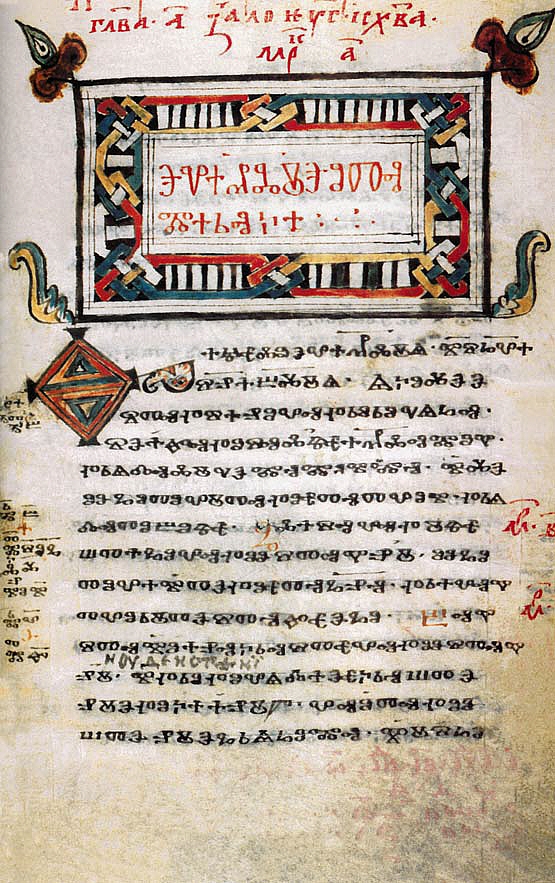
    The Glagolitic Gospels: Codex Zographensis and Codex Marianus

    Codex Zographensis: the first page of the Gospel of Mark in Glagolitic, late 10th or early 11th century. National Library of Russia, via Wikimedia Commons
    Codex Zographensis: the first page of the Gospel of Mark in Glagolitic, late 10th or early 11th century. National Library of Russia, via Wikimedia Commons · Public domain

    A century after Cyril and Methodius gave the Slavs an alphabet and began to translate the Scriptures (already on this timeline), two books of the four Gospels in their Glagolitic letters stand among the oldest witnesses to the Old Church Slavonic language. Codex Zographensis belonged to the Bulgarian Zograf Monastery on Mount Athos; it has 304 leaves, the first 288 holding Matthew, Mark, Luke and John in Glagolitic, and it is dated to the end of the 10th or the beginning of the 11th century. The monks gave it to the Russian emperor in 1860, and it is now in the National Library of Russia at St Petersburg. Codex Marianus, dated to the beginning of the 11th century, was found by Victor Grigorovich in a hermitage of the Monastery of the Mother of God on Athos in 1844-45 and is now in the Russian State Library at Moscow. Both use the rounded Glagolitic script, the oldest recorded Slavic alphabet. The plate is the opening of the Gospel of Mark in Codex Zographensis. “The beginning of the gospel of Jesus Christ, the Son of God” (Mark 1:1, KJV).

    Source en.wikipedia.org: Wikipedia, “Codex Zographensis” (304 ff., 288 Glagolitic Gospels; end 10th/start 11th c.; Zograf Monastery, Athos; Mihanović 1843; given to Alexander II 1860; National Library of Russia) + “Codex Marianus” (early 11th c.; Grigorovich 1844-45; Russian State Library; with Zographensis among oldest OCS witnesses; round Glagolitic). Mark 1:1 KJV verified.

  3. Scripture & Canon

    The Codex Egberti: the Gospel readings of the church year, pictured for Egbert of Trier

    Codex Egberti, fol. 27v: Christ rescues Peter from the sea. Stadtbibliothek Trier (Cod. 24), via Wikimedia Commons
    Codex Egberti, fol. 27v: Christ rescues Peter from the sea. Stadtbibliothek Trier (Cod. 24), via Wikimedia Commons · Public domain

    The Codex Egberti was made for Egbert, archbishop of Trier (977-993). It is a book of Gospel readings, the passages read in services through the church year, and besides portraits of the four Evangelists it carries fifty-one miniatures of events told in those readings, the oldest and most extensive series of pictures of the life of Christ in a single book. Where it was made is told two ways: Wikipedia credits the scriptorium of Reichenau monastery, while Trier’s own tourist office credits a scriptorium Egbert set up at St Maximin’s in Trier, with the gifted painter known as the Master of the Registrum Gregorii among its artists. Egbert later gave the book to the church of St Paulinus in Trier, where it was used into the eighteenth century; it is now in Trier’s city library (Cod. 24), and since 2004 it has been listed in UNESCO’s Memory of the World. The plate shows Peter sinking and caught by the Lord’s hand (Matthew 14). “And immediately Jesus stretched forth his hand, and caught him, and said unto him, O thou of little faith, wherefore didst thou doubt?” (Matthew 14:31, KJV).

    Source en.wikipedia.org: Wikipedia, “Codex Egberti” (Reichenau for Egbert of Trier 980-993; Trier city library Cod. 24; lectionary; Evangelist portraits + 51 miniatures; oldest, most extensive Life of Christ cycle; UNESCO Memory of the World 2004). Trier-info.de, “Codex Egberti” (St Maximin scriptorium; Master of the Registrum Gregorii; to St Paulinus, used into 18th c.). Matt 14:31 KJV verified.

  4. The English Bible

    The Wessex Gospels and Ælfric’s Old Testament

    The Old English Hexateuch, 11th century, a page of the illustrated manuscript that used Ælfric’s translations. British Library, Cotton MS Claudius B IV, fol. 60r, via Wikimedia Commons
    The Old English Hexateuch, 11th century, a page of the illustrated manuscript that used Ælfric’s translations. British Library, Cotton MS Claudius B IV, fol. 60r, via Wikimedia Commons · Public domain

    About 990 a full, free-standing translation of the four Gospels appeared in the West Saxon dialect of Old English. It is known as the Wessex Gospels, and seven manuscript copies survive. It gives the most familiar Old English form of the Lord’s Prayer, beginning “Fæder ure þu þe eart on heofonum.” At about the same time Ælfric, a monk trained at Winchester and later abbot of Eynsham (c. 955-c. 1010), was asked by the nobleman Æthelweard to translate Genesis into English. He did so reluctantly, and wrote a preface warning readers not to take the customs of ancient Israel as rules for Christians. His translations of the books of Moses, Joshua and Judges were used for the illustrated Old English Hexateuch. Ælfric translated by the sense and not word for word. It was among the first translations of the Old Testament from Latin into Old English. After the Norman Conquest of 1066, Old English gave way to Middle English, and the next whole English Bible would not come until Wycliffe’s day.

    Source en.wikipedia.org: Wikipedia, “Wessex Gospels” (c. 990; seven MSS; Lord’s Prayer), “Ælfric of Eynsham” (Æthelweard’s request; preface to Genesis; sense-for-sense), and “Old English Bible translations” (Hexateuch; 1066).

Plates are hung only where a genuine image of the subject could be found under a public-domain or open licence. Each carries its credit and links to its licence record. Entries without a plate are awaiting one that meets that standard. More entries are being prepared, and each will be added only with its citation.

Provenance

Every entry in this hall was checked, when it was added, against the source linked beneath it; notes name the underlying scholarship where the source cites it. Where historians disagree (for example, over John Wycliffe’s own share in the Bible that bears his name), the entry says so. Scripture is quoted verbatim from the King James Version. Plates are reproduced almost entirely from Wikimedia Commons: public-domain works, works dedicated to the public domain (CC0), or photographs under Creative Commons Attribution (CC BY 2.0-3.0) or Attribution-ShareAlike (CC BY-SA 2.0-4.0) licences. Each plate’s licence is stated beneath it, with a link to the record where it was confirmed.