Baptist Militia A library & museum of the Whole Armour of God Visit
Find

Hall III · The Timeline

The Early Middle Ages

Page 3 of 5 · 800 to 850

“But the word of the Lord endureth for ever. And this is the word which by the gospel is preached unto you.”1 Peter 1:25, KJV

How the Scriptures were received, carried into the English tongue, and confessed by the Baptist churches. Each date is linked to its source, so that you may test every word.

  • Scripture & Canon (75)
  • The English Bible (9)
  1. The Early Middle Ages6th-10th centuries

    Scripture & Canon

    Codex Campianus: a Gospel book in minute capitals, given to a king
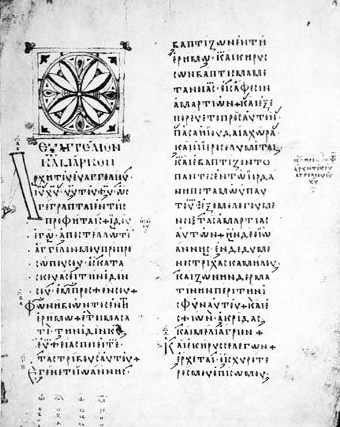
    Codex Campianus (M/021), fol. 91r: the beginning of the Gospel of Mark. Bibliothèque nationale de France, Gr. 48, via Wikimedia Commons
    Codex Campianus (M/021), fol. 91r: the beginning of the Gospel of Mark. Bibliothèque nationale de France, Gr. 48, via Wikimedia Commons · Public domain

    Codex Campianus, known as M (021), holds the complete text of all four Gospels on 257 parchment leaves, in two columns of what Scrivener called a “very elegant and minute uncial” script, in brown ink, with accents and reading marks added in red. It was made for reading aloud in church: the beginnings and endings of the lessons are marked in the text, and a harmony of the Gospels runs along the foot of each page, pointing the reader to the same event in the other Gospels. Before each Gospel stands a small picture of its evangelist. Its early history is unknown. It takes its name from the Abbé François de Camps, who gave it to King Louis XIV of France (the year is given as 1706 or 1707), and it is now in the National Library of France in Paris (Gr. 48). Its text is Byzantine. Kuster used it in 1710 in his reprint of John Mill’s Greek New Testament, and 19th-century editors praised it (Tregelles found in it “many good readings”), though 20th-century critical editions came to set it aside. “The beginning of the gospel of Jesus Christ, the Son of God;” (Mark 1:1, KJV).

    Source en.wikipedia.org: Wikipedia, “Codex Campianus” (M/021; 9th c. per INTF; 257 leaves, 2 cols; Scrivener’s description quoted; lection marks; harmony at foot of pages; evangelist miniatures; Abbé de Camps to Louis XIV, 1706/1707; Kuster 1710 for Mill; Tregelles quoted; later neglect; BnF Gr. 48). Mark 1:1 KJV verified.

  2. Scripture & Canon

    Codex Mosquensis II: from Mount Athos to Moscow

    Codex Mosquensis II (V/031): a page with Matthew 1:10-18, the close of the genealogy of Christ. State Historical Museum, Moscow, via Wikimedia Commons
    Codex Mosquensis II (V/031): a page with Matthew 1:10-18, the close of the genealogy of Christ. State Historical Museum, Moscow, via Wikimedia Commons · Public domain

    Codex Mosquensis II, known as V (031), is a small Greek Gospel book of 220 parchment leaves, each about 16 by 11.5 centimetres, written in one column of small, fine capital letters. Before the Gospels it carries Eusebius’s Letter to Carpianus and his canon tables, the ancient system that let a reader find the same story in each Gospel, and the section numbers stand in its margins. The capital-letter hand runs as far as John 8:39; from there a 13th-century scribe completed the book in a smaller hand. Its text is Byzantine, akin to Codex Campianus. It was kept at the Vatopedi monastery on Mount Athos until 1655, when the monk Arsenius brought it to Moscow at the suggestion of Patriarch Nikon. Christian Frederick Matthaei collated it in 1779 and 1783 and judged its scribe diligent, and Scrivener counted it among the best manuscripts Matthaei collated. Some leaves have been lost since his day. It is now in the State Historical Museum in Moscow. “And she shall bring forth a son, and thou shalt call his name JESUS: for he shall save his people from their sins” (Matthew 1:21, KJV).

    Source en.wikipedia.org: Wikipedia, “Codex Mosquensis II” (V/031; 9th c.; 220 leaves, 15.7 × 11.5 cm; Epistle to Carpianus + Eusebian tables; uncial to John 8:39, 13th-c. minuscule after; Byzantine, resembles M; Vatopedi → Moscow 1655, Arsenius, Nikon; Matthaei 1779/1783; Scrivener; State Historical Museum V. 9). Matt 1:21 KJV verified.

  3. Scripture & Canon

    Codex Petropolitanus: a small Gospel book from Smyrna

    Codex Petropolitanus (Π/041), fols. 164v-165r: the beginning of the Gospel of Luke. National Library of Russia, Gr. 34, via Wikimedia Commons
    Codex Petropolitanus (Π/041), fols. 164v-165r: the beginning of the Gospel of Luke. National Library of Russia, Gr. 34, via Wikimedia Commons · Public domain

    Codex Petropolitanus, known as Π (041), is a Greek Gospel book of 350 parchment leaves, each only about 14.5 by 10.5 centimetres. It is written in one column of small capital letters with breathings and accents, and it has a table of chapters before each Gospel, with the section numbers and Eusebian canon references in the margins. It holds almost the whole of the four Gospels; a few gaps remain, and the last verses of Mark and of John were supplied by a later hand in the 12th century. Its text is Byzantine, and it gives its name to a family of related manuscripts that includes Codex Cyprius. The book belonged to the Parodi family in Smyrna until Constantin von Tischendorf brought it to St Petersburg in 1859; it is now in the National Library of Russia (Gr. 34). The page shown opens the Gospel of Luke, who wrote so that his reader might be sure of what he had been taught. “That thou mightest know the certainty of those things, wherein thou hast been instructed” (Luke 1:4, KJV).

    Source en.wikipedia.org: Wikipedia, “Codex Petropolitanus (New Testament)” (Π/041; 9th c.; 350 leaves, 14.5 × 10.5 cm; kephalaia, Ammonian sections, Eusebian canons; Mark 16:18-20 and John 21:22-25 supplied 12th c.; Byzantine, family Π with Codex Cyprius; Parodi family, Smyrna; Tischendorf 1859; NLR Gr. 34). Luke 1:4 KJV verified.

  4. Scripture & Canon

    Codex Boreelianus: a Gospel book carried home to Holland

    Codex Boreelianus (F/09): the beginning of the Gospel of Mark, with its decorated headpiece and initial. Utrecht University Library, Ms. 1, via Wikimedia Commons
    Codex Boreelianus (F/09): the beginning of the Gospel of Mark, with its decorated headpiece and initial. Utrecht University Library, Ms. 1, via Wikimedia Commons · Public domain

    Codex Boreelianus, known as F (09), is a Greek Gospel book written in the larger late capital-letter hand, two columns to the page, by what Jodocus Heringa called an “elegant and careful” hand. Its headings are written in gold and red, and here and there decorated initials in red or gold mark the text. It was divided for reading by the Ammonian sections, with a table of chapters before each Gospel and lesson marks in the margin. Its text is the Byzantine text, the common text of the Greek churches; Metzger called it a typical Byzantine text. It takes its name from Johannes Boreel (1577-1629), Dutch ambassador at the court of James I, who is believed to have brought it back from the East. Wettstein cited it from a partial collation in his Greek New Testament of 1751. For almost two centuries it passed through private hands and many leaves were lost, until the Utrecht professor Jodocus Heringa identified it in 1823. It has been in Utrecht University Library since 1830 (Ms. 1), was digitised in 2007, and is still cited in the Nestle-Aland Greek New Testament. The page shown opens the Gospel of Mark. “The voice of one crying in the wilderness, Prepare ye the way of the Lord, make his paths straight.” (Mark 1:3, KJV).

    Source en.wikipedia.org: Wikipedia, “Codex Boreelianus” (F/09; 204 leaves, 2 cols, 19 lines; late uncial, “elegant and careful” hand per Heringa; gold and red headings; Ammonian sections, kephalaia tables, lectionary marks; Byzantine, “typical” per Metzger; Aland Cat. V; Johannes Boreel 1577-1629, ambassador to James I; Wettstein 1751; Heringa identified 1823; Utrecht University Ms. 1 since 1830; digitised 2007; in Nestle-Aland; dated 8th (Deane), 9th (INTF), 10th (Tregelles)). Mark 1:3 KJV verified.

  5. Scripture & Canon

    Codex Seidelianus I: a Gospel book that reached Wolf, Wettstein and the Harleian library

    Codex Seidelianus I (G/011): an opening of the manuscript, two pages written in two columns. British Library, Harley MS 5684, via Wikimedia Commons
    Codex Seidelianus I (G/011): an opening of the manuscript, two pages written in two columns. British Library, Harley MS 5684, via Wikimedia Commons · Public domain

    Codex Seidelianus I, known as G (011) and also called Codex Wolfii A, is a Greek Gospel book of 252 parchment leaves, written two columns to the page in capital letters, dated by its handwriting to the 9th or 10th century. It is divided by the Ammonian sections with references to the Eusebian canons, and it carries the chapter titles at the head of the pages. In the genealogy of Luke 3 each new name is set on a line of its own. Its text is chiefly Byzantine, the common text of the Greek churches. The scholar Andreas Erasmus Seidel brought it from the East to Germany; after his death in 1718 it passed through the Berlin royal librarian Mathurin Veyssière de La Croze to Johann Christoph Wolf, who published extracts from it in 1723. Wettstein and Griesbach cited it under the letter G. It was cut apart in 1721 so that pieces could be sent to Richard Bentley; most of it was later bought for the library of Edward Harley and is now in the British Library (Harley MS 5684), with one leaf at Trinity College, Cambridge. Tregelles found further fragments in 1845 and collated it in 1847. “Which was the son of Enos, which was the son of Seth, which was the son of Adam, which was the son of God.” (Luke 3:38, KJV).

    Source en.wikipedia.org: Wikipedia, “Codex Seidelianus I” (G/011, Wolfii A; 9th/10th c.; 252 leaves, 2 cols, 21 lines; Ammonian sections + Eusebian canons, titloi; Luke 3 genealogy one name per line (Scrivener); secondary Byzantine, Aland Cat. V; Seidel († 1718) → La Croze → J. C. Wolf, extracts 1723; mutilated 1721 for Bentley; Wettstein and Griesbach siglum G; Tregelles 1845/1847; British Library Harley MS 5684, one leaf Trinity College Cambridge B. XVII. 20). Luke 3:38 KJV verified.

  6. Scripture & Canon

    Codex Macedoniensis: a small, carefully written Gospel book

    Codex Macedoniensis (Y/034): the subscription at the close of the Gospel of Luke. Cambridge University Library, Add. MS 6594, via Wikimedia Commons
    Codex Macedoniensis (Y/034): the subscription at the close of the Gospel of Luke. Cambridge University Library, Add. MS 6594, via Wikimedia Commons · Public domain

    Codex Macedoniensis, known as Y (034), is a small Greek Gospel book of 309 parchment leaves, each about 18 by 13 centimetres, written in one column of capital letters in black and brown ink, with accents, breathings and punctuation. Its first describer, the historian William C. Braithwaite, called it “very carefully written.” Chapter lists stand before Mark, Luke and John, ornamented headpieces open Mark, Luke and John, and the chapter titles, section numbers and the signs marking the beginning and end of each church reading are picked out in carmine. Its text is Byzantine, the common text of the Greek churches. Its early history is unknown. In 1901 the stockbroker Joseph Bevan Braithwaite acquired it from Macedonia and gave it to his brother William, who described it in the Expository Times and dated it to the 9th century, the date it still bears. Metzger judged that it “deserves to be studied more thoroughly than has hitherto been the case.” It is now in Cambridge University Library (Add. MS 6594), where it has been digitised. The page shown is the close of the Gospel of Luke. “And were continually in the temple, praising and blessing God. Amen.” (Luke 24:53, KJV).

    Source en.wikipedia.org: Wikipedia, “Codex Macedoniensis” (Y/034; 9th c.; 309 leaves, 18 × 13 cm, 1 col; black and brown ink; Braithwaite “very carefully written”; kephalaia lists, ornamented headpieces, carmine lection marks; Byzantine, Aland Cat. V; J. B. Braithwaite acquired from Macedonia 1901 → W. C. Braithwaite, Expository Times 13; Metzger quoted; Cambridge University Library Add. MS 6594; digitised at Cambridge Digital Library and CSNTM). Luke 24:53 KJV verified.

  7. Scripture & Canon

    Codex Athous Dionysiou: a Gospel book still kept on Mount Athos

    Codex Athous Dionysiou (Ω/045): a page with John 21:15-22. Dionysiou monastery, Mount Athos, Ms. 55, via Wikimedia Commons
    Codex Athous Dionysiou (Ω/045): a page with John 21:15-22. Dionysiou monastery, Mount Athos, Ms. 55, via Wikimedia Commons · Public domain

    Codex Athous Dionysiou, known as Ω (045), is a Greek Gospel book of 259 thick parchment leaves, each about 22 by 16 centimetres, written in two columns of large capital letters in brown ink, with the first lines in red. It holds almost the whole text of the four Gospels; only a few verses of Luke 1 are missing. It was fully furnished for use in the church: tables of chapters before each Gospel, the Ammonian sections and Eusebian canons, lesson marks in the margins, a calendar of readings for the year (the Synaxarion and Menologion), and at the end of each Gospel a subscription with its count of lines. Its text is Byzantine, the common text of the Greek churches, with some readings of other families. Hermann von Soden counted it among the three oldest manuscripts of the earliest form of the Byzantine text, and Kurt Aland placed it in his Category V. It was collated by Mary W. Winslow and published by Kirsopp Lake and Silva New in 1932. It is kept today in the library of the Dionysiou monastery on Mount Athos (Ms. 55). The page shown carries John 21:15-22, where the risen Lord gives Peter his charge. “So when they had dined, Jesus saith to Simon Peter, Simon, son of Jonas, lovest thou me more than these? He saith unto him, Yea, Lord; thou knowest that I love thee. He saith unto him, Feed my lambs.” (John 21:15, KJV).

    Source en.wikipedia.org: Wikipedia, “Codex Athous Dionysiou” (Ω/045; 9th c.; 259 thick leaves, 22 × 16 cm, 2 cols; brown ink, first lines red; lacuna Luke 1:15-28; kephalaia, sections, canons, lection marks, Synaxarion, Menologion, stichoi; Byzantine, some Alexandrian readings; von Soden: among 3 oldest early-Byzantine; Aland Cat. V; Winslow, ed. Lake and New 1932; Dionysiou (10) 55). Plate passage per Commons. John 21:15 KJV verified.

  8. Scripture & Canon

    The Book of Armagh: an Irish New Testament, with Patrick’s Confession

    Book of Armagh, fol. 32v: the symbols of the four evangelists (man, lion, calf, eagle), c. 807. Trinity College Dublin, MS 52, via Wikimedia Commons
    Book of Armagh, fol. 32v: the symbols of the four evangelists (man, lion, calf, eagle), c. 807. Trinity College Dublin, MS 52, via Wikimedia Commons · Public domain

    The Book of Armagh, now in the Library of Trinity College Dublin (MS 52), is one of the earliest manuscripts from the insular (Irish and British) churches to hold a near-complete copy of the New Testament. It was once reputed to be the work of St Patrick’s own hand; research has shown that its first part was written by the scribe Ferdomnach of Armagh in 807 or 808 for Torbach, abbot of Armagh, with two other scribes assisting. It is a small book, written in two columns of fine Irish minuscule. Its New Testament follows the Vulgate, but with many Old Latin readings in Acts and the letters of Paul. Beside it are early Lives of Patrick, an abbreviated form of Patrick’s own Confessio, and some of the oldest surviving continuous prose in Old Irish. On folio 32v the four living creatures are drawn as the symbols of the evangelists: a man, a lion, a calf and an eagle. Honesty: most of the prefaces to Paul’s letters in the book are by Pelagius. “And the first beast was like a lion, and the second beast like a calf, and the third beast had a face as a man, and the fourth beast was like a flying eagle” (Revelation 4:7, KJV).

    Source en.wikipedia.org: Wikipedia, “Book of Armagh” (TCD MS 52; near-complete NT; once thought Patrick’s hand; Ferdomnach 807/808 for Torbach; 2 cols insular minuscule; Vulgate with Vetus Latina readings in Acts and Paul; Lives by Muirchú and Tírechán; Confessio abbreviated; Old Irish prose; f. 32v evangelists’ symbols; Pauline prefaces mostly Pelagius). Rev 4:7 KJV verified.

  9. Scripture & Canon

    The Harley Golden Gospels: the four Gospels written in gold ink

    Harley Golden Gospels, fol. 161v: St John. British Library, Harley MS 2788, via Wikimedia Commons
    Harley Golden Gospels, fol. 161v: St John. British Library, Harley MS 2788, via Wikimedia Commons · CC0

    The Harley Golden Gospels is a Carolingian Gospel Book made in about 800-825, probably at Aachen, and one of the manuscripts of the Ada School. Like the other “golden books” of the age, its text is written in gold ink. It opens with canon tables, which let a reader find the parallel passages in the four Gospels, and it has full-page portraits of the four Evangelists, each paired with a decorated opening page. It is now in the British Library in London, where it is catalogued as Harley MS 2788. “More to be desired are they than gold, yea, than much fine gold: sweeter also than honey and the honeycomb” (Psalm 19:10, KJV).

    Source en.wikipedia.org: Wikipedia, “Harley Golden Gospels” (British Library, Harley MS 2788; Carolingian Gospel Book c. 800-825, probably Aachen; Ada School; four pairs of full-page Evangelist portraits and Incipit pages; canon tables; text in gold ink). Plate f. 161v (John), CC0. Ps 19:10 KJV verified.

  10. Scripture & Canon

    The Utrecht Psalter: a drawing for every psalm

    Utrecht Psalter, Psalm 150 (detail): men playing and blowing an organ, labelled “et organo.” Utrecht University Library, via Wikimedia Commons
    Utrecht Psalter, Psalm 150 (detail): men playing and blowing an organ, labelled “et organo.” Utrecht University Library, via Wikimedia Commons · Public domain

    The Utrecht Psalter, now in the university library at Utrecht, is a Latin Psalter of the 9th century and a masterpiece of Carolingian art. It is famous for its 166 lively pen drawings in brown ink, one for each psalm and for each of the other texts in the book, among them the canticles and the Athanasian Creed. It is written in old-fashioned rustic capitals, which once led scholars to date it to the 6th century. It was made near Reims and is usually dated between 816 and 835, because it may have been sponsored by Ebbo, Archbishop of Reims. One suggestion is that it served young monks learning the Psalms by heart together. By about the year 1000 it had reached Canterbury, where it was copied three times in the Middle Ages; the second copy is the Eadwine Psalter, already on this timeline. It stayed in England until about 1640, came to the Netherlands soon after, and has been in Utrecht University Library since 1716. The plate shows the drawing for the last psalm, labelled “et organo.” “Let every thing that hath breath praise the LORD. Praise ye the LORD” (Psalm 150:6, KJV).

    Source en.wikipedia.org: Wikipedia, “Utrecht Psalter” (Utrecht UB MS 32; 9th c.; 166 pen illustrations; canticles, Te Deum, Athanasian Creed; imitation rustic capitals, once dated 6th c.; near Reims, perhaps sponsored by Ebbo, so usually 816-835; Canterbury by c. 1000; copied 3 times incl. Eadwine Psalter; in England c. 1000-1640; Utrecht 1716). Ps 150:6 KJV verified.

  11. Scripture & Canon

    The Gospels of Saint-Médard de Soissons: the Fountain of Life in a court Gospel book

    Gospels of Saint-Médard de Soissons, fol. 6v: the Fountain of Life. Bibliothèque nationale de France (lat. 8850), via Wikimedia Commons
    Gospels of Saint-Médard de Soissons, fol. 6v: the Fountain of Life. Bibliothèque nationale de France (lat. 8850), via Wikimedia Commons · Public domain

    The Gospels of Saint-Médard de Soissons is a Gospel Book of the Ada School, made before 827, when Louis the Pious and his wife Judith gave it to the abbey of Saint-Médard at Soissons in France. It stayed there until the French Revolution and is now in the Bibliothèque nationale de France in Paris. It holds the Latin Vulgate text of the four Gospels, with the Eusebian canon tables (already on this timeline) across twelve decorated pages and other prefaces. Its 239 surviving leaves carry six full-page miniatures and four decorated pages. One of them shows the Fountain of Life, a picture modelled on the one in the Godescalc Evangelistary. “But the water that I shall give him shall be in him a well of water springing up into everlasting life” (John 4:14, KJV).

    Source en.wikipedia.org: Wikipedia, “Gospels of Saint-Médard de Soissons” (BnF MS lat. 8850; 9th c.; Court/Ada School; given before 827 by Louis the Pious and Judith to Saint-Médard; at Soissons until the Revolution; Vulgate Gospels, Eusebian canon tables, prefaces; 239 ff., 362 × 267 mm; 12 decorated canon-table pages, 6 full-page miniatures, 4 decorative pages; Fountain of Life after Godescalc). John 4:14 KJV verified.

  12. Scripture & Canon

    The Stuttgart Psalter: every psalm illustrated, page by page

    Stuttgart Psalter, fol. 2r: the opening of Psalm 1, “Beatus vir”. Württembergische Landesbibliothek, Cod. bibl. fol. 23, via Wikimedia Commons
    Stuttgart Psalter, fol. 2r: the opening of Psalm 1, “Beatus vir”. Württembergische Landesbibliothek, Cod. bibl. fol. 23, via Wikimedia Commons · Public domain

    The Stuttgart Psalter is one of the most important illustrated books of the Carolingian age. Bernhard Bischoff’s study of its handwriting in the 1960s placed it at the royal abbey of Saint-Germain-des-Prés in Paris around 820; who first owned it is not known. Written in Carolingian minuscule, it gives the Psalms in the Latin Gallican version, with 162 decorated initials and 316 small pictures set into the text, two or three to a psalm. Some pictures show the words of the psalm itself, some show the Old Testament history a psalm recalls, and some show a psalm as speaking of Christ. It was sold to Charles Eugene, Duke of Württemberg, in 1787, was recorded in the ducal library at Stuttgart by 1818, and is now in the Württemberg State Library, which has put every page online. The plate is the opening of Psalm 1, “Beatus vir”. “But his delight is in the law of the LORD; and in his law doth he meditate day and night” (Psalm 1:2, KJV).

    Source en.wikipedia.org: Wikipedia, “Stuttgart Psalter” (WLB Bibl. fol. 23; Bischoff: Saint-Germain-des-Prés c. 820; owner unknown; Carolingian minuscule; Gallican Psalter; 316 images, 162 initials; literal / historical / Christological pictures; 1787 sale to Charles Eugene; in Stuttgart by 1818; full scans at WLB). Ps 1:2 KJV verified.

  13. The English Bible

    The Vespasian Psalter: the oldest English rendering of any part of the Bible

    The Vespasian Psalter, fol. 30v: King David the psalmist with his musicians, 8th century. British Library, Cotton MS Vespasian A I, via Wikimedia Commons
    The Vespasian Psalter, fol. 30v: King David the psalmist with his musicians, 8th century. British Library, Cotton MS Vespasian A I, via Wikimedia Commons · Public domain

    The Vespasian Psalter is a Latin book of the Psalms, with hymns and canticles, made in southern England, probably at Canterbury, in the second quarter of the eighth century. Some time later a scribe wrote an Old English word-for-word translation between the lines of the Latin. The hand of that gloss is typical of Canterbury scriptoria of about 820 to 850. It is the oldest surviving English translation of any portion of the Bible. It is not yet a free-standing English Psalter, but it puts the words of the Psalms into the tongue of the English people more than five hundred years before the Wycliffite Bible. The manuscript passed through the hands of Archbishop Matthew Parker and Sir Robert Cotton and is now in the British Library. “For ever, O LORD, thy word is settled in heaven” (Psalm 119:89, KJV).

    Source en.wikipedia.org: Wikipedia, “Vespasian Psalter” (BL Cotton Vespasian A.i; southern England, 2nd quarter 8th c.; interlinear Old English gloss “the oldest extant English translation of any portion of the Bible”; gloss script typical of Canterbury c. 820-850; Parker and Cotton). Ps 119:89 KJV verified.

  14. Scripture & Canon

    The Old High German Tatian: the four Gospels as one story, in Latin and German side by side

    The Old High German Tatian, St. Gallen, Stiftsbibliothek, Cod. Sang. 56, p. 25: Luke 1:1 in Latin (left) and Old High German (right), via e-codices and Wikimedia Commons
    The Old High German Tatian, St. Gallen, Stiftsbibliothek, Cod. Sang. 56, p. 25: Luke 1:1 in Latin (left) and Old High German (right), via e-codices and Wikimedia Commons · Public domain

    Around 830, at the abbey of Fulda under the direction of Rabanus Maurus, scribes made a German translation of the Gospel harmony that goes back to Tatian’s Diatessaron of about AD 170, which weaves the four Gospels into one continuous account. They copied it from a Latin text of the harmony, and set Latin and Old High German in two columns, line matching line and word following word. It is one of the most important translations of the Carolingian age. Six scribes wrote it. Only one copy survives, at the Abbey Library of St Gall since the 10th century (Codex Sangallensis 56). It seems to have served two ends: to bring the faith in their own tongue to people who knew little or no Latin, and to help clergy in training come to the Gospels themselves. The plate shows the page where Luke’s preface begins, “Quoniam quidem multi”. “That thou mightest know the certainty of those things, wherein thou hast been instructed” (Luke 1:4, KJV).

    Source en.wikipedia.org: Wikipedia, “Old High German Tatian” (Fulda under Rabanus Maurus c. 830; Diatessaron c. 170; Latin/OHG in two columns, same line and word order; six scribes; sole MS Cod. Sang. 56 at St Gall since 10th c.; two purposes: faith in the vernacular and clergy training). Library record: e-codices csg-0056. Luke 1:4 KJV verified.

  15. Scripture & Canon

    The Heliand: the life of Christ, “the Saviour”, sung in Old Saxon verse

    The Heliand, Munich manuscript: Bayerische Staatsbibliothek, Cgm 25, fol. 5r, via Wikimedia Commons
    The Heliand, Munich manuscript: Bayerische Staatsbibliothek, Cgm 25, fol. 5r, via Wikimedia Commons · Public domain

    The Heliand, whose name means “Saviour”, is a poem of about 6,000 lines in Old Saxon that tells the life of Jesus in the alliterative verse of the Germanic peoples. It was written in the first half of the 9th century, probably around 830, for the Saxons, who had lately become Christian. The poet drew not straight on the four Gospels but on a Latin Gospel harmony of the Tatian kind, and he knew the commentaries of Bede, Alcuin and Rabanus Maurus. A Latin preface, printed by Matthias Flacius in 1562 and generally held to be genuine, says the emperor Louis the Pious wished his people to have the word of God in their own tongue and asked a Saxon poet to put the Scriptures into verse. It is the largest work to survive in Old Saxon. Two nearly complete copies survive, one in the British Library and one in Munich, where marks above the words suggest the poem was sung, and pieces of four more have been found, the latest at Leipzig in 2006. “The entrance of thy words giveth light; it giveth understanding unto the simple” (Psalm 119:130, KJV).

    Source en.wikipedia.org: Wikipedia, “Heliand” (Old Saxon, first half of 9th c., probably c. 830 at Louis the Pious’s request; c. 6,000 lines; based on the pseudo-Tatian harmony; knew Alcuin, Bede, Rabanus; Praefatio printed by Flacius 1562, generally authentic; Cotton and Munich MSS, neumes in Munich; four fragments, Leipzig 2006). The Saxon-wars and “warrior” readings are deliberately not used. Ps 119:130 KJV verified.

  16. Scripture & Canon

    The Uspenski Gospels: the oldest dated manuscript of the New Testament

    The Uspenski Gospels (Minuscule 461, AD 835): the opening of St Mark’s Gospel, Mark 1:1-6. National Library of Russia, via Wikimedia Commons
    The Uspenski Gospels (Minuscule 461, AD 835): the opening of St Mark’s Gospel, Mark 1:1-6. National Library of Russia, via Wikimedia Commons · Public domain

    Greek scribes of the early Middle Ages seldom wrote down when they finished a book, so most New Testament manuscripts are dated only by the style of their handwriting. The Uspenski Gospels are the exception that begins the list. At the end of the book the scribe, a monk named Nicholas, wrote in the same hand and ink that he had finished this holy book in the year 835, and asked all who read it to remember him, that he might find mercy in the day of judgment. The book holds all four Gospels on 344 small leaves, written in the compact minuscule (lower-case) hand; before it was known, scholars thought that hand was not yet in use in the 9th century. Its text is of the Byzantine type, in its oldest form, and it carries marginal notes for reading in church, such as the note that Mark 1:1-8 is read on the Sunday before the Feast of Lights (Epiphany). It was probably written in Constantinople and later belonged to the monastery of Mar Saba in Palestine; in 1844 Porphyrius Uspensky took it to Russia, and it is now in the National Library of Russia in St Petersburg. Because of its date it is cited in the Nestle-Aland Greek New Testament. “The voice of one crying in the wilderness, Prepare ye the way of the Lord, make his paths straight” (Mark 1:3, KJV).

    Source en.wikipedia.org: Wikipedia, “Uspenski Gospels” (Minuscule 461; colophon of 835 by the monk Nicholas; oldest known dated NT MS; 344 leaves; minuscule; Byzantine, family K1; Mark 1:1-8 lection note; Constantinople → Mar Saba → Uspensky 1844 → NLR Gr. 219; cited in NA). Mark 1:3 KJV verified.

  17. Scripture & Canon

    Codex Tischendorfianus IV: one Gospel book kept in two cities

    Codex Tischendorfianus IV (Γ/036): a page with Matthew 8:11-18. Bodleian Library, Oxford, via Wikimedia Commons
    Codex Tischendorfianus IV (Γ/036): a page with Matthew 8:11-18. Bodleian Library, Oxford, via Wikimedia Commons · Public domain

    Codex Tischendorfianus IV, known as Γ (036), is a Greek Gospel book of 257 parchment leaves, each about 30 by 23 centimetres, written in one column of large capital letters that lean to the left, with breathings and accents. Its Gospels stand in the Western order: Matthew, John, Luke and Mark. Luke and John are complete; there are gaps in Matthew and Mark. Before each Gospel is a table of chapters, the margins carry chapter numbers, Ammonian sections and Eusebian canons, together with lesson marks and musical notes for reading in worship. Gregory noted that it is free of the common spelling errors of its age. At the end of John the scribe recorded that the book was finished on 27 November, on a Thursday; Tischendorf reckoned that the only such year between 800 and 950 was 844, though 979 is also possible, and its handwriting is usually dated to the 10th century. Its text is Byzantine, the common text of the Greek churches. Tischendorf found one part in an eastern monastery in 1853 and another in 1859, so the book is now divided: 158 leaves in the Bodleian Library, Oxford, and 99 in the National Library of Russia, St Petersburg. “That it might be fulfilled which was spoken by Esaias the prophet, saying, Himself took our infirmities, and bare our sicknesses.” (Matthew 8:17, KJV).

    Source en.wikipedia.org: Wikipedia, “Codex Tischendorfianus IV” (Γ/036; 10th c., 9th possible; 257 leaves, 30 × 23 cm, 1 col, 24 lines; Western order Mt-Jn-Lk-Mk; lacunae in Matthew and Mark, Luke and John complete; kephalaia, sections, canons, lection marks, musical notes; no itacisms (Gregory); colophon 27 Nov, Thursday → 844 (Tischendorf) or 979; Byzantine, Aland Cat. V; found by Tischendorf 1853 and 1859; Bodleian Auct. T. inf. 2. 2 (158 leaves), NLR Gr. 33 (99 leaves)). Matt 8:17 KJV verified.

  18. Scripture & Canon

    The Vivian Bible: a whole Bible from the scriptorium of Tours

    Vivian Bible (First Bible of Charles the Bald), fol. 367v: initial P opening the Acts of the Apostles. Bibliothèque nationale de France, Latin 1 (Gallica), via Wikimedia Commons
    Vivian Bible (First Bible of Charles the Bald), fol. 367v: initial P opening the Acts of the Apostles. Bibliothèque nationale de France, Latin 1 (Gallica), via Wikimedia Commons · Public domain

    In 845 Count Vivian, lay abbot of Saint-Martin at Tours, commissioned a complete illuminated Bible, and in 846 it was presented to King Charles the Bald on a visit to the church; it is also called the First Bible of Charles the Bald (Bibliothèque nationale de France, Latin 1). It has 423 vellum leaves, nearly half a metre tall, and is thought to be the third great illuminated Bible made at Tours, after the Bamberg Bible and the Moutier-Grandval Bible, the scriptorium where Alcuin’s revised Vulgate was copied (see 799). Among its paintings is a frontispiece to the Psalms showing David playing the lyre. The plate shows the great initial P that opens the Acts of the Apostles, the “former treatise” continued. “The former treatise have I made, O Theophilus, of all that Jesus began both to do and teach” (Acts 1:1, KJV).

    Source en.wikipedia.org: Wikipedia, “First Bible of Charles the Bald” (BnF Lat. 1; commissioned 845 by Count Vivian, lay abbot of Saint-Martin de Tours; presented 846; 495×345 mm, 423 folios; third Tours Bible after Bamberg and Moutier-Grandval; David frontispiece). Plate: fol. 367v, initial to Acts (Gallica btv1b8455903b). Acts 1:1 KJV verified.

  19. Scripture & Canon

    Codex Koridethi: a Greek Gospel book kept in the mountains of Georgia

    Codex Koridethi (Θ, 9th century): Mark 6:19-21, from the facsimile in Beermann and Gregory, Die Koridethi-Evangelien (Leipzig, 1913), via Wikimedia Commons
    Codex Koridethi (Θ, 9th century): Mark 6:19-21, from the facsimile in Beermann and Gregory, Die Koridethi-Evangelien (Leipzig, 1913), via Wikimedia Commons · CC BY-SA 3.0

    Codex Koridethi, marked Θ, is a Greek manuscript of the four Gospels on 249 parchment leaves, written in the 9th century in a rough hand by a scribe who seems not to have known Greek well. Notes in the book show it belonged from about 965 to a monastery at Koridethi, near the Black Sea in what is now Georgia, where it was rebound. It was later carried to a church at Kala, high in the Caucasus, and a visitor found it there in 1853, after it had probably lain there for centuries. Gustav Beermann and Caspar René Gregory published it in full in 1913. Its text is mixed: Byzantine in Matthew 1-14, Luke and John, closer to the Alexandrian type in the rest of Matthew, and in Mark it stands apart, and it became the chief witness for what B. H. Streeter called the “Caesarean” text, a grouping that later scholars such as Kurt and Barbara Aland have questioned. Parts of the first five chapters of Matthew are lost. It is kept today at the Georgian National Centre of Manuscripts in Tbilisi. “Heaven and earth shall pass away: but my words shall not pass away” (Mark 13:31, KJV).

    Source en.wikipedia.org: Wikipedia, “Codex Koridethi” (Θ/038; 9th c.; 249 leaves; scribe unfamiliar with Greek; Koridethi notes from c. 965, rebound; Kala, found 1853; Beermann & Gregory 1913; Byzantine in Mt 1-14, Lk, Jn; Mark “Caesarean” per Streeter, contested by the Alands; gaps in Mt 1-5; Tbilisi Gr. 28). Mark 13:31 KJV verified.

  20. Scripture & Canon

    Codex Nanianus: the Gospels written “carefully and luxuriously” in gold-lettered capitals

    Codex Nanianus (U, 9th century): the opening of St Matthew’s Gospel, Matt 1:1-5. Biblioteca Marciana, Venice, via Wikimedia Commons
    Codex Nanianus (U, 9th century): the opening of St Matthew’s Gospel, Matt 1:1-5. Biblioteca Marciana, Venice, via Wikimedia Commons · Public domain

    Codex Nanianus, marked U, is a complete Greek manuscript of the four Gospels on 291 parchment leaves, written in the 9th century in two columns of tall, rounded capitals. The 19th-century scholar F. H. A. Scrivener described it as written “carefully and luxuriously”; its initial letters are in gold and it is ornamented in gold and colours, with a picture of the baptism of Jesus before Mark and of John, with Prochorus writing, before John’s Gospel. It carries Eusebius’s letter to Carpianus and his canon tables, a table of contents before each Gospel, and the old chapter divisions. Its text is of the Byzantine type, with a small number of other readings. It takes its name from Giovanni Nanni (1432-1502), and it is now in St Mark’s Library in Venice. Tischendorf collated it in 1843 and Samuel Tregelles in 1846, and the two compared their work at Leipzig to correct each other. “The book of the generation of Jesus Christ, the son of David, the son of Abraham” (Matthew 1:1, KJV).

    Source en.wikipedia.org: Wikipedia, “Uncial 030” (Codex Nanianus, U; 9th c.; complete Gospels, 291 leaves, 2 cols; Scrivener “carefully and luxuriously”; gold initials, pictures before Mark and John; Carpianus, canons, kephalaia; Byzantine, Aland V; named for Giovanni Nanni; Venice, Marciana; Tischendorf 1843, Tregelles 1846). Matt 1:1 KJV verified.

Plates are hung only where a genuine image of the subject could be found under a public-domain or open licence. Each carries its credit and links to its licence record. Entries without a plate are awaiting one that meets that standard. More entries are being prepared, and each will be added only with its citation.

Provenance

Every entry in this hall was checked, when it was added, against the source linked beneath it; notes name the underlying scholarship where the source cites it. Where historians disagree (for example, over John Wycliffe’s own share in the Bible that bears his name), the entry says so. Scripture is quoted verbatim from the King James Version. Plates are reproduced almost entirely from Wikimedia Commons: public-domain works, works dedicated to the public domain (CC0), or photographs under Creative Commons Attribution (CC BY 2.0-3.0) or Attribution-ShareAlike (CC BY-SA 2.0-4.0) licences. Each plate’s licence is stated beneath it, with a link to the record where it was confirmed.