Baptist Militia A library & museum of the Whole Armour of God Visit
Find

Hall III · The Timeline

The Early Church

Page 4 of 5 · 324 to 450

“But the word of the Lord endureth for ever. And this is the word which by the gospel is preached unto you.”1 Peter 1:25, KJV

How the Scriptures were received, carried into the English tongue, and confessed by the Baptist churches. Each date is linked to its source, so that you may test every word.

  • Scripture & Canon (83)
  1. The Early Church1st-5th centuries

    Scripture & Canon

    Eusebius sums up the New Testament: accepted, disputed, rejected

    Rabbula Gospels (Syriac, completed 586), fol. 4v: the Eusebian canon tables for the four Gospels. Biblioteca Medicea Laurenziana, Florence, Plut. I.56, via Wikimedia Commons
    Rabbula Gospels (Syriac, completed 586), fol. 4v: the Eusebian canon tables for the four Gospels. Biblioteca Medicea Laurenziana, Florence, Plut. I.56, via Wikimedia Commons · Public domain

    Eusebius, bishop of Caesarea, wrote the first full history of the Church. It was completed in its present form at the end of 323 or in 324, after the persecutions had ended. In Book III he summed up the writings of the New Testament as the churches received them. “First then must be put the holy quaternion of the Gospels,” then the Acts, the epistles of Paul, 1 John and 1 Peter. These were the accepted books. He placed the Revelation with them “if it really seem proper,” noting that some rejected it. Among the “disputed writings, which are nevertheless recognized by many,” he named James, Jude, 2 Peter, and 2 and 3 John. Other books, such as the Shepherd of Hermas and the Epistle of Barnabas, he reckoned “among the rejected writings.” His lists show that the churches had been weighing these books for generations before any council ruled. Eusebius also drew up the Gospel canon tables, which show where the four Gospels run parallel.

    Source newadvent.org: Eusebius, Church History III.25 (Nicene and Post-Nicene Fathers 2nd ser. vol. 1, trans. McGiffert, 1890, public domain; text at newadvent.org), quoted verbatim. Dating: Wikipedia, “Ecclesiastical History (Eusebius)” (end of 323 or 324). Canon tables: Wikipedia, “Eusebian Canons”.

  2. Scripture & Canon

    The Council of Nicaea, 325, and the myth that it chose the books of the Bible

    The bishops who met at Nicaea in 325 confessed the full deity of the Son of God against Arius and framed the first form of the Nicene Creed; they also settled the date of Easter and issued church rules. A popular modern story, spread by novels such as The Da Vinci Code, says that the council, under the emperor Constantine, decided which books would be in the Bible. John D. Meade, professor at Midwestern Baptist Theological Seminary and co-director of the Text & Canon Institute, answers that there is no historical basis for it: no early record of the council and no eyewitness who attended, such as Eusebius or Athanasius, mentions any decision on the canon, and canon lists show the question discussed both before and after 325. Jerome did say the council “is read” to have counted Judith among the Scriptures, but the earliest Nicene writers, Jerome included, left Judith out of their lists. The story traces instead to a late ninth-century Greek summary, the Synodicon Vetus, printed in 1601, which tells of the true books staying on the altar while the false fell beneath it, a legend Voltaire later popularised. The churches recognised the books God gave; they did not make them. “My sheep hear my voice, and I know them, and they follow me” (John 10:27, KJV).

    Source textandcanon.org: John D. Meade, “Did Nicaea Really Create the Bible?”, Text & Canon Institute (MBTS), 2021; first at The Gospel Coalition (no basis for the claim; no council record or eyewitness (Eusebius, Athanasius) mentions it; lists disputed before and after; Jerome’s Judith preface; Synodicon Vetus, ed. Pappus 1601; Voltaire). Council’s work per Wikipedia, “First Council of Nicaea”. No plate: icons show Arius struck down. John 10:27 KJV verified.

  3. Scripture & Canon

    Cyril of Jerusalem: “Read the Divine Scriptures”

    Cyril of Jerusalem, an imagined likeness: engraving by Francesco Bartolozzi after a painting by Domenichino, via Wikimedia Commons
    Cyril of Jerusalem, an imagined likeness: engraving by Francesco Bartolozzi after a painting by Domenichino, via Wikimedia Commons · Public domain

    Around 348-350 Cyril of Jerusalem, bishop there from about 350, gave a course of lectures to people preparing for baptism. Each lecture was built on a text of Scripture, and in the fourth he told his hearers which books to read: “Read the Divine Scriptures, the twenty-two books of the Old Testament,” and “Study earnestly these only which we read openly in the Church,” having “nothing to do with the apocryphal writings.” He then recited the books by name: the five books of Moses, the histories, the five books in verse, and the prophets; and for the New Testament, “the four Gospels only,” the Acts, the seven general epistles, and “as a seal upon them all” the fourteen epistles of Paul. Honesty requires two notes: Cyril counted Baruch and the Epistle within Jeremiah, and his list does not include the Revelation. Nearly twenty years before Athanasius’s letter of 367, a pastor was already teaching new believers to know the books of God and read no others as Scripture. “And that from a child thou hast known the holy scriptures, which are able to make thee wise unto salvation through faith which is in Christ Jesus” (2 Timothy 3:15, KJV).

    Source newadvent.org: Cyril of Jerusalem, Catechetical Lecture 4.33-36, tr. E. H. Gifford, NPNF 2nd ser. vol. 7 (1894), via New Advent (quoted). Wikipedia, “Cyril of Jerusalem” (lectures c. 350 or 348; each based on a text of Scripture). Plate: engraving by Francesco Bartolozzi after Domenichino, an imagined likeness. 2 Tim 3:15 KJV verified.

  4. Scripture & Canon

    The Synod of Laodicea: only the canonical books read in church

    The Western Theatre at Laodicea on the Lycus in Phrygia, the city where the synod met
    The Western Theatre at Laodicea on the Lycus in Phrygia, the city where the synod met. Photo: Basak, 2021, via Wikimedia Commons · CC0

    About 363-364 some thirty clergy of Asia Minor met at Laodicea in Phrygia and set down sixty rules for the order of the churches. The 59th canon reads: “No psalms composed by private individuals nor any uncanonical books may be read in the church, but only the Canonical Books of the Old and New Testaments.” A 60th canon gives a list of the books, but it is missing from various Greek manuscripts and from the Latin versions, and its genuineness is doubted; that list also leaves out the Revelation. The certain decision is the 59th: in the worship of the churches, the canonical Scriptures alone were to be read as the Word of God. It was to the church at this same city that Paul had asked his letter to the Colossians to be sent on. “And when this epistle is read among you, cause that it be read also in the church of the Laodiceans” (Colossians 4:16, KJV).

    Source newadvent.org: Synod of Laodicea, Canon 59, tr. H. R. Percival, NPNF 2nd ser. vol. 14 (1900), via New Advent (quoted; Canon 60 marked “of most questionable genuineness”). Wikipedia, “Council of Laodicea” (c. 363-364; about thirty clerics; sixty canons; Canon 60 doubtful, missing from Greek MSS and Latin versions; omits Revelation). Col 4:16 KJV verified.

  5. Scripture & Canon

    Athanasius lists the twenty-seven books of the New Testament

    Athanasius holding a book: icon from Sozopol, late 17th century, tempera on wood. National Art Gallery, Sofia, via Wikimedia Commons
    Athanasius holding a book: icon from Sozopol, late 17th century, tempera on wood. National Art Gallery, Sofia, via Wikimedia Commons · Public domain

    In his Thirty-Ninth Festal Letter, Athanasius, bishop of Alexandria, listed the books of the Old and New Testaments received as canonical. His New Testament list is identical with the twenty-seven books in the Bible today, and the letter has been regarded as the first authoritative statement of the New Testament canon. He wrote it to end disputes over writings such as the Shepherd of Hermas and the Epistle of Barnabas. Historians note that recognition of the canon was a process, not the decision of one bishop.

    Source christianhistoryinstitute.org: Carsten Peter Thiede, “367 Athanasius Defines the New Testament,” Christian History, Issue 28 (1990).

  6. Scripture & Canon

    Ulfilas and the Gothic Bible

    Codex Argenteus (the Silver Bible), fol. 97, Gothic Gospels, c. 500. Uppsala University Library, via Wikimedia Commons
    Codex Argenteus (the Silver Bible), fol. 97, Gothic Gospels, c. 500. Uppsala University Library, via Wikimedia Commons · Public domain

    Ulfilas (c. 311-383), also called Wulfila, was descended in part from Christian captives carried off from Asia Minor by the Goths, and was raised a Christian among them. Consecrated bishop in 336 or 341, he preached among the Goths north of the Danube until persecution in 348 drove him and his followers into the Roman province of Moesia. There he is credited with devising a Gothic alphabet, largely from Greek letters, and with overseeing the translation of the Bible from Greek into Gothic. Tradition dates its completion to about 369. Analysis of the text suggests a team of translators, possibly under his direction. Its most famous surviving copy is the Codex Argenteus, the “Silver Bible,” written about 500 in silver and gold ink on purple vellum and now at Uppsala. Ulfilas held the Homoian, or Arian, view of Christ, which Nicene Christians rejected and which Baptists reject; he is remembered here for the Scriptures he gave a people in their own tongue.

    Source en.wikipedia.org: Wikipedia, “Ulfilas” (life; c. 369 traditional date; team-of-translators view; Homoian creed; citing Heather & Matthews 1991 and Wolfram 1988), and “Codex Argenteus” (Uppsala; UNESCO Memory of the World, 2011).

  7. Scripture & Canon

    Jerome and the Latin Vulgate

    Codex Sangallensis 1395, Vulgate Gospels, John 16:30-17:8, 5th or 6th century. Stiftsbibliothek St. Gallen, via Wikimedia Commons
    Codex Sangallensis 1395, Vulgate Gospels, John 16:30-17:8, 5th or 6th century. Stiftsbibliothek St. Gallen, via Wikimedia Commons · Public domain

    In 382 Damasus, bishop of Rome, asked the scholar Jerome to revise the Old Latin Gospels then in use from the best Greek manuscripts. Jerome finished the Gospels by 384 and then, on his own initiative, went on to translate the books of the Hebrew Bible directly from the Hebrew; his Psalter from the Hebrew dates from about 390-398. He called it the “Hebrew truth,” and he preferred it to the Greek Septuagint. His contemporary Augustine wrote that Jerome had made his translation “not from Greek but directly from the original Hebrew.” The rest of the New Testament in the Vulgate was revised by others. For more than a thousand years, from about 400 until the Reformation, this Latin Bible was the Scripture of Western Europe. It was from the Vulgate that the Wycliffite Bible of 1382 was translated. The plate shows one of the oldest surviving Vulgate Gospel manuscripts, now at St. Gall.

    Source en.wikipedia.org: Wikipedia, “Vulgate” (Damasus 382; Gospels by 384; Hebrew Psalter c. 390-398; Hebraica veritas; Augustine, City of God XVIII.43, as quoted there; c. 400-1530 dominance). “Codex Sangallensis 1395” for the plate (5th-century Vulgate NT).

  8. Scripture & Canon

    John Chrysostom preaches on the whole armour of God

    John Chrysostom, icon, Novgorod school, 15th century. National Museum of Art, Architecture and Design, Oslo (NG.M.01522), via Wikimedia Commons
    John Chrysostom, icon, Novgorod school, 15th century. National Museum of Art, Architecture and Design, Oslo (NG.M.01522), via Wikimedia Commons · Public domain

    John of Antioch (c. 347-407), later called Chrysostom, “golden-mouthed”, gave his early years to such strict devotion that he committed the Bible to memory; as a presbyter at Antioch (386-397) he became famous for preaching verse by verse through the Scriptures, and he died as the exiled archbishop of Constantinople. Some 600 of his sermons survive, among them a full series on Ephesians. When he reaches chapter 6 he treats the armour as a whole outfitting of the soul: we must first be armed within, he says, and if this is so with soldiers, “much more is it with spiritual soldiers.” Of the sword of the Spirit, the word of God, he writes: “by this we cut off even the serpent’s head.” Honesty requires one plain sentence: his early sermons against the Jews and Judaizing Christians are rightly condemned, and they did lasting harm. His expositions of Paul were nonetheless read and reprinted for centuries. “Wherefore take unto you the whole armour of God, that ye may be able to withstand in the evil day, and having done all, to stand” (Ephesians 6:13, KJV).

    Source en.wikipedia.org: Wikipedia, “John Chrysostom” (c. 347-407; Bible memorised; Antioch 386-397; archbishop of Constantinople; c. 600 sermons; Homilies on Ephesians; Adversus Judaeos 386-387). Quotations: Homilies on Ephesians 23 and 24, NPNF1 vol. 13, newadvent.org/fathers/230123.htm and 230124.htm. Eph 6:13 KJV verified.

  9. Scripture & Canon

    Augustine in Milan: “Take up and read”

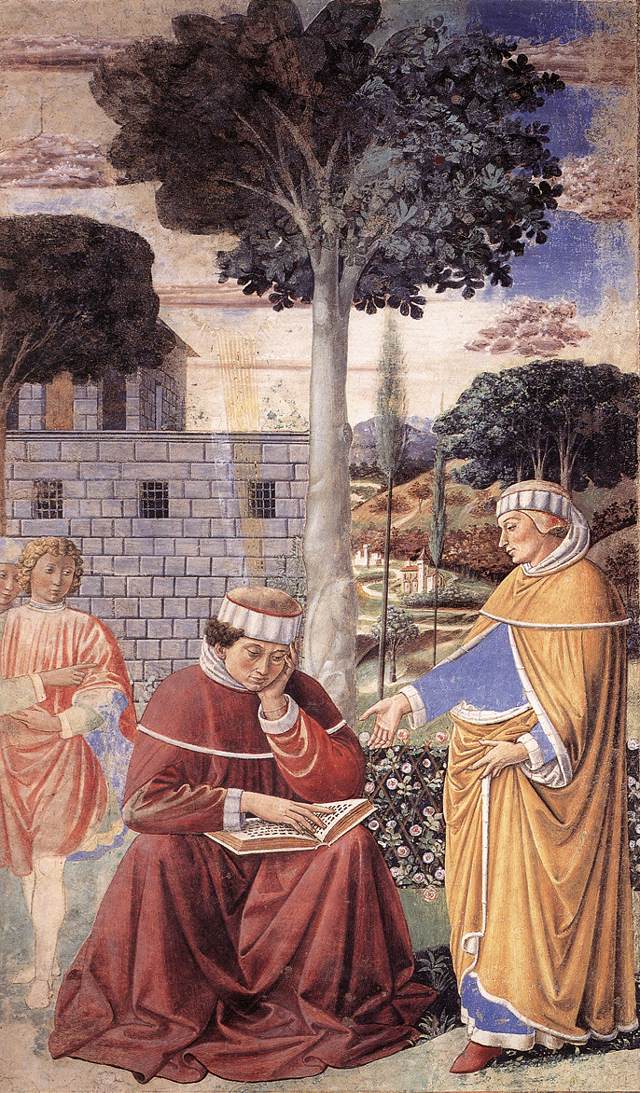
    Benozzo Gozzoli, St Augustine reading the Epistle of St Paul (“Tolle lege”), fresco, 1464-65, Sant’Agostino, San Gimignano. A later depiction, via Wikimedia Commons
    Benozzo Gozzoli, St Augustine reading the Epistle of St Paul (“Tolle lege”), fresco, 1464-65, Sant’Agostino, San Gimignano. A later depiction, via Wikimedia Commons · Public domain

    In late August of 386, in a garden in Milan, Augustine of Hippo, then a thirty-one-year-old teacher of rhetoric, came to faith in Christ through one sentence of Scripture. He told the story himself about ten years later in his Confessions (Book VIII, chapter 12). Weeping under a fig tree, he heard a child’s voice from a neighbouring house “chanting, and oft repeating, Take up and read; take up and read.” He went back to where he had left “the volume of the apostles” and read the first words his eyes fell on, Romans 13:13-14. “No further would I read, nor did I need; for instantly, as the sentence ended,—by a light, as it were, of security infused into my heart,—all the gloom of doubt vanished away.” He was baptised in Milan at Easter 387. He became bishop of Hippo in North Africa and one of the most influential writers in the history of the Western church. The picture is not from his time: it is Benozzo Gozzoli’s fresco of 1464-65 in San Gimignano, imagining Augustine reading the epistle. “But put ye on the Lord Jesus Christ, and make not provision for the flesh, to fulfil the lusts thereof.” (Romans 13:14, KJV).

    Source ccel.org: Augustine, Confessions VIII.12.28-29 (NPNF1 vol. 1, tr. J. G. Pilkington, 1886, PD; CCEL, cross-checked on New Advent 110108). Date, age, and baptism at Easter 387: Wikipedia, “Augustine of Hippo”. Rom 13:13-14 KJV verified.

  10. Scripture & Canon

    The Synods of Hippo and Carthage list the canon

    The Roman ruins of Hippo Regius (Annaba, Algeria); the basilica on the hill behind is 19th-century
    The Roman ruins of Hippo Regius (Annaba, Algeria); the basilica on the hill behind is 19th-century. Photo: Carole Raddato, 2022, via Wikimedia Commons · CC BY-SA 2.0

    In 393 a synod of North African bishops met at Hippo Regius, in modern Algeria. Augustine of Hippo attended some of these synods. It was the first time a council of bishops listed and approved a canon of Scripture, and the list was confirmed at Carthage in 397. Its New Testament is the same twenty-seven books Athanasius had named in 367 and that stand in our Bibles today: the four Gospels, Acts, fourteen epistles of Paul, two of Peter, three of John, James, Jude and the Revelation. Its Old Testament list, however, also included Tobit, Judith, Wisdom, Ecclesiasticus and the two books of Maccabees, which Protestants, Baptists among them, class as Apocrypha. Baptists confess that the authority of Scripture “dependeth not upon the testimony of any man or church, but wholly upon God,” and that the Apocrypha, “not being of divine inspiration, are no part of the canon.” The councils did not make the canon; they recognised it.

    Source en.wikipedia.org: Wikipedia, “Synod of Hippo” (393; Canon XXIV list; confirmed at Carthage 397). Baptist words quoted verbatim from the Second London Confession (1677/1689), ch. 1 §§3-4, as printed by The Reformed Reader (reformedreader.org/ccc/1689lbc/english/Chapter01.htm).

  11. Scripture & Canon

    Codex Washingtonianus: the four Gospels in an early Greek book

    Washington Manuscript III, the Four Gospels (Codex Washingtonensis), ink on parchment, Egypt, late 4th-early 5th century. Freer Gallery of Art, Smithsonian Institution, via Wikimedia Commons
    Washington Manuscript III, the Four Gospels (Codex Washingtonensis), ink on parchment, Egypt, late 4th-early 5th century. Freer Gallery of Art, Smithsonian Institution, via Wikimedia Commons · Public domain

    Among the manuscripts bought by the American industrialist Charles Lang Freer early in the 20th century was a Greek book of the four Gospels, written on 187 parchment leaves with painted wooden covers and first published by Henry A. Sanders. Dated by its handwriting to the 4th or 5th century, it is counted the third-oldest parchment codex of the Gospels in the world. Its copyist has been described as “generally a careful worker”. Honesty requires a note on its text, which is a mixture: in Matthew and in Luke from 8:13 to the end it reads with the Byzantine text, the family from which the Received Text descends, while other parts follow other textual families. Scholars have suggested it was assembled from several older copies, possibly ones that survived Diocletian’s destruction of the Scriptures. It is kept today at the Freer Gallery of Art in Washington. “Heaven and earth shall pass away, but my words shall not pass away” (Matthew 24:35, KJV).

    Source en.wikipedia.org: Wikipedia, “Codex Washingtonianus” (W/032; 4th or 5th c. by palaeography; 187 leaves, painted wooden covers; Freer, early 20th c.; Sanders; third oldest Gospel parchment codex; copyist “generally a careful worker”; Byzantine text in Matt 1-28 and Luke 8:13-24:53, other sections Western/Caesarean/Alexandrian; possibly pieced together from MSS that survived Diocletian). Matt 24:35 KJV verified.

  12. Scripture & Canon

    Codex Glazier: the Acts of the Apostles in the Coptic of Middle Egypt

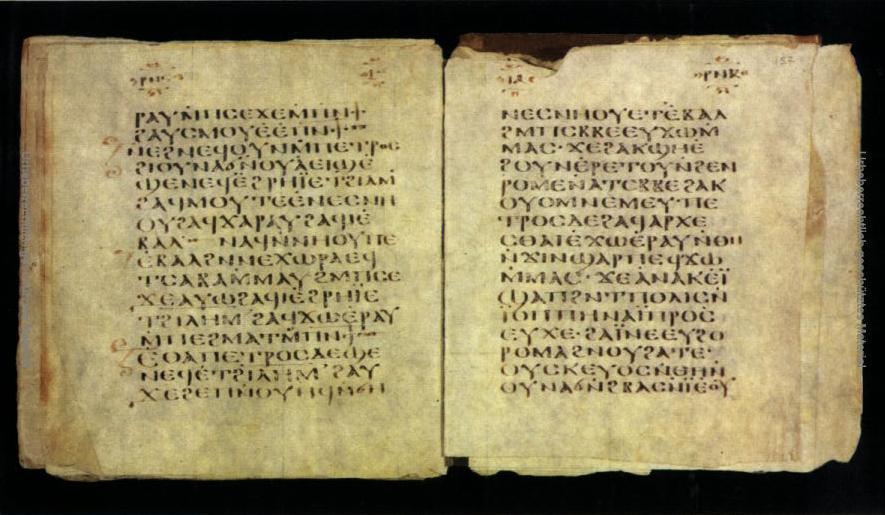
    Codex Glazier: a page opening of the Coptic Acts. Morgan Library & Museum, New York, via Wikimedia Commons
    Codex Glazier: a page opening of the Coptic Acts. Morgan Library & Museum, New York, via Wikimedia Commons · Public domain

    Codex Glazier is a small parchment book, about 12 by 10 centimetres, holding the Acts of the Apostles from 1:1 to 15:3 in Coptic, in the dialect of Middle Egypt. It is dated by its handwriting to the late 4th or early 5th century. The text runs in a single column with wide margins, the chapter numbers are written in the margin, and the sacred names are abbreviated in the ancient manner. At the end, on an added leaf, is a painted cross with a loop at its head in yellow, red and brown, a motif also found in Coptic textiles and carvings. Its text belongs to the so-called Western family and is very close to the Greek of Codex Bezae, and scholars value it because it lets them tell the older readings of that family from later ones. Among the passages it contains is Acts 8:37, the Ethiopian’s confession of faith before his baptism. It came to the Morgan Library in New York in 1983 with the collection of the banker William S. Glazier, and its text was edited by Hans-Martin Schenke in 1991. “And Philip said, If thou believest with all thine heart, thou mayest. And he answered and said, I believe that Jesus Christ is the Son of God” (Acts 8:37, KJV).

    Source en.wikipedia.org: Wikipedia, “Codex Glazier” (copG67; Acts 1:1-15:3, Middle Egyptian Coptic, parchment, 12.1 × 10.4 cm; late 4th/early 5th c.; crux ansata leaf; Western text close to Bezae; Acts 8:37 included; Glazier Collection to the Morgan 1983; Schenke ed. 1991). The page’s conflicting Berlin line is not used. Acts 8:37 KJV verified.

  13. Scripture & Canon

    The Old Syriac Gospels: the Curetonian manuscript

    The Curetonian Gospels: a facsimile page in Estrangela script, from The S.S. Teacher’s Edition of the Holy Bible (1890s), via Wikimedia Commons
    The Curetonian Gospels: a facsimile page in Estrangela script, from The S.S. Teacher’s Edition of the Holy Bible (1890s), via Wikimedia Commons · Public domain

    Before the Peshitta became the standard Syriac Bible, the churches of the Syriac-speaking East read the four Gospels in an older translation, now called the Old Syriac version. Only two manuscripts of it survive. One is the Curetonian Gospels, a 5th-century book written in the old Estrangela script without vowel points; the other is a palimpsest found at St Catherine’s Monastery on Mount Sinai in 1892. The Curetonian manuscript was among a great mass of books brought to England in 1842 from the Syrian monastery of St Mary Deipara in the Wadi Natrun in Egypt, and it is kept in the British Library; a few more of its leaves, bound into another book, are in Berlin. William Cureton published it in 1858 and argued that it preserved an Aramaic Gospel not translated from Greek; Henry Harman concluded in 1885 that its original had been Greek from the outset. Its Gospels run in an unusual order: Matthew, Mark, John, Luke. Its text may go back as early as the 2nd century. “But these are written, that ye might believe that Jesus is the Christ, the Son of God; and that believing ye might have life through his name” (John 20:31, KJV).

    Source en.wikipedia.org: Wikipedia, “Curetonian Gospels” (syr-cur; Old Syriac with the Sinaitic palimpsest; 5th-c. MS per Cureton; Estrangela, unpointed; from St Mary Deipara, Wadi Natrun, 1842; British Library Add 14451, Berlin leaves; Cureton 1858 vs Harman 1885; order Mt-Mk-Jn-Lk). Sinai find 1892 per “Syriac Sinaiticus”. John 20:31 KJV verified.

  14. Scripture & Canon

    The Cotton Genesis: a Greek Genesis that came through fire

    Cotton Genesis, fragment 26v: Abraham and the angels (Genesis 18), a leaf scorched in the fire of 1731. British Library, Cotton MS Otho B VI, via Wikimedia Commons
    Cotton Genesis, fragment 26v: Abraham and the angels (Genesis 18), a leaf scorched in the fire of 1731. British Library, Cotton MS Otho B VI, via Wikimedia Commons · Public domain

    The Cotton Genesis is one of the oldest illustrated Bible books to survive. It is a Greek copy of the book of Genesis in the Septuagint version, written in capital letters in one column, and Tischendorf dated it to the 5th century. It was a luxury book: from what remains, it seems to have had more than 440 pages and about 340 to 360 framed pictures set into the text. Kessler and Weitzmann argued that it was made in Alexandria. It appears to have been in Venice in the 1220s, when its pictures seem to have served as the pattern for the Genesis mosaics in the porch of St Mark’s. Two Greek bishops later brought it from Philippi and gave it to Henry VIII. It passed to Sir Robert Cotton, and until the mid-19th century it was thought to be the oldest manuscript of the Septuagint; Thomas Hartwell Horne counted it the most correct as well as the most ancient. In 1731 fire swept the Cotton library, and the book was reduced to charred and shrunken scraps. Most of those fragments are now in the British Library (Cotton MS Otho B VI). Tischendorf (1857) and Gotch (1881) deciphered them, and in 2026 the British Library imaged them in infrared and ultraviolet light. The fragment shown pictures Abraham and the three visitors of Genesis 18. “Is any thing too hard for the LORD?” (Genesis 18:14, KJV).

    Source en.wikipedia.org: Wikipedia, “Cotton Genesis” (BL Cotton MS Otho B VI; Greek LXX Genesis, uncial, one column; 4th or 5th c., Tischendorf 5th; c. 165 leaves, 340-360 miniatures; Alexandria per Kessler/Weitzmann; basis of St Mark’s narthex mosaics, 1220s; from Philippi to Henry VIII; Cotton; 1731 Ashburnham House fire; Tischendorf 1857, Gotch 1881; BL multispectral imaging 2026; Horne on its correctness). Gen 18:14 KJV verified.

  15. Scripture & Canon

    Codex Veronensis: the Gospels in silver on purple, as the West read them before Jerome

    Codex Veronensis, a purple leaf written in silver and gold. Biblioteca Capitolare, Verona, via Wikimedia Commons
    Codex Veronensis, a purple leaf written in silver and gold. Biblioteca Capitolare, Verona, via Wikimedia Commons · Public domain

    Codex Veronensis, known as b, is a 5th-century Latin book of the four Gospels. It is written on parchment dyed purple, in silver ink with some gold, in one column of eighteen lines to the page. The Gospels stand in the old Western order. The first page of each Gospel is written in gold, and so are the sacred names of God and of Christ wherever they occur. Its text is the Old Latin, the Latin the Western churches read before Jerome’s Vulgate, in its European or Italian form. It is one of the chief witnesses to that text. F. C. Burkitt judged that it represents the kind of text Jerome used as the basis of the Vulgate. Some leaves have been lost. It takes its name from Verona, where Giuseppe Bianchini examined it in the mid-18th century, and it is still kept in the Chapter Library of Verona Cathedral. It is cited by the letter b in the Nestle-Aland and UBS editions of the Greek New Testament. “Heaven and earth shall pass away, but my words shall not pass away.” (Matthew 24:35, KJV).

    Source en.wikipedia.org: Wikipedia, “Codex Veronensis” (VL 4, siglum b; 5th c.; purple vellum, silver and some gold ink, 1 col., 18 lines; Western order; gold first pages and nomina sacra; Old Latin, European/Italian recension; Burkitt on Jerome’s base; Bianchini mid-18th c.; Chapter Library, Verona). Matt 24:35 KJV verified.

  16. Scripture & Canon

    Codex Palatinus: Old Latin Gospels in gold and silver, kept in three cities

    Codex Palatinus, known as e, is a 5th-century book of the four Gospels in Latin, written on purple parchment in gold and silver ink. It has two columns of nineteen or twenty lines to the page, and its leaves measure about 35 by 26 centimetres. Its Gospels stand in the old Western order: Matthew, John, Luke, Mark. Its text is the Old Latin, the Latin of the churches before Jerome’s Vulgate. At root it is the African form of that text, strongly reshaped toward the European. It was probably made in northern Italy, and its earliest history is unknown. Much of it has been lost: of John, 1:1 to 18:11 survives, and of Luke most of the book from 1:1 to the end. It was acquired from Trent between 1800 and 1829 and kept in Vienna. Tischendorf published it in 1847. In 1919 it returned to Trent, where it is kept in the Library of the Buonconsiglio Castle (MS 1589). Two leaves separated from it in the 18th century are in Trinity College, Dublin, and the British Library. No licensed image of it has been found. “And the Word was made flesh, and dwelt among us, (and we beheld his glory, the glory as of the only begotten of the Father,) full of grace and truth.” (John 1:14, KJV).

    Source en.wikipedia.org: Wikipedia, “Codex Palatinus” (VL 2, siglum e; 5th c.; purple, gold and silver ink; 230 ff., 35.5×26 cm, 2 cols, 19-20 lines; Western order; African recension, Europeanized; probably N. Italy; acquired from Trent 1800-29; Tischendorf 1847; Vienna until 1919; Trent, Buonconsiglio MS 1589; leaves in TCD MS 1709 and BL Add. MS 40107). John 1:14 KJV verified.

  17. Scripture & Canon

    Codex Corbeiensis II: the Old Latin Gospels from the library of Corbie

    Codex Corbeiensis II, known as ff2, is a 5th-century Latin book of the four Gospels on 190 parchment leaves, written in a fine round capital hand. Its Gospels stand in the order Matthew, Luke, John, Mark. It has lost the first eleven chapters of Matthew and a few shorter passages. Its text is the Old Latin, the Latin of the Western churches before Jerome’s Vulgate, and it is close to the text of the Vercelli and Verona Gospels (Codex Vercellensis and Codex Veronensis). For centuries it belonged to the library of Corbie Abbey on the Somme, near Amiens. About 1638 it went with the best of that library to the abbey of Saint-Germain-des-Prés in Paris. Scholars from Sabatier and Bianchini onward quoted and collated it, and its full text was published by Belsheim, Buchanan (1907) and Jülicher. It is now in the National Library of France (Lat. 17225). No licensed image of it has been found. “Yea rather, blessed are they that hear the word of God, and keep it.” (Luke 11:28, KJV).

    Source en.wikipedia.org: Wikipedia, “Codex Corbeiensis II” (VL 8, siglum ff2; 5th c.; 190 ff.; round uncial; order Matt-Luke-John-Mark; lacunae incl. Matt 1:1-11:16; Old Latin, akin to a and b; Corbie Abbey → Saint-Germain-des-Prés c. 1638; Sabatier, Bianchini, Belsheim, Buchanan 1907, Jülicher; BnF Lat. 17225). Luke 11:28 KJV verified.

  18. Scripture & Canon

    Mesrop Mashtots: an alphabet made for the Bible in Armenian

    A page of an Armenian Gospel book written in 989, with ekphonetic (chanting) signs. Matenadaran, Yerevan, Ms. 2374, via Wikimedia Commons
    A page of an Armenian Gospel book written in 989, with ekphonetic (chanting) signs. Matenadaran, Yerevan, Ms. 2374, via Wikimedia Commons · Public domain

    About 405 the Armenian theologian and linguist Mesrop Mashtots (c. 362-440) invented the Armenian alphabet. The first monument of Armenian literature written in it was the version of the Holy Scriptures. According to Moses of Chorene, the catholicos Isaac (Sahak) made a first translation from the Syriac about 411. It was judged imperfect, and disciples were sent to Edessa and Constantinople, returning with authentic copies of the Greek text. From these the Bible was translated again from the Greek, following the Septuagint and Origen’s Hexapla, and the work was completed about 434. That version is still in use in the Armenian Church. Our chief source for Mesrop’s life is the biography written by his disciple Koriun.

    Source en.wikipedia.org: Wikipedia, “Mesrop Mashtots” (dates c. 362-440; alphabet c. 405; Koriun as chief source; the Scripture version: Isaac from Syriac c. 411 per Moses of Chorene, retranslation from Greek per LXX and Hexapla, completed c. 434).

  19. Scripture & Canon

    The Quedlinburg Itala: the oldest illustrated Bible leaves

    Quedlinburg Itala, a page of text in uncial script. Staatsbibliothek zu Berlin, Cod. theol. lat. fol. 485, via Wikimedia Commons
    Quedlinburg Itala, a page of text in uncial script. Staatsbibliothek zu Berlin, Cod. theol. lat. fol. 485, via Wikimedia Commons · Public domain

    The Quedlinburg Itala is what remains of a large and costly Latin Bible book made, probably in Rome, in the 420s or 430s. It carried an Old Latin (Itala) translation from before Jerome’s Vulgate, and it is the oldest illustrated biblical manuscript that survives. Only six leaves are left, each about 30 by 20 centimetres. The text is written in a fine uncial hand, and full pages of framed pictures carry the passages they illustrate on the other side of the leaf. There are fourteen miniatures in all, with gold used for highlights and captions, and among the scenes that survive is the story of Saul and Samuel. Where the paint has flaked away, the written instructions to the painter can still be read beneath. Kurt Weitzmann wrote that “it staggers the imagination” to picture what a fully illustrated book of Samuel and Kings must have looked like. The leaves were re-used in the bindings of 17th-century books in Quedlinburg, home of a great abbey. They were found there from 1865 onward and have been in the Berlin State Library since 1875-76 (Cod. theol. lat. fol. 485). The page shown is one of its pages of text. “Behold, to obey is better than sacrifice, and to hearken than the fat of rams.” (1 Samuel 15:22, KJV).

    Source en.wikipedia.org: Wikipedia, “Quedlinburg Itala fragment” (Berlin SBB-PK Cod. theol. lat. fol. 485; six folios, c. 305×205 mm; Old Latin 1 Samuel; probably Rome, 420s-430s; oldest surviving illustrated biblical MS; 14 miniatures; artist instructions visible; found in Quedlinburg bindings 1865-87; Berlin since 1875-76; Weitzmann quoted). 1 Sam 15:22 KJV verified.

  20. Scripture & Canon

    Codex Alexandrinus: the whole Greek Bible in one book

    Codex Alexandrinus, fol. 41v: the end of the Gospel of Luke with its decorative tailpiece, 5th century. British Library, Royal MS 1 D VIII, via Wikimedia Commons
    Codex Alexandrinus, fol. 41v: the end of the Gospel of Luke with its decorative tailpiece, 5th century. British Library, Royal MS 1 D VIII, via Wikimedia Commons · Public domain

    The Codex Alexandrinus is a fifth-century parchment manuscript of the Greek Bible, dated by its handwriting. It is one of the four great uncial codices, books that once held both Testaments entire. It survives in four volumes of 773 leaves, three of the Septuagint and one of the New Testament. In the Gospels its text is the oldest example of the Byzantine text-type, the form found in the largest number of surviving Greek manuscripts and underlying the Received Text of the Reformation Bibles. In the rest of the New Testament its text is Alexandrian. The Patriarch Cyril Lucaris brought it from Alexandria to Constantinople in 1621, and in 1627 it was given to King Charles I of England, sixteen years after the King James Bible. It is kept today in the British Library. A page from it hangs in our Gallery.

    Source en.wikipedia.org: Wikipedia, “Codex Alexandrinus” (5th c. by palaeography; 773 folios in four volumes; Byzantine in the Gospels, “the text-type’s oldest example,” Alexandrian elsewhere; Lucaris 1621; to Charles I 1627; British Library), and “Byzantine text-type” (majority of MSS; underlies the Textus Receptus).

Plates are hung only where a genuine image of the subject could be found under a public-domain or open licence. Each carries its credit and links to its licence record. Entries without a plate are awaiting one that meets that standard. More entries are being prepared, and each will be added only with its citation.

Provenance

Every entry in this hall was checked, when it was added, against the source linked beneath it; notes name the underlying scholarship where the source cites it. Where historians disagree (for example, over John Wycliffe’s own share in the Bible that bears his name), the entry says so. Scripture is quoted verbatim from the King James Version. Plates are reproduced almost entirely from Wikimedia Commons: public-domain works, works dedicated to the public domain (CC0), or photographs under Creative Commons Attribution (CC BY 2.0-3.0) or Attribution-ShareAlike (CC BY-SA 2.0-4.0) licences. Each plate’s licence is stated beneath it, with a link to the record where it was confirmed.