Baptist Militia A library & museum of the Whole Armour of God Visit
Find

Hall III · The Timeline

The Eighteenth Century

Page 6 of 9 · 1782 to 1787

“But the word of the Lord endureth for ever. And this is the word which by the gospel is preached unto you.”1 Peter 1:25, KJV

How the Scriptures were received, carried into the English tongue, and confessed by the Baptist churches. Each date is linked to its source, so that you may test every word.

  • Baptist Witness (169)
  • Scripture & Canon (1)
  • The English Bible (3)
  1. The Eighteenth Century1700-1799

    The English Bible

    Robert Aitken’s Bible: the first English Bible published in the United States

    Title page of The Holy Bible (Philadelphia: printed and sold by R. Aitken, 1782). Photograph by Kreuz und quer, 2023, via Wikimedia Commons
    Title page of The Holy Bible (Philadelphia: printed and sold by R. Aitken, 1782). Photograph by Kreuz und quer, 2023, via Wikimedia Commons · CC0

    When war with Britain cut off the supply of Bibles to America, Congress on 11 September 1777 asked its Committee of Commerce to import 20,000 Bibles from “Scotland, Holland or elsewhere.” In Philadelphia the Scottish-born printer Robert Aitken (1734-1802), who had printed the New Testament from 1777, undertook the whole Bible at his own expense, and on 21 January 1781 asked Congress to sanction it. Congress had its two chaplains, William White and George Duffield, examine the work for accuracy. On 12 September 1782 it resolved that it did “highly approve the pious and laudable undertaking of Mr. Aitken” and recommended “this edition of the bible to the inhabitants of the United States.” Aitken printed the resolution on the two pages after his title page. The Bible ran to 1,452 pages, and its title page carries the King James Bible’s own wording: “Newly translated out of the Original Tongues; And with the former Translations Diligently compared and revised.” The Library of Congress calls it the first English-language Bible published on the North American continent, and the only edition of the Bible authorized by Congress; an earlier Boston printing of 1752, issued under a false London imprint, has also been reported. When peace came, cheap imported Bibles returned, and Aitken later told George Washington that he had lost money on the work. “Thy word is a lamp unto my feet, and a light unto my path.” (Psalm 119:105, KJV).

    Source loc.gov: Library of Congress, “Religion and the Founding of the American Republic”, §4 (1777 import order; petition 21 Jan 1781; Sept 1782 resolution, quoted as printed there; printed after the title; first English Bible on the continent). LoC Bibliomania blog, 12 Jul 2023 (1,452 pages; title-page wording; only edition authorized by Congress). Wikipedia, “Robert Aitken (publisher)” (NT 1777; chaplains’ review; 1752 report; loss reported to Washington). Ps 119:105 KJV verified.

  2. Baptist Witness

    John Fawcett of Wainsgate and “Blest be the tie that binds”

    “The Revd. Dr. Fawcett, Halifax”, stipple engraving by John Kennerley after Hunter, published by Button & Son, Paternoster Row, September 1816. National Library of Wales, Welsh Portrait Collection
    “The Revd. Dr. Fawcett, Halifax”, stipple engraving by John Kennerley after Hunter, published by Button & Son, Paternoster Row, September 1816. National Library of Wales, Welsh Portrait Collection. Via Wikimedia Commons · Public domain

    John Fawcett (1740-1817) was born at Lidget Green, near Bradford, and in early life, says the Dictionary of National Biography, he “was powerfully impressed by the preaching of Whitefield.” In May 1764 he moved to the small Baptist church at Wainsgate, in the parish of Halifax, writing in his diary, “I have now set my hand to the plough, and have made a solemn entrance upon the work of the ministry.” On 31 July 1765 he “was solemnly ordained pastor over the church at Wainsgate.” His pay there never rose above £25 a year, and his house was small for a growing family. In the spring of 1772 he preached in London at “Dr. Gill’s meeting,” and afterwards he was invited, “in consequence of Dr. Gill’s decease,” to settle there. Furniture and books were sold, but, his son wrote, “his affection for his little flock, which he had so long tended ‘in the wilderness,’ would not suffer him to leave them when the trial came”; he resolved “to cast himself upon Providence, and live and die with them.” (Gill’s pulpit at Carter Lane went instead to John Rippon.) In 1782 Fawcett published Hymns adapted to the Circumstances of Public Worship and Private Devotion. These were verses written to be sung after his sermons, “principally composed in the midnight hours previous to the Sabbath.” Hymn CIV, headed “Brotherly Love,” begins: “Blest be the tie that binds / Our hearts in christian love; / The fellowship of kindred minds / Is like to that above.” Later writers link the hymn to his decision of 1772, though his son’s memoir does not draw that link. He went on to Brearley Hall and Hebden Bridge, kept an academy for much of his ministry, finished his Devotional Commentary in 1811, and died on 25 July 1817. “Behold, how good and how pleasant it is for brethren to dwell together in unity!” (Psalm 133:1).

    Source archive.org: [J. Fawcett jr], An Account of the Life, Ministry, and Writings of the late Rev. John Fawcett, D.D. (1818), pp. 110-11, 173-74, 251-52, and Fawcett, Hymns (1782), Hymn CIV (both Internet Archive; ſ modernised); DNB (1889); Hymnology Archive (Fenner 2018). Not claimed: the “loaded wagons” tale. Ps 133:1 KJV verified.

  3. Baptist Witness

    Andrew Fuller on the grace of hope: “This proves a helmet in your spiritual warfare”

    In 1782 the Northamptonshire Baptist Association sent its churches a yearly letter on The Excellency and Utility of the Grace of Hope. The Complete Works of Andrew Fuller (1845) print it first among his “Circular Letters addressed to the Churches of the Northamptonshire Association. 1782—1815.”. The letter calls hope “an expectation of future good”, and says the Christian’s hope “excels every other hope as much as a pearl excels a pebble”. “The grand foundation of all good hope is the Lord Jesus Christ, God’s revealed Mediator, embraced by faith.” Then, writing to believers who groan under indwelling sin, it takes up the apostle’s armour: “Now we ask what can afford relief in this case, but a good hope through grace of being freed at the hour of death? This proves a helmet in your spiritual warfare. This will inspire you with courage in every conflict: nothing invigorates the soldier like the hope of conquering at last.” Near its close it adds: “Remember, hope is one of those graces which must do its all within the limits of time”. “But let us, who are of the day, be sober, putting on the breastplate of faith and love; and for an helmet, the hope of salvation” (1 Thessalonians 5:8, KJV).

    Source archive.org: The Complete Works of Rev. Andrew Fuller, vol. III (Philadelphia: American Baptist Publication Society, 1845), pp. 308-317, “Circular Letters … 1782. The Excellency and Utility of the Grace of Hope” (Princeton Theological Seminary copy, Internet Archive; public domain), checked against the Baptist History Homepage transcription. KJV: 1 Thess 5:8.

  4. Baptist Witness

    Thomas Handley Chipman Is Ordained, a Father of the Baptists in Nova Scotia, 1782

    “Go ye therefore, and teach all nations, baptizing them in the name of the Father, and of the Son, and of the Holy Ghost: Teaching them to observe all things whatsoever I have commanded you: and, lo, I am with you alway, even unto the end of the world. Amen.” (Matthew 28:19-20). Cathcart’s Encyclopedia names Thomas Handley Chipman “one of the founders and fathers of the Baptist denomination in Nova Scotia,” “born Jan. 17, 1756.” He “was baptized at Horton, 1779, by Rev. Nicholas Pierson,” and “was ordained in 1782.” He “took part in forming the Baptist Association, June 23, 1800.” In 1809 he “removed from Bridgetown to Nictaux,” where he served the “Baptist church formed there, June 10, 1810,” until “his death, Oct. 11, 1830.”

    Source archive.org: William Cathcart, ed., The Baptist Encyclopedia (Philadelphia: Everts, 1881), vol. 1, s.v. “Chipman, Rev. Thomas Handley” (public domain; Internet Archive scan). Quotations verbatim, contiguous fragments only, machine-matched against the scan’s text (OCR typography normalised). KJV: Matthew 28:19-20.

  5. Baptist Witness

    Benjamin Lynn Forms the No-Lynn Church, Kentucky, 1782

    Of John the Baptist it was written, “The voice of him that crieth in the wilderness” (Isa. 40:3). Cathcart’s Encyclopedia calls Benjamin Lynn “the Daniel Boone of the Kentucky pulpit” and says he “is known only as the hunter-preacher of Southern Kentucky.” He was first “a wandering hunter in the Green River Valley before its settlement.” As soon as a few families had settled in stockade forts on the river that took his name, “he formed No-Lynn (now called South Fork) church of Separate Baptists, in 1782, according to tradition, in what is now La Rue County.” “Three years after he gathered Pottingess Creek church, in Nelson County,” and later Levelwoods church. The year rests on tradition, as Cathcart says. His name lives on in the Nolin River, Lynn Camp Creek and the Lynn Association.

    Source archive.org: William Cathcart (ed.), The Baptist Encyclopedia (Philadelphia: Everts, 1881), vol. 2, s.v. “Lynn, Rev. Benjamin” (public domain; Internet Archive scan). Quotations verbatim, contiguous fragments only, machine-matched against the scan’s text (OCR line-end hyphenation normalised; OCR misreadings corrected only outside quotation marks). KJV: Isa. 40:3.

  6. Baptist Witness

    David George: from Silver Bluff to Shelburne and Freetown

    A Black woodcutter at Shelburne, Nova Scotia, 1788, as inscribed on the drawing by Captain William Booth. Nova Scotia Archives, via Wikimedia Commons
    A Black woodcutter at Shelburne, Nova Scotia, 1788, as inscribed on the drawing by Captain William Booth. Nova Scotia Archives, via Wikimedia Commons · Public domain

    David George was born about 1743 in Essex County, Virginia, the son of enslaved African parents, John and Judith. He ran from a cruel master in 1762 and was later bought by the trader George Galphin and set to work at Silver Bluff, near Augusta. There he heard George Liele and a white preacher named Palmer, and between 1773 and 1775 the Silver Bluff Baptist Church was organised, with George as its leading elder and in time its pastor. When the British left Charleston he went with them to Halifax, Nova Scotia, and arrived in December 1782. In June 1783 he moved to Shelburne, where some 1,500 Black Loyalists had settled. Forbidden at first to preach in the town, he preached “in the woods” until a white settler gave him a lot, and by mid-1784 a chapel stood, with about fifty Black members and several white ones. That summer a mob drove him from it, and he preached and baptised at nearby Birchtown until he could return in December. He went on to gather Black Baptist congregations at Saint John, Fredericton and Preston, and the Dictionary of Canadian Biography judges that he had the largest following of any Baptist preacher, Black or white, in Nova Scotia and New Brunswick. Promised land and full rights in Africa, 1,196 Black Loyalists sailed for Sierra Leone in January 1792, among them almost all of George’s Baptists, and at Freetown they were for a time the largest church in the colony. In London in 1793 he told the story of his life to John Rippon and Samuel Pearce, and it was printed in the Baptist Annual Register. He died at Freetown in 1810.

    Source biographi.ca: J. W. St G. Walker, “GEORGE, DAVID,” Dictionary of Canadian Biography, vol. 5 (University of Toronto/Université Laval, 1983), citing George’s own “Account of the life of Mr. David George … given by himself,” Baptist Annual Register 1 (1790-93): 473-84.

  7. Baptist Witness

    Isaac Case Is Ordained and Goes to Maine, 1783

    “But watch thou in all things, endure afflictions, do the work of an evangelist, make full proof of thy ministry.” (2 Timothy 4:5). Cathcart’s Encyclopedia says “Father Case” was “born at Rehoboth, Mass., Feb. 25, 1761”, and that “At the age of eighteen he became a subject of God’s converting grace.” Of his ministry it records: “He was ordained in 1783, and went to Maine.” It judges that “He was, in the best sense of the word, an evangelist, and when converts to Christ were made, he formed them into churches, some of which afterwards became able and most useful organizations.” The entry adds that he “lived to an advanced age”, dying at Readfield, Maine, on 3 November 1852, and sums him up: “Without remarkable talents, by his earnest piety and good common sense he became one of the most useful ministers of his day.”

    Source archive.org: William Cathcart, ed., The Baptist Encyclopedia (Philadelphia: Everts, 1881), vol. 1, s.v. “Case, Rev. Isaac” (public domain; Internet Archive scan). Quotations verbatim, contiguous fragments only (line-end hyphens rejoined). Nothing beyond the entry is asserted. KJV: 2 Timothy 4:5.

  8. Baptist Witness

    Lewis Craig Organizes South Elkhorn Church, 1783

    “Enlarge the place of thy tent, and let them stretch forth the curtains of thine habitations: spare not, lengthen thy cords, and strengthen thy stakes” (Isaiah 54:2). Cathcart’s Encyclopedia calls Lewis Craig “a distinguished pioneer Baptist preacher of Virginia and Kentucky,” and says that he “was first awakened by the preaching of Samuel Harris, about the year 1765.” Of his Kentucky labours it records: “In 1783 he and most of Gilbert’s Creek church moved to the north side of Kentucky River and organized South Elkhorn church, in Fayette County.” Of the years that followed: “Here he remained about nine years, laboring zealously in all the surrounding country. A number of churches were founded, and Elkhorn Association was formed Oct. 1, 1785.” It adds that “About 1792 he moved to Bracken Co., Ky.”

    Source archive.org: William Cathcart, ed., The Baptist Encyclopedia (Philadelphia: Everts, 1881), vol. 1, s.v. “Craig, Rev. Lewis” (public domain; Internet Archive scan). Quotations verbatim, contiguous fragments only (line-end hyphens rejoined). KJV: Isaiah 54:2.

  9. Baptist Witness

    Reuben T. Battle: Thirty Years a Deacon at Powelton, Georgia

    “He hath dispersed, he hath given to the poor; his righteousness endureth for ever” (Psalm 112:9). Cathcart’s Encyclopedia says Reuben T. Battle “was born Sept. 10, 1784, and died Dec. 6, 1849.” It records that “For thirty years he was a deacon, and a prominent, useful, and benevolent man; his whole character illustrated the truths of Christianity, the beauty of true piety, and the loveliness of charity.” He “was converted at an early age; was baptized by Jesse Mercer, and united with the Powelton church, of which he remained an active and influential member until his death.” His “large wealth enabled him, by his benefactions, to aid greatly the cause of religion and to promote that of education,” and “To the orphan and widow, to the sick and sorrowing, he was most attentive.”

    Source archive.org: William Cathcart, ed., The Baptist Encyclopedia (Philadelphia: Everts, 1881), vol. 1, s.v. “Battle, Reuben T.” (public domain; Internet Archive scan). Quotations verbatim, contiguous fragments only, machine-matched against the scan’s text (OCR typography and line-end hyphenation normalised). KJV: Psalm 112:9.

  10. Baptist Witness

    The Georgia Association, the First Baptist Association in Georgia, 1784

    “Behold, how good and how pleasant it is for brethren to dwell together in unity!” (Psalm 133:1). Cathcart’s Encyclopedia records that “In 1784 the first Baptist Association, known as the Georgia, was formed in the State, probably at Kiokee church.” “At that time there were but six or eight Baptist churches in Georgia.” Among its principal ministers he names Abraham Marshall, Silas Mercer and Peter Smith. “The growth of the Association, which at that time embraced the whole denomination, was very rapid,” and “in 1792 the number of churches had increased to 56, scattered over a wide scope of country, some of them being in South Carolina.” In 1794 its southern churches were dismissed “to form the Hephzibah Association, the second formed in the State.”

    Source archive.org: William Cathcart (ed.), The Baptist Encyclopedia (Philadelphia: Everts, 1881), vol. 1, s.v. “Georgia Baptists, History of” (public domain; Internet Archive scan). Quotations verbatim, contiguous fragments only, machine-matched against the scan’s text (OCR line-end hyphenation normalised). KJV: Psalm 133:1.

  11. Baptist Witness

    The Prayer Call of 1784: “the first Monday in every calendar month”

    In June 1784 the ministers and messengers of the Northamptonshire Baptist Association met at Nottingham. Their minutes record that “brother Sutcliff preached from 1 Cor. vi. 19, 20”, that “brother Fuller preached from 2 Cor. v. 7”, and that the year’s Circular Letter, “drawn up by brother Ryland, jun.”, was read and approved. The letter, signed by the moderator Richard Hopper, grieved over reports of “languor, backslidings, want of edification, and fewness of converts” in the churches, and pressed the armour’s last word upon them: “above all, praying always with all prayer (public, social, private, ejaculatory) for the effusion of the Holy Spirit, whose influence alone can give us any success.” It pointed its readers to “Edwards on Prayer.” A postscript then set down what the meeting had resolved: to “wrestle with God for the effusion of his Holy Spirit,” the churches were to spend an hour together in prayer “on the first Monday in every calendar month.” Members who lived far from their chapels were to “unite in small societies at the same time,” and anyone left alone was to “retire at the appointed hour, to unite the breath of prayer in private.” “The grand object in prayer is to be, that the Holy Spirit may be poured down on our ministers and churches, that sinners may be converted, the saints edified, the interest of religion revived, and the name of God glorified.” Nor were they to pray for themselves only: “let the whole interest of the Redeemer be affectionately remembered, and the spread of the gospel to the most distant parts of the habitable globe be the object of your most fervent requests.” Christians “of our own or other denominations” were invited to join. The letter rested the plan on Ezekiel 36:37 (“I will yet for this be enquired of by the house of Israel, to do it for them”) and closed: “Surely we have love enough to Zion to set apart one hour at a time, twelve times in a year, to seek her welfare.” The minutes do not name who moved the resolution. Eight years later, Fuller, Ryland and Sutcliff were among the ministers who formed the Baptist Missionary Society at Kettering (1792). “Praying always with all prayer and supplication in the Spirit, and watching thereunto with all perseverance and supplication for all saints” (Ephesians 6:18, KJV).

    Source archive.org: The Nature, Evidences, and Advantages, of Humility, represented in a Circular Letter from the Ministers and Messengers of the Baptist Association, assembled at Nottingham, June 2, 3, 1784 (12 pp., 1784; British Museum copy, Internet Archive; public domain): letter p. 2, minutes p. 11, postscript p. 12, read as page images. Spelling modernised (long s). KJV: Eph 6:18; Ezek 36:37.

  12. Baptist Witness

    Andrew Gifford of Eagle Street and the Bristol Tyndale

    Dr Andrew Gifford (1700-1784), oil portrait by John Russell, 1774. British Museum, via Art UK and Wikimedia Commons
    Dr Andrew Gifford (1700-1784), oil portrait by John Russell, 1774. British Museum, via Art UK and Wikimedia Commons · Public domain

    Andrew Gifford (1700-1784), “baptist minister and numismatist,” was, says the Dictionary of National Biography, “the son of Emanuel Gifford, and grandson of Andrew Gifford, both baptist ministers at Bristol.” At the beginning of 1730 he accepted a call from the Baptist meeting in Eagle Street, London, and he remained its pastor until his death; Samuel Medley was among those who joined the church under him. A fellow of the Society of Antiquaries, he was “appointed assistant librarian in the British Museum in 1757.” He gathered early English Bibles, and on 13 May 1776 he bought the rarest of them: a copy of William Tyndale’s New Testament of 1526, the first New Testament printed in English. Its earlier owners are on record. It had been “picked up by one of the late Lord Oxford’s collectors” (Edward Harley, 2nd Earl of Oxford, died in 1741); in 1743 the antiquary Joseph Ames bought it, calling it “a Phoenix of the whole library”; and an inscription in the book by John White, who bought it at Ames’s sale in 1760, records that he “sold it to Dr Gifford for 20 guineas.” By his will of 13 July 1782 Gifford left “my books, library, pictures and also my curiosities” to “the Society of Baptists of Bristol,” for the academy there that trained Baptist ministers. He died on 19 June 1784, and late that year the collection reached Bristol: manuscripts, four Caxtons, and Bibles from Tyndale and Coverdale to two copies of 1611. In 1785 some duplicates were given to the Baptist college in Rhode Island, now Brown University. The Tyndale, complete apart from its title page and illuminated throughout, stayed at Bristol Baptist College for 210 years. In 1994 the college agreed its sale to the British Library, where it is one of only three known surviving copies of that first edition. “But the word of the Lord endureth for ever” (1 Peter 1:25).

    Source tyndale.org: M. West, “The Bristol 1526 Tyndale Testament,” Reformation 1 (1996) 113-17, tyndale.org (prints Gifford’s 1782 will, J. White’s inscription, Ames’s 1743 letter); DNB (1889), Gifford, Andrew; A. S. Langley, “Andrew Gifford’s Gifts to Bristol,” TBHS 7 (1921) 240-43 (1785 duplicates). Not claimed: the Anne Boleyn tradition (West: no firm evidence); the 1994 price; West-sale prices. BM post dated 1757 per DNB. 1 Pet 1:25 KJV verified.

  13. Baptist Witness

    Andrew Fuller publishes The Gospel Worthy of All Acceptation

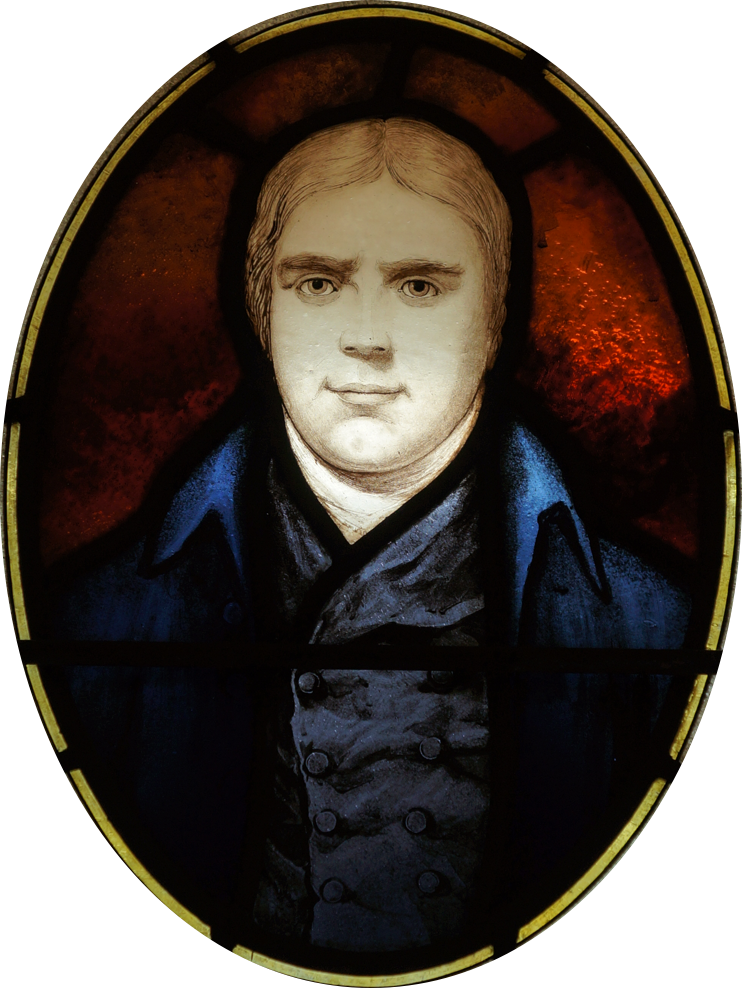
    Andrew Fuller, stained-glass portrait at Fuller Baptist Church, Kettering
    Andrew Fuller, stained-glass portrait at Fuller Baptist Church, Kettering. Photo: Bandrewsong, via Wikimedia Commons · CC BY-SA 4.0

    Andrew Fuller (1754-1815) was ordained pastor of the Baptist church at Soham in 1775 and became pastor at Kettering, Northamptonshire, in the early 1780s. Schooled in the hyper-Calvinism then current among some Particular Baptists, he became convinced that it was not scriptural. In 1785 he published The Gospel Worthy of All Acceptation, which, in the words of his biographer, did much to prepare his denomination to accept the missionary obligation. When the Baptist Missionary Society was formed at Kettering in 1792, Fuller became its secretary, and he served until his death.

    Source bu.edu: Boston University School of Theology, History of Missiology: Brian Stanley, “Fuller, Andrew,” Biographical Dictionary of Christian Missions (1998), with an essay by Travis Myers.

  14. Baptist Witness

    Andrew Marshall Joins the Church, 1785, and Pastors in Savannah, Georgia

    “Take heed to the ministry which thou hast received in the Lord, that thou fulfil it” (Colossians 4:17). Cathcart’s Encyclopedia records that Rev. Andrew Marshall was “pastor of the First African church of Savannah, Ga.” and “was born in South Carolina about 1755.” It says “Andrew purchased his liberty about the time he was converted, and he joined the church in 1785, and not long after he was licensed to preach.” Then: “In 1806 he became pastor of the Second Baptist church of Savannah.” Of his labours it says, “He baptized nearly four thousand converts.” The entry closes: “He died in Richmond, Va., Dec. 8, 1856, and he was buried in Savannah on the 14th of the same month,” and calls him “a man upon whose ministry the broad seal of divine approval conspicuously rested.”

    Source archive.org: William Cathcart, ed., The Baptist Encyclopedia (Philadelphia: Everts, 1881), vol. 2, s.v. “Marshall, Rev. Andrew” (public domain; Internet Archive scan). Quotations verbatim, contiguous fragments only (line-end hyphens rejoined). KJV: Colossians 4:17.

  15. Baptist Witness

    Cullen Battle, M.D.: Baptized by Jesse Mercer, a Liberal Friend of Church and School

    “The liberal soul shall be made fat: and he that watereth shall be watered also himself” (Proverbs 11:25). Cathcart’s Encyclopedia says Dr. Cullen Battle “was born in North Carolina in 1785” and that “In 1818 he removed to Powelton, Ga.,” where he “retired from the practice of medicine to attend to his increasing planting interests.” It records that “The cause of education, and every public interest, found in him an ardent advocate and a liberal benefactor,” and that “He was baptized in 1827 by Dr. Jesse Mercer.” Later, in Alabama, he “fostered the Baptist Church with a wise and tender care.” Of his home it says, “The hospitality of his home was famous,” and of his giving, “Of great wealth and liberality, his contributions to secular and religious enterprises were many and munificent.” “He died in Eufaula, Ala., in 1878.”

    Source archive.org: William Cathcart, ed., The Baptist Encyclopedia (Philadelphia: Everts, 1881), vol. 1, s.v. “Battle, Cullen, M.D.” (public domain; Internet Archive scan). Quotations verbatim, contiguous fragments only, machine-matched against the scan’s text (OCR typography and line-end hyphenation normalised). KJV: Proverbs 11:25.

  16. Baptist Witness

    Georgia Baptists Protest a State Salary for Ministers, 1785

    “Render therefore unto Caesar the things which are Caesar’s; and unto God the things that are God’s” (Matthew 22:21). Cathcart’s Encyclopedia records that “It was owing to a protest of the Georgia Association, in 1785, presented by Silas Mercer and Peter Smith, that the State Legislature repealed a law, then recently enacted,” for “giving two pence per pound to the minister chosen by any thirty families, for his support, to be paid out of the State treasury.” Baptists turned the money down even though, as Cathcart notes, “its ministers were the most numerous, and, consequently, the largest amount of the State grant would have come to them.” He sums up Georgia Baptists as “opposed to all union of church and state, the friends of entire religious liberty.”

    Source archive.org: William Cathcart (ed.), The Baptist Encyclopedia (Philadelphia: Everts, 1881), vol. 1, s.v. “Georgia Baptists, History of” (public domain; Internet Archive scan). Quotations verbatim, contiguous fragments only, machine-matched against the scan’s text (OCR line-end hyphenation normalised). KJV: Matthew 22:21.

  17. Baptist Witness

    The Prayer Call kept: “resolved, without any hesitation, to continue”

    A year after the Prayer Call of 1784, the Northamptonshire Baptist Association met at Oakham on 17-18 May 1785. Its Circular Letter, signed for the association by “John Ryland, jun. Moderator”, began with what the churches had reported: the brethren were glad to hear “in what manner the monthly prayer meetings which were proposed in our letter of last year, have been carried on, and how God has been evidently present in those meetings, stirring up the hearts of his people to wrestle hard with him for the revival of his blessed cause.” The letter did not hide the numbers: “Though as to the number of members, there is no increase this year, but something of the contrary; yet a spirit of prayer in some measure being poured out, more than balances in our account for this defect.” Nor was prayer to stand alone: “But while we rejoice to see such a spirit of united prayer, we must not stop here, brethren, lest in so doing we stop short.” So the letter, whose outlines, the minutes record, were “drawn up by our brother Fuller”, became An Enquiry into the Causes of Declension in Religion, with the Means of Revival. At the meeting Ryland preached from Isaiah 26:18, Hall of Arnsby from Psalm 118:25, and Sutcliff of Olney from 1 John 3:3. Then, say the minutes, “It was resolved, without any hesitation, to continue the meetings of prayer on the first Monday evening in every kalendar month.” Others had joined them: “several churches not in the association, and some of other denominations”. “May God give us all hearts to persevere.” If no great answer came at once, they reasoned, then “if not in our time, they may in time to come”; and in any case “there is profit enough in the exercise itself to be its own reward.” They rested on God’s word to Jacob, that he had “never yet said to the seed of Jacob, seek ye my face in vain” (compare Isaiah 45:19, KJV: “I said not unto the seed of Jacob, Seek ye me in vain”). “Praying always with all prayer and supplication in the Spirit, and watching thereunto with all perseverance and supplication for all saints” (Ephesians 6:18, KJV).

    Source archive.org: An Enquiry into the Causes of Declension in Religion, with the Means of Revival; being the Circular Letter from the Ministers and Messengers of the Baptist Association, assembled at Oakham, May 17, 18, 1785 (8 pp.; British Museum copy, Internet Archive; public domain): pp. 1-2 and the minutes on p. 8, read as page images. Spelling modernised (long s). KJV: Isa 45:19; Eph 6:18.

  18. Baptist Witness

    Stephen Gano Is Ordained, 1786; Pastor at Providence, 1792

    “But watch thou in all things, endure afflictions, do the work of an evangelist, make full proof of thy ministry” (2 Timothy 4:5). Cathcart’s Encyclopedia says of Stephen Gano, a physician: “While occupied with his practice as a physician in Tappan, now Orangetown, N. Y., he became a subject of God’s converting grace.” It continues: “At once he seems to have felt it to be his duty to give himself to the work of the Christian ministry, and was ordained on the 2d of August, 1786.” Then, “in 1792, a unanimous invitation to become the pastor of the First Baptist church in Providence, R. I.” He is recorded as having “died in the triumphs of faith on the 18th of August, 1828.”

    Source archive.org: William Cathcart, ed., The Baptist Encyclopedia (Philadelphia: Everts, 1881), vol. 1, s.v. “Gano, Rev. Stephen, M.D.” (public domain; Internet Archive scan). Quotations verbatim, contiguous fragments only (line-end hyphens rejoined). KJV: 2 Timothy 4:5.

  19. Baptist Witness

    Rippon’s Selection, and “How firm a foundation”

    John Rippon (1751-1836) followed John Gill as pastor of the Baptist meeting-house in Carter Lane, Southwark, in 1773, when he was twenty, and served that church for sixty-three years. In 1787 he published A Selection of Hymns from the Best Authors, Intended to Be an Appendix to Dr. Watts’s Psalms and Hymns. “Rippon’s Selection” was reprinted many times on both sides of the Atlantic, and his own church sang from it until Spurgeon’s Our Own Hymn Book of 1866. Its first printing brought a new hymn under the heading “Exceeding great and precious promises”: “How firm a foundation, ye saints of the Lord, / Is laid for your faith in his excellent Word.” The author was marked only “K—”. The likeliest candidate is Robert Keene, the church’s precentor, but it has never been proved. The hymn has God Himself speak His promises to His people in words drawn from Scripture, among them Isaiah 41:10, Isaiah 43:2 and Hebrews 13:5.

    Source hymnologyarchive.com: C. Fenner, “How firm a foundation,” Hymnology Archive (2020), from the 1787 first printing and citing K. R. Manley, Redeeming Love Proclaim: John Rippon and the Baptists (2004) and J. Julian, Dictionary of Hymnology (1892). Rippon’s pastorate and the 1866 replacement per Wikipedia, “John Rippon.” The hymn text (1787) is public domain.

  20. Baptist Witness

    Abraham Marshall and the Kiokee Revival, Georgia, 1787

    “And so were the churches established in the faith, and increased in number daily.” (Acts 16:5). Cathcart’s Encyclopedia gives Abraham Marshall “the highest place among the Baptist pioneer preachers of Georgia”, and records that he “succeeded him as pastor of Kiokee church” when his father Daniel Marshall died in November 1784. Of the year 1787 it says: “In the spring of 1787 a wonderful revival began, and spread far and wide: thousands attended the ministrations of the gospel, and multitudes were converted.” Of his labours in constituting churches it says that it was said to be “his business, his trade”, adding that “in three years the number of churches in the Association increased from 7 to 31, and in seven years to 56”, while “the ministers had increased from 6 to 36.” It adds that in New England his preaching drew crowds, “some comparing him to Whitefield in the fervor and power of his eloquence.”

    Source archive.org: William Cathcart, ed., The Baptist Encyclopedia (Philadelphia: Everts, 1881), vol. 2, s.v. “Marshall, Rev. Abraham” (public domain; Internet Archive scan). Quotations verbatim, contiguous fragments only (line-end hyphens rejoined). Nothing beyond the entry is asserted. KJV: Acts 16:5.

Plates are hung only where a genuine image of the subject could be found under a public-domain or open licence. Each carries its credit and links to its licence record. Entries without a plate are awaiting one that meets that standard. More entries are being prepared, and each will be added only with its citation.

Provenance

Every entry in this hall was checked, when it was added, against the source linked beneath it; notes name the underlying scholarship where the source cites it. Where historians disagree (for example, over John Wycliffe’s own share in the Bible that bears his name), the entry says so. Scripture is quoted verbatim from the King James Version. Plates are reproduced almost entirely from Wikimedia Commons: public-domain works, works dedicated to the public domain (CC0), or photographs under Creative Commons Attribution (CC BY 2.0-3.0) or Attribution-ShareAlike (CC BY-SA 2.0-4.0) licences. Each plate’s licence is stated beneath it, with a link to the record where it was confirmed.