Baptist Militia A library & museum of the Whole Armour of God Visit
Find

Hall III · The Timeline

The Eighteenth Century

Page 8 of 9 · 1791 to 1796

“But the word of the Lord endureth for ever. And this is the word which by the gospel is preached unto you.”1 Peter 1:25, KJV

How the Scriptures were received, carried into the English tongue, and confessed by the Baptist churches. Each date is linked to its source, so that you may test every word.

  • Baptist Witness (169)
  • Scripture & Canon (1)
  • The English Bible (3)
  1. The Eighteenth Century1700-1799

    Baptist Witness

    Christmas Evans rides to Anglesey

    Christmas Evans. Portrait by Hugh Hughes, c. 1820, Welsh Portrait Collection, National Library of Wales, via Wikimedia Commons
    Christmas Evans. Portrait by Hugh Hughes, c. 1820, Welsh Portrait Collection, National Library of Wales, via Wikimedia Commons · Public domain

    Christmas Evans was born on Christmas Day 1766 at Esgaer-waen, Llandysul, in Cardiganshire, the son of a bootmaker. He grew up as a parish apprentice and farm labourer. At about eighteen he joined one of the churches of David Davis of Castellhywel and learned to read Welsh. At about twenty-one he joined the Baptist chapel at Aberduar, where his preaching grew warmer. He was ordained in 1789 and married Catherine Jones at Bryncroes in Llŷn, and he walked and rode through that wide district preaching. On Christmas Day 1791 he rode from Llŷn to Anglesey, with Catherine riding pillion, to take charge of the island’s Baptists at Llangefni, and he liked to think of himself as the “bishop of Anglesey.” In 1802 he restarted the North Wales Baptist Association, and he made its meetings a gathering-place for some of the best preaching of the day. The Dictionary of Welsh Biography counts him one of the three giants of the Welsh pulpit in its golden age, “the master allegorist of the pulpit” in his time. He set the gospel before plain people in vivid, dramatic pictures, though at times, the Dictionary adds, his imagination ran ahead of the text. On a salary of seventeen pounds a year he gave generously to the Bible Society, the missionary societies and the Baptist college at Abergavenny. After later ministries at Caerphilly, Cardiff and Caernarfon he died at Swansea on 19 July 1838, while on a preaching tour, and he was buried beside Bethesda chapel there.

    Source biography.wales: J. T. Jones, “EVANS, CHRISTMAS (1766–1838), Baptist minister,” Dictionary of Welsh Biography (National Library of Wales, 1959), citing W. Morgan, Cofiant (1839) and D. Rhys Stephen, Memoirs of the late Christmas Evans (1847).
  2. Baptist Witness Baptists in America

    Jonathan Maxcy Is Ordained at Providence and Made President of Brown, 1791-1792

    “The fear of the LORD is the beginning of knowledge: but fools despise wisdom and instruction.” (Proverbs 1:7). Cathcart’s Encyclopedia records that Jonathan Maxcy “was born in Attleborough, Mass., Sept. 2, 1768,” and “graduated with the highest honors of his class in 1787.” Of his conversion it says “he was baptized by Rev. Dr. Manning, and connected himself with the First Baptist church in Providence.” It continues: “Mr. Maxcy was ordained Sept. 8, 1791, when he was but twenty-three years of age.” When Manning died, Maxcy was “unanimously elected president” of Brown University, and the Encyclopedia adds: “He was only twenty-four years of age.” It notes that Harvard conferred “the honorary degree of Doctor of Divinity,” and that later “he accepted an invitation to take the presidency of the South Carolina College, where he remained for sixteen years.” Of his death it states simply: “Dr. Maxcy died June 4, 1820.”

    Source archive.org: William Cathcart, ed., The Baptist Encyclopedia (Philadelphia: Everts, 1881), vol. 2, s.v. “Maxcy, Jonathan, D.D.” (public domain; Internet Archive scan). Quotations verbatim, contiguous fragments only (column-set OCR; hyphenated line-breaks rejoined). Nothing beyond the entry is asserted. KJV: Proverbs 1:7.

  3. Baptist Witness

    Benjamin Thomas, Faithful Pastor at Narberth, Pembrokeshire, for Forty Years

    “And let us not be weary in well doing: for in due season we shall reap, if we faint not” (Galatians 6:9). Cathcart’s Encyclopedia records that Benjamin Thomas, born in Carmarthenshire, Wales, in 1792, “Having been found an acceptable preacher by the Baptist church in that vicinity,” entered Horton (now Rawdon) College under Dr. William Steadman. It says that he “accepted the pastorate of the infant church at Narberth, Pembrokeshire, where he ministered with fidelity and acceptance for a period of forty years.” By his labours, it adds, “the wilderness was made to bloom with a new and spiritual life,” and “churches grew up and flourished in every part of that once neglected region.” Of his death the Encyclopedia says: “He died July 6, 1862, but his name and memory are fragrant in all that region of country still.”

    Source archive.org: William Cathcart, ed., The Baptist Encyclopedia (Philadelphia: Everts, 1881), vol. 2, s.v. “Thomas, Rev. Benjamin” (public domain; Internet Archive scan). Quotations verbatim, contiguous fragments only, machine-matched against the scan’s text (OCR typography and line-break hyphens normalised). The Encyclopedia gives no month or day for his birth or for the start of his pastorate. KJV: Galatians 6:9.

  4. Baptist Witness

    Col. Robert Johnson, of Great Crossing Church, Helps Frame Kentucky’s First Constitution, 1792

    “When the righteous are in authority, the people rejoice” (Proverbs 29:2). Cathcart’s Encyclopedia calls Col. Robert Johnson, a Virginian who moved to Kentucky during the Revolution, “the head of one of the most distinguished families in Kentucky.” Settling near the present site of Georgetown, in Scott County, “he was the principal instrument in organizing Great Crossing Baptist church, of which he was a member.” “He was prominent in the councils of the Baptists in the early settlement of the country.” In civil life, “He was a member of the convention which formed the first constitution of Kentucky in 1792, and of that which formed the second constitution, in 1799.” “He was eight times elected to the Kentucky Legislature,” and “Three of his sons were members of Congress from Kentucky.”

    Source archive.org: William Cathcart (ed.), The Baptist Encyclopedia (Philadelphia: Everts, 1881), vol. 1, s.v. “Johnson, Col. Robert” (public domain; Internet Archive scan). Quotations verbatim, contiguous fragments only, machine-matched against the scan’s text (OCR line-end hyphenation normalised). KJV: Proverbs 29:2.

  5. Baptist Witness The Age of Missions

    Carey’s Enquiry and the Nottingham sermon

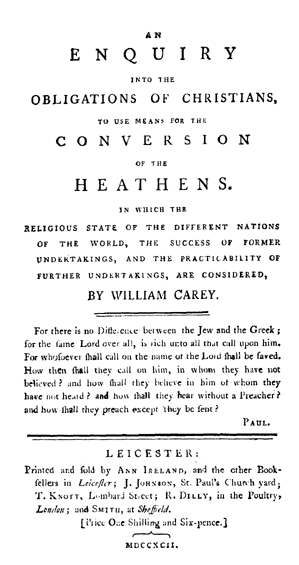
    Title page of the first edition, “Leicester: Printed and sold by Ann Ireland … MDCCXCII.” Scan from Project Gutenberg eBook #11449
    Title page of the first edition, “Leicester: Printed and sold by Ann Ireland … MDCCXCII.” Scan from Project Gutenberg eBook #11449 · Public domain

    In 1792 William Carey, pastor of the Baptist church in Harvey Lane, Leicester, published a short book with a long title: An Enquiry into the Obligations of Christians, to Use Means for the Conversion of the Heathens. A friend helped pay for it. It was printed and sold at Leicester by Ann Ireland for one shilling and sixpence, and its title page carries Romans 10:12-15: “how shall they hear without a Preacher? and how shall they preach except they be sent?” Many Christians of the day believed that if God meant to save the heathen, he would do it without human means. Carey answered that the command still stood: “Our Lord Jesus Christ, a little before his departure, commissioned his apostles to Go, and teach all nations.” He argued that if that command belonged only to the apostles, so did the command to baptize. The book surveys missions since the apostles, gives twenty-six pages of tables of the peoples and religions of every land then known, answers the objections, and ends with a plan: that Baptists form a society to send preachers and support them. On 30 May 1792 (some accounts say the 31st), at the Friar Lane chapel in Nottingham, Carey preached to his fellow ministers from Isaiah 54:2-3: “Enlarge the place of thy tent.” The sermon was never printed. Its two heads are remembered as “Expect great things from God; attempt great things for God,” though the earliest printed summary, in William Staughton’s Baptist Mission in India (1811), gives them simply as “Expect great things—Attempt great things.” That October the Baptist Missionary Society was formed at Kettering, and Britannica calls the Enquiry the “charter” of Protestant missions.

    Source gutenberg.org: W. Carey, An Enquiry (Leicester: Ann Ireland, 1792), Project Gutenberg #11449 (PD), title page and text; Christian History 36 (1992), CHI. Harvey Lane and the 26 pages of tables per Wikipedia, “William Carey (missionary)”; sermon date per Wikipedia, “Deathless Sermon”; the watchword’s earliest form per M. Haykin, “The Famous Sermon by William Carey” (CBTS, 2022), citing Staughton (1811), p. 15; “charter” per Britannica, “Christianity: Protestant missions.”

  6. Baptist Witness The Age of Missions

    The Baptist Missionary Society is founded at Kettering

    William Carey (1761-1834). Unknown artist; reproduced in J. B. Myers, William Carey (London, 1887)
    William Carey (1761-1834). Unknown artist; reproduced in J. B. Myers, William Carey (London, 1887). Via Wikimedia Commons · Public domain

    On 2 October 1792, at a meeting in Kettering, England, twelve Particular Baptist ministers, among them Andrew Fuller, John Ryland, Samuel Pearce and John Sutcliff, formed the Particular Baptist Society for the Propagation of the Gospel Amongst the Heathen. It was later called the Baptist Missionary Society. William Carey was the leading voice for its founding. In 1793 its first missionaries, Carey and John Thomas, sailed for Bengal.

    Source en.wikipedia.org: Wikipedia, “BMS World Mission” (citing Stanley, History of the BMS 1792-1992; Cox, 1842). Date and Carey’s role per Southern Baptist Historical Library & Archives.

  7. Baptist Witness The Age of Missions

    John Ryland of Northampton and Broadmead, Bristol

    John Ryland, the son of John Collett Ryland, was born at Warwick on 29 January 1753. The Dictionary of National Biography records that “he learnt Hebrew when only five years old, and Greek when under nine.” He was baptised in the river Nen near Northampton on 13 September 1767 and was admitted to the ministry on 10 March 1771. In 1786, on his father’s retirement, he was “entrusted with the sole charge of the congregation” at Northampton. In December 1793 he became minister of Broadmead chapel, Bristol, “combining with the post the presidency of the baptist college at Bristol,” and held both until his death. He joined in founding the Baptist Missionary Society on 2 October 1792 and was its secretary from 1815. The DNB calls him “a profound oriental scholar” who, “though not a great preacher,” “possessed, through his learning and uprightness, a great influence among the baptists.” “His views were Calvinistic, but in middle life he grew to sympathise with the opinions of Jonathan Edwards, and was more tolerant towards those who differed from him.” Among his friends were William Carey, Andrew Fuller, Robert Hall, John Newton and John Rippon. Among his books was a poem, The Divine Inspiration of the Holy Scriptures (1772), and in 1816 he published a Memoir of the Rev. Andrew Fuller. He died at Bristol on 25 May 1825 and was buried beside Broadmead chapel; Robert Hall, who succeeded him, preached the memorial sermon. The doctrine his early poem celebrated is Paul’s: “All scripture is given by inspiration of God, and is profitable for doctrine, for reproof, for correction, for instruction in righteousness” (2 Timothy 3:16, KJV).

    Source en.wikisource.org: W. P. Courtney, “Ryland, John (1753–1825)”, DNB vol. 50 (1897, PD), Wikisource; all quoted phrases verbatim; dates agree with Wikipedia “John Ryland”. The DNB’s tally of 8,691 sermons (“is said to have preached”) is not used. Poem title and 1816 Memoir per the DNB list of works. KJV: 2 Tim 3:16.

  8. Baptist Witness

    Daniel Merrill Forms the Church at Sedgwick, Maine, 1793

    “But when they believed Philip preaching the things concerning the kingdom of God, and the name of Jesus Christ, they were baptized, both men and women.” (Acts 8:12). Cathcart’s Encyclopedia records of Daniel Merrill: “He graduated at Dartmouth in 1789 with high honor.” Then: “In 1793 he formed a church in Sedgwick, Me., of 20 members, on the Congregational platform, and in 1805 it was the largest church of any denomination in the State.” It continues that Mr. Merrill “at this period of great prosperity was filled with doubts about the divine origin of infant baptism,” and that “when he declared himself a Baptist, it produced a great commotion.” The Encyclopedia adds: “A Baptist church was then organized of 85 members, and Mr. Merrill was ordained as its pastor.”

    Source archive.org: William Cathcart, ed., The Baptist Encyclopedia (Philadelphia: Everts, 1881), vol. 2, s.v. “Merrill, Rev. Daniel” (public domain; Internet Archive scan). Quotations verbatim, contiguous fragments only (line-end hyphens rejoined); where the scan is damaged the passage is not quoted and no date is supplied for the Baptist church. KJV: Acts 8:12.

  9. Baptist Witness

    Thomas Barrass: A Sent Missionary in the Jersey Hills

    “And how shall they preach, except they be sent?” (Romans 10:15). Cathcart’s Encyclopedia records that Rev. Thomas Barrass “was born in Leicestershire, England, July 22, 1793,” “came to this country in 1828,” and “was licensed to preach by that church Jan. 10, 1830, and ordained at Flemington, April 14, 1831.” He “itinerated in the upper part of Hunterdon, and through a considerable part of Warren County, as a missionary; was instrumental in gathering a constituency for the following churches: Oxford, Delaware, Bethlehem, and Mansfield.” The Encyclopedia says these churches “bear uniform testimony to his earnest, faithful, and devoted labors.”

    Source archive.org: William Cathcart, ed., The Baptist Encyclopedia (Philadelphia: Everts, 1881), vol. 1, s.v. “Barrass, Rev. Thomas” (public domain; Internet Archive scan). Quotations verbatim, contiguous fragments only, machine-matched against the scan’s text (OCR typography and line-end hyphenation normalised). KJV: Romans 10:15.

  10. Baptist Witness

    William Lancaster Founds the Maple Spring and Poplar Spring Churches, Franklin County, N. C., about 1793

    “In the multitude of counsellors there is safety” (Prov. 11:14). Cathcart’s Encyclopedia says William Lancaster, born in Warren County, N. C., in 1753, “was baptized by Rev. Wm. Walker” and “was the founder of the churches at Maple Spring and Poplar Spring, Franklin Co., about 1793.” He was a member of the State Convention and of “the convention to ratify the Federal Constitution,” and for many years chairman of the Court of Pleas and Quarter Sessions of Franklin County. “He closed his long and useful life Sept. 16, 1826.”

    Source archive.org: William Cathcart (ed.), The Baptist Encyclopedia (Philadelphia: Everts, 1881), vol. 2, s.v. “Lancaster, Rev. William” (public domain; Internet Archive scan). Quotations verbatim, contiguous fragments only, machine-matched against the scan’s text (OCR line-end hyphenation normalised; OCR misreadings corrected only outside quotation marks). KJV: Prov. 11:14.

  11. Baptist Witness

    Morgan John Rhees Brings a Welsh Company to America, 1794

    “By faith he sojourned in the land of promise, as in a strange country” (Hebrews 11:9). Cathcart’s Encyclopedia records that Morgan John Rhees “was born in Wales, Sept. 8, 1760,” and was “educated at Bristol College for the ministry.” After a pastorate in Wales he resolved “to lead a little colony of his countrymen to America in 1794.” Dr. Rogers of the First Baptist church of Philadelphia “gave him a cordial welcome on his arrival.” Rhees “traveled extensively through the Southern and Western States proclaiming the blessed gospel, and gathering converts into the kingdom.” He bought land in Pennsylvania “which he called Cambria, after his native Wales,” and “in 1798 he took his own family and a company of his countrymen to the new settlement,” where he “became pastor of the church formed there.” He “died Sept. 17, 1804.”

    Source archive.org: William Cathcart, ed., The Baptist Encyclopedia (Philadelphia: Everts, 1881), vol. 2, s.v. “Rhees, Rev. Morgan John, Sr.” (public domain; Internet Archive scan). Quotations verbatim, contiguous fragments only, machine-matched against the scan’s text (OCR typography and line-break hyphenation normalised); period wording is the encyclopedist’s. KJV: Hebrews 11:9.

  12. Baptist Witness

    Noah Barrell: Fifteen Churches and a Long Course Finished

    “I have fought a good fight, I have finished my course, I have kept the faith.” (2 Timothy 4:7). Cathcart’s Encyclopedia records that Rev. Noah Barrell “was born in Hartford, Washington Co., N. Y., May 5, 1794; died at Geneva, Wis., April 16, 1875, aged eighty-one years.” Through a long and active ministry “he served as pastor 15 churches in New York, Ohio, Wisconsin, and baptized about 1200 converts.” Of his last hours the Encyclopedia says only: “His end was great peace.”

    Source archive.org: William Cathcart, ed., The Baptist Encyclopedia (Philadelphia: Everts, 1881), vol. 1, s.v. “Barrell, Rev. Noah” (public domain; Internet Archive scan). Quotations verbatim, contiguous fragments only, machine-matched against the scan’s text (OCR typography and line-end hyphenation normalised). KJV: 2 Timothy 4:7.

  13. Baptist Witness

    Joseph Belcher, D.D.: Pastor and Editor of Andrew Fuller’s Works (b. 1794)

    “Precious in the sight of the LORD is the death of his saints” (Psalm 116:15). Cathcart’s Encyclopedia says Joseph Belcher “was born in Birmingham, England, April 5, 1794. In 1814 he put his trust in Jesus as his Saviour, and in 1819 he was ordained as pastor of the church at Somersham.” It adds: “He was pastor of several churches in England, and he founded one. In 1844 he crossed the Atlantic and visited the United States.” Of his labours with the pen it records, “He edited the complete works of Andrew Fuller.” Of his end: “His death was eminently peaceful.” Asked, “Is Jesus precious to you now?” he answered, “Yes, ten thousand times more precious than ever.”

    Source archive.org: William Cathcart, ed., The Baptist Encyclopedia (Philadelphia: Everts, 1881), vol. 1, s.v. “Belcher, Joseph, D.D.” (public domain; Internet Archive scan). Quotations verbatim, contiguous fragments only, machine-matched against the scan’s text (OCR typography and line-end hyphenation normalised). KJV: Psalm 116:15.

  14. Baptist Witness

    The Georgia Association Asks the Legislature to Stop the Importation of Slaves, 1794

    “Open thy mouth, judge righteously, and plead the cause of the poor and needy” (Proverbs 31:9). Cathcart’s Encyclopedia records that in 1794 the Georgia Association, “which met at Powell’s Creek meeting-house (now Powelton), Hancock Co.,” approved “a memorial to the Legislature, that a law be made to prevent the future importation of slaves.” It “was presented, read, and approved, and ordered to be signed by the moderator and clerk.” “Henry Graybill and James Sims were appointed to present the memorial to the Assembly. Abraham Marshall was moderator, and Peter Smith clerk.” The memorial asked Georgia to stop bringing in more enslaved people; it did not ask for an end to slavery itself.

    Source archive.org: William Cathcart (ed.), The Baptist Encyclopedia (Philadelphia: Everts, 1881), vol. 1, s.v. “Georgia Baptists, History of” (public domain; Internet Archive scan). Quotations verbatim, contiguous fragments only, machine-matched against the scan’s text (OCR line-end hyphenation normalised). KJV: Proverbs 31:9.

  15. Baptist Witness

    James Lemen Baptized at New Design, the First Baptism in Illinois, 1794

    “See, here is water; what doth hinder me to be baptized?” (Acts 8:36). Cathcart’s Encyclopedia says James Lemen, born in Berkeley County, Va., in 1760, served in the Revolution and in 1786 took his family down the Ohio by flat-boat to the Illinois country, losing all his household goods when the boat was wrecked. He settled at New Design, near Kaskaskia. Converted in 1787 under James Smith, he waited until 1794, when he and his wife and two others were baptized by Josiah Dodge. Cathcart writes: “This was the first instance of the administration of baptism in what is now the State of Illinois.” Two years later the Lemens joined a few others in “forming the first Christian church in Illinois.” He was licensed to preach in 1808, “being now nearly fifty years of age,” and died January 8, 1823.

    Source archive.org: William Cathcart (ed.), The Baptist Encyclopedia (Philadelphia: Everts, 1881), vol. 2, s.v. “Lemen, Rev. James” (public domain; Internet Archive scan). Quotations verbatim, contiguous fragments only, machine-matched against the scan’s text (OCR line-end hyphenation normalised; OCR misreadings corrected only outside quotation marks). KJV: Acts 8:36.

  16. Baptist Witness

    Elijah Peck Carries the Gospel into the “Beech Woods” of Pennsylvania, 1795

    “Preach the word; be instant in season, out of season” (2 Timothy 4:2). Cathcart’s Encyclopedia records that Elijah Peck “was born May 3, 1767, in Warren, Conn.” and that “Early in the spring of 1795 he” moved “from Cooperstown, N. Y., into the” “Beech Woods,” “and settled in Mount Pleasant, Wayne Co., Pa.” Of the journey it says: “This journey, in company with his wife and three children, he performed with an ox-team and sled; modern luxuries were then unknown.” The entry continues: “In June, 1806, he received ordination.” And: “From March 3, 1808, until his decease, March 16, 1835, he was the esteemed pastor of the Mount Pleasant church, but, like all pioneer ministers, he performed a vast amount of work in regions round about.”

    Source archive.org: William Cathcart, ed., The Baptist Encyclopedia (Philadelphia: Everts, 1881), vol. 2, s.v. “Peck, Rev. Elijah” (public domain; Internet Archive scan). Quotations verbatim, contiguous fragments only (line-end hyphens rejoined; one OCR misreading is not quoted). KJV: 2 Timothy 4:2.

  17. Baptist Witness

    Edward Manning Ordained 1795 and Immersed 1797, Nova Scotia

    “Therefore we are buried with him by baptism into death” (Romans 6:4). Edward Manning, whom Cathcart calls pre-eminent among “the founders of the Baptist denomination in the Maritime Provinces,” was “converted April 29, 1789,” and was “ordained Oct. 19, 1795.” Then, “renouncing Pedobaptism, was immersed, in 1797, in Lower Granville, by Rev. Thomas Handley Chipman.” Cathcart describes him as “a profound theologian and a very useful minister of Christ.”

    Source archive.org: William Cathcart (ed.), The Baptist Encyclopedia (Philadelphia: Everts, 1881), vol. 2, s.v. “Manning, Rev. Edward” (public domain; Internet Archive scan). Quotations verbatim, contiguous fragments only, machine-matched against the scan’s text (OCR line-end hyphenation normalised; OCR misreadings corrected only outside quotation marks). KJV: Romans 6:4.

  18. Baptist Witness

    Governor George Nixon Briggs of Massachusetts, a Conscientious Baptist

    “The integrity of the upright shall guide them: but the perverseness of transgressors shall destroy them.” (Proverbs 11:3). Cathcart’s Encyclopedia records that George Nixon Briggs “was born in Adams, Mass., April 12, 1796,” and that in 1848 his fellow-citizens, “elected him governor of the State.” Among the honours his own denomination gave him, “He was president of the Missionary Union.” The Encyclopedia writes that he was “true to the principles of the denomination with which he connected himself when he was but twelve years of age,” and adds, “It was understood that he was a conscientious Baptist, and that did not make him the less a conscientious Christian.” Of his last hours it reports the words, “God and Christ are my all.” “He died Sept. 12, 1861.”

    Source archive.org: William Cathcart (ed.), The Baptist Encyclopedia (Philadelphia: Everts, 1881), vol. 1, s.v. “Briggs, Hon. George Nixon” (public domain; Internet Archive scan). Quotations verbatim, contiguous fragments only, machine-matched against the scan’s text (OCR line-end hyphenation normalised); congressional and judicial service and the circumstances of his death are omitted. KJV: Proverbs 11:3.

  19. Baptist Witness

    Horace Fletcher: Fifteen Years at the Bar, Then Pastor at Townshend, Vermont

    “Also I heard the voice of the Lord, saying, Whom shall I send, and who will go for us? Then said I, Here am I; send me.” (Isaiah 6:8). Cathcart’s Encyclopedia records that Horace Fletcher “was born in Cavendish, Vt., Oct. 28, 1796.” He entered Dartmouth in 1815 “and graduated in 1817.” “Being admitted to the bar, he commenced the practice of his profession in his native place, and continued in it for fifteen years.” In those years “he became a hopeful Christian, and was baptized into the fellowship of the Baptist church of Cavendish.” “He now felt it to be his duty to preach”, and “he was ordained pastor of the Baptist church in Townshend, Vt., where he remained until his death.” “His work as a minister was greatly blessed, and precious revivals were experienced during his long pastorate.” “For some time he was a senator in the Legislature of Vermont.” He died November 27, 1871.

    Source archive.org: William Cathcart (ed.), The Baptist Encyclopedia (Philadelphia: Everts, 1881), vol. 1, s.v. “Fletcher, Horace, D.D.” (public domain; Internet Archive scan). Quotations verbatim, contiguous fragments only, machine-matched against the scan’s text (OCR line-end hyphenation normalised). KJV: Isaiah 6:8.

  20. Baptist Witness

    Jehiel Fox Settles in the Lake George Wilderness, 1796; Most of an Association Planted at His Own Charges

    “Who goeth a warfare any time at his own charges? who planteth a vineyard, and eateth not of the fruit thereof?” (1 Corinthians 9:7). Cathcart’s Encyclopedia calls Jehiel Fox “prominent among the pioneer Baptists of Northern New York”. He “was born in 1760, at East Haddam, Conn.” and “was licensed to preach at Hoosick Falls, N. Y.” “In 1796 he removed to Chester, in the region of Lake George, which country was then a wilderness. Here a church was organized and he was ordained.” “At his own charges, Elder Fox traveled and preached throughout the surrounding counties, and under his ministry were organized most of the churches of the Lake George Association.” He “gave his children the very best educational advantages the times afforded.” “He died in 1823.” His tombstone bears “the quaint inscription, dictated by himself,” that he passes from his labors in “the field and vineyard to his Master.”

    Source archive.org: William Cathcart (ed.), The Baptist Encyclopedia (Philadelphia: Everts, 1881), vol. 1, s.v. “Fox, Rev. Jehiel” (public domain; Internet Archive scan). Quotations verbatim, contiguous fragments only, machine-matched against the scan’s text (OCR line-end hyphenation normalised). KJV: 1 Corinthians 9:7.

Plates are hung only where a genuine image of the subject could be found under a public-domain or open licence. Each carries its credit and links to its licence record. Entries without a plate are awaiting one that meets that standard. More entries are being prepared, and each will be added only with its citation.

Provenance

Every entry in this hall was checked, when it was added, against the source linked beneath it; notes name the underlying scholarship where the source cites it. Where historians disagree (for example, over John Wycliffe’s own share in the Bible that bears his name), the entry says so. Scripture is quoted verbatim from the King James Version. Plates are reproduced almost entirely from Wikimedia Commons: public-domain works, works dedicated to the public domain (CC0), or photographs under Creative Commons Attribution (CC BY 2.0-3.0) or Attribution-ShareAlike (CC BY-SA 2.0-4.0) licences. Each plate’s licence is stated beneath it, with a link to the record where it was confirmed.