Baptist Militia A library & museum of the Whole Armour of God Visit
Find

Hall III · The Timeline

The Eighteenth Century

Page 3 of 9 · 1756 to 1765

“But the word of the Lord endureth for ever. And this is the word which by the gospel is preached unto you.”1 Peter 1:25, KJV

How the Scriptures were received, carried into the English tongue, and confessed by the Baptist churches. Each date is linked to its source, so that you may test every word.

  • Baptist Witness (169)
  • Scripture & Canon (1)
  • The English Bible (3)
  1. The Eighteenth Century1700-1799

    Baptist Witness

    Isaac Eaton’s Hopewell School for Ministers, 1756

    “And the things that thou hast heard of me among many witnesses, the same commit thou to faithful men, who shall be able to teach others also” (2 Timothy 2:2). Cathcart’s Encyclopedia says that Isaac Eaton “when twenty-four years of age took charge of the church in Hopewell, N. J., Nov. 29, 1748,” and that “Rich blessings descended upon his pastorate.” On 5 October 1756 the Philadelphia Association “Concluded to raise a sum of money toward the encouragement of a Latin grammar school, for the promotion of learning among us,” placed under Eaton’s care. Of the school Cathcart writes that Eaton “was the first teacher among American Baptists who opened a school for the education of young men for the ministry.” His students included James Manning, first president of Rhode Island College, and Hezekiah Smith. The tablet over his grave records that he “for upwards of 26 years was pastor of this church, from the care of which he was removed by death, on the 4th of July, 1772, in the forty-seventh year of his age.”

    Source archive.org: William Cathcart, ed., The Baptist Encyclopedia (Philadelphia: Everts, 1881), vol. 1, s.v. “Eaton, Rev. Isaac, A.M.” (public domain; Internet Archive scan). Quotations verbatim, contiguous fragments only, machine-matched against the scan’s text (the scan’s OCR misreads of the surname are not reproduced). KJV: 2 Timothy 2:2.
  2. Baptist Witness

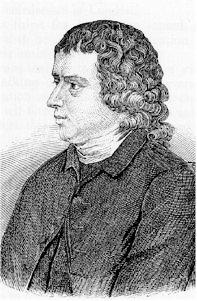
    Robert Robinson of Cambridge and “Come, Thou Fount of Every Blessing”

    Robert Robinson (1735-1790), portrait cropped from Edwin McKean Long, Illustrated History of Hymns and their Authors (1875)
    Robert Robinson (1735-1790), portrait cropped from Edwin McKean Long, Illustrated History of Hymns and their Authors (1875). Via Wikimedia Commons · Public domain

    Robert Robinson (27 September 1735-9 June 1790), a London barber’s apprentice who heard George Whitefield preach in 1752 and, by his own record, found full and free absolution through Christ’s blood on 10 December 1755 (Julian), wrote the hymn “Come, thou fount of every blessing” in 1758. The Hymnology Archive gives its oldest surviving printing as A Collection of Hymns for the Use of the Church of Christ: Meeting in Angel-Alley (London, 1759), in four eight-line stanzas, without music and unattributed; an earlier broadsheet is mentioned in Robinson’s own papers, but no copy survives. In 1759 Robinson was invited to preach to the Baptist congregation at Cambridge: Julian’s Dictionary of Hymnology puts his first sermon there on 8 January 1759, while the Hymnology Archive says July 1759. He was ordained in 1761 and remained that church’s pastor until his death. John Rippon included the hymn in his Selection of 1787 (see that entry), and Julian, having examined the evidence, concluded that Robinson is its author. Its second stanza begins “Here I raise mine Ebenezer; hither by thy help I’m come,” and the word “Ebenezer” (“stone of help”) is the stone of 1 Samuel 7:12 (the United Methodist Church’s hymn history): “Then Samuel took a stone, and set it between Mizpeh and Shen, and called the name of it Eben-ezer, saying, Hitherto hath the LORD helped us.” The man is told honestly: Wikipedia records that Robinson was later read throughout the growing Unitarian movement, and that he died in Birmingham, found dead on 9 June 1790, while staying at the home of William Russell after travelling there to meet Joseph Priestley; Julian judged the claims made from that contact to rest “on exceedingly slender grounds,” and the matter is disputed. The hymn is received here for what Scripture says in it, not for its author’s later course.

    Source hymnologyarchive.com: Hymnology Archive, “Come, thou fount of every blessing” and “Robert Robinson” (hymnologyarchive.com/robert-robinson); Julian, Dictionary of Hymnology (1907), “Robinson, Robert” (stempublishing.com/hymns/biographies/robinson); Wikipedia, “Robert Robinson (Baptist)”; UMC Discipleship, “History of Hymns: Come, Thou Fount”; KJV, 1 Samuel 7:12.

  3. Baptist Witness

    Benjamin Francis of Horsley: a village pastor who would not leave his people

    The Revd. Benjamin Francis, A.M. (1734-1799), engraving by Thomas Trotter, 1794; Welsh Portrait Collection, National Library of Wales
    The Revd. Benjamin Francis, A.M. (1734-1799), engraving by Thomas Trotter, 1794; Welsh Portrait Collection, National Library of Wales. Via Wikimedia Commons · Public domain

    Benjamin Francis (1734-1799), youngest son of the Welsh Baptist minister Enoch Francis, was baptized at fifteen, began to preach at nineteen, and studied at the Bristol academy from 1753. He settled at Horsley, Gloucestershire, where he was ordained in October 1758; the Dictionary of Welsh Biography gives 1759 for the move to Horsley and The Baptist Magazine memoir gives 1757, so the sources differ by a year or two. The church then had only 66 members and could raise about £20 a year for its pastor, yet it grew until the meeting-house was enlarged in 1760 and again in 1774; at his death it had 262 members, and he had baptized nearly 450 people at Horsley. The memoir records that he preached on monthly circuits through Gloucestershire, Worcestershire and Wiltshire, set up a fortnightly lecture at Minchinhampton that he kept for 35 years, and preached about 150 times in Wales, in Welsh and in English. In 1772 he preached two Lord’s Days in Dr. Gill’s meeting-house in London and received a call to succeed him. He wrote that he was “not satisfied it is my duty to remove” and stayed with his “poor dear people at Horsley.” He published two Welsh hymn collections, both titled Aleluia (1774, 1786); the Dictionary of Welsh Biography says several of his hymns are still sung. His life carried heavy grief: in 1765 his first wife and three of his children died within three months. He died on 14 December 1799, aged 66. As he took leave of the church’s officers he commended them in the words of Acts 20:32: “And now, brethren, I commend you to God, and to the word of his grace, which is able to build you up, and to give you an inheritance among all them which are sanctified.” When a relative whispered Psalm 23:4 to him, the memoir says he answered, “No, no,” adding, “for thou art with me, thy rod and thy staff they comfort me.”

    Source baptisthistoryhomepage.com: Memoir of the Late Benjamin Francis, The Baptist Magazine (1818), from Ryland’s 1799 narrative (public domain); Dictionary of Welsh Biography, “Francis, Benjamin (1734–1799)” (biography.wales/article/s-FRAN-BEN-1734); KJV Acts 20:32, Ps 23:4.

  4. Baptist Witness

    Hugh Evans Becomes President of the Bristol Baptist College, 1758

    “My little children, of whom I travail in birth again until Christ be formed in you,” (Galatians 4:19). Cathcart’s Encyclopedia records that Hugh Evans came of a Welsh line of Baptist pastors: his grandfather Thomas Evans, once a parish minister under the Commonwealth, joined the Baptist church at Pentre after the Restoration “and suffered much for conscience’ sake as pastor of that church”. Hugh was baptized by Mr. Foskett at Bristol on August 7, 1730, and in 1733 the Broadmead church called him to the ministry and made him Foskett’s assistant. “He soon became widely known as a preacher of extraordinary power and usefulness.” In 1758, on Foskett’s death, “he became president of the college and senior pastor of the church.” His student John Rippon (Cathcart spells it Ripon) wrote that “every one who knew him must admit that his gift in prayer was uncommon”. He closed his ministry at Bristol with an address to his flock on the words of Galatians 4:19, and “He died in perfect peace, surrounded by his family and his students, on March 28, 1781.”

    Source archive.org: William Cathcart (ed.), The Baptist Encyclopedia (Philadelphia: Everts, 1881), vol. 1, s.v. “Evans, Rev. Hugh” (public domain; Internet Archive scan). Quotations verbatim, contiguous fragments only, machine-matched against the scan’s text (OCR line-end hyphenation normalised). KJV: Galatians 4:19.

  5. Baptist Witness

    Anne Steele: “Father of mercies, in thy word”

    Frontispiece and title page of Poems on Subjects Chiefly Devotional, by “Theodosia” (Anne Steele), new edition (Bristol: W. Pine, 1780), with 1 Peter 1:4 beneath the frontispiece; Princeton Theological Seminary copy, digitised by the Internet Archive
    Frontispiece and title page of Poems on Subjects Chiefly Devotional, by “Theodosia” (Anne Steele), new edition (Bristol: W. Pine, 1780), with 1 Peter 1:4 beneath the frontispiece; Princeton Theological Seminary copy, digitised by the Internet Archive. Via Wikimedia Commons · Public domain

    Anne Steele (1717-1778) spent her whole life at Broughton in Hampshire. Her father, William Steele, was a timber merchant and the preacher of the Particular Baptist congregation there, and she joined his church at the age of fourteen. She wrote verse from girlhood but let it go to the press only with great reluctance. In 1760 two volumes appeared under the pen name “Theodosia”: Poems on Subjects Chiefly Devotional. In the first, in twelve stanzas, stood the hymn on the Bible itself that became one of her best known; one early hymn book heads it “The excellency and sufficiency of the Holy Scriptures”. As that book prints it, it opens: “Father of mercies, in thy word / What endless glory shines! / For ever be thy name ador’d / For these celestial lines.” A later stanza prays: “O may these heavenly pages be / My ever dear delight; / And still new beauties may I see, / And still increasing light!” In 1769 John Ash and Caleb Evans put sixty-two of her hymns into their Baptist collection at Bristol, six stanzas of this one among them, and John Rippon’s Selection of 1787 (told on this timeline) carried forty-seven, more than any other author but Philip Doddridge. Through such books she became, in the words of a 2015 Southern Seminary article, Baptist hymnody’s “biggest voice”. She died at Broughton on 11 November 1778. An early editor of her hymns recorded that she fell asleep “with these animating words on her dying lips, ‘I know that my Redeemer liveth’” (compare Job 19:25). No portrait of her is known. “More to be desired are they than gold, yea, than much fine gold: sweeter also than honey and the honeycomb.” (Psalm 19:10, KJV).

    Source equip.sbts.edu: C. Fenner, SBTS Towers, Aug. 2015 (father; Ash & Evans 62; Rippon 47 after Doddridge 101; “biggest voice”; her death, quoted). Hymnary.org with Julian’s Dictionary of Hymnology (1760, 12 stanzas; 6 in Ash & Evans) and the Hartford Selection text (quoted; checked with CCEL). Wikipedia, “Anne Steele” (member at 14; reluctance; “Theodosia”). Angus Library (death date; no portrait). The drowned-fiancé story is omitted as refuted. Ps 19:10 KJV verified.

  6. The English Bible

    Dr Parris’s Cambridge text: the King James Bible made ready for Blayney

    Genesis 1 in The Holy Bible (Cambridge: John Baskerville, 1763), the royal folio that reprinted Parris’s text; supplied words in italic
    Genesis 1 in The Holy Bible (Cambridge: John Baskerville, 1763), the royal folio that reprinted Parris’s text; supplied words in italic. Via Wikimedia Commons · Public domain

    In 1740 the Syndics of the Cambridge University Press, whose stated ambition was to “serve the Public with a more beautiful and correct Edition [of the Bible] than can easily be found,” invited Francis Sawyer Parris (1707-1760; the name is also spelled Paris) to check and proofread the Bibles their new printer, Joseph Bentham, would produce. Parris was a Fellow, and later Master, of Sidney Sussex College and the University Librarian. His first edition appeared in 1743. Its changes were small but not slight: it removed the comma that the 1611 printing set after “God” in Titus 2:13, so that the verse reads “the great God and our Saviour Jesus Christ” as one. He made larger alterations for the edition of 1756-58, and his revision culminated in the octavo of 1760, finished shortly before his death on 1 May that year. It brought textual corrections, more consistent italics for the words supplied in English, marginal notes, column headings and cross-references. Bentham’s folio of 1762 and John Baskerville’s celebrated Cambridge folio of 1763, shown here, reprinted it without further change. Benjamin Blayney’s Oxford edition of 1769, the template for the King James Bible printed today, made few changes from it. Blayney’s report to the Oxford Delegates, as F. H. A. Scrivener quotes it, said that Dr Paris’s edition of 1762 had “made large corrections in this particular” (the italics), but that “there still remained many necessary alterations, which escaped the Doctor’s notice.” Scrivener did not overpraise him either: “Nor can the correctness of Dr Paris be praised overmuch.” “Looking for that blessed hope, and the glorious appearing of the great God and our Saviour Jesus Christ;” (Titus 2:13, KJV).

    Source en.wikipedia.org: Wikipedia, “Francis Parris” (citing Norton, A Textual History of the King James Bible, 2005, and McKitterick, 1984): Syndics’ aim; Bentham 1740; editions 1743, 1756-58, 1760; Titus 2:13 comma; 1762 and 1763 reprints; Blayney 1769. F. H. A. Scrivener, Cambridge Paragraph Bible (1873, PD), Introduction, on the italics, via biblia.com/books/av1873/article/INTRO.3 (Blayney’s report; “Nor can the correctness…”). Titus 2:13 KJV verified.

  7. Baptist Witness

    John Gano and the First Baptist Church of New York, 1762

    “And Jesus, when he was baptized, went up straightway out of the water: and, lo, the heavens were opened unto him, and he saw the Spirit of God descending like a dove, and lighting upon him” (Matthew 3:16). The Baptist Encyclopedia (1881) says John Gano was “born in Hopewell, N. J., July 22, 1727”, the son of a pious Presbyterian father, and that “an examination of the subject of baptism led him to take the Saviour’s immersion in the Jordan as his model and to unite with the Baptist church of Hopewell.” He was “ordained May 29, 1754, and became pastor of the Scotch Plains church.” In June 1762 “the First Baptist church of New York was constituted”, its members having taken letters from the Scotch Plains church for the purpose, and they called him as pastor; he “held the position for twenty-six eventful years.” The church “commenced its ecclesiastical life with twenty-seven members”. In May 1788 he “removed to Kentucky, and became pastor of the Town Fork church, near Lexington. He died in 1804.” He was “the brother-in-law of Dr. Manning, the first president of Brown University, whose ordination sermon he preached.”

    Source baptisthistoryhomepage.com: William Cathcart, ed., The Baptist Encyclopedia (1881; PD), pp. 433-434, “John Gano” (baptisthistoryhomepage.com). Quotations verbatim. KJV: Matthew 3:16.

  8. Baptist Witness

    Samuel Jones Becomes Pastor at Lower Dublin, Pennsylvania, 1763

    “A wise man is strong; yea, a man of knowledge increaseth strength” (Prov. 24:5). Cathcart’s Encyclopedia says that Samuel Jones, D.D., “was born Jan. 14, 1735, in Glamorganshire, Wales,” “graduated in 1762,” and that “In 1763 he became pastor of the Lower Dublin Baptist church, and he held that office until his death, which occurred Feb. 7, 1814.” It calls him “the most influential Baptist minister in the middle colonies,” and records that he “was sent by the Philadelphia Association to Rhode Island, to assist in founding Rhode Island College.” “He prepared a new treatise of discipline for the Philadelphia Confession of Faith by request of the Association in 1798,” and in 1807 “he preached the centenary sermon of the Philadelphia Association.”

    Source archive.org: William Cathcart, ed., The Baptist Encyclopedia (Philadelphia: Everts, 1881), vol. 1, s.v. “Jones, Samuel, D.D.” (public domain; Internet Archive scan). Quotations verbatim, contiguous fragments only (line-end hyphens rejoined). Nothing beyond the entry is asserted. KJV: Prov. 24:5.

  9. Baptist Witness

    Nicholas Bedgewood Baptizes Converts at Whitefield’s Orphan House, Georgia, 1763

    “Pure religion and undefiled before God and the Father is this, To visit the fatherless and widows in their affliction” (James 1:27). Cathcart’s Encyclopedia records that Nicholas Bedgewood, an Englishman, “came over with Whitefield about 1751” and was put in charge of the Orphan House nine miles below Savannah. He “was converted to Baptist sentiments in 1757” and joined the church at Charleston, “being baptized by Rev. Oliver Hart, the pastor.” Two years later he was ordained, and in 1763 he “baptized several converts among the officers and inmates of the Orphan House.” Cathcart names this Orphan House branch of the Charleston church as the first of the sources from which Baptist principles entered Georgia.

    Source archive.org: William Cathcart (ed.), The Baptist Encyclopedia (Philadelphia: Everts, 1881), vol. 1, s.v. “Georgia Baptists, History of” (public domain; Internet Archive scan). Quotations verbatim, contiguous fragments only, machine-matched against the scan’s text (OCR line-end hyphenation normalised). KJV: James 1:27.

  10. Baptist Witness

    Joseph Hastings and the First Baptist Church of Suffield, Conn., 1763

    “Praising God, and having favour with all the people. And the Lord added to the church daily such as should be saved.” (Acts 2:47). Cathcart’s Encyclopedia records that Joseph Hastings of Suffield, Conn., first a member of the standing order, “seceded in the Great Awakening” and was “immersed in 1752.” He “in 1763 assisted in organizing the First Baptist church in Suffield, and became pastor,” and he “was at this time sixty-six years of age.” He remained pastor till 1775, “when his son John was associated with him.” Under John Hastings the church “became the most efficient church in Connecticut for the time.”

    Source archive.org: William Cathcart (ed.), The Baptist Encyclopedia (Philadelphia: Everts, 1881), vol. 1, s.v. “Hastings, Rev. Joseph” (public domain; Internet Archive scan). Quotations verbatim, contiguous fragments only, machine-matched against the scan’s text (OCR line-end hyphenation normalised). KJV: Acts 2:47.

  11. Baptist Witness

    Rhode Island College, the first Baptist college, is chartered

    University Hall, the College Edifice of 1770, front elevation. Photograph by Arthur W. LeBoeuf for the Historic American Buildings Survey, 1937, Library of Congress (HABS RI,4-PROV,81A-1), via Wikimedia Commons
    University Hall, the College Edifice of 1770, front elevation. Photograph by Arthur W. LeBoeuf for the Historic American Buildings Survey, 1937, Library of Congress (HABS RI,4-PROV,81A-1), via Wikimedia Commons · Public domain

    The Philadelphia Baptist Association had opened an academy at Hopewell, New Jersey, in 1756 and now wished for a college. Morgan Edwards, a Welsh Baptist preacher, raised the idea in 1762 and recorded that he was laughed at, and that many Baptists discouraged it out of a prejudice against learning. James Manning, a graduate of Hopewell and of the College of New Jersey (Princeton), came to Newport in 1763 to plant the college in Rhode Island, where soul liberty had flourished since Roger Williams. The Congregationalist Ezra Stiles drafted the charter, granted by the General Assembly in 1764. The college’s governing Corporation was to be mostly Baptist and its president a Baptist, with seats assigned also to Congregationalists, Episcopalians and Quakers, and there were to be no religious tests for students. Manning, pastor of the Baptist church at Warren, led the college from his parsonage there and from 1770 in Providence. Its first building, the College Edifice (now University Hall), was raised in 1770. Enslaved people worked on it alongside free Black, Native and white labourers, and a Newport slave trader gave timber. The college was renamed Brown University in 1804.

    Source library.brown.edu: Brown University Library, “Education for Everybody: The Founding” (online exhibit; quoting M. Edwards, Materials for a History of the Baptists in Rhode Island, 1771). University Hall’s construction in 1770 and its workforce per Wikipedia, “University Hall (Brown University)” (citing R. Emlen, “Slave Labor at the College Edifice,” Rhode Island History 66, 2008; Encyclopedia Brunoniana).

  12. Baptist Witness The Age of Missions

    Robert Hall Jr.: the preacher of Broadmead and Harvey Lane

    The Dictionary of National Biography (1890) records that Robert Hall, “youngest of fourteen children” of a Baptist minister, “was born at Arnesby, Leicestershire, on 2 May 1764.” “On 6 Sept. 1778 he received adult baptism, having confessed his faith on 23 Aug.” He entered the Baptist academy at Bristol that October, and by the spring of 1785 was assisting at Broadmead Chapel and tutoring in the academy. In January 1791 he succeeded Robert Robinson at Cambridge, and in 1800 “the delivery and publication of his discourse on ‘Modern Infidelity’ made a great sensation.” “On 7 Oct. 1807 he became minister at Harvey Lane, Leicester,” where he also published ‘On Terms of Communion’ (1815), and in 1826 he returned to Bristol to follow John Ryland at Broadmead. He died on 21 Feb. 1831. The same biography judges that “Hall’s fame rests mainly on the tradition of his pulpit oratory,” and that “His eloquence recommended evangelical religion to persons of taste.” It also tells his story honestly: in his early ministry his views were “somewhat influenced” by admiration for Joseph Priestley, yet he was “never losing faith in the divinity and atonement of our Lord.” Baptists treasure the gift of preaching only as the Apostle bounded it: “my speech and my preaching was not with enticing words of man’s wisdom, but in demonstration of the Spirit and of power” (1 Corinthians 2:4). No licence-verified plate has yet been found, so none is shown.

    Source en.wikisource.org: Alexander Gordon, “Hall, Robert (1764–1831),” Dictionary of National Biography, vol. 24 (1890), pp. 85-87 (public domain; Wikisource transcription: birth, baptism 6 Sept. 1778, Bristol, Cambridge 1791, Modern Infidelity 1800, Harvey Lane 1807, Terms of Communion 1815, Broadmead 1826, d. 21 Feb. 1831; the Priestley influence and the divinity-and-atonement sentence quoted verbatim); KJV 1 Cor 2:4 (bible-api.com). His illnesses are left untold.

  13. Baptist Witness Dissent & Persecution

    Elijah Craig: “the word of God is not bound”, Virginia 1771

    “Wherein I suffer trouble, as an evil doer, even unto bonds; but the word of God is not bound” (2 Timothy 2:9). Elijah Craig, brother of Lewis Craig, was “an eminent pioneer preacher of Virginia and Kentucky.” Cathcart’s Encyclopedia says he “was awakened to a knowledge of his lost estate under the preaching of the renowned David Thomas, in 1764,” and that, encouraged by Samuel Harris, he held meetings among his neighbours, “using his tobacco-barn for a meeting-house.” Before his baptism he was indicted “for preaching the gospel contrary to law.” Of his confinement in jail it records, “During his confinement Mr. Craig preached through the prison bars to large crowds.” He was ordained and became pastor of Upper Spottsylvania church in November 1770; “In 1771 he was again arrested and imprisoned for three months in Caroline County.” The Encyclopedia adds that he “continued preaching with great zeal and success until 1781,” when he and most of his church moved to Kentucky.

    Source archive.org: William Cathcart, ed., The Baptist Encyclopedia (Philadelphia: Everts, 1881), vol. 1, s.v. “Craig, Rev. Elijah” (public domain; Internet Archive scan). Quotations verbatim, contiguous fragments only (the scan is set in columns; OCR column interleaving avoided). KJV: 2 Timothy 2:9.

  14. Baptist Witness

    Dutton Lane Is Ordained to the Ministry, 1764

    “And they said one to another, Did not our heart burn within us, while he talked with us by the way, and while he opened to us the scriptures?” (Luke 24:32). Cathcart’s Encyclopedia says that Rev. Dutton Lane “was born Nov. 12, 1732, near Baltimore, Md.” and that “He was baptized by Shubael Sterns in 1758, and ordained to the ministry in October, 1764.” It testifies of him “a powerful voice, and a heart on fire with the love of Jesus, and he was greatly blessed by his Master,” and adds, “and for many miles around, the fruits of his ministry were visible to the whole community.”

    Source archive.org: William Cathcart, ed., The Baptist Encyclopedia (Philadelphia: Everts, 1881), vol. 2, s.v. “Lane, Rev. Dutton” (public domain; Internet Archive scan). Quotations verbatim, contiguous fragments only (line-end hyphens rejoined). Nothing beyond the entry is asserted. KJV: Luke 24:32.

  15. Baptist Witness Baptists in America

    Elnathan Davis, Once Reckless, Ordained by Samuel Harriss, 1764

    “But I obtained mercy.” (1 Timothy 1:13). Cathcart’s Encyclopedia says Elnathan Davis “was born in Maryland in 1739,” and that “his parents were Seventh-Day Baptists, but he was wild and reckless.” It tells how he came to a baptizing meaning to mock it, and was instead struck with dread over his sins; “He obtained relief by putting his trust in Jesus.” Then, “He was baptized on a profession of his faith, and he began at once to preach Jesus.” He moved to North Carolina in 1757 and “was ordained in 1764 by the celebrated Samuel Harriss, of Virginia.” He “remained in North Carolina till 1798, when he settled in South Carolina,” and labored there until his death. The Encyclopedia sums him up: “Mr. Davis was a miracle of mercy, and a useful minister of Jesus.”

    Source archive.org: William Cathcart, ed., The Baptist Encyclopedia (Philadelphia: Everts, 1881), vol. 1, s.v. “Davis, Rev. Elnathan” (public domain; Internet Archive scan). Quotations verbatim, contiguous fragments only, machine-matched against the scan’s text (OCR line-end hyphenation normalised); the conversion anecdote and the 1757 move are paraphrased. KJV: 1 Timothy 1:13.

  16. Baptist Witness

    James Manning Is Appointed President of the College of Rhode Island, 1765

    “And the things that thou hast heard of me among many witnesses, the same commit thou to faithful men, who shall be able to teach others also” (2 Timothy 2:2). Cathcart’s Encyclopedia says of James Manning, “He was its first president, we might almost say its founder,” and that he “was the son of Isaac and Catherine Manning, and was born at Elizabethtown, N.J., Oct. 22, 1738.” It records the burden of the age: “There was a strong feeling among the Baptists of their need of an educated ministry, and the Philadelphia Association, which met in 1762, resolved to attempt the establishment of a denominational college in Rhode Island, and to Mr. Manning was intrusted the carrying out of this object.” Then: “A charter was obtained from the General Assembly in 1764 authorizing the establishment of the College of Rhode Island.” The entry says that “In 1765 he was formally appointed” president, “with full power to act in these capacities at Warren and elsewhere.” Of the beginning it records: “The college opened at Warren in 1766 with one student. Three others, however, joined within a few days, and at the first commencement—1769—a class of seven was graduated.”

    Source archive.org: William Cathcart, ed., The Baptist Encyclopedia (Philadelphia: Everts, 1881), vol. 2, s.v. “Manning, James, D.D.” (public domain; Internet Archive scan). Quotations verbatim, contiguous fragments only (line-end hyphens rejoined). KJV: 2 Timothy 2:2.

  17. Baptist Witness

    Silas Burrows Is Ordained for the Church at Groton, c. 1765

    “Feed the flock of God which is among you, taking the oversight thereof, not by constraint, but willingly; not for filthy lucre, but of a ready mind” (1 Peter 5:2). Cathcart’s Encyclopedia says Silas Burrows “was born in Groton, Conn., in 1741” and was “one of the first members of the Second Baptist church in Groton.” It says “He was ordained about 1765, and held the pastoral office of the church for fifty-three years.” Of a revival that began in January 1809 it says he “baptized 130 persons.” It describes him as “Of sound native talents, ardent piety, eminently prayerful spirit, plainness of speech, and firmness of purpose,” and records “He fell asleep in 1818.”

    Source archive.org: William Cathcart, ed., The Baptist Encyclopedia (Philadelphia: Everts, 1881), vol. 1, s.v. “Burrows, Rev. Silas” (public domain; Internet Archive scan). Quotations verbatim, contiguous fragments only, machine-matched against the scan’s text; Cathcart gives the ordination date as “about 1765.” KJV: 1 Peter 5:2.

  18. Baptist Witness Baptists in America

    Samuel Stillman: forty-two years in one Boston pulpit

    Samuel Stillman was born in Philadelphia in 1737 and grew up in Charleston, South Carolina, where the pastor Oliver Hart, of the First Baptist Church there, saw his bent toward the ministry, baptized him in 1754 and began training him. He preached his first sermon on 17 February 1758 and was ordained on 26 February 1759. After a pastorate on James Island he was named in 1764 among the original trustees of the new Baptist college in Rhode Island (now Brown University), beside Manning, Backus, Gano and Morgan Edwards. In 1765 he became pastor of the First Baptist Church of Boston, the church Thomas Goold had gathered a century before, and he held that pulpit until his death in March 1807, forty-two years in all. One modern biography calls him “the leading Baptist minister in New England, if not the United States,” and the 1911 Britannica names him as the honoured pastor of the Boston church. In 1802 he was instrumental in founding the Massachusetts Baptist Missionary Society, the first Baptist missionary society in America. His charge is the one Paul gave Timothy (2 Timothy 4:2, KJV): “Preach the word; be instant in season, out of season; reprove, rebuke, exhort with all longsuffering and doctrine.” Details of his public and political life are left to the sources linked here; this entry concerns his pastorate. The sources agree on the broad outline; the exact day of his death is given as 11 or 12 March 1807.

    Source en.wikipedia.org: Wikipedia, “Samuel Stillman” (life, ordination, trusteeship, 1765-1807 pastorate, 1802 society; the quoted phrase is that article’s). Cross-checked: 1911 Encyclopaedia Britannica, “Baptists” (Wikisource, PD) names him as honoured pastor of the Boston church. Paraphrased. 2 Tim 4:2 per KJV.

  19. Baptist Witness

    Simeon Brown Organizes the Second Baptist Church in North Stonington, 1765

    “I have fought a good fight, I have finished my course, I have kept the faith:” (2 Timothy 4:7). Cathcart’s Encyclopedia says Simeon Brown, born at North Stonington, Connecticut, in January 1722, “was converted under Whitefield’s preaching about 1745” and “united with Rev. Stephen Babcock in forming the Baptist church in Westerly in 1750, and was deacon.” He “was baptized by Rev. Wait Palmer in 1764” and in March 1765 “organized the Second Baptist church in North Stonington, and was ordained pastor.” He “remained pastor of the church fifty years.” The Encyclopedia calls him “a strong, pure, earnest man.” He died on 24 November 1815, in his ninety-fourth year, “leaving a shining record.”

    Source archive.org: William Cathcart (ed.), The Baptist Encyclopedia (Philadelphia: Everts, 1881), vol. 1, s.v. “Brown, Rev. Simeon” (public domain; Internet Archive scan). Quotations verbatim, contiguous fragments only, machine-matched against the scan’s text (OCR line-end hyphenation normalised). KJV: 2 Timothy 4:7.

  20. Baptist Witness

    Hezekiah Smith and the Church at Haverhill, 1765

    “Verily, verily, I say unto you, Except a corn of wheat fall into the ground and die, it abideth alone: but if it die, it bringeth forth much fruit” (John 12:24). That was the text of Hezekiah Smith’s last sermon to his people. Sprague’s Annals of the American Pulpit records that he was born on Long Island on 21 April 1737, joined the Baptist church in New York City under John Gano “before he was nineteen years old,” and studied at the Baptist academy at Hopewell, New Jersey, and then at Princeton, graduating in 1762. He was ordained at Charleston, South Carolina, “by several ministers of the Charleston Association,” and in 1764 went north. At Haverhill, Massachusetts, “The church was organized May 9, 1765, and Mr. Smith was publicly recognised as the Pastor, November 12, 1766.” Vedder adds: “It was the only pastorate of his life, and at his death, in 1805, the church had become one of the strongest in New England, and is now the oldest surviving Baptist church north of Boston.” Sprague says he was early elected one of the Fellows of Rhode Island College (Brown) and received its Doctor of Divinity in 1797. Vedder, noting his long preaching journeys, calls him “a whole State mission society in himself.” He died on 22 January 1805.

    Source baptisthistoryhomepage.com: W. B. Sprague, ed., Annals of the American Pulpit (1860; PD), Hezekiah Smith notice, pp. 97-103 (transcription at baptisthistoryhomepage.com); H. C. Vedder, A Short History of the Baptists (1907; PD), ch. XX (reformedreader.org). Quotations verbatim. KJV: John 12:24.

Plates are hung only where a genuine image of the subject could be found under a public-domain or open licence. Each carries its credit and links to its licence record. Entries without a plate are awaiting one that meets that standard. More entries are being prepared, and each will be added only with its citation.

Provenance

Every entry in this hall was checked, when it was added, against the source linked beneath it; notes name the underlying scholarship where the source cites it. Where historians disagree (for example, over John Wycliffe’s own share in the Bible that bears his name), the entry says so. Scripture is quoted verbatim from the King James Version. Plates are reproduced almost entirely from Wikimedia Commons: public-domain works, works dedicated to the public domain (CC0), or photographs under Creative Commons Attribution (CC BY 2.0-3.0) or Attribution-ShareAlike (CC BY-SA 2.0-4.0) licences. Each plate’s licence is stated beneath it, with a link to the record where it was confirmed.