Baptist Militia A library & museum of the Whole Armour of God Visit
Find

Hall III · The Timeline

The Seventeenth Century

Page 2 of 4 · 1644 to 1659

“But the word of the Lord endureth for ever. And this is the word which by the gospel is preached unto you.”1 Peter 1:25, KJV

How the Scriptures were received, carried into the English tongue, and confessed by the Baptist churches. Each date is linked to its source, so that you may test every word.

  • Scripture & Canon (6)
  • The English Bible (4)
  • Baptist Witness (54)
  1. The Seventeenth Century1600-1699

    Baptist Witness Baptist Confessions

    Seven London churches publish the First London Confession
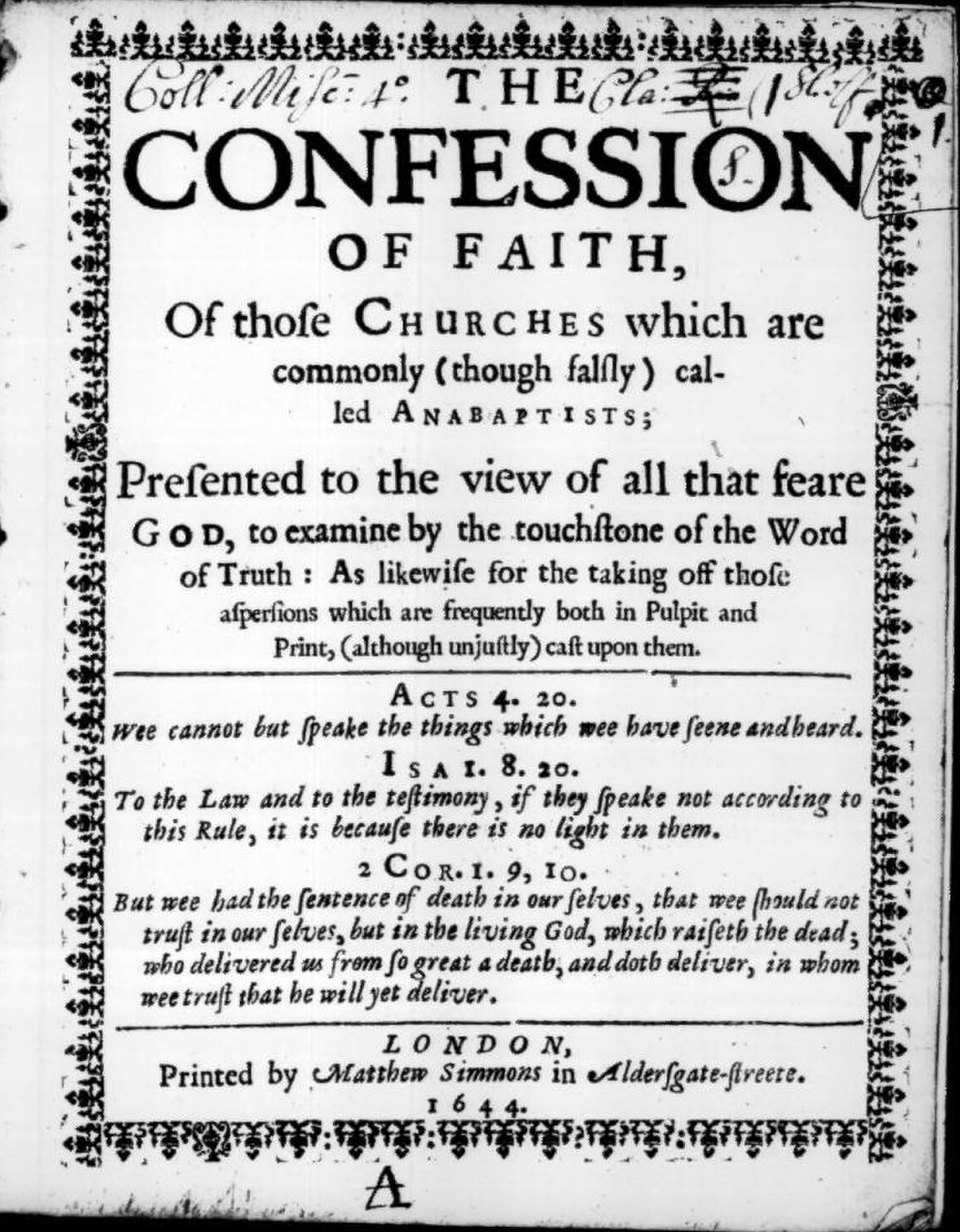
    Title page of the first edition: “The Confession of Faith, Of those Churches which are commonly (though falsly) called Anabaptists”, “London, Printed by Matthew Simmons in Aldersgate-streete. 1644.” Microfilm scan (Early English Books 1641-1700) via the Internet Archive and Wikimedia Commons
    Title page of the first edition: “The Confession of Faith, Of those Churches which are commonly (though falsly) called Anabaptists”, “London, Printed by Matthew Simmons in Aldersgate-streete. 1644.” Microfilm scan (Early English Books 1641-1700) via the Internet Archive and Wikimedia Commons · Public domain

    In October 1644 seven Particular Baptist congregations in London jointly issued The Confession of Faith, of those Churches which are commonly (though falsly) called Anabaptists, as its title page reads. It set out their doctrine of Christ, of salvation, and of a church of believers baptized on profession of faith. A corrected and enlarged second impression followed early in 1646 under a new title, A Confession of Faith of Seven Congregations or Churches of Christ in London, which are commonly (but unjustly) called Anabaptists. That edition is generally taken as the authoritative text. In its own words (E. B. Underhill’s 1854 reprint of the 1646 text, spelling modernised): on Scripture, Article VIII says the rule of faith and obedience is “only the word of God contained in the holy scriptures, in which is plainly recorded whatsoever is needful for us to know, believe, and practise, which are the only rule of holiness and obedience for all saints, at all times, in all places to be observed.” On baptism, Article XXXIX says it is “given by Christ, to be dispensed upon persons professing faith, or that are made disciples,” and Article XL that the way of it “is dipping or plunging the body under water; it being a sign, [it] must answer the thing signified, which is, that interest the saints have in the death, burial, and resurrection of Christ.” The 1644 title page offers the confession “to examine by the touchstone of the Word of Truth” and sets three texts before the reader: Acts 4:20, Isaiah 8:20 and 2 Corinthians 1:9-10. It prints Isaiah 8:20 in its own wording, “if they speake not according to this Rule”; in the King James Version the verse reads: “To the law and to the testimony: if they speak not according to this word, it is because there is no light in them.” In the preface the confession is “Subscribed in the Names of seven Churches in London.” Underhill notes that of the signers of the 1646 edition only William Kiffin and John Spilsbery had signed the earlier editions.

    Source en.wikipedia.org: Wikipedia, “Confession of Faith (1644)” (citing Bingham, JEH 68.3, 2017); title pages from the Angus Library scans (london1644.info) and Oxford Text Archive A80328. Quotations: E. B. Underhill (ed.), Confessions of Faith (Hanserd Knollys Society, 1854), pp. 26-27, 30, 41-42, page images read (archive.org confessionsfaith00undeuoft); KJV Isa 8:20.

  2. Baptist Witness Baptists in America

    Roger Williams pleads for liberty of conscience: The Bloudy Tenent

    Title page of The Bloudy Tenent of Persecution, 1644. Library of Congress, via Wikimedia Commons
    Title page of The Bloudy Tenent of Persecution, 1644. Library of Congress, via Wikimedia Commons · Public domain

    In 1644, while in England to obtain a charter for the Providence colony, Roger Williams published The Bloudy Tenent of Persecution, for Cause of Conscience, written as a dialogue between Truth and Peace in answer to John Cotton of Boston. Williams argued that the civil power may not compel the conscience in matters of worship, and he pointed Christians to the spiritual weapons of Ephesians 6 and 2 Corinthians 10 rather than the sword of the magistrate. Many copies were burned by order of Parliament. Williams had joined in gathering the Baptist church at Providence in 1638-39, but he left it within months and became a “Seeker” who belonged to no church. His plea for soul liberty was nonetheless taken up by Baptists after him.

    Source en.wikipedia.org: Wikipedia, “The Bloudy Tenent of Persecution for Cause of Conscience” (citing J. P. Byrd, The Challenges of Roger Williams, 2002; R. Groves ed., 2001). Williams’s later course as a Seeker per Encyclopedia.com, “Roger Williams.”

  3. Baptist Witness Dissent & Persecution

    William Kiffin: merchant, pastor, and the first name on the 1644 Confession

    William Kiffin, portrait by an unknown artist, 1667 (Art UK record 223112)
    William Kiffin, portrait by an unknown artist, 1667 (Art UK record 223112). Via Wikimedia Commons · Public domain

    William Kiffin (1616-1701), orphaned by the London plague of 1625, became a Baptist in 1641-42 in Henry Jessey’s congregation and was imprisoned in 1641 for attending a Southwark conventicle. When seven London Baptist churches issued their Confession of Faith in 1644, his name headed the signatories. He built a prosperous woollen trade and, from the 1640s until 1692, ministered to the Baptist congregation that opened its meeting house at Devonshire Square in 1667. After the Restoration he was arrested more than once and prosecuted for keeping conventicles. His standing with Charles II let him plead for his brethren, and he obtained a pardon for twelve Baptists of Aylesbury who had been sentenced to death under the Religion Act of 1592. He resigned his charge in 1692 and was buried at Bunhill Fields.

    Source en.wikipedia.org: Wikipedia, “William Kiffin” (incorporating A. Gordon, Dictionary of National Biography, 1885-1900, public domain; citing Crosby, History of the English Baptists, 1738-40, and Kiffin’s own Remarkable Passages, ed. W. Orme, 1823).

  4. Baptist Witness Dissent & Persecution

    Christopher Blackwood Searches the Question of Baptism at Cranbrook, Kent, 1644

    “These were more noble than those in Thessalonica, in that they received the word with all readiness of mind, and searched the scriptures daily, whether those things were so.” (Acts 17:11). Cathcart’s Encyclopedia records that Christopher Blackwood, born in 1606 and educated at Cambridge, was a clergyman in Kent when, in 1644, “the Rev. Francis Cornwell, in preaching a sermon at Cranbrook, in Kent,” questioned infant baptism and the ministers present agreed to examine the subject. “Mr. Blackwood studied the subject thoroughly, and felt compelled to renounce infant baptism forever.” Opponents wrote against him “because of his advocacy of liberty of conscience.” Cathcart adds: “He gathered a Baptist church at Spilshill, near Staplehurst,” and says of him that “Mr. Blackwood received the whole counsel of God, and he would neither hide the truth nor promote discord.” He was regarded as “a very learned man,” “better acquainted with the early Christian fathers than most men in his day.”

    Source archive.org: William Cathcart, ed., The Baptist Encyclopedia (Philadelphia: Everts, 1881), vol. 1, s.v. “Blackwood, Rev. Christopher” (public domain; Internet Archive scan). Quotations verbatim, contiguous fragments only, machine-matched against the scan’s text (OCR typography and line-end hyphenation normalised). Birth year and Cambridge education paraphrased from the same entry. KJV: Acts 17:11.

  5. Baptist Witness Dissent & Persecution

    The Westminster Assembly Divides 25 to 24 Over Dipping, 1644

    “Buried with him in baptism” (Colossians 2:12). Dr. John Lightfoot, a Presbyterian member of the Westminster Assembly, kept a journal of its debates, and Cathcart quotes his entry for Aug. 7, 1644: “And here fell we upon a large and long discourse, whether dipping were essential, or used in the first institution, or in the Jews’ custom.” The proposed Directory for public worship read, “The minister shall take water and sprinkle or pour it with his hand upon the face or forehead of the child,” and the count came out “the twenty-four for the reserving of dipping and the twenty-five against it.” Lightfoot wrote: “And there grew a great heat upon it; and when we had done all, we concluded upon nothing in it; but the business was recommitted.” Cathcart adds: “The next day dipping was effectually voted down as one of the modes of baptism in the Presbyterian Church.”

    Source archive.org: William Cathcart (ed.), The Baptist Encyclopedia (Philadelphia: Everts, 1881), vol. 1, s.v. “Dipping in the Westminster Assembly of Divines” and “Immersion” (public domain; Internet Archive scan). Quotations verbatim, contiguous fragments only, machine-matched against the scan’s text (OCR line-end hyphenation normalised). KJV: Colossians 2:12.

  6. Baptist Witness Dissent & Persecution

    Thomas Patient: from a New England doubt to a Bristol jail

    Thomas Patient (also spelled Patience) was an English minister who, the Dictionary of National Biography says, “went out with other godly ministers to New England” between 1630 and 1635. Soon afterwards he began to doubt infant baptism. In the preface to his own book he recalled that he “knew not a single soul who opposed infant baptism”, yet, “searching many authors night and day”, he came to believe that “true repentance was wrought in” him. A warrant was out to bring him before the general court of New England, and when the colony passed its first law against Baptists on 13 November 1644 he returned to England. He was at once chosen assistant to William Kiffin at the Baptist church in Devonshire Square, London, and signed the First London Confession of 1644, and the preface to its second edition (1646). In 1654 he published The Doctrine of Baptism and the Distinction of the Covenants, an argument against infant baptism. He later pastored a Baptist congregation in Dublin, and about 1660 returned to England and went to Bristol as assistant at the Baptist church in the Pithay. There, on 4 October 1663, he was sent to prison with Thomas Ewins and Edward Terrill for preaching, and stayed at least three months. On 28 June 1666 he was set apart as co-pastor with Kiffin at Devonshire Square, Hanserd Knollys and Kiffin laying on hands. The plague was raging round the meeting-house, and on 29 July 1666 he died of it; the church book records his death and burial on the next day. The apostle’s word on the ordinance, which Baptists have always set beside this story, is Romans 6:4: “Therefore we are buried with him by baptism into death: that like as Christ was raised up from the dead by the glory of the Father, even so we also should walk in newness of life.”

    Source en.wikisource.org: C. Fell Smith, “Patient, Thomas”, Dictionary of National Biography vol. 44 (1895, PD), Wikisource; quoted phrases verbatim. Cross-check: Wikipedia, “Thomas Patient” (same facts; d. 29 July 1666). Army, state and political episodes omitted. Rom 6:4 per KJV.

  7. Baptist Witness Dissent & Persecution

    John Tombes and the Defence of Believers’ Baptism

    John Tombes was born at Bewdley, Worcestershire, about 1603, studied at Magdalen Hall, Oxford, and was ordained, becoming a popular preacher and, from 1630, vicar of Leominster. The Dictionary of National Biography notes that “as early as 1627 he began to have doubts on the subject of infant baptism.” He laid his scruples before the Westminster Assembly of divines “but got no satisfaction,” and “declining to baptise infants” he lost his London parish in 1645, though he was soon made master of the Temple on condition that he not preach on baptism. In December 1645 he published Two Treatises and an Appendix concerning Infant Baptisme, the first of a long line of works on the subject, among them Antipædobaptism (1652-57), which answered twenty-three contemporary writers. At Bewdley he organised a baptist church that, in Richard Baxter’s reckoning, “never exceeded twenty-two members.” On 1 January 1650 he and Baxter debated baptism before a crowded chapel from nine in the morning till five at night; the DNB records Anthony Wood’s verdict that Tombes “got the better of Baxter by far” and Baxter’s own, that he “had still the advantage of a good cause.” Tombes’s place in Baptist history is a careful one: he held the baptist position all his life yet never made a break with the Church of England, and the DNB says plainly that after the Restoration he “conformed in a lay capacity” and “communicated as an Anglican.” It also calls him “always a courteous disputant, and a man of exceptional capacity and attainments.” He died at Salisbury on 22 May 1676. The text on which the argument turned is the Great Commission: “Go ye therefore, and teach all nations, baptizing them in the name of the Father, and of the Son, and of the Holy Ghost:” (Matthew 28:19).

    Source en.wikisource.org: A. Gordon, “Tombes, John”, DNB vol. 57 (1899, PD), Wikisource. All quoted phrases verbatim from the DNB. Birth year uncertain (1602 or 1603). He never joined a Baptist denomination as such; the Bewdley church was his own gathering. Matt 28:19 per KJV.

  8. Baptist Witness Dissent & Persecution

    Hanserd Knollys: scholar, schoolmaster and Particular Baptist pastor

    Hanserd Knollys, engraved portrait, from C. K. Bolton, Portraits of the Founders (Internet Archive: foundersportrai02bolt), p. 124
    Hanserd Knollys, engraved portrait, from C. K. Bolton, Portraits of the Founders (Internet Archive: foundersportrai02bolt), p. 124. Via Wikimedia Commons · Public domain

    Hanserd Knollys (c. 1598-1691), born at Cawkwell in Lincolnshire and educated at Cambridge, was ordained in the Church of England in 1620. Scruples about its ceremonies led him to resign his living, and in 1636 he renounced his orders and went to New England to escape the Court of High Commission. There he preached at Dover, New Hampshire, and came to hold the baptism of believers. Back in London from December 1641 he kept school, learned Hebrew and published The Rudiments of the Hebrew Grammar in English (1648). He baptized Henry Jessey in 1645 and in 1646 gathered a church that met in one place after another. He signed the 1646 edition of the London Confession and pleaded for liberty of conscience. On 10 May 1670 he was arrested at his meeting in George Yard under the Conventicle Act, preached to his fellow prisoners, and was discharged at the next sessions. He lived to see the Toleration Act of 1689 and, in extreme old age, laboured for the consolidation of the Baptist churches. He died on 19 September 1691 in his ninety-third year and was buried in Bunhill Fields.

    Source en.wikipedia.org: Wikipedia, “Hanserd Knollys” (incorporating A. Gordon, Dictionary of National Biography, 1892, public domain; citing K. G. C. Newport, Oxford DNB, 2004). See also D. C. Bustin, Paradox and Perseverance (2006).

  9. Baptist Witness Dissent & Persecution

    Vavasor Powell Carries the Gospel Across Wales, 1646

    “And he said unto them, Go ye into all the world, and preach the gospel to every creature.” (Mark 16:15). Cathcart’s Encyclopedia records that Vavasor Powell was born in Radnorshire, Wales, in 1617, and that through reading Puritan books and hearing their sermons he “was led to the Saviour.” In 1646, with a testimonial to his “able gifts for the work of the ministry,” he returned to Wales, where, Cathcart says, “He proclaimed Jesus at fairs, markets, and wherever there was a gathering of people” and “preached the glorious gospel upon mountains, in jails.” The Encyclopedia states that “Before 1660 Mr. Powell had formed more than twenty churches,” calls him “properly designated the Whitefield of that principality,” and says plainly, “He was also a Baptist.” It records that he “spent eight years in thirteen prisons” and died in the Fleet jail, London, on 27 October 1671, adding that “Mr. Powell was an ardent lover of the Bible.”

    Source archive.org: William Cathcart, ed., The Baptist Encyclopedia (Philadelphia: Everts, 1881), vol. 2, s.v. “Powell, Vavasor” (public domain; Internet Archive scan). Quotations verbatim, contiguous fragments only. Nothing beyond the entry is asserted; the entry’s remarks on civil politics are not reproduced here. KJV: Mark 16:15.

  10. Baptist Witness Dissent & Persecution

    William Dell Preaches Against Persecution Before the House of Commons, November 25, 1646

    “Stand fast therefore in the liberty wherewith Christ hath made us free, and be not entangled again with the yoke of bondage.” (Galatians 5:1). William Dell was educated at Cambridge, and after Episcopal ordination “he became a clergyman of the Established Church.” Cathcart’s Encyclopedia counts him among those who in the seventeenth-century awakening came to Baptist views on baptism and on the church. “He denounced all compulsion in matters of religion”, and wrote against uniformity enforced by law. “In 1645 he was appointed a chaplain in the army”, attending Sir Thomas Fairfax, and “preached at headquarters, where he exerted a powerful influence with leading men against Presbyterian legal intolerance, and in favor of religious liberty.” On November 25, 1646, he was appointed to preach before the House of Commons at a public fast. “His subject was Reformation, and in treating this popular topic he showed the folly and wickedness of trying to secure it by persecution.” Many hearers took offense, but “his conscience compelled him to tell these legislators some wholesome truths.” In 1649 he was made master of Caius College, Cambridge, and Cathcart records that he lost his rectory and college “through his fidelity to Baptist principles by the Act of Uniformity in 1662.”

    Source archive.org: William Cathcart (ed.), The Baptist Encyclopedia (Philadelphia: Everts, 1881), vol. 1, s.v. “Dell, Rev. William, A.M.” (public domain; Internet Archive scan). Quotations verbatim, contiguous fragments only, machine-matched against the scan’s text (OCR line-end hyphenation normalised). KJV: Galatians 5:1.

  11. Baptist Witness Dissent & Persecution

    Benjamin Cox and the Appendix to a Confession of Faith

    Benjamin Cox (also Coxe or Cockes) was born in Oxfordshire about 1595, took his M.A. at Oxford in 1617, and was ordained and held a living in Devonshire. The Dictionary of National Biography records that he later became a minister at Bedford and there “openly preached the invalidity of infant baptism.” Invited in 1643 to form a congregation at Coventry, he was drawn into a public dispute with Richard Baxter, after which the presbyterians ordered him to leave the town and, when he did not, imprisoned him. On his release he went to London and preached to a congregation of Baptists, and in 1645 joined Hanserd Knollys and others in a declaration about a public dispute on infant baptism at Aldermanbury that had been forbidden. His name, spelled Benjamin Cockes, stands among the signers of the London Confession of the seven churches. In 1646 he published An Appendix to a Confession of Faith, “A more full declaration of the faith and judgement of baptized beleevers,” written because godly persons in the country had asked what those churches believed, and published “for the further clearing of the Truth, and discovery of their mistake who have imagined a dissent in fundamentals where there is none.” Its opening sets the tone: “It is therefore our duty, in meekness and love, to give an answer to those godly persons which desire to be fully informed of our judgment.” Against the charge that such doctrine left nothing to preach, it answers: “through the goodness of God we know and preach to sinners this precious gospel”, and quotes John 3:16. Cox conformed in 1662 but afterwards gave up his living and, the DNB says, “continued a baptist until his death at an advanced age.” The Appendix opens on the apostle’s word in 1 Peter 3:15: “But sanctify the Lord God in your hearts: and be ready always to give an answer to every man that asketh you a reason of the hope that is in you with meekness and fear.”

    Source en.wikisource.org: W. Hunt, “Cox, Benjamin”, DNB vol. 12 (1887, PD), Wikisource. Appendix quoted verbatim from Underhill, Confessions of Faith (1854, PD; archive.org confessionsfaith00undeuoft). Underhill puts his name on the 1646 Confession; the DNB says 1647. 1 Pet 3:15 per KJV.

  12. The English Bible

    John Canne’s Reference Bible: Scripture the Best Interpreter of Scripture

    Readers who follow a column of references from one verse of the King James Bible to another walk a path that John Canne (d. 1667?) helped to lay. Canne was a Separatist pastor who became the successor of Henry Ainsworth over the congregation of English independents at Amsterdam, where he worked as a printer as well as a preacher. Visiting Bristol in 1640, he preached to the newly gathered Broadmead congregation, and its records call him “a baptized man by them called an anabaptist”. His lasting work was a King James Bible with notes and references in the margin. The Dictionary of National Biography dates the first known edition to Amsterdam in 1647 and calls it “the best work of its kind that had then appeared”; that edition already speaks of additions “to the former notes in the margin”, and the historian Anderson named a quarto of 1644, so the first printing is not certainly known. An edition of 1664, “no doubt printed abroad, perhaps at Amsterdam”, carries the title-page promise “with marginal notes shewing the Scripture to be the best interpreter of Scripture”. Darlow and Moule’s catalogue of the Bible Society’s library (1903) judged that his edition “was the first to contain a full apparatus of carefully selected marginal references”, and the DNB adds that it “was used in the preparation of Bagster’s ‘Comprehensive Bible,’ of which it is indeed the basis”. Canne also wrote on the public controversies of the Commonwealth, which lie outside this museum’s subject; he is believed to have died in Amsterdam in 1667. “Which things also we speak, not in the words which man’s wisdom teacheth, but which the Holy Ghost teacheth; comparing spiritual things with spiritual.” (1 Corinthians 2:13, KJV).

    Source en.wikisource.org: DNB vol. 8 (Axon, 1886, PD), “Canne, John”, Wikisource, read in full. Darlow & Moule, Historical Catalogue of the Printed Editions of Holy Scripture I (1903, PD; Internet Archive historicalcatal00librgoog), no. 540 (1664; “full apparatus”; Anderson’s 1644 quarto); post-1611 entries give the King James text. 1664 title per Morgan Library PML 16002.1. Cross-check: Wikipedia. Not claimed as a Baptist; political writings omitted on purpose. KJV: 1 Cor 2:13.

  13. Baptist Witness Dissent & Persecution

    John Myles: from Ilston to Swansea

    The First Baptist Church in Swansea, Massachusetts: the Greek Revival chapel of 1848, fifth home of the congregation Myles brought from Ilston. Photograph by Marc N. Belanger, 2009, via Wikimedia Commons
    The First Baptist Church in Swansea, Massachusetts: the Greek Revival chapel of 1848, fifth home of the congregation Myles brought from Ilston. Photograph by Marc N. Belanger, 2009, via Wikimedia Commons · Public domain

    John Myles (c. 1621-1683) was a Welshman educated at Brasenose College, Oxford. In London he attended the Glasshouse Church, one of the earliest Baptist churches there, and became convinced of the baptism of believers. Returning to Wales, he gathered a Baptist church at Ilston, on the Gower peninsula near Swansea, on 1 October 1649. It is the earliest Welsh Baptist church of which records survive, and its register, the Ilston Book, lists 261 members up to 1660, drawn from across South Wales. After the Restoration, when in 1662 every minister was required to conform to the Book of Common Prayer, Myles and a company from Ilston crossed to New England, taking the book with them. In 1663, in the house of John Butterworth at Rehoboth in Plymouth Colony, seven men covenanted together as a church: the first Baptist church in Massachusetts. In July 1667 the Plymouth court fined Myles and James Brown “for their breach of order, in setting up of a public meeting without the knowledge and approbation of the Court.” Before the year was out, on 30 October 1667, land at Wannamoisett was set apart for them, and there Myles led the church to found a town they named Swansea after their home in Wales. The First Baptist Church in Swansea is the oldest Baptist congregation in Massachusetts. The Ilston Book is kept today in the library of Brown University.

    Source en.wikipedia.org: Wikipedia, “Ilston Book” (citing B. G. Owens, ed., The Ilston Book, NLW, 1996), “John Myles (minister)” and “First Baptist Church in Swansea.” The date 1 October 1649, the Butterworth meeting, its seven members and the Plymouth court records of 2 July and 30 October 1667 per H. M. King, Rev. John Myles and the Founding of the First Baptist Church in Massachusetts (1905), baptisthistoryhomepage.com/myles.john.by.king.html. Public domain.

  14. Baptist Witness Baptists in America

    Obadiah Holmes suffers for conscience in Boston

    In July 1651 John Clarke, Obadiah Holmes and John Crandall of the Baptist church in Newport visited an elderly member of their congregation in Lynn, Massachusetts, and were arrested for their worship. Friends paid the fines of Clarke and Crandall. Holmes refused, as a matter of conscience, to let his be paid, and on 5 September 1651 he was publicly whipped in Boston. He returned to Newport and served as pastor of its Baptist church for some thirty years, until his death in 1682.

    Source en.wikipedia.org: Wikipedia, “Obadiah Holmes” (citing J. T. Holmes, 1915; Austin, 1887; Bicknell, 2005). Image intentionally omitted.

  15. Baptist Witness Dissent & Persecution

    Sir John Lawson, “a notorious Anabaptist”, Charges the Dutch Fleet, 1653

    “They that go down to the sea in ships, that do business in great waters” (Ps. 107:23). Cathcart’s Encyclopedia counts the Commonwealth admiral Sir John Lawson, born near Scarborough, among the Baptists. It says that on June 2, 1653, when the English fleet attacked the Dutch off Flanders, “Lawson charged through the Dutch fleet with forty ships,” and the Dutch were routed the next day. When the army set itself against the recalled Parliament after Richard Cromwell fell, Lawson brought the fleet into the Thames and declared for the Parliament. Cathcart quotes Lord Clarendon, no friend of Baptists, calling him “an excellent seaman, but then a notorious Anabaptist,” and “incomparably the modestest and the wisest man.” Wounded in the knee in the battle of June 3, 1665, he died a few days later on shore, “rejoicing in the blessed Saviour whom he was going to meet.”

    Source archive.org: William Cathcart (ed.), The Baptist Encyclopedia (Philadelphia: Everts, 1881), vol. 2, s.v. “Lawson, Admiral Sir John” (public domain; Internet Archive scan). Quotations verbatim, contiguous fragments only, machine-matched against the scan’s text (OCR line-end hyphenation normalised; OCR misreadings corrected only outside quotation marks). KJV: Ps. 107:23.

  16. Baptist Witness Baptists in America

    Henry Dunster: Harvard’s first president lays down his office over infant baptism

    Henry Dunster, born near Bury in Lancashire and trained at Magdalene College, Cambridge (B.A. 1630, M.A. 1634), was known as a fine Hebrew scholar. He came to Massachusetts in 1640 and on 27 August 1640 was made the first president of the newly founded Harvard College. For fourteen years he taught, held the college together through hard times, secured its charter of 1650, and helped revise the psalter used by the New England churches. Then, in 1653-54, he came to reject the baptism of infants and to hold that baptism belongs to believers. He did not bring his own infant son to be baptized and spoke openly for his view. Efforts to change his mind failed, and on 24 October 1654 he gave up the presidency. The Dictionary of National Biography says he “was persuaded” to resign; modern accounts describe him as forced out. He withdrew to Scituate in Plymouth Colony and preached there until his death on 27 February 1658/9. The same dictionary records: “He bequeathed legacies to the very persons who had clamoured the loudest for his removal from the college.” Neither source calls him a Baptist, but the historian William Brackney names him “an important precursor” of the Baptists in America, and his friend Thomas Goold of Charlestown went on to gather the First Baptist Church of Boston. The pattern he held to is the New Testament one (Acts 2:41, KJV): “Then they that gladly received his word were baptized: and the same day there were added unto them about three thousand souls.”

    Source en.wikisource.org: Dictionary of National Biography (1885-1900), vol. 16, “Dunster, Henry,” by Gordon Goodwin (1888, PD), via Wikisource, life, presidency, resignation 24 Oct 1654, Scituate, death; the legacies sentence is quoted verbatim. Cross-checked: Wikipedia, “Henry Dunster” (1653-54 change of view, unbaptized son, Brackney’s phrase). Paraphrased otherwise. Acts 2:41 per KJV.

  17. Scripture & Canon

    William Gurnall’s “The Christian in Complete Armour”

    William Gurnall, rector of Lavenham in Suffolk from 1644, preached through the close of Ephesians 6 in his regular ministry and published the sermons as The Christian in Complete Armour, in three volumes dated 1655, 1658 and 1662. He was not a Baptist: at the Restoration he conformed to the Church of England and remained at Lavenham until his death on 12 October 1679. The Dictionary of National Biography (1890) says he was born in 1617 in the parish of Walpole St Peter, near Lynn; the Encyclopaedia Britannica (1911) says King’s Lynn. The Britannica judged that “The work is more practical than theological”. Gurnall opens with the apostle writing from his chains: “Paul was Nero’s prisoner, but Nero was much more God’s.” He bids the faint-hearted be strong in the Lord, “on whose performance lies the stress of the battle, and not on your skill or strength.” Of the shield of faith he writes: “A grace of graces it is, and here fitly placed in the midst of the other her companions. It stands, methinks, among them, as the heart in the midst of the body.” “Finally, my brethren, be strong in the Lord, and in the power of his might” (Ephesians 6:10, KJV).

    Source en.wikisource.org: Dictionary of National Biography (1890), “Gurnall, William” (Lavenham 1644; volumes 1655, 1658, 1662; conformed; d. 12 Oct 1679; b. Walpole St Peter); Encyclopaedia Britannica (1911), “Gurnall, William” (b. King’s Lynn; “more practical than theological”). Quotations: The Christian in Complete Armour, London: Tegg, 1845 (public domain), checked against the 1862 and 1658 printings. KJV: Eph 6:10.

  18. Baptist Witness Dissent & Persecution

    Benjamin Keach Finds Peace in Christ and Is Baptized as a Believer, 1655-1658

    “And Philip said, If thou believest with all thine heart, thou mayest. And he answered and said, I believe that Jesus Christ is the Son of God” (Acts 8:37). Cathcart’s Encyclopedia records that Benjamin Keach “was born in Stokehaman, England, Feb. 29, 1640,” and “found peace through Christ in his fifteenth year.” Being “unable to discover infant baptism or baptism by sprinkling in the Bible, and being fully satisfied that every believer should be immersed, he was baptized after the Saviour’s example by John Russel, and united with a neighboring Baptist church.” That community, perceiving his gifts, encouraged him “when he was eighteen years old, to exercise his gifts as a minister.” (His later pastorate at Horsleydown appears in a separate entry.)

    Source archive.org: William Cathcart, ed., The Baptist Encyclopedia (Philadelphia: Everts, 1881), vol. 1, s.v. “Keach, Rev. Benjamin” (public domain; Internet Archive scan). Quotations verbatim, contiguous fragments only, machine-matched against the scan’s text (OCR typography and line-end hyphenation normalised). Years 1655 and 1658 are computed from the entry’s birth year (1640) and the stated ages fifteen and eighteen. KJV: Acts 8:37.

  19. Baptist Witness Dissent & Persecution

    The Somerset Confession: the West Country churches speak for themselves

    In 1656 the Particular Baptist churches of the Western Association, gathered in Somerset and the counties adjacent (Wiltshire, Devon, Gloucestershire and Dorset), issued a confession of their own: “A Confession of the Faith of Several Congregations of Christ in the County of Somerset, and Some Churches in the Counties Near Adjacent.” The accounts consulted for this entry place its approval at the Association’s meeting at Bridgwater on 5-6 September 1656. E. B. Underhill, who reprinted it in 1854, read the records differently: at a meeting at Bridgwater in November 1656 the Association already answered a question by referring to “the forty-fourth article of the confession of the faith of the churches in these parts,” so he judged it “probable” that the confession had been adopted at Wells the April before. Both views are given here. It has forty-six articles. Its epistle is signed for sixteen churches: eleven in Somerset, among them Bridgwater, Taunton, Chard, Wells and Wincanton, with North Bradley in Wiltshire, Luppit in Devon, Sedbury and Bristol in Gloucestershire, and “in and near Lime” in Dorset. Thomas Collier’s name follows the signers, and Underhill took it to be “the production of his pen.” The churches say they first wrote it not for public view “but did it rather for a trial of our unity in the faith,” and published it being “very sensible of the great distractions and divisions that are amongst professing people in this nation.” Of Christ as prophet, Article XVIII confesses: “As he is our prophet, so he hath given us the scriptures, the Old and New Testament, as a rule and direction unto us both for faith and practice.” The last article says that a church so believing and so walking, “though despised and of low esteem,” is still, to its Lord, “Black, yet comely,” “Kept by the Lord,” “Graven on the palms of his hands,” and that “The gates of hell shall not prevail against it.” It holds the doctrines of grace, believer’s baptism by immersion, and the order of the gathered church, and one account observes that the Calvinism of the Western Association “was not of a rigid type.” Its appeal is to Scripture: “To the law and to the testimony: if they speak not according to this word, it is because there is no light in them” (Isaiah 8:20); its concern for fellowship echoes “Endeavouring to keep the unity of the Spirit in the bond of peace” (Ephesians 4:3). Quotations follow Underhill’s reprint, in modern spelling. No licence-verified title-page plate has yet been found, so none is shown.

    Source baptisthistoryhomepage.com: E. B. Underhill (ed.), Confessions of Faith (Hanserd Knollys Society, 1854), pp. xi, 63-64, 73-74, 83, 106, read on the Internet Archive page images (confessionsfaith00undeuoft); see the Reading Room. Also: Baptist History Homepage, Somerset Association page; reformedreader.org “Somerset Confession of 1656” intro (Bridgwater, 5-6 Sept 1656; Collier); A. J. Westlake, Baptist Quarterly 13:3; KJV Isa 8:20, Eph 4:3.

  20. Baptist Witness Dissent & Persecution

    Second Edition of William Jeffery’s The Whole Faith of Man, Seven-Oaks, Kent, 1659

    “earnestly contend for the faith which was once delivered unto the saints” (Jude 3). William Jeffery, born about 1616, was at Seven-Oaks in Kent “one of the chief supporters, if he was not the founder, of the Baptist church.” With help from others he “was instrumental in founding more than twenty churches.” He wrote The Whole Faith of Man, “the second edition of which was issued in 1659.” Cathcart calls him “a very decided Baptist, never inviting controversy.” Once the magistrates “arrested all the men in his congregation while they were at worship, and kept them in prison an entire night.” Released the next day, the men came back to find the women, who “had continued in fasting and prayer for their release.” Later “Mr. Jeffery was imprisoned after the restoration of Charles II., and subjected to many hardships.”

    Source archive.org: William Cathcart (ed.), The Baptist Encyclopedia (Philadelphia: Everts, 1881), vol. 1, s.v. “Jeffery, Rev. William” (public domain; Internet Archive scan). Quotations verbatim, contiguous fragments only, machine-matched against the scan’s text (OCR line-end hyphenation normalised). KJV: Jude 3.

Plates are hung only where a genuine image of the subject could be found under a public-domain or open licence. Each carries its credit and links to its licence record. Entries without a plate are awaiting one that meets that standard. More entries are being prepared, and each will be added only with its citation.

Provenance

Every entry in this hall was checked, when it was added, against the source linked beneath it; notes name the underlying scholarship where the source cites it. Where historians disagree (for example, over John Wycliffe’s own share in the Bible that bears his name), the entry says so. Scripture is quoted verbatim from the King James Version. Plates are reproduced almost entirely from Wikimedia Commons: public-domain works, works dedicated to the public domain (CC0), or photographs under Creative Commons Attribution (CC BY 2.0-3.0) or Attribution-ShareAlike (CC BY-SA 2.0-4.0) licences. Each plate’s licence is stated beneath it, with a link to the record where it was confirmed.